

Summary Unavailable
This book is not suitable for a summary (it may be a textbook, workbook, cookbook, reference book, or collection). However, you can still explore the FAQs, about author, and other metadata below!
Key Takeaways
Dive for your senses ten minutes every morning to find your voice
Object writing is sense diving. Pattison's core exercise: pick any real object (a puddle, a pepper, a back porch), set a timer for exactly ten minutes, and free-associate using all seven senses. Beyond the usual five he adds organic sense (internal body signals like heartbeat and muscle tension) and kinesthetic sense (your body's relation to surrounding space, the drunk or seasick feeling). No rhyme, no story, no complete sentences.
Speed and depth are the goal. Stop the instant the timer beeps, even mid-sentence, so your writer stays hungry. Do it daily for six weeks minimum. Because everyone's sense memories are unique, sense-bound words become universal: your reader fills them with their own memories. Gillian Welch credits this exercise with much of her Grammy-winning success.
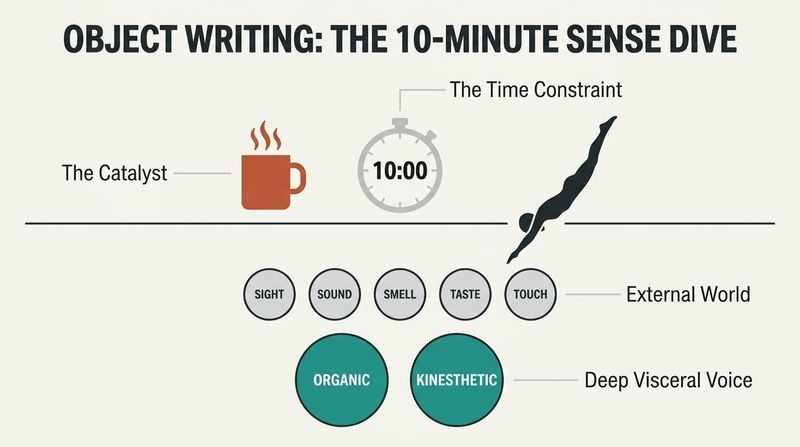
What's striking is how this mirrors modern creativity research. The ten-minute cap exploits the Zeigarnik effect, the psychological tendency to remember and keep chewing on interrupted tasks. Stopping mid-flow guarantees tomorrow's dive goes deeper. The emphasis on non-visual senses aligns with embodied cognition studies showing that smell and touch trigger more vivid autobiographical memory than sight. One caution: daily practice suits disciplined writers, but the exercise resembles morning pages from Julia Cameron's Artist's Way, with a crucial difference. Pattison insists this is training for craft, not therapy or journaling. The senses drive the bus, not your feelings.
Show Rusty's collar before you tell the class about your puppy
Show first, tell second. Pattison's nun told him he could not do show-and-tell without bringing the object. He turned this into a songwriting law: concrete sense images should precede commentary, because showing engages both senses and mind at once. He compares a vivid image to a bag of dye hung at the top of a verse: its color drips downward onto every line below it, but never upward.
Specifics beat generics. He demonstrates by vandalizing Gillian Welch's line about missing hills with windy pines, swapping it for a bland city/pretty rhyme. The whole song collapses into instant beige. The lesson: a real detail (hot rod hearts, high school rings) makes surrounding abstractions feel earned and emotional.
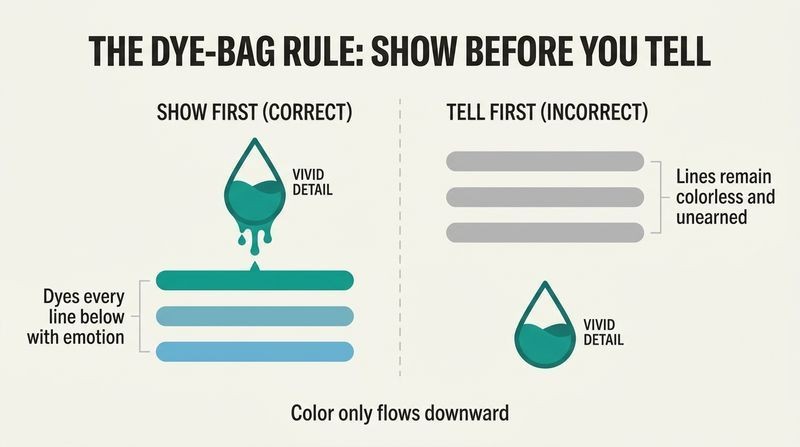
This is the songwriting cousin of the fiction workshop mantra and Ezra Pound's imagist creed, but Pattison adds a spatial mechanic that is genuinely useful: placement matters because color drips down, not up. Cognitive science supports him. Concrete words are processed faster and recalled better than abstract ones, a phenomenon called the concreteness effect. The steelman is strong. The mild critique: pure showing can leave meaning ambiguous. Great lyrics often need one well-placed tell to land the point, which Pattison himself acknowledges through Andrea Stolpe's destination writing. The art is knowing the ratio.
Clichés are narcolepsy for listeners; they can only tell, never show
Worn phrases put puppies to sleep. Pattison's running joke: a documentary puppy keeps collapsing asleep whenever cliché lines play on the radio. Phrases like break my heart, night and day, or take a chance have been rubbed smooth by overuse. They no longer conjure images. They point at a territory of meaning without ever taking you there.
Universal is not generic. He contrasts a hackneyed verse about the hustle and bustle of city streets with Yeats hearing lake water lapping in the deep heart's core. Both express the same longing, but only one arrives. Cliché rhymes (heart/start, fire/desire) telegraph what is coming, killing surprise. The fix: dive into your own sense pool and use imperfect rhyme types listeners will not predict.
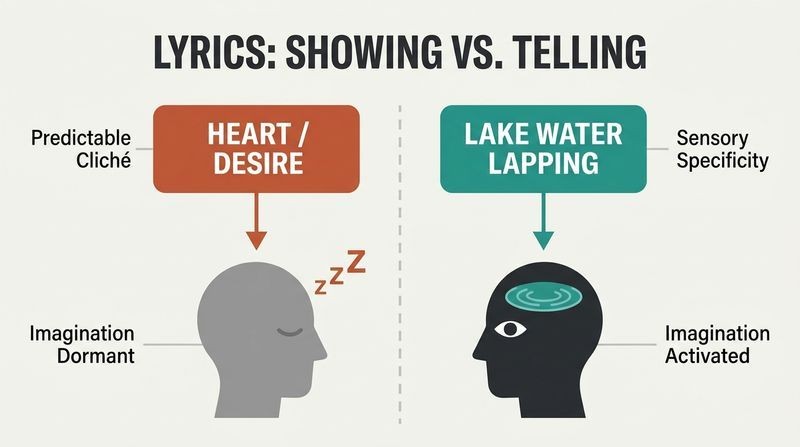
Pattison distinguishes universal from generic, a distinction many writers miss. This tracks with information theory: predictability equals low information. A rhyme the brain forecasts delivers zero surprise and zero engagement, which is why his sleeping puppy is a neuroscience metaphor in disguise. His advice to read good literature (you are what you eat) echoes research on how exposure shapes output. One useful extension: clichés are not always villains. Advertising and hooks sometimes weaponize familiarity for instant recognition. Pattison concedes this with friendly clichés, phrases recontextualized to feel new, like I'll be seeing you meaning both goodbye and everywhere.
Manufacture metaphors by colliding words that share a hidden third trait
Metaphor is productive collision. A metaphor jams together ideas that do not belong (an army is a rabid wolf) and forces you to reconcile them. All metaphors must be literally false, or they are just definitions. Pattison teaches metaphor-hunting as a trainable habit, not divine lightning.
Play in keys. Like musical notes in a key signature, words cluster around a shared quality. Words in the key of power: avalanche, army, Muhammad Ali, socket, tide. Combine them and metaphors tumble out. Ask two questions: what traits does my idea have, and what else has those traits? He notes verb-noun collisions outperform adjective-noun ones, because verbs are language's power amplifiers. Also: metaphor transfers your focus to the second image, while simile keeps focus on the first, making simile better for one-off comparisons.
Pattison operationalizes what Aristotle called the one genius that cannot be taught, seeing similarity in dissimilars, and insists it can in fact be trained. This aligns with Koestler's concept of bisociation, creativity as the collision of two unrelated frames. The playing in keys method resembles conceptual blending theory from cognitive linguistics, where meaning emerges from mapping shared structure across domains. His verb primacy claim is empirically shrewd. Verbs encode motion and causation, which the brain finds inherently salient. The simile versus metaphor focus-transfer analysis is unusually precise. Most guides stop at the like or as distinction, which Pattison rightly calls a surface symptom rather than the real mechanism.
Perfect rhyme is a cage; six rhyme types work like chords
Rhyme is a vowel connection, sung not read. Because singers stretch vowels, lyricists can bond sounds far beyond perfect rhyme. Pattison ranks six types from most to least stable:
1. Perfect rhyme (cat/hat)
2. Family rhyme (consonants from the same phonetic family, like rub/thud)
3. Additive rhyme (add a consonant, free/speed)
4. Subtractive rhyme (drop one, class/fast)
5. Assonance (matching vowels, unrelated consonants, hope/smoke)
6. Consonance (matching end consonants, changed vowel, one/gone)
Rhymes function like chord voicings. Just as a C chord with C in the bass feels more resolved than with E in the bass, perfect rhyme lands solidly while consonance leaves you hanging. This lets you control stability and support emotion. Expanding your options also lets you say what you actually mean instead of surrendering to the nearest cliché.
The chord analogy is the book's most original technical contribution. Framing rhyme as a spectrum of resolution rather than a binary right/wrong turns a rule into a tool with emotional range. This mirrors how music theory treats consonance and dissonance not as good and bad but as tension and release. Hip-hop practice vindicates Pattison decades on. Rappers built entire aesthetics on slant and multisyllabic near-rhyme, proving perfect rhyme is a stylistic choice, not a requirement. The insight that sung vowels forgive imperfect consonants is acoustically sound. The critique: some genres and audiences still reward crisp perfect rhyme, so stability is contextual, not universally superior.
Make every repeated chorus heavier than the last, like stacked boxes
Repetition must gain weight. A chorus sung three times risks becoming a joke told three times: less interesting each pass. Pattison's fix is the box model. Picture each verse-plus-chorus as a box, each one larger and heavier than the one before, because each verse adds a new angle that the chorus absorbs.
Verses are colored spotlights. In Strawberry Wine, the line the hot July moon saw everything means innocent first love in box one, doomed love in box two, and lost innocence forever in box three. Same words, tripled weight. He diagnoses Unanswered Prayers and Between Fathers and Sons as sagging when a verse fails to advance, so the following chorus repeats rather than deepens. The rule: put separate ideas in separate boxes, using shifts in perspective (you, I, we) or tense (past, present, future).
This is the craft insight most transferable beyond songwriting. Any repeated structure, a refrain, a slogan, a recurring scene, dies without accumulation. The box model resembles the musical technique of theme and variation and the narrative principle of the escalating callback in comedy, where a repeated line lands harder each time because context has shifted underneath it. Pattison's diagnostic rigor stands out: he does not just praise good songs, he autopsies hit records to show exactly where a second chorus goes limp. The you-I-we and tense formulas are helpful scaffolds, though he wisely warns that formulas can drain freshness if they harden into habit.
Link your verses into one avalanche, not a scenic travelogue
Travelogues bore because nothing connects. A Hawaii travelogue jumps from mountains to surfing to hotels with no link except geography. Many message songs do the same: verse one on pollution, verse two on war, verse three on poverty, connected only by the chorus we're losing the human race. Each verse is a separate, isolated snapshot.
Accumulate power like a rolling snowball. Pattison's image: three small avalanches started a third of the way up a mountain do less damage than one snowball rolled from the summit, gathering mass all the way down. Verses should feed each other, each setting up the next, so momentum compounds. His test: read the verses without the chorus. If you cannot tell what is happening or why the scenes belong together, you have a travelogue. The fix is making each verse a consequence of the one before.
The travelogue critique is essentially an argument for narrative causality over mere thematic listing, the same distinction E.M. Forster drew between a story (the king died, then the queen died) and a plot (the queen died of grief). Anthologies of examples feel additive; causal chains feel inevitable. This maps onto how memory works: the brain encodes linked, cause-and-effect sequences far better than parallel lists. The avalanche metaphor is vivid and physically accurate about momentum. A fair nuance: some deliberately fragmented, montage-style songs succeed precisely by resisting linear causality, relying on emotional rather than logical accumulation. But Pattison's default advice serves the vast majority of writers well.
Test every lyric in all three points of view before you commit
Point of view is your camera distance. Pattison frames perspective as cinematography. Third-person narrative is the wide panoramic shot: singer and audience observe a world neither inhabits. First-person narrative is the middle shot: the singer participates and reveals something personal. Direct address (I talking to you) is the intimate close-up, all feeling.
Never tell facts to someone who already knows them. His hangman lesson: a mother scolding her son recounts his crimes to him while really informing the father. Lyrics do this awkwardly when second person delivers backstory the you already lived. The fix is conversational phrasing or a switch to narrative. He urges a discipline: read every lyric aloud swapping pronouns through first, second, and third person. Second-person narrative (Bob Seger's The Fire Inside uses you as a universal stand-in) can be electric when it invites the listener to become the character.
Pattison's camera-angle metaphor makes an abstract grammatical choice tangible and directorial, echoing how film theory links shot distance to emotional identification. The hangman rule targets a subtle failure mode most writers never name: exposition disguised as dialogue, which screenwriters call as-you-know-Bob dialogue. His prescription to mechanically test all pronouns is refreshingly unromantic craft advice, treating revision as systematic experimentation rather than waiting for inspiration. The observation that second-person you can function as a universal (like the impersonal one) taps into a real linguistic phenomenon studied in psychology, where generic you invites listeners to map experiences onto themselves, boosting emotional resonance and perceived universality.
Structure is your film score: motion creates emotion beneath the words
Prosody means every element pulls together. Pattison's central thesis: chords, melody, rhythm, words, and lyric structure should all serve one purpose. Structure works like a movie soundtrack, steering feeling below conscious notice. In Can't Be Really Gone, a man insists his wife will return, but the verse uses an odd number of lines, unequal lengths, no rhyme, and unresolved consonance. The unstable structure quietly tells us he is in denial, even as his words claim otherwise.
Five structural elements create motion:
1. Number of lines (even feels stable, odd feels off balance)
2. Length of lines (matched stops, unmatched pushes forward)
3. Rhythm of lines
4. Rhyme scheme
5. Rhyme type
Ask of any section: is this emotion stable or unstable? Then build structure to match. A longer line followed by a shorter one leans harder than the reverse.
This is the book's intellectual keystone and its most sophisticated claim: form is not neutral packaging but an independent emotional channel operating below awareness. It parallels film-music research showing scores shape viewers' emotional read of identical footage, and Gestalt principles of tension and resolution. The idea that structural instability can ironically undercut a lyric's stated content is a genuinely advanced observation, akin to dramatic irony encoded in grammar and meter. Pattison is careful to say analysis reveals what works, not what the writer consciously intended, a wise epistemological move. The framework's power is also its risk: over-applied, prosody hunting can make writing mechanical rather than felt.
Spotlight key ideas by breaking the pattern you just established
Power positions are natural spotlights. The first and last lines of any section sit in bright light. The final line before a chorus is a trigger position: whatever it says colors how you hear the chorus. Beth Nielsen Chapman's Child Again opens each verse establishing an old woman's helplessness (she's wheeled, they return her), so the chorus about running in the summer wind hits as heartbreaking contrast.
Surprise creates extra spotlights. Set up an expectation with regular meter, then violate it. Add an unexpected line, shorten or lengthen one, delay a rhyme the ear is waiting for. Pattison shows Leonard Cohen's Closing Time stretching listeners two extra lines past the expected rhyme before finally delivering it in a blaze. The rule has a warning attached: once you turn spotlights on, put something worth seeing there, ideally the title. Never flip on the lights just to be cute.
Pattison fuses two ideas here: serial-position effects (we remember beginnings and ends best, well documented in memory research) and the violation-of-expectation mechanism central to music cognition, where delayed resolution generates pleasure and attention. His couplet warning is practically valuable. Matched rhyming pairs marching in lockstep make songs feel long and old, because predictability numbs. The Cohen example illustrates the rubber-band principle: tension must stretch far enough to matter but not so far it snaps into frustration. The discipline of pairing every structural surprise with substantive content (usually the title) guards against gimmickry, a trap that ensnares clever writers who mistake novelty for meaning.
Great lyrics are rewritten, not written; generate options and say no
Choice is power. Pattison compares writing to booking gigs: if you accept the first idea gratefully, you play cheap dives. Build a worksheet first, brainstorming key words and dozens of rhymes so you can reject the weak and cliche. His She Sells Sea Shells chapter walks through ten full revisions of one lyric, testing every point of view, tense, and song form before settling.
Attack the form itself. The v/v/ch/v/v/ch structure repeats the same music four times and often feels too long. Three fixes: distill two verses into one, convert a verse into a contrasting bridge, or restructure so verses stop repeating. And when co-writing, treat the room as a no-free zone: say every dumb idea aloud, stay silent instead of rejecting, because a dumb line can spark a decent one that sparks a great one.
The revision-heavy process demystifies mastery, reframing talent as accumulated iteration, consistent with deliberate-practice research from Anders Ericsson. Showing ten drafts of a single song is pedagogically rare and honest; most craft books present finished polish and hide the mess. The no-free zone anticipates modern creativity findings that premature evaluation kills idea generation, the same logic behind design thinking's separation of divergent and convergent phases. Silence as a request for more is an elegant social protocol that removes ego and defensiveness from collaboration. The song-form surgery is the practical payoff of the whole book: structure is not fate. A saggy song is a diagnosable, fixable engineering problem, not a failure of inspiration.
Analysis
Writing Better Lyrics is best understood as a craft manual disguised as a philosophy of art, and its through-line is a single word: prosody, the demand that every element of a song conspire toward one emotional purpose. Pattison, a Berklee professor whose students include John Mayer and Gillian Welch, structures the book as a spiral. It begins with generation (object writing, metaphor), moves to selection (worksheets, cliche detection, rhyme types), then to architecture (boxes, verse development, point of view), and finally to the deep engineering of motion, form, and process. What makes the book unusual is its refusal to treat inspiration as mystical. Diving for sense memories, colliding words to manufacture metaphor, and testing every lyric through all points of view are presented as trainable habits, the way a coach builds muscle memory.
The book's signal intellectual contribution is treating structure as an independent emotional channel. Pattison's claim that an unstable rhyme scheme can betray a narrator's denial while his words protest confidence is a genuinely advanced idea, closer to dramatic irony encoded in meter than to conventional rhyme-scheme advice. His analogy of rhyme types to chord voicings, ranging from fully resolved perfect rhyme to hanging consonance, converts a binary rule into a calibrated instrument.
The limitation is scope. Pattison largely brackets melody and harmony, acknowledging that setting music may change everything, which leaves the lyricist's craft slightly abstracted from the collaborative reality of songwriting. His examples skew toward literate folk, country, and singer-songwriter traditions; hip-hop, which built empires on the slant rhyme he champions, is absent. Yet the underlying principles, show before you tell, make repetition accumulate, break patterns to spotlight meaning, transfer across any medium that unfolds in time. The book's enduring value is its insistence that a boring song is not a curse but a diagnosable, fixable engineering failure.
Last updated:
Report IssueReview Summary
Writing Better Lyrics receives mostly positive reviews, with readers praising its practical exercises, in-depth analysis, and valuable tools for songwriting. Many find it essential for improving their lyrical skills, though some note its repetitive nature and focus on rhyming poems rather than music. Reviewers appreciate Pattison's teaching style and humor, as well as the book's emphasis on daily writing practice. While some find certain sections challenging or too technical, most agree it's a valuable resource for songwriters of all levels, offering unique insights into the craft of lyric writing.
People Also Read


FAQ
What's Writing Better Lyrics about?
- Comprehensive Guide: Writing Better Lyrics by Pat Pattison is a detailed guide for songwriters aiming to enhance their lyric writing skills.
- Techniques and Exercises: It covers various techniques and exercises to boost creativity and expression in songwriting.
- Focus on Structure: The book emphasizes the importance of lyric structure, rhyme schemes, and metaphor use, helping songwriters develop their unique voice.
Why should I read Writing Better Lyrics?
- Expert Insights: Pat Pattison, a professor at Berklee College of Music, shares insights based on years of teaching and industry experience.
- Skill Improvement: The book offers practical advice and techniques for both novice and experienced songwriters to refine their craft.
- Creative Inspiration: Engaging with the exercises can help overcome writer's block and inspire new songwriting ideas.
What are the key takeaways of Writing Better Lyrics?
- Object Writing: A key technique involves focusing on a specific object to unlock sensory memories and generate unique lyrical ideas.
- Show, Don’t Tell: Emphasizes using vivid imagery to convey emotions and experiences rather than simply stating them.
- Understanding Structure: Teaches the significance of verse development and creating powerful choruses that resonate with listeners.
What is object writing, as described in Writing Better Lyrics?
- Sensory Exploration: Object writing involves choosing an object and exploring it through all senses to access memories and associations.
- Time-Limited Practice: Setting a timer for ten minutes encourages spontaneous and unrestricted writing, leading to unique ideas.
- Regular Exercise: Practicing object writing regularly helps develop a habit of accessing sensory memories, enhancing overall writing skills.
How does Writing Better Lyrics address clichés in songwriting?
- Avoiding Clichés: Warns against using clichés, as they can make lyrics feel generic and uninspired.
- Examples and Alternatives: Provides a list of common clichés and suggests using personal experiences and sensory details for originality.
- Engaging Imagery: Encourages replacing clichés with fresh, vivid imagery that resonates with listeners.
How does Pat Pattison define prosody in Writing Better Lyrics?
- Definition of Prosody: Described as the appropriate relationship between elements like words, music, syllables, and notes.
- Emotional Support: Prosody should support the central intent and emotion of the work, enhancing the impact of lyrics.
- Practical Examples: Offers examples and exercises to help writers understand and apply prosody in their lyrics.
What is the significance of rhyme schemes in Writing Better Lyrics?
- Rhyme as a Tool: Rhyme schemes are crucial for creating motion and emotion, guiding the listener's ear.
- Creating Expectations: Different schemes can create expectations, and manipulating these can lead to engaging lyrics.
- Examples Provided: Offers numerous examples of effective rhyme schemes to support the song's message.
How does Writing Better Lyrics help with lyric structure?
- Understanding Forms: Explains various song forms and structures, helping writers organize lyrics for maximum impact.
- Verse Development: Emphasizes developing verses that build upon each other, enhancing the chorus.
- Power Positions: Teaches strategic placement of key ideas in lyrics to ensure important messages resonate.
What are some effective techniques mentioned in Writing Better Lyrics?
- Use of Metaphors: Explains creating metaphors by colliding unrelated ideas, adding depth to lyrics.
- Repetition for Impact: Discusses using repetition to ensure lines gain more meaning and emotional weight.
- Power Positions: Highlights placing key ideas in opening and closing lines to maximize impact.
What are some exercises included in Writing Better Lyrics?
- Object Writing Exercise: Focuses on writing about an object using all senses to unlock sensory memories.
- Dialogue and Point of View: Exercises on writing dialogue and exploring different perspectives to develop characters.
- Repetition and Structure: Provides exercises for practicing repetition and understanding song structure.
How does Writing Better Lyrics address the concept of balance in lyrics?
- Even vs. Odd Lines: Discusses how even lines create balance, while odd lines create instability for strategic use.
- Spotlighting Ideas: Balanced sections spotlight important ideas, while unbalanced sections push the listener forward.
- Practical Exercises: Includes exercises to practice balancing and unbalancing lyrics effectively.
What are the best quotes from Writing Better Lyrics and what do they mean?
- "You can't tell unless you show first.": Emphasizes using imagery and sensory details to engage listeners.
- "Motion creates emotion.": Highlights the connection between rhythm, flow, and emotional response.
- "Structure can be used to support emotion.": Stresses the importance of lyric structure in conveying emotion.
About the Author
Pat Pattison is an acclaimed songwriter, author, and educator specializing in lyric writing and poetry. He teaches at Berklee College of Music, where he has become a respected figure in songwriting education. Pattison has written several books on songwriting, with "Writing Better Lyrics" being his most popular work. He is known for his practical approach to teaching, emphasizing techniques like object writing and sensory exploration. Pattison's methods focus on developing a unique writing voice and understanding the technical aspects of lyric composition. His work has influenced many aspiring songwriters, and he frequently conducts workshops and online courses to share his expertise.
Download PDF
Download EPUB
.epub digital book format is ideal for reading ebooks on phones, tablets, and e-readers.








































