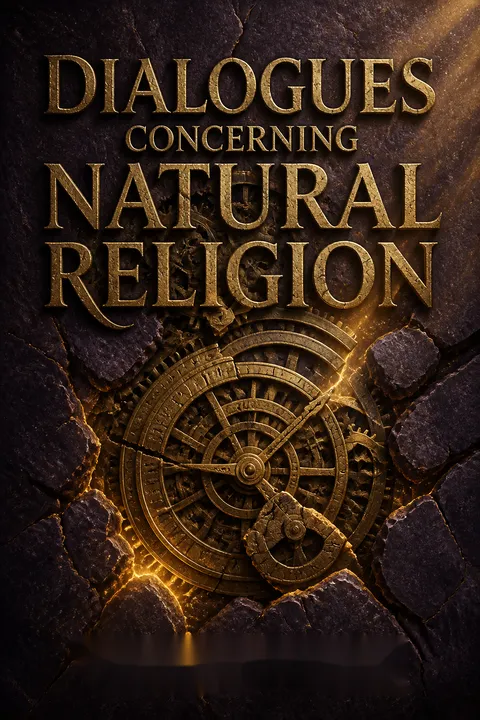

Key Takeaways
1. The Limits of Human Reason in Theological Inquiry
Let us become thoroughly sensible of the weakness, blindness, and narrow limits of human reason: Let us duly consider its uncertainty and endless contrarieties, even in subjects of common life and practice.
Embrace skepticism. Philo, the skeptic, argues that before delving into profound religious questions, one must first acknowledge the inherent limitations and fallibility of human reason. He suggests that by recognizing the uncertainties and contradictions in even familiar subjects, individuals will be less presumptuous when approaching the sublime and remote topics of natural theology. This intellectual humility is presented as a necessary foundation.
Reason's boundaries. Our understanding is confined to our experience. When we venture beyond "human affairs and the properties of the surrounding bodies" into "the two eternities, before and after the present state of things," we inevitably exceed the reach of our faculties. Unlike practical matters where common sense and experience provide anchors, theological reasonings lack this advantage, leaving us like "foreigners in a strange country."
Skepticism's role. While Cleanthes initially dismisses Philo's skepticism as insincere or impractical, Philo maintains that it is a crucial tool. It prevents dogmatism and forces a cautious approach to claims about the divine, especially when arguments stray far from empirical observation. This foundational skepticism prepares the mind for a more honest assessment of religious claims.
2. The Argument from Design is Fundamentally Flawed
If we see a house, Cleanthes, we conclude, with the greatest certainty, that it had an architect or builder because this is precisely that species of effect which we have experienced to proceed from that species of cause. But surely you will not affirm that the universe bears such a resemblance to a house that we can with the same certainty infer a similar cause, or that the analogy is here entire and perfect.
Weak analogy. Cleanthes proposes the universe as a "great machine," inferring a divine designer analogous to a human architect. Philo counters that this analogy is severely limited. We have no experience of universe-making, only of human artifacts. The dissimilarity between a house and the cosmos is so vast that any inference about their causes can only be a "guess, a conjecture, a presumption."
Proportional causes. Philo insists that effects prove causes only in proportion to their resemblance. The universe's immense grandeur and complexity far exceed human contrivance, making it unreasonable to infer a cause merely "similar to the mind of man." This argument challenges the very basis of attributing human-like intelligence, wisdom, or design to a divine creator based on observable effects.
Uncertain attributes. Even if some design is conceded, the argument cannot establish specific divine attributes. It cannot prove:
- Infinity: The effect (universe) is not infinite, so the cause need not be.
- Perfection: The universe appears flawed, suggesting a "fifth-rate deity," an "infant deity," or one who "afterwards abandoned it, ashamed of his lame performance."
- Unity: Multiple deities could have collaborated, just as many humans build a city.
- Spirituality: Why not corporeal deities, or ones that reproduce like animals?
3. The Problem of Evil Undermines Divine Benevolence
Is he willing to prevent evil, but not able? then is he impotent. Is he able, but not willing? then is he malevolent. Is he both able and willing? whence then is evil?
Epicurus's dilemma. Philo revives the ancient problem of evil, arguing that the existence of suffering and wickedness in the world is irreconcilable with a God who is simultaneously infinitely powerful, wise, and benevolent. If God wills happiness, why is there misery? If he is never mistaken, why does nature not tend to human felicity?
Four sources of evil. Philo identifies four circumstances contributing to suffering, none of which appear necessary or unavoidable to human reason:
- Pain as motivator: Pleasure alone could suffice to prompt action.
- General laws: Particular divine volitions could prevent specific evils without disrupting natural order.
- Frugality of powers: Creatures are given bare minimums for survival, not ample endowments for happiness.
- Inaccurate workmanship: Natural forces (winds, rains, passions) often run to extremes, causing harm.
Indifferent creator. Given these observations, Philo concludes that the "original source of all things is entirely indifferent to all these principles, and has no more regard to good above ill than to heat above cold." This suggests a morally neutral or even dualistic (Manichaean) creator, rather than a perfectly benevolent one, based on empirical evidence.
4. A Priori Proofs for God's Existence are Invalid
Nothing is demonstrable unless the contrary implies a contradiction. Nothing that is distinctly conceivable implies a contradiction. Whatever we conceive as existent, we can also conceive as non-existent. There is no being, therefore, whose non-existence implies a contradiction. Consequently there is no being whose existence is demonstrable.
Conceivability vs. necessity. Demea attempts to prove God's existence a priori, arguing that everything must have a cause, leading to a "necessarily existent Being." Cleanthes, surprisingly, refutes this, stating that any matter of fact (like existence) cannot be demonstrated a priori. If we can conceive of something not existing, its existence is not necessary.
No necessary existence. The concept of "necessary existence" is deemed meaningless if it cannot be shown that its non-existence implies a contradiction. Cleanthes argues that we can always conceive of any being, including God, as non-existent. Furthermore, he challenges why the material universe itself could not be the "necessarily existent Being," as we don't know all its qualities.
Infinite regress. Philo adds that asking for a "general cause or first author" in an eternal succession of objects is absurd, as each part is caused by what precedes it. The idea of a "whole" needing a cause is a mental construct, not a property of reality. This critique dismantles the traditional cosmological argument for a first cause.
5. Alternative Cosmogonies Challenge the Design Hypothesis
The world, therefore, I infer, is an animal; and the Deity is the Soul of the world, actuating it, and actuated by it.
World as organism. Philo proposes alternative hypotheses for the universe's origin, arguing they are as plausible, if not more so, than the design argument. He suggests the ancient idea of the world as an animal or vegetable, where order arises from "generation or vegetation" rather than conscious design. This analogy highlights that complex order can emerge without a human-like intelligence.
Epicurean chance. Philo also revives the Epicurean hypothesis: a finite number of particles in eternal motion will, given infinite time, eventually arrange themselves into every possible order, including our universe. This suggests that apparent design could be the result of chance and necessity over vast durations, without a conscious creator.
Matter's inherent order. He further posits that matter itself might possess an "eternal, inherent principle of order," undergoing continual revolutions that produce stable forms. This challenges the assumption that order must originate from mind, suggesting that matter could inherently organize itself, much like a tree produces another tree without conscious knowledge of the order it bestows.
6. The Divine Nature Remains Ultimately Incomprehensible
The essence of that supreme mind, his attributes, the manner of his existence, the very nature of his duration; these and every particular which regards so divine a being are mysterious to men.
Mysticism and skepticism. Demea, the orthodox believer, insists on the absolute incomprehensibility of God's nature, arguing that human reason is too limited to grasp divine perfections. Philo, the skeptic, surprisingly agrees, but from an empirical standpoint: our ideas are limited by experience, and we have no experience of divine attributes. Both conclude that God is "adorably mysterious."
Against anthropomorphism. Demea and Philo unite against Cleanthes' anthropomorphism, which depicts God as too similar to human intelligence. They argue that attributing human-like faculties (thought, passions, succession of ideas) to God degrades the Supreme Being and contradicts divine immutability and simplicity. Such comparisons are born of human partiality.
Verbal adoration. Philo suggests that when we ascribe "wisdom, thought, design, knowledge" to God, these are merely "honorable words among men" used to express adoration, not to describe actual divine qualities analogous to human ones. The true meaning of these terms, when applied to God, remains "totally incomprehensible," reflecting the infirmities of human nature.
7. The Soul's Mortality is Supported by Natural Analogy
Where any two objects are so closely connected, that all alterations, which we have ever seen in the one, are attended with proportionable alterations in the other: we ought to conclude, by all rules of analogy, that, when there are still greater alterations produced in the former, and it is totally dissolved, there follows a total dissolution of the latter.
Empirical evidence for mortality. Hume argues that reason, apart from revelation, struggles to prove the soul's immortality. He critiques metaphysical, moral, and physical arguments, finding the physical arguments from analogy to be the strongest for mortality. The close connection between mind and body suggests a shared fate.
Mind-body correlation. Our experience shows a direct correlation between the state of the body and the state of the mind:
- Infancy: Weakness of body and mind are proportional.
- Manhood: Vigor in both.
- Sickness: Sympathetic disorder.
- Old age: Common gradual decay.
The "step further seems unavoidable; their common dissolution in death."
Analogy with animals. Hume points out that animal souls are generally considered mortal, yet they bear a strong resemblance to human souls. If comparative anatomy is valid for bodies, then the analogy should extend to minds. He also notes that nothing in this world is perpetual, and it's contrary to analogy to imagine the frailest form (the soul) to be immortal.
8. Suicide Can Be a Rational and Morally Permissible Act
If it be no crime, both prudence and courage should engage us to rid ourselves at once of existence, when it becomes a burden.
No transgression against God. Hume argues that suicide is not a transgression against God because divine providence operates through general, immutable laws. Human actions, including ending one's life, are part of these laws. Altering the course of nature (like diverting a river or building a house) is not impious, and neither is ending one's own life if it becomes a burden.
No harm to society. A person who retires from life "only ceases to do good," which is the "lowest kind" of injury. If one is a burden to society or if their life hinders others, then resignation of life might even be "laudable." Obligations to society are reciprocal and have bounds; one is not obliged to suffer great harm for a small public advantage.
Rational self-interest. Hume contends that "no man ever threw away life, while it was worth keeping." If life becomes a burden due to age, sickness, or misfortune, then ending it is consistent with self-interest and prudence. He challenges the notion that suicide is an act of cowardice, suggesting it can require "prudence and courage."
9. Miracles Cannot Be Established by Human Testimony
That no testimony is sufficient to establish a miracle, unless the testimony be of such a kind, that its falsehood would be more miraculous, than the fact, which it endeavors to establish.
Experience vs. testimony. Hume's central argument is that belief in testimony is founded on experience, which tells us that witnesses are generally truthful. However, a miracle is a "violation of the laws of nature," which are established by "firm and unalterable experience." Therefore, the proof against a miracle (from uniform experience) is always stronger than any testimony for it.
The balance of probabilities. When faced with a report of a miracle, one must weigh two opposing probabilities:
- The probability that the event occurred.
- The probability that the testimony is false (due to deception or error).
It is always more probable that the testimony is false than that a law of nature has been violated.
Flaws in miraculous accounts. Hume identifies several reasons why testimony for miracles is inherently weak:
- Lack of credible witnesses: Seldom attested by sufficient numbers of educated, honest, reputable individuals.
- Human propensity to wonder: People are eager to believe and propagate the marvelous, especially in religious contexts.
- Origin in ignorant ages: Miracles abound in barbarous nations, diminishing their credibility.
- Conflicting miracles: Miracles from different religions contradict each other, mutually destroying their authority.
10. Religion's Roots Lie in Human Emotion, Not Pure Reason
So anxious or so tedious are even the best scenes of life that futurity is still the object of all our hopes and fears. We incessantly look forward and endeavor, by prayers, adoration, and sacrifice, to appease those unknown powers whom we find, by experience, so able to afflict and oppress us.
Misery and dependence. Demea and Philo agree that religion primarily arises from human misery, weakness, and dependence, rather than from rational arguments. People seek protection from a superior being due to their "imbecility and misery," and the "terrors with which we are incessantly agitated and tormented."
Psychological origins. Philo emphasizes that the "best and indeed the only method of bringing everyone to a due sense of religion is by just representations of the misery and wickedness of men." This suggests that religious belief is more a product of emotional need and existential dread than intellectual conviction.
Superstition's influence. The "terrors of religion commonly prevail above its comforts," leading people to form notions of unknown beings "suitable to the present gloom and melancholy of their temper." This psychological dynamic, rather than reasoned inquiry, explains the prevalence of religious belief and its often-pernicious consequences (factions, wars, oppression).
11. Theological Disputes are Often Merely Verbal
The theist allows that the original intelligence is very different from human reason: The atheist allows that the original principle of order bears some remote analogy to it. Will you quarrel, Gentlemen, about the degrees, and enter into a controversy which admits not of any precise meaning, nor consequently of any determination?
Ambiguity of terms. Philo suggests that much of the debate between theists and atheists is a "mere verbal controversy," stemming from the inherent ambiguity of language when discussing divine attributes. Both sides often agree on the underlying facts (e.g., order in the universe) but dispute the "degrees" or precise nature of the inferred cause.
Degrees of qualities. He argues that controversies concerning the "degrees of any quality or circumstance" are perpetually ambiguous because such qualities are not susceptible to exact measurement. Whether God's intelligence is "very different" or merely "remotely analogous" to human reason becomes a semantic quibble rather than a substantive philosophical disagreement.
Common ground. Philo pushes both theist and atheist to concede common ground: the theist admits an "immeasurable, because incomprehensible, difference" between human and divine minds, while the atheist acknowledges a "remote analogy" among all natural operations, including the principle of order in the universe. This convergence reveals the superficiality of their apparent conflict.
12. Skepticism as a Prerequisite for True Faith (or its Irony)
To be a philosophical skeptic is, in a man of letters, the first and most essential step towards being a sound, believing Christian.
Fideistic turn. Philo, after dismantling all rational arguments for God's existence and attributes, makes a surprising statement: philosophical skepticism, by exposing the limits of human reason, prepares the way for accepting revealed truth. This "fideistic" position suggests that since reason cannot provide certainty, one must turn to faith.
Hume's irony. This statement is often interpreted as deeply ironic, given Hume's own known irreligion. By suggesting that skepticism leads to Christianity, he highlights the irrationality required for such belief, implying that true faith must "subvert all the principles of his understanding" and embrace what is "most contrary to custom and experience."
The narrator's conclusion. Pamphilus, the narrator, concludes that Philo's principles are "more probable than Demea's, but that those of Cleanthes approach still nearer to the truth." This ambiguous ending leaves the reader to ponder whether Hume genuinely saw some merit in Cleanthes' empirical approach (albeit limited) or if it's a final layer of skeptical irony, suggesting that even the most "reasonable" religious position is still far from conclusive truth.
Review Summary
Dialogues Concerning Natural Religion receives high praise for its clarity, wit, and profound arguments on the existence and nature of God. Readers appreciate Hume's skepticism and his ability to present multiple viewpoints fairly. Many find the book thought-provoking and relevant to modern debates on religion. Some reviewers note its historical importance in challenging natural theology. While a few criticize Hume's arguments or writing style, most recommend it as an essential read for those interested in philosophy and religion.
People Also Read

Download PDF
Download EPUB
.epub digital book format is ideal for reading ebooks on phones, tablets, and e-readers.








































