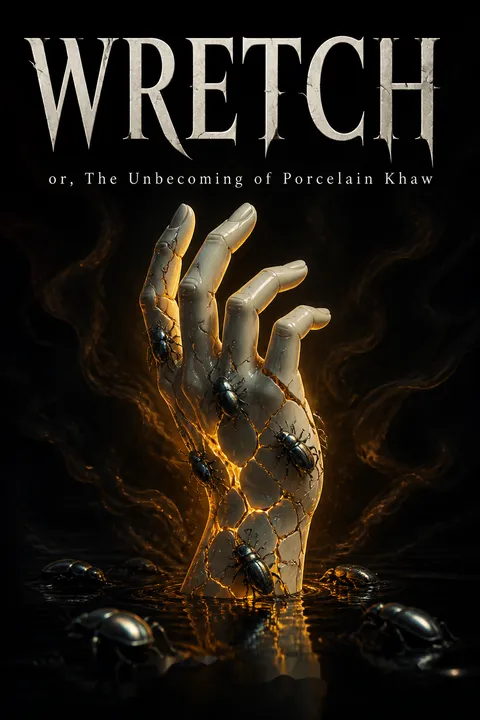

Plot Summary
Reverse Haunting
Genevieve Doyle, haunted by the loss of her husband Laird, seeks solace in a mysterious ritual. She visits a cold, undecorated house, surrendering a cherished photograph as an offering. The host, a man named Clovis, leads her through a corridor teeming with silver beetles to a room where she meets Porcelain Khaw, a spectral figure promising contact with the dead. Genevieve's longing is palpable—she yearns not just to be haunted, but to haunt, to possess what is lost. The ritual demands suffering, and as she submits, the boundaries between the living and the dead blur. Her fate is left uncertain, her presence lingering as a warning: the living can torment the dead as much as the dead haunt the living.
Cannibals and Comfort
Simeon Link, a gay widower, is consumed by despair after losing his husband Jonathan. He contemplates suicide in a work bathroom, feeling like a used-up object in a world of cannibals—where everything devours everything else. After being forced into unpaid leave, Simeon's isolation deepens. He wanders the city, witnessing a rat cannibalizing another, a grotesque metaphor for his own emotional state. At home, he seeks connection online, stumbling upon a forum discussing Porcelain Khaw—a figure who appears in dreams, offering comfort at a terrible price. Simeon's longing for relief is matched only by his fear of what true comfort might cost.
The Ordeal of Porcelain Khaw
Simeon reads a disturbing forum post describing a dream in which parents negotiate with Porcelain Khaw to sell their son as a living lure for insects, covered in jelly and devoured for another's comfort. The dream blurs into reality, echoing Simeon's own guilt and longing. The parents' debate—love versus survival, sacrifice versus complicity—mirrors Simeon's internal struggle. The dream's horror lies not just in the fate of the child, but in the parents' willingness to rationalize cruelty for relief. Porcelain, enigmatic and predatory, embodies the world's appetite for suffering, and the living's desperate need to be free of pain.
The Wretches' Invitation
Simeon is invited to join the Wretches, a secretive support group for the bereaved who seek their lost loved ones in photographs. The group's founder believed the dead communicate through images, and members obsessively search for faces in the mundane. Simeon, skeptical yet desperate, is drawn in by the hope of seeing Jonathan again. The group's rituals—taking and interpreting photographs—offer both solace and illusion. Simeon's skepticism battles with his yearning for magic over realism, as he wonders if comfort is found in truth or in the illusions we create to survive loss.
Reflections and Ghosts
With the help of Kent, a fellow Wretch, Simeon acquires a special camera and begins photographing places Jonathan loved. He captures an image in a park trellis that seems to reveal Jonathan's face, but when he shows it to his ex-wife Evelyn, she sees nothing. The photograph becomes a contested site of meaning—proof of haunting or a trick of longing. Simeon's grief is mirrored in his relationships: with Evelyn, who still loves him; with Carter, his son, whom he feels he's failed; and with Kent, who offers both friendship and the lure of deeper mysteries. The boundaries between memory, desire, and reality grow ever thinner.
The Photograph's Secret
Simeon presents his photograph to the Wretches, hoping for validation and acceptance. The group's reaction is tepid, leaving him feeling more isolated. He participates in a play, "Predator and Prey," that dramatizes the devouring nature of grief and the self. The performance blurs therapy and violence, echoing Simeon's own internal cannibalism—his fear that he consumes others' love and is consumed in turn. Afterward, Kent reveals a deeper secret: Porcelain Khaw is real, and can offer Simeon a chance to see Jonathan again, but only through a ritual that demands total surrender and suffering.
Predator and Prey
Simeon's obsession with Porcelain grows. He contacts Clovis, Porcelain's handler, and is instructed to send a precious item and care for a box of silver beetles as part of the ritual. The process is both bureaucratic and mystical, blending the mundane with the uncanny. Online, Simeon's conversations with the enigmatic "babyfacexoxo" (later revealed to be his own son, Carter) hint at betrayal and manipulation. The lines between predator and prey, parent and child, victim and perpetrator, blur as Simeon prepares to submit himself to Porcelain's power, hoping for relief but fearing annihilation.
Rituals of Grief
Simeon undergoes the ritual with Porcelain Khaw, surrendering his most cherished photograph. In a trance-like state, he is reunited with Jonathan, experiencing an ecstatic, erotic vision of their love. But the reunion is tainted by doubt—Jonathan's words are strange, his presence uncanny. Porcelain warns that suffering is the only path to comfort, and that the living can haunt the dead as much as the dead haunt the living. The ritual leaves Simeon emptied, both fulfilled and hollowed out, addicted to the fleeting relief and desperate for more.
Porcelain's Bargain
Unable to accept the limits of the ritual, Simeon begs for another session with Porcelain. Each encounter brings diminishing returns, as the boundaries between memory and invention dissolve. Jonathan's presence becomes less distinct, more a reflection of Simeon's own desires and fears than a true reunion. Porcelain, exhausted by Simeon's need, reveals the toll such rituals take on both client and medium. The relationship becomes parasitic—Simeon consuming Porcelain's power, Porcelain feeding on Simeon's longing. The cycle of grief, comfort, and suffering becomes inescapable.
Consumed by Longing
Simeon's repeated visits to Porcelain lead to a crisis. He is confronted with the possibility that his memories of Jonathan are false, that his longing has become a form of self-cannibalism. The rituals no longer bring comfort, only pain and confusion. In a final, desperate act, Simeon attacks Porcelain, seeking to possess him utterly. The violence is both literal and symbolic—a last attempt to fill the void within by destroying the source of both comfort and torment. But the act only deepens Simeon's isolation, trapping him in a cycle of endless hunger.
The Final Haunting
In the aftermath of violence, Simeon is consumed by Porcelain, his soul absorbed into the medium's body. He becomes one of many spirits trapped within, a wretch among wretches, condemned to witness the suffering of others and his own failures. Evelyn, seeking relief from her own grief and betrayal, writes to Clovis, hoping to undergo the ritual herself. Simeon, now a reflective beetle, can only watch helplessly as the cycle repeats—each new client seeking comfort, each becoming another ghost in Porcelain's collection.
Becoming Wretch
The novel closes with Simeon's realization that he has become what he most feared—a wretch, a parasite, a ghost haunting the living. He is joined by Genevieve and others, all trapped within Porcelain, all longing for release or recognition. The final image is one of futility and warning: the living, in their hunger for comfort and escape from pain, risk becoming the very monsters they fear, devouring themselves and each other in an endless, unbecoming cycle.
Analysis
A modern horror of grief, identity, and the hunger for comfortWretch: or, The Unbecoming of Porcelain Khaw is a meditation on the dangers of unchecked longing and the seductive power of suffering. Eric LaRocca crafts a narrative where grief is not merely endured but becomes a consuming force, transforming the bereaved into predators, parasites, and ultimately, wretches. The novel interrogates the boundaries between the living and the dead, the self and the other, comfort and destruction. Through its use of ritual, reflection, and cannibalistic metaphor, Wretch exposes the ways in which the search for relief can lead to self-annihilation and the perpetuation of harm. The story warns against the temptation to possess what is lost, to seek magic over realism, and to surrender autonomy for the illusion of reunion. In the end, the novel suggests that true healing may lie not in haunting or being haunted, but in accepting the irreparable nature of loss—and in resisting the urge to fill the void with anything, or anyone, at any cost.
Review Summary
Wretch receives mixed reviews, averaging 3.49/5. Fans praise LaRocca's intimate, unsettling prose, the innovative "reverse haunting" concept, and its raw exploration of grief, obsession, and body horror. Many highlight the atmospheric dread and stunning ending. Critics, however, find the protagonist Simeon unlikable to a fault, the pacing sluggish, and the prose overly dense and purple. Several reviewers note it falls short of LaRocca's earlier work, feeling bloated where it could have been a tighter novella.
People Also Read







Characters
Simeon Link
Simeon is the novel's central figure, a gay man paralyzed by the loss of his husband Jonathan. His relationships—with his ex-wife Evelyn, his son Carter, and the enigmatic Kent—are marked by guilt, longing, and self-loathing. Simeon's psychological landscape is a labyrinth of desire and despair; he oscillates between seeking comfort and courting annihilation. His journey through grief is both literal and metaphysical, culminating in his transformation from seeker to wretch, from haunted to haunting. Simeon's arc is a meditation on the dangers of unchecked longing and the ways in which the bereaved can become predators, consuming the memories and lives of those they love.
Jonathan
Jonathan is both a memory and a phantom, his presence reconstructed through Simeon's grief and Porcelain's rituals. In life, he was loving but distant, his relationship with Simeon marked by both tenderness and unspoken tensions. In death, he becomes a mirror for Simeon's desires and fears, his image mutable and unreliable. Jonathan's role is less that of an active character and more a catalyst for Simeon's unraveling—a symbol of the impossibility of true reunion and the dangers of idealizing the past.
Evelyn Rhodes
Evelyn is Simeon's former spouse and the mother of his son, Carter. She embodies both resilience and vulnerability, offering support even as she is repeatedly hurt by Simeon's emotional absence and betrayals. Evelyn's longing for love and closure mirrors Simeon's, but her suffering is quieter, more dignified. Her eventual decision to seek out Porcelain for relief from her own grief and confusion underscores the novel's theme: that suffering is contagious, and the search for comfort can lead to further loss.
Carter
Carter is the teenage son of Simeon and Evelyn, initially portrayed as a distant, misunderstood figure. The revelation that he is "babyfacexoxo," the online presence who subtly orchestrates Simeon's downfall, reframes him as both victim and perpetrator. Carter's actions are a twisted form of revenge and a cry for attention, reflecting the generational transmission of pain and the ways in which children can become both haunted and haunting.
Porcelain Khaw
Porcelain is the novel's central supernatural figure—a medium who offers the bereaved a chance to reconnect with the dead, but only through rituals that demand suffering and surrender. Porcelain is both alluring and monstrous, a vessel for others' pain and a predator who feeds on longing. His power is ambiguous: he can grant visions, but at the cost of identity and autonomy. Porcelain's own history is one of exploitation and transformation, and his relationship with Clovis and his clients is fraught with dependency and resentment.
Clovis R. Morrow
Clovis manages access to Porcelain, orchestrating the rituals and enforcing the rules. His relationship with Porcelain is complex—part handler, part lover, part victim. Clovis's own history as a former "jelly boy" hints at cycles of abuse and complicity. He is both protector and enabler, his loyalty masking deep wounds and unfulfilled desires. Clovis's presence underscores the transactional nature of comfort and the costs of serving as an intermediary between suffering and relief.
Kent Simmons
Kent is a member of the Wretches who befriends Simeon and introduces him to Porcelain. Charismatic and knowledgeable, Kent appears to offer genuine support, but his motives are ambiguous. He is both a survivor of Porcelain's rituals and a recruiter, perpetuating the cycle of suffering. Kent's own grief is both a bond and a weapon, and his role as both confidant and betrayer highlights the dangers of seeking solace in those who are themselves wounded.
Genevieve Doyle
Genevieve's story bookends the novel, her fate serving as a warning to others. Like Simeon, she seeks comfort through Porcelain's rituals and is ultimately consumed, becoming a ghostly presence within Porcelain. Her longing to haunt rather than be haunted reflects the novel's central paradox: the living's desire to possess the dead leads only to further loss and dissolution.
The Wretches
The Wretches are a support group for the bereaved, united by their obsession with finding the dead in photographs. They represent both the allure and the danger of communal suffering—offering validation and ritual, but also perpetuating illusion and dependency. The group's rituals mirror those of Porcelain, blurring the line between therapy and magic, comfort and cannibalism.
Babyfacexoxo
Initially an anonymous presence in Simeon's online life, babyfacexoxo is revealed to be Carter, Simeon's son. This persona orchestrates Simeon's journey toward Porcelain, embodying the novel's themes of betrayal, manipulation, and the hidden violence within families. Babyfacexoxo is both a symptom and a cause of the cycle of suffering, a reminder that the wounds of the past are never truly buried.
Plot Devices
Ritual as Transformation and Trap
The novel's central plot device is the ritual—whether in the Wretches' photography sessions or Porcelain's supernatural ceremonies. These rituals offer the hope of reunion with the dead, but always at a cost: the surrender of autonomy, the risk of self-destruction, the perpetuation of grief. Rituals serve as both transformation and trap, promising relief but delivering only deeper entanglement. The structure of the novel mirrors this device, with each section unfolding as a new stage in Simeon's descent, each ritual more consuming than the last.
Mirrors and Reflections
Mirrors, photographs, and reflective surfaces recur throughout the narrative, symbolizing the instability of identity and the unreliability of memory. Characters seek themselves and their lost loved ones in reflections, only to find distortion, absence, or monstrous transformation. Porcelain himself is described as a mirror, reflecting back the desires and fears of those who seek him. This device underscores the novel's central question: can we ever truly know ourselves or those we love, or are we always haunted by our own projections?
Cannibalism as Metaphor
The motif of cannibalism—literal, emotional, and spiritual—pervades the novel. Characters consume and are consumed by longing, guilt, and the need for comfort. The world is depicted as a place where everything eats everything else, where love and grief are forms of predation. This device is both metaphorical and literal, culminating in Simeon's absorption into Porcelain and his transformation into a reflective beetle—a wretch among wretches.
Foreshadowing and Circular Structure
The novel's structure is circular, with the fate of Genevieve foreshadowing Simeon's own. Early references to haunting, possession, and the dangers of seeking comfort anticipate the novel's climax, in which the seeker becomes the sought, the haunted becomes the haunting. The use of online forums, dreams, and plays within the narrative further blurs the boundaries between reality and illusion, past and present, self and other.
Download PDF
Download EPUB
.epub digital book format is ideal for reading ebooks on phones, tablets, and e-readers.








































