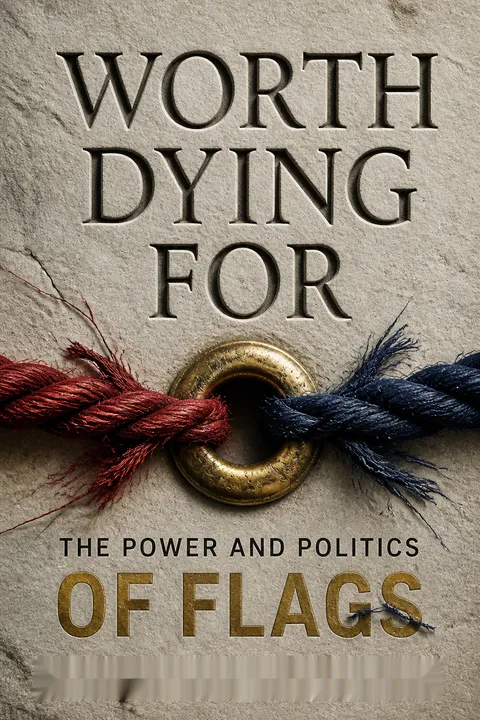

Key Takeaways
1. Flags as Potent Emotional Symbols
A country’s history, geography, people and values – all are symbolized in the cloth, its shape and the colours in which it is printed.
Emotional embodiment. Flags are far more than mere pieces of colored cloth; they are deeply invested with meaning and emotion, serving as powerful embodiments of a nation's identity, history, and values. This profound connection can inspire both immense pride and fierce opposition, often simultaneously. The meaning of a flag is subjective, residing "in the eye of the beholder," and can shift dramatically depending on individual perspective and context.
Unifying and divisive. Flags possess an extraordinary ability to unite populations behind shared ideals, yet they can also ignite intense conflict and division. The 9/11 flag-raising at the World Trade Center, for instance, symbolized American strength and defiance, evoking powerful emotions of courage and collective perseverance. Conversely, the "Greater Albania" flag flown by a drone during a Serbia-Albania football match in 2014 sparked outrage and violence, highlighting deep-seated ethnic and territorial tensions.
Ancient origins, modern power. While standards and symbols on cloth existed in ancient civilizations, the invention of silk by the Chinese allowed flags, as we know them, to flourish and spread. Adopted by Arabs and later Europeans during the Crusades, flags evolved from battlefield identifiers and heraldic bearings into potent symbols of the nation-state. Today, flags continue to wield immense power, communicating complex ideas quickly and drawing strongly on emotions, whether for national pride, commercial branding, or even religious and racial violence.
2. The American Flag: A Symbol of Reverence and Contention
No other national flag comes close to equalling the recognition commanded by the US flag, nor the scale of negative and positive emotions it evokes.
Ubiquitous reverence. The Stars and Stripes, or "Old Glory," is arguably the most recognizable flag globally, revered by most Americans as a primary symbol of national identity. It flies from countless buildings, homes, and military bases worldwide, embodying American dreams, freedoms, and its history of rebellion and success. This deep reverence is codified in complex laws and codes of conduct, governing everything from its display and folding to its ceremonial "retirement" by burning.
Global presence, varied reception. America's extensive global engagement means its flag is seen in over sixty countries, evoking diverse reactions. To allies, it signifies security; to detractors, it represents overweening power or imperialism. This disparity is evident in how the flag is perceived outside a base in Poland versus in Iraq, or by a Japanese fishing fleet versus a Chinese one. Domestically, artists like Jasper Johns and Andy Warhol have explored its iconic status, while politicians like Ronald Reagan have leveraged its power in campaigns.
Historical evolution and internal conflict. The US flag evolved over 183 years, from early colonial designs like the Sons of Liberty flag to the Continental, and through various Flag Acts that added stars for new states. The War of 1812 and Francis Scott Key's "Star-Spangled Banner" cemented its emotional significance. However, the flag has also been a site of contention, notably during the Civil War, where the Confederate flag became a symbol of Southern heritage but also of slavery and segregation, a legacy that continues to spark debate and protest today.
3. The Union Jack: A Complex Legacy of Unity and Division
As with any national flag, its beauty or otherwise is in the eye, imagination and politics of the beholder.
A union of symbols, a source of division. The Union Jack, a fusion of the crosses of St. George (England), St. Andrew (Scotland), and St. Patrick (Ireland), embodies a complex legacy of unity and division. While it represents the United Kingdom, its design has historically privileged England, omitting Wales entirely. This has fueled resentment, particularly in Scotland and Northern Ireland, where "Britain" and "England" are not interchangeable, and the flag can be seen as a symbol of English dominance or even colonial oppression.
Imperial reach and post-colonial rejection. The Union Jack once flew across a vast empire where "the sun never set," symbolizing British sea power, scientific progress, and exploration. Today, its presence in the canton of flags like Fiji, Australia, and New Zealand reflects this colonial past, though many former colonies, like India and Pakistan, rejected it upon independence. Even in countries that retain it, like Fiji, there's a growing movement to "dispense with the colonial symbols."
Internal struggles and re-appropriation. Within the UK, the Union Jack has faced challenges to its meaning. In Northern Ireland, it remains a highly sensitive symbol, often flown in opposition to the Irish tricolour, reflecting ongoing sectarian divides. In England, it was appropriated by extreme right-wing groups in the late 20th century, leading to a period where prominent display was viewed with suspicion. However, through sports and the actions of multi-ethnic British figures, both the Union Jack and the English Cross of St. George have seen a re-appropriation, symbolizing a more inclusive national identity, albeit one still grappling with the implications of Brexit and devolution.
4. European Flags: From Ancient Crosses to Modern Identity Struggles
The people of the nations of Europe have stubbornly resisted becoming one, not because they don’t like each other but because they like themselves.
A "Schrödinger's flag" for a complex union. The European Union flag, with its blue background and twelve stars, is officially an "emblem" rather than a national flag, a compromise reflecting member states' reluctance to supersede their own national symbols. While it represents the ideal of a peaceful, prosperous, and unified continent, the reality is a constant tension between a nascent European identity and deeply rooted national identities forged over centuries. The flag's origins, including a possible link to the Virgin Mary, add layers of historical and even conspiratorial interpretation.
Historical echoes in national designs. Many European flags carry centuries of history, often reflecting religious, dynastic, or revolutionary shifts.
- French Tricolor: Blue (St. Martin), red (Charlemagne), white (Joan of Arc), later symbolizing liberty, equality, and fraternity.
- German Black-Red-Gold: Associated with pan-German unity and democracy, contrasting with the black-white-red of the Second Empire and the Nazi swastika.
- Scandinavian Crosses: Based on Denmark's Dannebrog, the world's oldest national flag, symbolizing Christian heritage in a largely secular region.
- Post-Yugoslav Flags: New designs like Macedonia's sun, Kosovo's map and stars, and Bosnia's imposed triangle reflect complex ethnic and territorial disputes.
Symbols of conflict and change. European flags have witnessed profound ideological battles. The Nazi swastika, an ancient symbol weaponized for a decade of terror, remains globally recognized for evil. The Soviet hammer and sickle, while representing a system responsible for mass atrocities, still evokes hope for some, symbolizing international solidarity and labor. Today, the EU flag itself faces challenges from resurgent nationalisms, Brexit, and the migration crisis, as countries debate sovereignty and identity, often using their national flags to assert distinct values.
5. Arab Flags: Islamic Identity and Post-Colonial Realities
The flag of 1916 is known to most Arabs, and they identify with it. The history of the colours is generally known, if not all the detail, but in the most immediate thinking of Arabs, the link is to pan-Arabism.
Pan-Arab colors and Islamic significance. Many flags across the Middle East and North Africa share the pan-Arab colors of white, black, green, and red, all deeply significant in Islam. These colors were first combined in the Arab Revolt flag of 1916, designed to unite Arab tribes against Ottoman rule, with each color representing a historical Islamic dynasty or the Prophet Mohammed. This pan-Arab ideal, though politically unsuccessful, continues to resonate in the shared color schemes of countries like Syria, Jordan, Yemen, and Palestine.
Diverse national expressions. While pan-Arabism provides a common thread, individual nations have adapted these colors and added unique symbols:
- Saudi Arabia: A green flag with the shahada (profession of faith) and a sword, never lowered to half-mast, symbolizing its Wahhabi Islamic identity and the House of Saud.
- Turkey: The crescent and star, ancient symbols adopted by the Ottoman Empire, now represent a secular state but evoke historical and religious connotations in debates about its European identity.
- Iran: A green, white, and red tricolour with a stylized red tulip motif (laleh) in the center, symbolizing martyrdom, love, and the word "Allah," reflecting its deeply Shia Islamic and Persian culture.
- Egypt: The Arab Liberation Flag (red, white, black) with the "Eagle of Saladin," a symbol of Islamic warrior heritage.
"Tribes with flags" in a turbulent region. The concept of "tribes with flags" highlights that many modern Arab nation-states, with borders drawn by colonial powers, struggle with internal divisions despite shared language and religion. Flags like Iraq's, with its Allahu Akbar script, can be unifying for some but alienating for minorities. The region's ongoing turmoil, marked by sectarianism and the rise of non-state actors, suggests that while pan-Arab colors persist, the future may bring new flags reflecting federal arrangements or even new nation-states.
6. Flags of Fear: The Weaponization of Symbols by Non-State Actors
When most of us see this flag we see evil fanaticism. It is about as ‘other’ as a flag can be.
The chilling power of the IS flag. Islamic State (IS) has masterfully weaponized its flag, a black banner bearing the shahada ("There is no god but God: Muhammad is the Messenger of God") in a rough, archaic script. This stark image, deliberately chosen to evoke early Islam and prophetic prophecies (like the "black banners from the east" and the battle of Dabiq), has become synonymous with depravity and terror. Its instant recognition serves as a powerful, fear-inducing message, attracting recruits and striking dread into opponents.
Ideological competition and distinct messaging. The IS flag is not merely a symbol of terror but a declaration of ideological supremacy, claiming to represent the "original form of Islam" and challenging the legitimacy of existing Muslim states, including Saudi Arabia. Unlike the Red Flag of Communism, which conceptually embraces universal brotherhood, the IS flag screams exclusivity and a narrow, violent definition of acceptable belief, embodying an ultimate "us and them" mentality.
Diverse symbols of non-state actors. Beyond IS, numerous other non-state groups in the Middle East use distinct flags to convey their messages:
- Hezbollah (Lebanon): A yellow flag with a green logo depicting a globe, Koran, and an AK-47, symbolizing global reach, religious commitment, and armed resistance, often displayed with goose-stepping and fascist salutes.
- Hamas (Gaza): A green flag with the shahada, representing its Sunni Muslim identity, alongside a second flag featuring a map of all of Israel, the West Bank, and Gaza, crossed swords, and the Dome of the Rock, signaling a rejection of a two-state solution and a commitment to armed struggle.
- Fatah (West Bank): A yellow flag with crossed M16 rifles, a grenade, and a map of the entire territory, implying violence despite official policy of peaceful negotiation.
These flags, with their specific iconography and slogans, are crucial tools for these groups to rally support, communicate their aims, and assert their identities in a region defined by complex, often violent, identity politics.
7. Asian Flags: Echoes of Ancient Civilizations and Modern Revolutions
Within them we also find clues to the rich breadth of culture and history that gives ancient roots to the flags of these modern nation states.
Central Asian "Stans": New states, ancient symbols. The flags of the Central Asian republics, formed after the Soviet Union's collapse, blend ancient cultural references with modern statehood. Turkmenistan's flag, for instance, features a green background, crescent, five stars (for regions and states of matter), and five traditional carpet guls, symbolizing nomadic ancestry and neutrality. Uzbekistan's blue, white, and green tricolour includes a new moon (for independence) and twelve stars (for months and astronomical heritage), reflecting Turkic and Islamic influences.
India's Tiranga: Unity in diversity. India's "Tiranga" (tricolour) of saffron, white, and green, with the Ashoka Chakra (wheel) in the center, was adopted in 1947. While officially secular, the colors unofficially represent Hinduism, peace, and Islam. The chakra symbolizes eternal cosmic law and progress, speaking to India's diverse religious and philosophical traditions. Mahatma Gandhi's initial spinning wheel design, meant to promote self-reliance, was replaced by the chakra to represent a broader, non-sectarian unity.
China's Red Flag: Communist veneer, ancient roots. China's red flag with a large yellow star (Communist Party) and four smaller stars (Mao's "united front" classes) symbolizes the nation's revolutionary history. However, the five-pointed stars also echo ancient Chinese philosophy of Five Elements, signifying balance and completeness. Despite the Communist Party's suppression of regional flags (like Tibet's), the flag's design subtly incorporates cultural elements predating Communism, reflecting a blend of modern ideology and deep historical roots.
Japan's Hinomaru: Wartime shadow, enduring identity. Japan's Hinomaru ("sun mark flag"), a red disc on a white background, has symbolized the "Land of the Rising Sun" for centuries. While it represents a stable democracy today, its use during brutal wartime occupation in the 20th century makes it a sensitive symbol, particularly for neighbors like Korea and China. Despite post-war efforts to re-appropriate it, the flag, and especially the military's Rising Sun flag, continue to evoke strong emotions and debates about Japan's historical accountability.
8. African Flags: Pan-Africanism and the Quest for Post-Colonial Identity
His massive propaganda for pride, not shame, in a black skin left an ineradicable mark on African nationalism everywhere.
Ethiopia and Garvey: The genesis of pan-African colors. Ethiopia, uniquely uncolonized, provided the red, gold, and green color scheme that became a powerful symbol of African independence. This was amplified by Jamaican-born Marcus Garvey, who, through his Universal Negro Improvement Association (UNIA) in the early 20th century, championed the red, black, and green pan-African flag. Garvey's message of black pride and "Back to Africa" profoundly influenced future African leaders, even if his specific racial separatism wasn't universally adopted.
Post-colonial adoption and new meanings. As African nations gained independence in the 1960s, many adopted variations of these pan-African colors:
- Ghana: The first sub-Saharan nation to gain independence, Ghana adopted red, gold, and green with a black star (in homage to Garvey's Black Star Line), symbolizing emancipation and unity.
- Kenya: Incorporated Garvey's colors (green, red, black) with white fimbriations and a Maasai warrior shield, representing the people, blood for freedom, natural resources, peace, and protection.
- Mozambique: Features an AK-47 assault rifle, the only national flag with a modern weapon, symbolizing the nation's determination to defend its freedom, though it remains a controversial element.
Diversity and challenges to unity. While pan-African colors promote continental unity, individual flags also reflect the diverse ethnicities and histories within nations. Rwanda, post-genocide, abandoned its old flag for a blue, yellow, and green design symbolizing peace, development, and enlightenment. Burundi's flag, with three red stars, attempts to represent its Tutsi, Hutu, and Twa ethnic groups, though ethnic violence persists. Nigeria's simple green-white-green flag, designed by a student, symbolizes agriculture and peace, but has been criticized for its lack of unique cultural imagery in a country of 250 peoples.
9. Latin American Flags: Revolutionary Ideals and European Influences
A country starts out from a name and a flag, and it then becomes them, just as a man fulfils his destiny.
European inspiration, local adaptation. Unlike Africa, Latin American flags often draw heavily on European revolutionary ideals, particularly the French tricolour, reflecting the European descent of many independence leaders. There is no single pan-Latin American color scheme, but regional groupings exist.
- Gran Colombia (Bolívar's Republic): Its yellow, blue, and red horizontal tricolour, inspired by Francisco de Miranda and Goethe's color philosophy, became the template for the flags of modern-day Venezuela, Colombia, and Ecuador, symbolizing wealth, the ocean, and courage.
- Central American Federation: Blue-white-blue stripes, possibly inspired by Argentina, represented the land between the Atlantic and Pacific oceans, adopted by Guatemala, Honduras, El Salvador, Costa Rica, and Nicaragua, hinting at a shared history and hope for future reunion.
Indigenous symbols and national identity. While less prevalent, indigenous iconography appears in some flags:
- Mexico: Its green, white, and red tricolour features an Aztec eagle standing on a cactus with a snake in its mouth, a powerful ancient legend symbolizing the founding of Tenochtitlan and a means of separating from Spanish colonial identity.
- Bolivia: Alongside its red, yellow, and green tricolour, the multicoloured Wiphala flag, representing indigenous peoples, has been decreed a second national emblem, reflecting growing recognition of native cultures.
Flags of convenience and conflict. Panama's unique red, white, and blue flag, with two stars, reflects its political parties and oceans, but is globally known as a "flag of convenience" for its lax shipping laws. The Falklands/Malvinas dispute between Argentina and Britain highlights how flags can become central to ongoing territorial conflicts, with Argentina using its blue-white-blue flag with the "Sun of May" to assert its claim. Brazil's vibrant green and yellow flag, with a blue globe and stars, symbolizes its rainforests, gold, and a blend of royal history and positivist philosophy, projecting a strong global identity.
10. Beyond Nations: Flags of Global Movements and Diverse Meanings
Flags do not need to represent a nation or a political idea to engender emotion and convey a message.
The Jolly Roger: From terror to romance. The skull and crossbones, or Jolly Roger, originated in the 12th century with the Knights Templar and became the iconic symbol of pirates in the 18th century. Its black background and gruesome imagery (hourglass, full skeleton) were a clear statement of intent, designed to instill fear and encourage surrender. Today, while still a serious threat in some contexts, it has been romanticized in popular culture, demonstrating how a flag's meaning can transform over centuries.
Universal symbols of humanity and conflict.
- White Flag: An ancient, globally recognized symbol of truce, ceasefire, or surrender, codified in international law, representing a demand for mercy and trust amidst the brutality of war.
- Red Cross/Crescent/Crystal: Emblems of neutrality and humanitarian aid, designed to be universally recognizable and protected in conflict, though their religious connotations have led to the adoption of the non-religious Red Crystal.
- NATO Flag: A dark-blue field with a white compass rose, symbolizing the unity and peaceful purpose of the military alliance, despite internal squabbles over national flag placement.
Flags of identity and global aspiration.
- Olympic Flag: Five interlaced rings on a white background, symbolizing the unity of the five continents and peace, though the Games often become a platform for national pride and competition rather than purely individual athletic prowess.
- Checkered Flag: The universal symbol for the end of a race, originating from "checkers" marking time limits in early American automobile rallies, now synonymous with speed and victory.
- LGBT Rainbow Flag: Designed by Gilbert Baker, it symbolizes the diversity of the LGBT community and has become a global emblem of freedom, inclusivity, and a battle standard in an ongoing culture war.
- United Nations Flag: A map of the world in white on a blue background, framed by olive branches, representing the idea of global unity and peace. Despite its "Byzantine politics" and structural reflections of 1945 power dynamics, it remains the only flag aspiring to represent all 7 billion people, a visual affirmation of diversity and a reminder of our shared humanity.
Review Summary
Worth Dying For receives mixed reviews, averaging 3.65/5 stars. Many readers appreciate Marshall's accessible writing style and fascinating historical information about flags worldwide. However, significant criticisms emerge regarding Western bias, particularly in the "Flags of Fear" chapter focusing on Islamic organizations while excluding Nazi and KKK symbols. Multiple reviewers note factual errors, orientalist perspectives, and the author's political biases undermining credibility. Some find the book too unstructured or wish for more images. Positive reviews praise its educational value and entertaining approach to vexillology, while negative reviews criticize it as superficial and opinion-heavy.
People Also Read


Politics of Place Series
About the Author
Other books by Tim Marshall


Download PDF
Download EPUB
.epub digital book format is ideal for reading ebooks on phones, tablets, and e-readers.








































