


Key Takeaways
Rescue Eve, and you rescue every woman who knew better but chose wrong
Eve deserves compassion, not condemnation. Sarah Jakes Roberts opens with a confession: for years she rolled her eyes at Eve, the woman who supposedly ruined humanity over a piece of fruit. Then at a women's conference, surrounded by shirts celebrating Sarah, Ruth, Esther, and Mary (never Eve), compassion hit her. Eve is not the villain. Eve is the mirror.
Everyone has an Eve moment. We all know what it feels like to eat french fries in the car before bringing dinner home, to stalk the social media of someone who hurt us, to know exactly what is good for us and choose the opposite anyway. Roberts calls this repeated self-defeating cycle your forbidden fruit. How you judge Eve's failure predicts how you will judge your own.
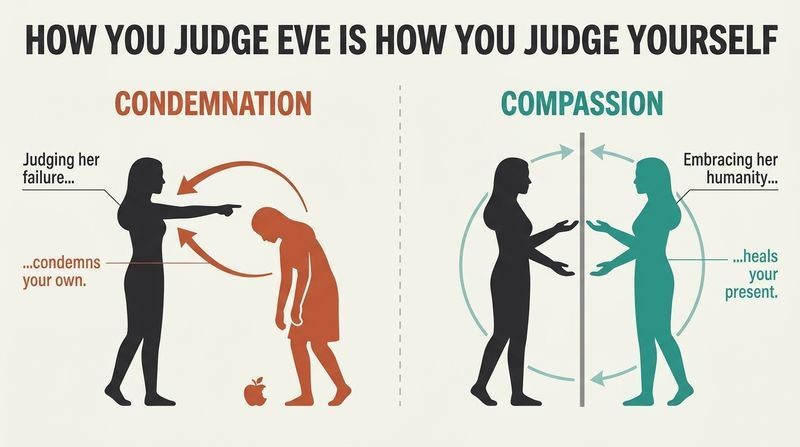
What's striking is the therapeutic reframe of a text used for millennia to shame women. By locating Eve inside the reader rather than in ancient history, Roberts converts a story of blame into one of self-compassion, echoing Kristin Neff's research showing self-compassion outperforms self-criticism in driving actual behavior change. The move also resonates with narrative therapy, which holds that re-authoring the stories we tell about ourselves alters our future choices. The claim that judging Eve predicts judging yourself is psychologically shrewd: harsh moral absolutism toward others typically boomerangs inward.
Attack the root question, not the bad behavior it produces
The serpent's weapon was a question, not fruit. Roberts notes the serpent never forced Eve to eat. He asked, "Did God really say?" That single question destabilized her entire environment, moving her from certainty to doubt. The eating came much later. Sabotage is slow: it pokes a pinhole in your faith and waits for it to deflate.
Find the question haunting you. Roberts thought her trauma began with teen pregnancy at thirteen. Retracing her steps, she found the real seed planted at age seven, when her family moved churches and she lost her seat beside her mother among 1,500 strangers. The question "Do I belong here?" became the soil where insecurity grew for decades. She frames it as a cycle: thoughts are seeds, environment determines growth, and actions are the fruit. Change the fruit by changing the root question.
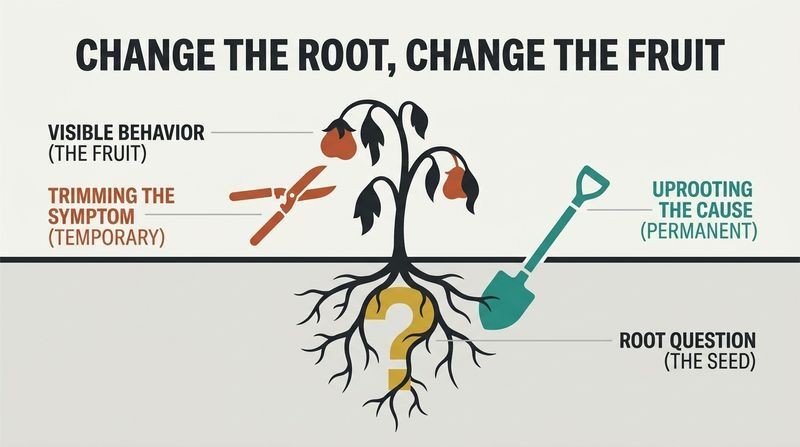
This anticipates cognitive behavioral therapy's core insight that automatic thoughts, not events, drive emotion and behavior, and it dovetails with schema therapy's search for early maladaptive beliefs formed in childhood. Roberts' seven-year-old church memory illustrates how seemingly minor attachment ruptures can install lifelong core wounds, a point developmental psychologists like Bowlby would recognize. Her refusal to let readers minimize small hurts ("when something wounds you, it doesn't matter whether it would have wounded someone else") is clinically sound. The seed-to-fruit metaphor is memorable, though it risks implying single-cause origins for complex problems that usually have many roots.
Convert what you think into what you know, and action follows
Thinking is not knowing. Roberts wrestles with Maya Angelou's line about doing better once you know better. Her inner Eve knew better but never did better because she only thought she deserved more, she never truly knew it. Her test: when she thinks she should lose weight, she works out in the morning and eats cake at night. When she knows it, she cuts the sugar. Knowing flips a switch that thinking cannot.
Stop the "I don't know" reflex. She observes women who explain exactly how they feel, then end with "but I don't know." That phrase robs them of certainty they already possess. She challenges readers to stop adding what they genuinely know to the pile of what they don't. Trust in the unknown, she argues, is believing progress and unanswered questions can coexist, not needing every answer before moving.
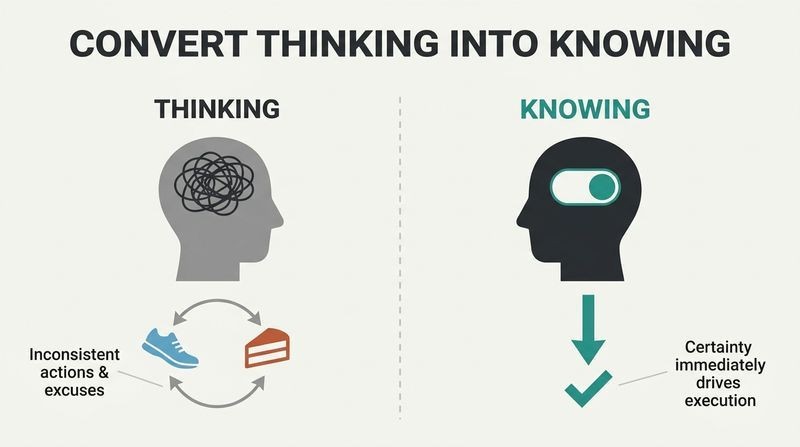
The distinction between propositional belief and embodied conviction maps onto the psychology of self-efficacy, where Bandura showed that believing you can execute a behavior predicts whether you actually do. Roberts intuits that verbal endorsement ("I should") and felt certainty ("I know") activate different motivational systems. The critique of "I don't know" as a self-protective hedge is sharp; linguists note such qualifiers often signal fear of commitment rather than genuine uncertainty. One nuance worth adding: sometimes "I don't know" is honest, and the skill is discerning genuine ambiguity from defensive self-erasure.
Guard your eyes: control, contain, and compare what you consume
Opened eyes cannot un-see. When Adam and Eve ate, their eyes opened and they suddenly judged their nakedness as shameful. Roberts argues much of what we see was never meant for us. During the George Floyd coverage in 2020, she kept seeking out social media commentary she knew would enrage her, until she realized she was voluntarily consuming poison. Her three-part discipline:
1. Control (and replace): stop feeding on what deflates you, then substitute something nourishing.
2. Contain (and embrace): label emotions accurately, like relabeling her canceled 2020 conference from "failure" to "necessary for growth."
3. Compare (and release): compare your view not to other people but to how God sees the situation.
Discipline is removing options. Like clearing junk food from the pantry, sometimes willpower works best when the tempting choice simply is not within reach.
This is essentially media hygiene and cognitive reappraisal dressed in scriptural language. The "control by removing options" principle aligns with behavioral economics: Thaler and Sunstein's choice architecture and research on willpower depletion both confirm that environmental design beats raw self-restraint. The relabeling step (contain and embrace) is textbook cognitive reappraisal, which Stanford's James Gross has shown regulates emotion more durably than suppression. Roberts is careful to distinguish containing from repressing, an important clinical caveat. The weakest link is "compare to how God sees it," which for secular readers can be translated as adopting a wiser, less ego-driven vantage point.
Your struggle is a threat to the world, not just to you
Enmity means you were built for the rematch. In Genesis 3:15, God curses the serpent by promising hostility between the serpent's seed and the woman's. Roberts reads this as astonishing trust: God chose the very woman who failed for the rematch rather than benching her. Each morning you wake is a bell signaling God signed you up again to keep darkness from having the final say.
Redirect misplaced hostility. Pregnant at thirteen, Roberts turned hostility inward, becoming her own enemy. The revelation: you cannot love and attack yourself simultaneously. Take that hostility and aim it at the actual opposition, the narratives of shame, depression, and self-disgust. She reframes personal issues like addiction, procrastination, and low self-esteem not as private flaws but as forces waging war on your capacity to produce and contribute.
Reframing self-directed anger as misaimed energy that belongs pointed at destructive patterns is a genuinely useful therapeutic maneuver, resonant with Internal Family Systems, which treats self-critical "parts" as protectors to be redirected rather than destroyed. The collectivist framing, that your growth or stagnation ripples outward, finds support in social contagion research (Christakis and Fowler showed behaviors like obesity and happiness spread through networks). The bolder theological claim, that setbacks are literally a hidden adversary, could risk externalizing responsibility, yet Roberts pairs it with radical ownership, keeping the tension productive rather than escapist.
Your how is buried in your now: practice greatness before you arrive
Titles are what you do; essence is who you are. Roberts separates roles (wife, pastor, author) from qualities (servant, listener, joy-carrier) that show up in every role. You do not become confident after arriving; confidence is what gets you there.
Master the small assignment first. Eve was named "mother of all living" before bearing children, because she was already mothering the animals and vegetation. Your present qualifies you for your next. As a single mom, Roberts worked as a temp receptionist, the lowest rung, yet built systems, arrived first, left last, and turned projects around early. A decade later those exact habits run her companies. She cites Sara Blakely, who sold fax machines and cried before sales calls, before founding Spanx. And she warns against faking a persona: Bozoma Saint John kept her bold red lipstick despite advice to tone down, and rose to CMO of Netflix.
The insight that character skills are transferable muscles exercised in humble roles is well supported by the deliberate practice literature (Ericsson) and by career research showing that "how" you work predicts advancement more than "what" role you hold. The Blakely and Saint John examples smartly counter survivorship bias by naming the unglamorous pre-success grind. The authenticity warning is astute: identity-based performance is more sustainable than impression management, echoing Brené Brown's work on wholehearted living. A caveat: not every menial job builds relevant muscle, and the advice works best when the reader is intentional about which capacities to cultivate.
Offer your "little" to the right person and watch it multiply
Surrender requires uncomfortable vulnerability. In the feeding of the five thousand, a boy hands over five loaves and two fish, not to Jesus directly, but to a stranger among the disciples. Roberts stresses the harder surrender is trusting your inadequate resources to another human, not God. She applies this to business mergers: her growing platform needed a partner to tour multiple cities because she lacked the staff and know-how.
Know three things before you surrender.
1. Know where you are, so you do not give yourself to someone equally lost.
2. Know who you are with, someone actively devising a plan for your little, not exploiting it.
3. Know what you have, because your little is more than enough for you.
The disciples were underresourced but knew what they faced. God multiplies; He never merely adds.
The partnership economics here are surprisingly rigorous: "successful partnerships require each party to have something to lose" mirrors game theory on skin in the game and Nassim Taleb's argument that shared risk aligns incentives. Roberts cites a Ramsey Solutions finding ranking money conflict as the second leading cause of divorce after infidelity, correctly noting that spending reveals priorities more than it reveals math. The vulnerability framing connects to trust research by Mayer and Davis, whose model of ability, benevolence, and integrity roughly maps onto her "know who you are with." The multiplication metaphor is inspiring but should not obscure that discernment about the receiver is doing the real work.
When a blessing turns hard, ask: did the gift change, or did I?
Good does not equal easy. Roberts admits she initially resented Adam for blaming Eve ("the woman You gave me"), then reread it generously: maybe Adam was insisting the blessing still came from God even amid chaos. Choosing celibacy makes dating harder; quitting an addiction costs you your friend group; saving money strips your lifestyle. Difficulty is not evidence you left God's will.
Practice soul care, not just self-care. She distinguishes the two: running is self-care (she feels strong afterward, not rested), while meditation, reading, and sleep are soul care (they restore peace). Using the Mary and Martha story, she argues we should stop waiting until our breaking point to ask for help. She hauls all the groceries in one trip until the bags cut into her arms, then wonders why no one helped. Innovation, she adds, is the product of frustration: stress signals it is time to restructure, not just rest and return to the same broken rhythm.
The self-care versus soul care distinction is genuinely useful and under-discussed; exercise physiology confirms that activation (running) and parasympathetic recovery (rest, meditation) are different nervous-system states, both necessary. The "did the gift change or did I" question is a potent gratitude intervention, and positive psychology research by Emmons links gratitude practice to measurable well-being gains. The reframe of stress as a signal to redesign systems, rather than merely recover, echoes Moses fleeing Midian and anticipates modern burnout research showing that returning from vacation to an unchanged workload reliably reproduces exhaustion. The insight that we ask for help only at the breaking point is a widespread, correctable pattern.
Break big dreams into bite-size goals to literally rewire your brain
Goals heal the brain. Roberts cites a University of Texas study on multiple sclerosis patients: those who set wellness goals experienced less severe symptoms. She explains that setting an actual goal (not just talking about one) makes part of the brain treat it as already finished, which is why failing a goal triggers grief-like distress. Two neurotransmitters are implicated: dopamine (satisfaction and accomplishment) and serotonin (mood, sleep, appetite).
Stack three goal horizons.
1. Short-term goals determine whether long-term goals happen; without them, a long-term goal is just a dream.
2. Long-term goals sustain motivation through failed attempts.
3. Generational goals recognize your life outlives you.
Using Peter walking on water, she argues the point is not reaching the destination but daring to step out. Peter sank, yet learned something about Jesus no disciple who stayed in the boat ever could.
The neuroscience is broadly directional rather than precise: the dopamine-reward and serotonin-mood associations are real, though the claim that the brain treats a set goal as "finished" oversimplifies research on goal-gradient and the Zeigarnik effect (unfinished tasks actually stay more active in memory). Still, the practical prescription, decompose distal goals into proximal subgoals, is among the best-validated findings in motivation science; Bandura and Schunk showed proximal goals boost self-efficacy and performance far more than distant ones. The generational goal tier adds a meaningful long-horizon dimension often missing from productivity advice, connecting personal achievement to legacy and intergenerational impact.
Commit to the process, because the first attempt rarely looks like the promise
Keep producing after failure. Eve was promised her seed would defeat the serpent, then her first son Cain murdered her second son Abel. Her promised outcome looked like catastrophe. Yet she kept going, bearing Seth, whose line began calling on God's name. Roberts frames discipline not as a fixed state but as a process of correction: when you lack discipline, what you actually lack is the willingness to correct patterns you know must change.
Learn your correction language. Borrowing from the five love languages, Roberts proposes examining how you give and receive correction. Early in marriage she could not accept her husband's feedback because she fused his correction with his affection, a residue of being a teen mom wearing a "scarlet letter." Criticism carries meanness; correction comes from love. Cain's fatal flaw was not a bad offering but his inability to handle God's correction.
The reframe of discipline as ongoing correction rather than a personality trait aligns with Carol Dweck's growth mindset, which distinguishes fixed self-labels from improvable processes. The "correction language" concept is a clever extension of Gary Chapman's love languages into the underexplored domain of feedback reception, and it maps onto organizational research on feedback-seeking behavior, where the ability to decouple critique from self-worth predicts learning and performance. Roberts' personal insight, that she conflated her husband's correction with the withdrawal of his love, names a common attachment pattern. The Cain example lands the point: talent or offering matters less than teachability.
Trust the heart God hands back after surrender, and celebrate other women
Learn to trust yourself again. Roberts argues the deepest damage from failure is not feeling broken but losing self-trust, living in perpetual second-guessing. You can trust God with all your heart, but the harder task is trusting the heart He gives back after healing. Before a tour launch, the old wound resurfaced ("I always knew to expect something like this out of you"), then in worship she heard God repurpose those exact words as affirmation. She only saw herself as Eve; God saw her as Mary.
Choose celebration over comparison. When Mary learned of her pregnancy, she rushed to her pregnant cousin Elizabeth, because favored women need other favored women. Comparison is dangerous, Roberts warns, because you measure yourself by someone's results without knowing their start. Become the woman who makes every other woman feel valuable, whether affirming a stranger or a lifelong friend.
The self-trust theme addresses something rarely named in faith literature: the erosion of self-efficacy after moral failure, which social psychology links to learned helplessness. Roberts' insight that giving her heart away stemmed from not trusting herself with herself is a penetrating observation about how low self-worth drives relational patterns. The comparison critique ("measuring yourself by someone's results without their start") is a crisp statement of the base-rate error behind social comparison, well documented since Festinger. The Mary-and-Elizabeth model reframes female relationships from rivalry to mutual confirmation, countering the culturally reinforced "women don't get along" narrative that research on internalized sexism shows is often self-fulfilling.
Run toward the wilderness God reserved for you, not away from fear
Your place requires leaving comfort. Roberts closes with the woman of Revelation 12, a fusion of Eve and Mary who flees into the wilderness to a place God prepared. Crucially, the wilderness (uncultivated, uninhabited, inhospitable) is where she is sustained. Your assignment may feel wild and unwelcoming to others, but if God reserved it for you, it does not matter who else could not survive there.
The second return comes with wings. When the dragon attacks again, the woman is given wings to soar back rather than flee on foot. Roberts reads this as evidence that returning to alignment gets faster once you know where home is, which is why documenting your wins matters as much as dissecting failures. She invokes real "wild women", Harriet Tubman, Susan B. Anthony, Ellen Johnson Sirleaf, and Navy pilot Madeline Swegle, who earned her wings in 2020, as proof that ordinary women keep achieving firsts when they partner with God.
The wilderness reframe inverts a common fear: that discomfort signals wrong direction. Roberts argues the opposite, that your prepared place may be precisely the inhospitable frontier others avoid, which resonates with research on post-traumatic growth and with the entrepreneurial literature on productive discomfort. The "wings on the second return" metaphor captures a real learning-curve phenomenon: once a skill or state is encoded, re-accessing it accelerates, consistent with how neural pathways strengthen through repetition. She grounds inspiration in named historical women, avoiding vague empowerment. The prescription to document wins, not just analyze failures, corrects a genuine bias in self-improvement culture toward post-mortem over positive-pattern recognition.
Analysis
Woman Evolve is a hybrid of memoir, biblical exposition, and self-help, structured as a chapter-by-chapter walk through Eve's story that doubles as Sarah Jakes Roberts' own testimony (teen pregnancy, divorce, rebuilding into a pastor and media entrepreneur). Its central move is hermeneutical rehabilitation: taking Christianity's most maligned woman and recasting her not as the cause of the fall but as the prototype of resilience, the "mother of all living" who kept producing after catastrophe. The wordplay anchoring the book, that saying "evolve" slowly sounds like "Eve," signals the thesis that transformation is Eve's true legacy.
What distinguishes the book from generic faith-based empowerment is its psychological literacy. Roberts repeatedly arrives, through scripture, at conclusions that map cleanly onto cognitive behavioral therapy, schema therapy, self-compassion research, and behavioral economics. The "root question" framework is functionally a search for core beliefs; "control, contain, compare" is cognitive reappraisal plus media hygiene; "self-care versus soul care" distinguishes physiological activation from parasympathetic recovery. She cites real studies (University of Texas MS goal-setting, Ramsey Solutions on divorce) and real women (Sara Blakely, Bozoma Saint John, Harriet Tubman), grounding inspiration in evidence and example rather than platitude.
The book's limitation is also its structure: readers outside the Christian frame must translate heavily, and the seed-thought-fruit causality can imply single-origin explanations for multi-causal problems. The theological claim that setbacks are a personified adversary risks externalizing responsibility, though Roberts consistently counterbalances it with radical ownership. Her voice, colloquial, funny, self-deprecating (the imagined scene confronting Adam in heaven), makes dense material accessible without dumbing it down.
Ultimately the book argues that women have been penalized for their failures but never credited for how they fought back, and that healing is not private but civic: your unhealed wound leaves an empty space that gives others permission to stay empty too. That framing, personal growth as a debt owed to the collective and the next generation, is its most original and durable contribution.
Review Summary
Woman Evolve receives overwhelmingly positive reviews, with readers praising its empowering message, biblical insights, and personal anecdotes. Many found the book transformative, offering hope and encouragement to overcome past mistakes and embrace personal growth. Readers appreciated Sarah Jakes Roberts' relatable writing style and her fresh perspective on Eve's story. Some critics noted disjointed storytelling and questioned the author's career advice. Overall, the book is highly recommended for women seeking spiritual guidance and self-improvement.
People Also Read






Glossary
Woman Evolve
Roberts' multimedia empowerment movementThe community, podcast, event, and curriculum platform Roberts founded to help women connect, grow, and pursue the best version of themselves. The name derives from the observation that pronouncing "evolve" slowly sounds like "Eve," linking the biblical first woman's transformation to every woman's journey out of shame toward purpose.
Forbidden fruit
Your repeated self-defeating cycleRoberts' reframe of the Genesis fruit as any recurring pattern in your life that ends with you feeling less valuable, such as overspending, closet eating, or stalking someone who hurt you. Identifying your forbidden fruit is the first step to breaking the cycle and establishing a healthier pattern.
Seed, word, flesh
Cycle of promise becoming realityRoberts' progression for how divine promises manifest: God gives a seed (a word about your destiny), the seed grows into a word you build your life on, and the word becomes flesh (lived reality). Drawn from linking Genesis 3:15 (Jesus as seed) to John 1 (Jesus as Word made flesh).
Control, Contain, Compare
Three-part discipline for consuming inputRoberts' framework for managing what you allow into your mind after your "eyes are opened" to good and evil. Control (and replace) filters harmful input and substitutes nourishing input; Contain (and embrace) accurately labels emotions rather than repressing them; Compare (and release) measures your view against how God sees rather than against other people.
Self-care versus soul care
Restoration versus mere maintenanceRoberts' distinction between activities that maintain you but do not bring peace (self-care, like running, which leaves her strong but not rested) and activities that genuinely restore inner peace (soul care, like meditation, reading, and sleep). She urges practicing soul care before hitting a breaking point rather than only in crisis.
Correction language
How you give, receive feedbackRoberts' extension of the five love languages concept to feedback: examining the specific way each person best gives and receives correction. She distinguishes correction (offered from love to aid growth) from criticism (tinged with meanness). Learning your correction language helps you separate feedback on your actions from judgments about your worth.
God factor
Shared knowing a relationship is divineThe term Roberts and her husband use in counseling to describe when both partners possess an irrefutable knowing that the other is a gift from God. When a couple has the God factor, the counseling goal shifts to getting them back to God, since honoring the divine origin of the blessing guides how they navigate conflict.
FAQ
What's "Woman Evolve: Break Up with Your Fears and Revolutionize Your Life" about?
- Reimagining Eve's Story: The book reimagines the biblical story of Eve, drawing lessons from her life to empower women to overcome their past mistakes and fears.
- Personal Growth and Empowerment: It focuses on using past failures as stepping stones to revolutionize one's life and break free from being defined by past mistakes.
- Spiritual and Personal Insights: Sarah Jakes Roberts combines scriptural insights with personal anecdotes to guide women toward a future where they can crush their fears and embrace their potential.
- Central Message: The core message is that "bruised heels can still crush serpents' heads," symbolizing resilience and the power to overcome adversity.
Why should I read "Woman Evolve"?
- Empowerment for Women: The book is a powerful tool for women seeking to break free from the constraints of their past and embrace their full potential.
- Practical Guidance: It offers practical advice and exercises to help women identify and overcome their fears and insecurities.
- Spiritual Growth: Readers will find spiritual encouragement and insights that align with Christian teachings, making it a valuable resource for personal and spiritual growth.
- Inspiring Stories: Sarah Jakes Roberts shares her own journey and struggles, providing relatable and inspiring stories that motivate readers to pursue their own transformation.
What are the key takeaways of "Woman Evolve"?
- Embrace Your Past: Use past mistakes as lessons rather than letting them define you, and understand that everyone has "Eve moments" of knowing better but not doing better.
- Power of Vulnerability: Embrace vulnerability as a strength and a necessary step toward personal growth and empowerment.
- Set Goals and Evolve: Establish short-term, long-term, and generational goals to guide your personal evolution and impact on the world.
- Community and Support: Surround yourself with a supportive community that celebrates your growth and encourages your journey.
How does Sarah Jakes Roberts redefine Eve's story in "Woman Evolve"?
- Compassion for Eve: Roberts develops empathy for Eve, viewing her not as the villain but as a relatable figure who made a mistake.
- Eve's Redemption: She emphasizes Eve's potential for redemption and growth, suggesting that Eve's story is one of resilience and empowerment.
- Modern Application: The book applies Eve's story to modern women's lives, encouraging them to break free from societal and self-imposed limitations.
- Eve as a Reflection: Roberts sees Eve as a reflection of all women, highlighting the universal struggle with fear, shame, and the quest for redemption.
What is the "Rescue Eve" concept in "Woman Evolve"?
- Empathy and Understanding: The concept involves developing empathy for Eve and understanding her story from a place of compassion rather than judgment.
- Redefining Mistakes: It encourages women to redefine their mistakes as opportunities for growth and transformation.
- Eve's Value and Worth: Roberts emphasizes that Eve, like all women, still has value, promise, and worth despite her mistakes.
- Personal Application: The concept is about rescuing the "Eve" within each woman, allowing them to embrace their potential and overcome their fears.
What are the "Working It Out" exercises in "Woman Evolve"?
- Self-Reflection: These exercises encourage readers to reflect on their past experiences, identify patterns, and understand their fears and insecurities.
- Goal Setting: They guide readers in setting realistic and meaningful goals that align with their personal and spiritual growth.
- Practical Application: The exercises provide practical steps for applying the book's teachings to everyday life, fostering personal transformation.
- Prayer and Meditation: Roberts includes prompts for prayer and meditation, helping readers connect with their spirituality and seek divine guidance.
How does "Woman Evolve" address the concept of fear?
- Identifying Fears: The book helps readers identify the fears that hold them back and understand their origins.
- Breaking Up with Fear: Roberts encourages women to "break up" with their fears, viewing them as obstacles to be overcome rather than insurmountable barriers.
- Faith Over Fear: The book emphasizes the importance of faith and trust in God as tools to combat fear and embrace one's potential.
- Empowerment Through Action: By taking actionable steps, women can confront their fears and move toward a more empowered and fulfilling life.
What role does community play in "Woman Evolve"?
- Supportive Networks: Roberts highlights the importance of surrounding oneself with a community that supports and celebrates personal growth.
- Shared Experiences: The book encourages women to share their experiences and learn from one another, fostering a sense of solidarity and empowerment.
- Encouragement and Accountability: A strong community provides encouragement and holds individuals accountable to their goals and aspirations.
- Collective Empowerment: By uplifting one another, women can collectively break free from societal constraints and achieve their full potential.
What are some of the best quotes from "Woman Evolve" and what do they mean?
- "Bruised heels can still crush serpents' heads." This quote symbolizes resilience and the power to overcome adversity despite past mistakes.
- "You are a beautiful, vast, ornate demonstration of God’s thoughts and hope for humanity." It emphasizes the inherent value and potential within each woman as part of God's creation.
- "Your deliverance from everything that has so easily ensnared you is so you can become intentional about loosening the chains from another person’s life." This highlights the importance of using personal growth to inspire and uplift others.
- "When you commit to growth after trauma, there is resurrecting power that demands your hope, potential, and faith to rise up." It underscores the transformative power of healing and personal development.
How does "Woman Evolve" encourage goal setting?
- Short-Term and Long-Term Goals: The book advises setting both short-term and long-term goals to guide personal growth and transformation.
- Generational Goals: Roberts encourages readers to consider the impact of their goals on future generations, fostering a legacy of empowerment.
- Actionable Steps: The book provides practical steps for achieving goals, emphasizing the importance of discipline and perseverance.
- Aligning with Purpose: Goals should align with one's purpose and values, ensuring that personal growth is meaningful and fulfilling.
What is the significance of the "War of Seed" in "Woman Evolve"?
- Spiritual Battle: The "War of Seed" represents the ongoing spiritual battle between good and evil, as depicted in the biblical story of Eve.
- Generational Impact: It highlights the importance of breaking generational curses and creating a legacy of empowerment and faith.
- Personal Responsibility: Roberts emphasizes the role of personal responsibility in overcoming adversity and fulfilling one's potential.
- Victory Through Faith: The concept underscores the belief that faith and trust in God can lead to victory over life's challenges.
How does "Woman Evolve" redefine the concept of vulnerability?
- Strength in Vulnerability: The book presents vulnerability as a strength rather than a weakness, essential for personal growth and empowerment.
- Authentic Connections: Embracing vulnerability allows for authentic connections with others, fostering a supportive community.
- Overcoming Shame: By confronting and embracing vulnerability, women can overcome shame and self-doubt.
- Path to Healing: Vulnerability is portrayed as a necessary step on the path to healing and self-discovery, leading to a more fulfilling life.
Download PDF
Download EPUB
.epub digital book format is ideal for reading ebooks on phones, tablets, and e-readers.








































