

Key Takeaways
We make things to remake ourselves, not the object
Craft is self-transformation in disguise. Peter Korn, a furniture maker who founded a woodworking school in Maine, spent forty years asking not just how to cut a dovetail but why anyone chooses the demanding work of bringing beautiful objects into being. His answer: the real product is never the chair. It is the person the maker becomes while building it.
His proof came from a single sentence he wrote at age forty during a writing seminar. He realized the words he used to describe his furniture, integrity, simplicity, and grace, were actually the qualities he wanted to cultivate in himself. Students travel to his school not because they need a little hardwood bench, the beginner project, but because they hunger to grow through making. The object is a byproduct. The maker is the masterpiece.
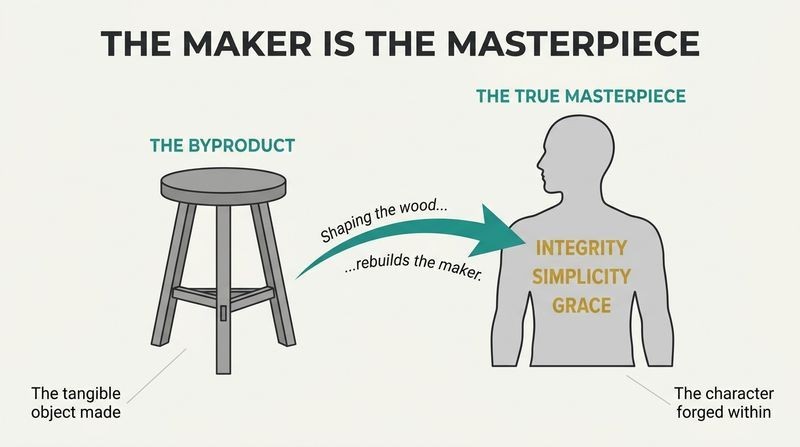
What's striking is how this reframes the entire debate about craft's decline. Where Pirsig, Sennett, and Crawford diagnose a lost culture of quality, Korn locates the payoff inside the individual psyche rather than in social reform. This aligns with self-determination theory in psychology, which finds intrinsic motivation and competence to be core drivers of wellbeing. The claim has limits worth naming: not everyone who makes things transforms, and plenty of transformation happens through parenting, sport, or science. Korn's contribution is showing that materiality gives self-transformation an unusually honest mirror, since wood cannot be flattered into cooperation.
Chase fulfillment, not happiness; only one is self-generated
Happiness fades, fulfillment is manufactured. Korn distinguishes two states people routinely confuse. Happiness is the glow you get from a new car, a lover, a candy bar. You adapt, the glow drains into the ordinary, and you hunt for it again. Fulfillment is different. It arises from exercising your own creative capacity, and it persists.
His evidence is visceral. Turning legs for a dining table from three-inch oak, he ruined seven billets to get four good ones. He felt frustrated, incompetent, and anxious about the skew chisel shredding splinters. He was not remotely happy. Yet his will was fully engaged, his senses alive to the scent of cut oak and the squeal of end grain. It was, without question, the stuff of fulfillment. Ask him if he is happy while working, and he has to stop and think.
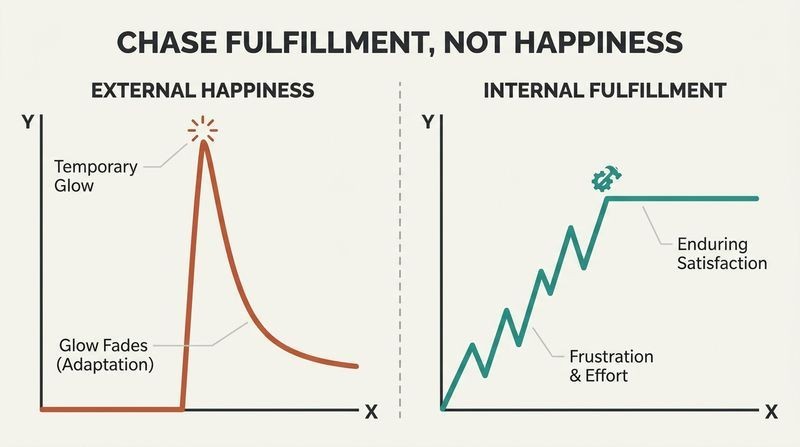
This distinction predates Korn but he gives it teeth through failure rather than flow. Positive psychology separates hedonic wellbeing (pleasure) from eudaimonic wellbeing (meaning and growth), and longitudinal studies suggest the latter buffers against depression more durably. What's notable is Korn's insistence that fulfillment lives in generation, not possession, so it cannot be banked. The wires go dead without fresh effort. A useful challenge: this can shade into a workaholic ethic that devalues rest and simple contentment. Korn himself admits his creative devotion made him a lesser husband and friend, which suggests fulfillment has real relational costs.
You navigate life by a mental map you rarely notice
Reality is a story you can't see yourself telling. Korn borrows the term mental map to describe the fluid mesh of ideas, beliefs, facts, and impressions each person overlays on the universe to say, with conviction, here I am. Its pieces are mental models. The map filters everything: a woodworker's ear isolates the ker-thunk of wood kicking back on a table saw from ordinary shop noise, while a non-woodworker hears nothing.
He discovered the map's invisibility through violence. Mugged and choked on an Acapulco beach at nineteen, sleepless and stranded, he heard Abbey Road drift through a bus station and suddenly saw his sense of security as the dream-walk of an Ivy League boy. The walls of his mental aquarium, normally invisible like water to a fish, briefly became visible. His secure worldview was revealed as a fiction specific to one time and place.
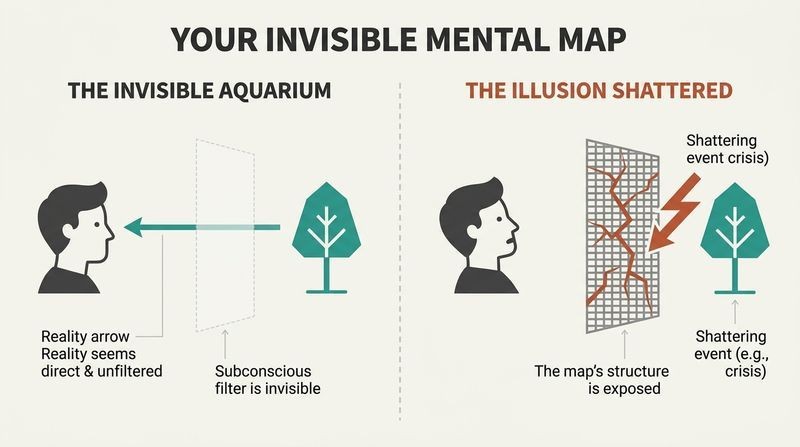
Korn is popularizing ideas from Peter Senge's mental models and Dan Sperber's epidemiology of representations, which treats culture as ideas spreading person to person like a contagion. Modern neuroscience supports his claim that every new idea physically reorganizes neural pathways, making information transfer a bodily process. The framework's power is that it dissolves the myth of the detached individual: your map is porous, largely furnished by your era. A caution: the metaphor can slide toward relativism, implying all maps are equally valid. Korn avoids this by insisting maps must still survive contact with physical reality, which is precisely what craft forces.
Your mind serves comfort as often as it serves truth
We believe what soothes, not what's accurate. Korn argues the mental map answers to competing masters. Survival demands seeing things as they really are. But we also crave psychic comfort, so we plot our maps to satisfy needs for context, belonging, order, meaning, hierarchy, and respect. When comfort wins, we get cognitive dissonance: facts knock politely and we pretend not to hear.
His own case is painful and funny. For twelve years he cut every mortise by hand with mallet and chisel, modeling himself on the romantic lone artisan, while earning a taxable income under $3,000 a year. He never stocked his map with useful stories about marketing, pricing, or efficiency because the artisan fantasy felt better. When trendy new studio furniture eclipsed his restrained work, he dismissed it as morally deficient rather than adapt. Blind faith in our own certitudes, he notes, is itself an adaptive trait: you do not want to reweigh every assumption before exiting a burning building.
This is one of the book's most honest passages, echoing Tavris and Aronson's Mistakes Were Made on self-justification. Behavioral economics adds confirmation bias and motivated reasoning as the machinery Korn describes anecdotally. What elevates his version is the evolutionary steelman: intransigence saves cognitive energy and enables timely action. The insight is genuinely useful for anyone stuck in a failing strategy while calling their rivals sellouts. The practical question Korn leaves underexplored is how, absent a mugging or cancer, one deliberately pierces one's own comfortable map. His answer arrives obliquely: creative practice is the gentler stress test that reality otherwise imposes by force.
Working in a resistant material forces honesty willpower cannot fake
Wood refuses to be bullshitted. Korn's central argument for craft specifically, versus writing or music, is its materiality. At the keyboard, words are malleable enough to enable self-deception. At the bench, a chisel is either sharp enough to pare cleanly or it is not. Joints are tight or gapped. A chair is comfortable or it is not. Craft is continuous feedback in which working suppositions get fact-checked by physical reality.
He compares it to sailing his tiller-steered sloop on Penobscot Bay. The tiller transmits the rudder directly to his hand, so the boat becomes a live thing and his senses extend into water, wind, and sky. Skilled woodworking is like that: consciousness inhabits the tip of the knife. Quoting Crawford, he notes that manual competence relieves a person of the need to offer chattering interpretations of his own worth. He can simply point: the joint holds.
This is the book's strongest philosophical move, refuting Cartesian mind-body dualism through the workbench. Cognitive scientists call this embodied cognition, the view that thinking is not confined to the skull but distributed through body, tools, and environment. Korn's tiller example is essentially a description of tool transparency, a concept Heidegger explored with his hammer that disappears into use. The honesty argument is compelling but slightly overstated: markets, ergonomics, and taste can still be fudged, and plenty of beautiful furniture is structurally unsound in ways only time reveals. Still, the core is sound. Resistant materials impose a discipline that pure symbol manipulation escapes.
Objects carry meaning; we think with things, not just words
Furniture is a prescription for how to live. Korn insists a made object articulates a worldview on many levels. His own desk, with its natural wood, exposed hand-cut dovetails, and absence of hardware, speaks simultaneously of Shaker sacrament and Eames-era modernist optimism. Every physical detail, the continuous grain flowing through drawer faces, the care taken on a drawer's hidden back, carries silent freight about the maker's stance toward work, nature, and beauty.
He separates two ideas people conflate. Information is intrinsic and permanent, encoded in the object's physical characteristics by thousands of maker decisions. Meaning is extrinsic and subjective, residing in the respondent's mind. This is why a Katrina survivor mourns lost childhood snapshots over electronics, and why someone flees a fire clutching a grandmother's embroidered sampler. The most meaningful objects are often the most mundane. They are talismans that confirm fragile, personal narratives of identity.
Korn draws on Esther Pasztory's Thinking With Things and Sherry Turkle's Evocative Objects, joining a rich tradition in material culture studies and anthropology. His information-versus-meaning split is genuinely clarifying and maps onto semiotics: the object is a stable signifier, but the signified shifts per viewer. The heirloom insight connects to research on transitional and identity-linked objects. One tension worth flagging: if meaning is entirely in the respondent, the maker's intention matters less than Korn's craftsmanship ethic implies. He resolves this with transparency, the idea that a strong work conveys its maker's voice clearly enough to survive the babble of other people's projections.
Craft as we know it was invented only 130 years ago
The craftsman is a Victorian construction, not a timeless type. Korn dismantles the assumption that craft is an eternal human category. Medieval weavers, Renaissance goldsmiths, and Louis XV's cabinetmakers never thought of themselves as practicing craft. The word originally meant shrewdness and manipulation, as in witchcraft and statecraft. Only in the turbulent wake of the Industrial Revolution did John Ruskin and William Morris rebrand it.
These early socialists wove together three strands of nineteenth-century thought into a counter-industrial narrative:
1. The applied or decorative arts
2. The vernacular (nostalgia for rural, handmade folk production)
3. The politics of work (the moral welfare of the laborer)
Their movement failed commercially, undercut by mass production and shattered by World War I. But its burnished image of the calm, virtuous artisan lodged permanently in the culture. By Korn's generation, that image had mutated: the politics of work had become the politics of me, craft as a vehicle for self-expression and self-actualization.
This is intellectual history at its most useful, denaturalizing a concept readers assume is ancient. Korn draws on Paul Greenhalgh and the historiography of the Arts and Crafts Movement. His sharpest observation is the inward migration of truth: from Homer's public glory to Aristotle's contemplation to medieval salvation, the self was always a component of a larger whole with truth located externally. By the mid-twentieth century, truth relocated inside the individual, which is why studio craft became spiritual autobiography. This dovetails with Charles Taylor's Sources of the Self. The framework usefully explains why a modern potter making a dripping teapot is doing something historically unprecedented, not reviving an old trade.
Creativity needs three parts: individual, field, and domain
A lone genius shouting into the wind changes nothing. Korn adopts Mihaly Csikszentmihalyi's model that creative success requires three interacting elements. The creative individual generates novel ideas. The field is a specialized body of knowledge with its own language, such as furniture making. The domain is the community of people who judge what belongs in the field, deciding which makers actually advance the craft.
Korn illustrates this with his own generation's history. American studio furniture began not as a movement but as a demographic surge: thousands of 1970s hippies independently rediscovering woodworking, each feeling like a lone explorer landing on an abandoned continent, only to find crowds already there. Fine Woodworking launched in 1975, schools and craft fairs proliferated, and an open-source community bootstrapped its collective skill past the eighteenth-century French masters whose secrets were thought lost. The individual only matters in the context of a field and a domain that receive and refine the work.
Csikszentmihalyi's systems model of creativity, developed at the University of Chicago, remains influential precisely because it kills the romantic myth of solitary genius. It anticipates network theory and the sociology of innovation, where breakthroughs cluster because ideas need a receptive ecosystem. Korn's lived example is more textured than the theory: he shows how a movement can be invented retroactively by an academic, Edward Cooke of Yale, who coined studio furniture and imposed a generational narrative. This is a fascinating wrinkle. The domain does not just judge existing work, it can conjure a coherent movement into being through language, giving scattered makers a shared identity they never felt at the time.
Kill your darlings when experience proves the plan flawed
Treat your whole life as a design process. Korn maps his career onto the logic of design. Every project begins with a brief, a problem to solve, which may be as specific as a $6,000 dining table for six or as vague as making a mirror that reflects your taste. His life brief was to discover a good life, built on assumptions like office work is deadening. His first-draft solution, carpentry, evolved into self-employment as a solitary furniture maker.
But in design you sometimes must kill your darlings: eject aspects of the brief that seemed essential once experience exposes them as limiting. Korn's darling was working alone and apart, which he treasured because isolation let him build his identity without contradiction. It was also economically fatal. After a client who commissioned his major Dancing Cranes desk was arrested for embezzling $27 million, and after years netting under $4,000, he stopped taking furniture orders and took a job at Anderson Ranch. He was not abandoning his brief. He was killing a darling.
The design-thinking-as-life-strategy metaphor has since been formalized by Stanford's Bill Burnett and Dave Evans in Designing Your Life, but Korn arrives at it through hard-won failure rather than curriculum. What's valuable is his reframing of a painful pivot as iteration rather than defeat, which protects against the sunk-cost fallacy that traps people in failing plans. The darling worth examining is his desire for solitude, an introvert's preference dressed as artistic principle. His eventual thriving in administration and community suggests many of our cherished self-conceptions are untested assumptions. The honest lesson: distinguish the brief (a good life) from the tactics (working alone), and sacrifice tactics freely.
Give away ownership to multiply your creative reach
Sole control caps what you can build. When Korn founded the Center for Furniture Craftsmanship in Maine in 1993, it succeeded but chained the institution to one man's knowledge and relationships. Facing a second cancer diagnosis in 1998 with a grim 20 percent five-year survival estimate, he made a counterintuitive move: he converted the profitable school into a nonprofit and handed ownership to a volunteer board.
He calls it the best decision he ever made. As a for-profit, growth would have required cramming in students, hiking tuition, and cutting the gallery and fellowships. As a nonprofit, gifts paid for buildings, an endowment funded scholarships and faculty pay, and the school carried no debt. More profoundly, delivering ownership into other hands opened the gates to their emotional and financial investment. People invest where they feel ownership. Administration became a new creative medium: instead of shaping wood or words, he shaped human nature, asking not who am I but who are we.
Korn's insight prefigures distributed-leadership and stewardship literature, and echoes Dee Hock, the VISA founder he quotes, who described organizations as mental constructs people are drawn to by shared purpose. The move from personal to collective creativity is psychologically demanding: it requires surrendering the tight authorial control that makes solo craft satisfying, in exchange for effects multiplied a thousandfold. There is a real trade-off he names honestly, that institutional work entails constant compromise. The broader principle resonates with open-source software and the commons: relinquishing ownership can paradoxically increase both durability and impact. Not everyone can make this shift, and Korn concedes many craftspeople recoil from exactly this kind of collaborative harness.
Mastering a craft won't fix your life or your character
Virtuosity is not virtue. Korn punctures his own founding fantasy, that having your craft together would mean having your life together, with an unforgettable scene. At Anderson Ranch, the legendary ceramicist Peter Voulkos arrives an hour late to a packed symposium, falls out of the van straight to the ground, apparently wrecked by alcohol or drugs, beside a hind-legless dog on a little cart. Twenty minutes later, positioned at the wheel, Voulkos throws a mammoth wedge of clay with a mastery no one else in that tent could summon. The clay summons a gift that flows through him like current.
Voulkos mastered ceramics but not his own demons. Korn's blunt conclusion: creatively engaged people are not necessarily happier or more fully realized than anyone else. Creative practice does not deliver enlightenment. It simply makes life richer in meaning and fulfillment than it might otherwise be. For some, it is one of the few slender threads binding a life together at all.
This is the book's most bracing act of intellectual honesty, and it inoculates the whole argument against the self-help genre's usual overpromising. The Voulkos anecdote functions like a Zen koan: the flawed vessels he was famous for punching holes in mirror the flawed man. Research on creativity and mental health complicates any neat story: studies link certain creative professions with elevated rates of mood disorders, though causation is contested. Korn's refusal to claim craft as salvation actually strengthens his thesis. By promising only enrichment rather than transformation into a better person, he makes the more modest claim harder to dismiss. He even indicts himself as a mediocre husband and friend.
Think the world into being rather than assembling it from a menu
Be a cook, not a Mr. Potato Head. Korn's closing challenge distinguishes two ways of living. The path of least resistance is what he calls the Mr. Potato Head approach: constructing your mental map from off-the-shelf beliefs your environment readily confirms. Being a sports fan, a political partisan, a devoted follower of fashion. This keeps the mind comfortably occupied, eyes averted from an indifferent universe, but it does not make for a vibrant life.
The alternative is proactive: to test the recipes of others in your own kitchen, to take responsibility for creating some small portion of your world. Creative practice is the sharpest tool for this because it directly challenges the status quo of your mental map. Quoting Viktor Frankl from Man's Search for Meaning, Korn notes that man is ultimately self-determining, deciding at every moment what he will become. With the awesome power to shape reality comes accountability for how we choose to wield it.
This is Korn's synthesis, tying craft to existential philosophy via Frankl and Socrates's examined life. The Mr. Potato Head metaphor is a memorable indictment of passive consumption in an attention economy that manufactures ready-made identities at scale. The claim connects to constructivist psychology and to Jerome Bruner's work on narrative construction of the self. A fair critique: the cook-versus-consumer binary can feel elitist, implying that following the Red Sox or reading the newspaper is a lesser existence. Most rich lives blend received and self-authored narratives. But Korn's core provocation stands: agency is a practice, not a possession, and it atrophies without deliberate, generative use.
Analysis
Why We Make Things is a philosophical memoir disguised as a craft book, and that hybridity is exactly what makes it hard to summarize and worth reading. Peter Korn braids three genres: an autobiography of a Jewish suburban dropout turned Nantucket carpenter turned furniture maker turned school founder; an intellectual history of how craft was invented; and a theory of mind arguing that creative work is fundamentally self-construction. The risk in summary is severing the argument from the life that earned it, since Korn's abstractions (mental maps, fulfillment over happiness, materiality as honesty) draw their authority from lived stakes: two bouts of Hodgkin's disease, chronic poverty, a failed marriage, and the bliss of a chemotherapy remission.
The book's most durable contribution is its inversion of the standard craft-revival argument. Where Pirsig, Sennett, and Crawford treat quality as a lost social virtue to be recovered, Korn relocates the entire payoff inside the individual psyche. The object is a byproduct; the maker is the point. This move rescues craft from nostalgia and connects it to the deepest currents of modern selfhood, drawing on Charles Taylor's account of how truth migrated from external cosmic orders into the interior individual. Korn's synthesis of Csikszentmihalyi's systems model, embodied cognition, and material-culture theory is genuinely interdisciplinary.
The book's limits are its virtues in reverse. Korn generalizes from a sample of one, and his repeated admission that his creative devotion damaged his relationships raises an unexamined question: is the fulfillment he describes partly a sophisticated rationalization for self-absorption? His refusal to claim craft as enlightenment, dramatized by the Voulkos scene, is the honest answer. Craft enriches; it does not redeem. For readers, the transferable insight transcends woodworking entirely: any resistant medium, wood, words, an institution, or a life, becomes a mirror that reflects honest information back at the mind that would otherwise flatter itself.
Review Summary
Why We Make Things and Why It Matters receives mixed reviews. Many readers appreciate Korn's philosophical musings on craftsmanship and creativity, finding the book insightful and inspirational. Some praise his writing style and personal journey. However, others feel the title is misleading, expecting more general exploration of making things rather than Korn's autobiography. Critics note the book's meandering structure and overemphasis on the author's life story. Despite this, many find value in Korn's reflections on craft, self-transformation, and the search for meaning through creative work.
People Also Read



FAQ
What's "Why We Make Things and Why It Matters" about?
- Exploration of Craft: The book delves into the philosophy and practice of craft, particularly woodworking, as a means of self-transformation and fulfillment.
- Personal Journey: Peter Korn shares his personal journey from a novice carpenter to a master craftsman, illustrating how craft has shaped his life and identity.
- Cultural and Historical Context: It examines the historical evolution of craft, its cultural significance, and its role in contemporary society.
- Philosophical Inquiry: The book poses fundamental questions about why we create and the deeper meanings behind the act of making things.
Why should I read "Why We Make Things and Why It Matters"?
- Insightful Perspective: The book offers a unique perspective on the value of craft in a world dominated by mass production and consumerism.
- Personal Growth: It provides insights into how engaging in craft can lead to personal growth and a deeper understanding of oneself.
- Cultural Understanding: Readers gain an understanding of the historical and cultural significance of craft and its impact on society.
- Inspiration for Creatives: The book is a source of inspiration for anyone involved in creative work, encouraging them to explore the deeper meanings behind their craft.
What are the key takeaways of "Why We Make Things and Why It Matters"?
- Self-Transformation: Craft is a process of self-transformation, allowing individuals to explore and express their identities.
- Material Engagement: Engaging with materials and tools provides a grounding experience that connects the maker to the physical world.
- Cultural Evolution: Craft is part of a larger cultural conversation that evolves over time, reflecting changes in society and individual perspectives.
- Fulfillment through Creation: The act of making things is inherently fulfilling, offering a sense of purpose and meaning beyond material success.
How does Peter Korn define "craft" in the book?
- Chameleon-like Nature: Korn describes craft as a term with varied meanings, encompassing both verb and noun, and applicable to a wide range of activities and objects.
- Contemporary Craft: He focuses on craft as practiced in industrialized nations, where it often addresses the spiritual needs of the maker rather than purely functional purposes.
- Historical Context: The concept of craft as we know it is a relatively recent invention, originating with the Arts and Crafts Movement.
- Cultural Construct: Craft is seen as a cultural construct that evolves in response to societal changes and mindsets.
What is the "inward migration of truth" mentioned in the book?
- Shift in Selfhood: Korn discusses a historical shift where truth and meaning have moved from external sources to being found within the individual.
- Individual Fulfillment: This shift has led to a focus on personal fulfillment and self-expression, particularly in creative fields like craft.
- Cultural Impact: The inward migration of truth reflects broader cultural changes, influencing how people perceive their roles and identities.
- Artistic Expression: In the context of craft, this shift emphasizes the importance of self-expressive work as a means of exploring and understanding one's inner truths.
How does Peter Korn view the relationship between craft and identity?
- Identity Construction: Korn sees craft as a means of constructing and expressing one's identity through the act of making.
- Social Influence: The objects created serve as emissaries that influence how others perceive the maker's identity.
- Continuous Process: Craft is a lifelong project of self-construction, where the maker's identity evolves with each creation.
- Community and Belonging: Engaging in craft also fosters a sense of belonging and connection to a larger community of makers.
What role does "creative practice" play in the book?
- Self-Discovery: Creative practice is portrayed as a journey of self-discovery, where the maker explores new ideas and possibilities.
- Existential Questions: It involves investigating existential questions about identity, purpose, and the nature of being human.
- Holistic Engagement: Creative practice engages the whole person—mind, body, and spirit—in a unified effort.
- Cultural Contribution: Through creative practice, individuals contribute to the ongoing cultural conversation and evolution.
What are some of the best quotes from "Why We Make Things and Why It Matters" and what do they mean?
- "Creative effort is a process of challenging embedded narratives of belief in order to think the world into being for oneself." This quote emphasizes the transformative power of creative work in reshaping personal beliefs and perceptions.
- "We practice contemporary craft as a process of self-transformation." Korn highlights the idea that craft is not just about making objects but about personal growth and change.
- "The effort to bring something new and meaningful into the world is exactly what generates the sense of meaning and fulfillment for which so many of us yearn so deeply." This underscores the intrinsic value of creation as a source of deep personal satisfaction.
- "Craft is a process of continuous feedback in which the craftsman’s working suppositions are subject to constant fact-checking by the real world." This quote reflects the grounding nature of craft, where reality constantly tests and refines the maker's ideas.
How does Peter Korn address the concept of "fulfillment" in the book?
- Beyond Happiness: Korn distinguishes between happiness and fulfillment, suggesting that fulfillment is a deeper, more enduring state achieved through creative engagement.
- Creative Capacity: Fulfillment arises from exercising one's creative capacities and bringing new ideas into the world.
- Process-Oriented: It is found in the process of making, rather than in the finished product or external validation.
- Connection to Self: Fulfillment is linked to a sense of purpose and connection to one's true self through the act of creation.
What is the significance of the "creative cycle" in the book?
- Three Contexts: Korn describes the creative cycle as involving first-person making, second-person response, and third-person engagement through language and images.
- Cultural Evolution: This cycle contributes to cultural evolution by disseminating new ideas and narratives throughout society.
- Value-Added Process: Each stage of the cycle adds value, as ideas are refined and expanded through interaction with others.
- Collective Contribution: The creative cycle highlights the interconnectedness of individual creativity and collective cultural development.
How does "Why We Make Things and Why It Matters" explore the relationship between craft and commerce?
- Marketplace Dynamics: Korn examines how craft objects are positioned as commodities in the marketplace, influencing their perception and value.
- Commercial Success: The book discusses the tension between creative exploration and commercial viability, and how this tension can drive innovation.
- Role of Merchants: Merchants play a crucial role in shaping the craft market, often driven by passion and a desire to promote meaningful work.
- Cultural Exchange: Commerce serves as a mechanism for the exchange and dissemination of cultural ideas embodied in craft objects.
What does Peter Korn suggest about the future of craft and its role in society?
- Continued Evolution: Korn sees craft as an evolving cultural construct that will continue to adapt to societal changes and individual needs.
- Source of Meaning: He believes craft will remain a vital source of meaning and fulfillment for those who engage in it.
- Cultural Relevance: Craft will continue to contribute to cultural conversations, offering insights into human identity and potential.
- Educational Value: Korn emphasizes the importance of craft education in fostering creativity and personal growth, suggesting a bright future for institutions like the Center for Furniture Craftsmanship.
Download PDF
Download EPUB
.epub digital book format is ideal for reading ebooks on phones, tablets, and e-readers.








































