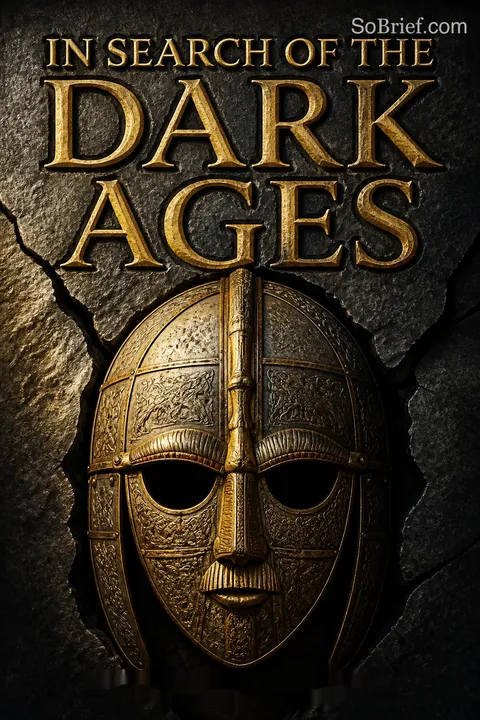

Key Takeaways
1. The Dark Ages: A Millennia of Invasions Forging British Identity
This book spans a period of a thousand years of their history. Its framework is the gradual transformation of mainland Britain under the impact of various invading peoples.
A tapestry of invasions. Britain's "Dark Ages," spanning from the Roman withdrawal to the Norman Conquest in 1066, were far from shadowy; they were a dynamic, formative era defined by successive waves of invaders. These included the Romans, Anglo-Saxons, Vikings, and Normans, each leaving an indelible mark on the island's landscape, culture, and political structure. This continuous influx of peoples fundamentally shaped what would become the English nation.
Defining distinctions. Historically, the "British" were the original Celtic-speaking inhabitants, ancestors of today's Welsh, while the "English" were the Anglo-Saxon newcomers. This crucial distinction, often blurred today, is central to understanding the conflicts and cultural shifts of the period. The book explores how these diverse groups clashed, coexisted, and ultimately contributed to the complex identity of modern Britain.
Sources of knowledge. Our understanding of this long and often obscure period relies on a diverse array of sources. These include narrative histories like chronicles and annals, documentary records such as laws and charters, and a wealth of material evidence from archaeology, coinage, and artifacts. These fragments, though variable in quality, allow historians to piece together the dramatic story of Britain's transformation.
2. Boudica's Fury: A Desperate Stand Against Roman Imperialism
What made this war exceptional was that they had to fight for their lives against a woman.
A brutal colonial war. Boudica, queen of the Iceni, led one of the most savage revolts against Roman rule in Britain (AD 60–61). This was a desperate struggle between a "backward" native people and a "civilized" imperial power, marked by terrible atrocities on both sides. The Romans, accustomed to conquest, were shocked to face such fierce resistance, especially from a female leader.
Seeds of rebellion. The Iceni, initially a client kingdom, suffered immense indignities after their king Prasutagus died. Roman agents plundered the royal household, Boudica was flogged, and her daughters raped. This brutal treatment, coupled with the appropriation of land for Roman veterans and the imposition of crippling loans, ignited a widespread rebellion among the Iceni, Trinovantes, and other tribes.
Devastation and defeat. Boudica's forces swiftly destroyed major Roman settlements, including Colchester (Camulodunum), the provincial capital, and London (Londinium), a booming commercial hub. Tens of thousands of Roman colonists and Britons were slaughtered. However, the Roman governor Suetonius Paulinus eventually cornered Boudica's vastly outnumbered but poorly equipped army in a decisive battle, likely near Mancetter. The Britons were annihilated, and Boudica reportedly poisoned herself, leaving a legacy of fierce, though ultimately futile, resistance.
3. King Arthur: Myth, Mystery, and the Twilight of Roman Britain
Yet, reluctantly we must conclude that there is no definite evidence that Arthur ever existed.
A persistent legend. The myth of King Arthur, with his knights and the Holy Grail, has captivated imaginations for centuries, especially during times of national decline. However, beneath the romantic tales lies a period of profound historical obscurity: the 5th century, when Roman civilization in Britain collapsed and Anglo-Saxon invaders began to dominate. Modern historians have sought a "historical Arthur" in this tumultuous era.
Scarcity of reliable sources. The primary texts mentioning Arthur, such as Nennius's History of the Britons (c. 830) and the Annals of Wales (compiled c. 954), are far from contemporary. They were written centuries after the supposed events, often incorporating legendary details and poetic embellishments. For instance, Nennius's list of Arthur's twelve battles is widely believed to be a poetic construct, not a factual record, and Gildas, a near-contemporary source for the Battle of Badon Hill, does not mention Arthur at all.
Sub-Roman survival. Archaeology, however, reveals a fascinating picture of post-Roman Britain. Cities like Wroxeter saw attempts to rebuild in timber, reflecting a desire to maintain Roman grandeur. Many Iron Age hillforts, such as South Cadbury (often linked to Camelot), were refortified in the late 5th century, suggesting a period of intense local warfare and the rise of warlords. While these discoveries illuminate the era, they offer no concrete evidence for a specific historical Arthur, leaving him an enduring enigma.
4. Sutton Hoo: Unveiling the Splendor of Early Anglo-Saxon Kingship
The richness and craftsmanship of the artefacts forced a revision of our view of the early Anglo-Saxons as a primitive culture.
A royal revelation. The 1939 discovery at Sutton Hoo, Suffolk, revealed the impression of a 90-foot wooden ship burial filled with treasures and war gear, likely belonging to an early Anglo-Saxon king. This astonishing find shattered preconceptions of the Anglo-Saxons as a primitive people, showcasing instead a culture of immense wealth, sophisticated craftsmanship, and wide-ranging international contacts.
The identity debate. While the presence of a body was initially debated, later analysis of coffin fittings confirmed a burial, most likely that of Raedwald, the East Anglian Bretwalda (overlord) who died around 624 AD. The grave goods, including a magnificent helmet, sword, gold buckle, and imported Byzantine and Merovingian items, reflect a powerful royal court. The "sceptre" (a giant whetstone) and "standard" found within suggest symbols of high office, though their direct link to the Bretwaldaship remains debated.
Paganism and global connections. The burial, with its ship and barrow, is distinctly pagan, reflecting a time before Christianity fully assimilated into the East Anglian royal house, as exemplified by Raedwald's ambivalent faith. Yet, the artifacts also reveal extensive trade networks reaching the Byzantine Empire, Scandinavia, and the Rhineland. The strong parallels with Swedish boat burials and war gear suggest a possible ancestral link between the Wuffingas dynasty and the royal house of Uppsala, highlighting the complex origins and far-flung connections of early English kingship.
5. Offa's Mercian Hegemony: Laying the Blueprint for an English Kingdom
He it was who ordered the great dyke to be constructed between Wales and Mercia, stretching from sea to sea.
A ruthless rise to power. Offa seized the Mercian throne in 757 after the murder of King Aethelbald and a civil war, ruthlessly consolidating his power and suppressing rival claims. He presented himself as a legitimate ruler, even tampering with historical records to justify his accession. Offa's reign marked the end of a primitive system of local tribal governance in central England, paving the way for a unified Mercian kingdom.
The Great Dyke. Offa's most enduring legacy is the massive earthwork known as Offa's Dyke, a 150-mile fortified barrier along the Welsh frontier. Recent archaeology reveals it was not merely a boundary but a formidable defensive structure, built by subject labor and garrisoned. This monumental undertaking, comparable to the Great Pyramid in effort, demonstrated Offa's "Roman genius and energy" and his ambition to create clear, defensible borders for his expanding realm.
Imperial ambitions and European standing. By the 770s, Offa had extended his influence over all of England south of the Humber, effectively becoming a "Bretwalda" or "Britain-ruler." He asserted control over Kent, defeated Wessex, and even established a new archbishopric at Lichfield to diminish Canterbury's influence. His diplomatic exchanges with Charlemagne, including trade agreements and the anointing of his son Ecgfrith as co-king, showcased his growing stature as a European statesman, transforming Mercia from a regional power into a formidable, proto-English empire.
6. Alfred the Great: England's Savior and Architect of Revival
But after six weeks of roughing it in the swamp came the turning point. Alfred and Aethelnoth were able to construct ‘something of a fort’ at a place deservedly hallowed in the British story, Athelney.
A kingdom on the brink. By 878, the relentless Viking "blitzkrieg" had destroyed all Anglo-Saxon kingdoms except Wessex. Alfred, who became king at 21, faced overwhelming odds, including the "blood eagle" ritual inflicted on other defeated kings. After a series of defeats, he was forced into hiding in the marshes of Athelney, a period immortalized by the legend of the burning cakes, symbolizing the nadir of English fortunes.
The turning point at Edington. From Athelney, Alfred launched a daring counterattack, culminating in the decisive Battle of Edington (878). His victory, achieved against a numerically superior Danish army, saved Wessex from total collapse. This triumph led to the Treaty of Wedmore, formally partitioning England into English Wessex and the Danish-controlled Danelaw, a pragmatic solution that recognized the permanent Viking presence.
Rebuilding a nation. Alfred's greatness lay not just in military victory but in his visionary reforms. He initiated a massive program of urban planning, creating a network of fortified "burhs" (towns) across Wessex for defense and commerce, a system that laid the foundation for England's urban recovery. Crucially, he also spearheaded an educational revival, translating essential Latin texts into Old English to restore learning and strengthen royal governance, thereby preserving the "essential Englishness of our culture and language."
7. Athelstan's Empire: Unifying Britain and Asserting English Supremacy
First king of the English to subdue all the nations within Britain under his arms, though none of his successors extended the boundaries of the empire further than he did.
A disputed but decisive reign. Athelstan, Alfred's grandson, ascended the throne in 925 amidst a succession crisis, his legitimacy questioned due to his mother's status. Despite this, his coronation at Kingston, marked by Carolingian-inspired anointing, signaled a new era of kingship. He proved to be a formidable military leader, quickly consolidating his power and embarking on a campaign to unify Britain.
Conquest and imperial councils. Between 927 and 928, Athelstan launched a "blitzkrieg" across Britain. He expelled Viking rulers from York, subdued the kings of Scotland, Cumbria, and Wales, and crushed resistance in Cornwall, establishing the Tamar as a new boundary. These conquests were formalized in grand imperial councils, such as at Eamont Bridge and Exeter, where subject kings acknowledged his overlordship and paid immense tribute, solidifying his status as "Emperor of the world of Britain."
Law, coinage, and European prestige. Athelstan's reign saw significant administrative advancements, including the first English coinage laws, which standardized currency and minting across his vast dominion. His law codes, reflecting a need for justice on a wider scale, aimed to strengthen royal control and combat rampant criminality. Internationally, Athelstan's court became a hub of European diplomacy, receiving ambassadors and fostering exiled royalty, earning him renown as "the greatest king in the northern world" and a "new Charlemagne."
8. Eric Bloodaxe: The Last Viking King of York and a Northern Identity
King Eric was treacherously killed by Earl Maccus in a certain lonely place which is called Stainmore, with his son Haeric and his brother Ragnald, betrayed by Earl Oswulf, and then afterwards King Eadred ruled in these districts.
A saga hero in England. Eric Bloodaxe, a former king of Norway and son of Harald Finehair, arrived in Northumbria in 947, invited by Archbishop Wulfstan and the local "witan" (council) to rule Viking York. His arrival marked a tumultuous 15-year struggle for Northumbrian independence against the expanding power of Alfred's successors, Edmund and Eadred, who sought to fully incorporate the region into the English kingdom.
Viking York: A vibrant hub. Under Eric and other Norse kings, York was a thriving, cosmopolitan city, a "racial melting-pot" with English, Danish, and Norwegian inhabitants. Archaeological finds reveal a bustling industrial quarter with leatherworkers, comb makers, and bronze foundries, engaged in extensive trade with Scandinavia, Ireland, and even the Rhineland. Despite its pagan roots, Christianity was growing, and English moneyers minted coins for Viking kings, reflecting a complex Anglo-Scandinavian culture.
Betrayal and the end of an era. Eric's rule was marked by constant conflict with the southern English kings, who viewed Northumbrian autonomy as treachery. After a brief first reign, he was expelled, possibly engaging in slave trading in Spain during his exile, before returning to York in 952. His second reign ended in 954 when he was ambushed and killed at Stainmore, betrayed by the English Earl Oswulf. His death marked the definitive end of independent Viking kingship in Northumbria, a loss lamented by northern chroniclers as the end of their "lost liberty."
9. Ethelred the Unready: A Kingdom's Collapse Amidst Viking Onslaught
But can a king who reigned for 38 years have really been that bad?
From golden age to crisis. Ethelred's reign (978-1016) followed the "golden age" of King Edgar, whose empire had achieved unprecedented unity and military strength. However, Edgar's sudden death in 975 plunged England into a succession crisis and renewed Viking raids. Ethelred, a ten-year-old boy who ascended the throne after the murder of his half-brother Edward, inherited a kingdom ill-prepared for the escalating threat.
A reign of "bad policies." The chronicler, a bitter and ironic observer, paints a devastating picture of Ethelred's rule, characterized by indecision, treachery, and ineffective resistance. Despite massive payments of "Danegeld" (tribute), the Viking raids intensified, devastating vast swathes of England. The Battle of Maldon (991), though a local defeat, became a heroic poem celebrating local resistance, contrasting sharply with the perceived failures of the royal army.
The kingdom unravels. Ethelred's paranoia led to the St Brice's Day Massacre (1002), a brutal act against Danes in England that further inflamed hostilities. Naval initiatives failed spectacularly, and internal disloyalty among the aristocracy became rampant. By 1013, Swein of Denmark had conquered most of England, forcing Ethelred into exile. Though briefly recalled, his son Edmund Ironside fought valiantly but ultimately fell, leading to Canute's ascension and the end of the Anglo-Saxon royal line.
10. William the Conqueror: Reshaping England Through Conquest and Control
But without William’s personal force, his implacable drive, there would undoubtedly have been no Norman Conquest and that peculiar amalgam of the Anglo-Saxon and the European in English culture might never have been.
A formidable duke. William, Duke of Normandy, a ruthless and ambitious bastard son, transformed his Viking-descended duchy into a formidable military power. His early victories, like Val-ès-Dunes and Varaville, showcased his tactical brilliance and the effectiveness of his "modern" feudal army, composed of heavily armored, mounted knights. By 1066, Normandy was a highly organized state, ready for expansion.
The path to conquest. William's claim to the English throne stemmed from his kinship with Edward the Confessor and Harold Godwinson's alleged oath of fealty. When Harold seized the throne in 1066, William immediately prepared a massive invasion fleet. Harold, after defeating Harald Hardrada at Stamford Bridge in the north, was forced to march his exhausted army south to meet William's invasion at Hastings.
Hastings and its aftermath. The Battle of Hastings (1066) was a decisive Norman victory, despite fierce English resistance. Harold's impetuous strategy, combined with the superior tactics of William's cavalry and archers, led to the destruction of the English army and Harold's death. The Conquest, though met with further resistance, led to a radical redistribution of wealth and power, with Norman magnates replacing the Anglo-Saxon aristocracy. Domesday Book (1086), a comprehensive survey of land and resources, solidified William's control and stands as a testament to both Norman administrative ruthlessness and the underlying sophistication of the pre-Conquest English government.
Review Summary
In Search of the Dark Ages by Michael Wood explores British history from Boudica to William the Conqueror through individual chapters on key figures. Readers praise Wood's accessible writing and engaging approach to a complex period, though some find it dense or dated. The book excels in covering political figures like Alfred, Offa, and Athelstan, but critics note limited coverage of daily life and women's roles. Originally accompanying a BBC series, it provides an excellent introduction for general readers, though those familiar with the subject may find it too basic. Overall rating 4.01/5.
Download PDF
Download EPUB
.epub digital book format is ideal for reading ebooks on phones, tablets, and e-readers.








































