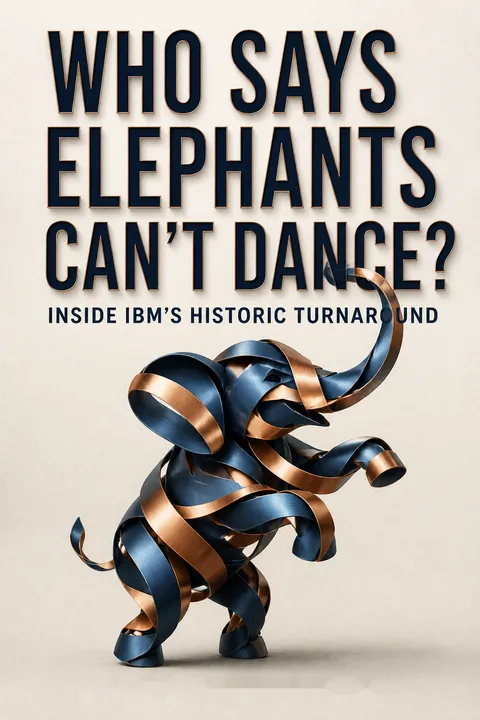

Key Takeaways
1. The Crisis and the Call: An Outsider's Reluctant Arrival
"I told Burke that, given my lack of technical background, I couldn’t conceive of running IBM."
A daunting challenge. Louis Gerstner, a consumer products executive, was unexpectedly approached to lead IBM in late 1992. The company, a revered national institution, was in a state of near-collapse, hemorrhaging cash, losing market share, and facing widespread skepticism about its future. Gerstner initially resisted, citing his non-technical background and the overwhelming nature of the task.
The "national treasure" appeal. Despite his reservations, a persistent board member, Jim Burke, convinced Gerstner that leading IBM was a national obligation. The company was losing billions, its stock had plummeted, and the media was predicting its demise. Gerstner's decision to accept the role was driven by the sheer magnitude of the challenge and a growing realization that his current role at RJR Nabisco was also nearing its end.
First impressions. Gerstner's initial days at IBM were a stark introduction to its insular, bureaucratic culture. He encountered locked doors, a pervasive administrative assistant system, and a company obsessed with internal processes rather than external market realities. The traumatic shareholders' meeting, where angry investors blasted the board, underscored the urgency and depth of the crisis he had inherited.
2. The Foundational Bet: Keeping IBM Whole
"So keeping IBM together was the first strategic decision, and, I believe, the most important decision I ever made—not just at IBM, but in my entire business career."
Against conventional wisdom. In 1993, the prevailing industry and internal IBM view was that the company should be broken up into smaller, independent units to compete in a fragmented market. Investment bankers were already preparing IPOs for various divisions. Gerstner, however, saw this as a "knee-jerk reaction" that would destroy IBM's unique competitive advantage.
The integrator's role. Drawing on his experience as a customer, Gerstner recognized that the industry's fragmentation had burdened clients with the complex task of integrating disparate technologies. He believed IBM's scale and broad capabilities uniquely positioned it to be the "general contractor" – the integrator of technologies and solutions for customers. This vision provided the fundamental rationale for keeping the company unified.
Rejecting atomization. Gerstner immediately halted all activities related to breaking up the company, including dismissing investment bankers and accountants working on spin-offs. He stopped internal efforts that created separate business processes and systems for each unit, which were draining energy and money. This bold move, though met with mixed reactions internally, signaled a clear, unified direction for IBM's future.
3. Stopping the Bleeding: Restructuring the Economic Model
"Since the repositioning of the mainframe was a long-term challenge and we had to reduce mainframe prices and thus our gross profit, the only way to save the company, at least in the short term, was to slash uncompetitive levels of expenses."
A dire financial state. IBM was hemorrhaging cash, with sales and profits declining at an alarming rate. The company's expense-to-revenue ratio was significantly higher than competitors, indicating a massive $7 billion expense problem. Gerstner realized that immediate, drastic action was needed to stabilize operations and prevent insolvency.
Four critical decisions: Gerstner outlined four immediate priorities to stop the decline:
- Keep the company together: As discussed, this was the overarching strategic decision.
- Change the economic model: Launch a massive $8.9 billion expense reduction program, necessitating 35,000 layoffs in addition to previous cuts.
- Reengineer how business was done: Overhaul cumbersome, expensive, and redundant business processes across the entire organization.
- Sell unproductive assets: Divest non-essential assets to raise cash, including corporate real estate, the airplane fleet, and the Federal Systems Company for $1.5 billion.
The mainframe gamble. A crucial early decision was to dramatically cut mainframe prices, despite it being the source of over 90% of IBM's profits. This risky move, coupled with a prior technical bet on CMOS technology, was essential to regain market share and prevent the mainframe business from dying. This decision, if it failed, would have led to IBM's demise, but it ultimately fueled a staggering turnaround in mainframe capacity shipped.
4. The Big Strategic Bets: Services, Software, and Technology
"Our bet was this: Over the next decade, customers would increasingly value companies that could provide solutions—solutions that integrated technology from various suppliers and, more important, integrated technology into the processes of an enterprise."
Beyond the PC era. Recognizing that the PC-dominated computing model was shifting, IBM made two fundamental bets on the industry's future:
- Services-led model: Customers would increasingly demand integrated solutions, making IT services the most influential segment.
- Networked computing: Stand-alone computing would give way to ubiquitous networks, built on open standards.
Building Global Services. Gerstner empowered Dennie Welsh to transform IBM's small, product-tied services unit into a global powerhouse. This meant recommending competitors' products, separating services from the traditional sales force, and managing a labor-based business with different economics. IBM Global Services grew from $7.4 billion in 1992 to $30 billion in 2001, becoming a massive revenue engine and a strategic imperative for integration.
Software as the linchpin. IBM, despite being the largest software vendor, lacked a unified strategy. Gerstner appointed John Thompson to consolidate 4,000 products, 30 labs, and 60 brands into a focused software business. The strategic high ground was identified as "middleware" – software connecting operating systems and applications – which would need to be cross-platform and network-enabled. The acquisition of Lotus Development Corporation for $3.2 billion, including its Notes collaboration software, was a bold move to fill a middleware gap and signal IBM's commitment to this new direction.
Opening the company store. IBM decided to sell its leading-edge technology components (semiconductors, intellectual property) to competitors, a move that was both pragmatic and risky. This strategy aimed to:
- Commercialize underutilized IBM Research discoveries.
- Influence industry standards.
- Recoup substantial R&D expenditures.
- Meet demand for specialized chips in a post-PC, networked world.
This led to IBM becoming number one in custom-designed microelectronics, diversifying its revenue beyond traditional computer sales.
5. Focusing the Portfolio: Unstacking the Stack
"We had to accept the fact that we simply could not be everything to everybody."
The "stack" dilemma. IBM's historical model involved designing and making every layer of the computing "stack" – from components to services. However, the industry had fragmented, with new "stacks" emerging around UNIX and Intel/Microsoft. IBM's declining market share necessitated a strategic withdrawal from areas where it couldn't compete effectively or where it was losing money.
Exiting application software. IBM had invested $20 billion in application development over two decades with a negative 70% return, while alienating potential partners like SAP and PeopleSoft. By 1999, IBM exited most application development, choosing instead to partner with leading application providers. This shift generated billions in incremental revenue and significant market share gains by aligning IBM as an integrator rather than a competitor.
Divesting the IBM Network. Despite believing in a networked world, IBM sold its global data network (Advantis/IBM Global Network) to AT&T for $5 billion. This decision was driven by the realization that competing with telecommunications companies in capital-intensive network ownership was unsustainable and not strategically vital. It allowed IBM to avoid massive capital investments and exit a business whose value would quickly deteriorate.
The persistent PC dilemma. The PC business remained a challenge, consistently unprofitable despite significant revenue and technical achievements. IBM struggled with distribution, manufacturing costs, and the dominance of Intel and Microsoft. While Gerstner acknowledged its spotty record, the PC business was retained, albeit refocused on mobile computing and enterprise integration, with manufacturing eventually outsourced to third parties.
6. The e-business Revolution: Redefining the Industry Agenda
"Its exploitation is, and will be, the single most important driver of change in business, health care, government, education, and society."
Discovering "the cloud." Early discussions with Dennie Welsh about network computing and the "cloud" concept revealed the potential for a revolution in business and human interaction. This networked model would shift workloads from PCs to larger enterprise systems and the network itself, reversing the PC's dominance and creating massive global connectivity.
A network computing blueprint. Gerstner mobilized the entire company to lead this next wave of computing, committing resources to open, standards-based architectures. This involved:
- Internet-enabling software products and developing new ones (e.g., Domino Web Server, Websphere).
- Building a significant Web hosting and e-business consulting services.
- Developing specialized chips for network access devices.
- Creating an "Internet Division" led by Irving Wladawsky-Berger to evangelize the strategy across all units.
Shaping the conversation. IBM coined the term "e-business" in 1996 to articulate its vision of the Net's broader impact beyond online commerce. Despite initial skepticism, a memorable advertising campaign by Ogilvy & Mather, featuring black-and-white office dramas, humanized the concept and became an immediate hit. IBM invested over $5 billion in e-business marketing, establishing itself as the agenda-setter for this new era.
Beyond dot-com mania. While the e-business concept inadvertently contributed to the dot-com bubble, IBM remained focused on the fundamental transformation of existing institutions. Gerstner emphasized that "e-business is just business" – requiring real, disciplined work, not shortcuts. This focus allowed IBM to emerge stronger after the dot-com collapse, having rediscovered its voice and leadership in the industry.
7. Culture is the Game: Confronting IBM's Inside-Out World
"I came to see, in my time at IBM, that culture isn’t just one aspect of the game—it is the game."
The hothouse effect. IBM's decades of unchallenged success fostered an insular, "hothouse" culture, cut off from external realities. This led to:
- Customer disinterest: Preoccupation with internal politics over market needs.
- "Culture of no": A pervasive nonconcur system where any individual or division could block action, leading to unconscionable delays and internal rivalries.
- Bureaucracy: Staff protecting turf, duplicated functions, and endless debates over transfer pricing.
- IBM Lingo: A unique vocabulary and acronyms that reinforced insularity.
- Presiding vs. acting: Senior executives often organized work but didn't actively participate in problem-solving.
Corrupted "Basic Beliefs." Thomas Watson Sr.'s foundational "Basic Beliefs" (excellence, superior customer service, respect for the individual) had morphed into dysfunctions:
- "Superior customer service" became merely servicing machines, not understanding changing business needs.
- "Excellence" became an obsession with perfection, leading to slow decision-making and product launches.
- "Respect for the individual" devolved into entitlement, lack of accountability, and immunity from market realities.
The toughest nut to crack. Gerstner realized that changing the attitudes and behaviors of hundreds of thousands of people was the hardest part of the transformation. He couldn't mandate it but had to create the conditions for change, provide incentives, and define marketplace realities. His ultimate goal was to re-instill self-belief and foster a collaborative, hungry, and curious mindset among IBMers.
8. Leading by Principles, Not Process: Driving Behavioral Change
"Decisions need to be made by leaders who understand the key drivers of success in the enterprise and then apply those principles to a given situation with practical wisdom, skill, and a sense of relevancy to the current environment."
Eradicating process. To combat the stifling bureaucracy, Gerstner insisted on few rules or procedures, replacing them with a statement of eight core principles. These principles emphasized:
- Marketplace as the driving force.
- Commitment to quality technology.
- Customer satisfaction and shareholder value as primary measures.
- Entrepreneurial organization with minimum bureaucracy and focus on productivity.
- Clear strategic vision.
- Sense of urgency.
- Teamwork among dedicated people.
- Sensitivity to employees and communities.
Waking up the leadership. In a pivotal 1994 meeting, Gerstner confronted 420 senior executives with stark data on declining market share and customer satisfaction. He used direct, passionate language, showing photos of competitors and quoting their belittling remarks, to ignite "collective anger" and a competitive focus. He demanded accountability, speed, and an end to "pushback" and internal fighting.
"Win, Execute, Team." To simplify the cultural message and make it actionable for all employees, Gerstner introduced the mantra: "Win, Execute, Team." This became the core of a new performance management system, where annual "Personal Business Commitments" (PBCs) were tied to these three words, with performance directly impacting merit and variable pay. This reinforced collaboration and market focus.
Building a new leadership cadre. Gerstner created the Senior Leadership Group (SLG) with a cap of 300 members, emphasizing that membership was based on demonstrated leadership and commitment to change, not just title. High turnover and visible departures of non-team players reinforced the new behavioral model. IBM also formalized "Leadership Competencies" to guide executive development and evaluation, ensuring a diverse yet aligned leadership.
9. The Power of Focus: Knowing and Loving Your Business
"History shows that truly great and successful companies go through constant and sometimes difficult self-renewal of the base business."
Avoiding "the grass is greener." Gerstner observed that many companies, when facing difficulties in their core business, mistakenly diversify into new industries where they lack expertise. He cited examples like Xerox into financial services or Coca-Cola into movies, which often led to further weakening of the base business. He advocated for "sticking to your knitting" and the constant self-renewal of the core business.
Resisting acquisition fever. While IBM made 90 acquisitions during his tenure, Gerstner emphasized saying "no" to many glamorous, large-scale deals (e.g., MCI, Compaq) proposed by investment bankers. He stressed that successful acquisitions fit neatly into an organic growth plan, filling critical holes or accelerating existing strategies, rather than attempting to buy new positions in new marketplaces.
Steely-eyed strategies. Effective strategies, Gerstner argued, are built on massive, objective quantitative analysis of customer needs, competitive environments, and economic realities. He exposed IBM's flawed customer satisfaction surveys, which were biased by sales force selection, and replaced them with independent, comprehensive surveys. Competitive analysis, he stressed, must be hard-nosed and unbiased, examining every aspect of competitors' products and operations.
Allocating resources effectively. A critical challenge is ensuring resources are allocated to the most important strategic elements, even if they don't yield immediate quarterly results. Gerstner implemented rigorous portfolio reviews, treating all investment dollars as corporate assets, to "starve the losers and invest in new big bets." This required protecting future-oriented projects from short-term budgetary pressures, a constant battle against "survival of the fattest."
10. Execution Trumps Vision: Making Strategy Happen Daily
"Execution—getting the task done, making it happen—is the most unappreciated skill of an effective business leader."
Strategy is rarely unique. Gerstner argued that truly unique strategies are rare and often highly risky, as industries are bounded by known economic models and competitive structures. Most competitors fight with similar weapons, and success factors are often universally understood. Therefore, execution—doing things better, faster, and more productively than competitors—becomes the critical differentiator.
"People respect what you inspect." A common mistake executives make is confusing expectations with inspection. Many companies develop brilliant strategies but fail because leaders don't actively inspect whether change is actually happening on the ground. Execution involves translating strategies into detailed action programs, setting measurable targets, and holding people accountable, making quick changes when targets are not met.
Three pillars of execution: Effective execution is built on:
- World-class processes: Companies must build processes that allow them to outperform competitors on key industry success factors (e.g., Wal-Mart's inventory management, GE's cost management). IBM invested heavily in reengineering core processes like product design.
- Strategic clarity: Employees need crystal-clear messages about the mission, strategy, and their role. Conflicting signals (e.g., demanding quality while cutting costs) undermine execution.
- High-performance culture: This involves a deep commitment from employees, a passion for winning, intolerance for mediocrity, and a focus on excellence.
Beyond predicting rain. Gerstner emphasized that no credit should be given for merely predicting problems; only for building solutions. IBM, despite knowing its problems, had been paralyzed. Execution is the "tough, difficult, daily grind" of moving the company forward, demanding accountability, and making swift changes when performance falls short.
11. Leadership is Personal: Passion, Visibility, and Integrity
"All of the great leaders I have known may be tough (in fact, all of them were tough-minded, which is very different from some people’s description of “tough”). However, all of them were, at the same time, fair."
The shadow of individuals. Great institutions are not merely managed; they are led by individuals passionate about winning. Leaders create high-performance cultures by setting demanding goals, measuring results, and holding people accountable. They are constant change agents, driving their institutions to adapt faster than competitors.
Visibility and active participation. Personal leadership requires visibility across the institution, with leaders rolling up their sleeves and tackling problems personally, not hiding behind staff. They are visible with customers, suppliers, and partners, and are both strategic and operational, deeply understanding the financial underpinnings of their business.
Communication and passion. Leaders communicate openly and honestly, treating every employee with respect and ensuring they understand the enterprise's direction. Most importantly, personal leadership is about passion—a relentless drive to win every day, every hour. Gerstner recalled a pivotal P&G interview that highlighted this "visceral" passion, which he later sought to instill at IBM.
Integrity and fairness. Great leaders are tough-minded but fair. They maintain an environment of fairness and principled judgment, resisting appeals for exceptions to policies. Playing favorites or excusing some while punishing others destroys morale and trust. Gerstner faced numerous requests for exceptions at IBM, but consistently upheld uniform adherence to principles, recognizing that leadership erodes when trust evaporates.
12. Elephants Can Dance: Balancing Integration and Decentralization
"It isn’t a question of whether elephants can prevail over ants. It’s a question of whether a particular elephant can dance."
The "small is beautiful" fallacy. Gerstner challenged the dogma that small companies are inherently superior to large ones. He argued that size offers leverage, allowing for greater investment, risk-taking, and patience for future payoffs. The real challenge for large enterprises ("elephants") is to become nimble and responsive ("dance").
Rethinking decentralization. While decentralization has benefits, Gerstner believed it was taken to an extreme in many companies, leading to:
- High costs: Duplication of back-office functions (data centers, HR, purchasing) across decentralized units.
- Slowness: Turf battles and incompatible systems when multiple units needed to collaborate.
- Inadequate customer response: Inability to provide integrated solutions due to internal conflicts.
Great institutions, he argued, must balance common, shared activities with highly localized, unique ones.
Three categories of shared activities:
- Leveraging scale (back-office): Unifying functions like data processing, networks, purchasing, and real estate management to achieve economies of scale. This is a "no-brainer" for CEOs.
- Market-linked processes (front-office): Common customer databases, fulfillment systems, and CRM systems. These offer powerful benefits but require profit-center managers to relinquish some control.
- New/redefined marketplace (strategic integration): A shared approach to winning in a new market, often requiring units to subjugate their own objectives for the greater good. This is a "bet-the-company" proposition.
The "step too far" warning. Gerstner cautioned against utopian levels of integration, especially in category three, where conflicts over resources, pricing, and branding can be overwhelming. He cited failures in financial supermarkets and media convergence. If a CEO chooses this path, critical steps include:
- Shifting power: Taking power from existing "barons" and publicly bestowing it on new leaders aligned with the integrated vision.
- Measuring and rewarding the future: Changing compensation systems to reinforce the new direction (e.g., executive bonuses tied to total company performance, not just unit results).
- Walking the talk: The CEO must be personally involved, demonstrating commitment daily, as the assignment cannot be delegated.
Review Summary
Reviews for Who Says Elephants Can't Dance? are largely positive, averaging 3.91/5. Many readers praise Gerstner's honest, unpretentious account of IBM's remarkable turnaround, highlighting insights on culture change, execution, and leadership. Reviewers appreciate the practical management lessons and engaging storytelling. Critics, however, find the book self-indulgent, dry, and overly corporate in tone. Some note that certain ideas feel outdated. The book resonates most with business professionals and managers, while casual readers may find portions dense or slow-paced.
People Also Read







Download PDF
Download EPUB
.epub digital book format is ideal for reading ebooks on phones, tablets, and e-readers.








































