


Key Takeaways
Race to the break-even point: where you give more than you take
Your first months decide everything. Watkins, drawing on coaching hundreds of leaders at Johnson & Johnson and beyond, argues that a new leader starts as a net consumer of organizational value and must climb toward the break-even point, the moment contributions finally exceed the costs of bringing you in. Over 200 CEOs estimated this takes a typical midlevel hire roughly 6.2 months.
Opinions harden fast. In a survey of 1,300 senior HR leaders, nearly 90% called role transitions the toughest moments in a leader's professional life, and three-quarters said early performance predicts overall success. You manage under a microscope before you have relationships or knowledge. Rigorous application of these methods can cut time-to-break-even by up to 40%. The goal: trigger virtuous cycles where early credibility accelerates learning, not vicious spirals where bad first calls erode trust.
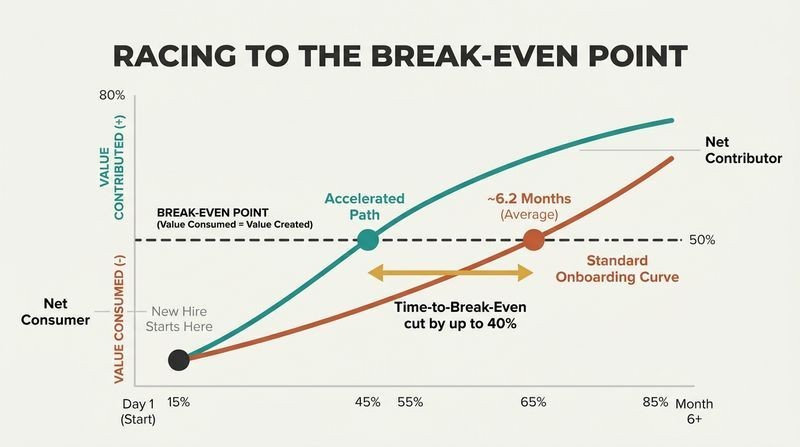
The break-even framing reframes onboarding as a measurable investment problem rather than a vague settling-in period, which is genuinely useful. It echoes startup unit economics and customer-acquisition payback math applied to a human being. One caveat worth naming: the 6.2-month figure is an aggregate of executive guesses, not hard accounting, and varies wildly by situation. The deeper insight is psychological. Research on first impressions (Ambady and Rosenthal's thin-slicing work) supports the claim that judgments form within minutes and resist revision via confirmation bias. Watkins essentially weaponizes this against itself: if perceptions calcify quickly, deliberately seed the good ones early.
The strengths that earned the promotion can sink you in it
Stop doing what made you a star. Watkins tells of Julia Gould, a marketing standout promoted to lead a cross-functional product launch. Her trademark attention to detail and need for control made her micromanage the one area she knew, marketing, while alienating the team she now had to lead without direct authority. Within six weeks she was demoted. Her hammer made everything look like a nail.
Prepare by letting go. The most dangerous assumption is that success in the new role simply means more of your old role. Watkins recommends a clean mental breakpoint (pick a weekend, consciously release the old job) and a problem-preferences audit: rank your intrinsic interest in technical, political, and cultural problems across functions. Low scores expose blind spots. Compensate with three tools: self-discipline to work outside your comfort zone, hiring people who cover your gaps, and an advice network.
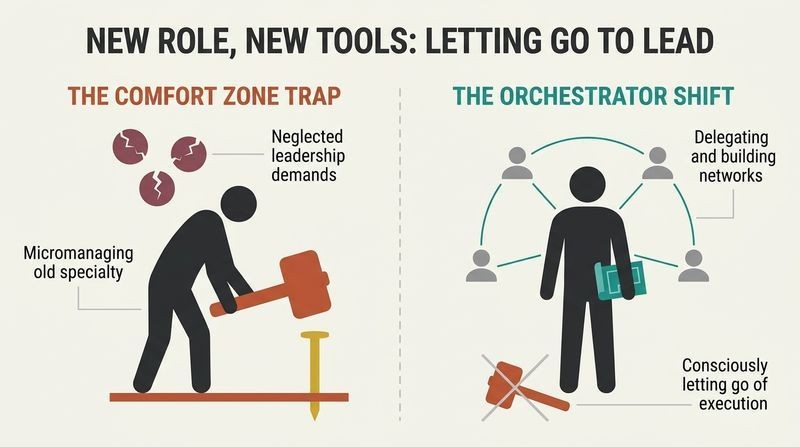
This is the Peter Principle's antidote. Marshall Goldsmith made the same argument in "What Got You Here Won't Get You There," but Watkins grounds it in the structural shift from individual contributor to leader, where competence is replaced by orchestration. The problem-preferences diagnostic is clever because it targets motivation rather than skill: people neglect domains they dislike, not just ones they cannot do. A useful extension comes from the deliberate-practice literature, which shows experts plateau when they stop seeking discomfort. The promotion is precisely the moment to rebuild the atrophied left arm rather than over-train the strong right one.
Diagnose your STARS situation before choosing any strategy
One playbook does not fit all. Watkins's signature framework, STARS, sorts every transition into five business situations, each demanding different leadership:
1. Start-up: build from scratch with limited resources
2. Turnaround: rescue a business everyone knows is failing
3. Accelerated growth: scale a winner without breaking it
4. Realignment: wake a successful organization drifting toward trouble
5. Sustaining success: protect vitality and find the next peak
Match your style to the diagnosis. Karl Lewin crushed a European turnaround with bold, heroic surgery: closing plants, cutting staff. Promoted to a North American realignment where no crisis was visible, he wisely tempered those instincts, since slashing would have triggered resistance. Turnarounds are ready-fire-aim and reward heroes; realignments are ready-aim-fire and reward stewards who build awareness before acting. Most leaders inherit a portfolio mixing several STARS types at once.
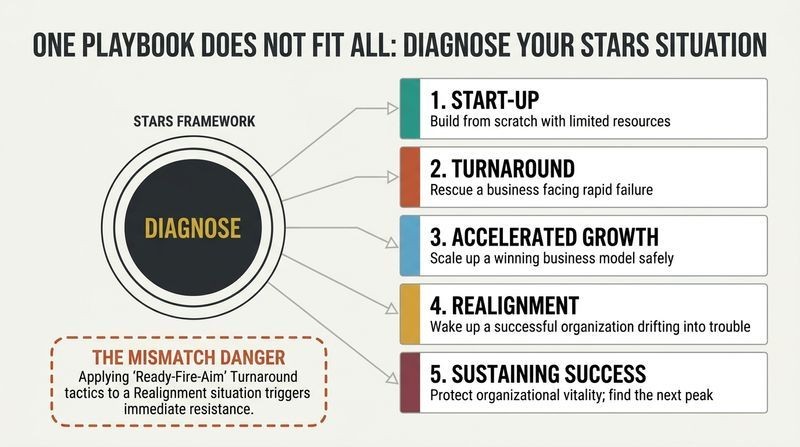
STARS endures because it converts an overwhelming question (what should I do?) into a tractable one (what kind of situation is this?). Its sharpest contribution is the survey finding that leaders crave start-ups and turnarounds (visible, measurable heroics) while avoiding realignments, even though realignment is rated the hardest. This exposes a perverse incentive: organizations lavishly reward firefighters and ignore fire-preventers, quietly manufacturing future crises. It resonates with reliability research where the absence of disaster (the dog that doesn't bark) goes unrewarded. The hero-versus-steward distinction also anticipates situational-leadership theory, but Watkins ties personality preference to misfit risk more concretely than most.
Never arrive with the answer; treat learning as an investment
Coming in certain is fatal. Chris Hadley left a world-class operation to fix a struggling one and immediately declared it should be rebuilt "his old company's way," hiring consultants who trashed the existing staff. Productivity collapsed. He had skipped the baseline question: how did things get this way? The underinvested team had achieved remarkable results with scraps, and his contempt alienated the very people with the answers.
Learn efficiently and effectively. Watkins frames learning as extracting actionable insights with scarce time. Define a learning agenda (questions about past, present, future), then use structured methods rather than wandering conversations. Ask every direct report the same five questions, including "What are our biggest challenges and why?" and "If you were me, what would you focus on?" Identical questions reveal consensus, divergence, and who points fingers versus who takes ownership. Beware the action imperative: the compulsive need to do something that crowds out understanding.
The standardized-interview technique is underrated and borrows from qualitative research methodology: holding the instrument constant lets variance in answers become signal rather than noise. It also defends against anchoring, the bias where the first or loudest voice disproportionately shapes your view. The action imperative deserves emphasis because it is socially rewarded; visible busyness reads as competence. Yet Watkins's claim that displaying genuine curiosity itself builds credibility is supported by research on humility in leadership (Bradley Owens's work), which links expressed teachability to team performance. The harder skill, rarely taught, is knowing when to stop learning and commit.
Have five distinct conversations with your new boss, not one
Shape the game, don't just play it. Michael Chen, warned his tough new boss Vaughan Cates would "eat him alive," negotiated a 30-day diagnostic window before any major call, then delivered a strong plan, hit interim targets, and only later raised the style difference: judge me on results, not methods. Watkins distills boss management into five threaded conversations:
1. Situation: how does she see your STARS portfolio?
2. Expectations: what does success look like, and when?
3. Resources: what do you need, framed as a menu of outcomes per investment
4. Style: how should you two communicate and decide?
5. Personal development: how are you doing (around the 90-day mark)?
The cardinal rules. Take 100% responsibility for the relationship, never surprise the boss with bad news, underpromise and overdeliver, and aim early wins at what your boss cares about so she feels ownership in your success.
Sequencing the conversations is the quiet genius here: leading with situation and expectations before resources prevents the rookie error of demanding budget before establishing shared diagnosis. The menu approach to resources (7% growth costs X, 10% costs Y) is a negotiation tactic that reframes asking as a value proposition rather than a plea. Watkins's "recruiting is romance, employment is marriage" line captures a real hazard documented in expectation-violation research: pre-hire promises rarely survive contact with reality. The one tension is that 100% ownership can curdle into self-blame when a boss is genuinely dysfunctional; the framework assumes more good faith than some workplaces offer.
Chase early wins that serve long-term goals, not just easy fruit
Momentum is manufactured. Elena Lee, promoted over former peers to fix customer service, dismantled a punishment culture by coaching managers, sidelining two who refused to change, and chartering a team to build new quality metrics, which she piloted and scaled. Within a year, satisfaction and morale both jumped. Watkins's research shows effective leaders work in waves: a first wave of early wins, then consolidation, then deeper structural change.
Avoid the low-hanging-fruit trap. Grabbing quick wins that lead nowhere is like launching a rocket with only a big first stage; you fall back to earth once momentum fades. Early wins must do double duty: improve performance now and model the behavior you want long-term. Get wins that matter to the boss, won in ways consistent with the culture. And hunt for predictable surprises, the ticking time bombs everyone had information to spot but nobody assembled.
The double-duty criterion separates this from generic quick-win advice. An early win achieved through bullying buys results but poisons the culture you are trying to build, so means and ends are inseparable. The predictable-surprises concept, which Watkins developed with Max Bazerman, connects to organizational-failure research on the Columbia and Challenger disasters: information silos mean the puzzle pieces exist but never converge. The waves model also aligns with change-fatigue studies showing that relentless reorganization burns people out and obscures what is actually working. The subtle warning is that leaders, addicted to the action imperative, mistake motion for progress and pick fruit precisely because it is reachable, not because it matters.
Become the architect: align strategy, structure, systems, and skills
Charisma cannot overcome misalignment. Hannah Jaffey was hired to fix a warring executive team, but diagnosed that the real culprit was structural: a product-based reorganization with incentives that pitted units against each other over shared customers. She kept pushing her skeptical CEO until he agreed to a hybrid structure, and growth resumed. The lesson: senior leaders are organizational architects who must align four interacting elements:
1. Strategic direction (mission, vision, strategy)
2. Structure (how people are grouped, measured, rewarded)
3. Core processes (the systems that turn inputs into value)
4. Skill bases (the capabilities of key people)
Resist restructuring reflexively. Reorganizing to fix problems that actually live in processes or culture is rearranging deck chairs on the Titanic. Watkins also rehabilitates SWOT into TOWS, insisting you analyze external threats and opportunities first, before internal strengths and weaknesses, so the discussion stays anchored rather than becoming abstract navel-gazing.
This chapter is an accessible port of the McKinsey 7S model, and its strength is sequencing: direction drives structure drives processes drives skills, so changing one without the others creates new misalignments. The TOWS reordering is a small but real fix; behavioral research confirms that unanchored strength-weakness brainstorming produces vague, self-flattering lists, whereas starting with the environment forces specificity. The deeper claim, that you cannot lead your way out of a badly designed system, runs counter to the great-man bias in business media. It rhymes with Deming's insight that most performance problems are system problems, not people problems, a humbling corrective to leaders who reach first for the org chart or the firing line.
Your most important early decisions are about people, not strategy
Inherited teams need honest triage. Liam Geffen found his predecessor's reviews rated everyone either outstanding or marginal, evidence of favoritism. Through skip-level meetings and quiet outside searches, he gave two underperforming VPs two-month plans; one washed out, one rose to the challenge. Watkins urges evaluating each member against six criteria: competence, judgment, energy, focus, relationships, and trust, with one designated as your non-negotiable threshold.
Balance stability against change. The common error is keeping weak players too long, not acting too fast, though shaking the tree can also drop good people, so reassure your stars. Sort everyone into keep, develop, move, replace, or observe. Then align the team using push tools (goals, metrics, incentives) and pull tools (a vision that taps intrinsic motivation). Match your decision style to the moment: consult-and-decide for divisive or urgent calls, build-consensus when you need energetic buy-in you cannot police.
The consult-and-decide versus build-consensus distinction is the most practically valuable nugget, because most leaders default to one mode and apply it everywhere. Watkins's rule that divisive loss-sharing decisions should be made by the leader (don't outsource pain to a doomed consensus process) is supported by group-dynamics research showing unanimity requirements produce lowest-common-denominator compromises or endless drift. The judgment-testing trick, probing predictions in someone's passion domain like sports or cooking, is a creative proxy for expertise that is hard to observe on the job. One limitation: the six-criteria audit can feel clinical, and treating trust as immutable may foreclose redemption arcs that Watkins elsewhere prizes.
Authority is never enough; map who quietly influences whom
Persuasion beats position. Alexia Belenko, a star country manager, became regional marketing VP and assumed her airtight business case would win the day. Caught between a corporate boss wanting centralization and former peers wanting autonomy, she presented to thirty stakeholders and sank in quicksand. Her error: she diagnosed problems but ignored the political landscape. Watkins prescribes mapping influence networks, the shadow organization where people defer to opinion leaders regardless of the org chart.
Build winning alliances deliberately. Identify who must say yes (your winning alliance) and who could band together to block you. Sort players into supporters, opponents, and persuadables, then diagnose each pivotal person's motivations, the driving and restraining forces acting on them, and how they see their alternatives. Deploy influence tools: framing arguments via logic, principle, and emotion; incrementalism (move step by step); sequencing (recruit the right ally first); and action-forcing events that make inaction impossible.
Alexia's failure illustrates a classic trap of analytically gifted leaders: believing rational superiority is self-executing. The influence-network mapping draws on social-network analysis (Krackhardt's work on informal organizations), where informal advice ties predict who actually moves decisions. Watkins's emphasis on situational forces over personality echoes the fundamental attribution error from social psychology: we wrongly read resistance as character flaw when it often reflects incentives and peer pressure. The sequencing insight, that early allies compound like interest, mirrors diffusion-of-innovation dynamics. The framework's only risk is sliding into manipulation; Watkins keeps it ethical by stressing fair process and genuine trades, but the same toolkit could be weaponized by the cynical.
You cannot create value at work while destroying it at home
Transitions amplify your weaknesses. Stephen Erikson moved from New York to Toronto assuming the cultures were nearly identical. The job frustrated him, his wife couldn't find schools she liked, the family stayed behind, and weekend commuting wore everyone down until he had to choose between the job and his marriage. He chose to leave. Watkins names four self-sabotaging syndromes: undefended boundaries, brittleness (clinging to bad decisions), isolation, and work avoidance.
Build three pillars of self-management. First, apply the 90-day strategies themselves. Second, enforce personal disciplines: plan-work-evaluate cycles, deferring commitments (start with no, it is easy to say yes later), and going to the balcony to gain perspective in heated moments. Third, construct a support system, including a stabilized home front and an advice network of three types: technical advisers, cultural interpreters, and political counselors, balanced between trusted outsiders and well-connected insiders.
Watkins invokes the Yerkes-Dodson curve, the century-old finding that performance rises with arousal until excess stress causes collapse, to explain why overloaded leaders work harder and achieve less. The home-front emphasis is unusually candid for a business book and reflects spillover research showing work and family stress are bidirectional, not separable. The three-adviser typology is genuinely portable: most people cultivate technical advisers but neglect political counselors precisely when stakes rise. "Begin with no" is sound defense against the planning fallacy, where distant commitments look deceptively cheap. The chapter's quiet thesis, that derailment is usually self-inflicted through avoidable syndromes rather than external sabotage, is both empowering and slightly uncomfortable.
A common transition language can accelerate an entire company
Transitions are constant and contagious. About a quarter of managers in a typical Fortune 500 company change jobs yearly, and each transition materially affects roughly a dozen surrounding people, bosses, peers, and reports. The average leader makes a major transition every 1.3 years. A single failed senior transition can cost hundreds of thousands of dollars directly, plus delayed launches and lost high-potentials. One health-care company's program showed a 1,400% ROI.
Institutionalize acceleration. Watkins argues firms should treat transition risk like any enterprise risk. The single highest-leverage move is adopting one shared framework, language, and toolkit (STARS, the five conversations, early wins) so bosses, peers, and reports all support newcomers the same way. Deliver help just in time in digestible blocks, customize for promotion versus onboarding, match intensity to leader level, and link recruiting to onboarding so cultural-fit risks identified during hiring feed the acceleration process.
This scales the individual playbook into a system, and the strongest argument is the multiplier: helping one leader ripples to a dozen others, so even a 10% acceleration compounds across an organization. The recruiting-onboarding integration point is shrewd, because "best athlete" hiring (capability over fit) plants future derailments that no onboarding can fully cure, an insight supported by turnover research linking culture misfit to early exits. The distinction between transition coaching and developmental coaching is practical: a transition coach needs business acumen and organizational knowledge, not just behavioral technique. The honest limitation is cost; intensive coaching cannot economically reach lower levels, which is why Watkins tiers delivery from coaching down to self-guided materials.
Analysis
"The First 90 Days" succeeded because it tilled what Watkins calls a virtually untilled field: the science of leadership transitions as distinct from leadership itself. Its enduring achievement is converting a moment of maximum anxiety into a structured, diagnosable problem with named traps, sequenced tasks, and reusable tools. The book's intellectual spine is situational contingency. Where most leadership literature peddles universal traits, Watkins insists the right move depends entirely on which STARS situation you inherit, a stance closer to contingency theory and Kotter's change work than to charismatic great-man narratives.
The framework's portability is both its strength and its blind spot. The same logic that helps a CFO and a shift supervisor can feel generic, and the relentless taxonomizing (six criteria, five conversations, four pillars, four onboarding pillars) risks reducing messy human situations to checklists. Watkins partly defends against this with vivid composite cases, Julia, Chris, Karl, Elena, Hannah, Liam, Alexia, Stephen, that dramatize how smart people derail in predictable ways. These stories carry more pedagogical weight than the matrices.
What dates the book mildly is its assumption of relatively stable hierarchies and clear org charts; gig-era, matrixed, and remote organizations stretch the model, though the virtual-team addendum gestures at this. What ages well is the psychological core: confirmation bias hardening first impressions, the action imperative as socially rewarded self-sabotage, and the recognition that home-life collapse silently torpedoes careers.
The deepest contribution may be the reframe of leadership as orchestration rather than heroics. The break-even concept, the architect metaphor, and the influence-network mapping all decenter the individual in favor of systems and relationships. The book quietly argues that the leader who needs to be the smartest person in the room, like Alexia with her business case, is precisely the one most likely to drown. Its practical wisdom: be systematic about learning, modest about certainty, and ruthless about people decisions early.
Review Summary
The First 90 Days receives mostly positive reviews, with readers finding it helpful for navigating career transitions and new leadership roles. Many praise its practical advice, structured approach, and useful checklists. Some criticize it as too focused on traditional corporate environments or lacking depth in certain areas. Readers appreciate the STARS framework and strategies for early wins. While some find it common sense, others consider it invaluable for career development. The book is widely recommended for managers at various levels preparing for new positions.
People Also Read




FAQ
What's The First 90 Days about?
- Leadership Transitions Focus: The First 90 Days by Michael D. Watkins provides strategies for leaders transitioning into new roles, emphasizing the importance of the first 90 days in establishing credibility and effectiveness.
- Framework for Success: It introduces the STARS model, categorizing transitions into five types: start-up, turnaround, accelerated growth, realignment, and sustaining success, helping leaders tailor their strategies accordingly.
- Practical Tools and Advice: The book offers actionable frameworks, tools, and checklists to help leaders navigate their transitions successfully.
Why should I read The First 90 Days?
- Critical for New Leaders: Essential for anyone stepping into a new leadership role, addressing unique challenges and opportunities during transitions.
- Proven Strategies: Based on extensive research and real-world experience, providing leaders with strategies to accelerate learning and secure early wins.
- Long-Term Impact: Applying the principles can significantly enhance chances of long-term success and career advancement.
What are the key takeaways of The First 90 Days?
- Importance of Early Wins: Securing early wins is crucial for building credibility and momentum, establishing a positive perception among peers and superiors.
- Learning as an Investment: Leaders should focus on understanding the organization’s culture, politics, and operational dynamics as an investment process.
- Negotiating Success: Building a productive relationship with a new boss is vital; leaders should negotiate expectations, resources, and communication styles.
What is the STARS model in The First 90 Days?
- Five Transition Types: The STARS model categorizes transitions into start-up, turnaround, accelerated growth, realignment, and sustaining success, each with distinct challenges.
- Tailored Strategies: Understanding the transition type allows leaders to tailor their approach, focusing on specific needs and dynamics.
- Framework for Diagnosis: Serves as a diagnostic tool, helping leaders assess their current situation and develop appropriate action plans.
How can I secure early wins according to The First 90 Days?
- Identify High-Potential Opportunities: Focus on areas where quick, visible improvements align with your boss's priorities and the organization's goals.
- Build Personal Credibility: Early wins should enhance your reputation as a capable leader who can deliver results.
- Engage the Team: Involve your team to foster collaboration and buy-in, ensuring sustainable changes supported by those affected.
What are some common traps new leaders fall into as described in The First 90 Days?
- Sticking with What You Know: Relying on past experiences and skills not applicable to the new role can lead to ineffective decision-making.
- Action Imperative: Pressure to take immediate action can result in hasty decisions without adequate understanding of the new environment.
- Setting Unrealistic Expectations: Failing to negotiate clear, achievable objectives can lead to underperformance and disappointment.
How does The First 90 Days suggest leaders manage themselves during transitions?
- Self-Awareness: Leaders should assess their strengths and vulnerabilities, understanding how these traits may impact their new role and relationships.
- Building a Support Network: Establishing a network of advisors and mentors can provide guidance and perspective during the transition period.
- Maintaining Balance: Important for leaders to manage stress and maintain perspective, ensuring sound decisions and avoiding burnout.
What is the significance of the 90-day plan in The First 90 Days?
- Structured Approach: The 90-day plan serves as a roadmap for new leaders, helping them prioritize learning, relationship-building, and early wins.
- Regular Check-Ins: Leaders are encouraged to schedule regular reviews with their boss to assess progress and adjust the plan as necessary.
- Focus on Long-Term Goals: While the initial focus is on immediate wins, the plan should also align with longer-term objectives for sustained success.
What are some effective strategies for negotiating success with a new boss?
- Clarify Expectations Early: Engage in open discussions with your boss to understand and align on expectations, goals, and performance metrics.
- Regular Communication: Maintaining consistent communication helps prevent misunderstandings and keeps the boss informed of progress and challenges.
- Seek Resources: Negotiate for necessary resources—financial, personnel, and support—framing requests in terms of mutual benefits.
What is the role of alliances in The First 90 Days?
- Building Support: Alliances are crucial for gaining support from individuals over whom leaders have no direct authority.
- Navigating Politics: Understanding the political landscape within the organization is essential; leaders should map influence networks.
- Creating Win-Win Situations: Effective alliance building involves negotiating mutually beneficial agreements that align interests.
What are some specific strategies for influencing others in The First 90 Days?
- Consultation and Active Listening: Engaging in consultation and actively listening to stakeholders can build trust and buy-in.
- Framing Arguments: Carefully frame arguments to resonate with the motivations of influential players, using logical reasoning and emotional connections.
- Incrementalism and Sequencing: Introducing changes gradually and strategically can help build momentum and minimize resistance.
What are the best quotes from The First 90 Days and what do they mean?
- "Your goal in every transition is to get as rapidly as possible to the break-even point.": Emphasizes quickly contributing value to establish credibility and momentum.
- "Transitions are critical times.": Highlights the significance of the transition period, where leaders can set the stage for success or face challenges.
- "You cannot figure out where to take a new organization if you do not understand where it has been.": Underscores the necessity of understanding the organization's history and context to lead effectively.
About the Author
Other books by Michael D. Watkins
Download PDF
Download EPUB
.epub digital book format is ideal for reading ebooks on phones, tablets, and e-readers.








































