

Key Takeaways
Stop asking who moved your Cheese — start searching for the new
Johnson's parable has four characters navigating a Maze in search of "Cheese" — a metaphor for whatever you want in life: a career, a relationship, health, money, or peace of mind. Two mice, Sniff and Scurry, rely on instinct and simplicity. Two Littlepeople (human-like beings), Hem and Haw, rely on complex thinking and emotions. All four find a massive stash of Cheese at Cheese Station C — until one day it vanishes.
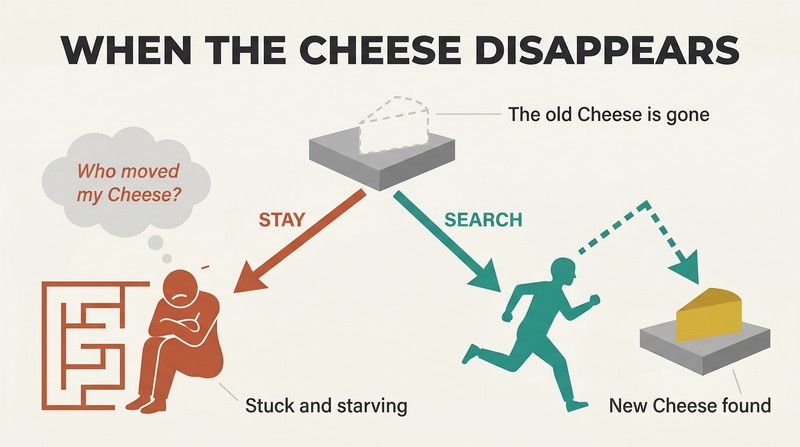
The mice waste zero time grieving. They lace up their running shoes and sprint into the Maze searching for new Cheese. Hem and Haw stand paralyzed, shouting "Who moved my Cheese?" and demanding it be returned. The rest of the story follows Haw's slow, painful journey toward accepting that the Cheese is gone, that nobody owes him more, and that the only productive response is to go find something new.
Keep your running shoes around your neck, not stored in a closet
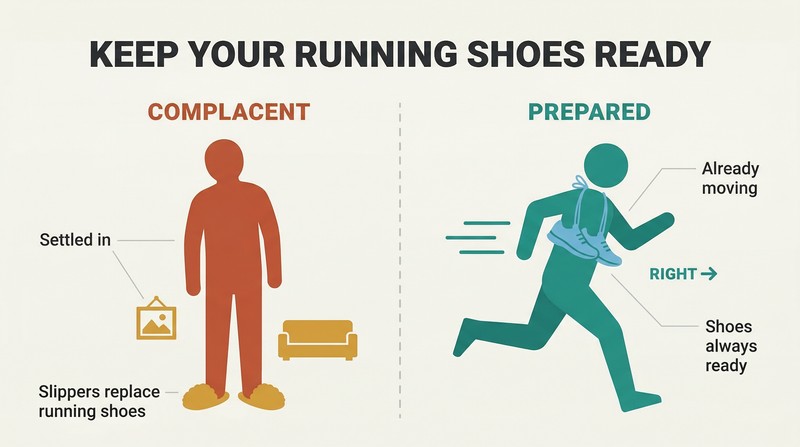
In the early days, everyone hustled. All four characters raced to Cheese Station C every morning in running gear. But as the Littlepeople grew comfortable, their habits softened. Hem and Haw arrived later, walked instead of running, swapped running shoes for slippers, and moved their homes closer to the Cheese. They decorated the walls and bragged to friends. "There's enough Cheese here to last us forever," Hem declared.
The mice never let comfort dull their edge. Sniff and Scurry kept their running shoes tied around their necks — ready at a moment's notice. When the Cheese vanished, the mice laced up and left within seconds. The Littlepeople couldn't even find their shoes. The moment you feel secure enough to stop preparing for change is precisely when you're most vulnerable to it.
Smell the Cheese often so decay never surprises you
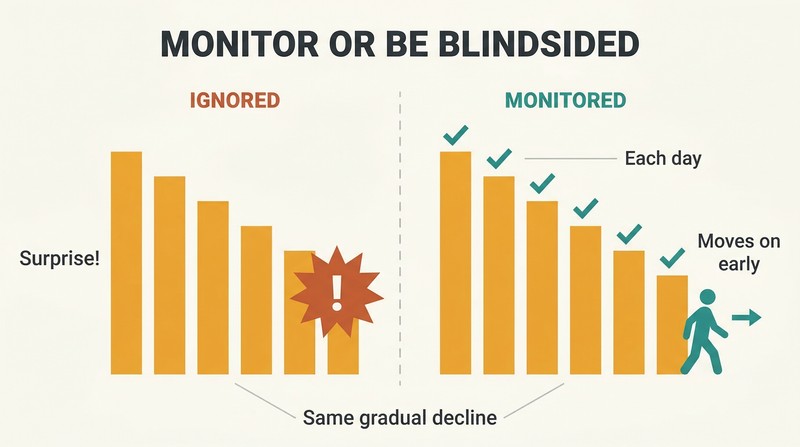
The Cheese didn't vanish overnight. Looking back, Haw realized the supply had been shrinking for days — maybe weeks. The remaining Cheese had grown old, possibly moldy. But because Hem and Haw stopped inspecting their environment, the disappearance felt sudden and unfair. The mice, by contrast, sniffed and scratched around Cheese Station C every single morning, checking for changes. When the day finally came with zero Cheese, they weren't surprised.
Regular monitoring is the simplest habit that separates those who adapt from those who are blindsided. In the book's Discussion section, Nathan admits his family's chain of small stores was destroyed by a mega-store — a change he saw happening in other regions but hoped wouldn't affect him. The signal was there. He just stopped sniffing.
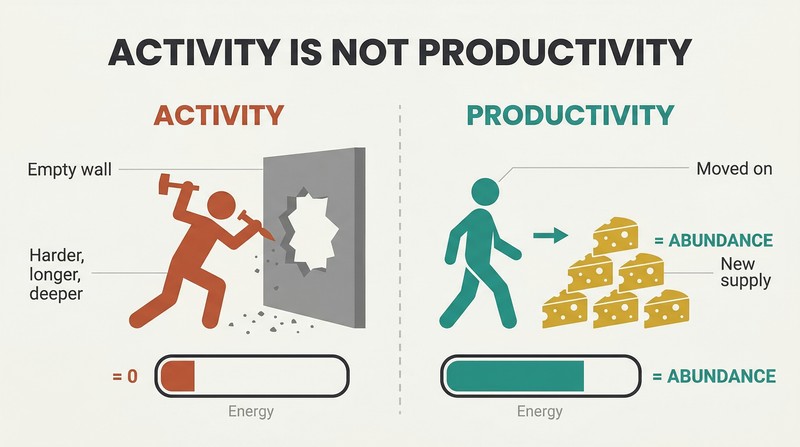
Chiseling walls in an empty station isn't progress — it's denial
Hem and Haw's response to the empty station was to work harder at the wrong thing. Hem held a chisel while Haw hammered holes in the walls of Cheese Station C, convinced the Cheese was hidden behind them. They started earlier, stayed longer, and dug deeper. All they produced was a large hole and growing exhaustion.
Frantic effort can disguise denial. Returning daily to a place with no Cheese, digging walls that contain none, felt like work — but yielded nothing. Meanwhile, the mice had already found Cheese Station N, stocked with the biggest supply they'd ever seen. Jessica's encyclopedia company echoed the same trap: they kept optimizing their door-to-door sales force while a competitor put the entire product on a single disk for a fraction of the cost.
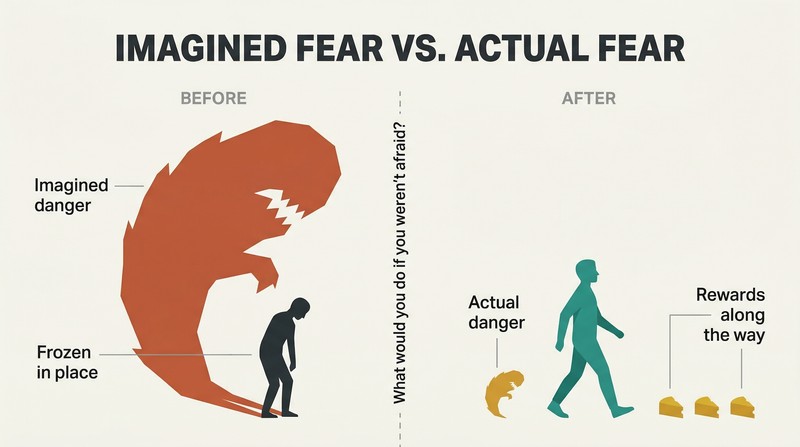
Ask what you'd do if you weren't afraid, then do exactly that
Haw's turning point came from one question he wrote on the wall: "What Would You Do If You Weren't Afraid?" He realized fear had chained him to an empty room. He was afraid of getting lost, looking foolish, failing, and going it alone. These imagined dangers felt more real than the actual danger of starving in Cheese Station C.
Once Haw stepped into the Maze, his fears shrank rapidly. The corridors were unfamiliar but not the death traps he'd envisioned. He found small bits of Cheese along the way — enough to sustain him. He discovered that moving itself was energizing. Some fear is healthy — it signals real danger. But most of Haw's fears were irrational and self-imposed, and they evaporated the moment he started running.
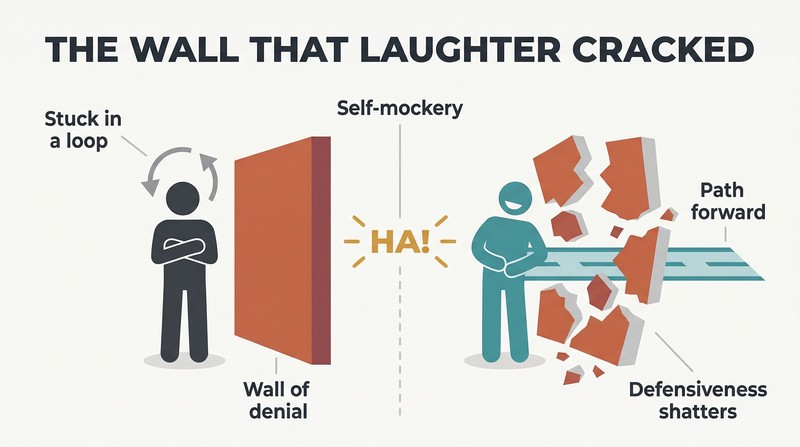
Laughing at your own stubbornness is the fastest exit from denial
Haw's breakthrough wasn't courage — it was comedy. After days of returning to the empty Cheese Station, Haw finally looked at his situation and burst out laughing: "We keep doing the same things over and over again and wonder why things don't get better. If this wasn't so ridiculous, it would be even funnier." That single moment of self-mockery cracked his paralysis.
Humor dissolves defensiveness. When Haw stopped taking himself so seriously, he could see his own behavior clearly for the first time. He stopped needing to be "right" about the Cheese returning and started being honest about his situation. In the Discussion section, Frank echoes this: "I tend to take myself too seriously. I noticed how Haw changed when he could finally laugh at himself." Self-awareness through laughter preceded every productive step Haw took.
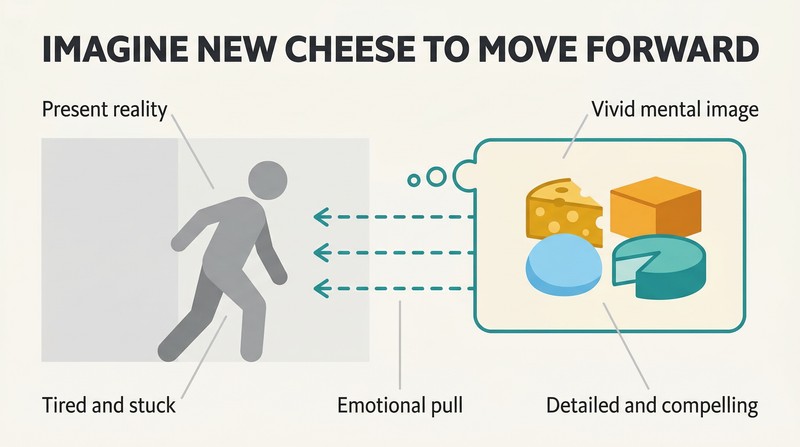
Paint New Cheese in vivid detail to pull yourself forward
Before moving a single step, Haw rehearsed success in his mind. He imagined eating Swiss cheese with holes in it, bright orange Cheddar, Italian Mozzarella, and soft French Camembert. He pictured himself sitting in the middle of a pile of his favorite cheeses, tasting each one. The images were so vivid they felt real. This mental rehearsal gave him the emotional fuel to lace up his shoes and leave.
The visualization technique reappears throughout Haw's journey. Whenever he grew discouraged — lost in corridors, tired, and hungry — he would repaint the mental picture of enjoying New Cheese. Each time, the image pulled him forward. In organizational terms, Michael applied the same principle at his company: his job was to paint a picture of New Cheese compelling enough that the whole team wanted to pursue it.
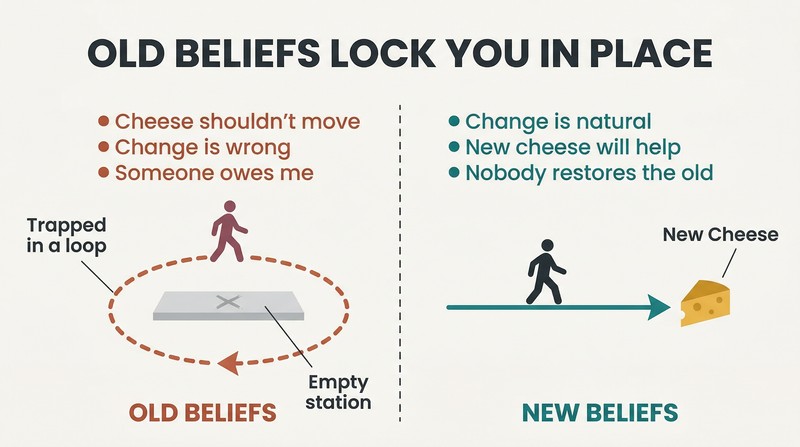
Old beliefs keep you returning to the empty Cheese Station
Haw held beliefs that trapped him. He believed Cheese should never be moved. He believed change was wrong. He believed someone owed him a replacement. These beliefs felt like facts, but they were just stories — stories that justified sitting still. Haw inscribed on the wall: "Old Beliefs Do Not Lead You To New Cheese."
The shift happened when Haw swapped his beliefs for new ones: change is natural and continual; finding New Cheese will help, not hurt; nobody is going to restore the old supply. Once his beliefs changed, his behavior followed immediately. He stopped going back to the empty station and started exploring new corridors. New beliefs generate new behaviors, which generate new results. Your beliefs are the invisible software that either moves you forward or locks you in place.
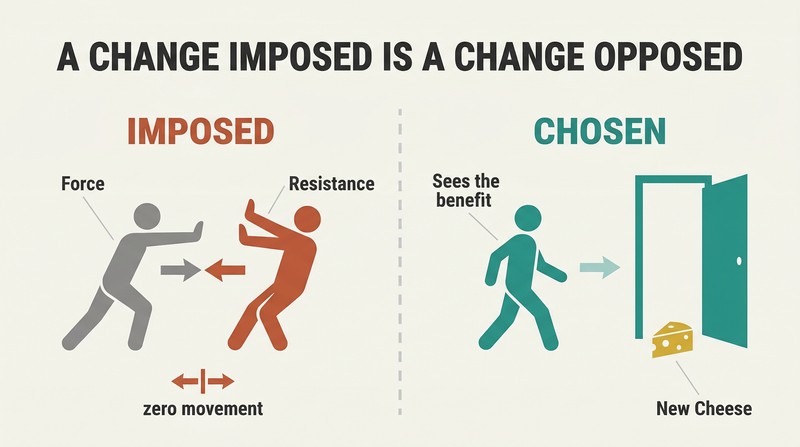
You can't drag Hem into the Maze — people must choose change
Haw tried everything to bring Hem along. He argued, pleaded, and even brought back bits of New Cheese from the Maze. Hem refused every time, insisting he wanted his own Cheese back: "It's not what I'm used to. I want my own Cheese back and I'm not going to change until I get what I want." Haw eventually accepted a painful truth: no one else could make Hem change. Hem had to see the advantage for himself.
In organizations, this plays out predictably. Michael found that sharing the Cheese story shifted peer pressure — nobody wanted to be seen as a Hem. That social dynamic moved more people than any top-down mandate. But some employees never budged and had to be let go. The leader's job isn't to force change but to make refusing it more uncomfortable than adapting.
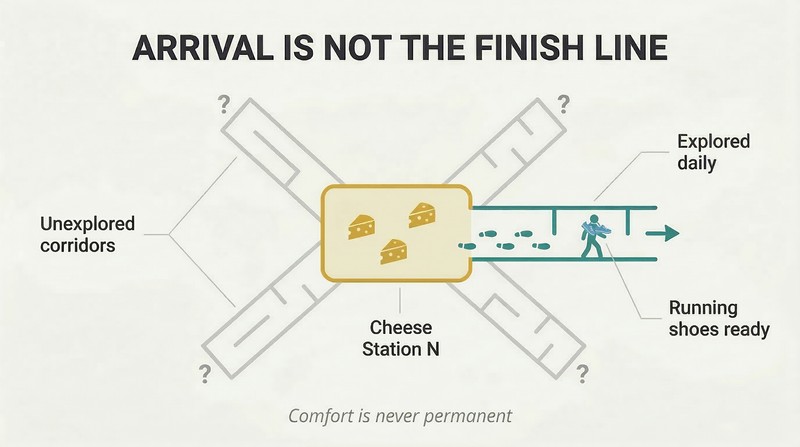
Even at Cheese Station N, keep exploring the Maze
Finding Cheese Station N wasn't the end of the story. When Haw arrived — greeted by Sniff and Scurry, already fat and happy — he immediately adopted new habits. He tied his running shoes around his neck. He inspected the Cheese daily to track its condition. And crucially, he regularly ventured out into unfamiliar corridors of the Maze, even with plenty of Cheese at home.
Haw understood the cycle would repeat. The Handwriting on the Wall captures this as the final lesson: "Be Ready To Change Quickly And Enjoy It Again & Again — They Keep Moving The Cheese." Comfort is never permanent. The book's last image: Haw hears footsteps approaching Cheese Station N, hoping Hem has finally decided to move. The story ends — or begins again.
Analysis
Who Moved My Cheese? is less a book than a diagnostic tool disguised as a bedtime story. Its approximately 14,000 words contain no research citations, no case studies, and no analytical frameworks that would survive a business school seminar. Yet it sold over 21 million copies and became Amazon's all-time bestselling title by 2005. The obvious question — why? — has a non-obvious answer.
The parable works because it bypasses ego. Direct advice ('you need to adapt faster') triggers defensive reasoning. But watching cartoon mice outperform Littlepeople in a maze activates a different cognitive pathway. Readers self-identify with one of four archetypes and, crucially, feel embarrassed to be a Hem. This is social proof through fiction — nobody wants to be the character who starves while demanding the universe restore what's gone.
Hem and Haw's arc maps neatly onto the Kübler-Ross grief model: denial (returning daily to the empty station), anger ('It's not fair!'), bargaining (chiseling walls), depression (sleepless nights, weakening bodies), and — for Haw — acceptance. Losing your Cheese is grief, and the book normalizes it while refusing to let it become permanent. The mice, unburdened by complex cognition, skip grief entirely — a pointed reminder that our sophisticated brains are often the obstacle, not the advantage.
Johnson's real innovation isn't the content but the shared language the book creates. Organizations that adopted the story didn't gain strategic insights; they gained low-friction vocabulary for uncomfortable truths. 'They moved our Cheese' is easier to say in a meeting than 'our business model is obsolete.' The peer-pressure dynamic — nobody wants to be identified as a Hem — is a genuine behavioral mechanism that operates independently of the parable's simplicity.
The book's limitations are real. It treats all change as weather — something that happens to you — never examining who moves the Cheese or whether they should. Its individual-responsibility framing can be weaponized by institutions imposing painful restructuring while blaming employees for failing to adapt. Still, as a psychological mirror, the book earns its longevity. Most resistance to change isn't intellectual — it's emotional. Johnson gives that emotional stuckness a name, a face, and a punchline.
Review Summary
Who Moved My Cheese? receives mixed reviews. Many praise it as a simple yet powerful fable about adapting to change, finding it motivational and applicable to both personal and professional life. Critics argue it oversimplifies complex issues and promotes blind acceptance of corporate decisions. Some find the message obvious and the writing style lacking. The book's short length and use of animal characters make it accessible, but also a target for those who feel it's too simplistic. Despite divided opinions, it remains a popular business and self-help book.
People Also Read



Glossary
Cheese
what you desire in lifeThe book's central metaphor. Cheese represents anything a person wants—a good job, a loving relationship, money, health, recognition, freedom, or peace of mind. Each character defines Cheese differently based on their own values. When Cheese is found it brings happiness; when it vanishes or is 'moved,' characters must decide how to respond.
The Maze
where you pursue goalsThe environment in which characters spend time seeking Cheese. It represents any setting where people pursue what they want: a workplace, a community, a relationship, or an industry. The Maze contains both promising corridors leading to Cheese and dark corners and blind alleys leading nowhere, making navigation uncertain.
Sniff
detects change earlyOne of two mice in the parable. Sniff represents the instinct to sense and anticipate change before it fully arrives. He uses his nose to smell out the general direction of Cheese and notices when the supply is shrinking. Sniff embodies the part of us that stays alert to shifts in the environment.
Scurry
takes immediate actionThe second mouse in the parable. Scurry represents the instinct to act quickly once change is detected, without overthinking. When Cheese Station C empties, Scurry sprints into the Maze without hesitation. He embodies the part of us that moves fast and adapts through trial and error rather than analysis.
Hem
resists and denies changeOne of two Littlepeople in the parable. Hem represents the part of us that clings to the familiar, feels entitled to what we have, and refuses to adapt. He stays in the empty Cheese Station C demanding the old Cheese be returned, growing weaker while denying reality and blaming others for his situation.
Haw
adapts through painful reflectionThe second Littleperson. Haw initially resists change alongside Hem but eventually overcomes his fear, laughs at his own folly, and ventures into the Maze to find New Cheese. He represents the part of us that can learn, reflect, and ultimately embrace change—though often later than ideal.
Cheese Station C
the original comfort zoneThe specific location in the Maze where all four characters initially find a large supply of Cheese. It represents any situation where past success has created comfort—a reliable job, a stable relationship, a thriving business. When the Cheese disappears, it becomes the place people cling to out of habit and fear.
Cheese Station N
the new opportunity discoveredThe location deep in the Maze where Sniff and Scurry (and eventually Haw) discover the biggest supply of Cheese any of them has ever seen. It represents the better opportunities that await those willing to let go of old situations and explore unfamiliar territory.
The Handwriting on the Wall
Haw's trail of lessonsA series of messages Haw writes on the walls of the Maze as he journeys from Cheese Station C to Cheese Station N. Each message captures a lesson about dealing with change, such as 'If You Do Not Change, You Can Become Extinct.' They serve as both self-reminders for Haw and trail markers for Hem to follow.
Littlepeople
human-like maze inhabitantsThe two characters in the parable—Hem and Haw—who are as small as mice but think and behave like humans. They represent the complex parts of ourselves: our beliefs, emotions, rationalizations, and fears. Their sophisticated brains both help and hinder their ability to deal with change, often making them slower to adapt than the simpler mice.
FAQ
What's "Who Moved My Cheese?" about?
- Story of Change: "Who Moved My Cheese?" by Spencer Johnson is a parable about change that takes place in a maze where four characters search for cheese, a metaphor for what they want in life.
- Characters Representing Traits: The story features two mice, Sniff and Scurry, and two Littlepeople, Hem and Haw, who represent different ways people deal with change.
- Metaphor for Life: The cheese represents happiness and success, while the maze symbolizes the environment where people search for what they want.
- Adaptation and Change: The narrative explores how each character reacts to change, highlighting the importance of adapting to new circumstances.
Why should I read "Who Moved My Cheese?"?
- Understanding Change: The book provides insights into how people can better handle change in their personal and professional lives.
- Simple Yet Profound: Its simplicity makes it accessible, yet it offers profound lessons on adaptability and resilience.
- Universal Appeal: The story's universal themes have resonated with readers worldwide, making it a bestseller.
- Practical Application: Readers can apply the lessons to improve their careers, relationships, and overall well-being.
What are the key takeaways of "Who Moved My Cheese?"?
- Change is Inevitable: The book emphasizes that change is a constant in life and resisting it can lead to stagnation.
- Adapt Quickly: It suggests that adapting quickly to change can lead to new opportunities and success.
- Let Go of Fear: Overcoming fear and embracing change can lead to personal growth and fulfillment.
- Monitor Change: Being aware of small changes can help anticipate larger shifts and prepare accordingly.
Who are the main characters in "Who Moved My Cheese?" and what do they represent?
- Sniff and Scurry: These mice represent simplicity and instinct, quickly adapting to change without overthinking.
- Hem: A Littleperson who resists change due to fear and denial, representing those who struggle with adapting.
- Haw: Another Littleperson who initially resists but eventually learns to embrace change, symbolizing adaptability and growth.
- Metaphorical Roles: Each character embodies different human traits and responses to change, offering insights into our own behaviors.
How does "Who Moved My Cheese?" illustrate the concept of change?
- Cheese as a Metaphor: Cheese symbolizes what people desire in life, such as success, love, or security, and its movement represents change.
- Maze as Life's Journey: The maze represents the environment where people search for their "cheese," facing challenges and uncertainties.
- Character Reactions: The varied reactions of the characters to the missing cheese illustrate different approaches to dealing with change.
- Lessons on Adaptation: The story teaches that adapting to change can lead to discovering new opportunities and personal growth.
What are the best quotes from "Who Moved My Cheese?" and what do they mean?
- "What would you do if you weren't afraid?" This quote encourages readers to overcome fear and take action in the face of change.
- "When you stop being afraid, you feel good!" It highlights the relief and empowerment that come from embracing change.
- "The quicker you let go of old cheese, the sooner you find new cheese." This emphasizes the importance of moving on from the past to embrace new opportunities.
- "Smell the cheese often so you know when it is getting old." It advises staying alert to changes in one's environment to adapt proactively.
How can "Who Moved My Cheese?" be applied in real life?
- Career Adaptation: The book's lessons can help individuals adapt to changes in their careers, such as job transitions or industry shifts.
- Personal Growth: It encourages personal development by embracing change and overcoming fear.
- Relationship Dynamics: The story's insights can improve relationships by fostering adaptability and open-mindedness.
- Organizational Change: Businesses can use the book to help employees understand and embrace change within the organization.
What is the significance of the maze in "Who Moved My Cheese?"?
- Symbol of Life's Journey: The maze represents the complex and unpredictable journey of life where people search for their desires.
- Challenges and Opportunities: It illustrates the challenges and opportunities encountered while pursuing goals.
- Navigating Change: The maze emphasizes the need to navigate change and adapt to new circumstances.
- Personal Exploration: It encourages self-exploration and finding one's path amidst uncertainty.
How does "Who Moved My Cheese?" address fear and resistance to change?
- Fear as a Barrier: The book highlights how fear can prevent individuals from adapting to change and achieving success.
- Overcoming Resistance: It shows that overcoming resistance to change can lead to personal growth and new opportunities.
- Haw's Transformation: Haw's journey from fear to acceptance illustrates the positive outcomes of embracing change.
- Encouragement to Act: The story encourages readers to take action despite fear, leading to empowerment and fulfillment.
What lessons does "Who Moved My Cheese?" offer for businesses and organizations?
- Embrace Change: The book encourages organizations to embrace change to remain competitive and successful.
- Employee Adaptability: It highlights the importance of fostering a culture of adaptability among employees.
- Vision and Leadership: Leaders can use the story to inspire and guide their teams through transitions.
- Proactive Change Management: The book advocates for proactive change management to anticipate and respond to industry shifts.
How does "Who Moved My Cheese?" compare to other works by Spencer Johnson?
- Consistent Themes: Like Johnson's other works, it focuses on simple yet profound lessons for personal and professional development.
- Storytelling Approach: The use of parables and storytelling is a common technique in Johnson's books to convey complex ideas.
- Practical Insights: Both "Who Moved My Cheese?" and his other books offer practical insights that readers can apply in various aspects of life.
- Universal Appeal: Johnson's works, including this book, have a universal appeal due to their relatable themes and accessible language.
What impact has "Who Moved My Cheese?" had since its publication?
- Bestseller Status: The book quickly became a #1 bestseller, with millions of copies sold worldwide.
- Global Reach: Its universal themes have resonated with readers across different cultures and languages.
- Influence on Change Management: It has influenced change management practices in businesses and organizations.
- Enduring Popularity: The book's enduring popularity is a testament to its relevance and effectiveness in addressing change.
About the Author

Download PDF
Download EPUB
.epub digital book format is ideal for reading ebooks on phones, tablets, and e-readers.








































