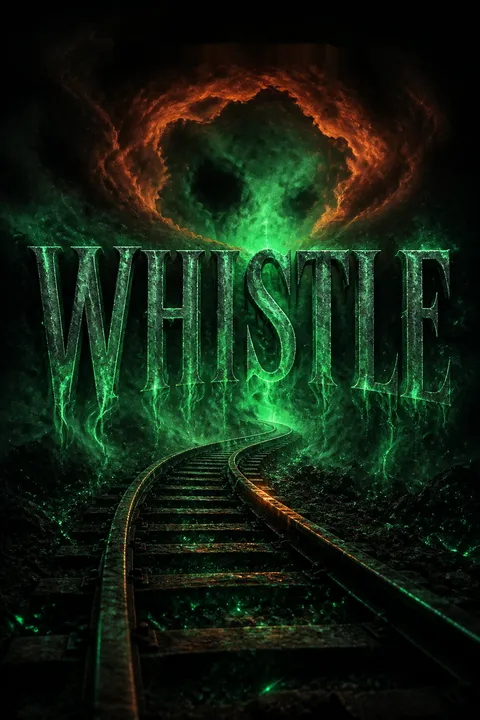

Plot Summary
Christmas Morning's Dark Magic
On a bleak Christmas morning in 2001, young Jeremy receives a box of used toy trains instead of the PlayStation he desperately wanted. Disappointed, he's soon drawn into the trains' strange allure, feeling a tingle of energy as he touches them. In a moment of childish revenge, he ties his sister's Bratz doll to the tracks, and as the train derails, his sister suffers a real-life injury in the kitchen—her finger severed, mirroring the doll's fate. The uncanny connection between the toy and reality is established, hinting at a dark, supernatural force at play. This moment plants the seed for the story's central horror: the boundary between play and reality is dangerously thin, and something in the trains is hungry for more than just imagination.
The Penguin That Could Fly
Annie Blunt, a beloved children's author, creates the Pierce the Penguin series, culminating in a book where the penguin learns to fly. The story's message of boundless possibility inspires millions, but tragedy strikes when a young fan, Evan, leaps from a balcony, believing he too can fly. Annie is consumed by guilt, her life and career derailed by the boy's death. The world debates the responsibility of creators, but Annie's pain is personal and unrelenting. Her husband John tries to support her, but the shadow of the accident lingers, setting the stage for further loss and the unraveling of Annie's world.
Tragedy and Guilt Unleashed
As Annie struggles to recover, her husband John is killed in a hit-and-run, his beloved Marvin the Martian watch stolen from his body. Annie's grief is compounded by the mysterious disappearance of the watch and the sense that fate—or something darker—is punishing her. Her son Charlie begins sleepwalking, haunted by his father's absence. The family's pain is mirrored by strange, inexplicable events, and Annie's sense of reality grows increasingly fragile. The city that once felt like home now feels haunted, and Annie is desperate for escape, not knowing that the true source of her torment is only beginning to reveal itself.
A Retreat to Nowhere
Annie and Charlie flee New York for a rented country house, hoping for peace. The house is idyllic but carries its own scars—a neighbor's wife was driven mad there, and the shed in the backyard is locked tight. Charlie discovers a box of old toy trains in the shed, and as he assembles them, the same strange energy from Jeremy's Christmas morning returns. The trains become Charlie's obsession, and Annie's unease grows. The house's history, the neighbor's warnings, and the trains' inexplicable power all converge, suggesting that the family has not escaped their troubles, but stumbled into the heart of them.
The House Across the Tracks
Annie befriends Daniel, the neighbor whose wife Dolores suffered a breakdown in Annie's house years before. Dolores, now a shell of herself, is haunted by memories she cannot articulate. Annie learns that the previous residents fled without explanation, leaving behind the very trains Charlie now plays with. The house's past is littered with tragedy, and Annie begins to suspect that the trains are more than mere toys—they are conduits for something malevolent. As storms rage and power flickers, Annie's dreams and waking life blur, and the trains' influence grows stronger.
The Boy and the Trains
Charlie's world narrows to the trains and the miniature town he builds, mirroring the real Lucknow. Annie, meanwhile, is plagued by visions—spiders pouring from boxcars, phantom trains roaring through the night, and her own monstrous sketches coming to life. The trains run even when unplugged, and the boundaries between imagination and reality dissolve. Charlie's sleepwalking intensifies, and Annie's attempts to protect him only deepen her sense of helplessness. The house becomes a crucible for their fears, and the trains' true purpose begins to emerge.
The Shop That Shouldn't Exist
In the nearby (and soon-to-be-doomed) town of Lucknow, a mysterious shop called Choo-Choo's Trains appears overnight, run by the enigmatic Edwin Nabler. The shop's trains are irresistible, each set customized and imbued with a strange "tingle." Customers feel compelled to buy, and soon, the trains are scattered in homes throughout the town. Nabler is more than a shopkeeper—he is a supernatural agent, harvesting tragedy and chaos through his creations. As disappearances and bizarre deaths mount, the town's police chief, Harry Cook, begins to suspect that something is terribly wrong.
The Chief's Unraveling
Chief Harry Cook investigates a series of gruesome disappearances and deaths—bodies found deboned, pets and people dying in inexplicable ways, and a rash of accidents all linked by the presence of toy trains. As Harry digs deeper, he encounters Nabler, whose identity and history are a void. The chief's rational mind is tested as evidence mounts that the trains are not just toys, but instruments of supernatural malice. Harry's own family is drawn into the web, and his pursuit of the truth becomes a race against time and fate.
The Collector of Bones
Nabler's backroom is a grotesque masterpiece—a sprawling model train layout built from human bones, hair, teeth, and personal artifacts. Each train that runs through it absorbs a piece of this horror, carrying it into the world. Nabler is not human, but a being from the "sliver," a realm of chaos that feeds on suffering. He is both artist and predator, orchestrating tragedy on a grand scale. As Harry closes in, Nabler's power grows, and the town's doom is sealed.
The Town That Died
A catastrophic train derailment destroys Lucknow, killing thousands in a cloud of toxic gas. The disaster is triggered by a mirrored accident in Nabler's model—tanker cars derailing, chaos unleashed. The town's destruction is both literal and symbolic, the ultimate expression of Nabler's purpose. Survivors are few, and the town becomes a ghostly monument to the power of the sliver. Harry dies in the chaos, his family lost, and Nabler prepares to move on, his appetite undiminished.
The Sliver's True Face
Drawn by supernatural compulsion and her son's disappearance, Annie follows the trail to Lucknow, now abandoned and haunted. She discovers Choo-Choo's Trains, where Nabler reveals his true form—a monstrous rat-wolf, the very creature Annie has been sketching. Nabler confesses to orchestrating John's death, Evan's tragedy, and the entire chain of events. He offers Annie a terrible choice: become his successor, the new agent of chaos, or lose Charlie forever. The sliver's logic is seductive and inescapable, and Annie is forced to the brink.
The Child's Impossible Journey
Charlie, believing he can find his father, embarks on an epic, impossible bike journey toward Lucknow, guided by dreams and Nabler's manipulations. Along the way, he is both victim and hero, evading danger, surviving on scraps, and finally being picked up by Nabler himself. Charlie's innocence and determination are weaponized by the sliver, and his arrival in Lucknow sets the stage for the final confrontation. The bond between mother and son is tested to its limits.
The Mother's Descent
Inside Nabler's lair, Annie is forced to drink a potion that will transform her into his successor. She bargains for a final moment with Charlie, using coded language to communicate a desperate plan. As Nabler's power begins to consume her, Annie relies on her creative instincts and the bond with her son to fight back. The lines between reality and nightmare blur, and Annie's fate hangs in the balance.
The Ghost Town's Invitation
Lucknow, now a ghost town, is both setting and symbol—a place where the past refuses to die and the sliver's influence lingers. Annie and Charlie's escape is fraught with danger, as the remnants of Nabler's power threaten to consume them. The burning of Choo-Choo's Trains marks the end of one cycle, but the scars remain. The town's silence is both a relief and a warning: evil can be banished, but never fully destroyed.
The Final Embrace
Annie and Charlie, battered but alive, flee Lucknow. Their bond, tested by supernatural horror and personal tragedy, is unbreakable. Annie's creative spirit is rekindled, and the possibility of healing emerges. The world is changed, but hope endures. The story closes on a note of resilience—love is the only force that can stand against the sliver, and the only thing worth fighting for.
The Monster's Undoing
Annie's artistic gift, the very thing that made her a target, becomes her weapon. With Charlie's help, she uses a sculpture of Nabler's true form to mirror and destroy him, exploiting the sliver's own rules. The act is both creative and destructive, a final assertion of human agency against supernatural evil. Nabler is undone, his lair consumed by fire, and the cycle of chaos is broken—at least for now.
Ashes and Aftermath
In the aftermath, Annie and Charlie return to a world forever changed. The scars of their ordeal remain, but so does the possibility of renewal. The house that was the site of so much pain burns to the ground, and the neighbors who suffered for decades are finally freed. The story ends with a sense of hard-won peace, but the memory of the sliver lingers—a warning that the boundary between play and reality, creation and destruction, is always perilously thin.
Analysis
Whistle is a masterful fusion of supernatural horror, psychological thriller, and metafictional meditation on the power—and peril—of creativity. At its core, the novel interrogates the boundary between imagination and reality, asking what happens when the stories we tell, the toys we play with, and the art we create take on a life of their own. Through the lens of Annie's guilt and Charlie's innocence, Linwood Barclay explores the dangers of unchecked belief, the randomness of tragedy, and the seductive logic of chaos. The sliver, as both cosmology and metaphor, represents the unpredictable, often cruel forces that shape our lives—forces that can be harnessed, but never fully controlled. The novel's structure, with its mirroring of miniature and real-world disasters, its unreliable reality, and its recursive storytelling, invites readers to question the nature of agency, responsibility, and fate. Ultimately, Whistle is a story about the cost of survival, the resilience of love, and the enduring power of art to both wound and heal. Its lesson is both cautionary and hopeful: creation is a double-edged sword, and the only thing that can stand against the darkness is the courage to imagine something better.
Review Summary
People Also Read

Characters
Annie Blunt
Annie is a celebrated children's author whose imaginative gifts become both her salvation and her curse. Her creation, Pierce the Penguin, inspires joy but also tragedy, as a child's death is linked to her work. Annie is wracked by guilt, her sense of responsibility for Evan's death and her husband's loss nearly overwhelming her. Her psychological journey is one of grief, self-doubt, and ultimately resilience. As a mother, her love for Charlie is fierce and unwavering, driving her to confront supernatural evil. Annie's creativity is both her vulnerability and her weapon—her ability to see and shape the world is what makes her the sliver's target, but also what allows her to fight back. Her arc is one of transformation: from victim to survivor, from creator to destroyer of monsters.
Charlie Blunt
Charlie is Annie's young son, traumatized by his father's death and drawn into the orbit of the trains' supernatural power. His sleepwalking, obsession with the trains, and eventual journey to Lucknow are both the result of manipulation and his own longing for family. Charlie's innocence is weaponized by Nabler, but his bond with Annie and his own resourcefulness become crucial in the final battle. He is both a victim and a hero, his journey a testament to the resilience of childhood and the enduring power of love.
Edwin Nabler (Mr. Choo)
Nabler is the story's true antagonist—a being from the "sliver," a realm of chaos that feeds on suffering. Disguised as a genial toy train shop owner, he is in fact a monstrous rat-wolf, a collector of bones and orchestrator of tragedy. Nabler's psychology is alien, his motivations rooted in a cosmic logic of balance and entropy. He is both artist and destroyer, harvesting pain through his creations. His desire to find a successor in Annie is both practical and perverse—a search for meaning, legacy, and continued chaos. Nabler's undoing comes from his own rules, his underestimation of human creativity and love.
John Traynor
John is Annie's late husband, an animator and kindred creative spirit. His death—engineered by Nabler—shatters Annie and Charlie, setting them on their journey. John's presence lingers as memory, dream, and inspiration. He represents the life Annie has lost and the love that sustains her. His stolen watch becomes a symbol of the sliver's theft of joy and the personal cost of supernatural evil.
Harry Cook
Harry is the police chief of Lucknow, a rational man confronted with the irrational. His investigation into the town's mounting tragedies is methodical, compassionate, and ultimately doomed. Harry's arc is one of growing horror and helplessness, as he realizes that the evil he faces is beyond the reach of law or reason. His death is both a personal tragedy and a symbol of the town's annihilation—a good man lost to forces he cannot comprehend.
Daniel Patten
Daniel is Annie's neighbor in the country, whose wife Dolores was driven mad by the house's supernatural influence. He is a figure of empathy and warning, his own suffering a mirror for Annie's. Daniel's arc is one of endurance and, finally, release, as the destruction of the house frees Dolores and restores their love. He represents the collateral damage of the sliver's presence and the possibility of healing.
Dolores Patten
Dolores is a casualty of the house's dark history, her mind shattered by an encounter with the trains' power. She is both a warning and a mystery, her fragmented memories hinting at the depth of the evil at work. Dolores's recovery at the story's end is a sign that the cycle of suffering can be broken, if only temporarily.
Finnegan Sproule
Finnegan is Annie's editor and confidant, whose efforts to help her inadvertently draw her deeper into the sliver's web. His death is a shock, a reminder that good intentions are no defense against supernatural malice. Finnegan's role is that of the supportive outsider, his fate a warning about the dangers of proximity to the story's central evil.
Jeremy Anderson
Jeremy is the boy from the prologue whose Christmas morning encounter with the trains sets the story's horror in motion. His childish malice and the trains' supernatural power combine to unleash tragedy, establishing the rules of the sliver's game. Jeremy is both innocent and culpable, a symbol of the story's central theme: the peril of imagination unmoored from reality.
Evan Corcoran
Evan is the child whose death is linked to Annie's book, the event that shatters her life and sets the story in motion. He is both a victim and a symbol—the cost of creativity, the danger of stories, and the vulnerability of belief. Evan's presence haunts Annie, his fate a constant reminder of the stakes of the sliver's game.
Plot Devices
The Haunted Object
The central plot device is the toy train—an object that bridges the gap between imagination and reality, childhood innocence and adult horror. The trains are not merely cursed, but actively predatory, absorbing the essence of suffering and tragedy from the sliver. Their power is amplified by the model town built from human remains, and their influence spreads through play, dreams, and obsession. The trains' ability to mirror and trigger real-world events is the engine of the story's horror, blurring the line between cause and effect, play and peril.
The Sliver
The sliver is the story's cosmology—a dimension of chaos that seeks to restore "balance" by orchestrating tragedy. Its agents, like Nabler, are both artists and predators, using creativity as a weapon. The sliver's logic is seductive, its rules both arbitrary and inescapable. It is a metaphor for the randomness of suffering, the unpredictability of fate, and the dangers of unchecked imagination.
Mirroring and Sympathetic Magic
The story's supernatural mechanics are rooted in the idea of mirroring—actions taken in the model world are reflected in the real one. This is both literal (the derailment in the model triggers the real disaster) and psychological (Annie's art becomes her weapon). The device is used to explore themes of responsibility, agency, and the power of creation. It also allows for foreshadowing and escalation, as small acts of play become harbingers of catastrophe.
The Unreliable Reality
Throughout the novel, the distinction between dream and reality is constantly undermined. Annie's visions, Charlie's sleepwalking, and the trains' inexplicable behavior all contribute to a sense of unreality. This device heightens suspense, disorients the reader, and reflects the characters' psychological states. It also serves as a metaphor for trauma, grief, and the difficulty of distinguishing between guilt and fate.
The Successor's Dilemma
Nabler's search for a successor is both a plot engine and a thematic device. It externalizes the story's questions about creativity, responsibility, and the cost of survival. Annie's choice—to become the new agent of chaos or sacrifice herself for her son—drives the climax and forces a confrontation with the story's deepest fears. The device allows for a final twist, as Annie uses her own creative power to subvert the sliver's rules and destroy Nabler.
Download PDF
Download EPUB
.epub digital book format is ideal for reading ebooks on phones, tablets, and e-readers.








































