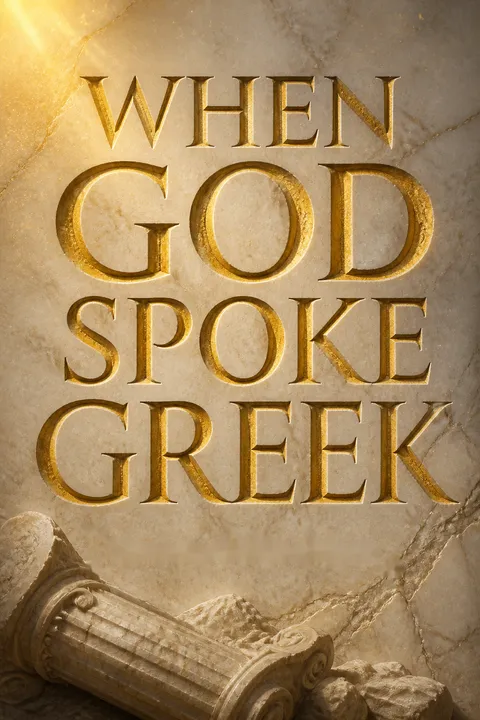

Key Takeaways
1. The Septuagint: The Unsung Foundation of the Christian Bible
You may never have heard of it, but the Septuagint will have made its way to you if you have read or so much as glanced at a Bible.
Hidden influence. The Septuagint (LXX), the ancient Greek translation of the Hebrew scriptures, is a foundational text for Christianity, yet its significance is often overlooked. Many Old Testament book names, like Genesis and Deuteronomy, derive from their Greek titles in the LXX. More profoundly, the language and theology of the New Testament writers are deeply indebted to the LXX, not primarily to the Hebrew Bible.
Beyond footnotes. Modern English Bibles, largely based on the medieval Hebrew Masoretic Text (MT), often relegate the LXX to footnotes, suggesting it only offers alternative readings when the Hebrew text seems problematic. This marginalization obscures the LXX's critical role in shaping early Christian thought and its witness to a period of rich textual diversity. The discovery of the Dead Sea Scrolls (DSS) dramatically confirmed that the LXX often translated Hebrew texts that differed significantly from the later standardized MT.
A theological imperative. Understanding the LXX is crucial for comprehending the development of Jewish thought in the Hellenistic period and, especially, the formation of early Christian theology. Many core New Testament teachings and doctrines were explicitly shaped by the LXX, not the MT. To ignore the LXX is to miss a vital part of the Bible's history and its profound impact on Christian faith.
2. Before the Bible: A World of Fluid Scriptures
To be candid: before the Bible, there was no Bible.
Textual fluidity. Contrary to common assumptions, a fixed, canonical "Bible" as we know it did not exist before the second century CE. Instead, there were "scriptures" or "scriptural texts"—authoritative writings whose individual forms were still evolving, and whose collection boundaries were undefined. This period was characterized by textual plurality, not uniformity.
Dead Sea Scrolls' revelation. The discovery of the Dead Sea Scrolls revolutionized biblical scholarship by providing Hebrew and Aramaic manuscripts far older than the medieval MT. These scrolls revealed that:
- Many manuscripts differed from the received Hebrew Bible.
- Some agreed with divergent LXX passages, proving the LXX translated alternative Hebrew texts.
- The MT, while ancient, represents only one of several scriptural traditions circulating before the 2nd century CE.
Meaningful variations. The differences were not trivial. For instance, the LXX version of Jeremiah is roughly one-sixth shorter than the MT and has a different chapter order, a feature confirmed by Qumran manuscripts. The famous David and Goliath story in 1 Samuel is significantly shorter in the LXX, reflecting an earlier Hebrew edition. These variations demonstrate that biblical texts were in an "extraordinary state of fluctuation" for centuries, a reality that did not seem to trouble ancient readers.
3. Hellenism's Gift: The Genesis of the Greek Torah
The Septuagint, the translation of the Hebrew Torah into the lingua franca of the Hellenistic world, was “at once the greatest achievement of Hellenistic Jewry and its most important legacy to western mankind.”
A cultural imperative. The conquests of Alexander the Great in the 4th century BCE ushered in the Hellenistic Age, transforming the Mediterranean world with Greek language and culture. For Jews dispersed across this new Greek-speaking world, particularly in Alexandria, their competence in Hebrew diminished. Translating their sacred texts into Greek became a matter of cultural survival and religious continuity.
The Aristeas legend. The origins of the Septuagint are shrouded in legend, primarily from the 2nd-century BCE Letter of Aristeas. This fictional account describes Ptolemy II Philadelphus commissioning 72 Jewish scholars (six from each tribe) from Jerusalem to translate the Hebrew Torah into Greek for the Library of Alexandria. The legend emphasizes:
- Royal patronage and scholarly rigor.
- The release of Jewish slaves as a prerequisite.
- A miraculous consensus among the translators, hinting at divine inspiration.
Alexandrian ingenuity. While the legend is not historical, it reflects the reality that Hellenized Jewish scholars in Alexandria, likely in the late 3rd or early 2nd century BCE, undertook this monumental task. The translation of the Pentateuch (Torah) was a unique achievement, as no religious text of such size had ever been translated into an entirely different language. This Greek Torah, later followed by other books, became a new revelation for Greek-speaking Jews, ensuring the vibrancy of Judaism in the Diaspora.
4. A Different Story: The Septuagint's Divergent Narratives
The Septuagint often preserves a witness to an alternative, sometimes older, form of the Hebrew text.
Beyond mere translation. The Septuagint is not simply a Greek rendering of the Hebrew Bible; it often presents a distinct literary and theological tradition. This divergence stems from two main factors:
- Translators working from different Hebrew source texts than those that later formed the MT.
- Translators introducing intentional changes, interpretations, or even errors.
Striking examples of divergence:
- Genesis: The LXX states God finished creation on the sixth day (Gen 2:2), resolving an apparent contradiction in the MT which says the seventh.
- Samuel: The David and Goliath narrative (1 Sam 17) is significantly shorter in the LXX, lacking key details found in the MT, suggesting the MT is a later expansion.
- Jeremiah: The LXX is about one-sixth shorter than the MT, with different chapter orders and theological nuances, such as God being "unconcerned" for disobedient Israel (Jer 31:32 LXX) versus being "their husband" (MT).
- Amos: The LXX transforms Amos's locust vision into an apocalyptic army led by "Gog the king" (Amos 7:1), reflecting Hellenistic Jewish eschatological interests.
- Psalms: Psalm 8:5 in the LXX reads "a little lower than angels" instead of "a little lower than God" (MT), a theological softening that influenced later Christian thought.
These examples demonstrate that the LXX offers a window into the textual plurality of early Judaism and often presents a "spectacularly different message" from the MT, shaping subsequent religious interpretation.
5. Beyond the Canon: The Apocrypha's Enduring Influence
The collection of books in the so-called Old Testament Apocrypha has a different story from that of the pseudepigrapha.
Hidden but not forgotten. The term "Apocrypha" (meaning "hidden" or "secret") refers to a collection of biblical books that were included in the Septuagint but later excluded from the Jewish and Protestant canons. These books, alongside the "Pseudepigrapha" (falsely attributed works like 1 Enoch), represent a vibrant literary period between 200 BCE and 200 CE.
Diverse origins and genres:
- Some Apocryphal books were originally composed in Greek (e.g., Wisdom of Solomon, 2-4 Maccabees, Additions to Esther B and E).
- Others were translated from Hebrew or Aramaic (e.g., Tobit, Sirach, 1 Maccabees, Additions to Daniel).
- They span genres like wisdom literature (Sirach, Wisdom), apocalyptic (2 Esdras), historical fiction (Judith, Tobit, 3 Maccabees), and historical accounts (1-2 Maccabees).
Theological richness and canonical fluidity. These texts offered unique theological insights and narratives:
- Wisdom of Solomon: One of the first Jewish texts to discuss the immortality of the soul and influenced Pauline theology.
- 2 Maccabees: Contains the strongest biblical statement for creation ex nihilo (7:28) and powerful martyrdom accounts that inspired early Christians.
- Tobit: A story of faithfulness in exile, featuring angelic intervention and cosmic battles.
- Additions to Esther: Added explicit mentions of God and piety to the otherwise secular Hebrew book.
While not universally accepted into all canons, many early Jews and Christians treated these books as "scriptural texts," and they remain canonical in Roman Catholic and Orthodox traditions, demonstrating the fluid nature of the biblical canon for centuries.
6. The New Testament's Old Testament: A Greek Foundation
The language and theology of the New Testament writers are indebted far more to the Septuagint than to the Hebrew Bible.
LXX as primary source. When New Testament authors quote the Old Testament, they overwhelmingly cite the Greek Septuagint, not the Hebrew Bible. This is crucial because, as established, the LXX often presents different readings and theological nuances than the MT. This reliance on the LXX shaped the very fabric of early Christian thought.
Gospel examples:
- Matthew: Despite being the most "Jewish" Gospel, Matthew's citations often align with the LXX, notably in the prophecy of the "virgin birth" (Isaiah 7:14 LXX uses parthenos for "virgin," while the Hebrew 'almah means "young woman").
- Luke: Jesus' mission to proclaim "recovery of sight to the blind" (Luke 4:18) is a direct citation from the LXX of Isaiah 61:1, absent in the Hebrew. Luke also weaves in phrases from Isaiah 58:6 (LXX) to emphasize liberation.
- Acts: James's argument for Gentile inclusion at the Jerusalem Council (Acts 15:16-18) quotes Amos 9:11-12 from the LXX, which shifts the focus from Israel inheriting nations to Gentiles seeking the Lord.
Pauline theology. The apostle Paul's theological framework, particularly in Romans, is deeply rooted in the LXX. He often "misreads" or reinterprets LXX passages to support his arguments for Gentile inclusion and Christ's role:
- Romans 2:24: Paul quotes Isaiah 52:5 (LXX) to accuse Israel: "The name of God is blasphemed among the Gentiles because of you."
- Romans 9:33: Paul combines Isaiah 28:16 (LXX) to speak of Christ as a "stumbling stone" and the object of belief, where the Hebrew is less explicit.
- Romans 10:15: Paul's use of Isaiah 52:7 (LXX) transforms Isaiah's lone herald into "messengers who bring good news," legitimizing widespread evangelism.
The NT writers' use of the LXX was not merely incidental; it provided them with the textual basis for many of their unique theological claims and missionary endeavors, often exploiting the textual plurality of the era.
7. God's New Word: The Septuagint as the Church's Revelation
As God did for the Jews in Hebrew and Aramaic, so now he had spoken in Greek for the church.
The Church's Old Testament. Early Christians, writing predominantly in Greek, naturally adopted the Greek Jewish scriptures as their Old Testament. This was not merely a practical choice but quickly evolved into a theological conviction: the Septuagint was seen as a new, divinely inspired revelation specifically for the burgeoning Christian church.
Missionary expansion. The LXX was instrumental in the global spread of Christianity. As early as the 2nd century, the LXX was translated into Latin (Old Latin version), and later into Syriac, Coptic, Armenian, and other languages. These "daughter translations" allowed diverse local Christian communities to access the scriptures, making the LXX the vehicle for the gospel beyond the Greek-speaking world.
Legend and justification. Christian writers amplified the Letter of Aristeas legend to bolster the LXX's authority. Philo of Alexandria explicitly claimed divine inspiration for the LXX translators, stating they "prophesied" in unison. Later, Eusebius of Caesarea argued the LXX was part of God's praeparatio evangelica ("preparation for the Gospel"), providentially guiding a Greek translation so that the nations could recognize Christ's prophecies. This narrative positioned the LXX as superior to the Hebrew Bible, which Jews, in their "jealousy," supposedly withheld.
Theological formation. The LXX profoundly shaped early Christian doctrine and piety:
- Christological titles: The LXX's use of kurios for Yahweh and christos for "anointed" allowed NT writers and Church Fathers to apply these titles to Jesus, affirming his divinity and messianic identity.
- Trinitarian theology: Passages like Isaiah 61:1 ("The spirit of the Lord is upon me") and Amos 4:13 ("announces his anointed to humans") were interpreted to support the unity of Father, Son, and Spirit.
- Typological exegesis: The Greek name Iēsous (Joshua/Jesus) enabled parallels between Joshua leading Israel into the land and Jesus leading believers into salvation.
- Liturgical language: Many prayers, hymns, and theological terms in early Christian liturgies were directly drawn from the LXX.
For centuries, the Septuagint was unequivocally "the Christian Old Testament," shaping every aspect of Christian life and thought.
8. The Hexapla's Unintended Legacy: Origen's Double-Edged Sword
Origen’s Hexapla was the beginning of the end of the Septuagint in the church, but only by accident.
Origen's monumental scholarship. Origen (c. 185–254 CE), nicknamed "Adamantius" (man of steel), was arguably the most influential scholar of the early church. Based in Alexandria and later Caesarea, he was a prolific exegete and theologian, deeply immersed in allegorical interpretation and diverse philosophical traditions. His magnum opus, the Hexapla, was a six-columned Bible compiled in the mid-230s.
The Hexapla's structure:
- Hebrew text (proto-Masoretic)
- Hebrew transliterated into Greek characters
- Aquila's Greek version (hyper-literal)
- Symmachus's Greek version (elegant)
- The Septuagint (the Church's Bible)
- Theodotion's Greek version (revision of LXX towards Hebrew)
Purpose and unintended consequences. Origen's motivations for the Hexapla were complex:
- Apologetics: To be prepared for debates with Jews by comparing versions.
- Textual "healing": To "correct" the LXX where it diverged from the Hebrew, though he didn't realize the Hebrew itself was still evolving.
- Exegetical maximalism: To offer a richer, expanded Bible for deeper interpretation, believing divergences were providentially guided for the Church's edification.
Crucially, Origen never intended to replace the LXX. He believed Providence guided its translators and that its "errors" were stepping-stones to higher understanding. However, the fifth column of the Hexapla, a hybrid text where Origen inserted readings from other Greek versions (marked with asterisks) to align with the Hebrew, was later copied without these critical signs. This "Hexaplaric Septuagint" spread widely, unintentionally contaminating the original LXX textual stream and introducing Hebrew-aligned readings into the Church's Greek Bible.
9. The Battle for the Bible: Jerome's Hebrew Truth vs. Augustine's Greek Tradition
Jerome’s experiences reading the Hebrew Bible with Jews and learning rabbinic exegetical traditions had a profound impact on his perspectives on the nature of scripture, and he knew he was one of only a handful of Latin Christians who could read the Hebrew.
Jerome's radical shift. Jerome (c. 347–420 CE), a brilliant scholar with a classical education and a hard-won knowledge of Hebrew and Syriac, initially revised the Old Latin Bible based on Origen's Hexaplaric Septuagint. However, his interactions with Jewish teachers in Bethlehem convinced him of the "Hebraica veritas" – the "Hebrew truth" – as the ultimate authority for the Christian Old Testament. In the 390s, he embarked on a revolutionary project: a new Latin translation (the Vulgate) directly from the Hebrew Bible.
Jerome's arguments for the Hebrew Bible:
- Aristeas legend as a lie: He dismissed the foundational myth of the LXX's divine inspiration.
- LXX errors: He argued the LXX was full of contradictions and errors, produced by "amateurs."
- New Testament's true source: He falsely claimed the NT writers used the Hebrew Bible.
- Apocrypha's demotion: He "invented" the Apocrypha as a separate category of books to be admired for their stories but not treated as truth, effectively removing them from the integrated Old Testament.
- Linguistic superiority: He believed the truth resided in the Hebrew language itself, making him the gatekeeper of this mysterious treasure for the Latin church.
Augustine's defense of the Septuagint. Augustine (354–430 CE), Bishop of Hippo, vehemently opposed Jerome's project, fearing it would destabilize the church. He argued:
- Divine inspiration: The LXX was divinely gifted to the church, its translators guided by the Holy Spirit to produce a text "suitable for the nations."
- NT precedent: The New Testament writers used the LXX, validating its authority.
- Church unity: Introducing a new Bible would cause schism between the Greek East and Latin West, and within local congregations (e.g., the "gourd" vs. "ivy" controversy in Jonah).
- Philosophy of language: For Augustine, language was merely a sign pointing to God; differences between Hebrew and Greek were not problematic, and God could intentionally obscure meanings to encourage deeper spiritual understanding.
Despite Augustine's powerful arguments, Jerome's Vulgate eventually triumphed in the West, not necessarily due to the "Hebrew truth," but because it offered a single, stable text in a period of political and ecclesiastical fragmentation.
10. Reclaiming the Septuagint: A Call for Modern Christian Theology
Many modern Christians are fixated with the search for an “original text,” but from the beginning it was not so.
Modern anxiety vs. ancient appreciation. The modern Christian preoccupation with finding a single, "original text" of the Bible stands in stark contrast to the early church's approach. Early Christians, including Augustine, embraced textual diversity, viewing multiple versions as complementary avenues to divine truth, not as hindrances. They found richness and deeper meaning even in divergences and perceived "errors."
The Septuagint's modern neglect. After Jerome's Vulgate gained ascendancy in the West, and especially after the Reformation's emphasis on ad fontes (return to the sources) which was interpreted as a return to the Hebrew Bible, the Septuagint's prominence waned. It became relegated to an ancillary discipline, primarily studied for its value as a witness to the Hebrew text rather than as a theological text in its own right. This bias persists in many Christian educational institutions today.
Unique theological contours. The Septuagint is not merely a translation; it often presents distinct theological trajectories that differ from the Hebrew Bible. These include:
- Eschatology and Messianism: As seen in Amos's "Gog the king" or Isaiah's messianic prophecies.
- God's character: Passages like Exodus 15:3 ("The Lord, when he shatters wars" instead of "The Lord is a warrior") or Psalm 9:21 ("Set a lawgiver over them" instead of "Put them in fear") soften the image of a punitive God.
- Fulfillment of prophecy: The LXX provided the specific wording that enabled New Testament authors to connect Jesus to Old Testament prophecies, such as the "virgin birth."
An indispensable resource. If the Septuagint profoundly shaped the New Testament writers and the Church Fathers, forming the very foundation of early Christian theology, then its neglect in modern Christian thought is a significant oversight. Re-engaging with the Septuagint, not just as a textual variant but as a primary witness to the Christian Old Testament, offers new vistas for theological reflection and a richer understanding of the Bible's complex history and its enduring message.
People Also Read






Download PDF
Download EPUB
.epub digital book format is ideal for reading ebooks on phones, tablets, and e-readers.








































