

Key Takeaways
Stop believing science simply reads facts off the world
Observation is never neutral. The popular image of science holds that a careful, unprejudiced observer opens their eyes, records what is there, and builds theory to fit. Chalmers dismantles this. Two people with identical retinal images can see different things: a novice and an expert peering at the same X-ray or microscope slide perceive utterly different worlds. The expert sees diseased lungs; the beginner sees shadowy blotches. What you see depends on your training, expectations, and concepts.
Facts are statements, not raw sensations. To state a botanical fact you need botany first. Even the observation "the earth is stationary" was once a confirmed fact, later overturned once inertia was understood. Facts and theory are interdependent and both are fallible.
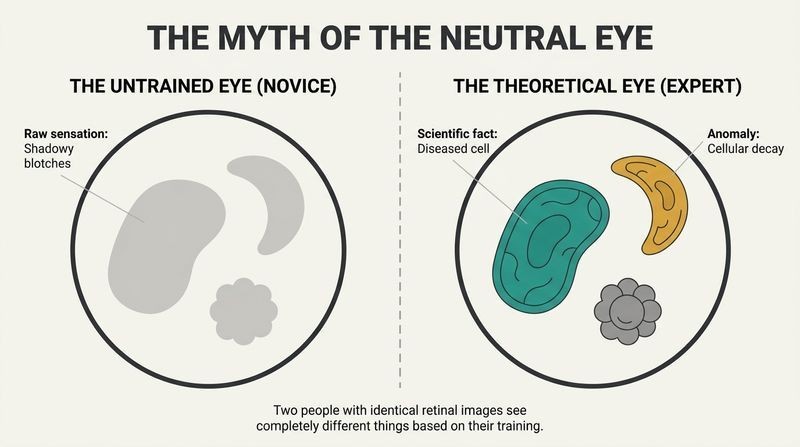
This opening move aligns Chalmers with N.R. Hanson's "theory-ladenness of observation" and anticipates cognitive science findings on perception as prediction. The brain is not a passive camera but an active hypothesis-tester, as Andy Clark's predictive-processing framework now argues. The danger is overreach: if all observation is theory-soaked, how does evidence ever discipline theory? Chalmers wisely resists total relativism, noting that a single physical world constrains what we can see. The tension he opens here, between the constructed and the given, animates the entire book and remains unresolved across the philosophy of science.
No pile of observations can ever prove a universal law
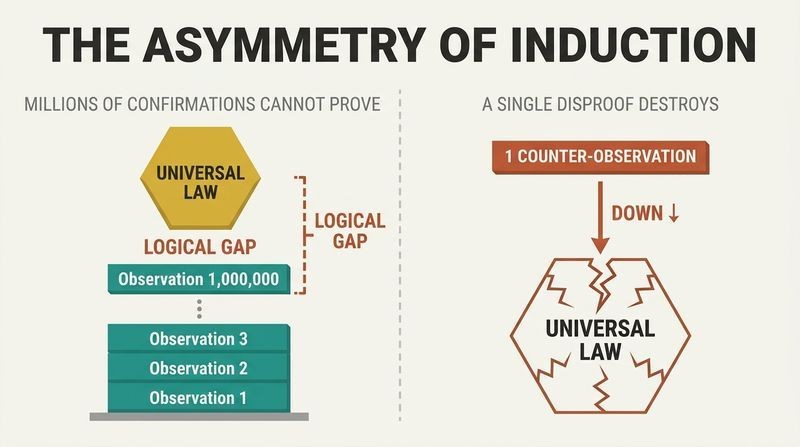
Logic runs one way only. Scientific laws are universal statements ("all metals expand when heated"), but evidence consists of finite singular observations. Deducing the universal from the particular is not logically valid: even a million confirming instances cannot guarantee the next case. Bertrand Russell's turkey captures it perfectly. Fed at 9am every morning, the turkey inductively concludes it will always be fed at 9am, right up until Christmas Eve, when its throat is cut instead.
Induction cannot justify itself. Hume's problem: you cannot defend induction by saying "it has worked before," because that argument is itself inductive, assuming what it sets out to prove. Attempts to soften this to "probably true" fail too, since any universal law has infinite possible cases, driving its probability toward zero.
Hume's problem has never been dissolved, only managed. Karl Popper thought he escaped it by abandoning induction entirely; Bayesians (whom Chalmers examines) try to rehabilitate it with subjective probabilities. Nassim Taleb popularized the turkey as the "Black Swan," warning that absence of evidence for catastrophe is not evidence of absence. The practical lesson bites hardest in risk-heavy domains: financial models, epidemiology, and engineering all lean on inductive extrapolation that can fail suddenly and catastrophically. What's underappreciated is that working scientists rarely lose sleep over this; the gap between philosophical rigor and productive practice is itself a datum worth explaining.
A theory that explains everything predicts nothing and isn't science
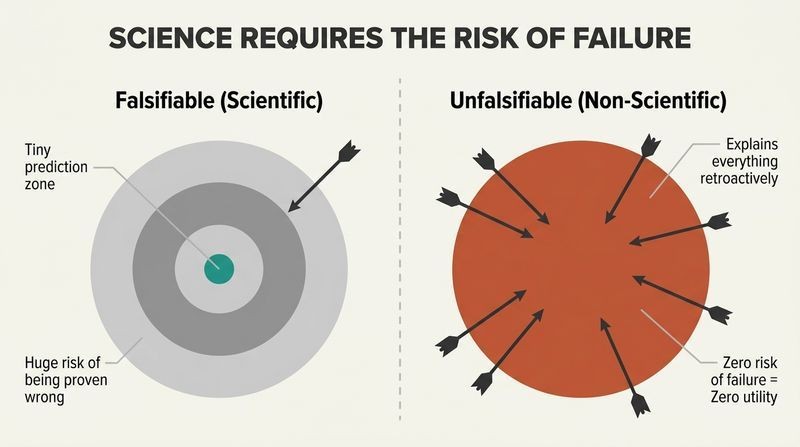
Falsifiability is the test. Karl Popper, disenchanted by how Freudians and Marxists could reinterpret any event as confirmation, argued that genuine science sticks its neck out. A theory is scientific only if it forbids something, if there exists a conceivable observation that would refute it. Einstein's general relativity risked everything on the 1919 prediction that starlight would bend near the sun; had the eclipse measurements gone the other way, the theory was dead. That risk is its virtue.
Bold conjectures, ruthless testing. Science advances not by accumulating confirmations but by proposing daring, highly falsifiable guesses and trying to kill them. The more a theory forbids, the better it is. "It never rains on Wednesdays" is scientific (and false); "luck is possible in gambling" forbids nothing and tells us nothing.
Popper's demarcation criterion remains the most quoted idea in philosophy of science, beloved by practicing scientists precisely because it flatters the heroic self-image of bold risk-taking. Yet Chalmers shows its edges fray. Astrology makes falsifiable, falsified predictions, so falsifiability alone cannot expel pseudoscience. And confirmation clearly does matter: the value of the 1919 eclipse lay in a risky prediction coming true, not merely surviving. Modern demarcation debates (creationism, string theory's testability) still invoke Popper, but most philosophers now treat falsifiability as necessary-ish rather than sufficient. It is a sharp tool with a loose handle.
You can never conclusively falsify a theory in isolation
Every test smuggles in assumptions. This is the Duhem-Quine thesis. To test a theory you must add auxiliary assumptions: descriptions of instruments, initial conditions, background laws. When a prediction fails, logic tells you only that something in the whole bundle is wrong, not what. So a stubborn scientist can always deflect the blame away from the core theory onto an auxiliary assumption.
History proves the point. When Uranus misbehaved, astronomers did not ditch Newton; they conjectured an unseen planet, and found Neptune. Lakatos imagined a scientist saving Newtonian theory endlessly by postulating hidden planets, then dust clouds, then magnetic fields, forever refusing refutation. Tycho Brahe thought he had refuted Copernicus by finding no stellar parallax, when in fact his estimate of stellar distances was wrong. Falsification is never clean.
Duhem-Quine is the quiet acid that dissolves naive falsificationism. It means data never uniquely dictate which belief to revise, a point W.V.O. Quine radicalized into holism: in principle any statement can be held true if we adjust enough elsewhere. This has teeth beyond physics. In machine learning, a failed prediction could indict the model, the training data, the loss function, or the preprocessing, and disentangling them is genuine craft. The worry is that Duhem-Quine licenses dogmatism. Chalmers' rejoinder, developed through Lakatos and Mayo, is that while logic underdetermines the choice, good methodology and severe testing can still discipline where blame legitimately falls.
Science lurches through revolutions, it doesn't just accumulate
Kuhn's cycle. Thomas Kuhn argued that mature science operates within a paradigm: a constellation of shared assumptions, exemplary problem solutions, instruments, and standards. Under it scientists do normal science, puzzle-solving that never questions fundamentals. Anomalies pile up, confidence cracks, a crisis erupts, and a rival paradigm eventually triggers a revolution. The shift resembles a gestalt switch or religious conversion more than a logical proof.
Rival paradigms are incommensurable. Because competing paradigms define their terms, questions, and even observations differently, no neutral standard forces a rational scientist to switch. Aristotelians and Newtonians, Kuhn said, in a sense "live in different worlds." Chalmers admires the descriptive accuracy but attacks the relativist streak: if standards shift with paradigms, in what sense is a new paradigm genuinely better?
Kuhn's 1962 book is among the most influential of the twentieth century, exporting "paradigm shift" into boardrooms and self-help. Chalmers performs a valuable surgical separation: Kuhn's insight about normal science as necessary dogmatism is powerful (echoed in how disciplines need shared frameworks to make cumulative progress), but his conversion rhetoric invites the relativism sociologists later ran with. The sharpest critique Chalmers offers, borrowing from Deborah Mayo, is that Kuhn actually out-explains Popper on astrology: astronomers could learn from failed predictions because they had a paradigm; astrologers could not. Normal science, not falsifiability, marks the difference. That is an elegant repair.
Judge research programs over decades, not experiments overnight
Hard core and protective belt. Imre Lakatos tried to rescue Popper from Duhem-Quine. A research program has a hard core of fundamental principles (Newton's laws, say) that scientists agree by convention not to question. Around it sits a protective belt of auxiliary assumptions, which absorb the blows of apparent falsifications and get modified instead. A negative heuristic forbids touching the core; a positive heuristic maps out how to develop the belt.
Progressive versus degenerating. A program is progressive if it keeps predicting new phenomena that get confirmed (Newton's program predicting Neptune, Halley's comet's return). It degenerates when it merely patches failures with contrived, ad hoc fixes. Crucially, Lakatos insisted there is "no instant rationality": a temporarily degenerating program may revive, so appraisal only works with historical hindsight.
Lakatos elegantly reframes the unit of scientific appraisal from single theories to evolving programs, which matches how research actually feels from inside a lab. But Chalmers presses two problems. First, the "hard cores" are less fixed than advertised; Copernicus himself tinkered with what should have been untouchable. Second, if degenerating programs may always stage comebacks, Lakatos cannot tell a contemporary scientist to abandon anything, which guts his claim to police "intellectual pollution" like astrology or Marxism. The demand that novel predictions be genuinely novel also had to be softened to "natural rather than contrived," since Copernicus's triumph explained long-known facts. A rich framework, honest about its own limits.
"Anything goes" is Feyerabend's dare, not his conclusion
Against Method. Paul Feyerabend took the failures of every proposed method to their extreme: there is no fixed scientific method, and science holds no rational superiority over myth, magic, or voodoo. His weapon was Galileo. If even Galileo, the icon of scientific progress, advanced by rhetoric, propaganda, and defying the plain evidence of the senses, then no tidy methodology captures real science.
Freedom over rules. Feyerabend framed this as humanitarian liberation, invoking John Stuart Mill: individuals should be free to choose between science and other traditions, and the state should be as separated from science as from church. Chalmers counters that Feyerabend's notion of freedom is purely negative, ignoring that individuals are born into pre-existing structures that shape what choices are even available, a point Hume made against Locke's social contract.
Feyerabend is philosophy of science's provocateur, and his Galileo case study is genuinely unsettling even to those who reject his conclusions. Chalmers' response is shrewd: he grants that universal, ahistorical method is a fantasy, but denies that the only alternative is nihilism. The false dichotomy (perfect method or no method) is Feyerabend's rhetorical trick. Interestingly, Chalmers also corrects Feyerabend's history, showing Galileo mounted rigorous, testable arguments for the telescope via the irradiation effect, not mere trickery. The deeper worry Feyerabend raises endures in today's science-authority debates: once you admit method is messy and historical, defenders of science need a subtler story than "we follow The Method."
Scientific standards evolve piecemeal, like repairing a ship at sea
Chalmers' middle way. There is no universal, timeless method that judges Aristotle and Einstein alike, but that does not mean anything goes. Standards, methods, aims, theories, and facts form a web, and any strand can be revised while the rest holds firm, providing the ground to argue from. You cannot rationally change everything at once, but you can change any one thing.
Galileo changed the rules rationally. Aristotelians held that the senses were "the criterion of science itself." Galileo overturned this by making telescopic data trump naked-eye data, using shared low-level observations both sides accepted (a distant lamp looks bigger at night than up close) and the irradiation effect to build a compelling case. He changed a standard by appealing to standards not currently in dispute.
This is Chalmers' constructive answer and it resembles Neurath's famous image of rebuilding a ship plank by plank while afloat, never in dry dock. It also parallels Larry Laudan's reticulated model, where aims, methods, and theories mutually adjust. The philosophical crux is answering John Worrall's challenge: to call a change "progress" you seem to need higher standards, which reintroduces universal method. Chalmers concedes a thin "commonsense" method (take argument and evidence seriously; don't chase knowledge beyond available means) but notes it is too banal to require philosophers. The genuinely useful upshot: debates over what counts as science (creation science, for instance) need detailed comparison, not a magic definition.
Experiments have a life of their own, independent of grand theory
The new experimentalism. Against decades of theory-obsessed philosophy, this movement (Ian Hacking, Deborah Mayo) insists experiment can establish robust knowledge without settling high-level theoretical disputes. When Faraday built a primitive electric motor in 1821 and mailed working samples across Europe, the effect was real and reproducible regardless of whether you believed his field theory or the rival Continental action-at-a-distance theory.
Reality by manipulation and cross-check. Hacking's example: view a microscopic grid through two microscopes working on entirely different physical principles (light and fluorescence). If both show the same dense bodies in the same grid squares, they are real, not artifacts, no detailed optical theory required. Mayo adds that a claim is supported only by a severe test: one the claim would very probably fail if it were false.
This is philosophy of science coming down to earth, and it rings true to bench scientists who trust their instruments long before they trust their theories. Mayo's severe-testing account, rooted in error statistics, elegantly dissolves puzzles like the "tacking paradox" (why observing a comet confirms Newton but not "Newton plus emeralds are green"). Her reanalysis of Eddington's 1919 eclipse is a gem: it confirmed Einstein's law of gravity but not his full general relativity, because rival spacetime theories predicted the same bending. Chalmers' fair caveat: once results must travel beyond the lab that produced them, theory reenters, since judging which experiments count as "the same type" is theory-laden.
Laws describe nature's hidden powers, not just observed regularities
Why does matter obey laws? Boyle's old puzzle: society's laws are obeyed by people who understand them, but rocks cannot comprehend gravity. The regularity view (Hume) answers that laws are merely constant conjunctions: events of type A are always followed by type B. But this fails twice. It cannot distinguish accidents from laws (maybe no moa ever lived past fifty, yet that is no law of nature), and real laws have exceptions (falling autumn leaves rarely accelerate uniformly).
The causal alternative. Chalmers argues the world is active: things possess powers, tendencies, and dispositions. Balls bounce because they are elastic; electrons respond to fields because of their charge. Laws characterize these capacities, which combine in messy ways to produce actual events. This explains why we need contrived experiments to isolate a single power, and why lab knowledge transfers outside the lab.
Chalmers here sides with a dispositionalist, causal-powers metaphysics associated with Rom Harre, Roy Bhaskar, and Nancy Cartwright, whose "How the Laws of Physics Lie" argued that fundamental laws are literally false as descriptions of behavior but true as descriptions of tendencies. The view has surged in contemporary metaphysics (Mumford, Bird) precisely because it honors scientific practice: physicists talk incessantly of capacities. The honest crack in the account, which Chalmers admits, is that conservation laws and thermodynamics resist causal reading. Why is energy conserved? "They just do." That residue suggests powers explain much but not all of nature's lawfulness, leaving Boyle's question partly open.
Theories capture reality's structure even when their pictures get junked
The realism dilemma. Realists say science's stunning predictive success would be a miracle unless theories were approximately true about unobservables like electrons. Anti-realists reply with history's graveyard: caloric, phlogiston, and the luminiferous ether were all predictively successful, yet false, so today's theories may fare no better. Optics is the killer case, lurching from Newton's particles to Fresnel's ether waves to Maxwell's fields to photons.
Structural realism as the truce. Chalmers, following John Worrall, proposes keeping the best of both. What survives theory change is not the pictures (the elastic ether vanished) but the mathematical structure: Fresnel's equations for reflection and refraction live on inside modern optics. Science progressively refines the structure of reality even as its representations of what fills that structure are discarded.
Structural realism has become one of the liveliest positions in current philosophy of science, sharpened by James Ladyman and others into "ontic structural realism," which boldly claims structure is all there is, relations without relata. Its appeal is that it answers the pessimistic meta-induction (the graveyard argument) while explaining novel predictive success like Fresnel's white spot. Hacking's complementary move deserves note: entities you can spray, manipulate, and use to cause effects (positrons fired at targets) are hard to dismiss as fictions. The unresolved question is whether "structure" can be cleanly separated from "content" across radical theory change, or whether the distinction quietly begs the question.
Analysis
Chalmers wrote the rare textbook that doubles as an argument. Ostensibly a beginner's tour of twentieth-century philosophy of science, its deeper structure is a demolition derby: each proposed answer to "what makes science special?" is built up sympathetically, then wrecked, its salvageable parts carried forward. Inductivism dies on Hume's problem; falsificationism on Duhem-Quine and history; Kuhn on relativism; Lakatos on hindsight-only appraisal; Feyerabend on a false dichotomy. This dialectical honesty is the book's signature virtue and its pedagogical genius. Readers learn not doctrines but the moves and countermoves of a living debate.
The book's arc mirrors a broader twentieth-century intellectual drift from foundationalism toward historicism and practice. Chalmers refuses the fashionable terminus of that drift, social-constructivist relativism ("the levellers"), while conceding the ground that made relativism tempting: there is no universal, ahistorical method, and philosophers possess no Archimedean standard. His positive proposal, the revisable web of aims, methods, and facts plus the new experimentalism's robust effects, is deliberately modest. He would rather be right and boring than bold and wrong.
What dates the book slightly is its confidence that physics is the paradigm science; the social and historical sciences, and increasingly the messy data-driven sciences of biology and machine learning, sit awkwardly in his framework, as he admits. His late-career embrace of causal-powers metaphysics and structural realism reflects a naturalistic turn: let science's own practice, its talk of dispositions and its surviving equations, guide our philosophy rather than a priori logic. The residual mystery he leaves open, why systems obey conservation laws that resist causal explanation, is refreshingly unresolved. The enduring lesson is temperamental as much as doctrinal: treat science as fallible, historical, and experimentally grounded, neither infallible oracle nor arbitrary fairy tale.
Review Summary
What Is This Thing Called Science? receives mixed reviews. Many praise it as an excellent introduction to philosophy of science, with clear explanations of key concepts and theories. Some find the writing style accessible, while others struggle with dense philosophical language. Readers appreciate the historical context and examples from physics, though some wish for broader scientific coverage. Critics note the author's personal biases and find later chapters less coherent. The book is widely used in academic settings but may be challenging for casual readers. Translation quality varies in non-English editions.
People Also Read


FAQ
What's What Is This Thing Called Science? about?
- Exploration of Science's Nature: The book investigates what distinguishes scientific knowledge from other forms of knowledge, focusing on methods, theories, and historical developments.
- Philosophical Perspectives: It presents various philosophical views on science, such as empiricism, positivism, and falsificationism, and how these ideas have evolved.
- Critical Examination: Chalmers critically examines assumptions about science, like the belief that scientific knowledge is purely derived from observable facts.
Why should I read What Is This Thing Called Science??
- Accessible Introduction: The book is an accessible entry point into modern philosophy of science, suitable for students and general readers.
- Engaging Historical Context: It uses historical examples, like the Copernican Revolution, to illustrate the dynamic nature of scientific progress.
- Critical Thinking: Reading it encourages reflection on the scientific method and the assumptions underlying scientific knowledge.
What are the key takeaways of What Is This Thing Called Science??
- Science is Not Just Facts: Science involves theories, hypotheses, and data interpretation within a broader context, not just fact collection.
- Falsification Over Induction: Chalmers discusses Popper's idea that scientific theories should be testable and falsifiable.
- Role of Paradigms: Kuhn's concept of paradigms shows that scientific progress often involves revolutionary changes in theoretical frameworks.
How does Alan F. Chalmers define scientific theories?
- Conjectures and Hypotheses: Scientific theories are conjectures or hypotheses that aim to explain natural phenomena.
- Falsifiability Criterion: Theories must be falsifiable, making predictions that can be tested and potentially disproven.
- Dynamic Nature: Theories evolve over time with new evidence and rigorous testing, leading to more accurate explanations.
What is the significance of observation in science according to Chalmers?
- Active Process: Observation requires active engagement and interpretation, influenced by prior knowledge and expectations.
- Theory-Dependent: Observations are shaped by the theoretical frameworks used to interpret them, challenging the notion of objectivity.
- Fallibility of Observations: Observations can change with new theories, highlighting the evolving nature of scientific knowledge.
What is the difference between induction and falsificationism in science?
- Induction: Involves deriving general laws from specific observations but struggles with justifying generalizations from finite instances.
- Falsificationism: Proposed by Popper, it asserts that theories should be testable and potentially falsifiable, emphasizing rigorous testing.
- Progress Through Falsification: Science progresses by eliminating false theories, leading to a more robust understanding of the natural world.
How does What Is This Thing Called Science? address the relationship between theory and experiment?
- Interdependence of Theory and Experiment: Experiments yield knowledge but are often guided by theoretical frameworks.
- Historical Context: Historical examples show how theories inform experimental design and interpretation, highlighting their collaborative nature.
- Challenges to Pure Empiricism: The book critiques the idea that science can be purely empirical, showing that theoretical assumptions often underpin experiments.
What is the significance of the "new experimentalism" discussed in What Is This Thing Called Science??
- Focus on Experimental Knowledge: Emphasizes experimental results as a foundation for scientific knowledge, independent of theoretical assumptions.
- Learning from Error: Experiments help identify errors, leading to scientific progress and a dynamic view of science.
- Practical Strategies: Outlines strategies for establishing the reality of experimental effects, applicable across scientific disciplines.
How does Alan F. Chalmers critique the idea of a universal scientific method?
- Rejection of One-Size-Fits-All Approach: Argues against a universal method, emphasizing the diversity of scientific practices.
- Historical Variability: Highlights how methods have evolved and vary across disciplines, suggesting a flexible approach.
- Philosophical Implications: Suggests that philosophical inquiries into science must be grounded in specific scientific practices.
What role do historical examples play in What Is This Thing Called Science??
- Illustration of Key Concepts: Historical examples make abstract philosophical ideas more concrete and relatable.
- Support for Philosophical Claims: Serve as evidence for philosophical claims, demonstrating the development of scientific practices.
- Engagement with Scientific Practice: Highlight the interplay between theory and experiment, emphasizing empirical evidence in shaping knowledge.
How does What Is This Thing Called Science? address the challenges posed by anti-realism?
- Counterarguments to Anti-Realism: Emphasizes the predictive success of theories as evidence of their approximate truth.
- Role of Experimentation: Successful experiments provide a basis for believing in the reality of unobservable entities.
- Philosophical Engagement: Explores how anti-realism challenges traditional views of scientific knowledge, calling for a nuanced understanding.
What are the best quotes from What Is This Thing Called Science? and what do they mean?
- "Science is a structure built upon facts": Suggests science is grounded in observable phenomena, but Chalmers critiques this as oversimplified.
- "There is more to seeing than meets the eyeball": Highlights the complexity of observation, influenced by prior knowledge and expectations.
- "Theories are conjectures that must be tested": Emphasizes the falsificationist view that theories require rigorous testing and can be revised.
Download PDF
Download EPUB
.epub digital book format is ideal for reading ebooks on phones, tablets, and e-readers.








































