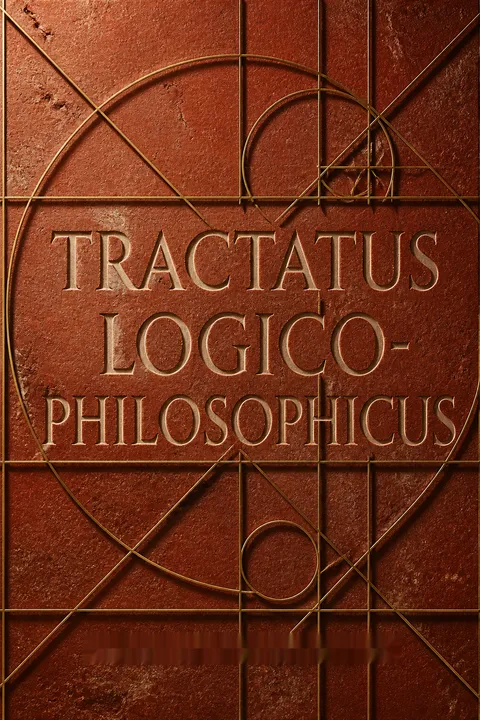

Key Takeaways
1. The World is a Totality of Facts, Not Things
- The world is all that is the case.
Facts define reality. The world is not merely a collection of objects, but rather the sum total of existing states of affairs, or "facts." These facts determine what is and what is not the case, forming the complete structure of reality. Objects themselves are simple, unalterable constituents that combine to form these states of affairs.
Objects are substance. Objects are the fundamental, simple elements that make up the world's substance. They are not composite and cannot be broken down further. Their possibility of combining into states of affairs is inherent in their nature, meaning that if an object can exist, it inherently carries the potential for all its possible configurations with other objects.
Structure of reality. The way objects are connected in a state of affairs constitutes its structure. This structure, and the possibility of it (form), is what defines how facts are built. The totality of existing states of affairs forms the entire world, and this totality also implicitly defines which states of affairs do not exist, thereby establishing reality.
2. Language Functions as a Picture of Reality
2.12 A picture is a model of reality.
Pictures represent facts. We form mental "pictures" of facts. A picture, whether a drawing, a musical score, or a linguistic proposition, presents a situation in logical space by modeling the existence and non-existence of states of affairs. Its elements correspond to objects in reality, and their arrangement in the picture mirrors the arrangement of objects in the depicted situation.
Shared logical form. For a picture to represent reality, it must share something in common with what it depicts: its logical form. This logical form is the possibility that things in reality are related in the same way as the elements in the picture. A picture cannot depict its own pictorial form; it can only display it, showing how it represents its subject from an external standpoint.
Truth and falsity. A picture agrees or disagrees with reality, making it correct or incorrect, true or false. Its sense is what it represents, independently of its truth value. To determine if a picture is true, we must compare it with reality; its truth or falsity cannot be deduced from the picture alone, meaning there are no pictures that are true a priori.
3. Thoughts are Logical Pictures of Facts
- A logical picture of facts is a thought.
Thoughts are propositions. A thought is essentially a logical picture of facts, and a thinkable state of affairs is one we can picture to ourselves. The sum of all true thoughts constitutes a complete picture of the world. Thoughts inherently contain the possibility of the situations they represent, implying that whatever is thinkable is also possible.
Logic's boundaries. Thought cannot conceive of anything illogical. If it could, we would have to think illogically, which is a contradiction. Just as geometry cannot represent a figure that defies spatial laws, language cannot represent anything that contradicts logic. This means that any a priori correct thought would be one whose possibility guarantees its truth.
Expression in language. Thoughts find expression in propositions, which are perceptible signs (spoken or written) used to project a possible situation. A propositional sign is a fact where its elements (words) are arranged in a determinate way, mirroring the configuration of objects in the thought. Names in a proposition represent objects, and their configuration reflects the configuration of objects in the state of affairs.
4. Philosophy Clarifies Language, Not Doctrine
4.003 Most of the propositions and questions to be found in philosophical works are not false but nonsensical.
Language disguises thought. Everyday language is incredibly complex and often obscures the underlying logic of our thoughts. Its outward form is not designed to reveal the true structure of thought, leading to profound philosophical confusions. Many philosophical problems arise from a misunderstanding of language's logic, resulting in questions that are not false, but nonsensical.
Philosophy as activity. Philosophy is not a body of doctrine or a natural science; it is an activity aimed at the logical clarification of thoughts. Its purpose is to make thoughts clear and define their boundaries, not to produce "philosophical propositions." Russell's contribution was showing that a proposition's apparent logical form might not be its real one.
Setting limits. Philosophy's task is to set limits to what can be thought and, by extension, what cannot. It achieves this by working outwards through what can be thought, thereby signifying what cannot be said by clearly presenting what can be said. Everything that can be thought can be thought clearly, and everything that can be put into words can be put clearly.
5. Propositions are Truth-Functions of Elementary Statements
- A proposition is a truth-function of elementary propositions.
Building blocks of meaning. All propositions are ultimately derived from elementary propositions, which are the simplest assertions about the existence of states of affairs. Elementary propositions consist of names in direct combination, forming a nexus. The truth-possibilities of these elementary propositions determine the truth and falsity of all other propositions.
Truth-operations. Complex propositions are formed by applying truth-operations to elementary propositions. These operations (like negation, logical addition, logical multiplication) generate new truth-functions. The sense of a truth-function depends on the sense of its constituent elementary propositions, and these operations reveal the internal relations between propositional structures.
No logical objects. There are no "logical objects" or "logical constants" in the world corresponding to these operations. Signs like 'and', 'or', 'not' are not names for objects or relations; they are merely ways of combining propositions. Their interdefinability shows they are not primitive signs, and their function is to express the logical structure, not to denote entities.
6. Logic and Mathematics are Tautological, Saying Nothing About the World
6.11 Therefore the propositions of logic say nothing.
Tautologies reveal form. The propositions of logic are tautologies—statements that are unconditionally true, true for all possible truth-conditions of their elementary propositions. Because they are always true, they convey no information about the world; they say nothing. They are analytic propositions, whose truth can be recognized from the symbol alone.
Mathematics as logic. Mathematics is a logical method, and its propositions are equations, which are pseudo-propositions. Mathematical propositions do not express thoughts or describe facts about the world. Instead, they demonstrate the logical structure of reality, just as tautologies do. Equations express the substitutability of expressions, revealing their shared logical form.
Formal properties. Logical propositions demonstrate the formal, logical properties of language and the world. They show how propositions relate to one another structurally, for example, by revealing contradictions or implications when combined. This means we can recognize logical truths by inspecting the symbols themselves, without needing to compare them to reality.
7. Causality and Science Describe Forms, Not Necessities
6.32 The law of causality is not a law but the form of a law.
Laws as forms. The so-called laws of nature, including the law of causality, are not propositions with sense or a priori laws in themselves. Instead, they are forms of laws, or general frameworks within which scientific propositions can be cast. They impose a unified descriptive form on the world, much like a grid imposes a structure on a picture.
Scientific description. Newtonian mechanics, for instance, provides a specific system for describing the world, dictating the form that all propositions used in its description must take. The possibility of describing the world with such a system tells us nothing about the world itself, but the precise way it can be described, or if one system is simpler than another, does reveal something about reality.
Induction's psychological basis. The procedure of induction, which involves accepting the simplest law consistent with our experiences, lacks logical justification. It is a psychological, not a logical, process. There is no logical necessity compelling one event to follow another; the only necessity is logical necessity. Belief in causality is a superstition, as we cannot infer future events from present ones with logical certainty.
8. Ethics and Mysticism Lie Beyond the Reach of Language
6.42 So too it is impossible for there to be propositions of ethics.
Value outside the world. The sense of the world, including any value it might possess, must lie outside the world itself. Within the world, everything simply is as it is and happens as it happens; no inherent value exists. If value did exist within the world, it would be accidental, thus lacking true value. Therefore, ethics, which deals with value, cannot be expressed in propositions.
Ethics is transcendental. Ethics is transcendental, meaning it lies beyond the realm of what can be put into words. Ethical laws, like "Thou shalt...", do not relate to punishment or reward in the conventional sense, as these would be accidental events within the world. Instead, ethical reward and punishment must reside in the action itself, altering the limits of the world, not its facts.
The mystical. The mystical is not how things are in the world, but that the world exists. To view the world sub specie aeterni (under the aspect of eternity) is to see it as a limited whole, and this feeling is what is mystical. These are things that cannot be put into words; they make themselves manifest, revealing themselves without being stated.
9. What Cannot Be Spoken Must Be Passed Over in Silence
- What we cannot speak about we must pass over in silence.
Limits of language. The limits of our language define the limits of our world. Logic pervades the world, and its boundaries are also the world's boundaries. We cannot logically say what is not in the world, as that would require us to go beyond the world's limits and think the unthinkable. Therefore, what cannot be thought cannot be said.
The riddle vanishes. Questions that cannot be framed in words also cannot be answered. The "riddle of life" does not exist in a solvable form; its solution is seen in its vanishing. When all scientific questions are answered, the problems of life remain untouched, yet there are no questions left, and this absence of questions is itself the answer.
Philosophy's true method. The correct philosophical method is to speak only of what can be said—propositions of natural science—and to demonstrate to anyone attempting to speak metaphysically that they have failed to give meaning to certain signs. Wittgenstein's own propositions in the Tractatus are elucidatory; they serve as a ladder to be discarded once the reader has climbed through, on, and over them, finally seeing the world aright.
Review Summary
Tractatus Logico-Philosophicus is a challenging, influential work of analytical philosophy. Readers praise its logical rigor and profound insights, while acknowledging its difficulty. Many find the book's structure and arguments complex, with some feeling frustrated by its abstract nature. The ending, which seemingly undermines the preceding work, is controversial. Despite its challenges, many consider it a masterpiece of 20th-century philosophy, addressing fundamental questions about language, logic, and reality. Readers appreciate Wittgenstein's unique approach, even if they don't fully grasp all his propositions.
People Also Read

Download PDF
Download EPUB
.epub digital book format is ideal for reading ebooks on phones, tablets, and e-readers.








































