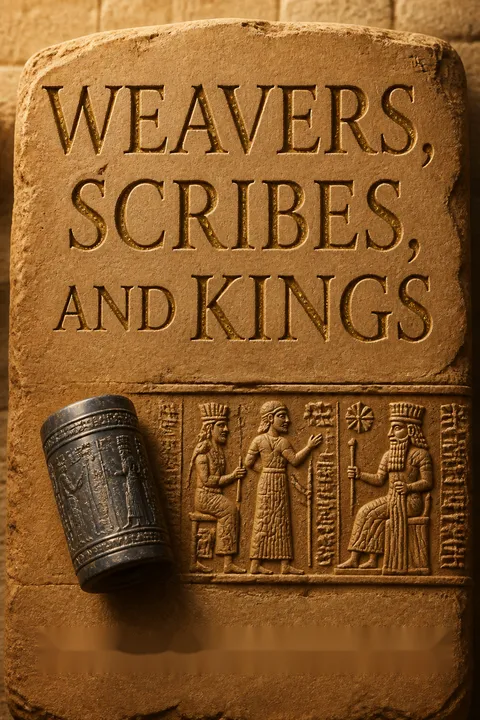

Key Takeaways
1. Uruk: The Birthplace of Cities and Administrative Writing.
For this first chapter I can provide you with no names for the inhabitants of Uruk whose lives interest us.
Urban Revolution. Around 3500 BCE, Uruk in southern Mesopotamia became the first true city on Earth, housing up to 40,000 people and setting the mold for future urban cultures. This unprecedented concentration of population necessitated new forms of social organization and resource management, transforming human interaction and governance. The city's monumental architecture, like the Stone Cone Temple, showcased astonishing sophistication and a collective effort to honor the gods.
Proto-Cuneiform's Genesis. The demands of managing Uruk's vast temple economy led to the invention of proto-cuneiform, initially a system for tracking commodities rather than recording language. This early script, using pictograms and numerical signs, was a practical tool for administrators like Kushim, who managed immense quantities of barley for beer production. The system, though limited, laid the groundwork for all future writing in the Near East.
Early Innovations. Uruk was a hub of innovation, developing:
- Mass-produced pottery (beveled-rim bowls for rations).
- Cylinder seals for accountability.
- Early forms of concrete and mosaic decoration.
- Sophisticated irrigation systems.
- A centralized economy managed by temple institutions.
These advancements, driven by the needs of urban life, profoundly impacted subsequent Mesopotamian civilization.
2. Kingship's Evolution: From Pious Leaders to Divine Conquerors.
The Mesopotamians embraced monarchy and came to believe that the gods had given it to them as the ideal form of government.
From Priest-King to Lugal. The Early Dynastic period (2900–2300 BCE) saw the emergence of recognizable kings, evolving from the earlier priest-kings of Uruk. These rulers, like Ur-Nanshe of Lagash, focused on pious acts such as temple building and canal digging, often depicting themselves as humble servants of the gods. Their inscriptions, though self-serving, provide the earliest narratives of individual achievements and royal priorities.
Imperial Ambition's Dawn. Lugalzagesi of Umma was the first to dream of a vast empire, claiming rule "from the Lower Sea... to the Upper Sea" and "from the sunrise to the sunset." This rhetoric of universal dominion, though initially an exaggeration, inspired Sargon of Akkad, who became the world's first empire builder. Sargon's conquests, like his capture of Lugalzagesi, established a new model of aggressive, militaristic kingship.
Divine Kingship's Zenith. Sargon's grandson, Naram-Sin, took royal ambition to its peak by claiming divinity, placing a star-shaped "dingir" sign before his name and wearing horned helmets previously reserved for gods. This audacious claim, along with his military prowess, set a precedent for later rulers like Shulgi of Ur and Enlil-bani of Isin, who also declared themselves divine, blurring the lines between mortal and immortal in the eyes of their subjects.
3. The Unseen Architects of Power: Scribes and Bureaucracy.
This was because scribes wrote about the things that mattered, the things they were asked to write about.
The Rise of the Scribe. Scribes were indispensable professionals who mastered cuneiform after years of training, making them central to every aspect of ancient Near Eastern society. From recording royal decrees to managing administrative details, their work ensured the functioning of complex economies and governments. Their meticulous record-keeping, often on durable clay tablets, is the primary reason we have such detailed insights into these ancient civilizations.
Education and Curriculum. Scribal schools, like House F in Nippur, provided rigorous, multi-year training, starting with basic wedge formation and progressing to complex literary and mathematical texts. Students like Elletum copied:
- Lexical lists of nouns and professions.
- Multiplication and reciprocal tables.
- Sumerian hymns and epic poems (e.g., Gilgamesh).
This education not only equipped them for administrative roles but also fostered a scholarly elite dedicated to preserving ancient knowledge, even in dead languages.
Bureaucracy's Enduring Legacy. The administrative systems developed by scribes, from the proto-cuneiform lists of Uruk to the vast archives of Ur III and Mari, were remarkably consistent and efficient. They managed:
- Ration distribution and labor allocation.
- Trade networks and tax collection.
- Legal contracts and court proceedings.
This bureaucratic infrastructure, though often impersonal, provided stability and order, allowing complex societies and empires to function for millennia.
4. Women of Influence: Queens, Priestesses, and Business Leaders.
For most of the time, men and women had little interest in pigeonholing their friends, neighbors, or (in the case of kings) their subjects as members of particular social classes.
Royal Women's Authority. From the Early Dynastic period onward, queens and priestesses wielded significant power, often managing vast estates, engaging in diplomacy, and performing crucial religious rituals. Queen Baranamtara of Lagash, for instance, oversaw a massive workforce and maintained diplomatic ties, while Queen Tabur-damu of Ebla participated in elaborate wedding rituals that consecrated her as a co-ruler. These women were not merely consorts but active political and religious figures.
Priestesses as Pillars of Society. High priestesses, such as Enheduana of Ur and Adad-guppi of Harran, held immense religious and economic authority. They managed temple estates, performed sacred rites, and served as intermediaries with the gods. Enheduana, notably, is considered the world's first identified author, her hymns reflecting deep personal devotion and political turmoil.
Women in the Economy. Beyond royal and religious roles, women were central to the economy, particularly in textile production. Weaving supervisors like Zum in Lagash managed large workshops, and women were involved in various trades. In the Old Babylonian period, naditums in Sippar, unmarried priestesses from elite families, became shrewd businesswomen, managing extensive properties and engaging in lucrative financial transactions, demonstrating significant economic autonomy.
5. The Cycle of Conquest and Diplomacy: Forging Empires and Alliances.
But diplomacy was almost always attempted before military conflicts were declared, and combatants almost always sought peace.
Warfare's Relentless Cycle. The ancient Near East was characterized by a recurring pattern of conflict and conquest, with ambitious kings constantly seeking to expand their domains. From the border disputes between Lagash and Umma to Sargon's empire-building and the Neo-Assyrian expansion, military campaigns were a constant feature. These wars, often brutal and destructive, led to the rise and fall of numerous kingdoms and empires.
The Art of Diplomacy. Despite frequent warfare, diplomacy was a sophisticated and essential tool for managing inter-state relations. Kings engaged in:
- Formal alliances, often termed "brotherhood pacts."
- Exchange of envoys and messengers.
- Negotiation of peace treaties.
- Dynastic marriages to cement alliances.
The Amarna letters vividly illustrate this system, where kings, though never meeting, communicated as "brothers" through a complex network of letters and gifts.
Imperial Strategies. Empires like the Akkadian, Ur III, Old Babylonian, and Neo-Assyrian developed diverse strategies for control:
- Sargon's military might and propaganda.
- Shulgi's administrative reforms and tax systems.
- Hammurabi's legal pronouncements and land grants.
- Assyrian mass deportations and professional armies.
These strategies aimed to consolidate power, extract resources, and maintain stability across vast, multi-ethnic territories, though often with significant human cost.
6. Life Under the Yoke: Deportation, Slavery, and Social Stratification.
The deportees had to build whole new lives; they had little energy left for rebellion.
The Trauma of Deportation. Mass deportations were a hallmark of Neo-Assyrian imperial control, uprooting hundreds of thousands of people from their homelands and forcibly resettling them across the empire. Relief sculptures, like those of Sennacherib, vividly depict families, including women and children, carrying their meager possessions, marching under guard to an unknown future. This policy aimed to break local loyalties and integrate diverse populations into the imperial fabric.
Slavery's Varied Realities. Slavery was a pervasive institution throughout the ancient Near East, with individuals becoming enslaved through war, debt, or birth. While some slaves, like the brewers Nabu-utirri and Mizatu in Neo-Babylonian Babylon, enjoyed considerable autonomy and even owned property, others, like the children sold in Emar during a famine, faced desperate circumstances. The legal system, though upholding slavery, also provided some protections and pathways to manumission.
Social Hierarchies. Societies were often stratified, with distinct classes and roles:
- Maryanni: Elite chariot warriors in Mittani.
- Released ones: Artisans exempt from corvée labor.
- Peasants: Farmers obligated to military and corvée service.
- Tenants: Landless laborers.
These hierarchies, though sometimes fluid, dictated access to resources, power, and freedom, shaping the daily lives and opportunities of individuals across the millennia.
7. The Divine Hand: Omens, Prophecies, and the Gods' Will.
To them, the gods and goddesses existed, they were real, they controlled everything, and they made non-negotiable demands of their human subjects.
Gods in Daily Life. Religion was not a separate concept but an intrinsic part of existence, with gods and goddesses controlling all natural phenomena and human destiny. From the Uruk period's temple complexes to the elaborate rituals of the Late Bronze Age, humans constantly sought to appease and understand their deities through offerings, prayers, and festivals. The physical presence of gods in their statues was a tangible reality, demanding constant care and veneration.
Divination's Central Role. Kings and commoners alike relied heavily on divination to discern the gods' will and guide their decisions. Specialists like the astronomer Bel-ushezib interpreted:
- Astronomical phenomena (eclipses, planetary movements).
- Dreams and prophetic utterances.
- The internal organs of sacrificed animals (extispicy).
These practices, though seemingly superstitious to modern eyes, were systematic attempts to read the "sacred writing" inscribed across the natural world, providing crucial guidance in matters of war, succession, and personal fate.
The Power of Prophecy. Prophets, often speaking in a state of divine possession, delivered direct messages from the gods, which were taken with utmost seriousness. Even an enslaved girl in Harran, proclaiming a god's message of treason against King Esarhaddon, triggered a royal investigation. The belief in divine intervention was so profound that kings like Erra-imitti and Esarhaddon even employed "substitute kings" to deflect prophecies of their own death, highlighting the desperate measures taken to outwit fate.
8. Trade and Innovation: Connecting Distant Worlds and Advancing Technology.
The web of connections among ancient peoples was profound and long-lasting, with influences flowing in all directions.
Ancient Globalism. From the earliest periods, the Near East was a highly interconnected region, driven by extensive trade networks that spanned vast distances. Urukian colonists established outposts hundreds of miles from home, and later, Assyrian merchants like Ashur-idi and his sons built a thriving business trading tin and textiles between Ashur and Anatolia. These networks facilitated the exchange of goods, ideas, and technologies across diverse cultures.
Technological Leaps. Innovation was a constant force, transforming various aspects of life:
- Writing: From proto-cuneiform to cuneiform, and later the Phoenician alphabet.
- Architecture: From the Stone Cone Temple's concrete to massive ziggurats and elaborate palaces.
- Metallurgy: From early bronze to sophisticated lost-wax casting and the eventual adoption of iron.
- Transportation: From reed boats to horse-drawn chariots and sturdy seagoing vessels.
These advancements, often driven by practical needs or military ambitions, reshaped societies and economies.
Cultural Exchange. Trade routes were also conduits for cultural exchange. The water buffalo on Kitushdu's seal from the Akkadian period, imported from the Indus Valley, symbolizes the exotic goods and ideas that flowed into Mesopotamia. The adoption of cuneiform by Hittites and Urartians, and the spread of the Phoenician alphabet, demonstrate the profound impact of these interactions on language and literacy across the region.
9. The Rise of Private Lives: From Palace Archives to Personal Records.
In this book I will take you behind many of those doors to listen in on men and women from the very ancient past.
Beyond the Palace Walls. While early records were almost exclusively institutional, the Old Babylonian period saw a significant shift towards private literacy and record-keeping. Families began keeping personal archives in their homes, documenting:
- Land and house purchases.
- Loan agreements and business partnerships.
- Family letters and legal disputes.
This proliferation of private documents offers intimate glimpses into the lives of ordinary people, revealing their concerns, aspirations, and daily routines outside the direct purview of kings and temples.
Individual Stories Emerge. These private archives bring to life individuals like the washerman Ina-teshi-etir, the baker Ina-qate-Nabu-bultu, and the innkeeper Ishunnatu, whose contracts detail their professions, financial dealings, and social interactions. Even enslaved individuals like Nabu-utirri and Mizatu, brewers in Babylon, managed their own businesses and accumulated wealth, demonstrating a degree of autonomy previously unseen in the records.
The Human Element. These personal documents, though often terse, reveal universal human experiences:
- Family dramas, like Ashur-nada's children leaving their grandparents.
- Legal disputes, such as Geme-Suen's silver loan case.
- The struggle for survival during famine, as seen in Ku'e's heartbreaking decision to sell her children.
These records, often discarded as trash, now provide invaluable insights into the rich tapestry of ancient life, allowing us to connect with individuals across millennia.
10. The Enduring Legacy: Collapse, Continuity, and the Lasting Impact of Cuneiform.
This is not a story of progress; history never really is.
The Cyclical Nature of Power. The history of the ancient Near East is marked by the cyclical rise and fall of empires, often triggered by internal strife, external invasions, or environmental crises like drought. The collapse of the Akkadian, Ur III, Late Bronze Age, and Neo-Assyrian empires demonstrates the inherent fragility of vast political entities, yet new powers invariably rose to fill the vacuum, often adopting and adapting the administrative and cultural legacies of their predecessors.
Cultural Resilience. Despite political upheavals and periods of "Dark Ages" with scarce records, core cultural elements persisted:
- Language: Sumerian endured as a scholarly language for millennia, even after it ceased to be spoken.
- Religion: The same gods and goddesses were worshipped for thousands of years, their cults adapting to changing political landscapes.
- Daily Life: Fundamental aspects like farming, trade, family structures, and legal practices remained remarkably consistent.
This continuity highlights the deep-seated traditions that anchored societies through periods of profound change.
Cuneiform's Lasting Echoes. The invention of cuneiform writing in Uruk initiated a tradition that lasted over 3,000 years, shaping communication, administration, and intellectual life. Even as it was eventually supplanted by simpler alphabetic scripts and new languages like Aramaic and Greek, dedicated scribes like Rimut-Anu in Uruk continued to study and copy ancient texts, preserving a vast body of knowledge. Their efforts ensured that the voices and stories of countless individuals, from kings to commoners, would resonate far into the future, long after their empires had crumbled.
Review Summary
Weavers, Scribes, and Kings by Amanda H. Podany receives widespread praise (4.4/5 stars) for bringing ancient Mesopotamian history to life through individual stories drawn from cuneiform tablets. Readers appreciate Podany's focus on ordinary people—traders, weavers, scribes—alongside rulers, spanning 3,000 years from Uruk (3500 BCE) to the Persian conquest. The audiobook, narrated by Podany herself, is well-received. While some find the writing occasionally chatty or dense with names, most commend her accessible approach to social history, attention to women's roles, and ability to humanize this remote period through archaeological evidence.
People Also Read


About the Author
Other books by Amanda H. Podany
Download PDF
Download EPUB
.epub digital book format is ideal for reading ebooks on phones, tablets, and e-readers.








































