

Key Takeaways
You already perform biblical miracles daily and call them Tuesday
The book's central hook: technologies once reserved for gods now sit in your pocket, yet we barely notice. A two-millimeter photovoltaic chip (Science Corporation's PRIMA implant) restores sight to the legally blind by converting infrared light into signals the optic nerve reads. In UK and European trials, all 32 subjects improved five lines on an eye chart. Drones deliver blood. AI answers any question in seconds.
Why no awe? Ray Kurzweil noted we keep renaming AI once it works (the ATM was once cutting-edge). By 9 a.m. you've summoned knowledge from the ether (Google), moved money with a gesture (Apple Pay), and spoken across the globe (FaceTime). The miracles multiply, but familiarity erases wonder.

The framing echoes Arthur C. Clarke's dictum that sufficiently advanced technology is indistinguishable from magic. What's compelling is the inversion: the problem isn't that magic is rare but that it is so abundant it has become invisible. Behavioral economists call this hedonic adaptation, the treadmill by which any gain becomes the new baseline. The authors weaponize this against pessimism. A fair challenge: cataloguing capabilities is not the same as measuring flourishing. Access to a miracle chip means little if 47% of humanity lacks basic diagnostics, a gap the book itself acknowledges elsewhere.
When exponential curves collide, progress doesn't add, it detonates
Exponential technology is anything that doubles in performance while dropping in price on a schedule, riding Moore's law once it becomes digital code. But the book's real engine is convergence: when multiple exponentials intersect, acceleration itself accelerates. The PRIMA eye implant exists only because computing, AI, nano-fabrication, and materials science matured simultaneously.
The numbers stagger. Computing power that doubled yearly when the authors wrote Abundance (2012) hit tenfold annual growth by 2022 and is climbing toward hundredfold gains. Consequences arrived faster than predicted: over 30 autonomous car companies, warehouse robots at nearly every major retailer, and Zipline drones making thousands of deliveries daily. The authors argue we now change 233% faster than in 2010.
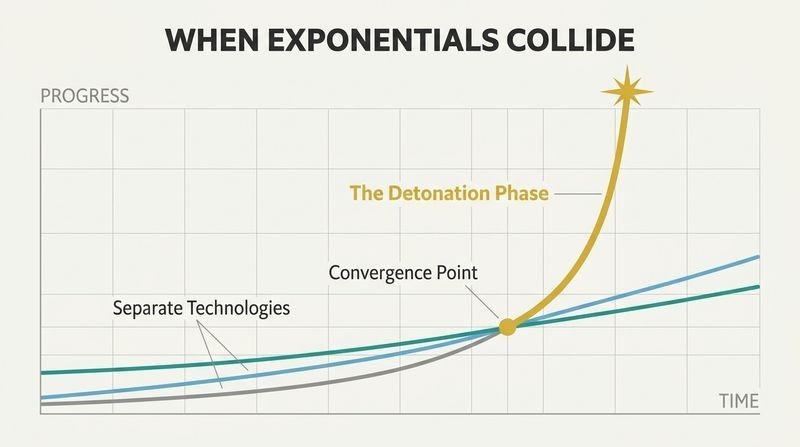
Convergence is the book's most defensible big idea, and it maps onto complexity theory's notion of emergence, where interacting parts produce behavior no single part predicts. Brian Arthur's work on combinatorial evolution makes a similar case: new technologies are recombinations of existing ones, so the toolkit compounds. The skeptic's counter is that not everything digitizes cleanly. Physical bottlenecks (energy, materials, biology's messiness) resist Moore's law, which is why fusion and self-driving cars perpetually feel five years away. The book's own examples of decades-long stalls in perennial rice quietly concede this friction.
Your brain evolved for a local, linear world that no longer exists
We feel besieged rather than blessed because of biology. The brain is a prediction engine optimized for scarcity, spending 25% of the body's energy at rest and obsessed with conserving calories. It evolved when life was local (everything within a day's walk) and linear (generations barely changed). Today's world is global and exponential, so the brain's pattern-matching keeps failing.
When analogies fail, we reach for archetypes (superhero films exploded from one in the 1970s to sixty-plus by 2010) and then for the apocalypse. Add information overload: humanity produced 2.8 zettabytes of data in 2012 and 181 zettabytes by 2025. Attention, only 50 to 120 bits wide, collapses. Overwhelmed and negativity-biased, we grow blind to good news.
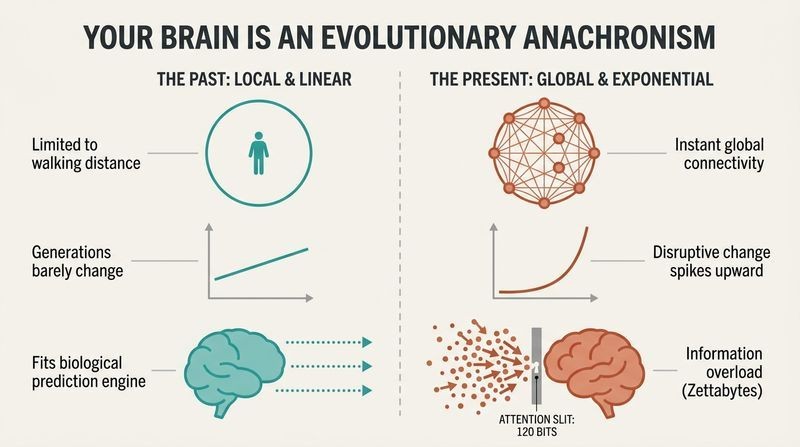
This is the book's neuroscientific spine, drawing on predictive processing theory (Friston, Clark, Barrett) that frames perception as controlled hallucination corrected by error signals. The insight that emotion is the body's readout of information is genuinely useful reframing. The negativity bias claim is well-supported: Baumeister's 'bad is stronger than good' shows losses loom larger than gains. One nuance worth flagging: the book treats media doom as pure cognitive malfunction, but some vigilance is rational. The question isn't whether the brain misfires but how to distinguish genuine tail risks (bioterror, misaligned AI, which the authors take seriously) from ambient algorithmic panic.
Every exponential technology travels the same six-stage road
The Six Ds of Exponentials is the book's forecasting framework, tracing how a technology evolves:
1. Digitization: it becomes code and jumps onto Moore's law
2. Deception: early doublings of tiny numbers look like nothing (0.01, 0.02, 0.04)
3. Disruption: the curve breaks the surface and old markets vanish
4. Demonetization: cost falls toward zero
5. Dematerialization: the physical product disappears (your phone ate the camera, GPS, and encyclopedia)
6. Democratization: it reaches everyone
Kodak invented the digital camera in 1975, dismissed it as a toy, and missed the deceptive doubling of pixels until bankruptcy. Hollywood produced 1,150 hours yearly at its peak; YouTube now adds 500 hours every minute.
The framework's strength is diagnostic: it explains why incumbents die not from stupidity but from linear intuition applied to exponential curves, the deceptive phase being a cognitive trap. Christensen's disruption theory covers similar ground but the Six Ds add the crucial demonetization and dematerialization stages. The weakness is survivorship selection. The framework fits technologies that succeeded (music, cameras) but many digitized promises stalled or failed (VR headsets, blockchain applications, 3D printing's revolution). As a predictive tool it risks being unfalsifiable, since any lag is relabeled 'still deceptive.' Best used as a lens, not a crystal ball.
One entrepreneur can now halve a nation's maternal deaths
The book's most vivid evidence for abundance is the scale of impact a single founder wields. Zipline, founded by Keller Rinaudo Cliffton in 2014, began with a less-than-5% chance of success and now runs the planet's largest autonomous delivery network. In Rwanda, blood arrives by parachute 20 to 30 minutes after a text order, cutting maternal mortality by 51% and supplying 75% of the country's blood.
Other exemplars: Josh Tetrick's Eat Just replaced 500 million chicken eggs with a mung-bean substitute using 98% less water. Mary Lou Jepsen's Openwater shrinks MRI-grade imaging into a headband. Damilola Ogunbiyi brought solar mini-grids to millions in rural Nigeria. Individuals now solve problems once reserved for governments.
The through-line is leverage: exponential tools plus one motivated person equals civilizational impact, a democratization of agency that recalls how the printing press turned monks into pamphleteers. The stories are genuinely inspiring and well-chosen for geographic spread beyond Silicon Valley. A sober counterweight: heroic-founder narratives can obscure the unglamorous infrastructure (Rwanda's government was Zipline's first and only early customer, regulators, supply chains) that makes miracles possible. Impact at scale is rarely a solo act. The book knows this but the framing tempts readers toward great-man thinking when systems and institutions deserve co-billing.
Every solution to abundance breeds a new abundance problem
The abundance paradox: solving one problem strains another. Domesticating the horse built cities, then buried 1890s New York under three million pounds of daily manure, solved by the car, which triggered the climate crisis. The pattern now accelerates from millennia to roughly forty days: social media reached mental health, AI learned to fake voices.
The authors' top-ten dark side includes climate, an obesity epidemic (38% of the world overweight, headed past 50% by 2035), fentanyl and engineered addiction, microplastics (roughly a plastic spoon's worth in each human brain), biodiversity collapse, and bioterror (a virologist synthesized horsepox by mail order for under $100,000). Their stance: the tools that create these dilemmas often hold their solutions.
This is the book's intellectual honesty on display, and it rescues the argument from naive techno-optimism. The abundance paradox resembles Jevons' paradox (efficiency gains increase total consumption) and the wider law of unintended consequences. E.O. Wilson's line about Paleolithic emotions, medieval institutions, and godlike technology anchors the danger well. The book's faith that innovation outpaces devastation is a genuine wager, not a proof. Climate and biodiversity operate on tipping-point dynamics where being late is qualitatively different from being slow. Optimism about the race is warranted only if paired with the urgency the authors themselves stress.
Feeling the future happens to you shuts your brain down
The book's psychological core: adopting an external locus of control (believing life happens to you) signals the brain that nothing you do matters, so it powers down into what Martin Seligman called learned helplessness. Since the brain hoards energy, surrendered agency ends creative problem-solving. An internal locus (feeling you shape your destiny) keeps it engaged.
The fix is retuning three cognitive filters: frame (your in-the-moment lens), mindset (durable belief structures), and bias (automatic energy-saving shortcuts). Start with frame because it's most conscious. Gratitude signals safety and recalibrates negativity bias. Reframing a challenge as thrill rather than threat matters because anxiety and excitement share one chemical, norepinephrine; only interpretation differs.
The locus-of-control literature (Rotter, 1966) robustly links internal locus to resilience, achievement, and health, so the foundation is solid. The reframe of anxiety as excitement has direct experimental support from Alison Wood Brooks at Harvard, whose subjects performed better by saying 'I am excited' before stressful tasks. Where the book is vulnerable is the leap from individual mindset to civilizational survival. Telling someone facing mass automation to feel gratitude can read as bootstrapping past structural problems. The authors would counter that mindset is the only interface available, which is true but incomplete: agency also requires actual options, not just optimistic framing.
Lateral thinking in flow is the one edge AI can't copy
Flow is a state of total absorption where the prefrontal cortex quiets, self-talk vanishes, and action and awareness merge, letting the brain parallel-process across networks. Captain Sully's 208-second Hudson River landing exemplifies it: time slowed, training took over. Flow boosts productivity (a McKinsey study found up to 500%) and accelerates learning.
Crucially, flow amplifies lateral thinking, the ability to leap between unrelated ideas. In the nine-dot puzzle (connect nine dots with four lines without lifting the pen), fewer than 5% normally succeed, but stimulating flow raised success to 58% in one study. Large language models are convergent, matching like with like; they can't diverge unless hallucinating. The future of work is humans in flow collaborating with machines.
The human-AI complementarity argument is the book's most practically important claim for careers. It aligns with the 'centaur' finding from chess, where human-plus-machine teams beat both solo grandmasters and solo engines for roughly a decade. The lateral-thinking distinction is sharp but softening fast: modern generative models do produce genuinely novel combinations, and the boundary between recombination and creativity is philosophically murky. The safer version of the claim is that humans retain judgment, taste, and the ability to know which weird leap matters, a curatorial edge. Flow science itself, while promising, still wrestles with replication and measurement rigor.
Aim for 10x, not 10%, because it forces first-principles thinking
The moonshot mindset treats the impossible as achievable, and paradoxically a tenfold goal is often easier than a 10% one because incremental targets trap you in old assumptions while 10x demands you rebuild from scratch. Astro Teller of Google X calls the required attitude 'enthusiastic skepticism.'
First-principles thinking (from Aristotle) means reducing a problem to self-evident truths. Musk asked why rockets are expensive (single-use), then built reusable ones, slashing costs tenfold. For batteries he priced the raw metals (lithium, cobalt, nickel) at pennies and found the expense was in production, not materials. The Bannister effect shows the mechanism: once Roger Bannister broke the four-minute mile, others followed within weeks; the barrier was mental, not physical.
The 10x-over-10% principle has become Silicon Valley orthodoxy, and the psychological logic is sound: modest goals invite optimization of the existing, radical ones invite reinvention. It dovetails with research on construal-level theory, where distant, abstract goals unlock more creative cognition. The Bannister example is beloved but historically contested; training methods and competition, not just belief, drove the cascade. The real caution is selection bias in moonshot worship. For every SpaceX there are graveyards of 10x ventures that simply failed, and survivorship makes the strategy look more reliable than it is. Moonshots are high-variance bets, best made with eyes open.
Paradise without purpose is a tomb, not a utopia
The book's most haunting warning comes from Universe 25, ethologist John Calhoun's 1968 experiment giving mice unlimited food, water, and safety. The population peaked at 2,200, then collapsed to extinction. Not from scarcity but from the breakdown of social bonds. Males called 'the beautiful ones' withdrew entirely, grooming and eating, doing nothing else. Mothers abandoned young. The damage proved irreversible even when space reopened.
The lesson for a coming post-scarcity, radically extended-lifespan world: abundance without challenge breeds decay. Jaak Panksepp showed play is a hardwired mammalian circuit that only activates in safety, making it the emotion built for abundance. To thrive we must manufacture what survival once forced on us: challenge, curiosity, purpose, social bonds, awe, and productive failure.
Universe 25 is a powerful parable but deserves scientific caution: Calhoun's work has been critiqued for overcrowding confounds and anthropomorphic interpretation, and extrapolating from caged mice to human societies is a stretch the authors make somewhat freely. That said, the underlying point converges with robust human findings. The Harvard Study of Adult Development (85-plus years) identifies relationship quality as the strongest predictor of health and happiness, and self-determination theory (Deci and Ryan) shows autonomy, competence, and relatedness drive wellbeing more than comfort. Viktor Frankl reached the same conclusion from a darker laboratory: humans need meaning more than ease. The warning about cognitive offloading to AI is prescient and testable.
Guard cognition like a muscle: struggle is the signal, not the bug
As AI removes friction, the book warns of cognitive offloading, where outsourcing tasks atrophies the underlying skill. It began with phone numbers we no longer memorize and the 'Google effect' of forgetting facts we can look up. The danger with AI is offloading not just memory but thinking, creativity, and meaning itself.
Karl Friston's free energy principle explains why: the brain minimizes surprise to save energy, so if a tool removes the need to think, the brain gladly stops. Carol Dweck's work found growth-mindset children show neural spikes when they err (their brains hunt for why) while fixed-mindset brains don't bother processing the mistake. The prescription: use AI as a challenger, not a crutch, preserve the first creative spark yourself, and keep failure in the loop.
This may be the book's most immediately actionable warning for knowledge workers. Early empirical signals support it: studies on GPS use and spatial memory, and emerging research on LLM reliance dampening critical engagement, both point toward skill erosion when tools do the cognitive lifting. The framing as 'the AI effect, one step beyond the Google effect' is clarifying. The deeper principle connects to desirable difficulties (Bjork's research), where learning that feels harder produces more durable retention. The tension the book doesn't fully resolve: some offloading is liberating and correct (nobody mourns lost long-division drills). The art is deciding which cognitive struggles are load-bearing for growth and which are mere drudgery.
Analysis
We Are as Gods is a sequel to Diamandis and Kotler's 2012 Abundance, structured in three movements: evidence that exponential abundance has arrived, a candid accounting of its dark side, and a neuroscience-grounded survival guide. The difficulty in summarizing it is that it braids three genres: techno-optimist reportage, popular neuroscience, and self-help, held together by a governing metaphor (humanity acquiring godlike powers) that is more rhetorical than analytic.
The book's genuine contribution is synthesis. Its convergence thesis (that intersecting exponentials produce super-linear acceleration) is its strongest and most defensible idea, and the Six Ds offer a serviceable diagnostic lens. The pivot in Part 3 to locus of control, flow, and cognitive filters is where the book distinguishes itself from generic futurism, arguing that the binding constraint on a good future is neurological and psychological, not technological. That reframe, that the last mile to abundance is human cooperation and human cognition, is intellectually honest and underappreciated in the genre.
The weaknesses are characteristic of the form. The evidentiary style is anecdote-plus-projection: hand-picked founder heroics and forward-looking estimates presented with a confidence the underlying uncertainty rarely warrants. Selection bias runs throughout, since the framework naturally showcases exponentials that worked. The 233%-faster figure and similar composite metrics are the authors' own constructions dressed as findings. Universe 25 and the Bannister effect are rhetorically potent but scientifically contested.
What elevates the book above cheerleading is its refusal to ignore the abundance paradox: every solution spawns a harder problem, now at forty-day intervals. The authors hold optimism and alarm simultaneously, which is the correct posture. The deepest insight is quiet: in a world where machines handle survival, the scarce resource becomes meaning, and humans must now manufacture the challenge, purpose, and productive failure that scarcity once imposed for free. That is a philosophical claim wearing a technologist's clothes, and it lands.
Review Summary
Reviewers of We Are as Gods consistently praise it as a thought-provoking and essential read. Described as both exhilarating and cautionary, the book explores humanity's expanding technological capabilities, including AI, genetics, and longevity, while emphasizing the need for evolving wisdom alongside progress. Reviewers highlight its honest confrontation of ethical and existential challenges, its warnings about runaway AI, and its celebration of human potential. Multiple reviewers consider it required reading for anyone curious about the future.
People Also Read







About the Author


Download PDF
Download EPUB
.epub digital book format is ideal for reading ebooks on phones, tablets, and e-readers.








































