
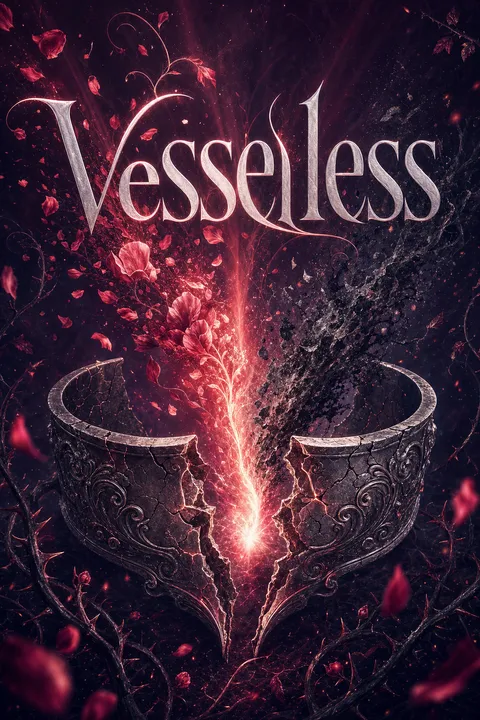


Plot Summary
Prologue
At eleven, Nizzara1 clutches a single book carried from the Zo libraries into a Zarr castle her father3 just seized, its walls still fresh with blood. Mazzar,3 kneeling with a father's warmth, forces a gold vessel ring onto her finger; its tendrils burrow into her flesh as she screams and refuses to become his heiress or a caster.
He introduces a pink spirit named Liha4 and begs her to accept the ghost into the energy now clinging to her skin. Her stubborn mind says no, but her soft heart yields, and she opens herself to Liha.4 In one gesture, tenderness and violence fuse into the father she will spend a decade both loving and fearing.
The opening compresses the novel's central wound into a single coerced gift. Mazzar frames domination as protection, the abuser's oldest grammar, and Nizzara's capitulation is not weakness but the tragedy of a child whose love is weaponized against her judgment. The vessel, an unremovable ring sunk into living flesh, literalizes bonded trauma: power she never wanted, permanently attached. Her book, a relic of idealism, marks knowledge as her only chosen refuge. The scene establishes the recurring tension between a warm heart and a hard world, and it plants the paradox driving her arc, that the same organ making her humane also, in her father's eyes, makes her prey.
The Heiress Who Won't Kill
Enthroned between her parents, Nizzara1 watches Mazzar3 wield the white First-Made Vessel to force a condemned innkeeper to stab his own throat, then order the man's grieving widow cut down too. She smiles through her horror because any flicker of pity draws crueler punishment.
Beneath the dueler's snarl she nurses a soft heart and a strategy: winning the coming King's Duel Tournament is her only escape from the betrothal law and her only leverage to free the kingdom's Awom bondslaves and mend trust with the rebels Mazzar3 butchers. Above all she refuses to take a life, the one boundary she believes separates her from the drunk, power-mad king he has become since seizing the throne.
The execution scene stages tyranny as theater, where obedience is performed under threat and cruelty demands an audience of complicit smiles. Nizzara's mask is survival, but it also corrodes her, forcing her to counterfeit the very monstrousness she despises. Her refusal to kill functions as moral scaffolding: a self-imposed limit that both dignifies and endangers her. The chapter frames power in Zarr as puppetry, control over other bodies, foreshadowing the hereditary gift she will later dread. Her private goals, freeing bondslaves and courting rebels, reveal a reformer trapped inside the apparatus she means to dismantle, and the psychological cost of biding time inside evil.
A Dead King's Bargain
In Baratrum, a frozen hell of glaciers and hungry shadows, a deathwalker named Dagen2 kneels before Nil,14 the god who owns his soul. Ten years earlier Dagen2 ruled Zarr until his own general, Mazzar,3 shot him with a soul gun. Now Nil14 offers a bargain: deliver one pure soul and earn a hundred years of freedom.
The condition is cruel, because this soul cannot be ripped out like the wretched ones Dagen usually hunts; it must be surrendered willingly, before the night of the King's Final Duel. When Nil14 names the target as the heiress1 living in the Zarr castle, on Dagen's2 own stolen throne, the chance to go home and learn who survived his murder overrides his caution. He accepts.
Dagen's introduction mirrors Nizzara's imprisonment: both are bound by rings and rulers they never chose. The willing-soul clause is the story's moral engine, converting a hunter into a seducer and making consent the axis of damnation. Nil embodies bureaucratic evil, a god who prefers bargains to commands because trapped desire is more corrupting than force. Dagen's hunger for freedom is really a hunger for restored identity, home, sister, kingdom, the self death stripped away. The bargain's structure guarantees tragedy: to win his life he must betray the one person capable of thawing him, a setup that weaponizes intimacy and makes trust the terrain of the entire novel.
The Pure Soul Is Her
Invisible, Dagen2 drifts through his former castle, tasting old grief and hunting the heiress1 he means to betray. When his spirit slams into Nizzara's1 shimmering caster shield, her memories haul him inside, golden and warm, a sensation he has not felt since dying. He recognizes with dread that this sharp-tongued beast who smiles at executions carries a soul with no rotten edge at all.
Because Liha's4 protective gift hides that soul, he cannot simply tear it free; he must win Nizzara's1 trust and coax her to give it. Watching her secretly defend the bondslave Yisabell6 and threaten her own guards to shield the child, he begins to suspect his prey is nothing like the villain a god14 described.
The memory invasion inverts the predator dynamic: to consume her, Dagen must first understand her, and understanding breeds attachment. Her warmth is narratively literal, thawing a soul the cold has hollowed, dramatizing how empathy resurrects the numbed. The pure soul concept also complicates good and evil; purity here is not innocence but wholeness, a self unbroken by the world's brutality. Dagen's growing doubt marks the first fracture in his mission, the moment a transaction begins mutating into a bond. The chapter also seeds the surveillance motif that recurs throughout: to be truly known is both the deepest intimacy and the gravest vulnerability, a theme the honesty pact will later formalize.
Wearing a Dead Man's Mask
Hunting for a soul gun and for his vanished sister Lo,15 Dagen2 infiltrates the Red Cape, a masked brothel wired to rebel networks. He devours the soul of Red, the brutal owner assaulting a dancer named Helina,8 then assumes Red's identity. He wins over Helina8 and Jasper,9 a bouncer who is secretly a mind-reading half-witch, and turns their smuggling operation toward the starving rebel camps in the Barrens.
Guided at last to the rebels, he meets their leader, Reb, who astonishes everyone by revealing himself as a Dark Jaxelli, ceding command to the rightful king2 before dissolving into time. Dagen2 inherits a suffering people and a sharpening reason to want Mazzar3 dead, whatever his bargain with Nil14 demands.
Dagen's disguise literalizes his liminal state, a dead king masquerading as a living criminal to do a ruler's work. The Red Cape exposes the underbelly of Zarr's glittering cruelty, where the powerless barter dignity for survival. His refusal to force the bouncers, insisting on willing loyalty, quietly rhymes with Nil's willing-soul rule, marking consent as Dagen's private ethic even amid deception. Reb's cryptic abdication introduces the Jaxelli mythos and the theme of destined stewardship, suggesting forces larger than the three kingdoms orchestrate events. The rebels reframe Dagen's mission: freedom for himself becomes inseparable from liberation for the people whose faith in a dead king never died.
A Warrior From Another Realm
At breakfast Mazzar3 announces Nizzara's1 fate: she will wed Lekk,5 second general of the Light Jaxelli, warriors able to move armies between realms. To guarantee the match he seizes two of Lekk's5 companions as hostages and grants the courtship two moon cycles, ending precisely on the King's Final Duel. Lekk,5 honorable and nearly two centuries old, insists on genuine courting rather than a cold political mating.
Nizzara1 despises being traded like a clause in a treaty and resolves to stall, intending to win the tournament and spend its royal prize voiding the betrothal law altogether. She realizes her father3 imposed her celibacy for this alone, since the prudish Jaxelli refuse any mate who has known other lovers.
The betrothal externalizes patriarchal ownership: Nizzara's body becomes a diplomatic instrument, her celibacy a resource husbanded for trade. Mazzar's hostage-taking exposes his transactional worldview, where love is leverage and trust is collateral. Lekk complicates the arranged-marriage trope by being decent, which denies Nizzara an easy villain and forces her resistance to be about autonomy rather than aversion. The two-cycle deadline braids her romantic plot to her competitive one, making the tournament simultaneously her escape from marriage and her path to reform. The chapter deepens her defining drive: not to avoid a man, but to refuse any future decided for her by the men who claim to protect her.
The Rave's Cruel Lesson
At the drunken Winter Rave, Nizzara1 corners Kazem,13 the Zem heir, and nearly kisses him purely to spite the betrothal and get herself banished from the party. Mazzar's3 puppet power seizes Kazem,13 forcing his own blade to his throat, until King Rajim begs for a substitute. Mazzar3 accepts a stand-in, and an Awom bondslave is shot dead by soul gun in the middle of the ballroom, his soul damned to the Lost Realm.
Nizzara,1 alone in understanding the man's dying words in his native tongue, must smile while an innocent dies for her stunt. The punishment is deliberate: caring is a weakness Mazzar3 will always make her pay for through others. Kazem,13 publicly humiliated, swears to kill her in the ring.
Mazzar's pedagogy of pain reaches its sadistic apex, teaching that attachment invites atrocity by punishing Nizzara's whims with a stranger's death. The scene indicts a system where the powerful spend the powerless as currency, and where a princess's small rebellion is priced in a slave's soul. Nizzara's fluency in the Awom tongue isolates her grief, underscoring that her empathy is both her humanity and her torment. Kazem's vendetta seeds the climactic duel, converting wounded male pride into lethal narrative momentum. Thematically, the rave dramatizes complicity: survival under tyranny requires performing pleasure at horror, a corrosion Nizzara feels devouring her from within.
The Ghost Becomes a Man
By now the dark spirit called Dae2 haunts Nizzara's1 chambers, trading barbed banter for quiet comfort. When she mistakenly pours an enchanted seduction oil into her bath, Dae2 materializes into a solid man to prove he is no agent of her father.3 She knows him at once from the portrait she secretly kissed as a girl: King Dagen,2 the ruler Mazzar3 overthrew.
He confesses everything, that Nil14 sent him to take her soul, yet swears his intent toward her has changed. Nizzara1 sets a single price for trust: brutal, total honesty, no lies even by omission. He accepts, and their guarded sparring hardens into an alliance charged with a tension neither is willing to name aloud.
Materialization collapses the safe distance of ghosthood, turning flirtation into embodied desire and forcing both to confront risk. Dagen's confession is a radical gamble: honesty as seduction's opposite, offering her power over him instead of manipulating her. Nizzara's demand for brutal truth is the wound of the betrayed made into a boundary; having been lied to by father, mother, and spirit, she weaponizes transparency as her only currency of intimacy. The girlhood portrait kiss reframes their bond as fated longing predating the plot. The chapter pivots the novel from surveillance to negotiated trust, where being fully known becomes a chosen vulnerability rather than a violation.
Two Betrayals in the Coves
Deep in the underground book coves, Nizzara1 presses Soriah11 for the truth and it guts her: she is not Soriah's11 daughter at all. Mazzar3 fathered her with a woman he loved and lost, then forced Soriah11 to raise the child as her own to keep Tarella12 alive. Soriah11 intends to flee with Tarella,12 leaving Nizzara1 behind, and gives her a book hinting at a hidden lineage.
Worse follows when Liha4 admits she has always been Mazzar's3 spy, reporting Nizzara's1 kindnesses, even while secretly shielding her soul from Gravera, the goddess possessing her father.3 Feeling abandoned on every side, Nizzara1 demands space, never grasping that both women partly betrayed her to keep her alive.
The double revelation detonates Nizzara's identity and attachments simultaneously, exposing that her entire family history was a coerced fiction. Soriah's coldness is recontextualized as trauma rather than cruelty, complicating the villain-mother archetype into a fellow captive. Liha's confession embodies the novel's core paradox: protection and betrayal issuing from the same hand, love that surveils. Learning she is fatherless in the sense that matters, and born of a lost woman, Nizzara becomes truly alone, priming her to accept Dagen's chosen loyalty over blood ties. The scene argues that inherited belonging is fragile, and that the bonds we choose may outrank the ones imposed on us.
Blood on the Megadome Mat
In the roaring Megadome, Nizzara1 faces a Zarr infantry soldier in the King's First Duel and still refuses to drain Liha4 or deal a killing blow. He guts her, opening her belly to the artery, and she collapses. Forbidden to strike physically, Dagen2 threatens the soldier with an icy, invisible voice long enough for her to sever the man's vessel hand and claim victory.
Then he races to Jasper,9 extorts a rare healing potion at a price to be collected later, and smuggles it to Preysee,10 saving her life. At the afterparty he leads her to the Megadome's glass roof and dances with her beneath the fog-veiled sky, both of them circling a kiss neither dares to take.
The duel tests whether Nizzara's ethics can survive contact with lethal reality, and she nearly dies proving them. Her refusal is heroic and self-destructive, a purity that borders on martyrdom. Dagen's intervention marks his shift from soul-hunter to protector, spending favors and future debts to keep alive the very soul he was sent to harvest, an act that quietly sabotages his own bargain. The rooftop dance offers a rare pocket of chosen tenderness above a city built on coercion, the unclaimed kiss embodying restraint as a form of devotion. The chapter fuses violence and intimacy, the arena and the ballroom, into a single grammar of risk.
The Brothel and the Drugged Cup
To teach Nizzara1 to shield her thoughts from prying spirits, Dagen2 sneaks her into the brothel disguised as a dancer, driving there in a gem-melded car despite her buried terror of vehicles, born from her father's3 drunken crash. When he steps away to manage Helina8 and a bouncer named Garret, Garret spikes Nizzara's1 drink and drags her off to assault her.
Dagen2 arrives in a black fury, tears Garret's soul to nothing, and wraps her in his shirt. Helina8 then teaches her to wall off her mind. Afterward Dagen2 refuses to take any part of her, no kiss, no soul, insisting a deathwalker who still intends to kill her father3 can offer her no future worth having.
The assault brutally reasserts the novel's world, where women's bodies are constantly contested terrain, even inside a supposedly protected space. Dagen's killing of Garret is protective rage indistinguishable from the monster he fears being, complicating his self-condemnation. The car ride externalizes how trauma lives in the body, fear untethered from present danger, and her insistence on facing it fast mirrors her whole philosophy of pain. His refusal of her is love as renunciation: he denies himself intimacy precisely because he values her future, an ethic of restraint that both honors and wounds her. Mind-shielding, meanwhile, gives her the first agency over her own inner life.
The Goddess in Frozen Time
When a Zem opponent's void gems nearly drain the failing Liha4 to death, Nizzara1 finally opens her caster shield and lets Dagen's2 bottomless power flood in, winning without killing. In a later bout against a Zo nobleman, her own buried gift erupts, halting time itself, and a golden figure steps from the light: Wala, goddess of life and knowledge, her real mother.
Wala explains she bore Nizzara1 knowing childbirth would eventually claim her life, that Nil14 touched the infant in the womb, and that her daughter is woven from both life and death to fight a coming war. She heals Nizzara,1 names the darkness in her veins a burden rather than a curse, and dissolves into her final death.
Letting Dagen into her shield is the intimacy of merged power, a metaphysical consummation preceding the physical one, and a surrender of the control she guards obsessively. Wala's revelation reframes Nizzara's dreaded rage as divine inheritance: she is ontologically dual, life-giver and death-bringer, which resolves her self-loathing as tragic design rather than personal failing. The mother who dies to make her possible echoes the prophecy of sacrifice, seeding the climax's logic. Time-stopping literalizes the goddess-born exceptionality she has suppressed. The chapter transforms Nizzara from a princess resisting power into a being who must accept that her capacity for darkness is inseparable from her purpose.
Choosing the Deathwalker
Lekk5 arrives and formally offers his matehood, his sword, and centuries of loyalty. Nizzara1 declines, unwilling to betray the deathwalker she now loves,2 and flees into a dark room where Dagen2 finally kisses her. That night, after goading him into a sparring match and flooring him with a burst of her golden strength, she collects the promise he owes her and they come together at last, time freezing around their bond.
She swears she will never marry against her will and chooses Dagen2 despite his warning that Nil14 will drag him back after the Final Duel and that other deathwalkers will keep hunting her soul. She also shows him a page of Lo's diary, proof his lost sister15 escaped alive.
Rejecting Lekk is Nizzara's fullest act of self-determination, refusing even a kind, advantageous future because it was not chosen freely. Her choice of a doomed love over a secure one reframes agency as the right to elect one's own heartbreak. The consummation, sealed by her power stopping time, literalizes intimacy as a shared suspension of the world's demands. Dagen's warnings underscore the tragic economics of their bond: love borrowed against certain loss. The diary page gifts him hope even as she embraces her own peril, an exchange of vulnerabilities. The chapter crystallizes the novel's thesis that loyalty freely given, to a person or a self, is the only power no god can coerce.
Becoming the Monster She Feared
On the morning the rival kings abruptly move the King's Final Duel up to catch her off guard, Dagen2 is lured far away by Jasper's9 lie about a rogue attack on the rebels. Alone, with Liha4 gone to her dying father,3 Nizzara1 faces Kazem,13 whose blare gems and instant-healing Mark make him nearly impossible to kill.
Beaten, impaled, and bleeding out on the mat, she at last embraces the hereditary blood-control power she has feared her whole life, the same puppetry her father3 wields. She bends Kazem's13 own blade up through his jaw and kills him, crossing the line she swore never to cross. The crowd chants her name as her divine blood stitches her wounds closed.
The duel forces Nizzara's long-postponed reckoning: survival requires becoming what she loathes. Her first kill is not corruption but integration, the acceptance that her darkness is a tool, not a destiny, echoing Wala's counsel. Kazem's unkillable advantages make the choice unavoidable, stripping away the moral luxury of refusal. The schedule manipulation and Dagen's absence isolate her deliberately, ensuring she saves herself. Thematically, the chapter interrogates whether identity is fixed or chosen: she feared she would fall to her father's level, yet uses the same gift to protect rather than tyrannize. The distinction between them is not the power itself but the will directing it.
A Soul for a King's Freedom
Jasper,9 revealed as the hidden heir of Zo, locks a void-gem collar on Nizzara1 and drags her to the Zo palace, meaning to trade her to a god14 and bait Mazzar3 into the open. Her father3 arrives, briefly himself, and helps cut down the Zo guards before Gravera reclaims him. Nil14 manifests to collect his prize.
As Dagen's2 power freezes time, Nizzara1 strikes her last bargain: her soul for Dagen's2 complete freedom, declaring him the King of Kings. She drives a blade through her possessed father's heart, then surrenders her soul to Nil,14 who tears it away to Baratrum. Their bond shatters, her vessel ring drops, and the freed Dagen2 destroys Jasper9 in grief-stricken fury.
The climax completes Nizzara's arc of chosen sacrifice, converting the willing-soul rule from a trap into her instrument of love. Where the bargain was designed to damn her, she reverses its logic, giving her soul not to be conquered but to liberate another, the ultimate assertion of agency inside coercion. Killing her father is both mercy and grief, ending the man she loved and hated in one stroke. Jasper's exposure as the Zo heir crowns the kingdoms' hidden conspiracy. The shattered bond and fallen ring visualize severance and loss. The scene argues that even total powerlessness, collared and doomed, cannot strip the freedom to choose what one dies for.
The Sister Returns
Days later Dagen2 haunts Nizzara's1 empty room, clutching her black dagger and her fallen vessel while her funeral looms. A knock brings his tutor, who sheds a disguise to reveal Lo,15 his cunning sister, alive after ten years in hiding. Their reunion cracks his grief open.
Together they begin plotting a war on every front: flesh-eating Skeeves breaching the borders, and the treacherous kings Tigous and Rajim who poisoned their family and schemed to plant their own heir on Zarr's throne. Every night Dagen2 walks the frozen wastes of Baratrum hunting for Nizzara's1 white hair, refusing to accept that she took his place in hell. He resolves to find something Nil14 wants and buy her soul back.
The resolution refuses closure, converting mourning into mission. Lo's survival, hidden in plain sight as the tutor Thaddeus, rewards the diary subplot and restores Dagen's severed family, giving his freedom a purpose beyond grief. The exposed royal conspiracy reframes the whole saga as a web of dynastic murder, promising escalation. Dagen's nightly descent into Baratrum inverts the opening bargain: once he hunted a soul there to escape, now he returns freely to rescue one. The chapter reframes love as refusal to accept loss as final, and freedom as meaningless without the beloved. It is a resolution that resolves nothing except resolve, ending on defiant hope rather than peace.
Epilogue
A bonus glimpse reaches into the distant past of the tyrant Mazzar,3 once a Dark Jaxelli warrior named Vexom. He loves Nexia, a warrior born with rare and dangerous shadow gifts, and waits years for the mating urge so he can claim her. When they beg the Bond King and Queen for mercy on Nexia's deadline to master her powers, the royal bond magic instead binds Nexia to the Bond Prince.
To save her from execution, the prince throws himself into his father's flames, accepting her, and Nexia masters her shadows to become the next Bond Queen. Torn from Vexom3 by forces neither can resist, she is lost to him, seeding the ancient grief beneath the man who would become Zarr's cruel king.
The teaser recasts the novel's chief villain as a tragic figure, a warrior whose mate was stolen by the same coercive bond-magic Nizzara spent the book resisting. It universalizes the theme of chosen versus imposed love: even Mazzar's monstrousness is rooted in a matehood denied, a title given to the epilogue's own name, Mateless. By revealing his Dark Jaxelli origin, it retroactively explains his puppet powers, his alliances, and his self-loathing, suggesting his tyranny is displaced heartbreak. The prince's self-sacrifice mirrors Nizzara's, framing love-as-sacrifice as a cross-generational pattern. As sequel bait, it widens the mythology while insisting that villains, too, were once someone's almost-mate.
Analysis
Vesselless dresses a familiar enemies-to-lovers romantasy in an unusually coherent metaphysics of consent. Its governing idea, that a pure soul cannot be taken but only given, turns the entire plot into an argument about agency under coercion. Nizzara1 lives inside overlapping cages: a vessel forced onto her flesh, a betrothal that trades her body, a father3 who punishes her love, and gods who want her dead. Against every imposition, the novel insists on the one freedom no ring, god, or king can strip away, the freedom to choose what one loves and what one dies for. Her arc reframes her greatest terror, the hereditary appetite for power and violence she shares with her father, not as a curse to avoid but as a duality to integrate. Wala's revelation that she is made of both life and death recasts self-loathing as tragic design, and her first kill becomes not corruption but the acceptance that intent, not power, defines the monster. The book pairs this with a sustained meditation on being known. Dagen's2 memory-reading makes intimacy literal and dangerous; the honesty pact converts surveillance into trust; and repeatedly, the people who protect Nizzara1 also betray her, dramatizing love as a hand that can shield and wound at once. Politically, the novel is sharp about how tyranny spends the powerless as currency, staging cruelty as theater that demands complicit smiles. Its weaknesses are structural, an abundance of duels and a torrent of late-stage revelations, but the emotional throughline holds. The final bargain, where Nizzara1 weaponizes the god's own rule to buy her beloved's2 freedom, delivers the thesis with force: even collared and doomed, the self that chooses cannot be conquered. Grief, not triumph, closes the tale, and defiance outlasts loss.
Review Summary
Vesselless receives mixed reviews (4.02/5). Readers praise the unique spirit-bonding magic system, compelling dual POV between Princess Nizzara and ghost-king Dagen, and addictive writing style. Positive reviews highlight the slow-burn romance, banter, and emotional depth. However, critics cite confusing worldbuilding, particularly jarring modern elements (cars, guns) in a medieval setting, rushed pacing, underdeveloped characters, and formulaic romance. The phrase "cruel little beast" and self-aware "shadow daddy" references drew criticism. Some found the debut promising despite flaws, while others deemed it poorly executed with inadequate content warnings for parental abuse.
People Also Read



Characters
Nizzara
Reluctant heiress duelerThe chosen heiress of Zarr, raised by a father3 who forced power on her and taught her to fear her own rage. Nizzara masks a fiercely soft heart behind a dueler's snarl, refusing to kill even as violence is bred into her. A voracious reader, she treats books as sanctuary and knowledge as her drug of choice. She loves the bondslave Yisabell6, the servant Preysee10, and even her spy of a spirit4, and vows to free the kingdom's slaves once crowned. Her defining conflict is internal: she carries the same lava-hot temper and hereditary appetite for control that ruined her father3, and she dreads that touching real power will turn her into him. Loyal to the point of self-destruction, she chooses others' safety over her own again and again.
Dagen (Dae)
Dead king turned deathwalkerOnce the young, ruthless-yet-reforming king of Zarr, Dagen was murdered by his general Mazzar3 and dragged to Baratrum, where a god14 remade him into a soul-hunting deathwalker. Cocky, silver-tongued, and endlessly flirtatious, he hides a bottomless grief and an honorable heart beneath the ice. He can read memories and desires, materialize into a solid man, and wields cold, near-limitless power, but he loathes the monster inside him that hungers for souls. Sent to steal a pure soul for his freedom, he is undone by the warmth of the woman he is meant to betray1. Driven by love for his lost sister15, his suffering people, and eventually Nizzara1, he wrestles constantly with the question of whether a killer can choose not to be a monster.
Mazzar
Tyrant father-kingThe infantry general who overthrew Zarr's throne and forced a vessel onto his young daughter1. Mazzar is a study in contradiction: capable of tender, protective love one moment and choking, whipping violence the next, his cruelty deepening as wine and something darker consume him. He rules through the puppet power of the First-Made Vessel and teaches Nizzara1 that caring is weakness, punishing her affections through those she loves. He insists everything he does is to make her strong enough to survive a merciless world. Powerful, unpredictable, and increasingly not himself, he embodies the terror of loving someone who also destroys you.
Liha
Bonded spirit companionA once-royal elf princess of Heshena, tortured and killed in her past life, now the pink spirit bonded to Nizzara's1 vessel. Vain, gossipy, obsessed with fashion and handsome men, she deflects heavy emotion and flees at the sight of blood. Beneath the sass runs deep, fierce love for Nizzara1 and a protective gift that shields her soul from unseen predators. Her loyalties are more tangled and costly than they first appear.
Lekk
Jaxelli betrothed generalSecond general of the Light Jaxelli, a realm-walking warrior nearly two centuries old, marked with glowing red glyphs. Honorable, humble, and disciplined, he refuses cold political mating and insists on genuine courtship, valuing peace and tranquility. Newly gripped by the once-in-a-lifetime mating urge, he offers Nizzara1 loyalty, protection, and a stable future, making him a decent rival rather than a villain.
Yisabell
Awom bondslave childA brave twelve-year-old Awom bondslave with white hair and ice-blue eyes, gifted with wisdom far beyond her years. She and Nizzara1 share stolen moments, stories of the mother spider, and dreams of tasting chocolate. She gives Nizzara1 a simple iron snake ring symbolizing transformation, and her belief in pathways and good hidden inside bad anchors Nizzara's1 hope and her vow to free the slaves.
Sorren
Brutal infantry generalMazzar's3 fearsome infantry general, controlled by a silver vessel, who trains Nizzara1 with merciless precision, breaking bones to force her past her fears. Shadows seem to flicker around him, and his brutality hides a strange, sorrowful resolve. He pushes her hardest to stop hiding from her power, hinting he understands more about her father's3 fate than he says.
Helina
Dancer and rebel allyA redheaded dancer at the Red Cape, secretly a rebel courier who ferries supplies to camps where her young daughter lives. Fierce, weary, and pragmatic, she survives a brutal trade through self-preservation and loyalty. Once helped by Nizzara's1 anonymous kindness, she becomes one of Dagen's2 staunchest allies and a moral voice questioning the cost of his mission.
Jasper
Mind-reading bouncerA pierced-browed bouncer at the Red Cape, secretly a half-witch descended from a goddess of consciousness, able to read minds and shape thoughts through touch. Clever, ambitious, and hard to read, he claims a debt against Mazzar3 and pledges service to the returned king2. His true allegiances and hidden heritage run deeper and more dangerous than they seem.
Preysee
Loyal handmaidNizzara's1 scarred, hard-faced handmaid, warmer beneath the surface than her Zarr edges suggest. She tends Nizzara's1 wounds with healing oils, covers for her escapes, and quietly risks her life smuggling people to the rebels, serving both her princess1 and her suffering people with steady courage.
Soriah
Cold Zo motherA Zo noblewoman married off to Mazzar3, now the exiled librarian of the castle book coves. Brilliant, bitter, and emotionally withholding toward Nizzara1 while doting on Tarella12, she guards painful secrets about the past. Her coldness masks a coerced history and a survivor's calculation, and she shares Nizzara's1 love of books and knowledge despite herself.
Tarella
Jealous elder sisterNizzara's1 older sister, a gifted singer favored by their mother11, who watches every one of Nizzara's1 duels with a mix of admiration, envy, and resentment. Their relationship is built on snide barbs, though flickers of buried loyalty occasionally break through.
Kazem
Deadly Zem rivalThe heir of the Zem Kingdom and the highest-ranked dueler in the King's Duel, muscled, arrogant, and lethal. Publicly humiliated at the Winter Rave, he nurses a vendetta and vows to kill Nizzara1 in the ring. His duels are brutal spectacles, and he guards secret advantages that make him a supremely dangerous opponent.
Nil
Bargaining god of deathThe god who rules Baratrum and owns Dagen's2 soul, appearing in borrowed, often monstrous forms built from the souls he has consumed. Patient, cunning, and bound by his own arcane rules regarding pure souls, he traffics in bargains because trapped desire corrupts more surely than force. He collects the awful and the powerful like trophies.
Lo
Dagen's hidden sisterDagen's2 fiercely intelligent older sister, the deceptive hand who once kept his throne secure through subterfuge, assassination, and disguise. Known chiefly through her poison-laced diary, she is a master manipulator devoted utterly to her brother2, hunting the conspiracies threatening their family.
Plot Devices
Vessels and caster shields
Bonds spirits to human powerUnremovable rings forged of divine craft that house a bond between spirit and human. A gold Second-Made vessel lets nobles like Nizzara1 move objects and manifest a unique Mark, while the single white First-Made vessel grants Mazzar3 puppet control over living flesh, and silver military vessels force soldiers to obey. Each caster is surrounded by an invisible shield only a bonded spirit may enter, a private dimension where power is drawn. The device structures the entire magic system and the political order: power is addictive, risks possession, and can be siphoned or amplified. Crucially, Nizzara1 can perceive spirits others cannot, which lets a certain deathwalker2 speak to her and eventually enter her shield.
The willing-soul bargain
Turns hunter into seducerThe god of death's14 central rule: a pure soul cannot be ripped away like ordinary souls; it must be surrendered freely. This clause converts Dagen's2 mission from murder into seduction, forcing him to earn Nizzara's1 trust and making consent the pivot of the whole story. It generates the romance's tragic tension, because every step toward intimacy is also a step toward betrayal, and it establishes that damnation and rescue alike hinge on choice. The rule's inflexibility, binding even a god14, becomes the mechanism through which the climax is resolved, when the same law meant to trap Nizzara1 is turned into her weapon of self-determination and love.
Lo's poisoned diary
Delivers hidden backstoryA small black diary hidden in Nizzara's1 reading chair, laced with transferable poison and ink to punish snoops. Its pages, interspersed throughout the novel, belong to Dagen's2 sister Lo15 and chronicle the political rot of the three kingdoms: cheating spouses, void-gem theft, poisonings, assassination plots, and the mystery of the King of Kings prophecy. The diary feeds the reader crucial history the living characters lack, builds dramatic irony, and drives Nizzara's1 growing fascination with the dead king Dagen2. It also seeds nearly every late revelation, from the kings' conspiracy to a beloved character's survival, functioning as the novel's buried key.
The King of Kings prophecy
Foretells sacrifice and ruleAn ancient riddle-prophecy in a Zo text that Nizzara1 studies with her tutor, foretelling a ruler of great power who will unite the kingdoms and bring life to barren soil, arriving amid rebels, stone-hard food, men turning to monsters, and blood-red earth. Its lines promise that someone will give her last breath to deliver the king, and that the king belongs to a golden light. The prophecy quietly organizes the entire plot, from the rogue plague to divine heritage, and its ambiguous phrasing sets up the climactic reinterpretation of who the true King of Kings really is and what his coming costs.
Void and blare gems
Siphons or amplifies powerTwo rare gems mined in Zem, nearly indistinguishable from ordinary glo stones. Blare gems, vibrant red, amplify whatever they are melded to, sharpening weapons, engines, and a rival dueler's abilities. Void gems, onyx black, siphon and drain, weakening spirits and severing casters from their power entirely. Melded into technology, cars, and soul guns by the lost fourth kingdom, they are banned and coveted. The gems escalate the stakes of every duel and confrontation: a collar of void gems can cage even the most powerful caster, while blare gems make an opponent almost unbeatable, and their theft underpins the kingdoms' deadly conspiracy.
Download PDF
Download EPUB
.epub digital book format is ideal for reading ebooks on phones, tablets, and e-readers.








































