


Plot Summary
Prologue
In the crumbling Tower of Scáth, a nine-year-old prince2 of the Shadow Plane endures a ritual he cannot refuse. His father, the Shadow King Dagon, dismisses his fear and sends his mother Helena away. The ageless Crones test his blood, confirm he is the Catalyst, then strip him and strap him to an obsidian altar. With a razor stylus and acidic ink, they carve the prophecy into his back while he screams.
They chant of two Harbingers: a Catalyst and a Conduit, one wielding All, the other None, mirrors destined to restore the Shadow Plane and wreak vengeance. The boy2 passes out three times; each time, they revive him. At dawn, the youngest Crone hands the king a scroll and warns that even he will kneel before the Harbinger.
The prologue establishes the central violation that shapes Kieran's entire existence: his body and destiny were stolen before he could consent. The ritual is not sacred but sadistic, a child tortured while his father watches with cold impatience. The Crones' prophecy is literally carved into flesh, making Kieran's skin a contract he never signed, a fate he can never escape. Dagon's obsession with a weapon over a son reveals the dehumanizing logic of dynastic power. The prince's attempt to be brave, reciting his father's mantra about fear, shows a child internalizing abuse as duty. The final warning, that even the king will kneel, foreshadows that the prophecy will ultimately invert the hierarchy that created it.
Lightborn in Darkness
Arken Asher,1 twenty-two, stands in the Hall of the Seeing before all nineteen Aetherborne. She has traveled six weeks by ship from the Brindlewoods, raised by a retired scholar after being abandoned in the forest as an infant. The Speaker instructs her to summon Light after the Elders plunge the chamber into absolute Shadow. In the oppressive dark, Arken1's Resonance initially fails.
Panic rises. Then she remembers: Light can be born from Shadow. Drawing on the surrounding darkness, she converts it into blazing orbs that float overhead like a constellation. The Elders are impressed. The Speaker names her a Conduit. The arcane brand, the Seed of Creation, is seared onto her wrist, glowing with quicksilver promise.
Arken's trial mirrors her entire arc: she transforms darkness into light, fear into power. Her instinct to convert Shadow rather than simply summon Light reveals her true nature as one who channels all elements, not just one. The orphan abandoned in the woods now stands before gods and proves herself extraordinary, yet she must immediately hide her full abilities. The glowing brand is both a key to her new life and a seal on her lips, binding her to the Studium's secrecy. Her loneliness, so palpable on the ship, finds its first antidote in recognition.
Stalker in the Wyldwoods
Captain Kieran Vistarii2 first spots Arken1 in the Market District, her face buried in a book, and is instantly drawn to her scent of citrus and sunshine. Days later, he signs his squad up for mundane lecture duty in the Wyldwoods specifically to observe her.
From across the clearing, Arken1 notices the tall, scarred guardsman staring. She spends the lecture memorizing his blind left eye, the tattoo climbing his neck, the sharp incisors revealed when he laughs. Her classmate Laurel Ansari3 teases her mercilessly.
That evening at The Clover tavern, Kieran2 bumps into Arken1's chair. Their banter is immediate and crackling: he calls her Little Conduit, she mocks his arrogance. When she reveals she is a Light Conduit, his shock is genuine. He introduces himself as Scouting and Reconnaissance Captain, and local asshole.
This meeting establishes the gravitational pull between them, a compulsion neither fully understands. Kieran's pursuit is framed as playful stalking, but it reveals an obsessive focus; Arken's willingness to engage his banter shows her attraction to danger. Their dynamic crystallizes instantly: he provokes, she parries, and both are secretly delighted. The scar cleaving Kieran's blind eye marks him as a survivor of violence, while Arken's open fascination with it signals her draw toward darkness. Their rare elemental opposition, Light and Shadow at opposite ends of the aetheric spectrum, adds cosmic resonance to what appears to be a chance encounter.
The Mural's Tears
Kieran2 takes Arken1 to the nearly empty Museum of Arcane History and leads her to the Mural of Creation, a sweeping depiction of the Source birthing the cosmos. As he explains the Aetherborne's belief that fallen immortals become stars, weaving fate from the heavens, Arken1 weeps openly.
She is moved by the beauty and by Kieran2's unexpected reverence. Afterward, walking among star charts, she nervously asks if he is comfortable keeping things platonic. Kieran,2 visibly relieved, agrees immediately: he does not do relationships.
They settle into an easy friendship, but the emotional intimacy lingers. He confesses he has few friends; she confesses she has never quite fit in. The word platonic becomes a fragile shield both already sense will not hold.
The museum scene is the true origin of their emotional bond. Kieran, who keeps everyone at a distance through charm and deflection, allows Arken to witness his genuine wonder. Her tears are not weakness but recognition: she experiences the world exactly as he does. Their agreement to stay platonic is a mutual defense mechanism, both wounded people who fear intimacy yet crave it desperately. Kieran's rare vulnerability in mentioning his estranged brother and dead father is the first deliberate crack in his armor. The quiet halls and cosmic art become a sanctuary where two profoundly lonely people discover they are not alone in their isolation.
The Harbinger's Dread
In Arcane Theory class, a student blurts out the Irrosi legend of the Harbingers: a mortal born with power over all six elements whose arrival would shatter the laws of arcane science and trigger a second Cataclysm. The scholar dismisses it as folklore, but Arken1's blood runs cold. She has hidden five of her six Resonances her entire life, terrified of being exactly such an omen.
That night, she practices her concealed elements in secret, trying to exhaust the aether that builds relentlessly within her. The legend gnaws at her: did her parents abandon her in the Brindlewoods as an infant because they knew what she was? The inner voice that once whispered encouragement now sounds like a warning.
This turning point externalizes Arken's deepest fear: that she is not gifted but cursed, not special but dangerous. The Harbinger legend gives language to the shapeless dread she has carried since childhood. Her compulsive nightly practice of all six elements is reframed not as ambition but as survival, a pressure valve for power that demands release or risks exposure. The scholar's dismissal of the myth as superstition only heightens the dramatic irony for readers who have seen the prologue's prophecy. Arken's immediate internalization of the legend as personal truth reveals how profoundly isolated she is: even in Sophrosyne, she cannot ask the one question that matters.
The Brother Stolen
Laurel Ansari3 arrives at Arken1's studio in tears, clutching a letter. Her eight-year-old brother Amir was snatched from the streets of Yvestra weeks ago. Her parents, consumed by the investigation, failed to inform her until Lord Ymir himself intervened, warning she might be a target.
Arken1 holds Laurel3 as she sobs, then draws her a bath, shares her bed, and offers a tray of collected stones in case she needs to throw something. The incident forces Arken1 to confront her helplessness: she can summon Light and secretly wield all elements, but she cannot protect anyone she loves.
Watching Kieran2 train with his lieutenants later, she realizes she wants to be capable of violence, not just knowledge. She asks him to train her for Physical Arcana.
Amir's kidnapping transforms the abstract political threat into visceral, personal grief. Laurel, usually a cyclone of irreverent energy, is reduced to a trembling child in Arken's arms. The scene exemplifies platonic intimacy at its most tender: Arken's care is practical (tea, a bath, stones for destruction) and emotional (holding space without empty platitudes). Her subsequent realization that knowledge alone cannot protect what she loves becomes the catalyst for her pursuit of combative training. It is a significant shift for a character who previously defined herself solely through curiosity and intellect. She now understands that love requires the capacity for violence.
Sweat and Denial
Kieran2 agrees to train Arken1 for the Physical Arcana entry exam, running her through grueling cardio and combat drills. But the proximity is exquisite torment. He corrects her stance with hands on her hips, breath against her neck; her cheeks flush for reasons beyond exertion. Both resort to increasingly explicit mail sprite banter at night, flirtations that dance on the edge of their crumbling platonic agreement.
When Arken1 has a one-night stand with Mason Park, Kieran2 spots the marks on her neck the next morning and is consumed by a jealousy he has no right to feel. He retaliates by ensuring she sees him leaving a tavern with another woman. Their game of mutual torment escalates, each daring the other to break first.
The training sessions transform their intellectual rapport into physical chemistry, making denial increasingly impossible. Kieran's corrections of her form are instructional on the surface but charged beneath. The mail sprite banter becomes a release valve for what they refuse to voice in person, words that would shatter the fragile peace. Kieran's jealousy over Mason Park exposes his possessiveness; he wants her exclusively, even though he has no claim. His retaliation, deliberately letting her see him with another woman, is juvenile but strategic: he is testing whether she feels the same gut-punch of imagined loss. Both are waiting for the other to surrender first.
Blade from His Shadow
After a night at The Clover, Anders Cragg,9 the lecherous heir to the House of Clay, corners Arken1 in an alley. He propositions her crudely, ignoring every refusal. Before he can touch her, Kieran2 materializes from the Shadows, hand on his dagger. But Arken1 moves first: she reaches for Kieran2's Shadow aether, converts it into a searing blade of pure Light, and holds it against Cragg9's throat.
She tells him to leave her friend alone. Cragg9 retreats, calling her a crazy bitch and Kieran2 a filthy Conduit. Kieran2 is stunned, not by the threat itself but by the impossible intimacy of what she did: drawing on his personal aether without consent. He finds it both arousing and deeply unsettling.
Arken's instinctive use of Kieran's Shadow to forge Light is a literal manifestation of their prophecy: she is the Conduit who channels his darkness into radiance, and the act requires a magical intimacy akin to sharing breath. Her defense of him, when he is more than capable of defending himself, reveals a protective ferocity that surprises them both. Kieran's reaction layers pride, arousal, and unease: he has never encountered anyone who could pull from his personal aether, and the implications are profound. The scene also establishes Anders Cragg as a petty antagonist who will not forget this public humiliation.
The Leshy's Poison
While foraging in the Wyldwoods at night, Arken1 and Kieran2 are ambushed by a Leshy, a towering daemon of bark and bone that feeds on aether. Kieran2 shields them with Shadow and fights savagely, but Arken1 takes a clawed strike across her ribs.
The poison works instantly, burning like acid through her veins. With Arken1 dying in his arms, Kieran2 abandons every pretense: he bites his own palm, draws a sigil in blood, and rips a rift through the void between realms, carrying her directly to safety.
He forces a forgotten antidote down her throat at an apothecary, then refuses to leave her bedside all night. The clerics heal her wounds, but scars remain. His men dispatch the Leshy, though arcane echoes from Kieran2's forbidden magick linger in the forest.
The Leshy attack is the narrative's point of no return. Kieran's use of blood magick, a forbidden art tied to his Scáthic heritage, irrevocably reveals that he is far more than a mortal Shadow Conduit. His desperation to save Arken strips away every layer of control: the composed captain becomes a terrified man willing to tear reality apart for her. The lingering arcane echoes are a beacon that will draw his enemies. Arken's near-death binds them in blood: she has now seen what he will sacrifice to keep her alive. The scars on her ribs become permanent proof of both the danger and his devotion.
The Dam Breaks
The day after the attack, Kieran2 brings Arken1 to his townhouse to tend a superficial head wound. The proximity becomes unbearable. He admits how desperately he wants her, how long he has waited. She confesses she has fantasized about him every night for months. She leans in and kisses him, and a year of denial dissolves.
He carries her to his bedroom, a space he has never shared with any lover. Their first time is consuming: tender then ferocious, reverent then raw. Afterward, in the dark, he murmurs the Scáthic words for I love you, a language she cannot understand. The platonic agreement lies in ruins. Neither speaks of what this means for their future.
The consummation is a pressure release a year in the making. Kieran's confession that he has wanted her since the moment he saw her reframes their entire history: the friendship was always charged with suppressed desire. Arken initiating the kiss is narratively crucial; she is not a passive prize but an active participant choosing this transgression. Kieran's bedroom as sacred space, never before shared, elevates Arken above every other lover he has taken. His whispered confession in Scáthic is a declaration he cannot yet make in Common, an intimacy offered only when she cannot understand, betraying his terror of full vulnerability.
Nine Days of Ruin
For over a week, Kieran2 and Arken1 barely leave each other's beds. Their dynamic deepens into explicit BDSM: she calls him Sir, he binds her in ropes of Shadow, and she discovers the profound release of surrender. But the intimacy is not only physical: they talk, laugh, share fragments of their pasts.
Kieran2 has a nightmare of the Crones carving the prophecy into Arken1's back while his sire slits her throat. He wakes gasping, daggers drawn. Later, riding alone to the Pyrhhan Coast, he stares at the sea and finally admits the truth: he is in love with her, a love so consuming he would fight the Fates themselves to protect it. He pockets a piece of astral quartz for her.
The nine days represent a private utopia, a bubble of perfect intimacy before external forces intrude. The BDSM dynamic is depicted not as deviance but as profound trust: Arken's submission is a gift, not a weakness, and Kieran's dominance is reverent, never cruel. His nightmare exposes the terror beneath his happiness: he has always believed the prophecy would end in blood, and now it threatens the person he loves most. The quartz, a fragment of the same crystal that powers Sophrosyne's wards, becomes a symbol of his desire to shield her. His admission of love to himself is the emotional climax before the fall.
The Ravenhound's Confession
Kieran2 detects foreign Scáthic magick in the Wyldwoods and tracks its source: Berith Apollyon, a Ravenhound serving Kieran2's younger brother Caen,10 the sadistic prince of the Shadow Plane. Using his suppressed blood magick, Kieran2 compels Berith to confess. Caen10 has been in Aemos for weeks, his hounds spying.
Berith taunts that the prince now knows about Kieran2's mortal plaything, his pretty weakness. Enraged beyond reason, Kieran2 tears out the Ravenhound's throat with his teeth and dumps the body in the Pyrhhan Strait. He now knows Arken1 is a confirmed target. The only viable strategy is to sever their connection so completely and publicly that Caen10's spies will deem her irrelevant.
Berith's confession forces the violent collision of Kieran's two worlds. His Scáthic heritage, carefully suppressed for years, has now endangered the one person who makes his mortal existence meaningful. The killing is animalistic, teeth to jugular, a regression to the monster his father tried to create. Kieran's calculus is brutally pragmatic: Arken's emotional devastation is preferable to her death. But the method he chooses, public humiliation and weaponized cruelty, will require him to become exactly the villain he fears he is. The deepest tragedy is that Arken will never know his reasons, only his betrayal.
A Tavern of Cruelty
After five days of calculated silence, Kieran2 executes his plan. Through intermediaries, he ensures Arken1 and her friends arrive at a specific tavern. She finds him lounging on a chaise with a woman between his legs and another draped over his shoulder. He meets her eyes and smirks.
When she confronts him, he calls her just a challenge, dismisses the sex as merely halfway decent, and claims their entire friendship was an assignment to monitor the rare Light Conduit. He offers her to his lieutenants for a good time. Arken,1 shattered, flees. Jeremiah Fairchilde,6 witnessing this, punches Kieran2 in the jaw before walking out in disgust. The performance convinces everyone.
Kieran's performance is surgical cruelty, weaponizing every insecurity Arken ever entrusted to him. The public setting is deliberate: he needs witnesses to sell the narrative, to make the humiliation so complete she will never return. The lie about the friendship being an Elder Guard assignment is the deepest wound because it retroactively poisons every genuine moment they shared. Even his lieutenants, who know him best, believe the act: Jeremiah's punch and Hans's confused silence prove Kieran has successfully alienated everyone who loves him. He is sacrificing not just Arken's heart but his men's respect. The audience knows it is a performance; Arken does not.
The Conduit Exposed
Kieran2 shadows Arken1 invisibly to her apartment to confirm his cruelty succeeded. It did. She collapses, sobbing, asking why to an empty room. Then grief transmutes into rage, and her body betrays her. Flames lick from her fists, scorching her tights. A wind swirls through the room, scattering papers. Shadow coils around her hands unbidden.
She hurls the astral quartz he gave her against the wall with Earth-enhanced force, shattering it. She screams at her own traitorous hands. Kieran,2 frozen in the darkness, watches with mounting horror. She wields all six elements. She is the Conduit Harbinger, the other half of the prophecy carved into his back. The fate he fled has found him.
Arken's emotional breakdown triggering her hidden elements is a visceral representation of her fractured self: the secret she has guarded her entire life explodes outward the moment her heart breaks. The shattered quartz, Kieran's gift of promise, destroyed by the very power that marks her as his fated counterpart, is a perfect symbol of their mutual destruction. Kieran's reaction, horror not triumph, underscores his fundamental decency: he never wanted the prophecy to be true because it would mean their connection was predestined rather than chosen. The dramatic irony is brutal: she loses control of her secret in front of the one person already planning to weaponize a secret against her.
The Final Severance
The next morning, Arken1 goes to Kieran2's townhouse demanding answers. She is met with cold contempt. When she insists she knows him, knows their connection was real, he drops the mask entirely. He reveals he knows she wields all six elements, has known since he watched her the night before.
He threatens to drag her before the Nineteen Aetherborne, implying exposure would mean her death or worse. He commands her never to speak to him again. Arken,1 her last hope incinerated, whispers Crystal and walks out without looking back. Kieran2 stands alone in the wreckage of what he destroyed, having successfully severed the only bond that ever made him feel whole.
The final confrontation crystallizes the book's central tragedy. Kieran weaponizes the very secret that made Arken most vulnerable to him, the one she could never share with anyone. His threat is a lie, he would die before handing her to the Elders, but Arken cannot know this. The tragedy is symmetrical: Arken believes the man she loved was a predator who used her; Kieran must live with having become the monster in her story. His cruelty was a shield forged from love, but the shield cuts both ways. The final image of him alone, having driven away the only person who ever saw him truly, is the devastating cost of his choice.
Epilogue
On the Blood Moon, the annual emissary from the Shadow Plane arrives at Kieran2's door: his uncle Abraxas. Kieran2 burns the missives from the Shadow King and Crones without reading them. Abraxas, who possesses the Sight, notes that Kieran2's aura has changed: Light is now inextricably woven through his Shadow. He realizes Kieran2 has found the other Harbinger.
Before Abraxas can report this, Kieran2 forces a blood oath of silence, threatening to flay him and hunt down Caen10 if Arken1's identity reaches Hel. Bound and bleeding, Abraxas speaks not with resentment but tenderness: he is happy his nephew has found his solys, his guiding light. The Lightbearer1 has imprinted on Kieran2's soul. The prophecy stirs.
The epilogue ends the book on a note of fragile stasis. Kieran's aura, now visibly entwined with Light, externally confirms what the narrative has suggested: Arken has fundamentally altered his very being. Abraxas, unlike the other emissaries, perceives this not as a threat but as a redemption; his term solys recontextualizes the prophecy from doom to something potentially salvific. The blood oath is a temporary measure, a finger in a cracking dam; the forces of Hel, Caen, and the prophecy are still in motion. The final line signals that this novel has been but prologue to a war. Kieran has bought Arken time, but the convergence of the Harbingers is no longer avoidable.
Analysis
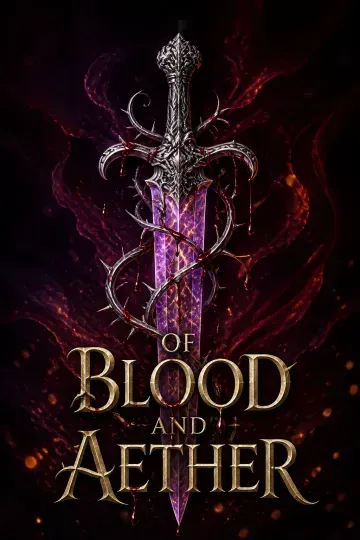
At its core, Of Blood and Aether is an exploration of whether love can exist independently of fate, or whether it is inevitably shaped by forces beyond individual control. Kieran2 and Arken1's relationship is constantly haunted by the question of authenticity: is their magnetic pull genuine chemistry or the mechanistic fulfillment of an ancient prophecy? The book refuses to answer definitively, instead dramatizing the psychological cost of both possibilities. Kieran2 embodies the terror of predestination. His body was literally inscribed with a destiny he did not choose, and his entire life has been a flight from that violation. His compulsive control, his refusal of attachments, his carefully compartmentalized existence are all strategies to avoid becoming the weapon his father wanted. Yet when he finally allows himself to love, the prophecy activates anyway, confirming his deepest fear: that he was never free. Arken1 represents the burden of the hidden self. Her multi-elemental Resonance is a secret she has guarded since childhood, a difference that isolates her even as it empowers her. The Harbinger legend gives her a language for her dread, but also pathologizes her very existence. Her arc is about integration: can she accept what she is without becoming the monster the myth describes? The book's structure, alternating between their perspectives, creates a dramatic irony that is both tragic and romantic. The reader knows Kieran2's cruelty is a performance born of love; the reader knows Arken1's secrets long before Kieran2 discovers them. The climax is not a battle but a severance, two people who have found their mirror choosing to shatter the glass to protect each other from the reflection. Ultimately, Of Blood and Aether argues that love is not the opposite of fate but its most dangerous expression. To love someone is to become exquisitely vulnerable to forces outside your control, to accept that losing them would destroy you in ways no prophecy ever could. Kieran2's final act is not defiance of fate but a desperate renegotiation of its terms: if he must be the Catalyst, he will at least ensure the Conduit survives. Whether that counts as victory remains to be seen.
Review Summary
People Also Read
Characters
Arken Asher
Orphaned Light Conduit seeking answersFound abandoned as an infant in the Brindlewoods under a full moon, Arken was raised by Amaretta Sinclair7, a retired scholar who became her mentor and surrogate mother. She possesses an insatiable curiosity and a mind that devours knowledge, but also carries a profound sense of being fundamentally different from others. She masks her social discomfort through careful observation and mimicry. Her Light Resonance manifested unusually early and strong, but she harbors a dangerous secret: she can wield all six elements, a trait Amaretta7 made her swear to hide at all costs. Arken is drawn to darkness and danger, finds comfort in Shadow, and possesses a hidden submissive streak that she rarely trusts others to see. Her journey to Sophrosyne is driven by a hunger to understand what she truly is.
Kieran Vistarii
Scarred Captain of the Elder GuardA Shadow Conduit who rose to captaincy young, Kieran is Sophrosyne's spymaster, operating in the gray spaces between law and necessity. His face bears a brutal scar cleaving his left eye blind; his body is marked with cryptic black tattoos. Charismatic and lethal, he uses seduction as both tool and shield, maintaining casual lovers while permitting no one genuine closeness. He claims to have no friends, only colleagues. Beneath the cocksure mask is a man shaped by profound violence who believes himself unworthy of love. His Shadow abilities are unusually potent, hinting at an origin beyond a mere Conduit. Dominant by nature, controlling and precise, he is nonetheless capable of startling tenderness.
Laurel Ansari
Arken's irreverent best friendEarth Conduit and eldest daughter of Samhaven's High Advisor of Trade, Laurel is being groomed to inherit her father's position, a destiny she both resents and accepts. She copes with the pressure through a rotating cast of girlfriends and a penchant for wine, gossip, and petty crime. Her eight-year-old brother Amir is kidnapped during the story, shattering her carefree facade and revealing a depth of grief and vulnerability beneath the bravado. She is fiercely loyal to Arken1 and serves as both comic relief and emotional anchor.
Sienna Makar
Heiress of Shadows, flirtatious allyDaughter of Lord Markus Makar of Luxtos & Stygos, Sienna is a striking Shadow Conduit with Irrosi heritage, silver tattoos, and effortless magnetism. She moves through Sophrosyne's social circles with the confidence of someone who has always been watched and desired. Her flirtation with Arken1 is genuine but light, a mutual appreciation of beauty without expectation. She is protective, sharp-tongued, and unafraid to challenge Kieran2 when he hurts her friend.
Hans Deering
Kieran's brash second-in-commandA non-Resonant human in a Conduit-dominated force, Hans developed a combat style specifically exploiting arcane weaknesses. He is boisterous, gossipy, and frequently inserts his foot into his mouth, but his loyalty to Kieran2 and his skill in battle are absolute. His friendship with Jeremiah6 and obsession with Atlassian political drama provide both comic relief and grounded perspective.
Jeremiah Fairchilde
Stoic Fire Conduit and third-in-commandReserved where Hans5 is loud, precise where Hans5 is messy. He carries a past heartbreak, a man named Caleb, that has kept him emotionally closed off for years. His quiet competence masks a fierce moral core: he is the first to punch Kieran2 when the captain's cruelty toward Arken1 crosses a line. His tentative feelings for a younger recruit represent his slow re-engagement with vulnerability.
Amaretta Sinclair
Arken's retired scholar mentorFormerly the High Scholar of Clerical Studies at the Arcane Studium, she found the infant Arken1 abandoned in the Brindlewoods and raised her with fierce love and stern warnings. She knows Arken1's secret and made her swear to hide her other Resonances, though the binding of her own arcane brand prevents her from fully explaining why.
Commander Hanjae Ka
Kieran's stern but caring commanderKa knows more about Kieran2's past than most and serves as a mentor who sees through the captain's deflections. He offers Kieran2 advancement opportunities while quietly monitoring his well-being, balancing the captain's ruthless tendencies with pragmatic leadership.
Anders Cragg
Sleazy heir to the House of ClayArrogant, entitled, and accustomed to getting what he wants, he corners Arken1 in an alley and receives an aetherblade to the throat for his trouble. He represents the toxic entitlement of the Atlassian nobility.
Caen Vistarii
Kieran's sadistic younger brotherThe heir presumptive of the Shadow Plane in Kieran2's absence. Sadistic and impulsive, Caen commands the Ravenhounds and has come to Aemos to spy on his exiled brother. He represents the immediate, personal threat that forces Kieran2 to push Arken1 away.
Plot Devices
The Prophecy of the Harbingers
Fated doom driving the plotCarved into Kieran2's back as a child by the Crones of Scáth, the prophecy foretells two Harbingers: a Catalyst and a Conduit, one wielding All elements and the other None, mirrors destined to restore the crumbling Shadow Plane and wreak vengeance on its enemies. The Catalyst must find the Conduit before ascending the throne. The prophecy has haunted Kieran2 his entire life; he fled to Aemos to escape it, believing he could defy fate. Throughout the book, the prophecy manifests as an inexplicable magnetic pull between Kieran2 and Arken1, a bond that feels both chosen and predestined.
The Arcane Brand
Magickal binding and key to the cityA tattoo of the Seed of Creation, seven overlapping circles representing the six elements and the Source, seared onto the dominant wrist of every Conduit by the Aetherborne. It serves as a key through Sophrosyne's wards, proof of Conduit status, and a magickal seal that prevents the bearer from speaking certain secrets of the Studium. Amaretta7's brand prevented her from fully explaining Arken1's danger; Arken1's brand now binds her in the same way. The brand is both privilege and cage.
Scáthic Blood Magick
Forbidden power revealing hidden originsAn ancient, dark form of arcana tied to the Shadow Plane's royal bloodline, allowing its wielder to tear rifts between realms, compel truth from enemies, and exert dominion through blood sigils. Kieran2 has suppressed this power for years, using only his mortal Shadow Conduit abilities. The Leshy attack forces him to unleash it to save Arken1, leaving arcane echoes that alert his enemies. His subsequent use against Berith and Abraxas reveals the full terrifying scope of his heritage. The magick is addictive and predatory, constantly whispering for him to surrender to his basest instincts.
Aether and the Six Elements
The world's magic systemAll life contains aether, the substance that fuels Resonance and arcana. Most Resonant humans can wield only one of the six elements (Light, Shadow, Fire, Water, Earth, Air). Wielding all six is considered impossible, the stuff of myth: the Irrosi legend of the Harbingers warns that such a being would disrupt the balance of the planes and trigger a second Cataclysm. Arken1 secretly possesses all six Resonances, a truth that defines her isolation and terror. Throughout the book, she must hide her other elements while using them in private to release the building pressure of her power.
Wardpoints
City defense and worldbuilding detailMassive chunks of astral quartz reinforced with umbral ore, placed at the six corners of Sophrosyne's walls. Enchanted by the Aetherborne, they preserve the complex warding arcana that protects the city, allowing the wards to persist without constant renewal. Kieran2 shows Arken1 the wardpoints during a clandestine tour, explaining that destroying one would only release stored power, making the wards stronger temporarily. The quartz is the same material as the stone Kieran2 gifts Arken1, which she later shatters in grief.
Harbingers Series Series
Download PDF
Download EPUB
.epub digital book format is ideal for reading ebooks on phones, tablets, and e-readers.








































