
Key Takeaways
1. Vectors and Tensors: The Universal Language of Modern Science and Data.
At its core, the story I’ll tell here is about the evolution of the way we humans record and make sense of all the data that swirl around us.
Information encoding. Vectors and tensors are mathematical concepts that encode multiple pieces of information simultaneously, going beyond simple scalar quantities (like speed or temperature) which represent only one attribute. This multi-dimensional data representation is crucial for understanding complex systems. For example:
- A vector can represent velocity, combining both speed (magnitude) and direction.
- Tensors can store even more layers of information, acting like multi-dimensional arrays.
Ubiquitous applications. These mathematical tools are indispensable across diverse fields, from fundamental physics to cutting-edge technology. They provide the language to describe and analyze phenomena in space and time, as well as abstract "dimensions" of information.
- Physics: Predicting gravitational waves, modeling quantum spin, describing electromagnetic fields.
- Engineering: Designing bridges, rotating robot arms, calibrating GPS systems.
- Data Science: Handling "big data," powering search engines, enabling artificial intelligence.
Unlocking mysteries. The power of vectors and tensors lies in their ability to reveal hidden patterns and underlying physical attributes, acting as a "magnifying glass" for the universe. Their development represents a series of mathematical revolutions that paralleled and enabled major scientific breakthroughs, from Maxwell's electromagnetism to Einstein's relativity.
2. Algebra's Liberation: From Concrete Arithmetic to Abstract, Rule-Breaking Symbols.
There is a reciprocal relation between symbolism and mathematical thought-processes, and it would be hard to overestimate the effect of Harriot’s techniques and clarity of thought expressed in a symbolism that directs what you do visually and therefore makes mathematics accessible in a totally new way….
Ancient roots. Algebra has existed for millennia, initially expressed through cumbersome word problems and geometric diagrams, as seen in Mesopotamian tablets solving quadratic equations by "completing the square." Early mathematicians like al-Khwārizmī provided algorithms but lacked symbolic notation, making generalization difficult.
Symbolic revolution. The shift from words and geometry to abstract symbols was a slow, arduous process, culminating with Thomas Harriot in the early 17th century and René Descartes shortly after. This symbolic language allowed mathematicians to:
- See general patterns at a glance (e.g., x² - 2x = 8 vs. x² - ax = b).
- Envisage higher dimensions beyond physical visualization (e.g., x⁴ as easily as x²).
- Manipulate concepts abstractly, leading to new mathematical structures.
Rule-breaking discoveries. The liberation of algebra from concrete meaning paved the way for revolutionary ideas, such as imaginary numbers (i² = -1) and non-commutative multiplication (a × b ≠ b × a). These initially "absurd" concepts, once formalized, opened up entirely new algebraic worlds, proving that mathematical rules could be expanded to describe previously unimaginable realities.
3. Calculus: The Revolutionary Mathematics of Change and the Infinitesimal.
It is vector and tensor calculus, however, that we’ll explore in the rest of this book, along with the ideas and applications of vectors and tensors themselves.
Quantifying change. Calculus, developed independently by Isaac Newton and Gottfried Leibniz in the 17th century, provides the tools to precisely describe rates of change (differential calculus) and to sum infinitesimal quantities (integral calculus). This allowed for the mathematical modeling of dynamic phenomena previously beyond reach.
- Differential calculus: Used for speed, growth, decay, wave propagation, and gradients.
- Integral calculus: Used for areas, volumes, lengths of curves, and work done by forces.
Overcoming infinity. Ancient mathematicians like Archimedes approximated infinite sums through "the method of exhaustion," but calculus provided rigorous algorithms to handle infinitesimals and infinities directly. This allowed for exact calculations of curved lengths and areas, moving beyond approximations.
- Newton and Leibniz grappled with defining "infinitesimal" and "limit," concepts that took centuries to formalize.
- The ability to manipulate infinity opened new avenues for mathematical and scientific inquiry.
Language of mechanics. Joseph-Louis Lagrange and Leonhard Euler translated Newton's geometric proofs into the more transparent and general language of algebraic calculus, making it the standard for describing motion and forces. This shift from geometric intuition to symbolic manipulation was crucial for extending physical theories and foreshadowed the need for vector and tensor calculus to describe complex, multi-directional changes.
4. Hamilton's Quaternions: A 4D Breakthrough for Describing 3D Rotations.
Hamilton gave the name “quaternions” to his 4-D creations; they contained two parts, a 1-D real number, which he called a “scalar,” and a 3-D (three-component) quantity having magnitude and direction, which he called a “vector.”
The quest for 3D rotations. William Rowan Hamilton spent years trying to find an algebraic system to represent rotations in three-dimensional space, analogous to how complex numbers (2D "couples") represent rotations in a 2D plane. His children famously asked him daily if he could "multiply triplets."
The Broome Bridge epiphany. In 1843, a flash of insight led Hamilton to realize that 3D rotations required a 4D mathematical system. He famously carved the core rules of his new "quaternions" onto Broome Bridge: i² = j² = k² = ijk = -1. This system introduced a groundbreaking concept: non-commutative multiplication (ij = -ji), where the order of multiplication matters.
Unforeseen applications. Hamilton's quaternions, initially a pure mathematical curiosity, proved to be incredibly efficient for complex rotations. They are now fundamental in:
- Robotics and CGI: Smoothly animating and controlling movements.
- Aerospace navigation: Guiding spacecraft and aircraft, avoiding "gimbal lock."
- Quantum mechanics: Describing the bizarre "spin" property of electrons, where a particle needs to rotate 720° to return to its original state, mirroring a quirk of quaternion algebra.
5. Grassmann's Vision: Pioneering N-Dimensional Geometry and Abstract Products.
I remain completely confident that the labor which I have expended on the science presented here and which has demanded a significant part of my life as well as the most strenuous application of my powers, will not be lost.
Independent discovery. Simultaneously with Hamilton, the German schoolteacher Hermann Grassmann independently developed a similar system of "extensions" (vectors) and their algebra, published in his 1844 book Ausdehnungslehre. Like Hamilton, he discovered non-commutative multiplication for his "outer products."
Abstract and general. Grassmann's approach was more abstract and less focused on immediate physical applications than Hamilton's. He built an algebra of geometric "lines" that could be "extended" to form planes and higher-dimensional objects, readily adaptable to any number of dimensions.
- He defined "inner products" (analogous to Hamilton's scalar product) and "outer products" (a more general version of Hamilton's vector product).
- His work laid the groundwork for n-dimensional linear algebra and the germ of tensor algebra.
Slow reception. Despite its brilliance, Ausdehnungslehre was largely ignored due to its dense, philosophical style and Grassmann's outsider status. Even Hamilton, upon discovering it years later, found it difficult to penetrate. However, his confidence in its future utility proved prophetic, as his ideas would later be rediscovered and integrated into modern mathematics, particularly in tensor analysis.
6. Maxwell's Field Theory: Unifying Electromagnetism with Whole Vectors.
…light itself (including radiant heat, and other radiations if any) is an electromagnetic disturbance in the form of waves propagated through the electromagnetic field according to electromagnetic laws.
Faraday's intuition, Maxwell's math. Michael Faraday, a self-taught experimentalist, conceived the revolutionary idea of "lines of force" and "fields" to explain electric and magnetic interactions, rejecting the prevailing "action-at-a-distance" view. James Clerk Maxwell, inspired by Faraday, provided the mathematical framework for this field concept.
Differential equations and fields. Maxwell realized that traditional integral calculus, used by his predecessors, implicitly supported action-at-a-distance by focusing on boundaries. He instead employed partial differential equations to describe how electric and magnetic forces change continuously throughout space, thus defining "vector fields."
- He formalized Faraday's law of induction and Ampère's law.
- He introduced the vector calculus operations "grad," "divergence," and "curl" to describe field properties.
The uncanny deduction. From his field equations, Maxwell made the astonishing deduction that electromagnetic disturbances propagate as transverse waves at the speed of light. This unified electricity, magnetism, and light, predicting the existence of other "radiations" (later discovered as radio waves). This monumental achievement, published in his 1873 Treatise on Electricity and Magnetism, marked a turning point for physics and the acceptance of vector methods.
7. The Vector Wars: Forging Modern Vector Analysis from Quaternionic Roots.
The virtue of the 4nions [quaternions] lies not so much as yet in solving hard questions, as in enabling us to see the meaning of the question and its solution.
Hamilton's legacy contested. After Hamilton's death, his ardent disciple Peter Guthrie Tait championed quaternions, publishing an accessible textbook and applying them to physics. However, many, including Maxwell's mentor William Thomson, found quaternions overly complex and unnecessary, preferring component-based equations.
The rise of vector analysis. Oliver Heaviside, an eccentric self-taught telegrapher, and Josiah Willard Gibbs, a Yale professor, independently developed a simplified "vector analysis" that stripped away the quaternion's scalar part and imaginary numbers. They introduced the modern notation (boldface for vectors, dot for scalar product, cross for vector product) and focused on the practical utility of vectors in physics.
- Heaviside famously "murdered" Maxwell's potentials to emphasize the physical electric (E) and magnetic (B) fields.
- He reformulated Maxwell's equations into the four elegant whole-vector equations known today.
The "Vector Wars." The 1890s saw fierce debates in scientific journals between quaternionists (Tait, McAulay) and vector analysts (Gibbs, Heaviside). The core argument revolved around:
- Representational economy: Quaternions and whole vectors offered compact, coordinate-free expressions.
- Computational practicality: Components were still needed for calculations, but whole vectors offered clearer physical insight.
- Generality: Grassmann's n-dimensional ideas hinted at limitations of 3D quaternions.
Ultimately, the utilitarian vector analysis of Gibbs and Heaviside triumphed for physics applications, though quaternions would later find their niche in computer-age technologies.
8. Minkowski's Space-Time: Uniting Space and Time into a 4D Continuum.
Henceforth space by itself, and time by itself, are doomed to fade away into mere shadows, and only a kind of union of the two will preserve an independent reality.
Relativity's challenge. Einstein's 1905 special theory of relativity showed that space and time measurements are relative to an observer's motion, but the speed of light remains constant. This required the Lorentz transformations to relate measurements between observers moving at constant relative speeds.
The 4D union. Hermann Minkowski, Einstein's former mathematics professor, recognized that the Lorentz transformations revealed a deeper, invariant reality: a four-dimensional "space-time" continuum. He showed that the expression x² + y² + z² - (ct)² (the "Minkowski metric") remained unchanged under these transformations, representing the invariant "interval" between events in space-time.
- Minkowski introduced "world lines" to represent objects' paths through space-time.
- He began developing 4D vector analysis, defining scalar products by analogy with the Minkowski metric.
Beyond intuition. Minkowski's concept was initially met with skepticism, even by Einstein, who preferred component-based equations. However, the mathematical elegance and power of space-time, particularly its invariant properties, proved indispensable. His work laid the foundation for:
- 4-vectors: Generalizing 3D vectors to 4D space-time.
- Tensor analysis: Providing the tools to describe physical laws in this new geometry.
Tragically, Minkowski died prematurely, but his vision of space-time became the bedrock for Einstein's later work on gravity.
9. Gauss and Riemann: Unveiling the Intrinsic Geometry of Curved Spaces.
What Riemann hinted at, however, was that there is a way to decipher the manifold’s curvature from these metric coefficients.
Geometry beyond Euclid. For millennia, Euclidean geometry, with its flat planes and parallel lines, dominated. However, observations like converging lines of longitude on Earth hinted at "non-Euclidean" geometries. Carl Friedrich Gauss, a master of geodesy, pioneered the mathematical description of curved surfaces.
The metric and intrinsic curvature. Gauss realized that for infinitesimally close points on a curved surface, the space is "locally flat," allowing the use of Euclidean distance (Pythagoras's theorem). He defined the "metric" (or "line element") as ds² = Edp² + 2Fdpdq + Gdq², where coefficients E, F, G encode the surface's intrinsic geometry.
- His theorema egregium showed that these coefficients alone could determine the surface's intrinsic curvature, without needing to view it from an external 3D space.
- He introduced "geodesics" as the shortest paths on curved surfaces, analogous to straight lines in flat space.
N-dimensional generalization. Bernhard Riemann, Gauss's brilliant student, extended this work to n-dimensional curved spaces, or "manifolds." He showed that the metric coefficients and their derivatives contained all the information needed to measure curvature in these abstract spaces.
- He introduced multi-index quantities (later called Christoffel symbols and the Riemann tensor) to describe curvature.
- The Riemann tensor, if non-zero, indicates that a space is intrinsically curved.
This work provided the essential geometric language for describing gravity as the curvature of space-time, a concept Einstein would later adopt.
10. Ricci's Tensors: The Absolute Calculus for Invariant Physics.
…his calculus and its notation “contribute not only to the elegance, but also to the agility and clarity of the demonstrations and conclusions.”
Formalizing invariance. Building on Gauss and Riemann, Gregorio Ricci developed "absolute differential calculus," now known as tensor calculus, in the late 19th century. His goal was to provide a rigorous mathematical theory for "systems of functions" (tensors) that encoded invariance under coordinate transformations.
Index notation and tensor types. Ricci introduced a powerful index notation, using upstairs indices for "contravariant" vectors (like column vectors) and downstairs indices for "covariant" vectors (like row vectors or "one-forms"). This notation visually distinguishes how components transform under coordinate changes.
- Tensor rank: Defined by the number of indices, each representing a different type of information (e.g., a vector is rank 1, a matrix is rank 2).
- Tensor products: A way to combine information from multiple tensors into a new, higher-rank tensor (e.g., a column vector ⊗ a row vector = a matrix).
- Contraction: Summing over a repeated upstairs and downstairs index reduces the tensor's rank, often yielding an invariant scalar.
The metric as a tensor. Ricci showed that the metric coefficients (gμν) are components of a tensor, as they "operate on" two vectors to produce an invariant scalar (the scalar product). This confirmed that the metric itself, which defines distances and curvature, is a fundamental tensor.
Covariant derivatives. To ensure that physical laws expressed as differential equations remained invariant (covariant) in curved spaces, Ricci developed the "covariant derivative." This derivative, unlike ordinary partial derivatives, accounts for the curvature of space-time, ensuring that the results are physically meaningful regardless of the chosen coordinate system.
11. Einstein's General Relativity: Gravity as the Curvature of Space-Time.
In the light of knowledge attained, the happy achievement seems almost a matter of course, and any intelligent student can grasp it without too much trouble. But the years searching in the dark, with their intense longing, their alternations of confidence and exhaustion and the final emergence into the light—only those who have experienced it can understand that.
The principle of equivalence. Einstein's "happiest thought" was realizing that gravity is indistinguishable from acceleration locally. An observer in a free-falling elevator feels weightless (no gravity), while one in an accelerating rocket feels a force (like gravity). This "principle of equivalence" implied that gravity must bend light and affect time, leading to gravitational redshift.
Grossmann and tensors. Struggling to find the mathematical language for a general theory of gravity, Einstein turned to his friend Marcel Grossmann, who introduced him to Ricci's tensor calculus and Riemann's geometry. Einstein made the daring assertion that the metric tensor (gμν) itself represents the gravitational potential, linking geometry and gravity.
The field equations. After years of intense struggle, Einstein, with initial help from Grossmann and later spurred by David Hilbert's parallel work, formulated his gravitational field equations in November 1915:
- Rμν - ½gμνR = kTμν
- These ten coupled, non-linear partial differential equations relate the curvature of space-time (left side, derived from the metric tensor) to the distribution of matter and energy (right side, the stress-energy tensor).
Unlocking the universe. These elegant tensor equations became the cornerstone of modern cosmology, correctly predicting:
- The anomalous precession of Mercury's perihelion.
- The bending of light by massive objects (confirmed by 1919 eclipse expeditions).
- The existence of gravitational waves (detected in 2015).
- The existence of black holes and the Big Bang singularity.
Einstein's general relativity, a triumph of tensor calculus, transformed our understanding of gravity from a force into a manifestation of space-time's geometry.
12. Noether's Theorems: The Profound Link Between Symmetry and Conservation.
You know that Miss Noether advises me continually regarding my work, and it is only thanks to her that I have understood these questions.
Resolving conservation laws. Following Einstein's publication of general relativity, David Hilbert and Felix Klein invited Emmy Noether to Göttingen to clarify the complex relationship between the theory's mathematical covariance and physical conservation laws. Einstein himself had struggled with this.
Symmetry and invariance. Noether's groundbreaking 1918 theorems established a fundamental connection: for every continuous symmetry in a physical system, there is a corresponding conservation law.
- Classical mechanics: Translational symmetry (invariance under shifts in position) implies conservation of momentum. Rotational symmetry implies conservation of angular momentum.
- General relativity: The infinite symmetry group of general coordinate transformations implies a complex, local conservation law for the energy-momentum of the gravitational field (Tμν;ν = 0), which is a mathematical identity rather than a direct physical conservation law like in classical mechanics.
Impact and legacy. Noether's work, initially overlooked due to its abstract nature and the prevailing sexism that hindered her academic career, proved to be profoundly influential. Her theorems:
- Provided a rigorous foundation for understanding conservation laws across all of physics, from classical mechanics to quantum field theory.
- Clarified the role of the Bianchi identities in general relativity, showing how they ensure consistency between the field equations and energy-momentum conservation.
- Became a cornerstone of modern theoretical physics, with applications extending to elasticity, fluid mechanics, and pure mathematics.
Noether's genius, recognized by Einstein and Hilbert, solidified the mathematical underpinnings of general relativity and revealed a deep, unifying principle governing the universe.
Review Summary
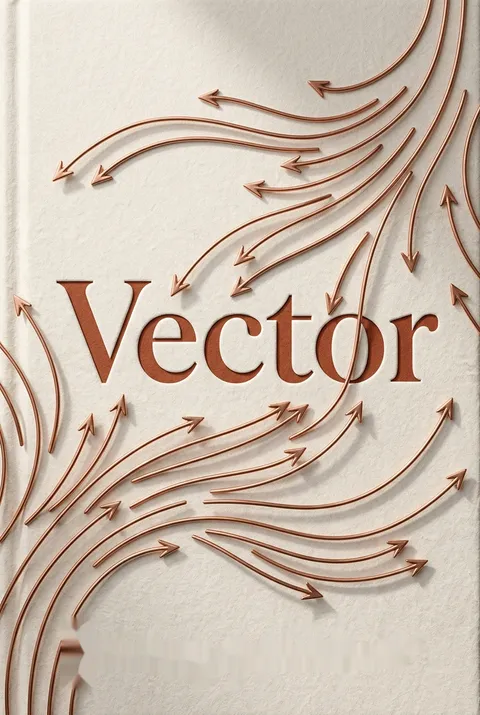
Vector is a mathematically rich history of the development of vectors, quaternions, and tensors, tracing their role in physics from Newton to quantum mechanics. Reviews are largely positive, with readers praising its depth, historical narrative, and the author's passion. Most recommend prior university-level mathematics knowledge for full appreciation. Critics note inconsistent audience targeting and occasional tangents, while some struggled with the advanced content. Overall, it is considered an outstanding contribution for mathematically inclined readers.
People Also Read





Download PDF
Download EPUB
.epub digital book format is ideal for reading ebooks on phones, tablets, and e-readers.








































