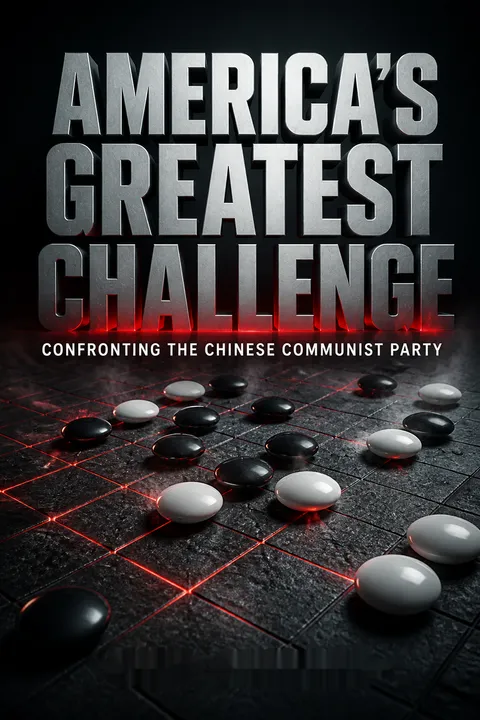

Key Takeaways
1. China's Leninist Totalitarianism Poses America's Greatest Challenge
The truth is, the real modern China is a totalitarian communist dictatorship that wants to be the world’s dominant superpower—and the United States is in the way.
A formidable competitor. After decades of misunderstanding, America must recognize China as a totalitarian communist dictatorship, a far more formidable competitor than previously realized. This challenge is the fifth great threat to American survival, comparable to the American Revolution, the Civil War, World War II, and the Cold War. The contest is between two fundamentally different systems: America's free and sovereign nation versus China's surveillance, control, deception, and cheating.
Xi's Leninist foundation. General Secretary Xi Jinping, whose primary title is General Secretary of the Chinese Communist Party, presides over a Leninist totalitarian system that has been in power since 1949. This system prioritizes the Party's absolute leadership, controlling the military and every aspect of society. Western perceptions of China as a developing nation that would naturally democratize were incredibly naive, ignoring its deep-seated communist ideology and history of crushing dissent.
A long-term, integrated effort. China's strategies are methodical, disciplined, and executed over long time horizons, contrasting sharply with America's short-term, often fragmented focus. The Chinese Communist Party's integrated approach—economic, diplomatic, military, political, and academic—aims to re-establish China as the "Middle Kingdom" at the center of global affairs. This requires a comprehensive, sustained American response, not just isolated reactions.
2. The "China Dream" is a Party-Orchestrated Vision for Global Dominance
Xi’s vision places the socialist system above the Chinese people—and calls on them to follow and depend on it to improve their lives.
Contrasting visions. President Trump's "Make America Great Again" is a patriotic vision of national success driven by the American people's ingenuity and dreams. In stark contrast, General Secretary Xi Jinping's "China Dream" is a party-orchestrated proposal that places the socialist system above the Chinese people, demanding their adherence to achieve national rejuvenation through Chinese socialism. This vision is fundamentally incompatible with American ideals of individual freedom and sovereignty.
Centennial goals. The "China Dream" outlines two centennial goals:
- By 2021 (100th anniversary of the Communist Party): Transform China into a "moderately prosperous society."
- By 2049 (100th anniversary of the People's Republic): Transform China into a "modern socialist country that is prosperous, strong, democratic, culturally advanced and harmonious," a world leader in science, technology, economics, and military might.
Collective over individual. Unlike the American Dream, which emphasizes individual success leading to national prosperity, the China Dream is centered on collective values. For Xi, the nation's success is a prerequisite for individual success, demanding unity and struggle from the Chinese people to achieve the Party's objectives. This collectivist approach, combined with Leninist control, poses a direct threat to the free world.
3. Systematic Intellectual Property Theft Fuels China's Economic Aggression
The Chinese Communist Party’s commitment to intellectual property theft is at the heart of this trade fight.
A staggering cost. China's intellectual property (IP) theft is not merely a trade issue but a core component of its strategy to dominate future industries, costing the US economy hundreds of billions of dollars annually. This theft, often through cyber hacking, forced technology transfers, and corporate espionage, is equivalent to stealing the entire economic output of a US state each year. Past US administrations failed to deter this, signing hollow agreements that China consistently flouted.
Diverse methods of pilfering. China employs a wide array of tactics to acquire foreign technology and IP:
- Forced joint ventures: Requiring foreign companies to partner with Chinese firms, making intangible assets vulnerable.
- Adverse administrative processes: Using licensing and security reviews to compel technology transfer.
- Cyber hacking: Direct theft of trade secrets and cutting-edge military blueprints.
- Acquisition of firms: Sponsoring the purchase of American companies to gain ownership of their creations.
- Reverse engineering: Flooding markets with knockoff products after stealing designs.
Trump's tough stance. President Trump has rightly leveraged tariffs to push back against these unfair practices, recognizing that China's negotiators often attempt to strip IP protections at the last minute. The goal is to compel China to play by international rules, as inaction is tantamount to surrender. Sanctions against entities procuring stolen IP and counter-subsidies to match China's predatory pricing are crucial tools to protect American innovation and jobs.
4. Big Data and AI Enable China's E-Tyranny and Global Surveillance
[Xi’s] strategy for understanding and responding to what is going on in a nation of 1.4 billion relies on a combination of surveillance, AI, and big data to monitor people’s lives and behavior in minute detail.
An unparalleled surveillance state. China is building an unparalleled surveillance state, leveraging big data and artificial intelligence (AI) to monitor its 1.4 billion citizens. This includes real-time tracking of alternative fuel vehicles, extensive data collection through popular apps like WeChat and TikTok, and the use of Chinese-made drones that could transmit sensitive data globally. This vast data collection fuels China's ambition to become a world leader in AI by 2030.
The social credit system. The culmination of this effort is China's social credit score system, fully implemented by 2020, which assigns a score to every citizen based on their behavior.
- Rewards: Preferential treatment for "trustworthy" citizens (e.g., waived deposits, shorter lines).
- Punishments: Restrictions for low scores (e.g., barred from trains/planes, internet slowdowns, children blocked from schools).
This Orwellian system, with no independent appeal, is a chilling example of "e-tyranny."
Xinjiang: A blueprint for control. The Xinjiang Uyghur Autonomous Region serves as a real-world laboratory for this digital authoritarianism, where millions of Uyghurs and other Muslim minorities are subjected to constant surveillance and detention in "reeducation" camps.
- Militarized checkpoints: Frequent checks with facial recognition.
- Mandatory surveillance software: Phones inspected for required apps.
- Reliability scores: Used to determine trustworthiness and detention eligibility.
This system, described as "automated authoritarianism," demonstrates China's intent to control its population and potentially export these repressive practices globally.
5. Crushing Dissent is Central to the Chinese Communist Party's Control
The simple fact is: There are no human rights in China.
No inalienable rights. In China, human rights are not inalienable but are granted by the state, prioritizing the Communist Party's survival and stability over individual freedoms. This fundamentally differs from Western values where power originates from the people and rights are God-given. The Party's anti-corruption campaigns, for instance, often serve to eliminate political opponents rather than uphold justice.
Tiananmen: A Leninist response. The 1989 Tiananmen Square massacre was not an aberration but a brutal Leninist response to calls for political liberalization, demonstrating the Party's willingness to use extreme violence to maintain control. This pattern of repression continues today against various groups:
- Religious persecution: Christians, Buddhists, and Falun Gong practitioners face severe crackdowns, with churches shut down, Bibles burned, and leaders imprisoned. The Party aims to "sinicize" religion, ensuring loyalty to communist ideology.
- Uyghurs and Tibetans: Millions are subjected to "reeducation" camps, forced labor, and cultural eradication in Xinjiang, a clear attempt to erase their identity and suppress any impulse towards independence.
Silencing opposition. The Party actively silences dissidents, journalists, and human rights lawyers through imprisonment, forced confessions, and intimidation of their families. The "709 crackdown" exemplifies this, using "residential surveillance at a designated location" to arbitrarily detain individuals without due process. The US must expose these abuses, sanction complicit companies, and launch information campaigns to support the Chinese people against totalitarian oppression.
6. China's Propaganda Machine Shapes Perceptions Domestically and Abroad
Today, the Chinese Communist Party has nearly a century of manipulating information and people to win the contest for public support.
A sophisticated apparatus. The Chinese Communist Party (CCP) employs a vast and complex propaganda machine, honed over nearly a century, to control information and shape public opinion both domestically and internationally. This is a critical tool for maintaining the Party's power and advancing its global agenda. Domestically, the "Great Firewall" censors the internet, blocking thousands of websites and employing tens of thousands of censors.
Controlling the narrative. The CCP ensures all media, including state-run outlets and social media, aligns with its messaging. Journalists are required to take Marxism classes and "spread positive information" about the Party. This extends to:
- Hollywood influence: China's massive film market is leveraged to compel studios to self-censor, altering plots (e.g., "Doctor Strange," "World War Z") and banning actors critical of the CCP.
- Corporate coercion: American companies are forced to apologize for acknowledging Taiwan or Hong Kong as distinct entities, demonstrating the CCP's power to dictate political stances.
- Confucius Institutes: These academic programs, funded and overseen by the Hanban (an agency of China's Ministry of Education), are "an important part of China's overseas propaganda set-up," promoting a CCP-approved view of Chinese culture and history while suppressing academic freedom.
The "United Front" strategy. The CCP's "United Front Work Department" coordinates political influence activities, co-opting and suppressing opposition globally. This involves cultivating relationships with influential foreign individuals and groups to promote Party interests and marginalize opponents. The US must expose these efforts, ensure transparency in academic institutions, and counter the CCP's attempts to rewrite history and suppress truth.
7. The 5G Race is a Critical Test of China's Global Technological Ambition
The most immediate and pressing challenge that we face with China is the race to develop and deploy the world’s 5G communications network.
The backbone of the future. 5G technology is not merely an upgrade but the foundation of the 4th Industrial Revolution, enabling self-driving cars, smart cities, and advanced AI. Whoever dominates 5G globally will control the future of technology and information. China, through its champion Huawei, is aggressively pursuing this dominance with heavy government subsidies, operating in 170 countries while US companies lag.
Security implications. Huawei's deep ties to the Chinese Communist Party mean that trusting Huawei is trusting a totalitarian system. If China controls global 5G infrastructure, it could:
- Censor the internet: Apply Chinese totalitarian rules to global communications.
- Monitor personal data: Aggressively mine data from every device on the network.
- Exert coercive leverage: Use its control for espionage, economic pilferage, and authoritarian rule.
This poses an existential threat to American privacy, individual freedoms, and technological leadership.
US failures and solutions. The US is losing this race due to a lack of concerted strategy, slow domestic deployment, and a problematic focus on higher-frequency millimeter wave spectrum, which limits coverage and isolates the US technologically. To win, America needs:
- Urgent leadership: A 5G Implementation Council, similar to the National Space Council, to coordinate a whole-of-government and whole-of-society effort.
- Spectrum reform: The DoD must free up sub-6 GHz spectrum to align with global standards and enable nationwide coverage.
- Market innovation: The FCC must open its auction system to new players and consider a wholesale model to foster competition and lower costs, especially for rural areas.
- Strategic alliances: Collaborate with allies to counter Huawei's subsidized pricing and ensure secure, reliable 5G networks globally.
8. China's "Gathering Sand" Espionage Strategy is Pervasive and Patient
The Chinese Communist Party looks for assets in virtually every aspect of modern life.
An all-of-society approach. China's espionage machine operates on a vast scale, not just through traditional spies but by leveraging everyday people and institutions. Chinese laws, like the 2017 National Intelligence Law, compel citizens and companies (including foreign firms operating in China) to "support, assist, and cooperate with state intelligence work." This grants the Party carte blanche authority to access private data and records.
High-level infiltration and cyber theft. China targets all levels of American society:
- Government: Infiltrating high-level officials (e.g., Senator Feinstein's driver) to gather political intelligence over decades.
- Cyberattacks: Hacking federal employee records (OPM hack, 22 million Americans affected) and health insurance companies (Anthem, 78 million people affected) for blackmail, identity theft, or strategic advantage.
- Economic espionage: Stealing cutting-edge military blueprints and proprietary commercial technologies from defense contractors and businesses.
- Recruitment: Using platforms like LinkedIn to recruit vulnerable non-Chinese citizens (e.g., former CIA officer Kevin Mallory) for espionage.
Academic infiltration. China's spy services also target US colleges and universities, exploiting the open exchange of ideas:
- Student monitoring: Chinese Students and Scholars Associations monitor Chinese students and report deviations from the Party line to consulates.
- Military scientists: Sponsoring over 2,500 military scientists to study abroad, often under false pretenses, to "pick flowers in foreign lands to make honey in China" by acquiring sensitive research and technology.
The US must strengthen counterintelligence, protect academic freedom, and hold China accountable for these pervasive and patient espionage efforts.
9. Understanding China Requires a "Go" Mindset, Not "Chess"
It is important to recognize that the competition we face with China today needs to be strategically approached like a game of go—not chess.
Contrasting strategic philosophies. American strategy often resembles chess: a linear, force-on-force game focused on decisive battles and eliminating powerful pieces. The US relies on overwhelming power and technological superiority for total victory. Chinese strategy, by contrast, is akin to Go: a game of protracted campaigns, subtle incremental gains, and acquiring territory rather than destroying opponents. All pieces have equal power, and victory is achieved through collective strength and strategic positioning across the entire board.
The dangers of a "chess mindset." Playing Go with a chess mindset is dangerous, leading to over-aggression, thinly stretched forces, and vulnerability. The US often fails to recognize China's long-term, multi-front campaigns because they don't fit our traditional understanding of conflict. China's actions in the South China Sea, for example, are a perfect illustration of Go strategy:
- Patience: Gradual assertion of claims over decades.
- Incremental gains: Building artificial islands, then militarizing them, without direct conflict.
- Territory acquisition: Expanding control over vital resources and trade routes.
- Minimizing violence: Avoiding direct confrontation while steadily shifting the balance of power.
Seeing the whole board. To effectively compete, America must adopt a "Go" mindset, looking at the entire strategic board, understanding the interconnectedness of China's various campaigns (5G, BRI, IP theft, military modernization), and recognizing that small, seemingly harmless moves can accumulate into decisive long-term advantages. This requires a shift from focusing on individual battles to understanding the broader, evolving balance of power.
10. The Belt and Road Initiative is a Framework for Global Influence and Debt Traps
The Belt and Road Initiative calls for joint contribution and it has a clear focus, which is to promote infrastructure construction and connectivity, strengthen coordination on economic policies, enhance complementarity of development strategies and boost interconnected development to achieve common prosperity.
A global infrastructure project. General Secretary Xi Jinping's signature foreign policy, the Belt and Road Initiative (BRI), is the most ambitious infrastructure investment in history, aiming to connect Eurasia, the Indo-Pacific, Africa, Latin America, and even space. While publicly framed as promoting "common development and prosperity," its true objective is to advance China's geopolitical influence and establish a China-led global order.
Debt-trap diplomacy. The BRI often involves opaque loans with high interest rates, primarily awarded to Chinese contractors, leading to "debt-trap diplomacy."
- Pakistan: Drowning in debt from the China-Pakistan Economic Corridor (CPEC), with energy projects requiring hefty returns on investment.
- Sri Lanka: Forced to cede control of its Hambantota port to China on a 99-year lease after defaulting on Chinese loans.
These cases illustrate how China gains economic leverage and control over strategically important assets, potentially undermining the sovereignty of host countries.
The Digital Silk Road. A less visible but equally insidious component is the Digital Silk Road, which focuses on integrating digital sectors globally (telecommunications, IoT, e-commerce). This effort, particularly in Africa, aims to:
- Export digital tyranny: Spread China's authoritarian model of internet censorship, surveillance, and control.
- Gain digital supremacy: Establish Chinese companies (like Huawei and ZTE) as dominant providers of digital infrastructure through cheap financing, creating a "digital iron curtain."
The US must offer transparent alternatives, like the BUILD Act, to counter China's predatory lending and prevent the erosion of global freedom and sovereignty.
11. Space Dominance is the New High Ground in the US-China Competition
The nation that aggressively travels to, harnesses, and inhabits space and other planets will be the nation that writes the rules for the future of humanity.
A critical frontier. The competition for space leadership is paramount, as the nation dominating space will define humanity's future. China, with its civil-military fusion model, is rapidly advancing its space capabilities, aiming to surpass the US by 2049. Every Chinese space project, from lunar missions to satellite development, has potential military applications, guided by the People's Liberation Army (PLA).
Rapid progress and strategic intent. China is progressing at an astonishing pace, matching NASA's nearly 40-year human spaceflight progression in less than 20 years. Its successful landing on the farside of the Moon and placement of a relay satellite in cislunar space signal a clear intent to establish a permanent presence and infrastructure in this "new high ground."
- Counter-space weapons: China is developing anti-satellite weapons, directed energy weapons, and cyberattack capabilities to "blind and deafen the enemy" by targeting US space assets.
- Economic weaponization: Chinese state-subsidized companies offer artificially low prices for launch services and satellites, aiming to bankrupt foreign competitors and dominate the commercial space market.
The Trump-Pence solution. The Trump administration has recognized this threat, reconstituting the National Space Council under Vice President Pence to reinvigorate the US space sector. The directive to return Americans to the Moon by 2024, with a focus on private sector innovation and accountability, aims to:
- Accelerate progress: Overcome bureaucratic inertia and cost overruns in traditional space programs.
- Ensure leadership: Guarantee that American values of freedom and the rule of law guide humankind's expansion into space.
- Counter China's ambitions: Prevent a future where China's totalitarian regime dictates the rules of space and, by extension, Earth.
12. American Renewal and a Whole-of-Society Response are Imperative
The burden on us to modernize and reform our own system is enormous.
Internal failures, not China's fault. Many of America's weaknesses that hinder its ability to compete with China are self-inflicted, not China's fault. These include:
- Education decay: Poor K-12 math and science education, and insufficient American graduate students in STEM.
- Bureaucratic inertia: Cumbersome defense procurement, slow technological adoption, and a "corporate welfare state" for large contractors.
- Infrastructure deficit: Overregulation and union rules making high-speed rail and other projects prohibitively expensive and slow.
- Economic vulnerabilities: Trillion-dollar deficits, runaway entitlement costs, and an expensive healthcare system.
- Societal division: Deep political partisanship, identity politics, and a shallow news media that ignores critical global challenges.
A call for comprehensive reform. Responding to China's totalitarian threat requires a "ruthlessly honest analysis" of American shortcomings and a "dramatic, deep resetting of American policy." This is a project on the scale of preparing for World War II or establishing Cold War institutions, demanding a whole-of-society effort.
- Public education: A national dialogue to build consensus on the existential threat posed by China.
- National strategy: A comprehensive, American-based strategy for society-on-society competition, leveraging private enterprise and non-profit institutions.
- Metrics for success: Clear benchmarks to ensure rhetoric aligns with reality and to drive persistent implementation, learning from failures, and constant adaptation.
Overcoming complacency. The greatest enemy is complacency. America must overcome its internal challenges, modernize its systems, and foster a renewed sense of national purpose. This requires a shift from "war posturing" to "war fighting," with a focus on proactive strategies, asymmetric capabilities, and rapid technological innovation. Only through such a profound transformation can America retain its position as the champion of freedom and prevent a future defined by Chinese communist characteristics.
Review Summary
Trump vs. China receives overwhelmingly positive reviews (4.22/5), with readers praising its comprehensive analysis of China's Communist Party as America's greatest threat. Reviewers appreciate Gingrich's detailed coverage of Chinese strategies including technological theft, surveillance systems, Belt and Road Initiative, and 5G dominance. Many found the book educational and alarming, highlighting China's totalitarian practices and global ambitions. Several readers recommend reading Michael Pillsbury's "The Hundred-Year Marathon" first. Some critics note the book focuses more on China itself than Trump's policies, and a few found it overly partisan and fear-mongering, though most consider it essential reading for understanding geopolitical risks.
People Also Read



About the Author
Other books by Newt Gingrich


Download PDF
Download EPUB
.epub digital book format is ideal for reading ebooks on phones, tablets, and e-readers.








































