

Key Takeaways
Startups die from weak distribution, not weak products
The number one killer is silence, not code. Almost every failed startup has a working product. What they lack is customers. Weinberg and Mares call the seductive belief that a great product markets itself "The Product Trap." Marc Andreessen, the Netscape founder turned venture capitalist, says the most common reason his firm passes on smart founders is that they obsess over features while treating distribution as an afterthought (or worse, insisting a "viral strategy" excuses having no strategy at all).
Traction is quantitative proof of demand. For a SaaS tool it is climbing monthly revenue, for a consumer app it is daily active users, for a search engine it is searches. Traction makes everything else easier: fundraising, hiring, press, and partnerships all flow toward companies whose growth curve bends up and to the right.
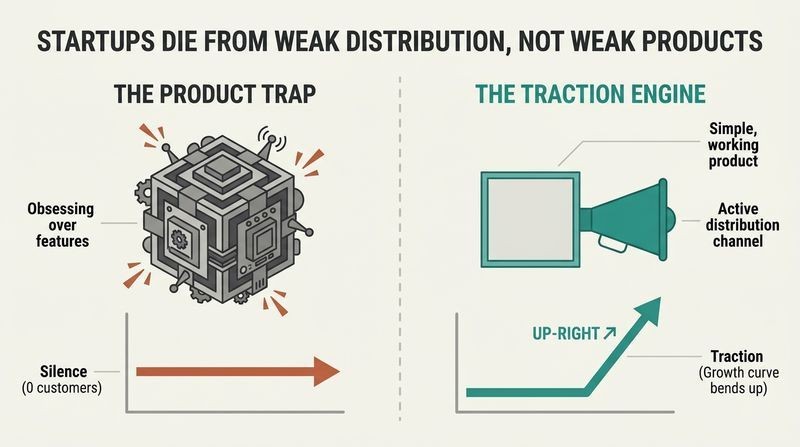
The claim inverts Silicon Valley's engineer-first romance. Peter Thiel makes the same argument in Zero to One: most businesses get zero distribution channels working, and poor distribution, not product, is the leading cause of death. There is nuance worth flagging. Products with strong inherent network effects (Slack, Zoom) can blur the line, since usage itself becomes distribution. And in deep-tech or biotech, product risk genuinely dominates early. But for the vast software middle where this book lives, the diagnosis holds. The deeper insight is psychological: founders default to product work because it is controllable and familiar, while distribution feels like begging. Comfort, not logic, drives the neglect.
Nineteen ways to get customers exist; you dismiss most on instinct
Founders reuse the same two or three channels. After interviewing more than forty founders, the authors catalogued nineteen distinct customer-acquisition channels, from search ads and SEO to trade shows, speaking gigs, affiliate programs, offline events, and community building. The problem is not scarcity of options but bias. Most teams gravitate only toward channels they already know or think their product "should" use, crowding into search marketing and PR while ignoring the rest.
Bias comes in three flavors:
1. Out of sight (speaking engagements never cross your mind)
2. Distaste (you hate cold-calling, so you skip sales)
3. Fear of schlep (business development and trade shows feel tedious)
The punchline: a channel your competitors refuse to touch can become your temporary monopoly. Every one of the nineteen has driven initial traction for both consumer and enterprise startups.
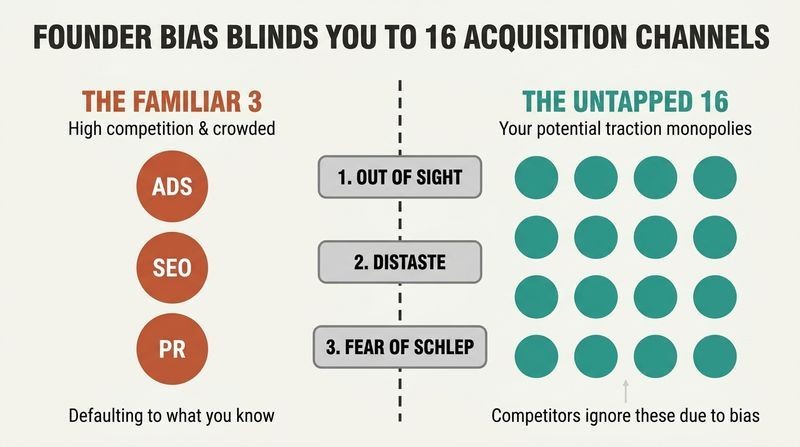
This is essentially a debiasing exercise dressed as a marketing taxonomy. Behavioral economics calls the underlying error the availability heuristic: we overweight options that come easily to mind. The authors' fix, forcing consideration of all nineteen, mirrors how good decision science combats narrow framing (Chip and Dan Heath's "widen your options" in Decisive). The competitive angle is sharpest: channels obey supply and demand for attention, so the crowded ones are expensive precisely because everyone is comfortable there. The arbitrage lives in the channels that feel beneath you. One caveat: nineteen channels can induce paralysis, which is exactly why the next idea, a filtering framework, matters.
Run cheap parallel tests, then pour everything into the one winner
Bullseye is a five-step aiming system. Brainstorm one realistic idea for every channel, rank them into three rings (most promising, possible, long-shot), prioritize your top three into the inner circle, run cheap parallel tests, then focus relentlessly on whatever works. The metaphor is a target: cast wide, then aim for the center.
Test cheaply, then commit hard. Tests should cost hundreds, not thousands: run four Facebook ads, not forty. The goal is speed to data, answering what a customer costs, how many are reachable, and whether they are the right ones. Mint, the personal-finance startup Intuit bought for $170 million, ran this exact loop. They tested blogs, PR, and search ads, found targeting financial blogs converted best, and rode it to 40,000 users before launch, then repeated Bullseye and switched to PR to hit a million.
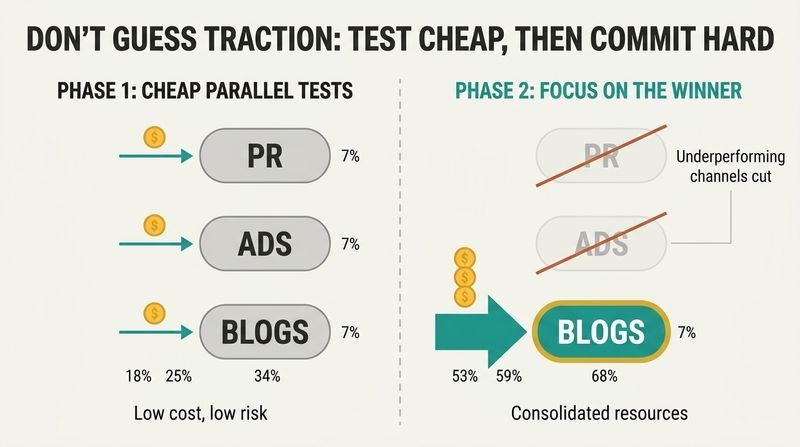
Bullseye is portfolio theory applied to growth: diversify the search, then concentrate the bet. The parallel-testing insistence is the sophisticated part. Sequential testing wastes the scarcest startup resource, time, because tests incubate while you set up the next. This echoes multi-armed bandit logic from statistics, where you balance exploring unknown options against exploiting the best-known one. The framework's real discipline is the focus step: at any moment one channel dominates acquisition, so spreading effort across five is how mediocre companies stay mediocre. The weakness is that "one realistic idea per channel" can produce lazy brainstorms, and rankings made from guesses can anchor you wrongly before a single test runs.
Give traction half your time from day one, not after launch
The 50% Rule splits your attention evenly. Spend half your hours on product and half on traction, in parallel, from the beginning. It feels wrong because the pull toward product is magnetic, and yes, it slows feature development in the short run. But it speeds time-to-market overall, because you stop wasting post-launch cycles discovering that nobody can be reached profitably.
Parallel work compounds knowledge. Dropbox tested search ads while building and found they were paying $230 to acquire a customer for a $99 product, so they pivoted to a built-in referral program that became their growth engine. Marketo blogged and did SEO before writing product code, and launched with a pipeline of 14,000 interested buyers. Building something people want is necessary but insufficient: markets can be too small, unreachable, unmonetizable, or too crowded.
The 50% Rule pairs neatly with Lean Startup: Lean tells you what to build, Bullseye tells you how to reach buyers, and both attack distinct risks (product risk versus market risk). The Dropbox anecdote is a clean illustration of unit-economics discipline: no amount of product polish saves a business where acquisition cost exceeds lifetime value. The Marketo example reframes marketing as demand-sensing rather than demand-shouting. One tension deserves naming: for pre-product-market-fit teams, splitting attention 50/50 can starve the product before it is good enough to retain anyone, pouring water into what the authors themselves call a leaky bucket. The rule works best once early retention signals appear.
Every marketing channel decays, so keep running small experiments
The Law of Shitty Click-Throughs. Coined by growth expert Andrew Chen, it states that over time all marketing strategies produce worse and worse response rates. When banner ads debuted they reportedly earned click-through rates above 75%; once everyone deployed them, rates collapsed. Any channel gets crowded, expensive, and ignored as competitors pile in and consumers grow numb.
Defense is constant, cheap experimentation. The edge belongs to whoever finds the next untapped tactic before it saturates. Zynga dominated Facebook's early ad and sharing features when almost no one competed there; replicating that today is nearly impossible because the channel is crowded and costly. Once a channel is working, optimize it with A/B testing (splitting users randomly between a control and a variant), which the authors say can improve channel efficiency two-to-three times. Startup growth arrives in spurts: a channel unlocks, spikes, saturates, flattens, and then you unlock the next.
This is arguably the book's most durable idea because it is a law of ecology, not tactics. It mirrors the Red Queen effect from evolutionary biology: you must keep running to stay in place. Economically it is simple arbitrage decay, alpha in any channel gets competed away as information spreads. The practical implication is uncomfortable for founders who crave a permanent growth formula: there isn't one. The organizations that endure institutionalize experimentation as a habit rather than a project. A useful extension the book gestures at but does not fully develop: the earliest adopters of a new platform capture outsized returns, so channel timing can matter more than channel execution.
Pick one traction goal, then ruthlessly cut anything that doesn't serve it
Critical Path answers what to work on. Choose a single meaningful traction goal (say, 1,000 paying customers or 1% of your market), then map backward to the fewest absolutely necessary milestones to reach it. That ordered sequence is your Critical Path. Every proposed activity gets one test: is it on the path? If not, don't do it.
The goal must be significant, not arbitrary. DuckDuckGo, the privacy search engine Weinberg founded, set 1% of the search market as its goal because that threshold means being taken seriously in a huge, sparse market, a goal that would be meaningless for most companies. Features like image results were deferred as off-path until a later, more mainstream goal made them necessary. After each milestone, reassess honestly, because your original plan is usually wrong. Departments and individuals get their own sub-paths that sum to the company's.
Critical Path is a focus technology, and its power lies in the negative: it is a machine for deciding what to abandon. This resembles the theory of constraints from operations management, where output is governed by the single binding bottleneck and everything else is noise. The DuckDuckGo detail about deferring obviously requested features is the hard part, since customer requests exert enormous emotional gravity. Saying no to a feature 100 users begged for requires the discipline of a stated goal to hide behind. The reassess-after-each-step loop guards against the classic planning fallacy, where founders overcommit to a roadmap built on assumptions that market contact immediately falsifies.
Real virality means every user brings more than one new user
Do the viral math. Two numbers govern viral growth. The viral coefficient (K) equals invites sent per user times the percentage who convert. A K above 1 means each user recruits more than one replacement, producing true exponential growth; the authors say aim for at least 0.5 for strong effects. The viral cycle time is how long the loop takes, and shorter is dramatically better. YouTube's cycle runs in minutes: see video, click, share.
Bake it into the product. Loop types include word of mouth, inherent virality (Skype is useless if your contacts lack it), collaboration (Google Docs), embedded signatures (Hotmail's famous footer), incentives (Dropbox's free storage for referrals), and social broadcasting. To improve K, raise either invites sent or conversion rate, and break conversion into steps to find the weak link. The pragmatic advice: copy a proven loop in detail before inventing your own.
The math is clarifying but also a warning label. A K of exactly 1 is a knife-edge that few products hold for long, which is why the authors sensibly recommend targeting 0.5 and using virality to amplify other channels rather than as a standalone engine. Epidemiologists will recognize K as R0, the reproduction number of a contagion, and the same threshold logic applies: below 1, the outbreak fizzles. The most underrated variable is cycle time, which compounds ferociously and explains why speed of sharing often beats breadth. The honest subtext is that most products are simply not inherently viral, and bolting Facebook buttons onto boring software fools no one.
Pitch small blogs; big media harvests stories from them
News now filters up, not down. In the old model, a New York Times mention was a scarce favor. Today blogs publish infinitely because every post earns page views and ad money, so when Business Insider covers you, you are doing them the favor. Major outlets like CNN and the Times increasingly scout smaller sites for stories. So skip pitching the giants directly; pitch the niche blogs the big outlets read, and let coverage climb the chain.
Package milestones into emotional stories. Reporters get pitched constantly (one former TechCrunch writer got over fifty pitches daily), so lead with newsworthy hooks: funding, launches, usage records, partnerships. DonorsChoose rode a small-outlet story to Newsweek to an Oprah endorsement. Keep pitches short, give an angle that provokes a shareable emotion, and build real relationships with specific reporters before you need them.
The filter-up thesis captures a genuine structural shift in media economics: the collapse of gatekeeping scarcity and the rise of attention-as-revenue. Ryan Holiday, quoted throughout, built a career (and the book Trust Me, I'm Lying) documenting how easily the lower rungs of this ladder can be gamed, which is the darker flip side the authors mostly leave alone. The advice to seed small and let stories ascend is sound but increasingly known, meaning the Law of Shitty Click-Throughs applies to PR tactics too. The durable takeaway is relational, not mechanical: journalists are overwhelmed humans who reward founders offering genuine angles and low-friction, forwardable pitches over PR-firm spam.
Engineer a stunt or a free tool competitors are too timid to copy
Unconventional PR: manufacture a spectacle. Half.com renamed the town of Halfway, Oregon, for a year and launched on the Today Show, earning coverage from the Times, the Wall Street Journal, and 40 million impressions. WePay dropped a 600-pound block of ice outside PayPal's own conference reading "PayPal freezes your accounts." Dollar Shave Club's $5,000 video drove 12,000 customers in two days. Blendtec blended an iPhone on camera and lifted sales 500%. The other half of this channel is customer appreciation: handwritten notes, surprise gifts, and Zappos-grade support that turns users into evangelists.
Engineering as marketing: build free tools as assets. HubSpot's free Marketing Grader analyzed over three million sites and drives a large share of its 50,000 monthly leads. Unlike an ad that stops working when you stop paying, a tool keeps generating leads indefinitely for a one-time build cost.
Both tactics exploit the same edge: they are hard, so few do them. A stunt requires creative nerve most companies lack, and building free software as marketing requires diverting expensive engineers, which feels heretical to product-obsessed teams. That difficulty is precisely the moat. The engineering-as-marketing framing as an appreciating asset rather than a depreciating expense is genuinely useful accounting, and it anticipates what later became known as product-led growth. The honest limits: stunts are unpredictable and unrepeatable (for every ice block there are quiet flops), and free tools work best when they mirror the core product, funneling qualified prospects rather than random traffic. Novelty is the fuel, and novelty is perishable.
Do unscalable things to win your first customers, then find the leverage
Recruit your first users by hand. Paul Graham of Y Combinator argues startups do not take off on their own; founders make them take off, usually by doing laborious, unscalable things at the start. Mint let users embed "I want Mint" badges for early access and got 600 blogs displaying them, driving 50,000 signups. AirBnB piggybacked on Craigslist; PayPal bought goods on eBay and demanded sellers accept its payment; Evernote raced to be first on every new platform launch, riding Apple's and Verizon's marketing pushes to hundreds of thousands of users.
What moves the needle changes by phase. In phase one a single tweet or a talk to a few hundred people is meaningful. At 10,000 daily visitors, a post sending 200 people is invisible. To add 100,000 customers at 1-5% conversion you must reach millions, which is why viral loops and community building scale with your base.
The unscalable-first principle resolves an apparent paradox: how do scalable businesses begin with manual grunt work? The answer is that early-stage learning and scale are different jobs requiring different tools. Doing things that don't scale is really disguised customer research, letting founders absorb high-bandwidth signal before automating. The phase-dependent definition of moving the needle is a crucial corrective to cargo-cult growth advice, since tactics that built a company at 1,000 users often become rounding errors at a million, and vice versa (PR is weak early, powerful later). The AirBnB and PayPal platform hacks also carry a warning the book underplays: borrowed platforms can revoke access, so today's growth hack is tomorrow's dependency risk.
Analysis
Traction succeeds as a taxonomy and a decision process more than as a theory. Its lasting contribution is reframing distribution as a first-class engineering problem with its own methodology (Bullseye), its own budget rule (50% of time), and its own prioritization discipline (Critical Path), positioned as the missing complement to Lean Startup's product methodology. The book's implicit model of the world is refreshingly humble: nobody can predict which of nineteen channels will work, so the rational response is cheap parallel experimentation followed by ruthless focus. This is sound epistemics dressed as marketing advice.
Three ideas have aged best. The Law of Shitty Click-Throughs is nearly a natural law, an ecology of attention arbitrage that guarantees any working tactic decays as it is copied. The channel-bias diagnosis is a sharp piece of applied behavioral economics. And engineering-as-marketing anticipated the product-led-growth wave that now dominates SaaS.
The book's limits are worth naming. Its evidence base is survivorship-heavy: forty-plus interviews with founders who won, with little counterfactual data on the identical tactics that failed. Many of its specific playbooks (Facebook's cheap early ads, Craigslist piggybacking, App Store featuring) exploited a 2008-to-2013 window of open, under-monetized platforms that has since closed, ironically proving the book's own saturation thesis. And the crisp product-versus-traction dichotomy underweights products where distribution is the product, where network effects and virality are inseparable from the feature set.
Still, the framework's meta-lesson transcends its dated examples: treat growth as a search problem, counteract your own biases, test cheaply, concentrate on the single channel that dominates, and expect to repeat the whole loop when it inevitably stops working. That process outlives any individual tactic.
Review Summary
Readers overwhelmingly praise Traction as an essential, practical guide for startups seeking growth. Many consider it the best marketing book they've read, appreciating its concise, actionable advice and comprehensive overview of traction channels. Entrepreneurs find the Bullseye framework particularly valuable for systematically testing and identifying effective growth strategies. While some readers felt certain sections were outdated, the majority found the book's core concepts highly relevant and applicable to their businesses.
People Also Read







Glossary
Traction
Quantitative evidence of customer demandMeasurable proof that a startup is growing: rising revenue, users, downloads, or active accounts. The authors treat traction as a growth curve bending up and to the right, and argue it makes fundraising, hiring, press, and partnerships dramatically easier. Their central claim, "traction trumps everything," holds that growth is the defining pursuit of a startup.
Bullseye Framework
Five-step channel selection processA method for finding your best traction channel through five steps: brainstorm one idea for each of the nineteen channels, rank them into three rings (promising, possible, long-shot), prioritize the top three into an inner circle, run cheap parallel tests, and then focus all resources on whichever channel works. Repeat the whole cycle when that channel saturates.
Traction Channels
Nineteen customer-acquisition avenuesThe nineteen distinct marketing and distribution routes the authors identified through founder interviews, including viral marketing, PR, unconventional PR, search engine marketing, social ads, offline ads, SEO, content marketing, email, engineering as marketing, targeting blogs, business development, sales, affiliate programs, existing platforms, trade shows, offline events, speaking engagements, and community building.
The 50% Rule
Split time product and tractionThe prescription to spend roughly half your time on product development and half on getting traction, pursued in parallel from the start rather than sequentially. It slows short-term product progress but speeds overall time to market by surfacing distribution and messaging insights before launch instead of after.
The Product Trap
Fallacy that product markets itselfThe mistaken belief that the best use of a founder's time is always improving the product, and that a great product will attract customers on its own. The authors identify this "if you build it, they will come" thinking as a primary reason startups fail to get distribution.
Critical Path
Fewest milestones to traction goalA focus framework in which you set one significant traction goal, then map backward to the minimum ordered sequence of absolutely necessary milestones to reach it. Every activity is judged against the path; anything not on it is dropped. The path is reassessed after each milestone using new market feedback.
Moving the Needle
Meaningful measurable growth impactFocusing only on marketing activities large enough to produce a significant, measurable change in your core metrics. What moves the needle shifts by phase: a single tweet matters at launch but is invisible at scale, where channels must reach millions to add hundreds of thousands of customers.
Law of Shitty Click-Throughs
All channels decay over timeAndrew Chen's principle that every marketing strategy eventually produces worse response rates as competitors adopt it and consumers grow numb. Banner ads once earned over 75% click-through rates before collapsing. The defense is constant cheap experimentation to find the next untapped tactic before it saturates.
Viral Coefficient (K)
New users each user generatesThe number of additional users each existing user brings in, calculated as invites sent per user multiplied by the conversion percentage of those invites. A K above 1 produces true exponential growth; the authors recommend aiming for at least 0.5 for strong growth effects.
Viral Cycle Time
Time to complete viral loopHow long it takes an average user to move through the entire viral loop, from exposure to inviting others. Shorter cycle times compound growth dramatically faster even at the same viral coefficient, which is why YouTube's minutes-long share loop drove explosive growth.
Engineering as Marketing
Free tools that generate leadsUsing engineering resources to build free tools, calculators, widgets, or micro-sites that attract and qualify potential customers. HubSpot's Marketing Grader analyzed over three million sites. The authors frame these tools as appreciating marketing assets that generate leads indefinitely for a one-time build cost, unlike ads that stop working when spending stops.
FAQ
What's "Traction: A Startup Guide to Getting Customers" about?
- Focus on Traction: The book emphasizes the importance of gaining traction for startups, which means achieving significant growth and customer acquisition.
- 19 Traction Channels: It introduces 19 different channels through which startups can gain traction, such as viral marketing, SEO, and business development.
- Bullseye Framework: The authors present a systematic approach called the Bullseye Framework to help startups identify the most promising traction channels.
- Practical Advice: The book is filled with interviews and case studies from successful entrepreneurs, providing practical strategies and tactics for gaining traction.
Why should I read "Traction: A Startup Guide to Getting Customers"?
- Comprehensive Guide: It offers a comprehensive guide to understanding and implementing various customer acquisition strategies.
- Real-World Examples: The book includes insights from over 40 successful founders, making the advice practical and relatable.
- Actionable Frameworks: It provides actionable frameworks like the Bullseye Framework and Critical Path to help startups systematically gain traction.
- Versatile Application: Whether you're in the early stages or scaling, the book's strategies are applicable to a wide range of startups.
What are the key takeaways of "Traction: A Startup Guide to Getting Customers"?
- Traction is Essential: Traction is crucial for startup success, as it makes fundraising, hiring, and partnerships easier.
- Experiment with Channels: Startups should experiment with multiple traction channels to find the most effective one.
- Parallel Development: Pursue traction and product development in parallel to avoid the "Product Trap."
- Focus on Growth: The ultimate goal is to move the growth curve up and to the right, indicating rapid expansion.
What is the Bullseye Framework in "Traction: A Startup Guide to Getting Customers"?
- Five-Step Process: The Bullseye Framework is a five-step process: brainstorm, rank, prioritize, test, and focus.
- Channel Selection: It helps startups systematically identify the most promising traction channel to focus on.
- Parallel Testing: Encourages running multiple tests in parallel to quickly find the best channel.
- Iterative Approach: The framework is designed to be repeatable, allowing startups to refine their focus as they gather more data.
How does "Traction: A Startup Guide to Getting Customers" define traction?
- Sign of Growth: Traction is defined as a sign that your company is taking off, evident in core metrics like user growth or revenue.
- Quantitative Evidence: It is quantitative evidence of customer demand, such as paying customers or a growing user base.
- Startup's Goal: The pursuit of traction is what defines a startup, as it is designed to grow fast.
- Traction Trumps Everything: The book emphasizes that traction is more important than other aspects like product features or team size.
What are the 19 traction channels in "Traction: A Startup Guide to Getting Customers"?
- Viral Marketing: Encouraging users to refer others to create exponential growth.
- SEO and SEM: Improving search engine rankings and using paid search ads to attract customers.
- Content and Email Marketing: Using valuable content and personalized emails to engage and convert customers.
- Business Development and Sales: Forming strategic partnerships and creating processes to directly exchange product for dollars.
What is the Critical Path method in "Traction: A Startup Guide to Getting Customers"?
- Focus on Traction Goal: The Critical Path involves focusing on a single traction goal and ignoring everything not required to achieve it.
- Milestone Planning: It helps startups identify and prioritize the necessary milestones to reach their traction goal.
- Resource Allocation: Ensures that time and resources are allocated efficiently towards achieving traction.
- Iterative Reassessment: Encourages reassessing the path after each milestone to adapt to new market knowledge.
How does "Traction: A Startup Guide to Getting Customers" suggest overcoming biases in channel selection?
- Awareness of Biases: Recognize natural biases towards or against certain traction channels.
- Systematic Evaluation: Use the Bullseye Framework to systematically evaluate all channels, even those that seem irrelevant.
- Mentor Guidance: Seek guidance from mentors who can provide an objective perspective on channel selection.
- Competitive Advantage: Overcoming biases can lead to a competitive advantage by acquiring customers in ways competitors ignore.
What are some best quotes from "Traction: A Startup Guide to Getting Customers" and what do they mean?
- "Traction trumps everything." This quote emphasizes that gaining traction is the most critical aspect of startup success, as it simplifies other challenges.
- "A startup is a company designed to grow fast." It highlights the essence of a startup, focusing on rapid growth rather than just being newly founded.
- "You can always get more traction." This encourages continuous efforts to improve growth metrics and not settle for current achievements.
- "The pursuit of traction is what defines a startup." It underscores that the primary goal of a startup is to achieve significant growth and market presence.
How does "Traction: A Startup Guide to Getting Customers" recommend using the Bullseye Framework?
- Brainstorming Ideas: Start by brainstorming reasonable ways to use each traction channel without dismissing any.
- Ranking Channels: Rank channels into inner circle, potential, and long-shot categories based on their promise.
- Prioritizing Tests: Focus on testing the top three channels in the inner circle to find the most effective one.
- Iterative Focus: Once a promising channel is identified, focus efforts on optimizing and scaling it.
What role do mentors play according to "Traction: A Startup Guide to Getting Customers"?
- Objective Perspective: Mentors provide an objective perspective, helping startups stay on their critical path.
- Channel Selection: They assist in overcoming biases and brainstorming channel ideas.
- Strategic Guidance: Mentors offer strategic guidance based on their experience, helping avoid common pitfalls.
- Accountability: Regular meetings with mentors create accountability and encourage critical thinking.
How does "Traction: A Startup Guide to Getting Customers" suggest testing traction channels?
- Cheap Tests: Run cheap tests to validate assumptions about channel strategies before fully committing.
- A/B Testing: Use A/B testing to optimize tactics within a chosen channel for maximum traction.
- Quantitative Metrics: Focus on quantitative metrics like cost per acquisition and conversion rates to assess channel effectiveness.
- Iterative Learning: Continuously learn from tests and refine strategies to improve traction outcomes.
About the Author
Other books by Gabriel Weinberg

Download PDF
Download EPUB
.epub digital book format is ideal for reading ebooks on phones, tablets, and e-readers.








































