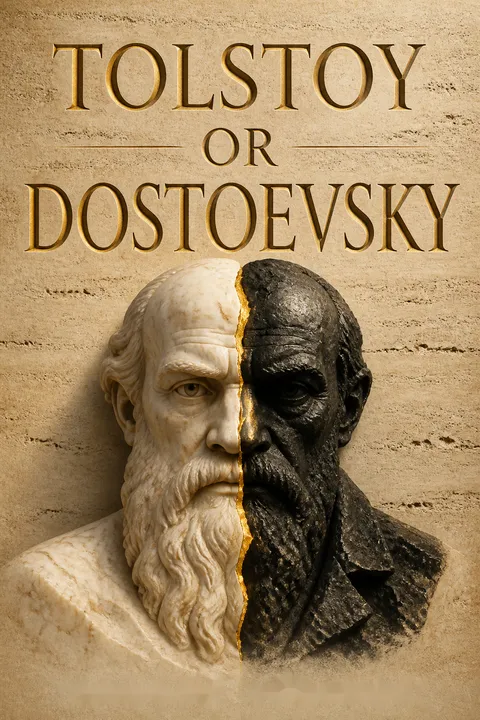

Key Takeaways
1. The Enduring Pre-eminence of Tolstoy and Dostoevsky
They are the two greatest of novelists (all criticism is, in its moments of truth, dogmatic; the old criticism reserves the right of being so openly, and of using superlatives).
Unmatched Magnitude. Tolstoy and Dostoevsky stand as unparalleled giants in the art of fiction, their pre-eminence defining fundamental points about Western literature. Their magnitude is not merely a matter of opinion but a profound recognition, akin to acknowledging Homer or Shakespeare. A reader's inevitable preference for one over the other often reveals a deeper philosophic and political stance.
Comprehensive Vision. These masters excel in both the comprehensiveness of their vision and the sheer force of their execution. Their works construct "realities" that are sensuous and concrete, yet deeply pervaded by the mystery of the spirit. This power marks them as "supreme poets of the world," capable of gathering immense sums of life into their narratives, from the domestic to the heroic, and exploring the soul's deepest recesses.
A Matter of "Ear." The assertion of their supremacy, while not subject to rational proof, resonates with an intuitive "ear" for certain essential tonalities in literature. Their works, like War and Peace and The Brothers Karamazov, can be spoken of in the same breath as the Iliad or King Lear, signifying a unique conjunction of genius that challenges comparison and demands interpretation.
2. The Critic's Role: A Debt of Love and Mediation
Literary criticism should arise out of a debt of love.
Transformative Impact. True criticism begins with admiration, recognizing how a poem, drama, or novel seizes our imagination and leaves us transformed. Like a Cézanne painting altering our perception of an apple, great art flings open doors of perception and reshapes our beliefs. The critic's primary instinct is to convey this impact, persuading others to open themselves to the experience.
Mediating Masterpieces. The critic's function is not to judge or anatomize, but to mediate, distinguishing between the good and the best. This involves recording the impact of art, putting our "shaken house in its new order," and sharing the quality and force of our experience. It is a love made lucid through bitterness, acknowledging the distance between the critic's craft and the poet's creation.
Paradoxical Obligation. Criticism's dignity lies in its paradoxical, often frustrated, obligation: to challenge and labor against the "mystery" of classic creation, while simultaneously giving that mystery and its realization a more precise authority and presence. This "old criticism" affirms that the writer matters far more than the critic, who is at best a "loving, clairvoyant parasite."
3. "Old Criticism" vs. "New Criticism": Literature's Broader Context
But it is just these relations which give to great literature its enduring significance and summons to interpretation.
Beyond Formal Purity. The "new criticism," with its focus on "close reading" of isolated passages and rejection of historical, biographical, or ideological context, proved inadequate for works of the scope and hybrid character of Tolstoy and Dostoevsky's novels. Such material demands a broader lens, connecting literary form to world-view.
Holistic Perspective. "Old criticism," in contrast, is philosophic in range and temper, believing literature exists not in isolation but as central to historical and political energies. It insists on "totality," focusing on the moral substance of the novel and postulating that a writer's techniques always refer back to his metaphysics. This approach reveals the enduring significance of great literature.
Crisis in Literacy. The rise of structuralist-semiotic decomposition, with its "analytic acrobatics" and "Narcissist arrogance," further alienates the literary text from its autonomy and the "truth of felt being." This confirms a crisis in humane literacy and humanistic values, making the plea for "old criticism" more polemically immediate than ever before.
4. The "Titanic" Scale of Russian Masters
The more we consider the two novelists, the more we come to realize that they and their works were hewn to the same scale.
Tolstoy's Gigantic Vitality. Tolstoy's life was marked by "gigantic vitality," "bearish strength," and "feats of nervous endurance." He composed on a vast canvas, conveying the impression of a giant stooping under an ordinary door. His energies were such that he questioned mortality itself, believing in untapped resources and his essential presence in the world.
Dostoevsky's Enormous Health. Despite images of creative neurosis, Dostoevsky possessed "exceptional strength and powers of endurance," with tremendous resilience and "animal toughness." He survived mock execution and Siberian katorga, writing voluminous novels under extreme duress. Thomas Mann saw his epilepsy as "a product of over-flowing vitality, an explosion and excess of enormous health," using illness as an instrument of perception.
"Titanic" Creations. Both authors, in their contrasting manifestations of creative might—Tolstoy's Olympian health and Dostoevsky's "holy sickness"—produced "Titanic" books. Their works restored to literature a wholeness of conception that had declined since epic poetry and tragic drama, reflecting the immense scale of their beings and their profound engagement with life.
5. The Russian Novel's Distinctive "Whiter Brilliance"
Two bodies of modern literature seem to me to have come to a real verge: the Russian and the American.
Beyond European Realism. European observers noted that Russian and American fiction radiated a "whiter brilliance" at the "extremities" of the European novel's wide-flung arms. These literatures gathered fierce intensity from the "outer darkness," from folklore, melodrama, and religious life, doing "violence to the conventions of the genre" as conceived by Defoe to Flaubert.
Ambiguous Relation to Europe. Both Russian and American intellectual life in the 19th century grappled with an ambiguous yet determining relationship to Europe. This confrontation provided a specific weight and dignity, as both civilizations sought their own image. Writers often experienced a "complex fate," a necessary part of exile or "treason," sometimes leading to a rediscovery of their home country.
Frontier Mythology and Primacy of Will. Both nations combined immensity with a romantic, vanishing frontier, exposing characters to grandiose natural forces. This vastness isolated as much as it enlarged, fostering a "primacy of will" reflected in heroes who assailed moral and natural law. This "pitch of extreme consciousness" carried them beyond the dwindling resources of European realism.
6. Dilemma of European Realism: The "Middling" and its Limitations
But from the outset there was present in the doctrine and practices of the realistic novel an element of contradiction.
Secular and Empirical Focus. The main tradition of the European novel, from Cervantes to Flaubert, was secular in outlook, rational in method, and social in context. It mirrored empirical reality, accumulating data of actuality and introspection, and documenting the world and past as "first cousins to history." This commitment predetermined its limitations.
The "Middling" Reality. As the 19th century progressed, the "middling" reality of the industrial middle classes became ponderous and uninspiring. Flaubert, in Madame Bovary, composed in a "cold fury," finding his subject matter inherently unbeautiful and leading to a "petrified feeling." This thoroughness and power confronted realism with the dilemma of whether to re-create a reality no longer worth re-creating.
Overwhelmed by Fact. The sheer mass of observed fact threatened to overwhelm artistic purpose, leading to the dissolution of the work of art under the pressures of reality. Zola's naturalism, aiming for "scientific" objectivity, risked becoming mere journalism. This contrasted sharply with the Russian novel, which, unburdened by these conventions, could embrace irrationalism and myth.
7. The Prophetic and Religious Core of the Russian Novel
The great Russian writers of the XlXth century felt that Russia was on the edge of an abyss into which it would hurl itself; their works reflect the revolution taking place within as well as the other revolution which is on the march.…
Anticipating Catastrophe. The Russian novel, from Gogol to Gorky, flourished under the "single sign of the historical Zodiac—the sign of approaching upheaval." Major works like Dead Souls and The Brothers Karamazov form a prophetic series, filled with presentiments of catastrophe, often against the authors' own political instincts.
God-Haunted Culture. This premonition assumed religious aspects, with the question of God's existence being the "final and all-determining focus of Russian thought." The iconography of the Messiah and eschatology of Revelation gave political debate a "bizarre and feverish resonance," with the shadow of millennial expectations lying across a stifled culture.
Religious Art. Unlike the secular tradition of Balzac or Flaubert, the art of Tolstoy and Dostoevsky was profoundly religious. It sprang from an atmosphere "penetrated with religious experience" and the belief in Russia's eminent role in the impending apocalypse. Their works, therefore, are not merely fictions but "poems of the mind" central to a "quest after the salvation of humanity."
8. Tolstoy's Epic Art: Homeric Scope and Earthy Reality
In his world, as in Homer’s, men’s caps owe their significance and their inclusion in works of art to the fact that they cover men’s heads.
Homeric Kinship. Tolstoy consciously fostered the view that his novels, particularly War and Peace and Anna Karenina, were epic, comparable to the Iliad. This kinship was rooted in his genius, evident in patriarchal settings, the poetry of war and agriculture, and a primacy of the senses that made language a window to the natural world.
Immanent Realism. Like Homer, Tolstoy's vision was "terribly sober," combining dynamic equilibrium with a sense of repose. His "immanent realism" celebrated the "complete 'realness' of the world," where God is strangely absent, but life itself is affirmed as a thing of beauty. This perspective is anti-Platonic, insisting that the Kingdom of God must be established "here and now."
Organic Form and Continuous Life. Tolstoy's novels achieve a "deep-breathing economy of an organic form," where physical objects derive meaning from human context, and narrative strands interweave densely. His disregard for formal neatness, with "unending-ness" in his conclusions, reflects his conviction that life is continuous, fragmented, and in incessant renewal, defying artificial literary closures.
9. Dostoevsky's Dramatic Art: Tragic Intensity and Urban Chaos
Dostoevsky perceived time from the point of view of a dramatist.
Primacy of Action. Dostoevsky's sensibility and linguistic strategies were saturated by drama. His novels are "colossal dramas," centered around or climaxing in acts of murder, reflecting an ancient concordance between murder and tragic form. He drew material from contemporary crimes, transforming journalism into a confirmation of his "strained vision of reality."
Concentrated Time and Space. Dostoevsky compressed tangled actions into the briefest plausible time spans, creating a sense of nightmare and stripping away superfluity. His characters, like those in tragic drama, are reduced to a "bare absolute," confronting each other in naked conflict. This "totality of motion" is evident in the 24-hour span of The Idiot or the 5 days of The Brothers Karamazov.
Gothic Melodrama Transformed. Dostoevsky translated the languages of drama into prose fiction, where dialogue is charged with utmost significance and gestures become irrevocable. He embraced melodrama's conventions—coincidences, extremes of tone, "monstrous" events—to portray the "tragico-fantastic" realities of urban chaos and the soul's dissolution, making disorder a new focus of understanding.
10. The Grand Inquisitor: A Metaphor for Tolstoy vs. Dostoevsky
The Legend was never imagined as an attack on Christ. It is the crowning symbol and primary conveyor of Ivan’s indictment of God.
Ivan's Indictment. The Legend of the Grand Inquisitor, a "poem" within The Brothers Karamazov, serves as Ivan Karamazov's ultimate indictment of God, not Christ. Ivan cannot accept a God who permits the suffering of innocent children, rejecting the "harmony" that demands such a high price. This echoes Belinsky's critique of theodicy and Schiller's Resignation.
The Inquisitor's Tolstoyan Echoes. The Grand Inquisitor, a ninety-year-old, blind cardinal, embodies attitudes strikingly similar to aspects of Tolstoyan thought. He argues for an earthly kingdom of order, happiness, and security, believing men prefer "brute calm of servitude" over the agony of free will. His desire to eliminate doubt and provide "solid, plain and clear principles" resonates with Tolstoy's rationalistic quest for a Christianity without paradox.
Clash of Worldviews. The Inquisitor's claim to love humanity "better than Christ" by offering material bread and certainty, rather than the burden of freedom, mirrors Tolstoy's humanitarian socialism and his distrust of Christ's "enigmatic" teachings. This allegorical confrontation highlights the "insoluble controversy" between Tolstoy's vision of a rational, earthly utopia and Dostoevsky's tragic, freedom-driven faith, where Christ's silence is the ultimate answer.
11. The "Underground Man": A Modern Anti-Hero and Critique of Reason
I wish to tell you, gentlemen (no matter whether you care to hear it or not), why I have never been able to become an insect.
Archetype of Alienation. The "underground man" is Dostoevsky's most poignant creation, an archetype of the alienated individual, "intelligence without power, desire without means." He is the "ewig verneinende Geist," a "thorn of contempt" who jeers at convention and schemes vengeance from his "labyrinth of fury," a direct descendant of Homer's Thersites and Diderot's Rameau's nephew.
Rebellion Against Reason. This anti-hero embodies a radical critique of pure reason, utilitarianism, and natural law. He defiantly rejects the notion that "twice two make four" if it doesn't meet his acceptance, proclaiming the "majesty of the absurd." This rebellion, a declaration of independence from reason, makes him a precursor to existentialist thought and a stark contrast to Tolstoy's rationalistic philosophy.
Dehumanization and the Insect Metaphor. The "underground man" represents a retreat from manhood, a "shame of being human," expressed through his self-loathing and the pervasive insect imagery. This dehumanization, where "the insect is gaining on the part of man," foreshadows the grim realities of 20th-century totalitarianism and mass culture, where human dignity is eroded by comfort or terror.
12. Irreconcilable Theologies: Earthly Kingdom vs. God-Haunted Freedom
To make of the spiritual realm of Christ a kingdom of this earth’ was Tolstoy’s principal endeavour. In The Possessed and The Brothers Karamazov, Dostoevsky asserted not only that ‘this is impossible,’ but that the attempt would end in political bestiality and in the destruction of the idea of God.
Tolstoy's Earthly Kingdom. Tolstoy sought to establish the Kingdom of God "here and now," on earth, through rational morality and non-violence. He denied the reality of death and rejected a "dead Church" that accepted earthly injustices in expectation of a hereafter. His Christ taught men "not to commit stupidities," aiming for a secular millennium where reason would perfect humanity.
Dostoevsky's God-Haunted Freedom. Dostoevsky's theology, in stark contrast, was founded on "total freedom"—the terrifying liberty to choose good or evil. He believed that without evil, there would be no free choice, and thus no path to God. His Christ did not descend from the cross to compel belief through miracles, but to offer freedom, even if it led to doubt and suffering, for "God is, because evil is. And that means that God is because freedom is."
Antagonism of Beliefs. This fundamental opposition—Tolstoy's rational, earth-bound humanism versus Dostoevsky's tragic, freedom-driven faith—is irreconcilable. Tolstoy's vision of a materially perfect society, where men look earthward with "contented brutes," was, to Dostoevsky, a prelude to atheism and the destruction of the soul. Their contrasting worldviews prefigure the ideological wars of the 20th century, asking which gave the truer image of human nature and history.
Review Summary
Reviewers celebrate Tolstoy or Dostoevsky as among the finest literary criticism ever written, praising Steiner's thesis that the two Russian giants represent opposing literary traditions — Tolstoy as heir to Homeric epic, Dostoevsky as successor to Shakespearean tragedy. Readers highlight Steiner's erudite yet passionate prose, his theological and philosophical depth, and his ability to illuminate both authors without declaring a winner. Several note the book inspired rereading of the novels themselves, while others appreciate its accessibility beyond academic audiences.
People Also Read
Download PDF
Download EPUB
.epub digital book format is ideal for reading ebooks on phones, tablets, and e-readers.








































