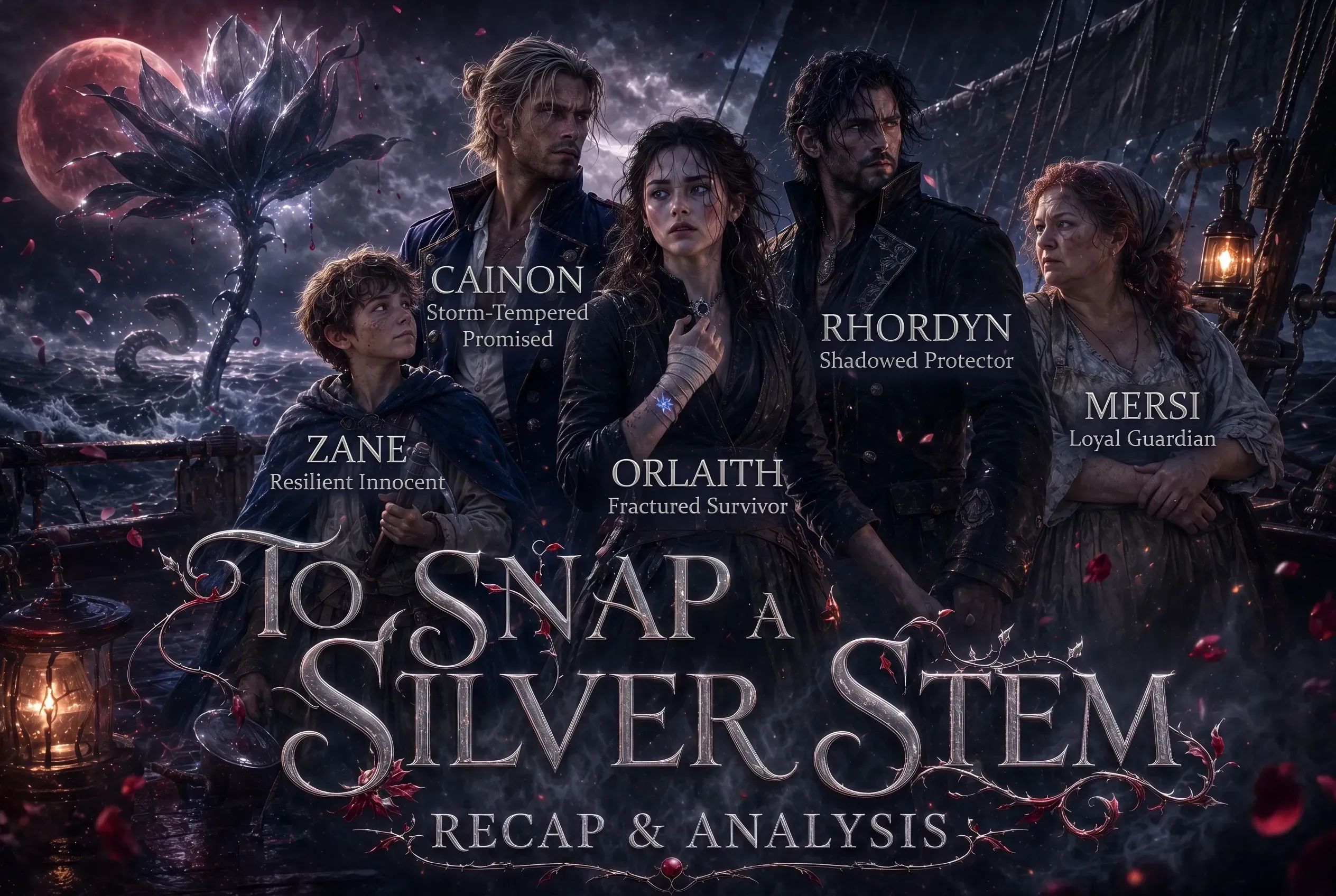


Plot Summary
Prologue
Rhordyn,2 High Master of Ocruth, hands his cook Mersi17 a pendant whose crystal he has deliberately blackened, ordering that the orphaned child1 in his northern tower wear it always. It will alter how she looks, hiding her not only from a world that would kill her but from her own reflection.
Mersi17 pleads that the broken three-year-old needs him, that her silent nightmares worsen nightly, that there is unblinking death in her eyes. Rhordyn2 refuses every plea, insisting he will only ever be the roof over her head and the shadow that conceals the strange mark on her shoulder. He vows to give the girl everything except himself, accepting that one day she will surely hate him for it.
The opening frames the entire novel as an act of protective erasure. Rhordyn's choice to mask a child from herself dramatizes a paradox the book will interrogate relentlessly: that love can express itself as concealment, and that safety purchased through lies costs the self. Mersi functions as the moral witness, naming the difference between keeping a child alive and letting her live. The blackened crystal, a corrupted gift from a dead mother, signals that survival here is built on inherited grief and shame. Rhordyn's willingness to absorb hatred rather than involvement establishes his fatalistic devotion, the engine of every later tragedy and the seed of Orlaith's wound.
Sold For A Fleet
Grown now, Orlaith1 sleeps in a ship's crow's nest, bound for Bahari to marry a High Master she barely knows.3 She has traded herself for a fleet of warships that Ocruth and Rouste need to stem the Vruk slaughter devastating the continent. By night she scrapes stolen cutlery together until the screech no longer breaks her, presses Rhordyn2's stolen pillow slip to her face, and chews on grief for a brother who died in her arms.
Her guard Vanth4 calls her a witch and watches her constantly. Nightmares of family torn apart by beasts haunt her sleep, and she relies on caspun bulbs and self-inflicted pain to stay in control, a woman who fled her tower convinced she hides a monster beneath pretty skin.
The premise fuses political sacrifice with intimate dissociation. Orlaith's marriage is a transaction of flesh for ships, but Parker layers it with the psychology of trauma survival: ritualized pain becomes a language of agency for someone who feels she controls nothing. The pillow slip is a fetish object, a tether to a love she resents needing. Already the central tension surfaces between duty to strangers she will never meet and a corrosive private longing. Vanth's hostility externalizes her self-loathing, casting her as monstrous before any power is shown. The chapter establishes a heroine who performs composure while quietly negotiating with despair.
The Serpent And The Harpoon
A glittering sea creature11 begins trailing the vessel, looping playfully through its wake. Orlaith1 insists it is curious, not hostile, and begs Vanth4 not to fire the mounted harpoon. Defying the Captain6's direct order, Vanth4 shoots, impaling the creature near its heart. Enraged, the beast breaches and rolls the ship; men are crushed, drowned, or taken by sharks.
Vanth4's brother Kavan is thrown into the water, and Vanth4 puts a crossbow bolt through his heart to spare him a worse death. The cabin boy Zane5 floats facedown; Orlaith1 dives, drags him aboard, and the Captain6 revives him. Among the dying she comforts Gage,8 the tattooed barrelman, who asks her to loosen his tourniquet so he can finally rejoin the family the Blight took from him.
The disaster contrasts Orlaith's instinctive empathy with the crew's fearful brutality. Her reading of the creature as playful rather than predatory foreshadows a bond the reader will later understand, while Vanth's panic dramatizes how superstition and grief manufacture violence. Gage's death scene is the book's quiet thesis on mortality: a man must die with a full heart to pass into the afterlife, and Orlaith's tenderness becomes a form of midwifery for the dying. The sequence also seeds her guilt complex, since the slaughter unfolds partly because no one heeds her, reinforcing her belief that her presence brings ruin.
Vanth Throws Her Overboard
Below deck Orlaith1 proves deft with needle and thread, stitching the wounded. Cornered later in the infirmary, a drunk, grieving Vanth4 gropes her and threatens to expose her supposed affair with Rhordyn;2 she sets her scissors against his groin and warns him off.
Days afterward, blaming her for Kavan's death, he ambushes her on deck, pours rum down her throat, hauls her up the mast, and shoves her over the rail, vowing she will die screaming. She clings to a single rung above shark-churned water until the Captain6 hauls her back from the brink. Dislocated and bloodied, she survives, but the attack confirms how merciless the world beyond her tower is, and how utterly alone she has become.
Vanth embodies grief metabolized as misogyny; he needs a witch to blame so his brother's death has a villain. Orlaith's scissor threat reveals the hardened survivor beneath her softness, a woman who drops into a numb interior place to endure assault. Tellingly, she refuses to weaponize his crime against him later, recognizing in his unraveling the same heartbreak-driven madness she fears in herself. The near-drowning resurrects her childhood trauma of water and powerlessness, and the Captain's rescue introduces the first figure in this world who offers protection without ownership, a contrast the narrative will sharpen.
Cainon Burns The Fleet
Cainon,3 the golden High Master of Bahari and Orlaith1's promised, arrives with an entire fleet rather than a single escort. He resets her dislocated shoulder without warning, then announces he will scuttle the storm-wrecked ship.
When a sailor infected with the Blight is discovered, Cainon3 orders two vessels torched with their crews aboard, men leaping burning into shark-filled water, dismissing the carnage as necessary sacrifice. Horrified, Orlaith1 realizes the man she has bargained her body to3 wields death like simple math.
He rows her toward his hidden cove, tosses her belongings about carelessly, and eyes the black jewel at her throat with suspicion. She lies that she has worn it since childhood, refusing to surrender her last tie to Rhordyn.2
Cainon's introduction inverts the rescuer trope: he saves her body while revealing a soul that calculates lives like ledger entries. The repeated word sacrifice becomes his signature, exposing a survivalist ethic dressed as leadership. Orlaith's bargain curdles in real time as she grasps that the ships she sold herself for belong to a man who would let a continent burn. Her lie about the necklace shows how reflexively she now guards her secrets, and how her tie to Rhordyn persists even as she flees him. The chapter establishes the central romantic triangle as a contest between two kinds of dangerous men.
Allies Brace For War
Far north, Rhordyn2 learns by mail sprite that Orlaith1's ship was wrecked and someone carried her off before it sank. Flashback reveals he once recruited Baze,9 a self-destructive Aeshlian, from a brothel to raise the orphaned child1 and lend her his light, while withholding the prophecy that an Aeshlian bearing a shadow seed will end the world.
Gutted now, Rhordyn2 rides to confront the Prophet Maars, hoping fate has shifted, and sends Baze9 to the warrior High Mistress Zali.10 At the barren Stretch beneath the Alps, Baze9 and Zali10 butcher Vruks together and discover the beasts are growing tactical, learning to cross the spike traps single file, proof the continent desperately needs Cainon3's ships.
This widening of scope reframes the marriage plot as one front in an existential war. The prophecy supplies the machinery of persecution and explains the secrecy that has caged Orlaith, while Rhordyn's pilgrimage to Maars introduces the question of whether doom is fixed or negotiable. Baze and Zali's reconnaissance dramatizes escalating dread: the Vruks are evolving, which means time is running out. Baze's brothel recruitment exposes the costs borne by Aeshlian survivors and complicates Rhordyn from monster toward tragic strategist. The interwoven point of view enlarges the emotional canvas while keeping the stakes personal and apocalyptic at once.
The Pillow Slip In The Fire
Landing at a hidden cove, Orlaith1 is led through a Blight-scorched jungle to the cane village of Blue Hollow. Reunited with the ship's Captain, now simply Gun,6 she sneaks out at night to dig up a clutch of bluebells that remind her of her dead brother, and unexpectedly befriends a family of Irilak, the light-fearing shadow creatures that, strangely, will not harm her.
In her room Cainon3 discovers Rhordyn2's pillow slip, accuses her of pining, and reveals that Rhordyn2 is coming to Bahari to collect his promised ships. To prove she is free of her old guardian,2 Orlaith1 hurls the cherished slip into the flames, amputating her comfort while privately vowing to play the flawless bride.
The burning is self-surgery, an attempt to cauterize a love she cannot reason away. Parker stages it as performance: Orlaith destroys her tether not because she is free but to convince herself and Cainon that she could be. The Irilak's immunity quietly plants the climax's mechanism, disguised as a tender oddity, since the shadow creatures sense something inhuman in her. Gun's reappearance deepens the network of chosen protectors, and Cainon's news that Rhordyn approaches sets the two men on a collision course. The bluebells, gathered in grief, will later be repurposed as a weapon, a small object loaded with the book's recurring fusion of beauty and harm.
The Trial Of The Bowl
At Cainon3's lapis palace, Orlaith1 learns she cannot be coupled until she passes a sacred trial: hauling herself unaided from a deep, slick pool called The Bowl before the city on her wedding morning. The hooded Elder Creed,15 who unnervingly resembles the robed man from her family's massacre, oversees her hours of failure as she throws herself at the walls, vomiting and sliding back.
She is housed in a guarded suite with stark white sheets meant to display her virginity, fed meals she must sift for poison berries, and forbidden to roam. Caged and restless, she begins memorizing the sentries' routines, plotting to scale the palace wall and slip into the glittering city below.
The trial literalizes the gatekeeping of female worth, binding a woman's value to public spectacle, chastity, and submission to ritual she finds absurd. The Bowl rhymes with the childhood pool where she nearly drowned, so each attempt reopens trauma rather than testing virtue. Elder Creed's resemblance to her family's killers links the palace's piety to the cult that hunts her, suggesting institutional faith and genocide share a face. The poisoned food and locked suite render her courtship indistinguishable from captivity, the very imprisonment Cainon accuses Rhordyn of. Her plotting marks the awakening of a will that refuses to be climbed out of, or married into, on command.
Rhordyn Hunts Her Through Parith
Slipping down the palace wall and across the bridge, Orlaith1 explores Parith and feels a cold, watching presence: Rhordyn,2 hooded, shadowing every step. Cheated and humiliated by a shopkeeper who swindles her out of her diamond pickaxe, she flees in shame. Unknown to her, Rhordyn2 discovers the merchant is a candescence dealer hoarding jars of severed Aeshlian ears and butchers him, then leaves Orlaith1 a heavy purse of bloodstained coin.
When she finally corners Rhordyn2 in an alley, she presses two blades to his throat and tells him of recurring dreams in which she dies, including one where he kills her. He warns her away from the square where a stake is being raised and insists he will hunt her to the ends of the continent.
Rhordyn's surveillance reads as both menace and worship, the watching of a man who cannot let go. The dealer's jars drag the abstract prophecy into visceral horror, revealing the marketplace built on Orlaith's people while she remains ignorant of her own peril. Her death dreams, especially the one of him killing her, prophesy the climax and braid love with mortal threat. The alley confrontation establishes their dynamic as mutual wounding: she draws his blood and feels alive doing it, he absorbs her cruelty and refuses to retreat. Parker frames their attraction as a feedback loop of pain, devotion, and refusal, beautiful and self-destructive in equal measure.
The Dinner Of Knives
On the pier Rhordyn2 presses Cainon3 about hoarding ships, the spreading Blight, and the wall that condemns the city's poor; Cainon3 stalls, insisting no vessels until the coupling is sealed. In the palace library Rhordyn2 gifts Orlaith1 a Valish translation that could decode the name he calls her, Milaje, but she burns it unread.
At a tense three-way dinner the rival rulers trade veiled threats while Orlaith1 eats nutrient slop to spite Rhordyn2's concern. To wound both men at once, she presents Cainon3 with the bluebells she gathered, signaling that she no longer needs Rhordyn2 as her crutch. Something like genuine hurt crosses his face before he rises and leaves, saying he has seen enough.
The dinner weaponizes intimacy, turning a meal into a duel of subtext. Orlaith's burning of the translation refuses the very self-knowledge the book insists she needs, dramatizing how deeply she fears her own name and nature. The bluebells, harvested in mourning, become a calculated cruelty aimed at the one man who reads her grief, proving she now hurts others to armor herself. Cainon performs ownership while Rhordyn performs care, and Orlaith plays both against each other to seize a sliver of control. The flash of Rhordyn's pain reveals the cost of her strategy, exposing that her invulnerability is itself a wound she keeps reopening.
The Serpent Man And Vicious
On the crystal island of Lychnis, Malakai,11 Orlaith1's cherished childhood friend who shares his body with a sea creature named Zykanth, wakes gravely wounded, the harpoon bolt having pierced near his heart. A feral, near-silent young woman he names Vicious12 tends him, plunging her hand into his chest to wrench the barb free and packing the wound with healing paste.
As he heals and Zykanth stirs back to life, he realizes she too has gills and is Aeshlian, the first he has met in years. After she saves him from a deadly fall, she speaks a single word, claiming him as hers. They bond and mate, and the sudden appearance of an Aeshlian child reveals he is no longer alone in the world.
This parallel romance offers the novel's rare register of tenderness, two hunted creatures learning trust through touch when language fails. Malakai's recovery confirms the serpent that capsized Orlaith's ship was no monster but a loved one watching over her, recoloring earlier violence with tragedy. Vicious embodies survival stripped to instinct, yet her fierce care critiques the idea that the feral cannot love. The discovery of another Aeshlian and a surviving child counters the prophecy's logic of extinction with the stubborn persistence of life. Against the political machinations elsewhere, Lychnis argues that kinship and tenderness are themselves acts of resistance for the nearly erased.
The Forest Nymph Lair
Gael,13 a sharp, glamorous Parith socialite assigned as her escort, smuggles Orlaith1 out for a stolen day of freedom. They descend into an underground forest nymph lair where masked dancers couple freely. Determined to reclaim a body that has been sold to a stranger,3 Orlaith1 chooses a masked man and loses her virginity, only to feel hollow and unclean afterward.
As they leave, her supposedly unbreakable cupla snaps at the clasp, an omen Gael13 calls catastrophically bad. The two then flee men who recognize Gael13 and threaten to ruin her family, escaping outside the city wall to a peach orchard where they eat fruit in the grass, two young women running from problems neither can name aloud.
Orlaith's first sexual choice is framed as a bid for autonomy in a world that treats her virginity as currency, yet the hollowness afterward complicates any triumphant reading. The novel refuses to romanticize rebellion; reclaiming the body proves messier and lonelier than imagined. The breaking cupla literalizes the fracturing of the ownership Cainon imposed, while Gael emerges as a mirror, another woman scarred by a faith that polices female desire. Their flight to the orchard offers a fragile pastoral, a breath of girlhood before catastrophe. Beneath the freedom runs dread, the sense that every door Orlaith opens swings toward consequence she cannot yet see.
The Orchard Detonation
While Gael13 steps away, three men ambush her, binding and gagging her. Orlaith1 attacks, caving in one man's face, but is overpowered and lashed to a tree. When a captor rips the black necklace from her throat, the dam breaks: lashing black vines erupt from her skin, incinerating the men and scorching the glen to ash, the same power that once killed her own family.
Waking naked among charred corpses, she finds a crystal flower budding from the mark on her shoulder and snips it off in agony. A massive black Vruk prowls in to feed on the dead; she barely escapes down a drain beneath the city wall, half-broken and certain she is the deadliest thing in the jungle.
The detonation is the novel's horrifying payoff for every hint of a caged monster, confirming that Orlaith's self-loathing has a literal source. Removing the mask unleashes both her true form and an indiscriminate destructive force, collapsing the distinction between victim and weapon. The crystal bloom growing from her wound externalizes her nature as something organic and inexorable, beautiful and grotesque, and her frantic severing of it reads as self-mutilation. The arriving Vruk, drawn to the carnage she made, links her power to the very monsters threatening the world. She emerges traumatized anew, her belief that she destroys everyone she loves now grounded in fresh blood.
The Truth At The Plant Shop
Soaked and bloodied, Orlaith1 flees to Gun6's botany shop, where he and his partner Enry7 shelter her. When her broken necklace falls and her true Aeshlian form shows, Gun6 reveals the terrible secret: the Shulak cult hunts and butchers her people, selling them on the black market, believing their extinction will avert the world's end.
He warns her to trust no one, not even Cainon,3 and never to seek Madame Strings. Then Gun's sister Della18 arrives, sees a heart-shaped birthmark identical to her own lost daughter's, and collapses, certain Orlaith1 is her child Viola, taken by the Blight years ago. Overwhelmed, Orlaith1 flees into the night, now understanding why she was hidden and why Baze9 lived so afraid.
This is the revelation that recontextualizes the entire novel: Orlaith's lifelong concealment was not cruelty but desperate protection against systematic genocide. Gun's blunt history transforms abstract prophecy into ongoing atrocity, indicting a faith that monetizes murder. Della's mistaken recognition adds a wrenching layer of displaced grief, offering Orlaith a family she cannot claim and a mother whose hope she cannot bear to extinguish. The scene weaponizes the warmth of chosen kin against the horror of her circumstances. Orlaith leaves armed with knowledge she did not want, the bliss of ignorance replaced by the unbearable weight of belonging to the hunted.
The Cupla Soldered Shut
Returning to the palace, Orlaith1 faces Cainon,3 who notices her missing cupla. In his smithy he fits an iron clasp, then solders the bracelet permanently onto her burned wrist, converting a betrothal token into an actual shackle, all while she smiles through the searing pain.
He confides his true contingency: he has been quietly fortifying the outer islands so his bloodline survives even if the Vruk infestation devours the rest of the continent, and boasts he could collapse the city bridge in seconds. Orlaith1 finally grasps that his ships are a hoarded lifeboat, not aid for a dying world, and resolves to dig a tunnel and steal a vessel herself rather than keep dancing for his empty promises.
The soldering scene makes ownership flesh, sealing Cainon's claim into Orlaith's body through pain she invited rather than refused, a chilling image of complicity under coercion. His island plan exposes the rot beneath his charm: his sacrifices were never for his people but for his dynasty, the continent merely expendable cover. The revelation severs Orlaith's last illusion that compliance might save lives, transforming her from bargaining bride into covert insurgent. Her decision to dig her own tunnel marks a pivotal shift toward self-determination, however desperate. The chapter crystallizes the book's argument that the cruelest cages are the ones we are persuaded to ask for.
Blackmail In The Rain
Drowning in despair, Orlaith1 gets blackout drunk in the city and is nearly assaulted before Rhordyn2 snaps her attacker's neck and carries her to his inn room. He nurses her hangover, then admits he used her as cover while scouting for Cainon3's hidden island fleet, his map pinned to the wall.
A charged encounter in his shower leaves them both undone; he begs to see her damage rather than her body, and she recoils from being truly seen. When he vows to seize the ships before the full moon and start a war for her sake, she threatens to tear off her necklace on a crowded street and expose herself to the cult unless he leaves. Believing her, he yields.
Their reunion stages intimacy as warfare, desire entangled with control on both sides. Rhordyn's plea to witness her damage rather than her flesh distinguishes him from Cainon, who wants only her surface, yet his manipulative use of her as cover blurs care into exploitation. Orlaith's blackmail is her most radical assertion of agency: she makes her own existence the hostage, threatening self-annihilation to command a man who would burn the world for her. It is autonomy as scorched earth, proof that she has nothing left to lose but herself. The scene escalates the romance toward its lethal logic, love measured by what each will destroy.
The Unseelie Burrow
Escorted back after a night away, Orlaith1 weathers Cainon3's jealous fury, then is led through tidal tunnels to an abandoned Unseelie burrow, its cells crowded with long-dead captives, including chained, naked Aeshlians once fed daily sun to keep their blood from blackening.
Cainon3 plants his theory: full-blooded Unseelie survived the Great Purge by hiding in seats of power, beings who must drink blood daily and never age, and Rhordyn2 fits every sign. He decrees there will be no ships and no coupling while Rhordyn2 circles. Shaken, Orlaith1 recalls her nightly blood offerings, his refusal to ever share a meal, his unchanging face across two decades, and the strange hole beneath the Conclave table, and begins to believe.
The burrow turns suspicion into dread by showing the historical machinery of Aeshlian bondage, the cells that kept beings alive only to be drained. Cainon weaponizes truth itself, planting doubt that reframes every tender memory as evidence of predation. Orlaith's mental inventory, the blood goblet, the missing meals, the ageless body, performs the reader's own reassembly of clues, making complicity feel inevitable. The chapter pits the monster she knows against the monster she does not, and Cainon's manipulation succeeds because it weaves genuine horror with genuine fact. It primes the climax by aligning Orlaith's love, her people's suffering, and her duty into a single unbearable choice.
The Talon Through The Heart
Orlaith1 lures Rhordyn2 into the jungle, crossing the line where the Irilak feed on every living thing except Aeshlians and Unseelie. To test the truth she removes her necklace; he steps across the threshold unharmed and transforms into his terrible Unseelie form, confirming everything. Yet he only calls himself hers. He drags her toward a roaring waterfall to finally reveal his worst self.
There, weeping, she confesses she killed her own mother, that her true name is Serren, and drives a Vruk talon, an Unseelie's single weakness, through his heart. As he dies he tells her not to cry, kisses her brow with warm lips, and topples off the cliff into the mist, leaving her hollowed by what her own hands have done.
The climax fuses the novel's two great themes, deception and lethal love, into one irreversible act. The Irilak, planted chapters earlier as a tender oddity, become the instrument that exposes Rhordyn's nature, transforming worldbuilding into devastation. Orlaith's confession that she killed her mother reframes her self-hatred as literal, and her choice to strike confirms her dream-prophecy while serving the desperate calculus of saving her people. Crucially, the kill is committed in love, not hatred; his final warmth and gentle command not to cry shatter the moral simplicity of monster-slaying. Parker refuses catharsis, leaving a heroine who has destroyed her shelter and confirmed her deepest fear about herself.
Epilogue
In a mirrored memory, a starving Aeshlian child waits in a death-cell after her captor vanishes, watching the other captives' candles snuffed by hungry shadows, until a black-haired man unlocks her door, drapes his cloak around her, and tells her life need not hurt like this, revealing this is how Rhordyn2 once saved the broken boy who became Baze.9
Back at the waterfall in the present, Orlaith1 finally unbinds the grief she caged, vines of hate, love, and guilt erupting through her on a sound that shreds her throat. She collapses under the truth that she has killed the man who would have struck down the world for her,2 the impossible happily ever after she believes she never deserved.
The mirrored rescue reframes Rhordyn entirely, exposing a lifelong pattern of saving discarded Aeshlian children and recasting his harshness toward Orlaith as a survivor's brutal pedagogy: bury the weakness or die in the cell. It retroactively softens the monster she just destroyed, deepening the tragedy of misread love. The final collapse refuses resolution; Orlaith's power, so long suppressed, finally surfaces as raw grief rather than violence, suggesting that what she has truly caged is feeling itself. The book closes on guilt and irreversibility, leaving healing as something that, like the title's snapped stem, must be grown slowly from severed roots rather than willed.
Analysis
To Snap a Silver Stem is a dark romantasy about the violence of concealment. Its heroine1 has spent her life behind a literal mask, taught that survival requires hiding her face, her grief, and the lethal power coiled inside her. Parker structures the novel as serial unmasking: each chapter strips away another protective fiction until Orlaith1 can no longer distinguish safety from erasure. Recurring images, the necklace, the soldered bracelet, the white wedding sheets, the bowl she cannot climb from, all literalize how institutions and even loving guardians convert protection into imprisonment, and how a woman's worth is repeatedly tied to her chastity, obedience, and usefulness. Pain becomes the book's grammar. Orlaith1 governs a chaotic interior through ritualized self-harm, scraping cutlery, pinching her skin, choosing wounds she can author. The romance is deliberately uncomfortable, framing love as something that both shelters and annihilates: Rhordyn2's devotion is nearly indistinguishable from possession, while Cainon3's charm masks a survivalist who treats human lives as arithmetic. The parallel storylines, Malakai11 and Vicious12 on Lychnis, Baze9 and Zali10 at the Stretch, enlarge the central question: what does it cost the hunted to keep living, and to dare tenderness anyway? Beneath the personal drama runs a sharp politics of genocide and othering. The Aeshlians are slaughtered for a prophecy that may or may not be true, their suffering monetized, their existence weaponized by the powerful. The book asks whether fate is fixed or chosen, and whether a person convinced she is a monster can ever be more than the worst thing she has done. Its harrowing climax refuses easy catharsis, suggesting that healing, like a snapped stem, cannot be willed but must be grown slowly from broken roots. The result is a story about reclaiming a self that everyone, the heroine included, conspired to erase.
Review Summary
To Snap a Silver Stem received mixed reviews, with ratings ranging from 1 to 5 stars. Many readers praised the poetic writing and complex world-building, while others felt frustrated by unanswered questions and Orlaith's character development. Some found the ending shocking and emotional, while others were disappointed. Positive reviews highlighted the dark fantasy elements, character depth, and intense romance. Critical reviews cited pacing issues, confusion, and dissatisfaction with plot direction. Overall, the book elicited strong reactions, with fans eagerly anticipating the next installment and others questioning whether to continue the series.
Characters
Orlaith
Hidden, haunted brideThe protagonist, raised in isolation in a northern tower and marked forever by the massacre of her family, convinced she harbors a monster beneath pretty skin. She manages a chaotic interior through ritualized pain, self-harm, and rigid control, yet she is fiercely empathetic, drawn to plants, wounded creatures, and overlooked people. Bartering her body in a political marriage to save a continent from monsters, she is torn between duty, a corrosive love for her secretive guardian2, and a starving hunger to finally live on her own terms. Her arc is a relentless unmasking: each secret she uncovers about her true nature peels away the self she has performed, forcing her to choose between the cages others build for her and the perilous freedom of becoming who she actually is.
Rhordyn
Brooding former guardianHigh Master of Ocruth and Orlaith1's enigmatic former guardian, ancient in bearing, physically overpowering, and ruthlessly secretive. He raised her at a deliberate distance, withholding truths he believed would destroy her, and communicates through silences and carefully chosen gifts rather than words. Driven by guilt and a fatalistic conviction that his love is lethal, he stalks Orlaith1 across a continent, unable to release her even as he insists she should hate him. He is at once her tormentor and her shelter, the architect of her concealment and the only person who truly perceives the damage she hides. Beneath his glacial composure runs a devotion so total it frightens even him, the engine of nearly every choice he makes.
Cainon
Golden, ambitious promisedHigh Master of Bahari and Orlaith1's charming, sun-kissed promised. Confident, flirtatious, and relentlessly ambitious, he courts her with silken flattery while treating the sacrifice of ships, land, and human lives as ordinary statecraft. He desires the naive, moldable girl he first met and the strategic alliance her hand would secure, and he frames his control as protection. Beneath the suave surface runs a cold survivalist logic and a possessiveness that mistakes ownership for love, willing to barter a continent's safety against his own bloodline's endurance. He is a study in how power dressed as generosity can conceal a heart that calculates rather than feels.
Vanth
Hostile shipboard guardOrlaith1's resentful guard aboard the ship to Bahari, convinced she is a cursed witch. Consumed by grief over his brother and by suspicion of her ties to Rhordyn2, he becomes a volatile predator whose escalating violence reveals how lethal and lawless the wider world is for a woman who has never left her tower. His unraveling mirrors the heartbreak-driven madness Orlaith1 fears in herself.
Zane
Mischievous cabin boyA freckle-faced young pickpocket and the ship Captain6's nephew, all grins and stolen trinkets. He treasures Orlaith1's small gifts and offers her uncomplicated affection and loyalty, a tender echo of the little brother she lost. His presence draws out her protectiveness and her grief in equal measure.
Gunthar
Principled captain, shopkeeperThe gruff, level-headed ship's captain, called Gun, who also runs a botany shop in Parith with his partner Enry7. Protective, plainspoken, and unexpectedly tender, he becomes an anchor and reluctant truth-teller for Orlaith1, willing to risk much to shelter her. His blunt honesty delivers some of the story's most devastating revelations.
Enry
Gentle botanist partnerGun6's warm, talkative botanist partner, soft where Gun is blunt. He offers Orlaith1 comfort, quiet wisdom, and a reminder that she is light and life, even when she cannot believe it herself.
Gage
Tattooed dying barrelmanA former captain turned aftermast barrelman, his skull tattooed like stitched seams, who lost his family to the Blight. His quiet death, and his gift of charcoal, leave a lasting mark on Orlaith1's conscience.
Baze
Scarred combat trainerOrlaith1's combat trainer, an Aeshlian shaped by a brutal captivity he masks with drink and dark humor. Fiercely loyal to Rhordyn2 and entangled in unspoken longing for Zali10, he embodies the wounds borne by survivors of his hunted people and the difficult work of refusing to break.
Zali
Fierce desert High MistressThe lethal, sharp-witted High Mistress of Rouste, allied with Rhordyn2 against the Vruk threat. Deadly with a blade and guarded in heart, she fights for the continent's survival while carrying buried griefs of her own, and shares a charged, prickly bond with Baze9.
Malakai
Bonded sea-dwellerOrlaith1's cherished childhood friend, called Kai, a sea-dwelling being who shares his body with a creature named Zykanth. Loyal, playful, and devoted, he risks everything to watch over her from the water, and his own survival becomes a tender parallel to her story of loneliness and kinship.
Vicious
Feral island survivorA wild, near-silent young woman surviving alone on the crystal island of Lychnis. She communicates through touch, instinct, and ferocity, hiding a fierce capacity for tenderness and care beneath sharpened teeth and watchful eyes. Her bond with Malakai11 reframes what survival and love can look like for the hunted.
Gael
Glamorous rebel socialiteA dazzling, sharp-tongued Parith socialite assigned to escort Orlaith1, who quickly becomes a true friend. Beneath her confidence lies a rebel scarred by her family's rigid faith and hungry for freedom, making her a mirror to Orlaith1's own caged longing and a guide into the city's secret undersides.
Old Hattie
Mute palace weaverA mute palace weaver and former governess who quietly recognizes Orlaith1 for what she truly is and, without judgment, shows her secret passages and a cliffside refuge. Her silent kindness offers Orlaith1 a rare, unspoken acceptance.
Elder Creed
Hooded trial overseerThe robed religious official who oversees Orlaith1's coupling trial at The Bowl. His hooded presence and cold pronouncements eerily evoke the robed killers of her childhood, binding the palace's piety to the menace stalking her people.
Kolden
Dutiful palace guardOrlaith1's assigned palace guard, dutiful yet quietly humane, who bends his orders to shield her from worse consequences. He represents a small mercy within a hostile, controlling court.
Mersi
Devoted childhood cookThe castle cook who lovingly raised the broken Aeshlian child1 when no one else would, pleading with Rhordyn2 to give the girl more than shelter. Her tenderness frames the novel's question of what survival without love is worth.
Della
Grieving lost motherGun6's sister, who lost a young daughter to the Blight years ago and carries that grief openly. A heart-shaped birthmark stirs in her a desperate, wrenching hope when she meets Orlaith1.
Plot Devices
The masking necklace
Hides her true identityA black crystal pendant that Rhordyn2 corrupted and locked around Orlaith1 as a child. While worn, it transforms her appearance, concealing her iridescent skin, thorned ears, and crystal eyes so she passes as ordinary, hiding her not only from a world that would kill her but from her own reflection. Removing it peels away the disguise and, far more dangerously, threatens to unleash what sleeps beneath. The chain becomes the book's central tension: her tether to safety, her last tie to Rhordyn2, and the lie she is forced to wear. Its clasp, its breaking, and her recurring temptation to tear it free drive nearly every escalation, making a single piece of jewelry the literal lock on her selfhood.
The cupla
Marks her as ownedThe lapis-and-gold betrothal band Cainon3 clasps onto Orlaith1's wrist, a public claim marking her as Bahari's future High Mistress. Custom insists it should never break or be removed. Throughout the story it functions as a barometer of her autonomy: she slips it off to move unseen, it snaps at a perilous moment that the superstitious call a dire omen, and it is repaired in increasingly permanent ways. What begins as a symbol of union curdles into a symbol of ownership, dramatizing the book's argument that promising yourself to another can mean losing yourself entirely. The band literalizes the slow narrowing of Orlaith1's freedom as the wedding looms.
The Bowl trial
Gates the couplingA deep, polished pool sunk into a sacred arena where Orlaith1 must prove the Gods deem her worthy of coupling by hauling herself out unaided before the city on her wedding morning. Surrounded by tanks of creatures and watched by Elder Creed15, the trial is physically near-impossible and psychologically corrosive, echoing the pool she nearly drowned in as a child. Her repeated failures measure both her exhaustion and the cruelty of a tradition that ties a woman's value to public spectacle and submission. Because the trial gates both the marriage and the ships she bargained for, it keeps her goals dangling forever out of reach, fueling her desperation and her turn toward stealing a vessel herself.
The shadow-seed prophecy
Justifies the genocideA doom carved into stone by the Prophet Maars, foretelling that an Aeshlian bearing a shadow seed will call down the end of the world. This prophecy underpins the persecution of Orlaith1's people and explains the secrecy that has shaped her entire life. It drives Rhordyn2's choices, the Shulak cult's systematic slaughter, and the dread that hangs over every revelation about what Orlaith1 truly is and what sleeps inside her. The question of whether fate can be altered becomes a quiet engine beneath the political and romantic turmoil, sending Rhordyn2 to seek the Prophet and forcing Orlaith1 to wonder whether she is destined to be the world's ending or merely its scapegoat.
The Irilak
Expose a hidden natureShadow creatures that drain the life from anything with a heartbeat, repelled only by light and strangely indifferent to Aeshlians. Established early through Orlaith1's unsettling immunity and the family of them that befriends her, they masquerade as atmospheric worldbuilding and tender oddity. In truth they are a living lie-detector, since they will not feed on Aeshlians or full-blooded Unseelie. At the story's climax this property becomes the instrument that exposes a long-concealed nature: crossing into their hunting ground without being touched proves what a being truly is. What seemed decorative becomes decisive, the quiet mechanism on which the entire devastating ending turns.
FAQ
```markdown
Synopsis & Basic Details
What is To Snap a Silver Stem about?
- A Traumatized Protagonist's Journey: To Snap a Silver Stem follows Orlaith, a young woman haunted by a devastating past and a monstrous power within, as she is forced from her isolated sanctuary at Castle Noir into a world of political intrigue and ancient prophecies. Her journey is one of reluctant self-discovery, forced into a political marriage with High Master Cainon of Bahari, while grappling with her complex, unspoken bond with her former protector, Rhordyn.
- Unveiling Hidden Truths: The narrative delves into Orlaith's struggle to understand her true nature, the origins of her unique abilities, and the dark history of her kind, the Aeshlian, who are hunted by a fanatical cult. As she navigates treacherous alliances and personal betrayals, Orlaith is compelled to confront the monsters both outside and within herself, leading to a climactic confrontation that redefines her identity and purpose.
- A World of Shifting Power: The story explores a continent fractured by territorial disputes, ancient prophecies, and the constant threat of monstrous Vruk attacks. Orlaith's personal quest for freedom and understanding becomes intertwined with the fate of entire territories, as she seeks to secure vital resources and challenge the established order, all while battling the psychological scars of her past.
Why should I read To Snap a Silver Stem?
- Deep Psychological Exploration: Readers should delve into To Snap a Silver Stem for its unflinching psychological depth, offering a raw and honest portrayal of trauma, self-hatred, and the complex journey toward self-acceptance. Orlaith's internal battles are as compelling as the external conflicts, providing a rich emotional landscape often missed in surface-level fantasy.
- Intricate World-Building & Symbolism: The novel crafts a vivid world where every location, from the suffocating Castle Noir to the vibrant yet dangerous city of Parith, holds symbolic weight, mirroring the characters' internal states. The subtle integration of unique flora, ancient languages, and mythological allusions enriches the reading experience, inviting readers to uncover hidden layers of meaning.
- Complex, Morally Ambiguous Relationships: For those who appreciate nuanced character dynamics, the tangled relationships, particularly between Orlaith, Rhordyn, and Cainon, offer a compelling exploration of love, control, and sacrifice. The story challenges conventional notions of heroism and villainy, presenting characters who are both monstrous and deeply human, making for a truly unforgettable read.
What is the background of To Snap a Silver Stem?
- A World Shaped by Ancient Purges: The narrative is set in a continent scarred by "The Great Purge," an event that supposedly wiped out the Unseelie, a race believed to feed on life force. This historical backdrop fuels the paranoia and fanaticism of the Shulák cult, who hunt anyone with Aeshlian blood, believing they will bring about the world's end. This deep-seated fear of the "other" is a core societal tension.
- Territorial Divisions & Resource Scarcity: The continent is divided into distinct territories (Fryst, Rouste, Bahari, Ocruth, Arrin), each with unique characteristics and political agendas. The constant threat of Vruk attacks, the spreading "Blight" sickness, and the strategic importance of trade routes like the River Norse highlight a world grappling with survival and resource management, often at the expense of its most vulnerable populations.
- Prophecy and Predestination: A central element is the prophecy carved into stones at Mount Ether by the Prophet Maars, which condemns Orlaith's kind as harbingers of destruction. This prophecy creates a sense of predestination that characters like Rhordyn and Cainon attempt to manipulate or defy, adding a layer of tragic inevitability and moral dilemma to their actions and Orlaith's fate.
What are the most memorable quotes in To Snap a Silver Stem?
- "Everything is nothing if you're in pieces, High Master.": Mersi's poignant observation to Rhordyn in the prologue encapsulates a core theme of the novel: the futility of external control or protection when one's internal world is shattered. This quote foreshadows Orlaith's own journey of internal fragmentation and the eventual necessity of confronting her brokenness for true healing.
- "You're a monster, Rhordyn." / "Your monster. Just yours.": This exchange near the climax reveals the twisted, yet profound, nature of Orlaith and Rhordyn's bond. It highlights Orlaith's acceptance of her own monstrousness and Rhordyn's possessive, self-sacrificing love, suggesting that their shared darkness is what truly binds them, making it a pivotal moment in To Snap a Silver Stem character analysis.
- "I'd strike the fucking world down for you.": Rhordyn's declaration to Orlaith, delivered with raw intensity, underscores the depth of his devotion and the extreme lengths he is willing to go to protect her, even if it means inciting war or sacrificing his own well-being. This powerful statement defines his character's ultimate motivation and the destructive potential of his love.
What writing style, narrative choices, and literary techniques does Sarah A. Parker use?
- Visceral, Sensory Prose: Sarah A. Parker employs a highly visceral and sensory writing style, immersing the reader in Orlaith's internal and external experiences. Descriptions often focus on tactile sensations ("damp earth clots," "silky smooth skin"), smells ("putrid waft of aged fish guts," "rich bouquet of sage and rosemary"), and sounds ("shrill screech," "thundering violence"), creating an immediate and often uncomfortable intimacy with Orlaith's reality.
- First-Person Limited & Internal Monologue: The narrative is primarily told from Orlaith's first-person perspective, offering deep access to her fractured thoughts, emotional turmoil, and psychological defenses. This choice emphasizes her isolation and internal struggle, often presenting events through her biased, trauma-filtered lens, which can lead to narrative misdirection and unreliable narration, especially regarding her perceptions of Rhordyn.
- Symbolic Imagery & Recurring Motifs: Parker heavily utilizes symbolic imagery and recurring motifs to enrich thematic depth. Examples include the "Safety Line" representing psychological boundaries, the "crystal bloom" symbolizing Orlaith's monstrous yet beautiful power, and the repeated imagery of "cracks," "shattering," and "bleeding" to denote trauma, vulnerability, and the breaking of illusions. This consistent use of symbolism invites a deeper To Snap a Silver Stem analysis.
Hidden Details & Subtle Connections
What are some minor details that add significant meaning?
- The Glossary's Significance: The detailed glossary at the beginning, listing specific locations within Castle Noir (Stony Stem, The Tangle, Whispers, The Grave, Puddles, Hell Hole, Spines), isn't just world-building; it subtly foreshadows Orlaith's confined existence and the psychological spaces she inhabits. Each named location becomes a symbol of her past, her training, or her hidden trauma, revealing how deeply her environment is intertwined with her identity.
- Gage's Tattoo and Daughter's Drawings: Gage's unique tattoo of "inky buttons and stitches" across his skull, coupled with his revelation that his deceased daughter "used to draw for me," is a subtle yet profound detail. It connects his personal grief to Orlaith's artistic expression and her own lost childhood, hinting at a shared language of pain and creation that transcends their brief interaction. His stitched appearance mirrors Orlaith's feeling of being "stitched together" or fragmented.
- The Mail Tree & Sprites: The description of the mail tree in the city, "riddled with small, open-mouthed hollows" and "dotted with lanterns and sitting sprites kicking their legs back and forth," is more than just a picturesque detail. It subtly contrasts with the isolated, controlled communication Orlaith experienced at Castle Noir, hinting at a more open, albeit still monitored, world. The sprites themselves, often seen as mere messengers, are shown to be vulnerable and even "roughed up," reflecting the harsh realities of the world even for seemingly ethereal beings.
What are some subtle foreshadowing and callbacks?
- Orlaith's Self-Harm as Foreshadowing: Early in the book, Orlaith's habit of slamming her head against the wall or dragging utensils against each other to create pain is presented as a coping mechanism. This subtly foreshadows her later, more extreme acts of self-mutilation and her willingness to inflict pain upon herself as a means of control or penance, culminating in her deliberate self-inflicted wounds. This is a key element in Orlaith's motivations explained.
- The "Broken Rung" and Orlaith's Fall: The broken rung on the aftermast ladder, which Orlaith warns the Captain about, is a literal detail that immediately precedes her own fall from the mast. This serves as a direct, physical callback to her precarious mental state and the constant threat of her "safety lines" snapping, mirroring her psychological collapse and the loss of control over her life.
- Rhordyn's "Indifference" and "Affection": Rhordyn's cryptic line, "My indifference is just as lethal as my affection," foreshadows the devastating impact of his emotional distance and his eventual, overwhelming display of love. It hints at the dual nature of his influence on Orlaith, where both his absence and his presence can be equally destructive or transformative, a crucial aspect of Rhordyn's character analysis.
What are some unexpected character connections?
- Gael and Orlaith's Shared Trauma: The revelation that Gael's father was the Shulák leader who killed Orlaith's brother, and that Orlaith, in turn, killed Gael's father, creates a deeply tragic and unexpected connection. This "sisters in death" bond, as Orlaith perceives it, highlights the cyclical nature of violence and how seemingly unrelated lives are intertwined by past atrocities, adding a profound layer to Gael's character explained.
- Gunthar's Family and Orlaith's Past: The connection between Captain Gunthar, his partner Enry, and Gunthar's sister Della, who believes Orlaith is her lost daughter Viola, is a poignant and unexpected link. This not only provides a temporary, albeit mistaken, sense of belonging for Orlaith but also reveals the widespread impact of the Blight and the Shulák's actions, showing how many lives are touched by the same tragedies.
- Baze's Unseelie Captor and Orlaith's Kind: Baze's traumatic past, where he was held captive and fed upon by an Unseelie, creates a chilling parallel to Orlaith's own nature. The detail that his captor "liked us limp when he feasted" and that Baze "hated Rhordyn for killing him" suggests a complex, almost Stockholm Syndrome-like bond, and subtly hints at the possibility of Orlaith's own Unseelie lineage, deepening the mystery of Orlaith's true identity.
Who are the most significant supporting characters?
- Mersi: The Unsung Moral Compass: Mersi, the castle cook, serves as a crucial moral compass and a voice of reason in Rhordyn's isolated world. Her direct confrontations with Rhordyn about Orlaith's suffering ("It's my heart that's tired," "She's broken, Rhordyn," "You don't wrap a wound without treating it first") highlight the emotional neglect Orlaith endures and Mersi's deep, maternal love, often overlooked amidst the main characters' drama.
- Captain Gunthar: The Unexpected Anchor: Captain Gunthar, initially a gruff authority figure, evolves into a surprising source of stability and genuine care for Orlaith. His quiet understanding of her pain ("People are dead," "And sea serpents have thick plated skulls"), his willingness to protect her (from Vanth, from the city guards), and his practical kindness (offering her a job, fixing her necklace) provide a grounded, paternal presence that contrasts sharply with Rhordyn's complex guardianship and Cainon's transactional affection.
- Old Hattie: The Silent Guide: Old Hattie, Cainon's governess, initially appears as a minor, eccentric character. However, her silent actions—leading Orlaith to the hidden tunnel, taking her to the cliff overlooking the glowing jellyfish, and deliberately breaking her cupla—reveal her as a knowing, almost mystical guide. She facilitates Orlaith's escape and self-discovery, acting as a catalyst for key revelations without uttering a single word, making her a powerful symbolic figure.
Psychological, Emotional, & Relational Analysis
What are some unspoken motivations of the characters?
- Rhordyn's Self-Punishment: Beyond protecting Orlaith, Rhordyn's extreme emotional distance and self-imposed isolation are driven by a deep-seated need for self-punishment. His confession, "I am her roof—the shadow that dims her light and keeps the world from seeing that mark on her fucking shoulder. Nothing more," reveals a belief that he deserves to suffer for his past actions, making his protection a form of penance. This is a key aspect of Rhordyn's motivations explained.
- Orlaith's Craving for Control through Pain: Orlaith's self-harm rituals (slamming her head, scratching skin, using utensils) are not merely coping mechanisms for her monstrous urges but also a desperate attempt to exert control over her own body and pain when everything else feels out of control. The physical pain anchors her to reality and serves as a penance for her perceived monstrosity, a subtle yet profound Orlaith character analysis.
- Cainon's Fear of Inadequacy: Cainon's ambition and desire for control, particularly over Orlaith and his territory, are subtly driven by a fear of inadequacy compared to Rhordyn. His need to "prove" Orlaith's loyalty and his constant comparisons to Rhordyn ("He's always been bigger, stronger, better than the rest of us") reveal a deeper insecurity beneath his charming facade, influencing his actions and the political landscape.
What psychological complexities do the characters exhibit?
- Orlaith's Dissociation and Self-Hatred: Orlaith exhibits profound psychological complexities, including dissociation (her mind "plummeting back to reality at a sickening speed," feeling "numb oblivion") and intense self-hatred ("I am all caustic blackness on the inside," "I'm a monster"). Her internal monologue often reveals a fractured self, where "Orlaith" is the masked persona and "Serren" is the monstrous, true self she struggles to accept, a deep dive into Orlaith's psychological state.
- Rhordyn's Burden of Guilt and Possessive Love: Rhordyn's character is complex due to his overwhelming guilt over his past actions and his possessive, almost destructive, love for Orlaith. He believes his love is "lethal" and that he is "her monster," yet he cannot let her go. His internal conflict between protecting her and allowing her freedom, coupled with his own hidden monstrous nature, creates a compelling and tragic figure.
- Cainon's Pragmatic Cruelty: Cainon embodies a complex blend of charm and pragmatic cruelty. His willingness to sacrifice lives ("Sacrifices," "I couldn't risk the spread") for the "greater good" of his territory, coupled with his personal desires for Orlaith, reveals a utilitarian mindset. His fear of Rhordyn and the Unseelie threat drives him to make morally ambiguous decisions, showcasing the psychological toll of leadership in a brutal world.
What are the major emotional turning points?
- The Shipwreck and Zane's Rescue: The shipwreck is a major emotional turning point for Orlaith, forcing her to confront her capacity for both violence and compassion. Saving Zane, despite her own trauma and the chaos, ignites a protective instinct and a fragile sense of purpose beyond her self-loathing, marking a shift from passive victim to reluctant heroine. This event is crucial for Orlaith's character development.
- The Lair of the Nymphs and Orlaith's Rebellion: Orlaith's visit to the forest nymph lair, and her subsequent sexual encounter, represents a pivotal emotional turning point where she reclaims agency over her body and desires. This act of rebellion, driven by a need to "bleed for myself" and challenge the control exerted by Cainon and Rhordyn, is a powerful assertion of her burgeoning selfhood, despite the immediate emotional fallout.
- Rhordyn's Death and Orlaith's Confession: The climax, where Orlaith stabs Rhordyn, is the ultimate emotional turning point. Her confession of love amidst the act of betrayal ("I just love you so much it hurts. Both of us") signifies her acceptance of their complex, toxic bond and her own capacity for both love and destruction. This moment shatters her remaining emotional shields, paving the way for a raw, painful, but potentially transformative healing process.
How do relationship dynamics evolve?
- Orlaith and Rhordyn: From Captor-Captive to Destructive Love: Their relationship evolves from a distant, guilt-ridden guardianship (Rhordyn as jailer, Orlaith as isolated ward) to a deeply entangled, almost co-dependent dynamic. Rhordyn's attempts to push Orlaith away paradoxically draw her closer, culminating in a love that is both toxic and profoundly intimate, marked by shared trauma and a mutual understanding of their monstrous natures. Their final confrontation is the brutal culmination of this complex evolution.
- Orlaith and Cainon: From Promised to Political Pawn: The dynamic between Orlaith and Cainon shifts from a formal, arranged engagement to a power struggle. Initially, Cainon offers a seemingly safe haven, but his controlling nature and political agenda (the ships, the bowl trial, his fear of Rhordyn) transform Orlaith into a pawn. Her growing awareness of his manipulative tactics and his fear-driven decisions ultimately leads to her disillusionment and a desire to subvert his control.
- Orlaith and Gael: From Friendship to Shared Burden: Their relationship quickly develops into a deep, sisterly bond, built on shared desires for freedom and vulnerability. However, the revelation of their intertwined pasts—Gael's father killing Orlaith's brother, and Orlaith killing Gael's father—introduces a devastating, unspoken burden. This twist transforms their dynamic from simple friendship to a complex connection rooted in shared tragedy and the weight of inherited violence.
Interpretation & Debate
Which parts of the story remain ambiguous or open-ended?
- The Nature of Orlaith's "Monster": While the story reveals Orlaith's Aeshlian heritage and the "crystal bloom" power, the full extent and precise nature of her monster remain somewhat ambiguous. Is it a literal entity, a psychological manifestation of trauma, or a combination? The narrative leaves room for interpretation regarding the degree of her control over it and its ultimate purpose, inviting readers to ponder the symbolism of the monster within explained.
- Rhordyn's True Fate: Despite being stabbed with a Vruk talon, Rhordyn's ultimate fate is left open to debate. His Unseelie nature, hinted at by Cainon, suggests a different kind of mortality. The final epilogue from the perspective of a captive Unseelie, who is then "rescued" by a figure resembling Rhordyn, strongly implies his survival, leaving readers to question the true meaning of his "death" and his potential return. This is a key point for To Snap a Silver Stem ending explained.
- The Future of the Territories and Alliances: The story concludes with the political landscape still volatile. Rhordyn's "death" and Orlaith's actions leave the alliances between Ocruth, Rouste, and Bahari in an uncertain state. The fate of the ships, the ongoing Vruk threat, and the Shulák cult's continued existence are unresolved, suggesting that the "war" Orlaith tried to prevent may still erupt, leaving the continent's future open-ended.
What are some debatable, controversial scenes or moments in To Snap a Silver Stem?
- Rhordyn's "Pity Fucking" of Orlaith: The scene where Rhordyn uses his fingers to sexually pleasure Orlaith on the balcony, which she later refers to as "pity fucked me with your fingers," is highly controversial. It blurs the lines between consent, manipulation, and a desperate attempt at connection, given Orlaith's trauma and her own conflicted desires. This moment sparks debate about Rhordyn's true intentions and the nature of their relationship.
- **Orlaith's
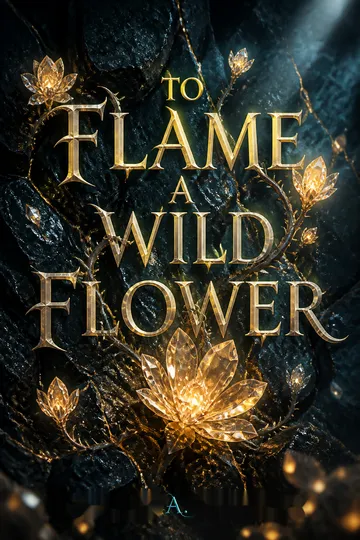
Crystal Bloom Series
About the Author
Other books by Sarah A. Parker


Download PDF
Download EPUB
.epub digital book format is ideal for reading ebooks on phones, tablets, and e-readers.








































