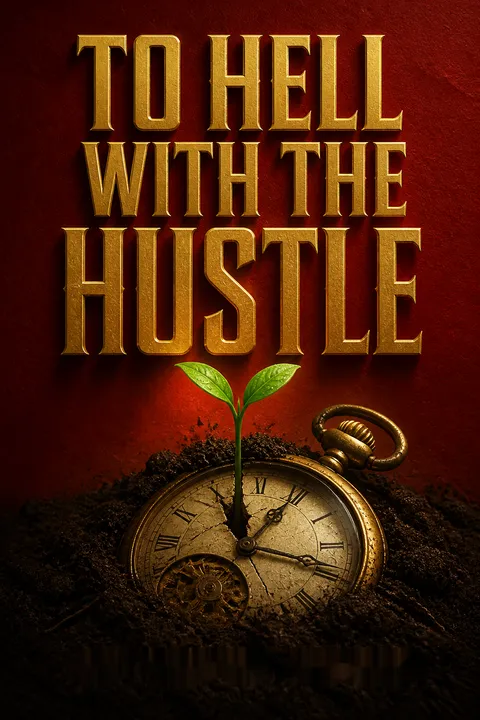

Key Takeaways
1. Hustle culture leads to burnout; true flourishing comes from formation, not achievement.
What if hustle is actually what got us to this point? What if it’s not the solution, but the problem?
The hustle trap. Modern culture pushes us towards constant busyness, equating self-worth with productivity and achievement. This relentless pursuit, often fueled by unrealistic expectations and social media comparisons, leaves us feeling tired, wired, anxious, and on edge, despite doing "all the right things." This "hustle" is a contagion, subtly flowing through our veins and manifesting in symptoms like chronic loneliness and anxiety, especially among millennials.
Work as identity. Historically, work was about material production; now, it's about "identity production," where our jobs define our purpose and value. This shift turns work into an idol, demanding our ultimate sacrifice and leading to longer hours, shorter vacations, and later retirements compared to other developed societies. The pressure to have a "cool, fulfilling, and impressive" dream job becomes a blueprint for spiritual and physical exhaustion.
Formation over goals. Instead of setting finite goals focused on external results, the author advocates for "formations"—practices that shape who we are becoming. This subtle but profound shift moves our north star from what we achieve to who we are, emphasizing process over outcome. Consistent, repeatable behaviors, like honoring a family sabbath or limiting phone use, are not about reaching a finish line but about continually becoming the fuller, richer, more anchored humans Jesus envisioned.
2. Information overload makes us "informationally obese" but not truly better.
The truth is, we are informationally obese. Gorging ourselves on information until we are sick and unhealthy.
Drowning in data. We live in an era of unprecedented information access, constantly consuming podcasts, videos, and "lifehacks" in a relentless quest for self-optimization. Despite this, we aren't becoming "superhuman"; instead, we're often worse off, feeling unfulfilled and anxious. This informational gorging, akin to an addiction, prevents genuine change and leaves us wondering why our efforts yield little lasting satisfaction.
Wisdom vs. shortcuts. Our obsession with metrics and goals, fueled by endless data, creates a vast gap between who we are and who we aspire to be, a gap constantly highlighted by curated online personas. We attempt to exchange deep wisdom, which requires years of life experience, for instant shortcuts found via a Google search. This overreliance on external information neglects our creaturely nature, which is shaped more by what we desire and love than by mere facts or data.
The cost of constant input. The sheer volume of daily information—quintillions of bytes created daily—overwhelms our capacity to process and focus. This constant input diminishes our ability to concentrate for extended periods, making us "data junkies in a data junkyard." Like past societal adoptions of cocaine or tobacco, we embrace new technologies without fully understanding their long-term consequences, slowly boiling ourselves alive in a culture of constant stimulation.
3. Unchecked freedom and limitless pursuit lead to slavery, not liberation.
True freedom has inherent restraint. Boundaries. Bumpers. And limits. But limits is the twenty-first-century swear word.
Freedom's dark side. While individual freedom is a cornerstone of Western society, when elevated to an ultimate god, it becomes a "cancer" of unchecked growth. The pursuit of freedom from all limits, originally a noble escape from tyranny, has morphed into a desire for freedom from any hindrance to our desires. This distorted view promises richer, better lives by removing obstacles, yet paradoxically leads to exhaustion, anxiety, and disconnection from our humanity.
The illusion of choice. In areas like sexuality, the pursuit of "freedom" has meant maximizing personal pleasure with minimal commitment, leading to a frictionless gratification of desires. However, this has resulted in a generation that is supposedly more connected but is actually lonelier. The author argues that true freedom, like a skydiver's parachute, is found within the confines of healthy restraints, such as covenantal marriage, which allows for deeper discovery and connection over a lifetime.
The assembly line of life. The industrial revolution, particularly Henry Ford's assembly line, made efficiency and profit gods, fostering a "churn-and-burn" culture. This mindset, now pervasive, treats everything—relationships, jobs, even spiritual development—as disposable, meant to serve immediate benefit with minimal effort. This constant pushing against limits, whether in work or personal life, ultimately depletes us, turning us into "assembly-line creatures" who prioritize extraction over sustainable flourishing.
4. Embrace agrarian rhythms and resist the efficiency-driven "assembly line" mindset.
Meaning the train has left the station. We aren’t going back to being an agrarian society. But we can bring some agrarian principles to our work and industrialized mind-set.
Lost rhythms. The rapid shift from an agrarian society (70% farmers in 1820) to an industrial one (1.5% today) brought massive productivity but also collateral damage. Agrarian life submitted to natural limits—weather, seasons, soil—while industrialization bucks these limits, driven by profit and efficiency. This has led to a loss of visual reminders that we are creatures of limits and rhythm, replacing them with a relentless pursuit of more.
The cost of convenience. Our modern advancements, from cars to pesticides to lightbulbs, offer immense convenience but come with hidden costs. Cars fostered consumerism and isolation; pesticides boost yields but harm health; artificial light extends productivity but disrupts sleep. We've prioritized privacy over community, leading to disconnection from neighbors and a reliance on impersonal services, treating life as disposable plastic straws for immediate gratification.
Reclaiming ritual and rhythm. To counteract the industrial mindset, we must reintroduce agrarian principles: rhythm, ritual, seasons, and integration. Rituals are habits of meaning that anchor our lives, like a quinceañera or bar mitzvah, offering rich transitions and purpose. Rhythms are consistent, nourishing practices, like a weekly family Shabbat dinner, that provide high points of celebration and connection. These practices offer rootedness and depth, resisting the cultural push to bend, hack, and destroy time and natural cycles.
5. Silence is a powerful, uncomfortable path to spiritual renewal and self-discovery.
Solitude is not a private therapeutic place. Rather, it is the place of conversion, the place where the old self dies and the new self is born.
The assault of noise. Our culture is saturated with noise pollution, constantly taxing a part of our brain meant for "sensory gating." This relentless stimulation, from coffee shop chatter to loud restaurants, exhausts our brains and can even be linked to chronic fatigue and mental health issues. We've normalized damaging noise levels, often weaponized for profit (e.g., loud music in restaurants to speed up table turns), making true quiet a rare and undervalued commodity.
The discomfort of quiet. True silence is often terrifying because it exposes our inner noise—a myriad of uncomfortable thoughts, distractions, and insecurities. This aversion to nakedness and awkwardness is precisely why we need silence; it's not a therapeutic escape but a "graveyard" for our false self. Henri Nouwen describes it as a dreadful nothingness that forces us to surrender unconditionally to Jesus, confronting our deepest fears and need for a Savior.
A quiet revolution. Embracing silence is an act of resistance against a culture that treats it as a disease. Figures like Mister Rogers exemplified this, strategically using calm, slow, and quiet moments on television and even in high-level meetings to counteract the media's overstimulation. He understood that "empty space does not need to always, inherently, be filled." Seeking and defending spaces of silence, like Gordon Hempton's "quietest place in the US," allows our old self to suffocate and our new self to be renewed, hearing God's voice amidst the world's clamor.
6. Cultivate margin by making "no" your default, creating space for what truly matters.
If you’re not saying no to good things, you’re probably not saying no enough.
The tyranny of hurry. Modern timekeeping, with its atomic precision, has transformed time into a pseudo-god, dictating our lives and creating an arbitrary sense of hurry. This constant pressure, often self-imposed, leads to "time stress"—a frantic mix of pressure and frustration that makes our souls give way to the idol of hurry. We are becoming our clocks, living a mechanized, calculated existence that erases the vital "margin" between our load and our limits.
The power of "no." Most of us operate with a default "yes," believing time will be more abundant in the future, leading to overscheduled lives and burnout. The author advocates for making "no" the default answer, ruthlessly starving one's schedule to create space and margin. This counter-cultural approach, though challenging, allows for intentional focus on priorities and prevents the slow, toxic erosion of flourishing caused by daily micro-mundane asks.
Freedom through limits. Saying "no" is not selfish; it's about loving others better by ensuring we have the capacity to truly serve. Jesus often allowed himself to be interrupted, demonstrating a pace responsive to the Spirit's leading, which is impossible without margin. By admitting our time is finite and prioritizing family, faith, craft, and community, we gain a superpower: the freedom to be present, to bear inconveniences with joy, and to engage in meaningful, unnoticed acts of service, rather than being enslaved by an overcommitted schedule.
7. Obscurity and ordinariness are gifts, not curses, for deep intimacy with God.
According to the way of Jesus, that is not a curse. In fact, we should choose it.
The gift of the desert. In an overconnected society, we often lack "obscurity"—the state of being unknown, inconspicuous, or unimportant. When facing trauma, like the author's miscarriage, the temptation is to overshare online for quick, cheap consolation, which short-circuits the healing process. True healing and wholeness are found in the "desert"—a dry, quiet, unapplauded, and isolating place where God does his best work and meets us most intimately, away from the noise of public opinion.
Jesus's example of obscurity. Jesus himself sought obscurity, constantly telling people not to reveal his miracles, and intentionally withdrawing to "lonely places" to pray. His ministry began only after his baptism (identity) and forty days in the desert (solitary place), where his belovedness was seared deep into his soul. This process of identity, obscurity, and then kingdom work is crucial; skipping the desert means belovedness gets drowned out by the demands of ministry and the world's voices.
Embracing the "boring." Our generation is terrified of ordinariness, yet the Scriptures define what our culture calls "boring" as quiet, beautiful, and faithful. The author's mantra, "be boring," means chasing a life of faithful, mundane repetition in marriage, family, and work, finding richness and depth there. Biblical figures like Moses and Abraham lived decades in obscurity, faithfully pursuing God's call without seeking sensationalism, demonstrating that God often works through the ordinary, calling us to be faithful rather than to do "big things."
8. Sabbath is a weekly act of resistance, a joyful return to God's design for rest and delight.
The way we topple the empire of workaholic-ness and individualism and burnout speeds is by walking around town every week with our TV of rest under our arms.
A day of defiance. The Sabbath is an ordinary yet deeply subversive act of resistance against a culture that worships productivity, work-based identity, and speed. Like the Polish citizens who publicly carried their TVs during news boycotts to defy communist propaganda, observing Sabbath is a weekly declaration: "We are not what we do, what we have, or what we can buy." It's a day to cease, stop, and delight, ensuring we remain in rhythm with God's design.
Sabbath's origin of delight. The Sabbath's origin story in Genesis reveals it as God's first act of celebration and filling after creation, with Adam's first experience being rest. This means we are meant to work from rest, not to get rest. The Sabbath is an invitation to fill the earth with God's presence, a "holy day" meant for joy and celebration, much like Christmas. It's not a burdensome obligation but a treat, an immense blessing, offering fifty-two mini-Christmases a year.
Practicing rest. While our culture rewards non-Sabbath behavior (more money, accolades), this short-term gain leads to long-term depletion, much like unsustainable coal mining. Observing Sabbath is a discipline that takes practice, like learning to dance. It's about "reps, not perfection," building a "memory mountain" of richness and meaning over time. This weekly rhythm counters the curse of futile, endless work, reminding us that God is a covenant God of love, rest, and delight, not a taskmaster.
9. Empathy, rooted in enemy-love, is the antidote to a dehumanizing, tribalistic world.
How can you hate me when you don’t even know me?
The empathy deficit. In a world increasingly fragmented by the Internet and tribalism, empathy—the ability to understand and share the feelings of another—is a crucial, yet diminishing, superpower. Daryl Davis, a black blues musician, exemplifies this by actively engaging white supremacists, disarming their hatred simply by listening and asking, "How can you hate me when you don’t even know me?" This approach demands eye-to-eye connection, making it difficult to caricature or hate someone up close.
The Internet's dehumanization. Platforms like Facebook, the "Empathy Killing Machine," desensitize us to atrocities and foster "false empathy" through curated content and emotional clickbait. Algorithms prioritize polarizing posts, creating echo chambers where we only see what we want, hardening our ability to engage with differing viewpoints. This digital environment encourages toxic, dehumanizing communication, turning disagreements into all-out wars because relationships don't matter as much as winning.
Overcoming fear with enemy-love. Our society's greatest fears—corrupt government, healthcare concerns—are amplified by media, fanning the flames of division and hate. The author argues that fear, not hate, is the deeper motivator behind atrocities and tribalism. As followers of Jesus, who had "nothing to fear" and willingly died for his enemies, we are called to lay down our fears and weapons and embrace "enemy-love." This sacrificial love, demonstrated by figures like Polycarp and Martin Luther King Jr., operates at a slower, peaceful pace, allowing for empathy and responsiveness to holy moments of grace.
10. Prioritize faithfulness over accomplishment; it's the ultimate, often overlooked, virtue.
There’s no greater antidote to the poison of hustle than diving headfirst into what the word faithfulness means.
The dying art of faithfulness. The word "faithfulness" is becoming obsolete in our culture, replaced by a preference for transience, individual happiness, and constant novelty. We resist faithfulness because it often entails obscurity and ordinariness, which are culturally perceived as curses. This aversion leads us to abandon jobs, marriages, and communities at the first sign of difficulty or mundanity, constantly seeking the next "Instagrammable" experience rather than rooting ourselves deeply.
The paradox of quiet consistency. Embracing quiet, steady, measured, and consistent faithfulness, though initially uncomfortable, paradoxically leads to profound joy and reduced pressure. The cultural anxiety to achieve a booming career, perfect life, and financial success by a young age is unsustainable. Instead, the author advocates for keeping one's head down, loving those nearby, honoring the process, and being present, trusting that this path leads to a "well done, my good and faithful servant" from God, rather than a "well accomplished, my busy and hustled servant."
God's measure of success. God's measure of success is not about doing "big things" or achieving extraordinary feats, but about becoming a faithful person who loves Him and their neighbors well in ordinary life. The author, despite commercial success with viral content, recognizes that God cares more about his relationships and presence than his online influence. This perspective liberates us from the relentless pursuit of external validation, allowing us to find deep meaning and purpose in the "boring," the obscure, and the mundane, which are, in God's economy, profoundly holy.
People Also Read







Download PDF
Download EPUB
.epub digital book format is ideal for reading ebooks on phones, tablets, and e-readers.








































