
Key Takeaways
1. The Blind Spot: The Unseen Source of Our Actions
The blind spot is the place within or around us where our attention and intention originates.
Unseen dimension. In leadership and daily life, we often focus on what we do and how we do it, but rarely on where our actions originate. This "blind spot" is the invisible dimension of our social field, the inner condition from which all our actions flow. It's the source of our attention and intention.
Impact on outcomes. The success of any intervention or creative process depends profoundly on this interior condition. The same person, in the same situation, doing the same thing, can achieve vastly different outcomes based on the inner place from which that action emanates. This highlights a fundamental factor often overlooked in social sciences.
Goethe's insight. As Goethe observed, "Every object, well contemplated, opens up a new organ of perception within us." To truly understand and shape our world, we must turn our gaze inward, illuminating this blind spot to access deeper levels of awareness and intentionality, moving beyond mere reaction.
2. The U Process: A Journey from Past to Emerging Future
The turbulent challenges of our time force all institutions and communities to renew and reinvent themselves.
Beyond past learning. Traditional learning focuses on past experiences (observe, reflect, plan, act). However, current global challenges demand a new form of learning: "learning from the future as it emerges." This is crucial when past experiences are insufficient or even detrimental to finding creative solutions.
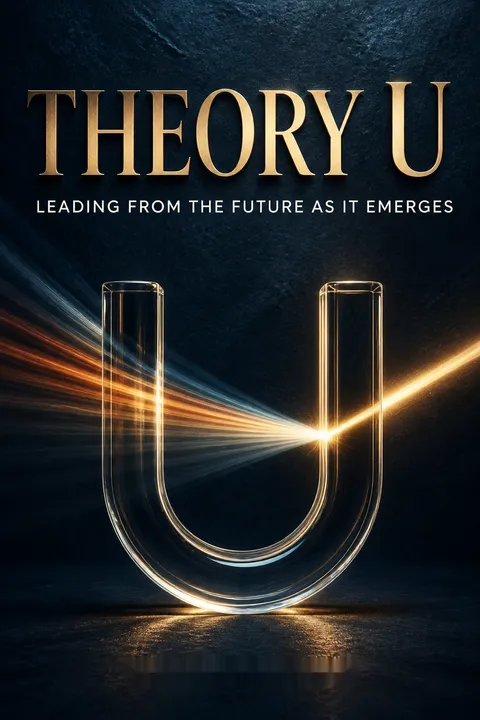
The U-shaped journey. The "U Process" is a framework for this transformative learning, guiding individuals and collectives through a journey from deeply connecting and sensing to enacting and realizing. It moves from shallow responses (reacting, restructuring) to profound renewal (reframing, regenerating).
Presencing as core. At the deepest point of the U lies "presencing," a blending of "presence" and "sensing." It signifies the ability to sense, tune in, and act from one's highest future potential, bringing it into being. This process allows us to transcend past patterns and tap into a different social field of creativity.
3. Three Instruments for Deeper Awareness: Mind, Heart, and Will
What I am suggesting as an alternative is to develop a new type of social technology that is based on three instruments that each of us already has—an open mind, an open heart, and an open will—and to cultivate these capacities not only on an individual level but also on a collective level.
Tuning our inner capacities. To navigate the U Process effectively, we must activate and cultivate three fundamental human capacities. These act as instruments for deeper perception and action, both individually and collectively.
The three instruments are:
- Open Mind (IQ): The capacity to see with fresh eyes, suspend judgment, and inquire into objective facts. It allows us to move beyond habitual thinking.
- Open Heart (EQ): The capacity for empathy, to tune into others' contexts, and to "exchange places" with another person or system. It enables deep connection and understanding.
- Open Will (SQ): The capacity to let go of old identities and intentions, connecting to our authentic purpose and the highest future possibility. It fuels generative action.
Collective cultivation. These instruments are not just individual tools; they can be cultivated collectively within groups and organizations. Tuning them allows a system to access deeper layers of the social field, fostering profound innovation and change.
4. Overcoming Internal Resistance: Confronting Judgment, Cynicism, and Fear
The reason the journey of the U is the road less traveled has a name: resistance.
Internal barriers. The path to deeper awareness and transformative change is often blocked by three powerful internal forces. These "enemies" prevent us from accessing our full creative and generative potential.
The three enemies are:
- Voice of Judgment (VOJ): Blocks the open mind, preventing us from suspending habitual thoughts and seeing reality with fresh eyes.
- Voice of Cynicism (VOC): Blocks the open heart, manifesting as emotional detachment, arrogance, or callousness, hindering empathy and connection.
- Voice of Fear (VOF): Blocks the open will, preventing us from letting go of the familiar self and world, and surrendering to the unknown future.
Discipline and courage. Developing the capacity to operate from the deeper levels of the U requires confronting and dealing with these forces of resistance. It demands commitment to truth (open mind), love (open heart), and courage (open will), enabling us to reliably access deeper spheres of social emergence.
5. Four Fields of Social Emergence: From Downloading to Presencing
Every social system and every social action can be performed and enacted from four different sources.
Qualities of interaction. Social systems, from individual thought to global governance, operate from four distinct "fields of attention," each yielding different patterns of emergence. These fields describe the quality of how we attend to the world and from where our actions originate.
The four fields are:
- Downloading (I-in-me): Reenacting past patterns, speaking from what's expected, leading to autistic systems.
- Debate (I-in-it): Speaking from what one thinks, exchanging divergent views, leading to adaptive systems.
- Dialogue (I-in-you): Speaking from seeing oneself as part of the whole, reflective inquiry, leading to self-reflective systems.
- Presencing (I-in-now): Speaking from what is moving through, collective creativity, leading to generative systems.
Shifting the field. Moving from one field to another involves specific "inflection points":
- Opening and Suspension: From downloading to seeing (open mind).
- Deep Diving and Redirection: From seeing to sensing (open heart).
- Letting Go and Letting Come: From sensing to presencing (open will).
These shifts are crucial for addressing increasing complexity and fostering profound innovation.
6. Co-sensing: Deep Immersion and Collective Seeing
When moving from seeing to sensing, perception begins to happen from the whole field.
Beyond external observation. Co-sensing is the movement of the U where we deeply connect with and tune into the contexts that matter. It moves beyond merely "seeing" external data to a state where perception originates "from the field" itself, collapsing the boundary between observer and observed.
Principles of co-sensing:
- Charging the Container: Creating intentional physical, time, relational, and intentional spaces for collective work.
- Deep Diving: Total immersion in the living presence of the phenomenon, becoming one with what is studied.
- Redirecting Attention: Shifting focus from individual objects to the formative forces connecting them, seeing oneself as part of the system.
- Opening the Heart: Activating emotional perception, using the heart as an organ of insight, often triggered by a "Grail Question" that comes from deep sincerity.
Collective sensing organs. This process allows a system to "see itself," moving from "what the system is doing to us" to "look what we are doing to ourselves." This collective self-awareness is a critical function for leading change, as demonstrated by the Patient-Physician Dialogue Forum.
7. Co-presencing: Connecting to the Source of Highest Future Possibility
Presencing, the blending of sensing and presence, means to connect with the Source of the highest future possibility and to bring it into the now.
Accessing authentic self. Co-presencing is the deepest point of the U, where perception connects to the source of an emerging future. It involves a merging of the presence of the past, the future, and one's authentic Self, leading to a profound shift in the place from which we operate.
Two root questions. This territory addresses the fundamental questions of creativity: "Who is my Self?" (one's highest self, transcending pettiness) and "What is my Work?" (one's authentic purpose). Connecting to these questions unlocks deeper sources of creativity and power.
Principles of co-presencing:
- Letting Go and Surrendering: Releasing old identities and intentions to create space for the new.
- Inversion: Passing through the "eye of the needle," where everything non-essential is shed, shifting perspective to the future.
- Coming into Being of a Higher Presence: Experiencing a new, authentic self that connects with a larger generative field.
- Power of Place: Creating holding spaces (like the Circle of Seven) that foster deep listening, unconditional witnessing, and impersonal love.
This deep connection, often experienced as stillness or grace, is a "social technology of freedom," enabling individuals and collectives to operate from their highest potential.
8. Co-creating: Prototyping the Future by Doing
Prototyping is the first step in exploring the future by doing and experimenting.
From vision to action. After connecting to the source (presencing) and clarifying vision (crystallizing), co-creating involves bringing the emerging future into reality through experimentation. This means exploring the future by doing, rather than just analyzing or planning.
Principles of prototyping:
- Power of Intention: Connecting to the "Grand Will" – the future that needs us to come into reality. This involves a "gift economy" where giving everything amplifies energy.
- Letting Come: Tuning into the universe's suggestions and feedback, discerning what helps and what harms the emerging idea.
- Integrate Head, Heart, and Hand: Balancing rational thought, emotional intelligence, and practical action. "Seek it with your hands; don't think about it, feel it."
- Iterate, Iterate, Iterate: Embracing "fail early to learn quickly" by constantly refining prototypes based on stakeholder feedback.
Strategic microcosms. Prototyping involves creating small, experiential versions of the desired future, acting as "landing strips" for emerging possibilities. These microcosms, like the new emergency care center in Germany, allow for fast-cycle learning and adaptation.
9. The Cycle of Absencing: Understanding Social Pathology
The social space of emergence and the social space of anti-emergence evolve in a dialectical relationship.
Shadow of the U. Just as the U-space fosters creative emergence, there is a "shadow space" of anti-emergence, a cycle of social pathology that leads to destruction. This cycle manifests when systems fail to access deeper levels of awareness and become stuck in old patterns.
Practices of absencing:
- Downloading: Reenacting past patterns, the seed of all pathology.
- Silencing Other Views: Discouraging diverse perspectives, denying disconfirming data.
- Blaming Others: Disconnecting from others' perspectives, failing to see one's own part in systemic problems.
- Absencing and Hubris: Disconnecting from one's authentic self, leading to self-delusion and ego-driven exploitation.
- Intrigue and Disinformation: Poisoning collective thought through manipulation.
- Harassing and Bullying: Destroying microcosms of emerging futures.
- Collective Collapse: The final destruction of relational structures and future potential.
Societal grip. This pathological cycle, characterized by rigid ideology, arrogance, and violence, explains why many institutions collectively produce undesirable outcomes despite individual good intentions. It highlights the urgent need to shift from destructive to generative conversational and organizational patterns.
10. The I-in-Now: The Revolutionary Force for Systemic Change
The revolutionary force in our time is the “I-in-now” or the capacity of every human being and social system to switch the structure of attention in a way that begins to connect them to the fourth stream of emergence.
The spark of freedom. The "I-in-now" is the hidden capacity within every human and social system to intentionally redirect and shift its field of attention. It's the "eye with will," the invisible origin of real presence and power, operating from the present moment.
Transforming causation. This capacity allows us to move from being driven by past patterns and external forces (exterior causation) to self-reflection and self-causation. It's the journey from a victim mindset to one where we actively shape our future.
Global implications. The challenges of our century, such as climate change and societal divides, compel us to interiorize our patterns of social causation. Cultivating the I-in-now, individually and collectively, is essential for unlocking deeper sources of emergence and fostering systemic change across all levels—micro, meso, macro, and mundo.
Review Summary
Theory U receives mixed reviews averaging 4.04/5 stars. Supporters praise its transformative framework for leading change through "presencing"—connecting to emerging futures by opening mind, heart, and will. They value its integration of mindfulness with organizational leadership and systems thinking. Critics find it overly long, repetitive, and esoteric, claiming it repackages existing concepts like Buddhism and mindfulness without sufficient rigor. Some appreciate practical tools but struggle with vague terminology like "Source" and "sensing." The U-process—moving from downloading past patterns through letting go to manifesting new possibilities—resonates differently across readers, with accessibility varying by background.
People Also Read







About the Author
Download PDF
Download EPUB
.epub digital book format is ideal for reading ebooks on phones, tablets, and e-readers.








































