

Key Takeaways
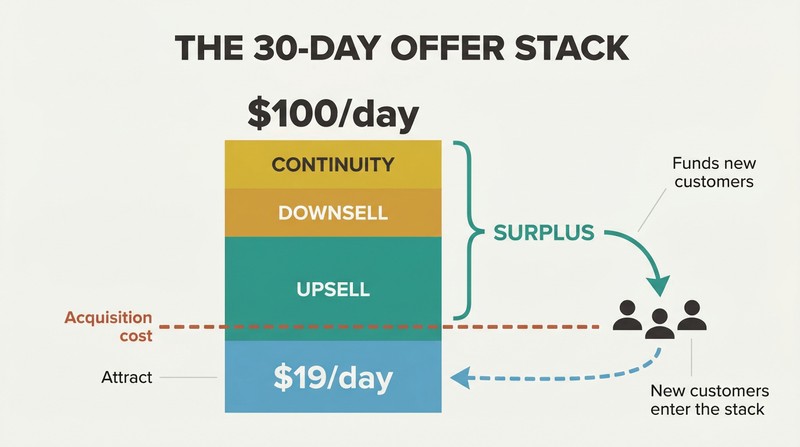
Stack offers so each customer's first 30 days fund acquiring many more
A Money Model is a deliberate sequence of offers — what you sell, when, and how — designed to make enough profit per customer within 30 days to cover all acquisition and delivery costs many times over. Hormozi watched a rental car agent transform a $19/day booking into $100/day through five sequential offers: truck upgrade, late return, premium insurance, minimum insurance fallback, and prepaid gas. Each solved a problem the customer discovered in real time.
Four offer types build the sequence:
1. Attraction Offers turn strangers into customers
2. Upsell Offers get them to spend more
3. Downsell Offers turn "nos" into "yeses"
4. Continuity Offers keep them paying month after month
When all four compound, cash stops being a bottleneck and becomes an accelerant for growth.
Your first sale opens the door — your upsells pay the rent
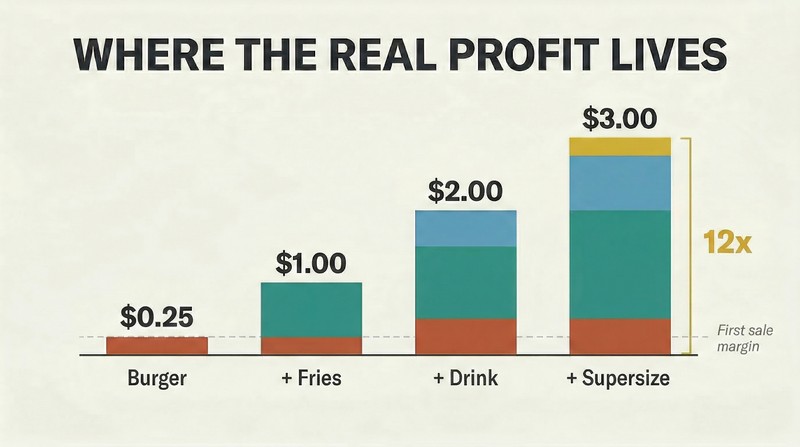
Upsells multiply razor-thin margins. A burger shop makes $0.25 profit on a $2 burger. Add fries and profit hits $1.00. Add a drink: $2.00. Supersize the meal: $3.00 — nearly a 12x increase from one product. If McDonald's only sold burgers, there would be no McDonald's. Yet most small businesses Hormozi encounters sell exactly one thing and wonder why they're broke.
Every purchase reveals the next need. You can't ride a bike without a helmet. You can't store a fur coat without paying for storage. The first offer creates immediate awareness of the next problem, and that problem is your upsell opportunity. Current customers buy at far higher rates than strangers, so the second, third, and fourth offers are where the real profit engine lives.
Charge upfront — then let customers win it back by showing up
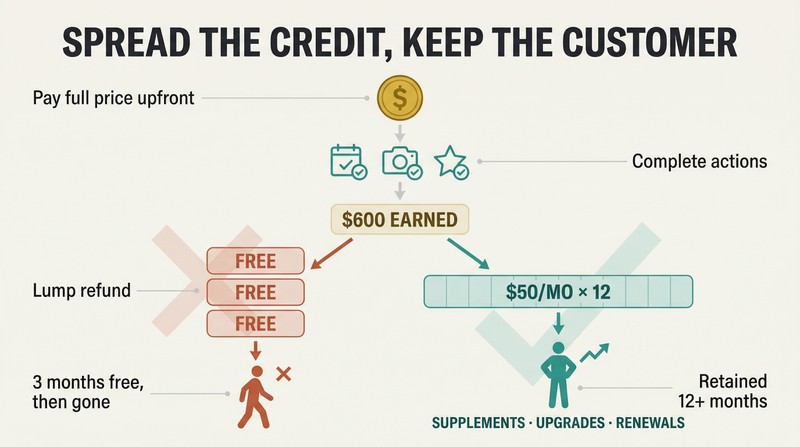
The Win Your Money Back offer charges customers full price upfront, then refunds them — as cash or store credit — if they complete required actions like attending sessions, posting progress, and leaving reviews. This single offer type generated over $1 billion in sales industry-wide across gyms. Only about 10% of customers request refunds; the rest either stay voluntarily or apply their credit toward longer commitments.
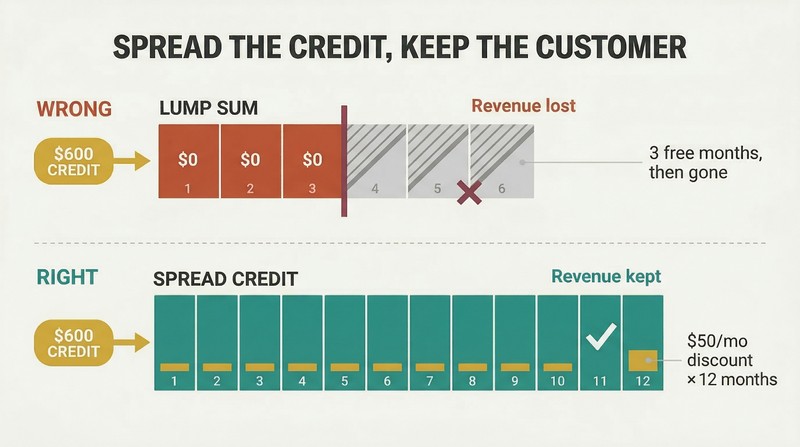
Smart credit application matters. When winners earn $600 back, don't hand them three free months — they'll cancel after. Instead, spread $600 over 12 months as a $50/month discount, keeping skin in the game. Make check-in meetings part of the qualifying criteria; each meeting doubles as a chance to offer supplements, memberships, or upgrades tailored to their progress.
Put a stripped-down decoy beside your real offer
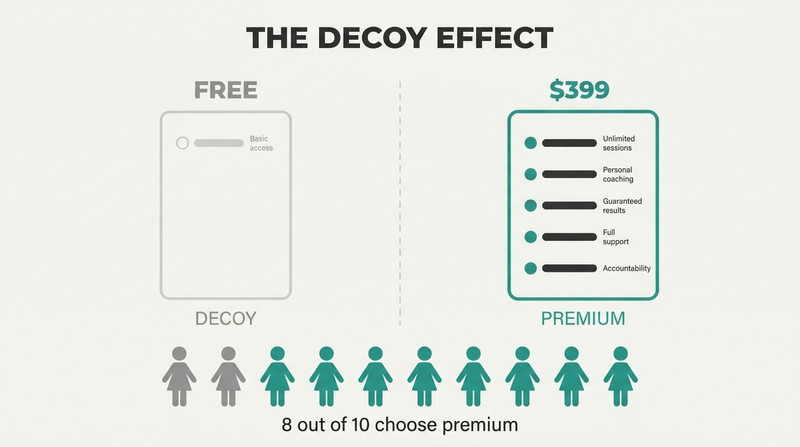
A Decoy Offer advertises something free or dirt-cheap, then presents a far more valuable premium option alongside it when the lead shows up. In Hormozi's gym, the decoy was free weekly workouts with no support or guarantee. The premium: unlimited sessions, personalized coaching, and guaranteed results for $399. Eight out of ten people chose the premium because the contrast made its value unmistakable.
Maximize the gap between options. Strip the decoy to its most basic form — remove personalization, guarantees, and support. Load the premium with everything. When presenting both, ask: "Are you here for free stuff or lasting results?" Most say "results," giving you permission to lead with the premium. Those who still pick the decoy become warm leads for future upsells.
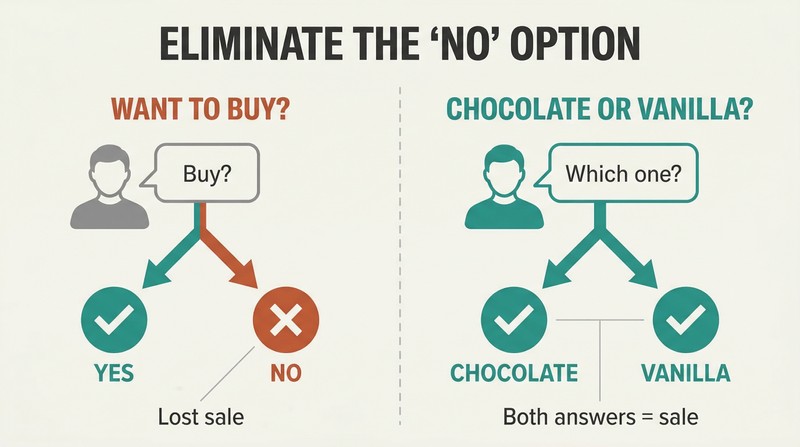
Ask 'chocolate or vanilla?' instead of 'want to buy?'
The Menu Upsell combines four tactics Hormozi refined over a decade of selling gym supplements:
1. Unselling: Cross out what they don't need, building trust for what they do
2. Prescription Upselling: Tell them what to use and how — as if they already own it
3. A/B Upselling: Ask which flavor, time, or package they prefer — never whether they want to buy
4. Card on file: "Wanna just use the card on file?" removes wallet friction
The breakthrough was accidental. Hormozi forgot his sales script during a consultation. Instead of pitching science, he blurted out "chocolate or vanilla?" The customer bought instantly. He sold the next twenty customers in a row the same way — eliminating the yes-or-no decision entirely and replacing it with preference choices.
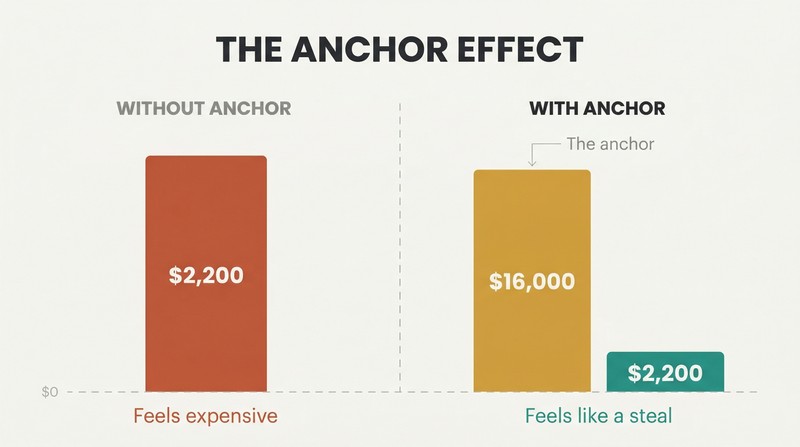
Show the $16,000 price tag first to make $2,200 feel like a steal
Anchor Upsells present premium options first. Hormozi walked into a suit shop budgeting $500. The owner draped a $16,000 designer suit on him. After the sticker shock — what Hormozi calls The Gasp — the owner asked if the designer label mattered. When Hormozi said no, a $2,200 suit appeared. It felt like a bargain. He spent four times his budget and walked out happy.
Make the anchor genuine. If you treat the expensive option as a prop, customers sense it and you lose trust. Actually sell the premium — some people will buy it, adding outsized profit. For those who don't, present your core offer with the same primary features at one-fifth to one-tenth the price. Both options should solve the same core problem; the premium just adds luxury extras.
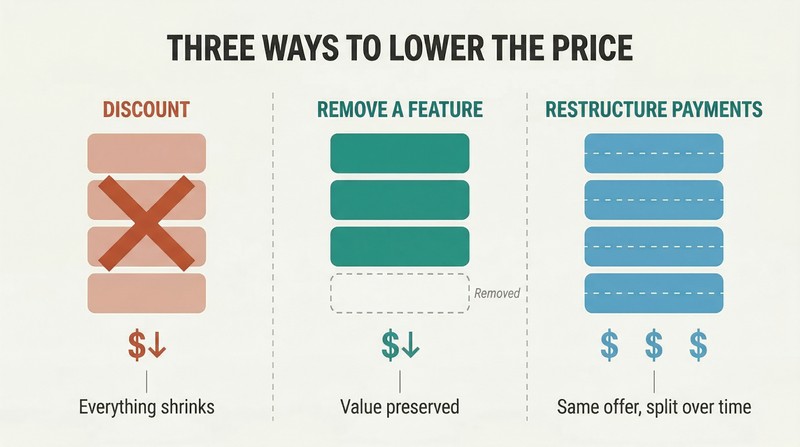
Never discount — remove features or restructure payments instead
Feature Downsells lower prices by removing components, not cheapening what's already there. One business removed its money-back guarantee as a downsell: "If you're okay giving up the right to get your money back, you pay less." Close rates tripled from 25% to 75% — and more people bought the original full-price offer because removing the guarantee revealed its worth.
When cash flow is the real issue, restructure payments instead. Hormozi's seven-step Payment Plan Downsell starts at full price, offers financing, halves the down payment, then thirds it — always checking desire between attempts. Data from 14,000 businesses shows annual billing produces just 2% monthly churn versus 10.7% for monthly, so always start with bigger, less frequent payments and work down.
Credit old purchases toward bigger, newer commitments
Rollover Upsells credit some or all of a customer's previous spending toward your next, more expensive offer — reframing sunk cost as investment. Hormozi's gym customers won $600 in fitness challenges but canceled after burning through three free months. The fix: spread credit over 12 months as a $50/month discount, so customers keep paying from day one while still getting full value.
Four rollover targets:
1. Lapsed customers: Hormozi recorded 200 personalized videos offering $4,000 credit; 20% accepted, adding ~$1.9M in annual revenue from one day of work
2. Upset customers about to request refunds
3. Competitors' unhappy customers (scrape negative reviews for leads)
4. Current customers ready for upgrades
Price the upsell at least 4x the credit so you still profit after the discount.
Bill every four weeks instead of monthly for hidden profit
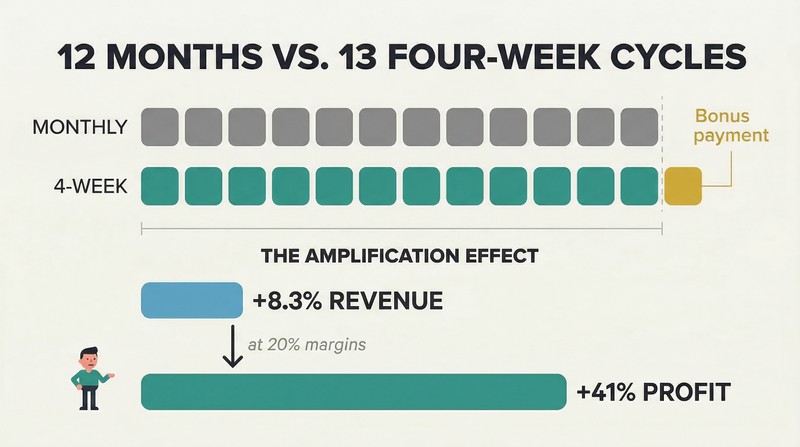
Switching from monthly to four-week billing collects 13 payments per year instead of 12 — an 8.3% revenue bump for changing a few words on an invoice. For a business running 20% margins, this single tweak boosts annual profit by 41% with zero extra work. Hormozi calls this the highest-value-per-word note in the entire book.
Stack two more micro-wins on top: First, add a 3% processing fee — Hormozi has never lost a sale over it, and for a 10%-margin business, that 3% means 30% more profit. Second, offer to waive the fee if the customer provides a backup payment method, ideally ACH (direct bank link). This reduces failed payments and locks in the cheapest transaction method. Three small changes, three permanent profit bumps.
Perfect one offer at a time — 100 ways to sell beats 100 things to sell
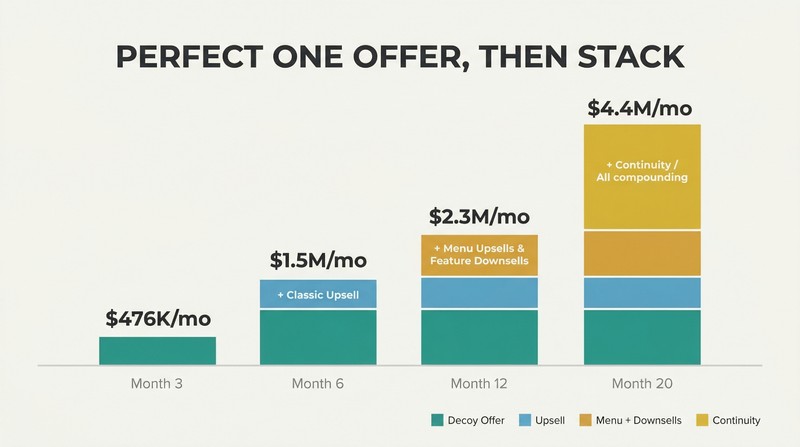
Money Models evolve through three stages: Get Cash (Attraction Offers), Get More Cash (Upsells and Downsells), and Get The Most Cash (Continuity Offers). Hormozi's Gym Launch illustrates: a Decoy Offer hit $476,000/month within three months. Adding a Classic Upsell pushed it to $1.5 million. Menu Upsells and Feature Downsells took it to $2.3 million. By month 20, with all four offer types compounding, the business reached $4.4 million per month — but each stage was perfected before the next was added.
Resist building everything at once. Don't start new businesses to fill offer gaps — use affiliate relationships, selling other companies' products for commissions. A massage therapist sells someone else's foam rollers; a consultant recommends specific software. Focus on finding 100 ways to package what you already have, not manufacturing 100 new products.
Analysis
Hormozi's third book completes a practical trilogy: $100M Offers answered 'what to sell,' $100M Leads answered 'how to find buyers,' and $100M Money Models answers 'how to extract maximum revenue per customer through offer sequencing.' Where most business books trade in principles, this one delivers plays — each chapter is a specific offer type with story, mechanics, examples, and implementation notes.
The core observation is deceptively simple: most businesses fail not because their product is bad but because cash-flow timing kills them. They spend to acquire customers faster than those customers generate returns. Hormozi's solution isn't to reduce acquisition costs but to compress the revenue timeline through systematic offer stacking. The four-category taxonomy — Attraction, Upsell, Downsell, Continuity — provides a combinatorial framework that transforms isolated tactics into unified revenue architecture.
What's genuinely novel is how the categories interact. The Decoy Offer doesn't merely attract — it pre-frames the premium's value. Feature Downsells often drive customers back to the original, higher-priced offer by revealing what they'd lose. Win Your Money Back simultaneously generates upfront cash, creates check-in meetings that become upsell opportunities, and produces customer-generated marketing. Each piece feeds the others in ways most sales-tactics books miss entirely.
The limitations are real. The high-touch, sales-conversation model maps cleanly onto services and local businesses but demands adaptation for automated e-commerce or product-led SaaS. The 30-day payback standard is genuinely aggressive — most venture-backed companies celebrate 6-month payback — and executing multiple offer types simultaneously requires operational sophistication Hormozi only gestures toward. The ethical line between 'helpful guide' and aggressive sequencing also thins in places, particularly with the Trial With Penalty.
Still, for bootstrapped entrepreneurs and small business owners, this may be 2025's most actionable business book. Specific pricing data — four-week billing yields 8.3% more revenue, annual billing cuts monthly churn by 80% versus monthly billing — could justify the read alone. Hormozi writes like a coach rather than a professor, and the playbook format means readers can implement a single chapter and measure results before finishing the book.
Review Summary
The reviews for $100M Money Models are generally positive, with an average rating of 4.79 out of 5. Readers praise the book for its creative ideas, practical sales tactics, and step-by-step guidance. Some highlight its value for entrepreneurs and marketers, noting its unique approach to selling and improving cash flow. A few critics mention that the content is similar to the author's course and that the strategies are comparable to common gym sales tactics. Overall, most reviewers find the book insightful and beneficial for business growth.
Glossary
Money Model
deliberate sequence of revenue offersA structured sequence of offers—Attraction, Upsell, Downsell, and Continuity—designed to maximize how many customers a business gets, how much they pay, and how fast they pay. The goal is generating enough profit from one customer in 30 days to fund acquiring and servicing many more, removing cash as a growth constraint.
Win Your Money Back
pay now, earn refund laterAn Attraction Offer where customers pay upfront and can earn their money back (as cash or store credit) if they meet specific criteria—such as attending sessions, hitting goals, or completing actions. Designed to lower buyer risk, increase results through accountability, and generate free marketing through required activities like posting progress and leaving reviews.
Decoy Offer
cheap option beside premium oneAn Attraction Offer that advertises a free or heavily discounted stripped-down version of a product, then presents a far more valuable premium version alongside it. The contrast between the bare-bones decoy and the loaded premium makes the premium appear clearly superior, converting a higher percentage of leads into premium buyers.
Menu Upsell
four-tactic personalized upselling methodA selling technique that combines four sequential tactics: Unselling (crossing out unneeded options to build trust), Prescription Upselling (telling customers exactly what they need and how to use it as if they already own it), A/B Upselling (asking preference between two options instead of yes or no), and Card on File (referencing stored payment info to reduce buying friction).
Anchor Upsell
show expensive option firstAn upselling technique that presents the most expensive option first, establishing a high price reference point. After the customer reacts with shock to the premium price—what Hormozi calls The Gasp—a significantly cheaper alternative with the same core features is offered, making it feel like a much better deal by comparison. Ideally the anchor is 5–10x the price of the core offer.
The Gasp
customer's shock at premium priceThe customer's visible shock reaction when presented with a premium price during an Anchor Upsell. Hormozi observes that the intensity of The Gasp correlates with how much the customer ultimately spends on the lower-priced alternative—bigger gasps signal bigger eventual purchases. The salesperson should expect and welcome it, then 'come to the rescue' with the more affordable option.
Rollover Upsell
credit past purchases forwardA technique that credits some or all of a customer's previous purchases toward a new, typically more expensive, offer. Used in four scenarios: re-engaging lapsed customers with winback campaigns, rescuing upset customers before they request refunds, attracting competitors' unhappy customers, and upgrading current customers to longer or higher-tier commitments.
Feature Downsell
remove features to lower priceA downselling technique that lowers price by removing specific features—quantity, quality, guarantees, service levels, or entire components—rather than discounting the same product. Removing high-value features often makes customers realize what they'd lose, driving more people back to the original full-price offer. Packages are typically named (e.g., First Class, Economy, Minimum).
Trial With Penalty
free trial with compliance feesA downsell offer where customers try a product or service for free, provided they meet specified terms such as attending meetings and completing homework. If they meet the terms, the trial stays free and they transition into paying customers. If they fail to comply, penalty fees are charged to their card on file, creating accountability.
BAMFAM
always schedule the next meetingAcronym for Book A Meeting From A Meeting. The practice of scheduling the next customer interaction before the current one ends. Every appointment concludes by confirming the next appointment's purpose and timing, ensuring continuous engagement and creating repeated opportunities to present upsell and downsell offers.
Unselling
crossing out unneeded optionsA sales technique where the seller explicitly tells customers what they don't need—visibly crossing items off a list or recommending against irrelevant products. This counterintuitive approach builds trust and credibility, making customers far more receptive to purchasing the items the seller then recommends. Hormozi even kept products on shelves specifically to cross them out.
Seesaw Downselling
gradual shift to smaller paymentsA simplified Payment Plan Downsell process that starts by asking whether the customer prefers 'giant monthly payments or tiny ones,' then presents prepayment as the positive choice. If they can't pay upfront, the salesperson gradually shifts the balance—reducing the down payment while increasing installments—until finding a payment structure the customer accepts.
FAQ
What’s "$100M Money Models" by Alex Hormozi about?
- Core Focus: The book teaches how to create "Money Models"—sequences of offers that maximize customer value and business profitability, based on Hormozi’s real-world experience scaling companies to over $100M in net worth.
- Practical Playbook: It provides actionable frameworks and examples for structuring offers to attract, upsell, downsell, and retain customers, applicable across industries.
- Personal Stories: Hormozi shares his entrepreneurial journey, including failures and successes, to illustrate how these models work in practice.
- Step-by-Step Structure: The book is organized to guide readers from foundational concepts to advanced strategies for building scalable, cash-generating businesses.
Why should I read "$100M Money Models" by Alex Hormozi?
- Proven Strategies: The book distills methods that have generated billions in sales across various businesses, not just theory but field-tested tactics.
- Immediate Application: Each chapter includes practical steps, examples, and templates you can use to improve your business’s cash flow and growth right away.
- Universal Relevance: Whether you run a service, product, software, or local business, the frameworks are adaptable to any industry.
- Mindset Shift: Hormozi challenges limiting beliefs and encourages creative thinking about offers, pricing, and customer value.
What are the key takeaways from "$100M Money Models"?
- Money Models Defined: A Money Model is a deliberate sequence of offers designed to maximize how much, how fast, and how often customers pay you.
- Four Offer Types: The core of every Money Model is built from Attraction Offers, Upsell Offers, Downsell Offers, and Continuity Offers.
- Cash Flow First: The best businesses make more money from customers in the first 30 days than it costs to acquire and serve them, removing cash as a growth bottleneck.
- Iterative Improvement: Start simple, perfect one offer at a time, and evolve your Money Model as your business grows and stabilizes.
What are the Four Types of Offers in "$100M Money Models" and how do they work?
- Attraction Offers: Designed to turn strangers into customers by offering something free or at a discount, making it easy for people to say yes.
- Upsell Offers: Presented after the initial sale to get customers to spend more, often by solving the next problem or offering a better version.
- Downsell Offers: Used when a customer says no, by tweaking payment terms or features to find a version they can accept.
- Continuity Offers: Aim to keep customers buying over time, typically through subscriptions or ongoing services, maximizing lifetime value.
How does Alex Hormozi define a "Money Model" in "$100M Money Models"?
- Sequence of Offers: A Money Model is a planned series of offers that guide customers from first purchase to long-term engagement.
- Solving Problems in Order: Each offer solves a new problem created or revealed by the previous one, encouraging further purchases.
- Cash Flow Engine: The goal is to generate enough profit from each customer quickly to fund more customer acquisition and business growth.
- Customizable Framework: While the structure is universal, the specific offers and sequence should be tailored to your business and audience.
What are the most effective Attraction Offers according to "$100M Money Models"?
- Win Your Money Back: Customers pay upfront with the chance to earn their money back by achieving specific results or actions.
- Giveaways: Offer a chance to win a high-value prize, then present a discounted offer to all non-winners, leveraging the excitement and engagement.
- Decoy Offers: Advertise a basic or free version, then present a premium, more valuable option side-by-side to encourage upgrades.
- Buy X Get Y Free: Increase perceived value by bundling free items with a purchase, often reframing discounts as free bonuses.
- Pay Less Now or Pay More Later: Let customers choose between paying a discounted price now or a higher price later, often with added bonuses for immediate payment.
How do Upsell Offers work in "$100M Money Models" and what are the main types?
- Classic Upsell: Offer the next logical product or service that solves a new problem created by the initial purchase (e.g., "Do you want fries with that?").
- Menu Upsell: Guide customers through options, unselling what they don’t need and prescribing what fits best, often using A/B choices and making payment easy.
- Anchor Upsell: Present a high-priced premium option first to make the main offer seem like a better deal, leveraging price anchoring psychology.
- Rollover Upsell: Credit previous purchases toward a bigger, longer-term commitment, encouraging customers to stay and spend more.
What are Downsell Offers in "$100M Money Models" and how can they save lost sales?
- Payment Plan Downsells: Offer the same product with more flexible payment terms, spreading out the cost to make it more accessible.
- Trial With Penalty: Let customers try the product or service for free, but charge a fee if they don’t meet certain usage or participation criteria.
- Feature Downsells: Reduce the price by removing features, quantity, or quality, allowing customers to choose a version that fits their budget or needs.
- Turn Nos into Yeses: Downselling is about finding the right combination of value and price for each customer, rather than simply discounting.
How do Continuity Offers in "$100M Money Models" create long-term revenue?
- Continuity Bonus Offers: Give a valuable bonus for signing up for a subscription or ongoing service, making the first payment feel like a great deal.
- Continuity Discount Offers: Offer free or discounted time (e.g., months free) in exchange for a longer-term commitment, spreading the discount over the term.
- Waived Fee Offer: Present a large setup fee for month-to-month customers, but waive it for those who commit to a longer contract, incentivizing retention.
- Recurring Value: The focus is on providing ongoing value so customers keep paying, boosting lifetime value and business stability.
How does Alex Hormozi recommend building your own $100M Money Model?
- Start with Attraction Offers: Perfect a compelling offer that reliably brings in customers and covers your costs.
- Add Upsells and Downsells: Once you have steady customer flow, introduce upsells and downsells to maximize 30-day profits and customer value.
- Layer in Continuity: After stabilizing cash flow, add continuity offers to create recurring revenue and long-term customer relationships.
- Iterate and Optimize: Don’t try to build the full model at once—improve each stage until it’s reliable before moving to the next.
What are some of the best quotes from "$100M Money Models" and what do they mean?
- “Risk comes from not knowing what you’re doing.” – Warren Buffett: Emphasizes the importance of preparation and understanding in business.
- “You cannot lose if you do not quit.” – Alex Hormozi: Persistence is key; enduring through setbacks is essential for entrepreneurial success.
- “We don’t get customers to make a sale, we make sales to get customers.” – Alex Hormozi: The real value is in the customer relationship, not just the transaction.
- “Simple scales. Fancy fails.” – Alex Hormozi: Focus on simple, repeatable systems rather than overcomplicating your business.
What are the most common mistakes businesses make that "$100M Money Models" helps to solve?
- Single Offer Limitation: Relying on just one product or offer, missing out on upsell, downsell, and continuity opportunities.
- Poor Cash Flow Management: Failing to generate enough profit quickly, leading to cash constraints and stunted growth.
- Ignoring Customer Segmentation: Not tailoring offers to different customer needs, budgets, or stages in the buying journey.
- Lack of Iteration: Trying to build a complex model all at once instead of perfecting each stage before scaling.
How can I apply the advice from "$100M Money Models" by Alex Hormozi to my own business?
- Audit Your Offers: Identify where you can add Attraction, Upsell, Downsell, and Continuity Offers to your current customer journey.
- Test and Iterate: Start with one new offer type, measure results, and refine before adding more complexity.
- Focus on 30-Day Profit: Structure your offers so that each new customer pays for their own acquisition and delivery within the first month.
- Stay Ethical and Transparent: Always treat customers well, give refunds when appropriate, and never mislead—long-term reputation is more valuable than short-term gains.
About the Author

Download PDF
Download EPUB
.epub digital book format is ideal for reading ebooks on phones, tablets, and e-readers.








































