
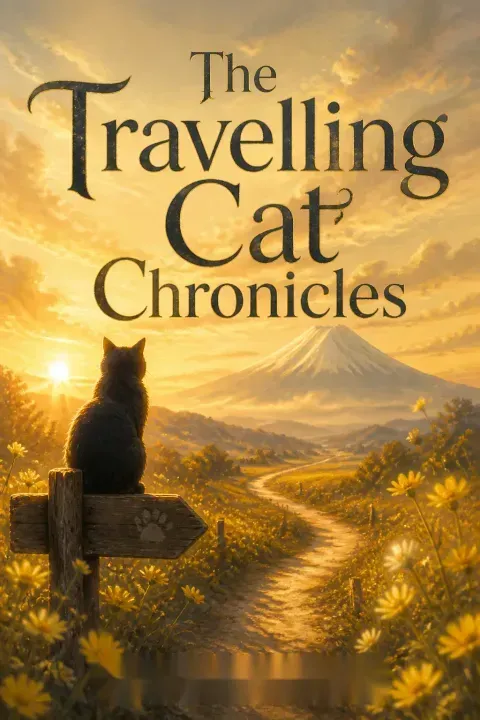


Plot Summary
Prologue
As a stray with no name, Nana1 sleeps on the bonnet of a silver van in Tokyo. Satoru Miyawaki,2 a lanky young man, leaves crunchies under the van nightly. When a car strikes Nana1 and snaps his hind leg, the cat drags himself to the van at dawn and screams for help. Satoru2 carries him to the vet and nurses him for two months.
Healed, Nana1 expects to leave, but Satoru2 asks him to stay. The cat1 agrees. Satoru2 names him Nana1 for his hooked tail shaped like a seven; Nana1 finds the name embarrassingly girlish but accepts it. They live together five contented years. Then Satoru2 apologizes, says he cannot keep Nana1 anymore, and loads the cat into the silver van for a final journey together.
The prologue reverses the typical rescue narrative. Nana, a self-reliant stray, seeks Satoru not from affection but survival instinct: he remembers the one human who consistently fed him. Satoru's tears reveal a man whose emotional life is bound to animals, particularly cats who resemble his lost Hachi. The naming scene is quietly devastating: Satoru names him after his tail (seven), explicitly linking him to Hachi (eight) while insisting on his uniqueness. Nana's acceptance of a name he dislikes mirrors the compromises love demands. The five-year ellipsis creates the weight of shared life that makes the coming separation unbearable. The prologue asks what it means to belong to someone and what we owe those who saved us.
A Cat Who Cannot Replace
Satoru2 drives Nana1 to the photo studio of Kosuke Sawada,4 his childhood friend. Kosuke's4 wife has left him after her miscarriage and his father's cruel comments about her ability to conceive. Kosuke4 hopes adopting Nana,1 who resembles their childhood cat Hachi,8 might lure his wife back.
Through flashbacks, their shared history emerges: the boys found a kitten with tabby markings shaped like the character for eight, named him Hachi,8 and ran away from home trying to keep him. Kosuke's4 domineering father refused the cat. Satoru's2 family took Hachi,8 but after Satoru's2 parents died in a car accident during a school trip, he had to give Hachi8 to distant relatives.
Kosuke4 has never forgiven himself for not taking Hachi8 then. Now Nana1 refuses to leave his basket. Satoru2 gently explains that Nana1 is his own cat, not Hachi's8 replacement, and suggests Kosuke4 find a new cat with his wife instead.
Kosuke's desire to adopt Nana is not about the cat but about unresolved grief and the fantasy of retroactive redemption. By taking a Hachi lookalike, he hopes to undo his childhood failure to stand up to his father. Satoru's refusal, though gentle, is an act of profound respect for Nana's individuality. He insists that Nana cannot serve as anyone's emotional prosthesis. The scene dramatizes a central tension: the difference between loving someone for who they are and loving them for what they represent. Kosuke's marital crisis, rooted in the same paternal tyranny that once cost him Hachi, shows how childhood patterns of submission echo into adulthood until consciously broken.
Strategic Cat Fight
Satoru2 visits Yoshimine,5 a farmer who was his junior high friend. Yoshimine5 has a rescued orange tabby kitten named Chatran,11 sweet but useless at catching mice. Flashbacks reveal Yoshimine5 transferred to Satoru's2 school during his parents' divorce. Satoru2 approached him without pity, and they revived the school's gardening club.
During a school trip, Yoshimine5 helped Satoru2 try to sneak to Kokura to visit Hachi,8 taking the blame when they were caught. Yoshimine's5 grandmother provided the unconditional home his parents could not. Now Nana,1 understanding Satoru2 will secretly be relieved if this adoption fails, teaches Chatran11 aggressive fighting stances.
When the humans return, Nana1 and Chatran11 appear locked in combat. Satoru,2 believing the cats incompatible, takes Nana1 home with visible relief. They stop at the sea, where Nana1 is so terrified of the waves that he claws Satoru's2 scalp and flees up a bluff.
Nana's strategic aggression toward Chatran is the novel's most cunning act of love. He does not simply refuse the new home; he manufactures a reason for Satoru to keep him while preserving Satoru's illusion that he tried his best. The manipulation reveals Nana's deep understanding of Satoru's psychology: the man needs to feel he exhausted every option before accepting what he secretly wants. Yoshimine's backstory mirrors Satoru's in early parental loss, but where Satoru internalized grief as gentleness, Yoshimine processed his through productive stoicism. The grandmother represents unconditional sanctuary. Nana's terror at the sea foreshadows his later courage: the cat who panics at waves will soon brave a Hokkaido winter for love.
Satoru's Belated Confession
Satoru2 takes Nana1 to a pet-friendly B&B run by high school friends Sugi6 and Chikako,7 set against Mount Fuji. Flashbacks reveal the trio's history: Sugi6 and Satoru2 bonded rescuing a blind Shih Tzu from a ditch. Satoru2 worked in Chikako's7 orchard to earn train fare to visit Hachi,8 but the cat died before he could go.
Sugi,6 secretly in love with Chikako,7 confessed his feelings to Satoru2 first, strategically blocking his friend from declaring his own. In college, Satoru2 admitted he had liked Chikako7 too, and Sugi6 begged him never to tell her.
At the B&B, Sugi's6 dog Toramaru9 barks aggressively; Nana1 claws the dog's muzzle bloody. The adoption fails. As they leave, Satoru2 casually tells Chikako7 he liked her in high school. She laughs, surprised. Sugi6 stands frozen, then finally joins the laughter.
Sugi's lifelong insecurity around Satoru stems from a painful accuracy: he knows Satoru is the better man. His preemptive confession was not an act of love but of strategic cowardice, and he has lived with the guilt of suppressing his friend's feelings. Toramaru, fiercely loyal to Sugi, picks up on his master's unresolved tension and attacks the perceived threat. The dog's aggression is Sugi's jealousy made physical. Satoru's casual, belated confession serves as a liberation: it removes the secret's power and proves that Sugi's fear was always disproportionate. Chikako's light response confirms what Sugi could never believe: that she chose him freely all along.
Don't Leave Me
Satoru2 and Nana1 board a ferry to Hokkaido. In the ship's pet room, dogs tease Nana1 about being pampered. A sharp-tongued chinchilla silences them, revealing that animals can smell death on Satoru:2 he is terminally ill and wants to spend his remaining time with Nana.1
The dogs become subdued and wag their tails kindly at Satoru2 when he visits. After docking, they drive through autumn landscapes. Satoru2 stops at a field where pampas grass stretches like a white sea. Nana1 slips into the tall grass and vanishes. Satoru's2 voice rises from worry to panic to desperation.
When Nana1 emerges, Satoru2 kneels in the dirt, clutches him, and sobs. He finally admits he does not want to be left alone. Nana1 understands: every failed adoption has been Satoru's2 secret relief. Nana1 licks Satoru's2 hands and vows silently never to leave.
The ferry pet room functions as a chorus of truth-tellers who perceive what humans politely ignore. The chinchilla's blunt revelation transforms the journey's meaning: Satoru is not merely rehoming a pet but orchestrating his own farewell. The pampas grass scene is the emotional fulcrum of the novel. Satoru's panic when Nana disappears externalizes his deeper terror of abandonment and death. For the first time, his carefully composed facade cracks. He confesses the need he has suppressed throughout each friend visit: he does not want to be alone; he does not want to lose Nana. The scene inverts the apparent premise: Nana is not the one being rescued. Satoru is.
A Rainbow for the Dead
Continuing through Hokkaido, Satoru2 and Nana1 see deer, horses, and fields of wild chrysanthemums and goldenrod. Satoru2 teaches Nana1 to distinguish shades of red on mountain ash berries. Rain falls from a sunlit sky, and before them a perfect double rainbow arches, both ends rooted in the hills.
Satoru2 whispers that its colors match the wildflowers they picked. They arrive at Satoru's2 parents' grave. He cleans the stone, replaces wilted flowers with the purple and yellow blooms, and lights incense. He introduces Nana,1 noting his resemblance to Hachi.8
He reveals his mother regretted selling the family farm. They visit his grandparents' grave as well. Satoru2 seems calm and complete, having done what he came to do. They drive toward Sapporo, toward his aunt Noriko's3 apartment, the journey's final destination.
The double rainbow functions as a visual theodicy: nature offers a moment of transcendent beauty that seems to justify the suffering preceding it. Satoru's observation that the rainbow colors match the wildflowers creates a circular logic of offering and blessing: what they gave to the dead, the sky returns. The grave visit is Satoru's preparation for his own death. By introducing Nana to his parents, he integrates the two great attachments of his life: the family he lost and the companion who will outlive him. The roadside flowers, not store-bought, reflect his philosophy that genuine offerings come from what is freely given. His calm afterward suggests spiritual resolution.
The Adoption Secret
They arrive at Noriko's3 apartment in Sapporo. The truth emerges: Satoru2 has terminal cancer. Doctors gave him a year; months have passed. Noriko,3 his maternal aunt and a former judge, has quit her career to care for him. Flashbacks unfold: Noriko3 adopted twelve-year-old Satoru2 after her sister and brother-in-law died.
On the very first day, she bluntly told him his birth parents had wrapped him in a plastic bag and abandoned him as a baby. The parents who raised him were adoptive. Noriko3 has spent decades regretting that brutal revelation.
Now Satoru2 reassures her: knowing he was chosen made him feel even more loved. He is grateful she raised him. Nana1 and Noriko3 begin an awkward coexistence; terrified of being bitten, she takes notes on how to pet him, always reaching for his tail by mistake while Satoru2 corrects her.
Noriko's confession and Satoru's response reframe the novel's central question: what makes a parent real? The birth parents who tried to kill him versus the adoptive parents who cherished him, and the aunt who took him in out of duty but struggled with emotional expression. Satoru's ability to transform the adoption revelation into a source of strength reveals extraordinary psychological resilience. He chose to interpret being chosen as proof of love rather than evidence of original rejection. Noriko represents a different kind of love: the love that does its duty without knowing how to be warm. Her note-taking on petting Nana is both comic and tender: she is finally learning to speak the language of affection.
The Cat Who Stayed
Satoru's2 body weakens. Hospital stays lengthen. One morning he leaves without Nana,1 closing the apartment door on the cat's frantic screams. Noriko3 cares for Nana,1 who mopes in Satoru's2 empty room. Eventually she drives him to visit Satoru2 in the hospital garden.
After their reunion, Nana1 unlocks his basket from the inside, bolts from the car, and vanishes into the snowy landscape. He becomes a commuting cat, living as a stray in the hospital grounds, finding shelter in garages and under boilers, accepting food from staff and visitors.
He appears on the terrace whenever Satoru2 is wheeled out. Satoru2 tries to catch him, but Nana1 evades every attempt. Hospital staff, initially attempting to trap him, eventually leave offerings. Nana1 curls in Satoru's2 lap each visit, purring as thin hands stroke him.
Nana's escape is the novel's most defiant act of loyalty. He rejects the comfortable home Noriko offers and chooses the hardship of a Hokkaido winter as a stray, all to remain near Satoru. The commuting cat arrangement is a compromise between his need to be close and his refusal to be possessed by anyone but Satoru. The hospital staff's shift from attempting capture to leaving offerings mirrors the reader's journey: resistance to the situation's tragedy gives way to reverence for the bond on display. Nana's evasion of capture is not feral skittishness but a sovereign choice. The image of the frail man and the small white cat on the snowy terrace distills the novel's essence: love persists precisely where it cannot save.
Goodbye Beneath the Fur
Snow falls for days. When it clears, Satoru2 does not appear on the terrace. Noriko3 arrives at the hospital pale and disheveled. She finds Satoru2 dying, the ECG waves weakening. A nurse accidentally knocks over the bedside photos: one of Noriko's3 family, one of Nana.1
Outside, the cat's1 wailing penetrates the ward. Noriko3 begs to bring the cat in. The matron refuses, then implies she should act without asking. Noriko3 races downstairs, scoops up Nana,1 and sprints back. She presses Satoru's2 hand onto Nana's1 small head.
Satoru's2 eyelids flutter open. His lips move silently: thank you. The ECG flatlines. Nana1 nuzzles Satoru's2 lifeless hand, then licks Noriko's3 fingers as she sobs. The matron orders the cat removed, but some nurses smile as they unplug the monitors.
The hospital death scene subverts every clinical protocol. Noriko, a former judge who spent her career upholding rules, commits an act of holy transgression by smuggling a cat into a dying man's room. The matron's whispered refusal to grant permission while hinting at action encodes the moral truth that law and love sometimes diverge. Satoru's final movement, touching Nana's fur, closes the circle that began when he first stroked the injured stray on the van bonnet. The silent thank you is directed at both Nana and Noriko, acknowledging the two beings who gave him family. The nurses' smiles suggest that even institutional spaces can recognize when a rule's violation serves a higher order.
Epilogue
After the funeral, Kosuke,4 Yoshimine,5 Sugi,6 and Chikako7 gather at Noriko's3 apartment. They share stories, exchange pet photos, and trade business cards. Kosuke4 has turned his studio into a pet photography business. Yoshimine's5 Chatran11 is now a skilled mouser. Sugi6 and Chikako7 have a daughter and a thriving B&B, and Noriko3 climbs Mount Fuji while they pet-sit Nana.1
Years pass. Noriko3 finds an abandoned calico kitten and brings her home. Nana,1 now elderly, helps raise Calico,12 teaching her to hunt. In his dreams, Nana1 meets Satoru2 in the flower field from their final journey. Satoru2 asks if he is ready. Nana1 says he must train Calico12 first, but soon he will cross that horizon. The field stretches purple and yellow to the sky.
The epilogue refuses the closure of tragedy, insisting instead on continuity. Each friend's life has been altered by Satoru's influence: Kosuke's business, Yoshimine's relationship with Chatran, Sugi's reconciliation with his jealousy, Noriko's long-delayed embrace of cats. The gathering at Noriko's apartment functions as a secular memorial, with pet photos replacing prayer cards and shared stories replacing eulogies. Calico's arrival completes Noriko's arc from cat-averse guardian to cat rescuer, but more importantly, it gives Nana a purpose beyond grief. By training Calico, Nana performs for her what Satoru did for him: preparing someone to carry on. The dream sequences reframe death not as cessation but as a journey to a familiar field, where the colors Satoru taught Nana to see will welcome him home.
Analysis
The Travelling Cat Chronicles operates as a reverse quest narrative: the hero's journey is not toward a treasure but toward an ending, and the prize is not something gained but something properly relinquished. Satoru2 drives across Japan not to find Nana1 a new home but to say goodbye to everyone he loves, Nana1 included. Each friend visit excavates a layer of his past, revealing the cumulative losses that shaped his extraordinary gentleness: abandonment at birth, adoption into love, the death of his parents, the forced surrender of Hachi.8 Satoru's2 refusal of bitterness is not naivety but a philosophical choice, a belief that being chosen and loved, even temporarily, outweighs being orphaned. Nana's1 narration provides the novel's central insight: that animals perceive what humans politely ignore. The chinchilla's blunt announcement of Satoru's2 approaching death, the dogs' shift from mockery to sympathy, all point to a world where creatures communicate honestly about mortality. Nana1 himself, for all his comic vanity about his hunting prowess and his name, understands Satoru's2 need long before Satoru2 can voice it. Their relationship is built on mutual rescue: Satoru2 saved Nana1 from the car accident, and Nana1 saves Satoru2 from dying alone. The structure of revisiting each friend in turn allows the novel to argue that a life's meaning lies in the connections it forms. Kosuke,4 Yoshimine,5 Sugi,6 and Chikako7 each carry a version of Satoru2 within them. Noriko3 carries the heaviest burden, the guilt of inadequate love, but Satoru's2 final gift to her is absolution. His death is not a tragedy of isolation but a gathering: the friends assemble, share stories, and carry his influence forward in their choices. The epilogue's quiet insistence on continuity, the new calico kitten,12 the elderly Nana1 dreaming of the flower field, proposes that death is not an end but a horizon we journey toward, carrying those we loved, and are carried in turn by those who follow.
Review Summary
The Travelling Cat Chronicles is a heartwarming tale of a man's journey with his beloved cat across Japan. Told from the cat's perspective, the story explores themes of friendship, love, and loss. Readers praised the book's emotional depth, charming narrative style, and insightful portrayal of the human-animal bond. Many found it touching and bittersweet, with some calling it a perfect read for animal lovers. While a few readers found the writing simplistic, most were moved by the poignant story and its exploration of life's important relationships.
People Also Read







Characters
Nana
The travelling cat, narratorA male stray cat with tabby markings on his forehead and a hooked tail bent like the number seven. Before Satoru2 rescued him, Nana survived on the streets through cunning and a network of food sources. He is fiercely proud, sharp-witted, and pragmatic, viewing human behavior with bemused detachment. His narration reveals a keen observer who understands far more than humans credit. Though he claims cats simply accept whatever comes, his actions betray profound loyalty. He chooses winter hardship over a warm apartment when Satoru2 is dying. His arc moves from self-contained survivor to a creature who discovers that belonging to someone does not diminish independence but gives it meaning.
Satoru Miyawaki
Nana's devoted, terminally ill ownerA gentle man in his early thirties. Orphaned at twelve when his adoptive parents died, he was raised by his aunt Noriko3. His first cat Hachi8 was taken from him after his parents' death, a loss that shaped his relationship with Nana1. Satoru's defining trait is an almost supernatural capacity to accept misfortune without bitterness and to prioritize others' feelings above his own. He conceals his terminal cancer from friends during their journey, wanting last memories to be happy. His psychology: having been abandoned at birth, adopted into love, then orphaned again, he learned early that love means risking loss. He never complains, but his desperate grip on Nana1 in the pampas grass reveals the need he hides.
Noriko
Satoru's aunt and devoted guardianSatoru's2 maternal aunt, a former judge who steps down to become his caregiver. Blunt, socially awkward, and prone to saying exactly the wrong thing, she masks deep devotion beneath a brusque exterior. She adopted twelve-year-old Satoru2 out of duty but immediately traumatized him by revealing the horrific circumstances of his abandonment. She has carried guilt for decades, believing she never made him happy. Her arc involves learning to express affection: first through caregiving, then through painstaking practice with Nana1 (she takes notes on how to pet him), and finally through rescuing a calico kitten12. She represents love as obligation transformed slowly into genuine warmth.
Kosuke Sawada
Satoru's childhood friend, photographerSatoru's2 elementary school friend who found Hachi8 with him. Now runs a struggling family photo studio. His wife left him after his father's cruel comments about her miscarriage. He has never overcome his childhood failure to stand up to his father and take Hachi8 when Satoru2 needed him. Satoru's2 visit and advice help him begin repairing his marriage and his relationship with himself.
Daigo Yoshimine
Satoru's junior high friend, farmerA farmer with a sturdy build and blunt manner. Abandoned emotionally by his career-obsessed parents, he was raised by his grandmother. He values cats for their utility but secretly has a tender heart, having rescued Chatran11 despite claiming he just wanted a mouser. His friendship with Satoru2 was built on mutual understanding of parental loss and a shared love of growing things.
Shusuke Sugi
Satoru's high school friend, B&B ownerCo-owner of a pet-friendly B&B, a dog person prone to insecurity. He loved Chikako7 from childhood and deliberately blocked Satoru2 from confessing similar feelings. His guilt over this manipulation and his sense of inferiority to Satoru's2 natural goodness have haunted him for decades. Satoru's2 final visit helps release him from that burden.
Chikako Sugi
Sugi's wife, passionate cat advocateSugi's6 wife and Satoru's2 high school friend. Spirited, decisive, and passionate about animals, she conceived the B&B's cat-friendly policy that became its success. She was unaware of Satoru's2 teenage feelings for her. Her easy laughter when Satoru2 finally confesses, decades late, reveals her uncomplicated nature: she chose Sugi6 freely and never wavered.
Hachi
Satoru's first cat, Nana's lookalikeA white cat with tabby markings shaped like the character for eight on his forehead. Found as a kitten by Satoru2 and Kosuke4. Died in a traffic accident while living with distant relatives, a loss that shaped Satoru's2 bond with Nana1.
Toramaru
Sugi's fiercely loyal Kai Ken dogA three-year-old brindle Kai Ken dog. Protective of Sugi6, he barks aggressively at Satoru2 and fights with Nana1, sensing his master's unresolved jealousy and tension toward his old friend.
Momo
Sugi's dignified elderly catA twelve-year-old brown tabby. Wise and dignified, she observes the dog-cat conflict with detached amusement and explains Sugi's6 complicated psychology to Nana1 from her perch on the warm boxy TV.
Chatran
Yoshimine's rescued orange tabbyA kitten Yoshimine5 rescued from a roadside. Initially helpless and not a real cat, he later becomes a skilled mouser thanks to the hunting and fighting training Nana1 secretly gives him during the visit.
Calico
Noriko's foundling calico kittenThe abandoned calico kitten Noriko3 brings home years after Satoru's2 death. Nana1 trains her to hunt and survive, preparing her to be Noriko's3 companion before he sets off on his own final journey.
Plot Devices
The Silver Van
Mobile home and journey vesselSatoru's2 vehicle, where Nana1 first slept as a stray and the conveyance for their final journey across Japan. It functions as a mobile home, carrying them through changing landscapes and seasons. The van represents the first place Nana1 ever felt safe, and its eventual transfer to Noriko3 after Satoru's2 death marks the passage of care from one guardian to the next. Every destination the van reaches reveals another layer of Satoru's2 past.
Nana's Basket
Voluntary confinement and escape toolThe cat carrier Satoru2 uses throughout the journey. Nana1 can unlock it from the inside using his paw, a skill he reveals early and deploys strategically. He never escapes during vet visits or uncomfortable moments, only when he needs to remain near Satoru2. The basket represents the voluntary nature of his loyalty: he stays inside by choice, not force, and his eventual escape from it at the hospital is his final declaration of independence in service of love.
The Cardboard Box
Chosen comfort over provided luxuryA simple cardboard box Noriko3 leaves out because Nana1 prefers it to expensive cat beds and scratching posts. Noriko3 even tries to craft an improved version, which Nana1 ignores entirely. The box symbolizes Nana's1 philosophy that the best things are chosen by oneself, not provided by others. Noriko's3 eventual, grudging acceptance of the shabby, claw-worn box in her otherwise tidy home marks her growing accommodation to love on the cat's terms rather than her own.
The Smell of Death
Animal truth-telling about mortalityAnimals throughout the journey can smell that Satoru2 is terminally ill. The elegant chinchilla on the ferry states it bluntly, and the dogs shift from mockery to sympathy. This olfactory knowledge creates dramatic irony: the reader gradually understands what the human characters do not. It also bonds the animal characters in a shared, wordless recognition of Satoru's2 approaching end, transforming the pet room from a collection of strangers into a community of witnesses.
The Rainbow and Wildflowers
Symbol of blessing and continuityThe purple wild chrysanthemums and yellow goldenrod that line Hokkaido's roads become the offering Satoru2 places on his parents' grave. Later, a perfect double rainbow appears, its colors matching the wildflowers exactly. This visual echo creates a sense of cosmic reciprocation: what is given to the dead is returned by the sky. In the epilogue, Nana1 dreams of meeting Satoru2 in a flower field of these same colors, transforming the motif into a symbol of reunion beyond death.
FAQ
Synopsis & Basic Details
What is The Travelling Cat Chronicles about?
- A final journey: The story follows Satoru, a kind man, and his beloved cat, Nana, as they embark on a road trip across Japan in a silver van.
- Seeking a new home: Due to "unavoidable circumstances," Satoru is looking for someone to adopt Nana, visiting old friends from his past along the way.
- Bonds of love and memory: Narrated primarily by Nana, the journey reveals Satoru's history, the enduring friendships that shaped him, and the deep, unspoken bond between a man and his cat, set against the backdrop of Japan's changing seasons.
Why should I read The Travelling Cat Chronicles?
- Unique feline perspective: The narrative voice of Nana offers a witty, insightful, and often humorous look at human behavior and emotions from a cat's point of view.
- Emotional depth and warmth: The story explores profound themes of friendship, family (both chosen and biological), loss, resilience, and the quiet power of love, promising a deeply moving reading experience.
- Beautifully rendered journey: Set against the diverse landscapes of Japan, the episodic structure of the road trip provides vivid descriptions and a sense of place that enhances the emotional core of the narrative.
What is the background of The Travelling Cat Chronicles?
- Contemporary Japan setting: The story takes place in modern Japan, utilizing elements like motorways, service stations, mobile phones, and sat-nav, grounding the emotional journey in a recognizable, contemporary world.
- Cultural nuances: Subtle references to Japanese customs appear, such as visiting graves during Higan, specific regional foods (Hakata ramen, ozoni), and traditional beliefs (hooked tails bringing good fortune), adding cultural texture.
- Focus on human-animal bond: The narrative highlights the significant role pets play in Japanese households and the emotional complexities surrounding pet ownership, adoption, and the difficulty of finding suitable homes.
What are the most memorable quotes in The Travelling Cat Chronicles?
- "I am a cat. As yet, I have no name.": This opening line, a playful nod to a famous Japanese novel, immediately establishes Nana's distinct, self-aware narrative voice and sets the tone for his unique perspective on the world.
- "Life, be it human or feline, doesn't always work out the way you think it will.": Nana's pragmatic observation reflects the novel's underlying theme of accepting fate and navigating unexpected challenges, highlighting the shared unpredictability of both human and animal lives.
- "You have to mourn your cat properly, or you won't get over it.": Chikako's empathetic advice to Satoru after Hachi's death underscores the novel's validation of grief for animal companions and the importance of processing loss for emotional healing.
What writing style, narrative choices, and literary techniques does Hiro Arikawa use?
- First-person animal narration: The primary narrative voice is Nana's, providing a blend of sharp observation, emotional interpretation (sometimes flawed, sometimes profound), and dry humor, offering a fresh lens on human interactions.
- Alternating perspectives: While Nana narrates most chapters, interludes shift to a human perspective (Kosuke, Yoshimine, Sugi/Chikako, Noriko), offering their internal thoughts and histories, enriching the emotional landscape and providing context Nana cannot know.
- Episodic structure with flashbacks: The road trip forms a clear episodic framework, with each stop triggering detailed flashbacks that reveal Satoru's past relationships and experiences, building a comprehensive picture of his life and character.
Hidden Details & Subtle Connections
What are some minor details that add significant meaning?
- Nana's tail shape: Beyond just the name "Nana" (seven), the hooked tail is mentioned as potentially bringing good fortune, subtly linking Nana to a traditional belief and hinting at his positive influence on Satoru's life, despite the circumstances.
- The cardboard box: Nana's persistent preference for the tattered cardboard box over a new cat bed symbolizes his comfort in simple, familiar things and his connection to the life he built with Satoru, resisting Noriko's attempts to replace it.
- Satoru's thinning hair: Early mentions of Satoru scratching at his "thinning hair" and later descriptions of his "completely bald" head are subtle physical markers of his declining health, foreshadowing the progression of his illness before it is explicitly named.
What are some subtle foreshadowing and callbacks?
- Hachi's traffic accident: The detail that Satoru's first cat, Hachi, died in a traffic accident subtly foreshadows Nana's own near-fatal car accident and highlights Satoru's deep-seated fear of losing another beloved cat in the same way.
- The Yojiya blotting paper: The recurring mention of the specific Kyoto blotting paper, first sought by Satoru for his mother before her death and later bought by Kosuke and then Satoru for Chikako, becomes a poignant symbol of missed opportunities, thoughtful gestures, and the enduring weight of past regrets and kindnesses.
- Nana's ability to open the basket: Nana's quiet revelation that he could always open his travel basket but chose not to ("Even if you've known how to get out all along, you still listened to me") is a powerful callback that demonstrates his loyalty and agency, proving his companionship was a choice, not confinement.
What are some unexpected character connections?
- Nana's connection to Hachi: Nana's striking physical resemblance to Hachi, Satoru's childhood cat, is a key connection that influences Satoru's immediate bond with Nana and becomes a point of reflection and comparison for Satoru's friends.
- The friends' shared "Nana stories": After Satoru's death, his friends (Kosuke, Yoshimine, Sugi, Chikako) bond by sharing their individual, often humorous, experiences of trying (and failing) to adopt Nana, revealing how Nana became a shared touchstone in their lives connected to Satoru.
- Noriko's connection to Satoru's birth parents' case: The revelation that Noriko's first major case as a judge involved Satoru's birth parents and their abandonment of him creates a profound, albeit difficult, connection that explains her initial stiffness and later deep commitment to Satoru.
Who are the most significant supporting characters?
- Noriko: As Satoru's aunt and eventual guardian, Noriko represents a different form of family and her journey from reserved duty to open affection is central to the novel's exploration of love and healing.
- Kosuke, Yoshimine, Sugi, and Chikako: These friends from different periods of Satoru's life collectively illustrate the diverse forms of human connection, loyalty, and the impact Satoru had on others, providing the human context for Nana's observations.
- Momo and Toramaru: The resident cat and dog at the pet-friendly inn serve as more than just animal characters; their interactions with Nana and their owners subtly mirror and comment on the human relationship dynamics playing out.
Psychological, Emotional, & Relational Analysis
What are some unspoken motivations of the characters?
- Satoru's true reason for the trip: While stated as finding Nana a home, Satoru's deeper, unspoken motivation for the road trip is to revisit meaningful places and friends from his past, creating a final pilgrimage of memory and connection before his death.
- Kosuke's desire to adopt Nana: Kosuke's eagerness to take Nana is subtly driven by a subconscious desire to atone for his past failure to stand up to his father and keep Hachi, and perhaps a hope that a cat could mend his strained marriage.
- Sugi's underlying jealousy: Sugi's occasional moodiness and competitive feelings towards Satoru are rooted in a long-held insecurity and jealousy, particularly regarding Chikako, stemming from a past where he felt Satoru was effortlessly superior or more deserving.
What psychological complexities do the characters exhibit?
- Noriko's struggle with emotional expression: Noriko, a capable judge, exhibits significant psychological complexity in her inability to express warmth or navigate emotional subtleties, stemming from her difficult past and leading to unintended bluntness that she constantly regrets.
- Satoru's quiet resilience and acceptance: Despite a life marked by profound loss (parents, Hachi, his own health), Satoru displays remarkable psychological resilience and a quiet acceptance of his fate, focusing on gratitude and the well-being of others rather than self-pity.
- The friends' projection of their issues: Kosuke projects his marital problems onto the idea of getting a cat, Yoshimine projects his desire for a "real" farm cat onto Nana, and Sugi projects his insecurities onto his interactions with Satoru, revealing how personal struggles influence their perceptions.
What are the major emotional turning points?
- Nana's decision to stay with Satoru: After recovering from his accident, Nana's choice to become Satoru's indoor cat, despite his stray instincts, marks a major emotional turning point, signifying his acceptance of love and belonging.
- Satoru's breakdown in the pampas grass field: Satoru's desperate cries for Nana and subsequent weeping in the Hokkaido field represent a crucial emotional release, where he finally articulates his fear of being left alone and his deep need for Nana's presence.
- Noriko's final act of bringing Nana to Satoru: Noriko's desperate, rule-breaking decision to bring Nana to Satoru's bedside in his final moments is a powerful emotional turning point, signifying her complete acceptance of Nana and her understanding of the profound bond between them, overcoming her past reservations.
How do relationship dynamics evolve?
- Satoru and Nana's bond deepens: Their relationship evolves from a wary stray-human acquaintance to a deep, mutually dependent bond forged through shared experiences, care during illness, and unspoken understanding, culminating in Nana's fierce loyalty.
- Noriko and Nana's cautious connection: Noriko's relationship with Nana transforms from initial fear and awkwardness ("EEEEEK!") to tentative acceptance, guided by Satoru, and finally to genuine affection and mutual comfort after Satoru's death.
- Satoru's friends reconnect and find common ground: The road trip and Satoru's eventual death serve to reconnect his disparate friends, who, despite their individual struggles and past rivalries, find common ground in their shared love for Satoru and bond over their "Nana stories."
Interpretation & Debate
Which parts of the story remain ambiguous or open-ended?
- The specific nature of Satoru's illness: While it's clear Satoru has a malignant tumor that is terminal ("One year left to live"), the exact type or progression of his cancer is not detailed, leaving the medical specifics ambiguous and focusing the narrative on the emotional impact.
- The future of Satoru's friends' relationships: While the friends reconnect after Satoru's death and exchange contact information, the extent to which these new bonds will deepen or endure long-term remains open-ended, hinted at only by future visits and shared stories.
- Nana's final journey: The Epilogue describes Nana's impending death and his dream of reuniting with Satoru in a field of flowers, leaving the interpretation of this final journey and reunion open to reader belief regarding animal afterlife or metaphorical closure.
What are some debatable, controversial scenes or moments in The Travelling Cat Chronicles?
- Satoru's decision to rehome Nana: Some readers might debate the ethics of Satoru's choice to seek a new home for Nana, questioning why he didn't keep Nana with him until the very end, especially given Nana's clear devotion and the eventual outcome.
- Noriko's initial bluntness with Satoru: Noriko's decision to tell the twelve-year-old Satoru about his birth parents immediately after his adoptive parents' death, and her subsequent awkwardness, could be seen as controversial or insensitive, sparking debate about her suitability as a guardian despite her good intentions.
- Nana's aggressive behavior towards Toramaru: Nana's deliberate attack on Toramaru at the inn, resulting in scratches and blood, could be debated as an unexpectedly violent moment for the protagonist, though the narrative frames it within feline instinct and loyalty to Satoru.
The Travelling Cat Chronicles Ending Explained: How It Ends & What It Means
- Satoru's peaceful death with Nana present: Satoru passes away in the hospital with Noriko and Nana by his side, brought together by Noriko in a final, rule-breaking act of love. This signifies the fulfillment of Satoru's wish to not be alone and Nana's unwavering loyalty until the very end.
- Nana's continued life with Noriko and legacy: Nana lives on with Noriko, helping her heal and eventually guiding her to adopt a new kitten, Calico. Nana becomes a living link to Satoru for his friends and Noriko, ensuring Satoru's memory and the love he shared endure through new connections and continued care for animals.
- Nana's anticipated reunion beyond life: The Epilogue portrays an aging Nana dreaming of reuniting with Satoru in a beautiful field, suggesting that their bond transcends physical life and offering a hopeful, poignant closure to their story, emphasizing that love and connection are eternal journeys.
Download PDF
Download EPUB
.epub digital book format is ideal for reading ebooks on phones, tablets, and e-readers.








































