
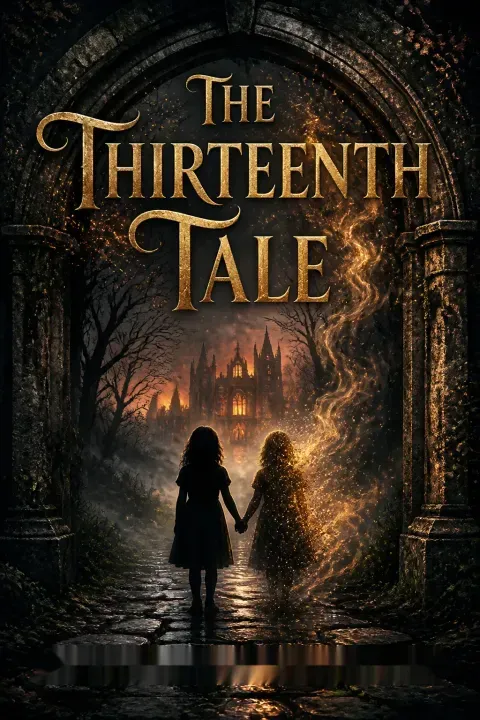


Plot Summary
Tell Me the Truth
Margaret Lea,1 an antiquarian bookseller and amateur biographer, finds a letter from Vida Winter,2 England's most famous living author, waiting on the stairs of her father's Cambridge shop one November evening. The handwriting is labored, almost childlike.
Winter2 has spent decades inventing false life stories for journalists, but now she is dying and wants to tell the truth at last. She summons Margaret1 to Yorkshire to write her biography. Reading the letter, Margaret1 recalls her own secret discovery at age ten: hidden documents in a biscuit tin revealing she was a twin.
Her sister died at birth, and the loss has shaped her entire solitary existence among books. The letter contains a tale of a young reporter11 who once demanded the truth, and whose plea has haunted Winter2 for forty years.
The letter functions as a double summons: Winter's call to Margaret as biographer, and Margaret's inward call to her own buried history. The parallel between the two women is established immediately. Both are lone twins who have constructed identities around loss. The labored handwriting hints at physical damage that will later be explained by the fire. Winter's admission that she lied to the young reporter establishes her as an unreliable narrator while simultaneously suggesting her current sincerity. Margaret's childhood memory of the biscuit tin confirms that truth-seeking is her deepest impulse.
The Rule of Three
Margaret1 travels north to Miss Winter's2 isolated Yorkshire estate, a house so muffled by velvet and tapestry that words seem to die in the air. At their first meeting, Winter2 is imperious, draped in jewel-toned silks, with elaborate copper hair and sunglasses hiding her famous green eyes.
She challenges Margaret's1 reluctance with uncanny insight, then agrees to provide three checkable facts. Her real name was Adeline March. She was born at St. Bartholomew's Hospital. Her childhood home, Angelfield, burned when she was sixteen.
As proof of the last, she reveals her right hand: the palm is a ruined landscape of melted flesh, with a deep Q-shaped scar burned into the center. Margaret1 realizes that every one of Winter's2 fifty-six novels was written left-handed.
The rule of three invokes fairy-tale logic, framing the biography as a magical pact with implicit dangers. Winter's theatrical appearance masks profound vulnerability. The scarred palm is the story's first physical evidence of trauma, a wound that conceals and reveals truth. The Q-shaped scar (later understood as the impression of a key) marks the moment she locked the library door. Margaret's agreement mirrors the reader's contract: we too must decide whether to trust a narrator who admits she has lied hundreds of times before.
Charlie's Dark Romance
Winter2 begins her story not with her own birth but with the generation before. Isabelle Angelfield6 is born during a rainstorm that kills her mother. Her father George,13 devastated by grief, neglects his older son Charlie5 and dotes obsessively on Isabelle,6 raising her as a wild, companionless child.
Charlie,5 a slow-witted boy, develops a sadistic intimacy with his sister,6 cutting her skin with wire while she returns the favor with eerie pleasure. When Isabelle6 seduces Roland March14 at a picnic, marries him, and leaves, Charlie5 scratches her name into his own shin bone with a needle.
Roland14 soon dies of pneumonia, and Isabelle6 returns to Angelfield with twin baby girls, Adeline and Emmeline,3 whom she neglects entirely. Charlie's5 passion for his sister6 remains his sole reason for existing.
This origin story establishes Angelfield as a closed system where trauma replicates across generations. The incestuous undertones between Charlie and Isabelle are unmistakable yet never directly named. Charlie's self-carving of Isabelle's name into his bone literalizes the idea that love and pain are indistinguishable in this family. Isabelle's neglect of her twins creates the vacuum that will later be filled by another child. The family history functions as gothic inheritance: the twins are born into damage they did not choose but cannot escape.
The Voom
Adeline and Emmeline3 grow up without discipline, speaking only a private twin language. The household has collapsed to just two aging servants: the Missus,9 a nearly blind housekeeper, and John-the-dig,8 a gardener whose topiary masterpieces represent his family's legacy.
The twins raid cottages, destroy property, and seem incapable of recognizing other people as real. When they become obsessed with a village woman's black perambulator, which they call the voom, they steal it with the baby still inside.
They drag the heavy pram up a hill, remove the infant, and send Adeline hurtling down in the carriage until it crashes spectacularly. Both baby and twin survive. The village delegation, terrified and angry, appeals to Doctor Maudsley10 for intervention.
The voom episode crystallizes the twins' moral vacancy. Their fascination with the perambulator is purely aesthetic; the baby inside is irrelevant to them. This instrumentalization of a human being foreshadows the novel's central concern with how identity itself can be treated as a possession. The Missus's realization (the twins see other people as 'amputees,' incomplete versions of their own twinned wholeness) is a pivotal psychological insight that explains their apparent cruelty. The villagers' fear of the 'big house' reflects the gothic convention of the isolated estate breeding monstrosity.
Hester's Gleaming Order
Hester Barrow7 arrives at Angelfield, plain-faced and fiercely competent. With soap and discipline, she transforms the filthy house, imposes mealtimes, and locks doors. Emmeline3 flourishes under her care, learning to smile and take baths.
But Hester7 notices something peculiar about Adeline. During lessons when Hester7 tells stories (particularly Jane Eyre ), a subtle change occurs: Adeline's breathing shifts, her clenched hands relax, and for brief intervals a different child seems to emerge from behind her sullen mask.
Hester7 calls this hidden personality 'the girl in the mist.' She believes a responsive, intelligent child is waiting to be reached. She begins collaborating with Doctor Maudsley10 on a research project, convinced she can pioneer new understanding of twin psychology.
Hester is a woman of genuine intellectual gifts confined by her era's gender expectations. Her observation of 'the girl in the mist' is the story's first direct clue that there are more than two personalities at play, though Hester misinterprets what she sees as a psychological phenomenon rather than a physical reality. The emphasis on Jane Eyre is significant: it is a novel about an orphaned outsider girl finding her place, and it will recur as a talisman. Hester's project with the doctor represents the dangerous intersection of scientific ambition and vulnerable human subjects.
Severance
Hester7 and the doctor10 devise an experiment: they will separate the twins to study whether Adeline's repressed intelligence can emerge without Emmeline's3 presence. At night, Hester7 carries sleeping Emmeline3 to a different room. Adeline awakes instantly to her sister's absence and collapses, catatonic, against the locked door. She becomes a ghost-like shell, unable to speak or feed herself.
Emmeline3 sobs for twenty-four hours before sinking into the same state. They are like amputees missing their very souls. Hester7 and the doctor,10 blind to the damage they are causing, interpret Emmeline's3 slow return to her previous habits as progress. Adeline remains largely unresponsive, locked away at the doctor's10 house for months.
The separation experiment is the story's most devastating critique of scientific hubris. Hester and the doctor are not cruel; they are merely incapable of seeing beyond their own intellectual excitement. The twins' collapse reveals that their identity is not merely shared but genuinely interdependent. The language of amputation recurs: each twin experiences the other's absence as a physical wound. This section also deepens the central mystery: if Adeline was at the doctor's house the entire time, who was the 'girl in the mist' that Hester had occasionally glimpsed?
Hester Sees a Ghost
One bright day, walking to the doctor's10 house, Hester7 spots both girls playing together in a distant field: Emmeline3 in navy, Adeline in green. It is impossible. Adeline is supposed to be at the doctor's10 house.
Hester7 runs there and bursts in, only to find Adeline present, wearing navy, her hair braided. Hester,7 a woman of science who does not believe in ghosts, has no rational explanation. Her emotional distress causes her to break down in the doctor's10 arms. Mrs. Maudsley15 catches them kissing.
The experiment ends immediately. John8 collects Adeline and returns her to Angelfield. Emmeline,3 sensing her twin's return, comes straight home and they reunite. Hester7 vanishes overnight, never to be seen at Angelfield again. The house reverts to decay.
Hester's ghost sighting is the story's most explicit clue that there are three girls. She saw exactly what she thought she saw: two girls playing in the field. But one of them was not Adeline. It was the hidden third child, wearing Adeline's green dress. Hester's scientific worldview prevents her from considering the possibility of a third child because she has been told there are only two. Her intellectual rigidity becomes her undoing. The scene also completes Hester's arc: her ambition, her genuine affection for the doctor, and her social vulnerability as a plain governess all reach their breaking point simultaneously.
What the Ladder Saw
After Hester's7 departure, the household spirals. The Missus9 loses her grip on time and memory. Charlie5 disappears from his locked nursery, leaving only blood, filth, and an empty bath. He has shot himself in the woods, but only one person knows.
Isabelle6 dies of influenza in the asylum. An unnamed girl, emerging from the shadows,4 takes charge: she meets with the solicitor, arranges finances, and impersonates Adeline when necessary. She begins learning topiary from John.8 Then, one afternoon, John8 falls from a ladder while repairing the roof.
The safety catch has been deliberately released. Decades later, recalling this death, Miss Winter2 weeps with a grief so raw it suggests guilt, yet she insists Emmeline3 is not to blame. The question of who tampered with the ladder remains unanswered.
The ladder death is the story's central locked-room mystery. John was the hidden girl's protector and teacher; his death devastates her. The sabotage points to Adeline, whose capacity for destruction is well established, but Miss Winter's raw grief complicates any simple assignment of blame. The ladder becomes a symbol of precariousness: the fragile scaffolding that supports life at Angelfield, which can collapse at any moment. John's death also forces the secret girl to fully step into her role as household manager, assuming responsibilities she had previously avoided.
The Giant in the Ruins
During her investigation, Margaret1 visits the burned-out shell of Angelfield House. While taking photographs, a door handle turns of its own accord. She flees, trips, and is helped by a gentle giant named Aurelius Love,11 who has visited the ruins for years. Over ginger cake and tea, he reveals he was a foundling discovered on the night of the Angelfield fire, wrapped in a game bag left on a cottage doorstep.
His only inheritance: a silver spoon engraved with an A, a page torn from Jane Eyre, a feather, a baby's linen gown, and a scrap of paper with faded letters. He has spent his life trying to decipher these clues, longing for a family. Margaret1 later recognizes the spoon as matching one she will see in Emmeline's3 possession.
Aurelius functions as a living clue, the tangible evidence of the story's hidden past. His physical gentleness, enormous size, and innocent longing for family make him a fairy-tale figure exiled from his own narrative. The objects in his inheritance are a puzzle box that only the complete story can unlock. The Jane Eyre page connects him to the library, to the fire, and to the ghost-child who loved books. His longing for family mirrors Margaret's own twin loss and foreshadows the reunion to come. The spoon inscribed with A (for Angelfield or Ambrose) is the key that will unlock his parentage.
Three Girls, Not Two
Margaret1 obtains and deciphers Hester's7 water-damaged diary. Between the lines of scientific observations, she finds repeated references to inexplicable events: books that move themselves, doors that unlock, a boy seen weeding the garden during school hours, a bookmark that shifts between pages.
Hester7 herself suspects a hidden presence but cannot name it. Meanwhile, Margaret1 begins hearing a five-note fragment of song in the garden at night.
Following it, she encounters a scarred, white-haired woman digging frantically in the flowerbeds: Emmeline,3 alive and hidden at Miss Winter's2 estate. Emmeline3 rasps a phrase in twin language: something about the dead going underground. Margaret1 finally assembles the pieces: there were never two girls at Angelfield, but three.
The diary is a masterful device providing all necessary clues while Hester remains blind to their meaning. The repeated anomalies (moving books, the boy in the garden) all point to a third inhabitant of the house moving invisibly through its spaces. Margaret's realization arrives as a gestalt shift, like an optical illusion resolving into a new image. The 'three girls, not two' revelation restructures everything the reader has been told, revealing Miss Winter's narrative as simultaneously true and deceptive. It recasts the entire story as a ghost story in which the ghost is not supernatural but achingly human.
Shadow in the Strawberries
Miss Winter2 finally tells the story behind the story. A child appeared in John's8 garden, knee-high, in an oversized hat, stealing strawberries. When John8 finally caught her, she was starving, flea-bitten, with a thorn embedded in her swollen foot. The Missus9 and John8 bathed her, fed her, and recognized her immediately: copper hair, emerald eyes.
She was Charlie's5 illegitimate daughter, the product of one of his rapes. They could not turn her in; she would be taken away. So they kept her secret, calling her Shadow4 because she followed John8 everywhere. She learned to read from seed catalogues, then from the library. She became the house's hidden third child, haunting its corridors and loving its inhabitants, especially Emmeline.3
Shadow's origin as a 'weed between two strawberries' captures her liminal existence: she belongs to Angelfield by blood but has no legal or social standing. Her ghostliness is a survival strategy, not a supernatural condition. The revelation that she is Charlie's daughter transforms the story from a tale of twins into a narrative about the consequences of sexual violence. Shadow's love for Emmeline, and later for Emmeline's baby, is the emotional engine driving the climax. Her literacy, self-taught in secret, foreshadows her transformation into a world-famous writer. She is at once invisible and essential, a ghost who sustains the living.
Book of Fire
After Ambrose Proctor,12 the young gardener, fathers Emmeline's3 child, Shadow4 dismisses him and cares for Emmeline3 through the pregnancy. The baby boy is born in January. Shadow4 loves him fiercely. But Adeline, jealous of anything that diverts Emmeline's3 attention, becomes obsessed with destruction.
She hoards petrol cans, hiding them around the house. One evening, Shadow4 falls asleep beside Emmeline3 and wakes to find Adeline placing the baby on a pyre of coals in the library fireplace.
Shadow4 rescues the infant, replacing him with a bolster. She watches in horror as Adeline tears pages from Shadow's4 beloved books (Jane Eyre, Wuthering Heights, The Woman in White) and heaps the crumpled paper onto the fire, then fetches a petrol can to douse everything.
The library fire is the novel's sacrificial center. Books, which have been Shadow's only escape and education, become kindling for Adeline's madness. The tearing of Jane Eyre carries particular weight: it is the novel about the orphaned outsider finding her place, now literally destroyed by the legitimate heir's rage. Adeline's pyre is an act of erasure aimed at both the baby and Shadow's intellectual existence. Shadow's rescue of the baby demonstrates her capacity for decisive action, while her frozen horror at seeing her books destroyed reveals what she values most. The scene recasts the library from sanctuary to potential tomb.
The Key Burns a Q
The fire catches. Petrol cans explode. Emmeline,3 believing her baby is still in the flames, fights Adeline with unprecedented fury, returning blow for blow for the first time in her life. Shadow4 drags one twin to safety, but the other turns back, bound by something stronger than fire. Shadow4 locks the library door from the outside, the hot key searing a Q-shaped scar deep into her palm.
She takes the baby in Ambrose's12 old game bag and leaves him at Mrs. Love's cottage, watching until he is safely taken in. When she returns to the scene, an ambulance man calls her 'Adeline.' She realizes she can claim either identity. The twin she saved is Emmeline.3 The twin who burned is Adeline. Shadow4 becomes Adeline, and later, Vida Winter.2
The key is the story's most potent symbol: it both locks the door (an act of killing by omission) and marks Shadow's palm (an act of self-definition). The Q-shaped scar is literally the impression of a key, but metaphorically it stands for 'question,' the unanswered mystery at the heart of identity. Shadow's choice to assume Adeline's name is both opportunistic and penitential: she takes on the identity of the girl she allowed to die. The moment captures the novel's central question: to what extent is identity chosen rather than inherited? Shadow, the child with no legal name, becomes Adeline March, then reinvents herself entirely as Vida Winter.
The Sister in the Garden
During her stay at Miss Winter's2 house, Margaret1 hears a five-note song fragment drifting through the garden at night. Following the sound, she discovers a scarred, white-haired woman digging frantically in the wet soil.
It is Emmeline,3 horribly burned in the fire, living secretly in a hidden wing of the house for sixty years. She speaks only fragments of twin language. On Margaret's1 birthday, consumed by fever and her own twin-longing, she impulsively brings Aurelius11 to meet his mother.3
The shock sends Emmeline3 into collapse. Margaret1 herself falls gravely ill, delirious with fever. When she recovers, she learns that Emmeline3 is dying. She joins Miss Winter2 in the deathbed vigil, reading aloud from beloved books as Emmeline's3 breathing grows shallow.
The revelation of Emmeline's survival reshapes everything we thought we knew. Miss Winter has spent decades caring for her disfigured sister in secret, maintaining the fiction of her stolen identity while hiding the one person who could expose her. Emmeline's digging suggests she is searching for Adeline's bones, or perhaps for the buried truth itself. The parallel between Emmeline and Margaret's dead twin becomes explicit: both are the lost halves that survivors can never quite relinquish. The vigil scene unites the novel's three women in a tableau of shared grief and storytelling, books providing the only available comfort.
The Wolf Takes All
On Christmas Eve, Margaret1 learns that bones have been discovered in the ruins of Angelfield's library. She rushes to confront Miss Winter,2 only to find that Emmeline3 has just died. Miss Winter,2 hollowed by grief, finally tells the complete truth. She was Shadow,4 the ghost-child, Charlie's5 daughter. She loved Emmeline3 beyond reason, and she locked Adeline in the burning library because Emmeline3 would not save herself.
She admits to taking Adeline's name and building a career on stories while caring for Emmeline3 in secret for sixty years. She speaks of her illness as a wolf that stalks her, and she has made a pact with it: it will let her finish her story, and then she will let it finish her. Before dawn, she dies.
The confession is partial, ambiguous, and all the more truthful for it. Miss Winter admits to letting Adeline die but remains evasive about John-the-dig's death, preserving a final mystery. Her love for Emmeline drives everything: every deception, every book written, every year of isolation was in service of protecting the one person she loved. The narrative structure withholds her true identity until this moment, making the reader complicit in Margaret's gradual discovery. Miss Winter's death immediately after finishing her story suggests that storytelling was literally keeping her alive, the wolf held at bay by words.
Cinderella's Child
After three funerals (one for Miss Winter,2 one for Emmeline,3 one for the bones identified as Adeline), Margaret1 returns to Angelfield to bury Adeline's ashes with Emmeline.3 She reunites Aurelius11 with his newly discovered half-sister Karen (Ambrose's12 daughter) and her children.
On a snowy afternoon, she opens Miss Winter's2 final gift: the famous missing thirteenth tale. It is a brutal retelling of Cinderella, in which the prince rapes the girl, she bears a child, and abandons her in a rich man's garden.
The story ends with the child hesitating between the garden door (where her mother disappeared) and a shed that looks like shelter. It may be Miss Winter's2 earliest memory, fictionalized. Or it may be just another story, the line between memory and invention permanently blurred.
The thirteenth tale is the book's final masterstroke. After all the intricate plotting, the one story everyone wanted proves to be a fragment of barely a page. Its brutality (rape, abandonment, a child choosing between two doors) recasts the entire Angelfield saga as a feminist critique of fairy-tale conventions. The story's incompleteness is the point: some truths cannot be fully told, only gestured toward. The child's hesitation at the threshold is Miss Winter's foundational moment, the instant that defined her as a creature of borders, neither wholly inside nor outside, neither fully ghost nor fully alive.
Epilogue
As Margaret1 packs for a holiday in Yorkshire with Dr. Clifton,17 her cat Shadow suddenly stares at the door. Margaret1 turns to see a tall, thin, brown-haired woman she would never notice in a crowd. Her twin sister, Moira. They embrace, scar pressing to scar. Margaret1 feels her blood synchronize with her sister's, remembering a oneness she had lost since birth.
Moira has come to say goodbye, but not forever: next time, it will be Margaret1 who goes to her. When she leaves, Margaret1 feels her heart recalibrate to its solitary rhythm. She touches her scar, now cool and ordinary. She is alive. Her life, at last, is entirely her own.
The twin's visitation can be read as dream, hallucination, or genuine supernatural event, but its emotional truth transcends the question of realism. Margaret has spent her life as a lone twin, defined by absence. Moira's appearance, even if only imagined, permits her to experience the reunion she has craved. The physical details (scar to scar, synchronized heartbeat) ground the vision in the body. The crucial line is 'My life was my own.' Having integrated her loss, Margaret can finally live as a single person rather than as half of a broken pair. The novel thus ends where it began, with twins and loss, now transformed into acceptance and peace.
Analysis
The Thirteenth Tale is a novel about the relationship between truth, identity, and storytelling. Vida Winter,2 a woman who built a career on beautiful lies, discovers near death that only the truth can set her free, but the truth itself proves to be a story with missing pieces. The novel suggests that identity is not a fixed essence but a narrative we construct, sometimes from the fragments left by others. Shadow's4 transformation from nameless ghost-child to famous author is the most extreme example: she literally takes a dead girl's name and builds an entirely new life upon it, proving that selfhood can be authored as deliberately as fiction. The book is also a profound meditation on twinship and loss. Margaret's1 psychological wound (the dead twin she carries as an absence) mirrors the novel's structural wound (the missing thirteenth tale ). Both are gaps that generate narrative energy. The story posits that we are all, in some sense, amputees, longing for completion through connection with others, whether through romantic love, familial bonds, or the communion between reader and writer. The gothic atmosphere serves a thematic purpose. Angelfield's decay mirrors the family's moral rot; the secret passages and hidden rooms literalize the psychological concealments that define the characters. The fire that destroys the house also liberates Shadow,4 suggesting that destruction can sometimes be a form of creation. The novel argues that stories are not merely entertainment but survival mechanisms. Miss Winter's2 compulsive storytelling kept her alive for decades after her 'real' life ended. Margaret's1 immersion in books protected her from the pain of her twin loss. And the thirteenth tale, though unfinished, offers a kind of completion: the child's hesitation at the threshold is the moment before identity is chosen, the space where all stories remain possible. The line between memory and invention is ultimately impossible to draw, because every story we tell about ourselves is both true and false, a fact and a fiction, a life and a lie.
Review Summary
The Thirteenth Tale is a gothic suspense novel that has polarized readers. Many praise its atmospheric writing, intricate plot, and homage to classic literature. The story follows a biographer uncovering the secrets of a reclusive author's past. Critics appreciate the book's exploration of storytelling, family drama, and literary references. However, some readers find it slow-paced, overly melodramatic, or derivative. Despite mixed opinions, the novel has garnered a dedicated fan base who admire its richly crafted narrative and celebration of the written word.
People Also Read

Characters
Margaret Lea
Narrator, antiquarian bookseller, amateur biographerA solitary woman in her thirties who works in her father's antiquarian bookshop and lives above it. She is pale, thin, and self-contained, preferring the company of dead writers to living people. At age ten, she discovered she was a twin whose sister died at birth, a secret her parents kept from her. This loss defines her: she carries a crescent-shaped scar on her torso from their physical separation, and she believes her sister's ghost haunts her periphery. She is drawn to biographies of obscure figures and has published a small essay on the Landier brothers. Her quiet exterior masks a fierce hunger for truth and a deep identification with stories of siblings and loss.
Vida Winter
Famous novelist, dying, secretive fabulistEngland's most beloved and prolific living author, having published fifty-six books in fifty-six years. She is known as much for her elaborate deceptions as for her stories: she has given dozens of contradictory life stories to journalists. Dying of a slow illness she calls her wolf, she has summoned Margaret1 to tell the truth at last. She presents as imperious and theatrical, with copper hair, emerald eyes, and heavy jewels, but beneath the persona is a woman who has lived in hiding since childhood. Her real name was Adeline March, but even that identity is not truly hers. She is left-handed; her right hand is scarred into uselessness from a burn suffered in a fire.
Emmeline March
Vida Winter's twin sister, placid and simpleThe gentler, slower twin, Emmeline is ruled by appetite and affection. She loves food, shiny objects, and warmth, and is incapable of malice. She never retaliates against her sister Adeline's attacks, accepting pain with passive bewilderment. She speaks a private twin language and connects with others primarily through physical presence rather than words. She was profoundly damaged by the separation experiment conducted by Hester7 and the doctor10; afterward, she learned to exist apart from her twin in ways Adeline never could. She becomes pregnant by Ambrose Proctor12, the young gardener, and her maternal devotion to her baby transforms her.
Shadow (The Ghost-Child)
Hidden third girl, Charlie's illegitimate daughterA child who appears as a starving waif in John-the-dig's8 garden, with the unmistakable copper hair and emerald eyes of the Angelfield bloodline. She is Charlie's5 daughter, abandoned at the estate, and raised in secret by the Missus9 and John8, who call her Shadow because she follows John8 everywhere. She haunts the house invisibly, scavenging food, reading books from the library, and loving Emmeline3 with a fierce devotion. She is quick, intelligent, and resourceful, learning to read and write from seed catalogues and then from the novels she treasures. Her existence is the central secret of the story, the ghost whom no one sees but whose presence explains every anomaly.
Charlie Angelfield
Isabelle's brother, obsessed and violentA slow-witted, lumpen man with carrot-colored hair, neglected by his father13 from the moment his sister Isabelle6 was born. He develops an obsessive, sadomasochistic relationship with Isabelle6, cutting her and allowing her to cut him. When she leaves, he carves her name into his shin bone with a needle. He rapes multiple women during his rages of frustrated desire, fathering at least one illegitimate child. After Isabelle's6 death, he locks himself in the nursery with his grief, living in squalor among rats and rotting food, until he finally shoots himself in the woods.
Isabelle Angelfield
Mother of the twins, wild and feral beautyBorn during a rainstorm that killed her mother, Isabelle was raised by her adoring father George13 with no discipline or boundaries. She is physically exquisite, with auburn hair, emerald eyes, and fine French bones, but she is utterly wild. She participates in Charlie's5 sadistic games with apparent pleasure. She seduces Roland March14, bears his twin daughters, and returns to Angelfield after his death, but she has no maternal instinct whatsoever. She is eventually committed to an asylum after attacking Mrs. Maudsley15 with a violin, and dies there of influenza.
Hester Barrow
Governess, ambitious researcher, plain geniusA governess of average appearance but exceptional intelligence, hired to bring order to the Angelfield household. She is obsessively clean and methodical, with a scientific mind far beyond her station. She makes genuine progress with Emmeline3 but becomes fascinated by Adeline, whom she believes harbors a hidden second personality she calls the girl in the mist. She collaborates with Doctor Maudsley10 on a research project about the twins, developing genuine feelings for him. Her ghost sighting (seeing both twins together when one should be absent) shatters her worldview and ends her career at Angelfield.
John-the-dig (John Digence)
Gardener, protector of the ghost-childThe head gardener of Angelfield, a man whose family has tended the estate's topiary garden for four generations. He is quiet, loyal, and deeply connected to the rhythms of plants and seasons. Along with the Missus9, he discovers and secretly cares for the ghost-child4, teaching her to garden and to read. His topiary garden, destroyed by the twins and then painstakingly restored, represents his life's meaning. He shares a deep, unspoken affection with the Missus9. He dies falling from a ladder with a sabotaged safety catch, a death that raises questions about who at Angelfield is capable of murder.
The Missus (Martha Dunne)
Elderly housekeeper, guardian of secretsAn elderly housekeeper who has served the Angelfield family her entire life. Nearly blind and deaf, she nonetheless perceives the truth of the household more clearly than anyone. She is the first to recognize the ghost-child's4 parentage and, with John8, decides to keep her hidden rather than risk her being taken away. She serves as a kind of grandmother figure, providing what maternal warmth exists in the house. As she ages, her memory fragments and she loses her grip on time, eventually dying in her sleep after a ceiling collapses in the hallway.
Doctor Maudsley
Village doctor, ambitious scientist, flawed allyThe village doctor, an intelligent and energetic man with a keen interest in the twins as a medical case study. He is drawn to Hester's7 intellectual companionship and collaborates with her on the separation experiment, genuinely believing it will benefit the children. He is blind to the harm he causes and to his own growing attraction to Hester7. His wife15 discovers them kissing, ending both the experiment and his professional relationship with the household. He is not a villain but a man whose scientific curiosity overrides his judgment, with tragic consequences for those in his care.
Aurelius Love
Foundling, gentle giant, Emmeline's sonA massive, gentle man with silver-blond curls and cherubic features, discovered as a baby on the night of the Angelfield fire. He was raised by Mrs. Love, a kindly woman who found him on her doorstep and gave him her name. He becomes a caterer, famous for his cakes, but has spent his entire life longing to know his origins. He keeps a small collection of objects found with him (a spoon, a page of Jane Eyre, a feather, a scrap of paper) and has made a pilgrimage to the Angelfield ruins for decades, sensing it is where he belongs. He briefly posed as a young journalist to try to get the truth from Vida Winter2, failing utterly.
Ambrose Proctor
Young gardener, Aurelius's fatherA tall, blond young man hired by John8 to help with the garden. He is quiet, hardworking, and kind, with a patient way of digging. He falls in love with the girl he knows as Adeline (actually Shadow4), but she rejects him out of loyalty to Emmeline3. He fathers Emmeline's3 child and is dismissed without explanation by Shadow4, who cannot bear to have him near. He leaves his game bag behind, which will later be used to carry his infant son to safety. He eventually marries and has a daughter, Karen.
George Angelfield
Isabelle and Charlie's father, doting widowerThe master of Angelfield House who falls into profound grief when his wife Mathilde dies in childbirth. He neglects his son Charlie5 entirely and dotes obsessively on his daughter Isabelle6, consulting her on household decisions from the age of three. When Isabelle6 runs away, he dies of septicemia caused by a lock of her hair that he twisted so tightly around his finger it cut into his flesh. His favoritism creates the family dysfunction that shapes the next generation.
Roland March
Isabelle's husband, brieflyA young man from a financially struggling aristocratic family who falls under Isabelle's6 spell at a picnic. He marries her and fathers her twin daughters, but dies of pneumonia shortly after their birth. His family, devastated by his death and repelled by Isabelle's6 fey indifference, wants nothing to do with the twins, leaving them to be raised entirely at Angelfield.
Mrs. Maudsley
Doctor's wife, moral crusaderA beautiful, self-righteous woman whose religion forbids her to believe ill of anyone. She visits Angelfield to meet Isabelle6 and is attacked with a violin by the wild woman, resulting in Isabelle's6 committal to an asylum. Later, she discovers her husband10 in an embrace with Hester7 and demands the governess leave immediately. Her rigid morality and determination to do good routinely cause harm to those she intends to help.
Judith
Miss Winter's devoted housekeeperMiss Winter's2 quiet, loyal housekeeper who has helped care for the hidden Emmeline3 for years. She is discreet to the point of secrecy, complicit in maintaining the fiction that Emmeline3 does not exist. Her natural kindness is constrained by her duty of silence, and she visibly relaxes when Margaret1 discovers the truth and she no longer has to maintain the deception.
Dr. Clifton
Miss Winter's physician, Margaret's eventual companionMiss Winter's2 attending physician, a dark-haired man with a severe brow who monitors her declining health and manages her pain medication. He is kind in his gruff way, becomes fond of Margaret1, and prescribes Sherlock Holmes stories as treatment for her romantic melancholy. After the story's conclusion, he invites Margaret1 (and her cat Shadow) to Yorkshire for an extended visit, suggesting the possibility of a future together.
Plot Devices
The Thirteenth Tale
Missing story, symbol of elusive truthVida Winter's2 first book, originally titled Thirteen Tales of Change and Desperation, was recalled because it contained only twelve stories, not thirteen. The missing tale became legendary, a mystery that defined her career. It is the story everyone wants but no one can have. The sole surviving copy of the misprinted first edition is kept in the safe at Margaret's1 father's bookshop. At the novel's end, Winter2 leaves Margaret1 the actual thirteenth tale: a brutal, fragmentary retelling of Cinderella that may be her earliest childhood memory, ending with a child hesitating between two doors. The story is incomplete, and the ambiguity is the point: some truths cannot be fully articulated, only gestured toward.
Hester's Diary
Reveals anomalies pointing to third girlA water-damaged diary kept by the governess Hester Barrow7 during her time at Angelfield. It records her scientific observations of the twins, her growing collaboration with Doctor Maudsley10, and her frustration with inexplicable events in the house. Between the lines, it documents the presence of the ghost-child4: books that move, doors that unlock themselves, a boy seen weeding the garden during school hours, a bookmark that shifts between pages. The diary is stolen and later returned by the hidden girl4. Margaret1 deciphers the blurred pages and uses the evidence within to deduce that there were three children at Angelfield, not two.
The Q-Shaped Scar
Physical proof of identity and the fireA deep scar burned into the palm of Vida Winter's2 right hand, roughly forming the letter Q. It was caused when she grasped the hot metal key to lock the library door during the fire, trapping Adeline inside. The scar is both proof of her presence at the fire and evidence of her act. It also explains why she writes left-handed. The Q shape is multiply symbolic: it represents the word question, the unanswered mysteries at the heart of identity; it echoes the letter O, suggesting a circle or zero; and it is literally the impression of the object that simultaneously killed one twin and saved the other.
Jane Eyre
Recurring literary touchstone and clueCharlotte Brontë's novel appears repeatedly throughout the story. It is the book the ghost-child4 finds under a pillow in the library; it is the story Hester7 reads to the twins, provoking the 'girl in the mist' to emerge; it is the book whose pages Adeline tears out to fuel her pyre; a torn page from it is found among Aurelius's inheritance. The novel (about an orphaned outsider girl who finds love and belonging) serves as a mirror for Shadow's4 own story and a thread connecting the scattered clues. In Miss Winter's2 imaginary game, she asks Margaret1 whether she would shoot a man to save all copies of Jane Eyre from a furnace, and Margaret1 realizes she values the book more than a human life.
Aurelius's Inheritance (Game Bag)
Connects foundling to Angelfield and his parentsA worn canvas game bag, originally belonging to Ambrose Proctor12 and used for carrying pheasants, which was used to carry baby Aurelius11 to safety on the night of the fire. Found with Aurelius11 on Mrs. Love's doorstep, it contains a silver spoon engraved with an A (for Angelfield or Ambrose12), a page torn from Jane Eyre, a feather (residue from its use as a game bag), a baby's linen gown, and a scrap of paper with faded letters that Aurelius11 believes spell his name but actually read Ambrose12. These objects constitute the only physical evidence of his origins, and he spends decades trying to decode them. The bag and its contents are the tangible link between the fire, the hidden child4, and Aurelius's11 true parentage.
FAQ
Synopsis & Basic Details
What is The Thirteenth Tale about?
- A biographer's quest: Margaret Lea, a book lover and biographer, is invited by the reclusive author Vida Winter to write her life story, a task that leads Margaret into a labyrinth of family secrets and twisted tales.
- Unraveling a mystery: The story explores the dark and complex history of the Angelfield family, focusing on the lives of twins Adeline and Emmeline, and the secrets surrounding their birth and upbringing.
- Truth versus fiction: The narrative blurs the lines between reality and storytelling, as Margaret must navigate through Vida's fabricated past to uncover the truth about her life and the haunting events at Angelfield.
Why should I read The Thirteenth Tale?
- Intricate storytelling: The novel is a masterclass in layered narratives, with a gothic atmosphere and a compelling mystery that keeps readers guessing until the very end.
- Complex characters: The characters are richly developed, with hidden motivations and psychological complexities that add depth to the story.
- Exploration of themes: The book delves into profound themes of identity, loss, family secrets, and the power of storytelling, making it a thought-provoking and emotionally resonant read.
What is the background of The Thirteenth Tale?
- Gothic setting: The story is set in the decaying Angelfield estate, a place filled with secrets and a haunting atmosphere, reminiscent of classic gothic novels.
- Literary allusions: The novel is rich with literary references, particularly to Victorian literature, which enhances its themes and adds layers of meaning.
- Psychological depth: The narrative explores the psychological complexities of its characters, delving into their motivations, traumas, and the impact of their past on their present.
What are the most memorable quotes in The Thirteenth Tale?
- "All children mythologize their birth. It is a universal trait. You want to know someone? Heart, mind and soul? Ask him to tell you about when he was born. What you get won't be the truth: it will be a story. And nothing is more telling than a story.": This quote highlights the central theme of the novel, emphasizing the power of storytelling in shaping our understanding of ourselves and others.
- "What good is truth, at midnight, in the dark, when the wind is roaring like a bear in the chimney? When the lightning strikes shadows on the bedroom wall and the rain taps at the window with its long fingernails? No. When fear and cold make a statue of you in your bed, don't expect hard-boned and fleshless truth to come running to your aid. What you need are the plump comforts of a story. The soothing, rocking safety of a lie.": This quote encapsulates the novel's exploration of the comfort and solace that stories can provide, even when they are not entirely truthful.
- "Life is compost.": This quote, spoken by Vida Winter, reveals her view of life as a collection of experiences that must decay before they can be used to nourish a work of fiction, highlighting the transformative power of storytelling.
What writing style, narrative choices, and literary techniques does Diane Setterfield use?
- Layered narrative: Setterfield employs a complex, multi-layered narrative structure, weaving together the stories of Margaret Lea and Vida Winter, creating a sense of mystery and intrigue.
- Gothic atmosphere: The novel is characterized by a gothic atmosphere, with its decaying settings, haunting secrets, and exploration of dark themes, creating a sense of unease and suspense.
- Metaphorical language: Setterfield uses rich, metaphorical language to enhance the emotional depth of the story, creating vivid imagery and adding layers of meaning to the narrative.
Hidden Details & Subtle Connections
What are some minor details that add significant meaning?
- The recurring image of a mirror: Mirrors appear throughout the novel, symbolizing the duality of the twins, the distorted perception of reality, and the search for identity.
- The significance of names: The names of characters, such as Vida (life) and Winter (death), foreshadow their roles and fates, adding layers of symbolic meaning to the narrative.
- The use of color: The color green, particularly in the twins' eyes, is a recurring motif, symbolizing their connection, their unique perspective, and the haunting nature of their story.
What are some subtle foreshadowing and callbacks?
- The mention of a fire: Early references to a fire at Angelfield foreshadow the devastating event that reveals the truth about Vida's past and the fate of the house.
- The recurring phrase "Tell me the truth": This phrase, initially spoken by a young reporter, becomes a haunting echo throughout the novel, highlighting the central theme of the search for truth.
- The description of the house: The decaying state of Angelfield foreshadows the tragic events that have occurred there, and the secrets it holds.
What are some unexpected character connections?
- Aurelius Love's true identity: The revelation that Aurelius is Emmeline's son, abandoned during the fire, connects him to the Angelfield family in an unexpected way, adding a layer of complexity to the narrative.
- The connection between Margaret and Vida: The shared experience of losing a twin creates a deep, unspoken bond between Margaret and Vida, influencing their interactions and the unfolding of the story.
- The link between John-the-dig and the ghost child: The gardener's connection to the ghost child, revealed through his knowledge of her hiding places and his protective nature, adds a layer of mystery to his character.
Who are the most significant supporting characters?
- Judith: The housekeeper's loyalty and quiet observation provide a grounding presence in the chaotic world of Angelfield, and her actions often reveal more than her words.
- John-the-dig: The gardener's connection to the land and his quiet wisdom make him a significant figure, and his relationship with the ghost child adds depth to the story.
- Doctor Clifton: The doctor's scientific approach and his growing interest in the twins' case highlight the themes of reason versus emotion, and his interactions with Hester reveal the complexities of human relationships.
Psychological, Emotional, & Relational Analysis
What are some unspoken motivations of the characters?
- Vida's desire for truth: Despite her history of fabricated stories, Vida's unspoken motivation is to finally reveal the truth about her life, seeking a form of redemption before she dies.
- Margaret's need for connection: Margaret's unspoken motivation is to find a connection to her lost twin, which is why she is drawn to Vida's story and the twins' bond.
- Hester's ambition: Hester's unspoken motivation is to prove her intellectual abilities and her scientific approach, which leads her to experiment with the twins and ultimately to her downfall.
What psychological complexities do the characters exhibit?
- Vida's fractured identity: Vida's complex personality is marked by her struggle to reconcile her fabricated past with her true self, leading to a sense of fragmentation and a need for control.
- Adeline's rage and jealousy: Adeline's psychological state is marked by her intense jealousy and her violent outbursts, stemming from her deep-seated fear of abandonment and her dependence on Emmeline.
- Emmeline's passivity and longing: Emmeline's psychological state is characterized by her passivity and her longing for connection, which makes her vulnerable to manipulation and exploitation.
What are the major emotional turning points?
- Margaret's discovery of her twin: The revelation of her twin's existence is a major emotional turning point for Margaret, explaining her lifelong sense of incompleteness and setting her on a path of self-discovery.
- The separation of the twins: The separation of Adeline and Emmeline is a traumatic event that reveals the depth of their bond and the devastating effects of their separation.
- The fire at Angelfield: The fire is a major emotional turning point, symbolizing the destruction of the past and the revelation of hidden truths, leading to a sense of loss and grief.
How do relationship dynamics evolve?
- Margaret and Vida: The relationship between Margaret and Vida evolves from a professional arrangement to a complex bond of shared secrets and mutual understanding, blurring the lines between biographer and subject.
- Adeline and Emmeline: The twins' relationship is marked by a complex mix of love, jealousy, and dependence, which is tested by their separation and the events at Angelfield.
- Hester and the doctor: The relationship between Hester and the doctor evolves from a professional collaboration to a personal connection, highlighting the complexities of human relationships and the dangers of unchecked ambition.
Interpretation & Debate
Which parts of the story remain ambiguous or open-ended?
- The true nature of the ghost child: The identity and motivations of the ghost child remain ambiguous, leaving the reader to question whether she is a real person or a figment of the characters' imaginations.
- The cause of the fire: The exact cause of the fire at Angelfield is left open to interpretation, with the possibility that it was an accident or a deliberate act of destruction.
- The fate of the characters: The ultimate fate of some characters, such as Charlie and Hester, is left ambiguous, leaving the reader to ponder their lives beyond the confines of the story.
What are some debatable, controversial scenes or moments in The Thirteenth Tale?
- Hester's experiment with the twins: Hester's decision to separate the twins for scientific purposes is a controversial moment, raising questions about the ethics of experimentation and the limits of human intervention.
- Adeline's violence towards Emmeline: Adeline's violent behavior towards her sister is a disturbing aspect of the story, raising questions about the nature of sibling relationships and the destructive power of jealousy.
- The nature of truth and storytelling: The novel's exploration of truth and storytelling is open to debate, with readers questioning whether it is possible to separate fact from fiction and whether stories can ever truly reveal the truth.
The Thirteenth Tale Ending Explained: How It Ends & What It Means
- The revelation of the ghost child: The revelation that Vida Winter is the ghost child, a third sister born of violence and hidden from the world, is a major twist that recontextualizes the entire narrative.
- The cyclical nature of the story: The ending emphasizes the cyclical nature of the story, with the past repeating itself in the present, and the characters' lives shaped by the secrets and traumas of their ancestors.
- The power of storytelling: The ending highlights the power of storytelling to shape our understanding of the world and ourselves, and the importance of finding truth in the stories we tell.
Download PDF
Download EPUB
.epub digital book format is ideal for reading ebooks on phones, tablets, and e-readers.








































