
Key Takeaways
Two cast-off technologies nobody wanted fused to create the AI era
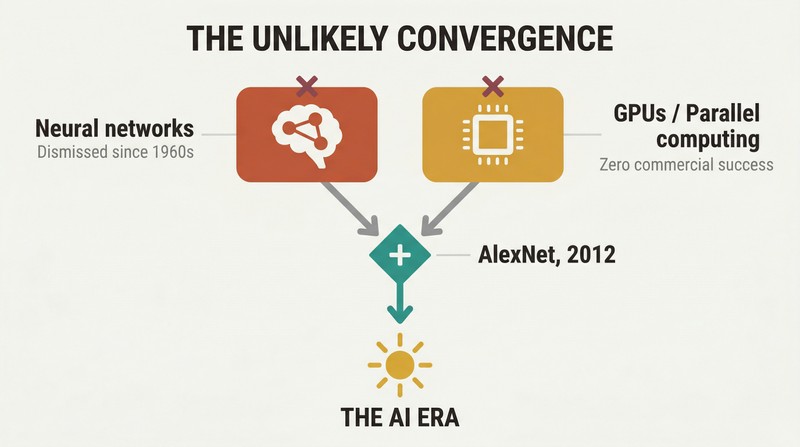
Nvidia's rise is an improbable marriage. Neural networks — software modeled on biological brains — had been considered obsolete toys since the 1960s. Parallel computing — processing many calculations simultaneously on a single chip — had a zero percent commercial success rate before Nvidia. Neither had obvious customers; both were starved of funding and dismissed by serious researchers.
When AlexNet was trained on two $500 gaming GPUs in 2012, the synthesis was revealed. The GPU's parallel architecture was perfectly suited to the matrix multiplication at the heart of neural-net training. Nvidia had spent a decade building CUDA, a free software platform that turned gaming cards into supercomputers. Neural nets were the killer app nobody saw coming. Two fringe technologies, detested by the establishment, interlocked to become the most consequential computing innovation of the century.
The boy bullied on a Kentucky bridge became worth $100 billion
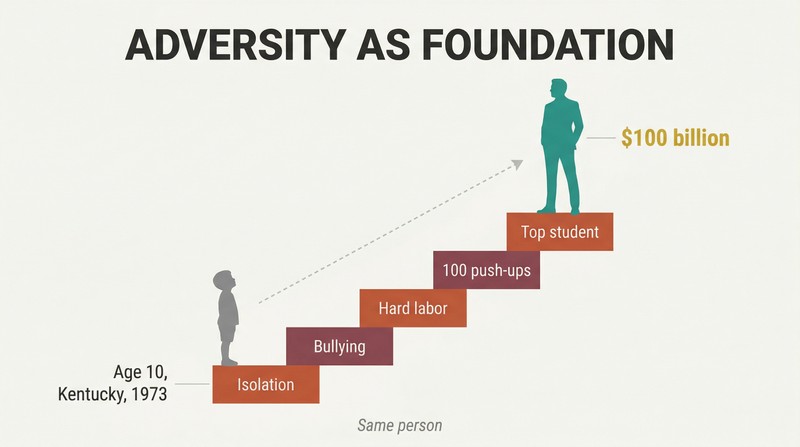
In 1973, ten-year-old Jensen Huang was sent from Thailand to Oneida Baptist Institute — a juvenile-reform school in one of America's poorest counties. His parents stayed behind in Bangkok. His roommate was a seventeen-year-old knife fighter who showed him his stab wounds. Classmates called him racial slurs daily and tried to shake him off a rope bridge into the river below.
Huang didn't crumble. He became the top student, taught himself to fight, cleaned toilets, and cut brush with a scythe. He did a hundred push-ups every night — a habit he maintained for life. Decades later, he donated a building to the school and called his time there "one of the best things ever to happen to him." The pattern was set early: adversity as fuel, fundamentals as religion.
Act thirty days from bankruptcy, especially when profits soar
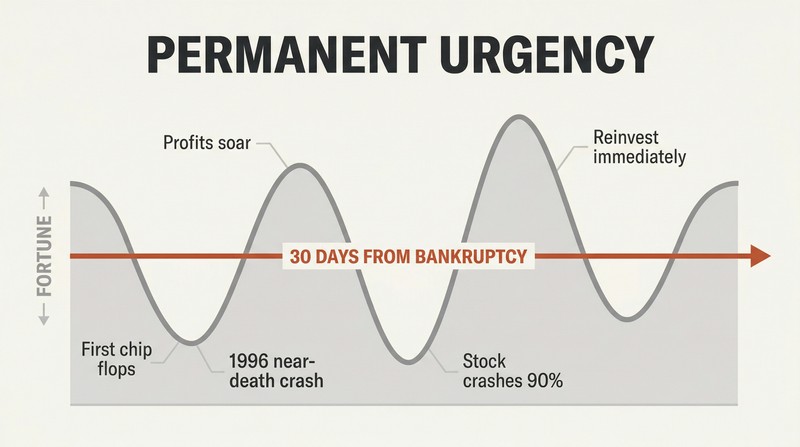
In 1996, Nvidia's first chip flopped. Huang laid off two-thirds of his staff, bet the last of the company's cash on an unproven hardware emulator, and skipped physical prototyping entirely — something no semiconductor firm had ever done. The resulting chip, built from what amounted to a digital napkin sketch, saved the company with weeks to spare.
The near-death experience became doctrine. For years, Huang opened staff presentations with the mantra above. Nvidia shipped new products every six months — twice the industry pace. When profits soared, he immediately reinvested in speculative technologies. When the stock crashed 90% (which happened twice), the culture barely flinched. Desperation sharpened decisions. Comfort killed companies. Huang engineered permanent urgency into Nvidia's DNA.
Chase markets so barren that no competitor even shows up
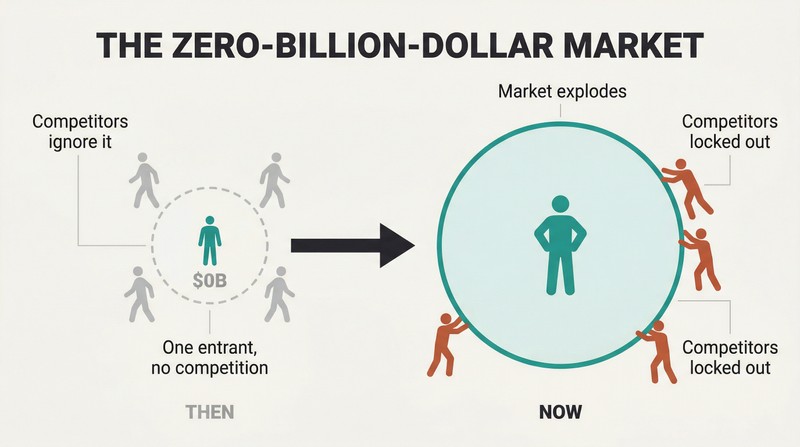
Huang's first CUDA customers were two breast cancer researchers who needed exactly two graphics cards for mammogram imaging. He invested millions to serve them. The project had no competitors because no rational company would pursue it. Huang called these "zero-billion-dollar markets" — customer segments so tiny they registered as nonexistent.
Clayton Christensen's Innovator's Dilemma was Huang's playbook. The Harvard framework showed how start-ups topple giants by serving marginal customers incumbents dismiss. Honda sold dirt bikes to teenagers; GM ignored them. Nvidia sold repurposed gaming cards to underfunded scientists. Sun Microsystems, Silicon Graphics, and Intel all ignored the market. By the time they noticed, Nvidia owned the infrastructure powering every major AI application on Earth.
Two $500 gaming GPUs in a bedroom cracked image recognition
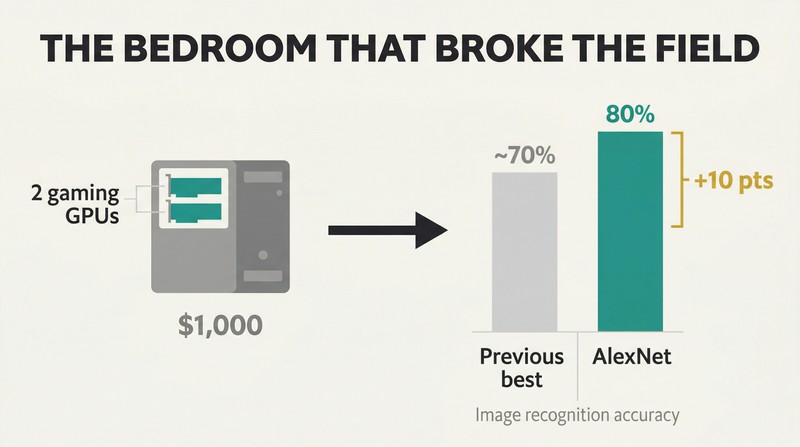
In 2012, Alex Krizhevsky — a reclusive grad student in Toronto — pooled money with his partner Ilya Sutskever to buy two Nvidia GeForce GTX 580s. He slotted them into a desktop in his childhood bedroom and trained a neural network for one week, his parents footing the electricity bill. The cooling fans ran at forty-four decibels, loud enough to keep him awake at night.
AlexNet demolished the field. It scored 80% accuracy on image recognition — ten percentage points above state-of-the-art in a discipline where gains were measured in fractions. The accompanying paper has been cited over 150,000 times. The three-person team behind it was acquired by Google for $44 million. Krizhevsky's key finding: GPUs could train neural networks hundreds of times faster than CPUs.
Nvidia's real competitive moat is software, not silicon
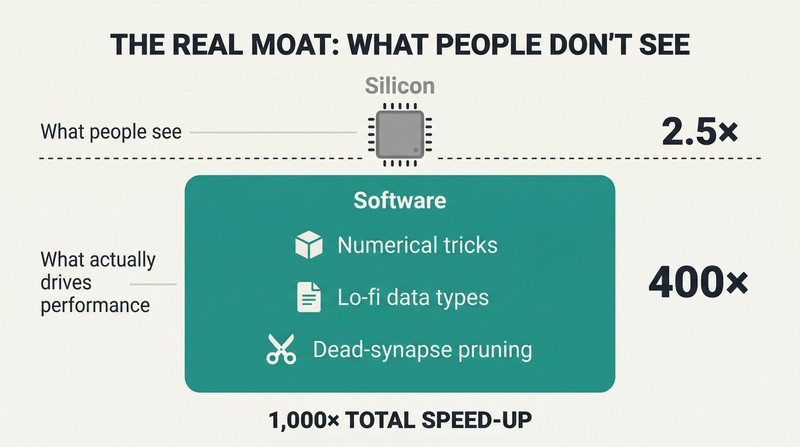
Between 2012 and 2022, Nvidia achieved a thousand-fold speed-up in AI inference. Only 2.5× came from shrinking transistors. The remaining 400× came from software: numerical tricks that acted like speed solvers on a Rubik's cube, lo-fi data types akin to switching from calligraphy to shorthand, and dead-synapse pruning that deleted unproductive neural connections. AMD could fabricate silicon of equal quality — they just couldn't make the math run as fast.
Nvidia deployed ten thousand programmers and nearly three hundred free software toolkits spanning drug discovery, climate modeling, cybersecurity, and more. A CalTech administrator said professors would rather wait eighteen months for Nvidia hardware than switch to a cheaper rival. Chief scientist Bill Dally wasn't worried about open-source competitors: "Because we're flooring it! We're always a couple of generations ahead of them."
Find the 'speed of light' for any process, then work backward
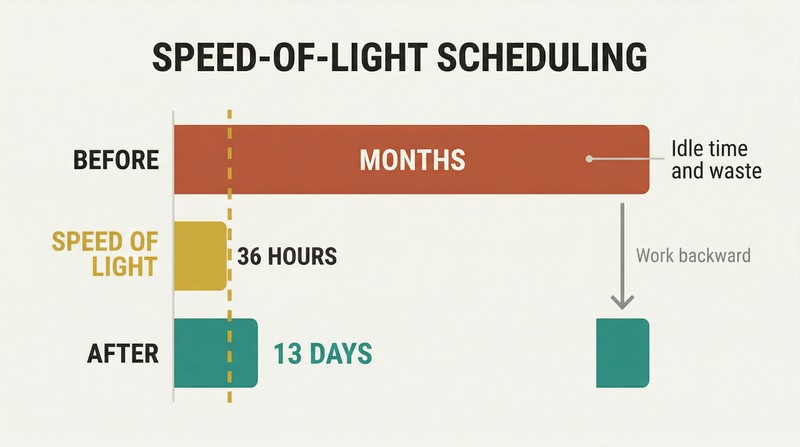
Huang's signature scheduling concept didn't mean "move quickly." It meant: identify the absolute fastest something could conceivably be accomplished given unlimited budget and zero errors. Then work backward to realistic but aggressive timelines. Operations chief Deb Shoquist flew to Taiwan and discovered chip packaging took three weeks of lead time but only thirty-six hours of actual labor. Closing that gap was expensive — costs jumped from $8 to $1,000 per chip — but physically possible.
The framework removed anxiety. If no one on Earth could go faster, you stopped worrying about competitors. It also killed the excuse of "impossible" — if the speed-of-light calculation showed one day, your job was to explain why you needed three. Shoquist ultimately compressed Nvidia's entire supply-chain cycle time from months to thirteen days.
The transformer — barely 20 lines of code — became AI's skeleton key
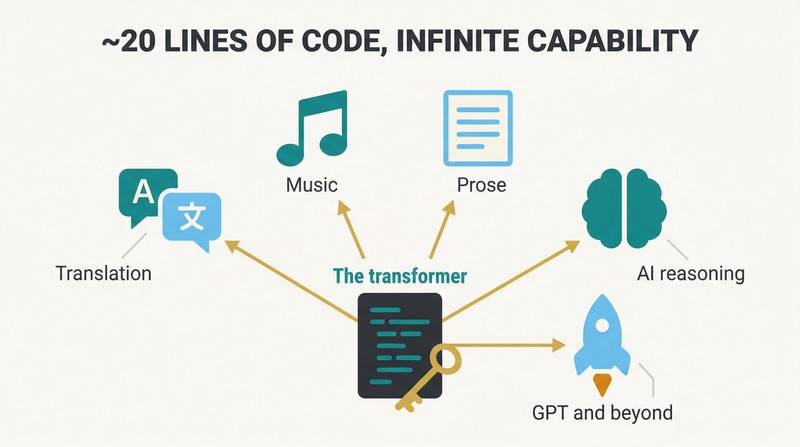
In 2017, eight Google researchers published "Attention Is All You Need," introducing the transformer. Unlike previous neural networks with complex memory structures, the transformer used "self-attention" — probabilistically linking every word in a text to every other word based on context alone. It predicted just one word at a time. After ablation testing stripped away unnecessary code, the core function was barely twenty lines.
The elegance was staggering. The transformer could translate languages, compose music, and generate convincing prose. When fed millions of Wikipedia articles and asked to write about itself, it produced a smooth, footnoted essay about a fictional Japanese punk band. All eight original researchers eventually left Google — the company failed to commercialize its own breakthrough. OpenAI used the transformer to build GPT, and the world changed.
Berate publicly, forgive privately, and almost never fire anyone
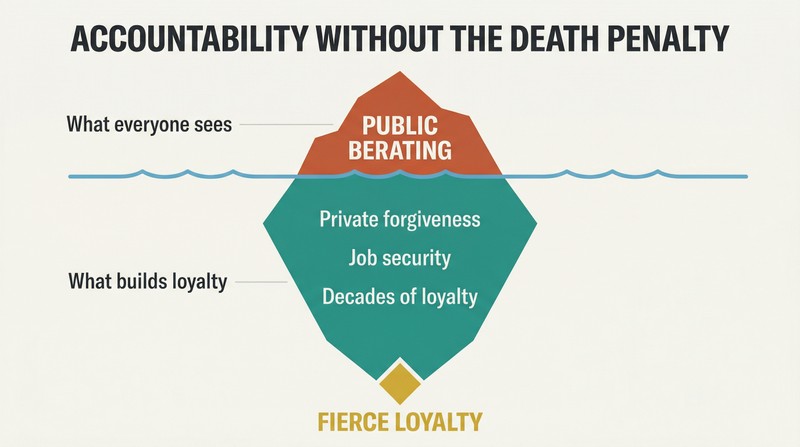
The "Wrath of Huang" was legendary. He once screamed at a chip architect for nearly two hours in a company cafeteria while 150 executives watched in mute horror. He asked one employee to calculate his lifetime compensation, then demanded a full refund. He called these episodes "educational" — failure, Huang believed, must be shared publicly so everyone could learn from it.
But Huang almost never fired anyone. The architect kept his job. When the refund employee was later diagnosed with a serious illness, Huang offered to pay for treatment out of pocket. Many employees had worked at Nvidia for decades. The formula was deliberate: extreme accountability without the death penalty. The result was a workforce so loyal that, as one observer noted, "they would follow him out of the window of a skyscraper."
Jensen manages fifty-five people directly — no deputies, no heir
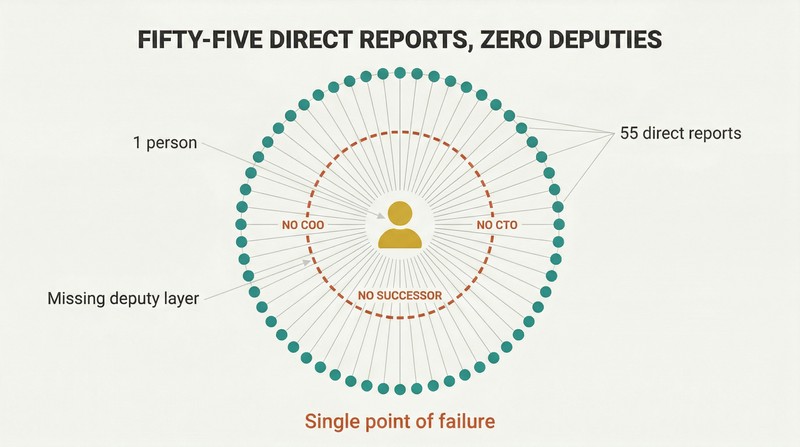
Management textbooks recommend eight to twelve direct reports. Huang had fifty-five. No COO, no CTO, no chief of staff, no obvious successor. He maintained radical flatness with fluid responsibilities, frequently reshuffling employees across divisions. "You never know when you might suddenly become the most important person in this company," he told his staff.
To maintain what his friend called "resonance," Huang received twenty thousand emails every Friday — five priorities from each employee — and sampled randomly at all hours. He sent hundreds of replies daily, some just a few words long. Nvidia's $3 trillion valuation was essentially a GDP-sized bet on one sixty-one-year-old man. Board members spoke openly of his irreplaceability. The radical flatness kept him informed but created what may be the largest single point of failure in corporate history.
The top AI scientists fear extinction; Huang's p is zero
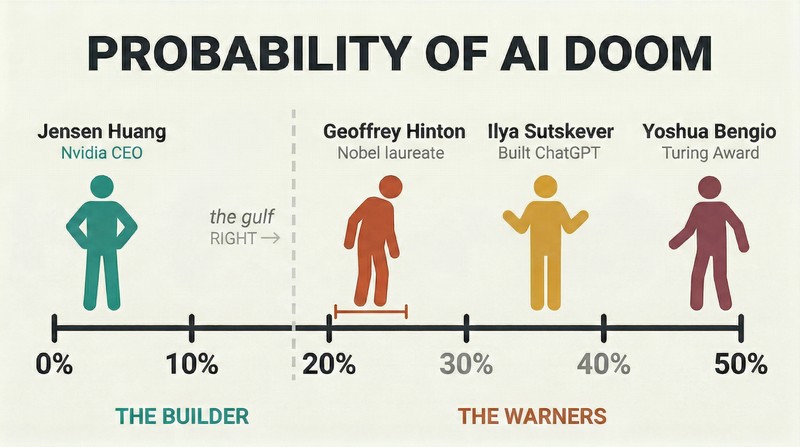
Geoffrey Hinton, the 2024 Nobel laureate whose lab produced AlexNet, estimated a 10 – 20% chance of catastrophic AI outcomes. Yoshua Bengio, fellow Turing Award winner, put it at 50%. Ilya Sutskever, who built ChatGPT, resigned from OpenAI to focus on ensuring superintelligent systems don't go rogue. These are the three most-cited computer scientists alive. All worried AI might kill us.
Huang rejected the entire framing. He called the speculation baseless, dismissed Hinton's concerns as self-promotion, and compared AI to microwaves. When the author showed him a clip about machine evolution, Huang erupted: "We are serious people, doing serious work. This is not a freaking joke!" Nvidia controls 90% of AI chip sales. The standoff between builders and warners remains the defining tension of the AI era.
Analysis
The Thinking Machine operates on a paradox that most business narratives would paper over: the same personality traits that made Jensen Huang the most successful semiconductor CEO in history may be precisely those that make him incapable of perceiving the technology's risks. Witt never resolves this tension, and the book is stronger for it.
What distinguishes this from standard tech biography is its attention to strategic specificity. Huang's "zero-billion-dollar market" concept — pursuing customer segments so tiny they register as nonexistent — is a genuine refinement of Christensen's disruption framework that advances the original theory. The "speed of light" scheduling concept offers a replicable tool for any operations leader. And the revelation that only 2.5× of Nvidia's thousand-fold AI speed-up came from transistor improvements, with the remaining 400× coming from software optimization, overturns the conventional understanding of semiconductor dominance entirely.
The book's treatment of organizational design is equally counterintuitive. Fifty-five direct reports, public beratings, no succession plan, no COO — Huang violates every principle of modern management. Yet Nvidia consistently ranks among America's best workplaces with remarkably low turnover. Witt suggests this works because Huang offers something more compelling than comfort: the chance to do your life's work. In environments where the mission is genuinely revolutionary, the traditional employer-employee social contract may matter less than the craftsman-master bond.
The most important contribution, however, is Witt's honest grappling with the AI safety debate. By juxtaposing Hinton's probability estimates against Huang's absolute zero, and by showing that Nvidia's internal culture systematically suppresses existential speculation, Witt illuminates how the most consequential technological decision of our era is being made by market forces rather than democratic deliberation. The final image — the author standing inside an AI supercomputer, feeling "inadequate in my obsolete and dying flesh" — is not melodrama but a legitimate dispatch from the frontier of a species confronting its possible successor.
Review Summary
The Thinking Machine receives mostly positive reviews, with readers praising its insightful account of Nvidia's journey and Jensen Huang's leadership. The book is lauded for connecting various technological topics through a coherent timeline and offering a balanced perspective on AI's evolution. Readers appreciate the well-researched content, engaging writing style, and timely relevance. Some criticism includes shallow coverage of certain topics and repetitive content in the latter half. Overall, reviewers find it informative, inspiring, and a must-read for those interested in technology and AI's future.
People Also Read





Glossary
CUDA
GPU programming platform for scienceCompute Unified Domain Architecture. A free software platform developed by Nvidia starting in 2006 that repurposes the parallel-computing circuits in gaming GPUs for general scientific computation. CUDA allows researchers to run demanding mathematical workloads—like training neural networks—on hardware originally built for video games. It works only on Nvidia hardware, creating powerful vendor lock-in.
Zero-billion-dollar market
Market with zero existing customersJensen Huang's term for a customer segment so small it registers as nonexistent in market research. By pursuing these invisible markets—such as mammogram imaging or underfunded physics simulations—Nvidia faced no competition while building expertise that later proved enormously valuable when demand scaled. The concept draws from Christensen's disruption theory but emphasizes market creation rather than market capture.
Speed of light
Theoretical fastest completion timeHuang's scheduling framework in which managers identify the absolute fastest something could conceivably be accomplished—assuming unlimited budget, zero errors, and perfect conditions. Managers then work backward from this unachievable constant to set aggressive but realistic delivery targets. The concept also reduces competitive anxiety: if the physics dictate a minimum timeline, no rival can beat it either.
CUDA tax
Hidden cost subsidizing scientific computingAn internal Nvidia term for the additional cost of manufacturing dual-purpose GPU chips that included both gaming and scientific-computing (CUDA) capabilities. The CUDA tax raised the GeForce's production cost above that of competitor AMD's Radeon. Huang gambled that gaming customers, entranced by titles like Half-Life 2, wouldn't notice they were subsidizing a speculative side quest into high-performance computing.
O.I.A.L.O.
Once In A Lifetime OpportunityAn acronym Huang wrote on his office whiteboard in 2013 after recognizing that neural networks represented a transformative application for Nvidia's CUDA platform. The phrase became a rallying cry repeated at every internal meeting as Huang bet the company on AI, redirecting resources from graphics to deep learning. He declared Nvidia was no longer a graphics company but an AI company essentially overnight.
cuDNN
Neural network acceleration software libraryA software library developed by Bryan Catanzaro and Philippe Vandermersch at Nvidia that accelerates neural-network training and inference on CUDA-enabled GPUs. Huang called it the single most important project in Nvidia's twenty-year history. cuDNN optimized matrix multiplication—the core mathematical operation in neural-net training—by truncating unnecessary precision and favoring speed over exactness, dramatically reducing training times.
AlexNet
Krizhevsky's breakthrough image-recognition neural networkA convolutional neural network trained by Alex Krizhevsky, Ilya Sutskever, and Geoffrey Hinton in 2012 using two consumer Nvidia GPUs. AlexNet won the ImageNet image-recognition competition with 80% accuracy—10 percentage points above state-of-the-art. Its accompanying paper has been cited over 150,000 times. AlexNet demonstrated that GPUs could train neural networks hundreds of times faster than CPUs, triggering the modern deep-learning revolution.
DGX-1
Nvidia's first dedicated AI supercomputerA 134-pound, $129,000 computer housing eight interconnected Nvidia P100 GPUs linked by NVLink high-speed data connections. Released in 2016, it was purpose-built for training neural networks. Jensen Huang hand-delivered the first unit to Elon Musk at OpenAI and the second to Fei-Fei Li at Stanford. The DGX-1 consumed as much power as a clothes dryer and is considered one of the most important computers ever built.
Wrath of Huang
Jensen's public berating ritualThe book's term for Huang's practice of publicly dressing down employees who made mistakes, often in front of large audiences. Huang considered these episodes educational—"Failure must be shared," he said—and used them so others could learn. Spectators described squirming in discomfort. Despite the severity of the beratings, Huang almost never fired the targets, creating a culture of extreme accountability paired with extreme job security.
p(doom)
AI extinction probability estimateA parametric variable used in AI safety circles to represent one's personal assessment of the probability that artificial intelligence will cause a catastrophic or extinction-level outcome for humanity. Geoffrey Hinton estimated his p(doom) at 10–20%, Yoshua Bengio at 50%, and Yann LeCun at zero. Jensen Huang's p(doom) was also zero—he rejected the entire framing as baseless speculation unsupported by evidence.
FAQ
1. What’s "The Thinking Machine: Jensen Huang, Nvidia, and the World's Most Coveted Microchip" by Stephen Witt about?
- Biography and Business Epic: The book is a biography of Jensen Huang, the founder and CEO of Nvidia, tracing his journey from a Taiwanese immigrant to the leader of the world’s most valuable semiconductor company.
- Nvidia’s Rise: It details how Nvidia evolved from a small gaming hardware startup into the dominant force in AI hardware, powering the current artificial intelligence revolution.
- Tech and Society: The narrative explores the intersection of technology, business strategy, and global geopolitics, especially the role of Taiwan and TSMC in the semiconductor supply chain.
- AI Revolution: The book also explains how Nvidia’s chips became the backbone of modern AI, and the implications of this for the future of humanity, industry, and global power.
2. Why should I read "The Thinking Machine" by Stephen Witt?
- Insider Tech History: The book offers a rare, detailed look at the inner workings of Nvidia and the semiconductor industry, revealing how technological innovation shapes the modern world.
- Leadership Lessons: Readers gain insights into Jensen Huang’s unique leadership style, decision-making, and resilience through adversity, which are applicable to business and personal growth.
- Understanding AI’s Backbone: It demystifies the hardware and software foundations of the AI boom, making complex concepts accessible to non-experts.
- Global Relevance: The book connects the dots between technology, economics, and geopolitics, showing why chips and AI are at the heart of 21st-century power struggles.
3. What are the key takeaways from "The Thinking Machine" by Stephen Witt?
- Vision and Persistence Matter: Jensen Huang’s relentless focus, willingness to take risks, and ability to adapt were crucial to Nvidia’s survival and dominance.
- Innovation from the Margins: Nvidia succeeded by targeting overlooked markets (like gaming GPUs) and later pivoting to AI, showing the power of disruptive innovation.
- Hardware-Software Synergy: The book highlights how Nvidia’s success came from not just hardware, but building a software ecosystem (CUDA) that locked in developers and customers.
- AI’s Double-Edged Sword: The narrative explores both the promise and the existential risks of AI, as well as the ethical and societal questions it raises.
4. How did Jensen Huang’s background and personality shape Nvidia’s culture and success?
- Immigrant Resilience: Huang’s early experiences as an immigrant, facing adversity and bullying, instilled a drive to prove himself and a willingness to take risks.
- Work Ethic and Perfectionism: He is known for his intense work ethic, attention to detail, and high standards, which set the tone for Nvidia’s culture.
- Direct and Demanding Leadership: Huang’s management style is famously direct, sometimes harsh, but also deeply loyal to those who meet his standards.
- Continuous Reinvention: His ability to learn, adapt, and pivot—whether in technology, business models, or personal branding—was key to Nvidia’s long-term survival.
5. What is Nvidia’s CUDA platform, and why is it so important according to "The Thinking Machine"?
- Software for Parallel Computing: CUDA is Nvidia’s proprietary software platform that allows developers to harness the parallel processing power of GPUs for tasks beyond graphics, especially scientific and AI workloads.
- Ecosystem Lock-In: By making CUDA the standard for AI and scientific computing, Nvidia created a “walled garden” that made it hard for customers to switch to competitors.
- Accelerating AI Development: CUDA enabled breakthroughs in deep learning by making it feasible to train large neural networks quickly and efficiently.
- Strategic Gamble: Investing in CUDA was a risky, long-term bet that paid off massively, transforming Nvidia from a hardware company into a platform company.
6. How did Nvidia transition from a gaming hardware company to the leader in AI hardware?
- Gaming Roots: Nvidia initially focused on graphics cards for PC gaming, which required high-performance parallel processing.
- Pivot to AI: The company recognized that the same GPU architecture could accelerate scientific and AI computations, especially deep learning.
- Early AI Adoption: Nvidia invested in supporting AI researchers, providing hardware and software tools that became industry standards.
- Market Domination: As AI exploded, Nvidia’s head start and ecosystem made it the default choice for data centers, cloud providers, and AI startups.
7. What are the most important concepts and technologies explained in "The Thinking Machine"?
- Parallel Computing: The book explains how GPUs differ from CPUs, and why parallelism is crucial for modern AI workloads.
- Deep Learning and Neural Networks: It covers the basics of neural networks, backpropagation, and why large-scale data and computation are game-changers.
- Moore’s Law and Its Limits: The narrative discusses the slowing of Moore’s Law and how Nvidia’s approach provided a new path for performance gains.
- Vendor Lock-In and Ecosystems: The importance of software ecosystems (like CUDA) in creating lasting competitive advantages is a recurring theme.
8. How does "The Thinking Machine" address the risks and ethical concerns of AI?
- AI Existential Risk: The book presents the debate among leading AI researchers about the potential for AI to surpass human intelligence and pose existential threats.
- Divergent Views: It contrasts the optimism of business leaders like Jensen Huang with the caution and fear of AI pioneers like Geoffrey Hinton and Yoshua Bengio.
- Regulation and Alignment: The narrative discusses proposed regulations, the “alignment problem,” and the challenges of ensuring AI systems act in humanity’s best interests.
- Societal Impact: It explores the impact of AI on jobs, creativity, and the potential for misuse, such as deepfakes and autonomous weapons.
9. What role do Taiwan and TSMC play in Nvidia’s and the global semiconductor industry’s story?
- TSMC as a Linchpin: Taiwan Semiconductor Manufacturing Company (TSMC) is the world’s leading chip foundry, manufacturing the most advanced chips for Nvidia and others.
- Geopolitical Importance: The book highlights how Taiwan’s dominance in chip manufacturing makes it a focal point in US-China tensions and global supply chain risks.
- Personal Connection: Jensen Huang’s Taiwanese heritage and relationship with TSMC’s founder, Morris Chang, are woven into Nvidia’s history and success.
- Supply Chain Fragility: The narrative underscores how much of the world’s technology depends on a few factories in Taiwan, raising concerns about potential disruptions.
10. How does "The Thinking Machine" portray the competition between Nvidia and its rivals (AMD, Intel, etc.)?
- Fierce Rivalries: The book details Nvidia’s battles with companies like 3dfx, ATI/AMD, and Intel, often resulting in dramatic industry shakeups.
- Strategic Differentiation: Nvidia’s focus on software, rapid product cycles, and willingness to take risks set it apart from more conservative competitors.
- Acquisitions and Failures: The narrative covers failed mergers, hostile takeovers, and how Nvidia outmaneuvered rivals through both innovation and aggressive business tactics.
- Current Landscape: Despite attempts by AMD and Intel to catch up, Nvidia’s ecosystem and first-mover advantage in AI hardware keep it ahead.
11. What are the best quotes from "The Thinking Machine" and what do they mean?
- “運氣,但有遠見作為基礎。” (“Luck, but with vision as the foundation.”) – Jensen Huang’s summary of Nvidia’s success, emphasizing the interplay of foresight and serendipity.
- “我們公司再三十天就要倒閉了。” (“Our company will go bankrupt in 30 days.”) – A mantra Huang used to keep Nvidia hungry and focused, even during times of success.
- “有時不聽客戶的意見是對的。” (“Sometimes not listening to customers is right.”) – Reflects the Innovator’s Dilemma and the importance of betting on disruptive, unproven markets.
- “AI不是一種演算法,而是一種方法。” (“AI is not an algorithm, but a method.”) – Highlights the paradigm shift in how software is developed and the transformative nature of deep learning.
12. What is the future of Nvidia and AI according to "The Thinking Machine"?
- AI as Infrastructure: The book suggests that AI, powered by Nvidia hardware, will become as fundamental as electricity or the internet, transforming every industry.
- Scaling and Limits: Nvidia’s focus is on ever-larger models and data centers (“AI factories”), but faces challenges in power consumption, supply chains, and competition.
- Societal Transformation: The narrative anticipates massive changes in work, creativity, and even the nature of intelligence, with both utopian and dystopian possibilities.
- Unanswered Questions: Despite Nvidia’s dominance, the book leaves open the question of whether AI’s benefits will outweigh its risks, and what role humanity will play in an AI-driven world.
Download PDF
Download EPUB
.epub digital book format is ideal for reading ebooks on phones, tablets, and e-readers.








































