


Plot Summary
A Flame on His Tail
Nina1 shows her best friends Matti and Sienna6 the impossible: her puppy Duncan,3 once a seemingly normal black hound, now has a blue flame flickering on the tip of his tail and glowing red eyes. His change happened overnight, weeks after his second birthday.
She confesses that strangers already tried to kidnap him twice, and she injured them badly to protect him. She can no longer hide him in her RV while traveling between campgrounds.
Matti,6 who spent his teen years at a secret magical ranch in Colorado run by his cousin Henri,2 proposes the only solution: she must go there, where a community of shapeshifters and mythical beings live protected behind fences and secrecy. The catch, he warns, is that joining permanently requires marriage. Nina,1 desperate and out of options, agrees immediately.
The flame represents both danger and illumination: Duncan's visible magic forces Nina out of hiding and into community. Her immediate acceptance of the marriage requirement reveals the depth of her devotion. The loss of mobility (the RV life) mirrors the loss of anonymity. Her instinct to injure rather than kill the kidnappers shows her relationship with her own lethal magic: she uses it only as a last resort, and even then with restraint. The scene establishes the central tension: how much of herself will she sacrifice for the being she loves most?
The Great Wolf Attacks
En route to the ranch, Nina1 spots a young centaur and two wolf pups fleeing through the trees. She and Matti6 track them to a river, where a Jenny Greenteeth, all slimy green skin and needle teeth, threatens to eat the children. Nina1 removes her obsidian bracelet, unleashing her hidden magical scent, and the crone flees in terror.
At the ranch gates, a wolf the size of a Clydesdale charges from the forest and tackles Nina1 to the gravel. The massive jaws hover inches from her face until she gasps his name: Henri.2 Duncan,3 all twelve pounds of him, clamps his jaws onto the giant wolf's tail in defense. Henri2 shifts to human form, holding Duncan3 by the scruff, and Nina1 bites his calf. Only then does he look at her face and say, "Cricket.1"
This sequence establishes the dual nature of the magical world: predatory danger and instant recognition of kinship. Henri's attack is territorial, but his shift upon hearing his childhood nickname for Nina shows memory trumping instinct. Duncan's defense of his mother, despite his tiny size, demonstrates a bond that will define the entire narrative. The rescued children (Shiloh, Pascal, and Agnes) immediately become Nina's first allies, foreshadowing her role as protector of the community's young.
Marriage Required to Stay
Inside the massive log clubhouse, six elders examine Duncan.3 Henri2 interrupts the proceedings to insist the mandatory three-month trial period be observed before any permanent union can take place. Nina,1 who had braced herself to marry a stranger within weeks, feels both relief and a sting of rejection from the man she once knew.
The elder named Franklin,5 wearing a gold-and-obsidian bracelet identical in function to hers, acts strangely watchful. Nina1 warns them about her involuntary effect on fertility: women near her for extended periods become pregnant. The elders wave this off as a gift. Henri2 remains aloof, his amber eyes tracking her every movement, his expression unreadable.
The trial period functions as a narrative pressure valve, delaying the marriage plot while allowing Henri and Nina's relationship to develop naturally. Franklin's bracelet is a subtle clue to his hidden identity, a Chekhov's gun the reader registers but cannot yet interpret. Nina's warning about her fertility power, delivered almost apologetically, reveals her deep-seated belief that her magic is a burden rather than a gift. Her gratitude for a year instead of a month shows how thoroughly she has internalized the need to earn belonging.
Abandoned Under a Full Moon
Two years before, on a full moon night in an Arizona state park, Nina1 lay awake when magic more potent than anything she had ever felt pressed against her consciousness. A telepathic voice whispered, "Care for him." She opened her camper door to find a newborn creature covered in birthing fluid, its eyes still sealed shut.
In the distance, two red eyes gleamed from the chaparral. The mother, whatever she was, howled once with a sound no coyote could produce and vanished forever. Nina1 raised the fragile pup herself, feeding him every two hours, carrying him in a sling. He stayed small, twelve pounds for two years, until the morning she woke to find his tail ablaze and his eyes the color of rubies.
The abandonment scene parallels Nina's own origin story: both she and Duncan were left by biological parents who could not or would not raise them. The howl that is neither coyote nor wolf hints at Duncan's true species long before the hellhound reveal. The telepathic communication establishes a gift that will become central to their bond. The full moon, a recurring symbol throughout the book, marks both beginnings and transformations. Nina's instant devotion to a creature she does not understand mirrors the unconditional love her adoptive parents gave her.
Cinnamon Tears and a Diner
Matti and Sienna,6 recovered from food poisoning, fly back to Chicago. At the terminal, Matti6 mouths a message to Nina:1 "Get my cousin to marry you." Driving back through the mountains, the grief of separation and the weight of uncertainty overcome her. She weeps.
Henri,2 in the passenger seat, notices her tears smell like cinnamon, a scent he admits makes him want to bite her. He pulls into a diner parking lot, cradles her head against his shoulder, and calls her "poor little Cricket.1
"Over lunch at the Howling Hill Diner, where Shiloh's10 mother Phoebe works as a waitress, Henri2 reveals fragments of his past: college, police work, then inheriting the ranch when Matti's6 mother died. He also returns Nina's1 obsidian bracelet, telling her she does not need to hide who she is.
The cinnamon tears scene marks a turning point in Henri's emotional availability. His confession that her scent triggers a physical urge to bite reveals the werewolf instinct to claim, even as he resists acting on it. The diner, staffed entirely by magical beings, serves as a liminal space between the human world and the ranch, where Nina can be vulnerable without fear. Matti's whispered instruction plants a seed that will take the entire novel to germinate, while Henri's return of the bracelet signals his growing trust.
Spencer's Split Ends
Weeks into her stay, Nina1 asks Randall, the strawberry-blond security guard, to help her find Spencer7 the sasquatch. She insulted his dry hair during their first hostile encounter and wants to apologize. Henri2 intercepts and drives her himself. Before they approach Spencer's7 cabin, complete with solar panels and satellite television, Henri2 rubs his cheeks across her face and neck, coating her with his scent.
Spencer7 calls her an abomination and a demon, but Nina1 offers a conditioner bar and a genuine apology. The eight-foot creature, lonely and perpetually angry, grudgingly accepts. As they leave, Henri2 tells Spencer7 to relay a message to a woman named Maggie, calling her a traitor.
The scene demonstrates Nina's defining quality: she refuses to let even justified anger sever potential connections. She understands that Spencer's cruelty masks loneliness. Henri's scent-marking is territorial, a public claim that contradicts his insistence on waiting for the trial period. The sasquatch's acceptance of the gift, however grudging, shows that even the most hostile beings can be reached through patient kindness. Spencer's mention of Maggie hints at a web of relationships within the community that Nina is only beginning to perceive.
The Gnomes Rejoice
During their nightly game of tag, Henri2 spots gnomes marching from the trees, carrying torches with green fire. They bow to Henri,2 calling him "Great Wolf" in recognition of his divine ancestry. To Nina,1 they speak in a language Henri2 cannot understand, claiming they rejoice in her presence.
Days later, they return and reveal more: her biological father,9 whom they call "the son of the night," is alive and well, though they had believed him dead. Their brethren in the south once lived among her mother's people, which explains why Nina1 can understand their tongue. When Henri2 asks what they said, Nina1 repeats their words, her hands shaking with the weight of a heritage she has never known.
The gnomes serve as oracles, revealing truths that the human characters cannot or will not speak. Their immunity to obsidian's concealing properties makes them uniquely positioned to see through Nina's defenses. The revelation that her father was thought dead adds a mythic dimension to her abandonment: he did not simply choose not to find her; he may not have known she existed. The language barrier, where Henri cannot understand the gnomes but Nina can, physically manifests the distance her heritage creates between her and the werewolf community.
Death in a Fanny Pack
Dominic8 corners Nina1 in the kitchen after being cruel to Agnes,4 his biological daughter whom he abandoned and whose parental rights Henri2 forced him to relinquish. When Nina1 tells him to leave, he gets in her face, snarling. She finally unleashes the magic she inherited from her father:9 she shows him the flame of life that burns inside every living being, explaining she can see it, gauge its strength, and pinch it out completely.
She tells him that death sometimes wears a fanny pack. Dominic,8 pale and shaken, flees. Moments later, Henri2 and Franklin5 enter. Agnes4 tells them Nina1 was going to kick his ass. Later, Nina1 confesses to Henri2 that she put Duncan's3 would-be kidnappers into comas by taking portions of their life force.
This confrontation forces Nina to publicly claim the power she has spent her life hiding. The fanny pack, a symbol of her practical, maternal identity, becomes a vessel for death magic, collapsing the false dichotomy between nurturer and destroyer. Her threat is carefully measured: she shows Dominic what she is capable of without actually harming him, demonstrating the restraint her adoptive parents taught her. Henri's response, learning the full truth and insisting there is nothing wrong with her, provides the unconditional acceptance she has craved since her magic first manifested at sixteen.
The Dreamer Calls Twice
A deep male voice intrudes on Nina's1 dreams: "Child? Are you there?" She wakes gasping. Henri,2 across the hall, heard it too. He finds her outside, barelegged and shaking, seeking answers from the gnomes, who tell her the voice belongs to her kin. Henri2 wraps her in his arms, then sits with her in the moonlit forest, her body on his thigh, and talks about the land.
Nina1 admits she finds him gorgeous, that her attraction means nothing, that she knows he only sees her as a friend. Henri's2 face tightens; he says, "I see." Days later, the voice returns, using her name. But this time Henri2 does not come, and Nina1 cries alone, curled around Duncan.3
The dream invasion represents the intrusion of Nina's biological past into the safe life she is building. Her father's power to reach across distance and into unconsciousness demonstrates the scope of divine magic, while his inability to communicate clearly suggests a being unaccustomed to connection. Henri's withdrawal after her confession mirrors the pattern of her life: people sense what she is and retreat. The contrast between his initial tenderness and subsequent absence teaches Nina the danger of hope, reinforcing her instinct to rely only on herself and Duncan.
Suitors Swarm the Kitchen
Word spreads that Nina1 stood up to Dominic8 without flinching. Suddenly, eight or nine male werewolves arrive for breakfast, including Dominic8 himself, who announces he will mate with her. Henri's2 reaction is immediate and volcanic: he orders them all to leave, then backs Nina1 against the counter and rubs his cheeks across her face, her neck, her hair, saturating her with his scent.
Franklin,5 bewildered, sets up a future schedule for courting. Meanwhile, the elder reveals the Alaskan community is sending a representative to evaluate Duncan.3 When Henri2 learns they might want to take the pup, he flatly refuses, promising Nina1 that no one will take her boy.
The suitor scene functions as a catalyst, forcing Henri to publicly acknowledge what he has been suppressing. Scent-marking, a werewolf behavior typically reserved for mates, contradicts his insistence on waiting for the trial period. The community's sudden interest in Nina after months of distance reveals the transactional nature of their acceptance: they value strength and fertility, not connection. Franklin's news about Alaska introduces a new threat to the fragile stability Nina has built, making Henri's protectiveness both necessary and complicated.
A Kiss and a Retreat
Exhausted by the relentless demands of the ranch, Henri2 is drowning in phone calls and crises. Nina1 hands him the keys to her RV and tells him to escape for a day while she handles his phone, lying to anyone who calls. When he returns, he presses his lips softly to hers and thanks her for the kindest thing anyone has ever done for him.
But days later, when the dream voice wakes her and she again asks Henri2 if he has changed his mind about marrying her, he leans away. His face closes. He says, "I see," and leaves. Nina1 resolves to stop hoping. She will find someone else, someone who wants her, because Duncan3 needs this place to work.
The kiss represents Henri's impulse breaking through his rigid self-control, but his retreat shows fear overriding desire. His identity is built on duty and rule-following; pursuing his own happiness before the trial period ends would violate the code he has enforced for others. Nina's decision to stop hoping is a survival mechanism, protecting herself from the pain of repeated rejection. Her willingness to marry a stranger for Duncan's sake demonstrates that her conception of love is fundamentally sacrificial, shaped by parents who chose her despite her difference.
Uncle Hypnos Revealed
Ilya,11 the leader of the Alaskan community, arrives and offers Nina1 sanctuary with a three-year mating deadline. He also reveals that Franklin5 knows who her father is. That night, Nina1 and Henri2 confront the elder in his bedroom.
Franklin5 unclasps his gold-and-obsidian bracelets, and the room floods with ancient, subtle magic. He confesses: his brother is Thanatos,9 the god of death. Nina's1 biological father. Franklin5 himself is Hypnos, god of sleep. Their parents, he explains, were the Night and Darkness.
Her father9 and her mother, a fertility goddess named Isha, met on a cruise ship, spent one night together, and later agreed to give the baby away. Franklin5 only learned of Nina's1 existence when she arrived at the ranch. He begs forgiveness.
The revelation recontextualizes every interaction Nina has had at the ranch. Franklin's watchfulness was familial recognition, not suspicion. His bracelet hid not shame but an identity too powerful to reveal casually. The story of her conception, a cruise ship encounter between two ancient beings, is almost absurd in its mundanity, stripping divinity of grandeur. Franklin's grief over outliving his own children across millennia explains his initial caution in approaching Nina. The chapter explores how biological connection can feel arbitrary while chosen family, built through daily acts of care, holds genuine meaning.
The River Almost Takes Her
Shiloh10 and Pascal10 have run off again, this time searching for the secret waterfall. Agnes4 guides Nina1 and Duncan3 to the river, where Pascal10 clings to a rock in the middle of a swift, waist-deep current. Nina1 wades in, inch by inch, the water so cold it numbs her legs. A submerged log slams into her back and sweeps her under. She swallows water, certain she will die.
She manages to throw Pascal10 toward a fallen tree trunk, then grabs a branch herself. On the bank, soaked and trembling in her underwear, she clutches the sobbing children. Henri2 arrives at a dead sprint, his face white with fear. He carries Pascal10 while Nina1 walks, wrapped in emergency blankets, her body convulsing with cold.
This sequence dramatizes Nina's defining ethic: her life is not more valuable than a child's. The river, a force she cannot control or intimidate with her death magic, represents mortality in its purest form. Her willingness to risk everything for children who are not biologically hers echoes the love her adoptive parents gave her and prefigures the family she will build. Henri's terror, visible on his normally stoic face, cracks his emotional defenses permanently. The log that nearly kills her is random and indifferent, a reminder that even gods' children can be ended by ordinary physics.
Beneath the Glowing Falls
That night, Henri2 finds Nina1 outside and admits he was never taking care of her for Matti's6 sake. He was trying to wait for the trial period to end, following rules he himself established. He cannot stomach the thought of her with another man. He kisses her, deeply, then says the words she never expected: "I want you to marry me."
When she asks why now, he reveals his ancestry: his mother was descended from Fenrir, the monstrous Norse wolf, and his father was the original Amarok, the Great Wolf. He would leave the ranch he inherited if Duncan3 chose Alaska. He takes her to the sacred waterfall, glowing with pink and purple bioluminescence from the ancient meteor's magic, and asks her to be his mate under the next full moon. She says yes.
Henri's confession reframes his entire behavior throughout the novel: his distance was discipline, not disinterest. His willingness to abandon the land his family has protected for centuries demonstrates that Nina has become his primary allegiance, surpassing even his ancestral duty. The waterfall, hidden and sacred, represents the private truth of their relationship, a beauty that only the trusted can witness. His disclosure of his parentage, almost casual after so much secrecy, signals that he is finally allowing himself to want something for himself rather than for the community.
Hellhound and Death God
Two elderly brothers from Alaska arrive and examine Duncan:3 he is, without doubt, a hellhound, their youngest sibling from the same long-lived mother. As they celebrate, the gate camera shows a man jabbing the intercom. Franklin5 recognizes his brother Thanatos.9 Dominic,8 violating every rule, lets him in.
Henri2 intercepts Dominic8 first, lifting the six-foot man by the throat with one hand and exiling him permanently. Nina1 then faces her biological father,9 who declares she is his daughter and he wishes to make amends. She tells him she has no interest. Franklin5 puts his brother to sleep with a wave of his hand. They leave the death god sprawled on the gravel.
The hellhound revelation gives Duncan a species and a history, yet he remains fundamentally the same creature Nina has always loved. His brothers' joy at finding him contrasts with Thanatos's belated, self-serving interest in Nina. Henri's physical domination of Dominic, a violence long restrained, represents the final rejection of the bully who has plagued the community for years. Nina's refusal to engage with her biological father's overtures is not cruelty but self-preservation: she has built a life and a family without him, and his regret cannot retroactively fill the absence he created.
A Boy on Two Legs
The hellhound brothers invite Duncan3 to live with them in Alaska. The pup presses against Nina1 and projects clearly: "No. No. Family." He stays. Three years pass. Nina1 and Henri2 have two babies, Shima and Nicolas. Agnes,4 now officially their daughter, fills her room with anime posters. Franklin5 is a doting uncle.
One ordinary night, Duncan's3 bedroom door opens and a lanky five-year-old boy with black hair and pale skin steps out, wearing a too-big T-shirt. He looks at Nina1 and says his first spoken word: "Mom?" Then he turns to Henri2 and whispers, "Hi, Dad." Henri2 drops to his knees, his eyes wet, and presses his forehead to his son's.
Duncan's transformation into a boy completes the circle of his story: from abandoned newborn to cherished child, from hidden creature to visible person. His choice to stay, articulated clearly through a strengthening telepathic gift, validates Nina's years of sacrifice. His first spoken word being "Mom" and his second "Dad" demonstrates that family is built through daily acts of love, not biological accident. Henri's tears, from a man who has spent decades suppressing his emotions to lead, represent the full integration of his public and private selves. The new babies extend the family forward, ensuring the ranch will have future protectors.
Epilogue
On a December night under a full moon, three immortal women stand in the tree line, watching through the windows of a small home. Inside, a dark-haired pregnant woman1 nestles against her towering mate.2 On the floor, a slim black-haired boy3 and two elderly men build with Legos.
On the couch, a gray-haired man5 holds a toddler while an older child pokes his ear. A blonde girl4 talks on her phone. The three watchers are the Night, the Moon, and the Hound: grandmothers and a mother who, centuries ago, made choices that separated them from their children.
But they have spent decades atoning, moving pieces across time and distance, orchestrating chance meetings and convenient arrivals until their scattered descendants found one another in this forest. They will never reveal themselves. A mother's burden, the shortest one murmurs, is to do what is necessary, even at her own expense.
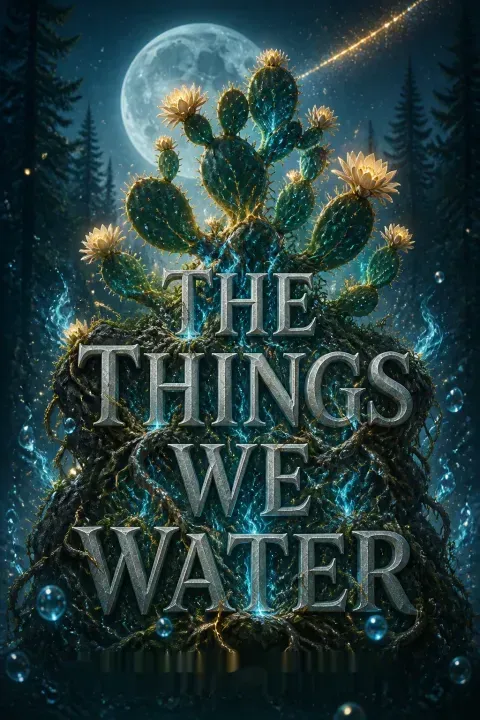
The epilogue transforms the entire novel into a cosmic act of maternal reparation. The three goddesses, revealed as the true architects of Nina and Duncan's journey, recast apparent coincidences (the ranch's existence, the gnomes' arrival, even the meteor itself) as deliberate interventions. Their anonymity is their sacrifice: they forego recognition to ensure their children's children can build lives unburdened by divine expectation. The scene mirrors Nina's own experience, as a woman raised by adoptive parents who never made her feel like a consolation prize. The book's title, 'The Things We Water,' finds its fullest expression here: love, like a garden, requires consistent tending across generations, often by hands that remain unseen.
Analysis
The novel's title, 'The Things We Water,' articulates its central thesis: relationships, like gardens, require consistent, patient nurturing. Over 200,000 words, Mariana Zapata demonstrates that love is not a lightning strike but a slow accumulation of small acts: Nina1 braiding Agnes's4 hair despite being snarled at, Henri2 preparing special breakfasts for the pups, Franklin5 traveling across the continent to identify a stranger's puppy, Nina1 wading into a freezing river for children not her own. Every major bond in the book, from Nina1 and Duncan's3 to Henri2 and Agnes's4 to Franklin5 and his newfound niece, is built through daily, unglamorous tending. The water metaphor extends to the setting itself: the ranch's magic, concentrated around its sacred waterfall and shimmering trees, represents what happens when something is cared for across centuries instead of exploited. Henri's2 family has 'watered' this land for generations, and in return it shelters generations of outcasts. Nina's1 fertility magic literalizes the metaphor: she cannot control it, cannot weaponize it, cannot turn it off. It simply is, creating the conditions under which life might flourish, if others choose to plant seeds. The novel argues that belonging is not inherited but cultivated, and that the families we build through choice can be more real, more nourishing, than the ones assigned by blood.
People Also Read





Characters
Nina Popoca
Death-touched protector and motherNina, 32, was abandoned as a newborn on the doorstep of two elderly werewolves who raised her with unconditional love. Her biological parents, Thanatos9 (death) and Isha (fertility), left her with a dual inheritance: women around her conceive effortlessly, and she can perceive and extinguish the flame of life inside any living being. She wears an obsidian bracelet to suppress her magical signature because many beings recoil from what they sense in her. Despite this power, she is warm, sarcastic, fiercely loyal, and deeply lonely, having spent years moving between campgrounds in an RV to avoid forming attachments that might end in rejection. Her entire moral framework is built around protecting the vulnerable, especially children, and she measures her worth by her capacity to love rather than by what she is.
Henri Blackrock
Great Wolf and reluctant leaderHenri, in his early forties, is the direct descendant of the original Amarok (Great Wolf) and a daughter of Fenrir. He inherited the Colorado ranch, a sanctuary for magical beings, from his older brother, who raised him after their parents left. A sheriff's deputy, Henri has spent his adult life crushed between duty to the community and duty to his job, never allowing himself to want anything personal. He is physically enormous, both as a man and as a wolf, and his presence commands instinctive deference from other werewolves. Beneath his stoic, rule-bound exterior, he possesses a dry wit, deep protectiveness, and a capacity for tenderness that surprises even him. His emotional arc involves learning that wanting something for himself, specifically Nina1, is not a betrayal of his responsibilities.
Duncan
Hellhound pup, Nina's sonDuncan, also called Donut, is a hellhound left as a newborn on Nina's1 camper steps by a mother who never returned. For two years, he appeared to be an ordinary black puppy, albeit one with unusual intelligence and a potent magical aura. On his second birthday, his tail sprouted a blue flame and his eyes turned ruby red. He communicates telepathically, primarily projecting emotions and simple words like 'yes' and 'love.' He is preternaturally calm, emotionally mature for his age, and utterly devoted to Nina1. His bond with her is the novel's emotional center: she is his mother in every way that matters, and he proves repeatedly that he would die to protect her, just as she would for him.
Agnes Blackrock
Abandoned wolf child, later daughterAgnes, an eight-year-old white wolf, is Dominic's8 biological daughter, but he relinquished parental rights. She lives in the clubhouse under the care of rotating nannies, with Henri2 and Franklin5 as her primary emotional anchors. Initially hostile toward Nina1, baring her teeth and refusing affection, she is a child armored by early rejection. Her gradual softening, asking Nina1 to braid her hair, admitting she was scared, and finally calling Nina1 'Mom,' is one of the novel's most carefully paced arcs. She is fierce, fiercely loyal, and a tattletale who will bite first and ask questions later.
Franklin (Hypnos)
Immortal uncle and god of sleepFranklin appears as an elder in his seventies, wearing glasses and tweed, but he is actually Hypnos, the ancient Greek god of sleep, brother to Thanatos9. He has lived for millennia, outliving multiple mortal children, and wears gold-and-obsidian bracelets to suppress his divine aura. He recognized Nina's1 magical signature as his brother's the moment she arrived but kept silent, both to confirm his suspicions and because he feared she would leave if she knew. He is precise, formal, and deeply lonely in a way he rarely acknowledges. His grief over the children he has buried across centuries makes his eventual acceptance of Nina1 as his niece profoundly moving.
Matti and Sienna
Nina's best friends and chosen siblingsMatti, Henri's2 cousin (technically his great-nephew), has been Nina's1 best friend since age three. A playful, mustachioed werewolf who loves city life, food delivery, and his white couch, he functions as Nina's1 emotional anchor and the person who knows her longest. Sienna, his wife and Nina's1 best friend since fifteen, is an iron wolf from old Baltic stock. Together they form the family Nina1 chose long before the ranch. Matti's whispered suggestion that Nina1 marry Henri2, based on the scent of attraction he detected from his cousin, plants the novel's romantic seed. They remain present through calls and visits, representing the love that distance cannot diminish.
Spencer
Grumpy sasquatch with dry hairSpencer is an eight-foot sasquatch permitted to live on the ranch's remote western edge. He has a cabin with solar panels, a refrigerator, and basic satellite TV. He is perpetually angry, insults everyone, and is tolerated because he is lonely and has nowhere else to go. Nina's1 apology for mocking his hair, delivered with a conditioner bar, begins a grudging tolerance between them. He later helps direct Henri2 to the river rescue, proving that even the most prickly beings can become reluctant allies.
Dominic
Bully and failed fatherDominic is Agnes's4 biological father who abandoned her and signed away his rights. A blond werewolf with a permanent chip on his shoulder, he resents Henri's2 authority, intimidates younger or weaker pack members, and serves as the novel's most persistent antagonist. His attempt to bully Nina1 backfires spectacularly when she reveals her death magic, and his final rule-breaking, letting Thanatos9 onto the ranch, results in Henri2 exiling him permanently by hoisting him off the ground by his throat.
Thanatos
Nina's biological father, death godThanatos, the Greek personification of death, is Nina's1 biological father. He met her mother Isha on a cruise ship, spent one night with her, and agreed to give the resulting child away. For thirty years, he made no effort to find Nina1. Only after Franklin5 confronted him did he begin reaching out through dreams, an ability he wields clumsily. He arrives at the ranch uninvited, demanding acknowledgment, but Nina1 refuses him. His character represents the limits of biological obligation: blood does not entitle him to a relationship he never built.
Shiloh and Pascal
Mischievous boys who need rescuingShiloh is a sweet satyr child who cannot keep a secret and thinks Nina1 looks like a forest princess. Pascal is a loud, fearless werewolf boy whose father was a Navy SEAL and who hero-worships Henri2. Together, they repeatedly run off into the dangerous forest, triggering both the Jenny Greenteeth incident and the river rescue. Their misadventures force Nina1 to repeatedly prove her willingness to risk herself for the community's children, earning her the parents' trust and gratitude.
Ilya
Alaskan community leader, firebreatherIlya leads the Alaskan magical community, a newer and smaller settlement than the Colorado ranch. He is blunt, calculating, and not above stirring drama. He offers Nina1 a place in Alaska with more generous mating terms, deliberately provoking Henri's2 possessive instincts. He also arranges the hellhound brothers' visit and, through strategic tip-offs to Thanatos9, helps force the confrontation that allows Nina1 to close the door on her biological past.
Plot Devices
Obsidian Bracelets
Suppress magical signatures and scentFire obsidian beads, when worn, suppress a magical being's distinctive scent and aura, rendering them nearly undetectable to other magical beings. Nina1 has worn one since age sixteen, after a woman threw holy water at her. Duncan3 wears a collar version to hide his hellhound nature. Franklin5 wears gold-and-obsidian bracelets to conceal his divine identity as Hypnos. The bracelets function as both protection and prison, allowing their wearers to pass unnoticed but also preventing genuine connection. Key scenes involve Nina1 removing her bracelet to frighten the Jenny Greenteeth and the bogeymen, and Franklin5 removing his to reveal his true nature to his niece.
The Three-Month Trial Period
Delays marriage, drives romantic tensionThe ranch community requires all new adult residents to complete a three-month trial period before being offered permanent membership, which includes the marriage requirement. This rule was established after too many newcomers left abruptly, sometimes stealing property. The trial period forces Nina1 to wait before courting potential mates and, crucially, prevents Henri2 from acting on his feelings. His insistence on following the rule, even as he grows increasingly possessive, creates the central romantic conflict. The device also explains why the community keeps Nina1 at arm's length initially, not from prejudice but from self-protection against repeated abandonments.
The Sacred Waterfall
Hidden site for mating ceremoniesDeep in the forest lies a waterfall fed by a river that never weakens, its boulders glowing with pink and purple bioluminescence caused by the ancient meteor's magic. The trees around it have twisted, iridescent trunks found nowhere else on Earth. Only community members who have passed the trial period are permitted to see it. Mating ceremonies are performed at its base under a full moon, with attendees swearing oaths of secrecy. Henri2 takes Nina1 there to propose, and their mating ceremony occurs there weeks later. The waterfall represents the sacred core of the ranch, a beauty that must be earned through commitment.
Telepathic Communication
Enables Duncan and Nina to bond across speciesDuncan3 communicates telepathically from birth, a gift inherited from his hellhound mother. Initially limited to projecting emotions and simple words like 'yes' and 'love,' his ability strengthens with age. By the novel's end, he can form short sentences. The telepathy allows Nina1 to understand Duncan's3 needs, consent, and emotional state, forming a bond that transcends the limitations of interspecies communication. His mother used the same ability to command Nina1 to care for him. The hellhound brothers also possess this gift, using it to speak privately with their youngest sibling.
Dream-Walking
Thanatos reaches Nina across impossible distanceThanatos9, as god of death, can project his voice into the dreams of others, though he lacks finesse with the ability. He used it to visit Nina1 sporadically throughout her childhood before her obsidian bracelet blocked him. When Franklin5 informs him of Nina's1 location, Thanatos9 resumes calling, but without her bracelet, he can only broadcast broadly, waking multiple people in the clubhouse. Franklin5 describes it as 'screaming into the abyss,' a sledgehammer approach to a gift Thanatos9 never mastered. The dream invasions function as both a source of fear for Nina1 and a catalyst that forces her to confront her origins.




Download PDF
Download EPUB
.epub digital book format is ideal for reading ebooks on phones, tablets, and e-readers.








































