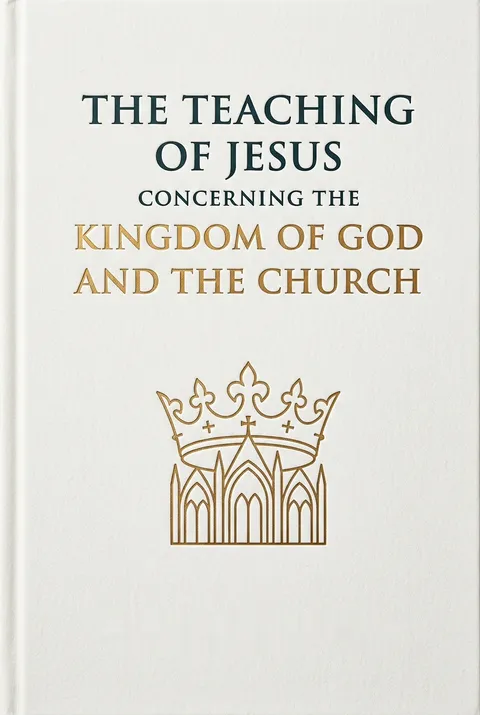

Key Takeaways
1. The Kingdom of God: A Unified, Supernatural Revelation
In the first place, the kingdom-conception involves the historic unity of Jesus’ work with the Old Testament work of God.
Historical continuity. Jesus' teaching on the Kingdom of God is not a radical departure but a fulfillment of Old Testament prophecy. He consciously built upon the ancient revelation given to Israel, seeing his work as the culmination of a single, overarching divine scheme. This perspective challenges both fundamentalist views that separate old and new covenants and modernist interpretations that deny Jesus' self-awareness of this unity.
Supernatural foundation. The Kingdom of God is fundamentally a supernatural reality, not merely a set of subjective ideas or experiences. It signifies the renewal of the world through the introduction of divine forces, demonstrating God's active intervention in history. This objective, supernatural dimension distinguishes Jesus' teaching from liberal theological attempts to reduce Christianity to a subjective, ethical system.
Beyond human effort. The Kingdom's arrival and realization are ultimately God's work, not man's. While human participation is called for, the power and grace that establish and sustain the Kingdom originate from God alone. This emphasis underscores that salvation is a divine gift, not a product of human striving or self-righteousness, aligning with the core evangelical message.
2. God's Absolute Supremacy: The Kingdom's Core Purpose
In this respect the kingdom is the most profoundly religious of all biblical conceptions.
God-centered purpose. At its core, the Kingdom of God is a God-centered conception, where everything converges and tends towards God as the highest good. Jesus taught that the ultimate purpose of the Kingdom, and indeed all of salvation, is to glorify God, not merely to benefit humanity. This perspective requires viewing the world and life from the standpoint of their subservience to divine glory.
Supreme pursuit. Because the Kingdom is centered in God himself, Jesus presents it as the supreme object of human pursuit, transcending all earthly concerns. Seeking the Kingdom is, at its deepest level, seeking God himself, aligning with the greatest commandment to love God with all one's heart, soul, strength, and mind. Any lower conception would interpose another object between God and man's ultimate aspiration.
Divine prerogative. The name "Kingdom of God" itself signifies that God is the supreme and controlling factor, exercising his glorious prerogatives of kingship. This includes his right to rule, his active power in salvation, and his role as Lawgiver and Judge. The Kingdom exists where God supernaturally carries through his supremacy against all opposing powers and brings humanity to a willing recognition of his reign.
3. The Kingdom: A Present Spiritual Reality and Future Consummation
There is one continuous kingdom-forming movement which first lays hold upon the inward spiritual center of life by itself, and then once more seizes the same in connection with its external visible embodiment.
Dual reality. Jesus taught that the Kingdom of God is both a present, internal, spiritual reality and a future, external, eschatological consummation. It began with his public ministry, manifesting in spiritual changes and the defeat of Satan's power, but will reach its full, absolute form at the end of the world with his second coming. This "now and not yet" dynamic is crucial for understanding Jesus' teaching.
Gradual and sudden. The present Kingdom comes gradually and imperceptibly, like a growing seed or leaven, transforming hearts and spreading its influence. However, its final consummation will be a sudden, supernatural world-crisis, a "palingenesis" or regeneration, involving cosmic changes that no spiritual force alone can produce. This distinction avoids the errors of both purely immanent (gradual evolution) and purely eschatological (only future, no present impact) views.
Infallibility preserved. Recognizing both aspects of the Kingdom preserves the infallibility of Jesus' teaching. He did not err in expecting the Kingdom to come within his generation, as it began spiritually through his work. Yet, he also clearly anticipated a future, visible, and complete manifestation. This two-sidedness reflects his Messianic consciousness: a humble earthly ministry and a glorious reign from heaven.
4. Jesus' Kingdom: Transcending Limited Jewish Expectations
It was little more than the name that Jesus borrowed from the kingdom-expectation of Judaism; whatever of the content of his own kingdom-teaching he had in common with the eschatological belief of his time belonged to the purer and nobler type of Jewish eschatology, that built up around the idea of “the coming age.”
Spiritual over political. Jesus profoundly transformed the prevailing Jewish understanding of the Kingdom, which was often intensely political, nationalistic, and even sensual. He completely dissociated his teaching from political ambitions, emphasizing a spiritual conflict against Satan and sin, rather than Israel versus Rome. His Kingdom is not of this world in its origin or primary nature.
Universal scope. While Jesus initially focused his ministry on the "lost sheep of the house of Israel," his teaching clearly anticipated the rejection of many Jews and the widespread extension of the gospel to the Gentiles. His "intensive universalism" sought to save the "man" in the Jew, applying principles of righteousness and salvation applicable to all humanity, regardless of race or caste.
Beyond sensualism. Jesus' Kingdom transcends the sensualistic elements often prominent in Jewish expectations of the Messianic age. While he used figures of eating, drinking, and inheriting the earth, these were metaphorical, pointing to objective, external realities of a higher plane where the body would have its part, but without the limitations of earthly senses. He explicitly taught that some sensual enjoyments of this life would cease in the world to come.
5. The Kingdom's Essence: Divine Power, Righteousness, and Blessedness
The kingdom is a conception which must of necessity remain unintelligible and unacceptable to every view of the world and of religion which magnifies man at the expense of God.
Divine power. The Kingdom of God is fundamentally a sphere of divine power, manifested in acts of conquest over Satan, demons, sin, and evil. Jesus' miracles were not merely authenticating signs but direct manifestations of this Kingdom-power, demonstrating that the forces to revolutionize heaven and earth were already at work. This power is both destructive to God's enemies and liberating, healing, and saving for humanity.
Divine righteousness. The Kingdom is also a sphere of divine righteousness, where God's will is perfectly fulfilled and his legislative and judicial authority are exercised. Jesus' teaching on righteousness, far from being a mere ethical code, is deeply religious and God-centered, demanding an inner moral conduct that reflects God's holy nature. This righteousness is both a state to be achieved through repentance and a blessing bestowed by God's grace.
Divine blessedness. Finally, the Kingdom is a sphere of divinely bestowed blessedness, representing the greatest conceivable happiness for man. This blessedness, a gift from the Father, includes the forgiveness of sins, the gift of righteousness, and the profound joy of sonship and eternal life—a life of intimate communion, knowledge, and love with God. This ultimate blessedness is the culmination of God's gracious purpose for humanity.
6. The Church: The Kingdom's Visible Embodiment and Expression
It must be possible, this much we may confidently affirm, to call the church the kingdom.
New congregation. The Church, first formally introduced by Jesus after Peter's confession, is the new congregation of God, taking the place of the old Israelite assembly. It is built by Jesus' Messianic acts—his death, resurrection, and exaltation—and stands under his Messianic rule. This signifies a shift from a national, ethnic identity to a community defined by faith in Jesus as the Messiah.
Visible embodiment. The Church serves as a veritable, visible embodiment of the Kingdom of God on earth. While the invisible church (the regenerate) is identical in extent with the Kingdom, the visible church provides an organized expression of Kingdom-life and power. Jesus' conferral of the "keys of the kingdom of heaven" to Peter, symbolizing administrative authority, underscores the Church's role as the Kingdom's earthly manifestation.
Supernatural power. The Church, as the Kingdom's form, receives a new influx of supernatural power, particularly through the indwelling of the Holy Spirit. This power, evident in extraordinary manifestations in the early church, makes it more than the immanent kingdom that existed before Jesus' exaltation. It forms an intermediate link between the present life and eternity, possessing the "powers of the world to come."
7. Entrance to the Kingdom: Repentance and Faith
Repentance and faith are simply the two main aspects of the kingdom, righteousness and the saving grace of God, translated into terms of subjective human experience.
Repentance: turning to God. Repentance is an indispensable prerequisite for entering the Kingdom, reflecting its essence as a kingdom of righteousness. It involves a profound, comprehensive change of the entire person—intellect, will, and affections—turning away from self and the world to the absolute supremacy and service of God. This God-centered sorrow over sin and spiritual destitution is exemplified by the prodigal son's return.
Faith: receiving God's grace. Faith is the responsive and receptive attitude required to share in the Kingdom's benefits, reflecting its essence as a kingdom of divine saving grace and power. It is a recognition of God's almighty power and gracious willingness to save, involving not just intellectual conviction but also the movement of the will and affections, culminating in personal trust in God and in Jesus as his representative.
Divine gift and human response. Both repentance and faith, while demanded of humanity, are ultimately divine gifts. Jesus taught that faith is not an arbitrary human endeavor but a work of God in man, enabling the individual to lay hold of God's exhaustless power. This divine initiative ensures that salvation remains God-centered, even as it calls for a radical human response.
8. Kingdom of God vs. Kingdom of Heaven: Emphasizing Divine Majesty
If the king be one who concentrates in himself all the glory of heaven, what must his kingdom be?
Synonymous terms. While "Kingdom of God" and "Kingdom of Heaven" are largely synonymous in Jesus' teaching, the latter, primarily used by Matthew, carries an added nuance. It reflects a Jewish custom of substituting "heaven" for "God" to emphasize divine exaltation and unapproachable majesty, a practice Jesus adopted not out of superstition but to evoke profound reverence.
Supernatural character. The phrase "Kingdom of Heaven" was intended by Jesus to color the conception of the Kingdom itself, highlighting its mysterious, supernatural character, absolute perfection, and grandeur. It draws man's thought upwards to the celestial regions where God reveals his glory in perfection, implying that the new order of things is of supreme value and originates from the higher, divine world.
Heavenly Father. This emphasis on "heaven" is also seen in the phrase "the Father in heaven," where "in heaven" reminds us of God's infinite majesty, balancing the condescending love expressed by "Father." Thus, "Kingdom of Heaven" means not just God's Kingdom in general, but God's Kingdom as known and revealed in those celestial realms, underscoring its transcendent and ideal nature.
9. The Kingdom's Pervasive Dominion: All Life for God's Glory
It proclaims that religion, and religion alone, can act as the supreme unifying, centralizing factor in the life of man, as that which binds all together and perfects all by leading it to its final goal in the service of God.
Total devotion. The concept of the Kingdom of God implies the subjection of the entire range of human life, in all its forms and spheres, to the ends of religion. It demands absolute, pervasive, and unrestricted dominion for true religion, requiring complete devotion to God in everything that is done. This service to the living God is presented as the only source of ultimate meaning and value in life.
Beyond the visible church. While the visible church is a primary manifestation of the Kingdom, it is not the only one. Jesus' teaching, particularly through parables like the leaven, suggests that the kingship of God is intended to pervade and control all legitimate spheres of human life: science, art, family, state, commerce, and industry. When these spheres come under the controlling influence of divine supremacy, the Kingdom of God becomes manifest within them.
Regenerated life. This broader manifestation of the Kingdom in culture and society, however, is not achieved by making all spheres of life subject to the visible church, as in the Old Covenant theocracy. Instead, these "Christian" expressions (e.g., Christian state, art, science) must grow out of the regenerated life of the invisible church, standing in living contact with the supernatural forces introduced by the Spirit of God.
Review Summary
Reviews for The Teaching of Jesus Concerning the Kingdom of God and the Church are largely positive, averaging 4.04 out of 5. Readers praise Vos's masterful, scripturally grounded treatment of the Kingdom of God, his balanced exegesis, and his pioneering articulation of inaugurated eschatology decades before scholars like Ladd popularized it. Many note the book's dense, demanding writing style, making it challenging for laypeople. Several reviewers highlight its enduring relevance, with some reading it annually per Ned Stonehouse's recommendation, while a few critics find it dated or insufficiently developed on certain theological distinctions.
People Also Read

Download PDF
Download EPUB
.epub digital book format is ideal for reading ebooks on phones, tablets, and e-readers.








































