

Key Takeaways
You can't act like Jesus on command without training like Jesus daily
The secret of the easy yoke. Willard's central image is the athlete. Teenagers who copy their idol's batting stance during the game will still strike out, because the star's excellence comes from an unseen daily regimen of diet, rest, and drills. The performance rests on preparation. Christians make the identical mistake: they try to turn the other cheek or love enemies in the heat of the moment while living the rest of life exactly like everyone else.
Jesus himself prepared through solitude, fasting, and prayer, mostly out of public view. His famous compassion flowed from that hidden life. Following him means adopting his whole lifestyle, not mimicking his crisis behavior. Willard reframes the popular slogan: asking "What would Jesus do?" mid-crisis is not enough without the training that makes right action natural.
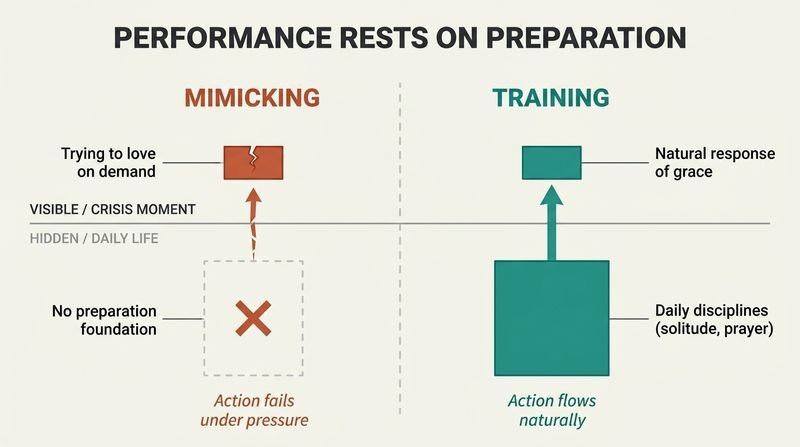
The athletic analogy is now cognitive science orthodoxy. Anders Ericsson's research on deliberate practice shows expert performance is built in unglamorous repetition, not summoned in the moment. Willard extended this to spiritual formation decades before "habit" books flooded shelves. What's striking is his target: he accuses evangelical Christianity of a magical belief that grace "infuses" strength on demand. The parallel to Aristotle's virtue ethics is direct: we become just by doing just acts until they become second nature. The weakness is measurability. Athletic gains are testable; Christlikeness is not, which makes the training regimen harder to calibrate or falsify.
Salvation is a new kind of life, not merely forgiven sins
Redefining what "saved" means. Willard argues Western Christianity shrank salvation down to a legal transaction: sins forgiven, heaven guaranteed, life untouched until death. He traces this to a historical drift. The New Testament word for salvation is simply "life," and the resurrection, not the crucifixion, was the early church's electrifying center, because it proved the vibrant Kingdom-life Jesus lived could not be killed.
He cites art historian Kenneth Clark's observation that the cross emerged as a dominant Christian symbol surprisingly late. As eyewitnesses to Jesus's transcendent life died off, the church narrowed its gospel to a ticket to the afterlife. Willard's fix: redemption is God imparting a seed of new life now, from which obedience and transformation grow naturally, the way blossoms come from a planted seed rather than being stapled on afterward.
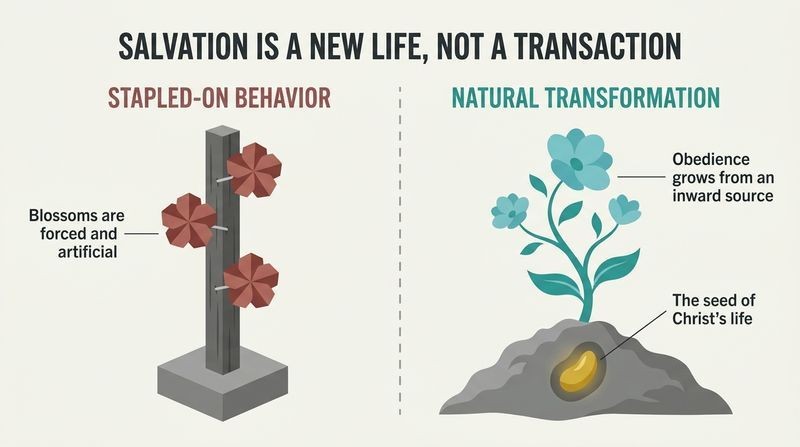
This is Willard's most consequential theological move, and it anticipates the "gospel of the Kingdom" recovery later championed by N.T. Wright and Scot McKnight. The critique of "cheap grace" echoes Bonhoeffer, whom Willard cites. What deepens his version is the diagnosis: he blames the loss not on laziness but on a mistaken theory of salvation that logically excludes daily life from redemption. A fair challenge: Reformation theologians would counter that justification and sanctification are distinct precisely to protect grace from works-righteousness. Willard's rejoinder, borrowing Luther's own words, is that living faith produces works as inevitably as fire produces heat.
Your body is the primary battlefield and instrument of spiritual growth
No body, no power. Willard insists spirituality is not a disembodied inner state. God gave humans bodies as their "primary area of power, freedom, and responsibility," the storehouse of the limited independent energy that lets us resemble and cooperate with God. Character, he argues, is nothing but the pattern of habitual ways a person carries and uses their body.
This is why the disciplines all involve concrete bodily actions. Sin gets embedded in our physical habits through years of living in a world set against God, which is why conversion of the will does not instantly change behavior. Simon Peter's hand grabbed a sword and his tongue denied Christ automatically, against his sincere intentions. The disciplines retrain the "flesh" (our body's ingrained tendencies, not evil matter) to serve righteousness as automatically as it once served sin.
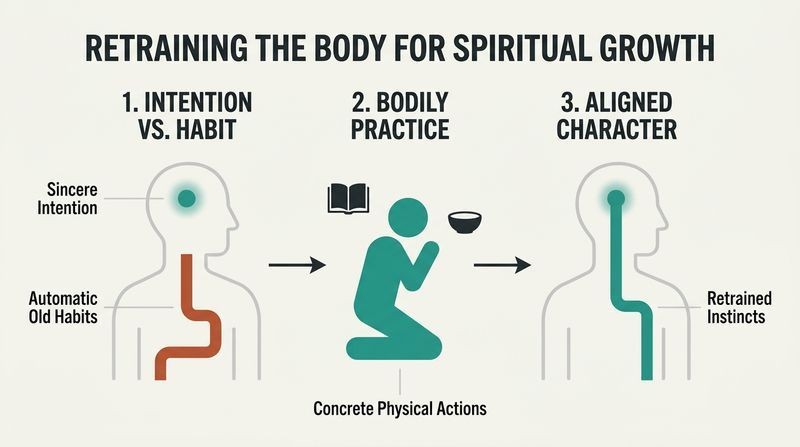
Willard's embodiment thesis has aged remarkably well. Contemporary neuroscience on habit formation (Ann Graybiel's basal ganglia research) confirms that repeated actions carve automatic pathways largely independent of conscious intention, precisely Peter's predicament. Embodied cognition research (Lakoff, Damasio) further dissolves the mind-body split Willard attacks. His reading of "flesh" as ingrained tendency rather than sinful matter is exegetically careful and rescues Christianity from the body-hatred that plagued monasticism. The interesting tension: he leans on both dualist language (spirit interacting with body) and anti-dualist embodiment, a philosophically unstable but pastorally rich middle position that mirrors debates still unresolved in philosophy of mind.
Master the discipline you're worst at, not the one you enjoy
Spiritual strength means needing the disciplines less. Willard offers a striking rule of thumb: the disciplines you should practice are the ones you are not good at and do not enjoy. Ease is a sign you do not need it. He invokes baseball's Pete Rose, who said he practiced what he was bad at while most people practice what they are already good at.
Crucially, Jesus was a master of the spiritual life precisely because he had little need to practice disciplines extensively while maintaining full spiritual vitality. The goal is not to become an ascetic superstar. The person heavy on disciplines is revealing weakness, not superiority. This was the fatal error of Western monasticism, which turned means into ends and produced competitive austerity: monks living on pillars for thirty years, vying for championships in self-punishment.
This inverts the intuitive scorekeeping of religious performance and aligns with modern skill acquisition: growth happens at the edge of incompetence, not in the comfort zone. Willard's warning against "asceticism for asceticism's sake" is essentially a critique of what psychologists call functional autonomy, where a means detaches from its original goal and becomes self-justifying (the miser who forgets money buys things). The bodybuilder chasing muscle for its own sake is his sharp secular parallel. One caveat: diagnosing which disciplines you "need" requires self-knowledge that the unformed self may lack, creating a bootstrapping problem Willard underplays.
Solitude and silence are the foundation that make every other discipline work
The disciplines of abstinence. Willard sorts practices into two groups. Disciplines of abstinence (solitude, silence, fasting, frugality, chastity, secrecy, sacrifice) counter sins of commission by freeing us from cravings. Disciplines of engagement (study, worship, celebration, service, prayer, fellowship, confession, submission) counter sins of omission by filling us with God. He calls them the outbreathing and inbreathing of spiritual life.
Solitude is primary. Willard cites a chilling experiment: it takes about twenty times more amphetamine to kill an isolated mouse than one in a group, and a drug-free mouse dropped among drugged ones dies within minutes. Our conformity to social patterns is as deadly. Only by withdrawing from the constant interaction that locks us into godless patterns can we gain the perspective to be free. Silence then makes solitude real.
The abstinence/engagement structure is genuinely useful diagnostically: it maps your spiritual gaps onto specific practices rather than vague resolve. The mouse experiment (Lasagna and McCann's crowding studies) dramatizes social contagion, and it foreshadows modern findings on peer effects, from obesity clustering (Christakis and Fowler) to smartphone-driven anxiety. Solitude as freedom-from-conformity resonates with Hannah Arendt's account of thinking as an inner dialogue requiring withdrawal. The risk Willard acknowledges: solitude "cracks open" the self and can be destabilizing. Modern retreat culture often sells solitude as relaxation, precisely the sentimentalizing he warns against. Real solitude confronts the haunted abysses within.
Redemption runs through three stages: die to sin, reckon, then submit your body
Paul as master psychologist. Willard reads Romans 6-7 as a practical psychology of change, not abstract theology. Stage one: baptism into Christ gives you a genuine alternative to sin's motivational system, so you are no longer forced to run on it. Stage two, "reckoning": you consciously and repeatedly regard yourself as dead to sin, actively dismissing wrong thoughts before they take root. Luther's image: you cannot stop birds flying overhead, but you can stop them nesting in your hair.
Stage three: you deliberately direct your bodily members toward righteous action until it becomes automatic. Oswald Chambers put it bluntly: God regenerates us and supplies the resources, but he cannot make us walk, the practicing is ours. When crisis hits, only a nature already trained through practice will hold, because grace works through, not instead of, our prepared bodies.
Willard's reading of "reckoning" as thought-dismissal is essentially cognitive-behavioral therapy avant la lettre, and he says so, citing the fourth-century monk Evagrius on intercepting thoughts before they set passions in motion. Modern CBT (Beck, Burns) rests on the identical premise: moods follow cognitions, and you can interrupt the chain. This convergence between desert asceticism and clinical psychology is remarkable and lends empirical weight to a 1600-year-old practice. The three-stage model also resembles relapse-prevention frameworks in addiction treatment. Where it strains: "reckoning yourself dead to sin" assumes a metaphysical reality (union with Christ) that does the motivational heavy lifting, which secular CBT cannot borrow.
Poverty isn't holy; managing wealth well is the harder spiritual discipline
Stewardship over idealized poverty. Willard attacks the romantic assumption that being poor makes one holier or closer to God. He distinguishes three things constantly confused: possessing riches, using riches, and trusting in riches. Only trust is the spiritual danger, and the poor often love and trust money more desperately than the rich do. Giving away everything ends your capacity to give again; if giving is good, having is good.
He skewers John Wesley, who despaired that his converts grew prosperous and corrupt yet could imagine no solution except giving it all away. Willard's alternative: the world's wealth does not vanish when the godly abandon it, it just falls to the servants of mammon. The real calling is producing mature people who can own and direct wealth without being owned by it, treating running a bank or factory as holy work.
This is Willard's most countercultural chapter and his boldest challenge to both liberation theology (he names Cardenal and MacIntyre) and pietist asceticism. The possession/use/trust distinction is analytically clean and defuses a lot of guilt-driven confusion. His point that abandoning wealth simply transfers it to worse stewards is a genuine insight economists would recognize as a counterfactual reasoning error in naive charity. The vulnerability: Willard underestimates how possession itself shapes character through what behavioral economists call endowment effects and status competition. Jesus's warning about the camel and the needle suggests the danger is more structural than Willard's "attitude is all" framing allows.
Monasticism poisoned the disciplines by tying them to merit and body-hatred
Why we inherited a prejudice. Willard explains our modern allergy to spiritual disciplines historically. Genuine asceticism, from the Greek for athletic training, simply means adapting suitable means to a valuable end. There is nothing body-hating or merit-earning in the concept. But after Constantine legalized Christianity in 311 and discipleship grew comfortable, zealous believers fled to the desert, and the disciplines got fused with earning forgiveness and punishing the "vile" body.
The result was grotesque: self-flagellation, hair shirts, competitive austerity. Protestantism then overreacted, rejecting disciplines wholesale as "works" that threaten salvation by grace. David Hume's contemptuous list of "monkish virtues" captured the Enlightenment verdict. Both sides missed that Jesus and Paul were ascetic (fasting, solitude, sacrifice) but never monkish, standing firmly in the world rather than fleeing it. Their disciplines were exercise unto godliness, not payment for sin.
Willard's genealogy is essentially a Nietzschean move turned constructive: he traces a concept's degradation to recover its original force. The linguistic recovery of askesis as training (shared root with athletics) is legitimate and important. His even-handedness is notable: he blames both monastic excess and Protestant overcorrection, refusing the easy tribal answer. The historical sweep occasionally flattens nuance (Benedictine monasticism was far more balanced than the pillar-saints he spotlights, as he partly concedes). Still, the core claim holds up against scholarship: the association of asceticism with masochism is a modern caricature. Margaret Miles, whom he quotes, made the same recovery argument in academic religious studies.
Society's evils rest on ordinary decent people's readiness to harm
Why we ask "why?" at atrocity. Willard's social theory locates mass evil not in monsters or ideology but in the ever-present readiness of normal, decent people to hurt others when security, ego, or desire is threatened. This readiness lies around us like flammable material. Wrath, a brother of revenge, is the detonator: an unrestrained impulse to harm that self-justifies through the sense of having been wronged.
Structural evils (corrupt business, discrimination, war) depend entirely on this individual readiness pooling into waves too large to control. His radical claim: if even a large percentage of people were constitutionally truthful, lying would collapse, because deceit depends on collusion. The kingdom of evil is structurally weak, resting on lies. This is why social reform alone fails, one oppressor replaces another, and why transformed character distributed through society is the only real solution.
Willard converges with Hannah Arendt's "banality of evil": atrocity is committed by ordinary people, not sadists. His emphasis on "readiness" anticipates situationist social psychology, Milgram's obedience experiments and Zimbardo's prison study, where decent participants harmed others under the right conditions. The claim that evil is structurally weak because it depends on lies is optimistic and echoes Havel's "living in truth" and Solzhenitsyn's refusal to participate in falsehood. The contestable part is his individualist reduction: he risks underweighting how institutions manufacture the very readiness he describes, a chicken-and-egg problem. Reform and formation are likely co-dependent, not sequential as he sometimes implies.
Discipleship is basic Christianity, not an advanced optional upgrade
The great omission. Willard's punchiest polemic: modern churches made following Jesus optional. You can convert, join, and stay a member for life with no expectation of becoming like Christ. He notes "disciple" appears 269 times in the New Testament and "Christian" only three times, first coined simply to describe disciples. The disciple is not the deluxe model of Christian; it is basic transportation.
He reframes the famous "cost of discipleship" (Bonhoeffer) with its neglected inverse: the cost of nondiscipleship. Not following Jesus costs peace, love, faith, hope, and power to withstand evil, the very abundance Jesus promised, even in this life. A disciple today is simply someone who, having counted the cost, arranges their whole life around becoming like Christ, the way an apprentice reorganizes life around a master. His license-plate summary of Paul: "Follow me. I'm found."
The word-count statistic is rhetorically devastating and factually correct, and it exposes how thoroughly "discipleship" got demoted to a specialty track. Willard's "cost of nondiscipleship" reframe is his most quotable contribution and has since become standard vocabulary in spiritual-formation circles. The move parallels secular arguments that treating excellence as optional guarantees mediocrity. A sharp reader might press: if discipleship is truly basic, why did Jesus himself speak of counting the cost as if it were demanding? Willard's answer is that the difficulty is front-loaded and the yoke becomes easy, but the empirical rarity of transformed Christians he keeps citing sits uncomfortably with his claim that the path is accessible to all.
Analysis
Dallas Willard's 1988 work is a philosophy professor's intervention into a pastoral crisis. Trained in phenomenology and analytic philosophy at USC, Willard brought unusual rigor to a genre prone to sentimentality. The book is thesis-driven: it argues that spiritual transformation is a learnable, embodied, psychologically intelligible process, and that Western Christianity abandoned this knowledge through a series of historical accidents. Its difficulty for summarizers is that Willard buries actionable insight inside dense theological anthropology (chapters 4-6 on human nature, which he invites less patient readers to skip).
The book's enduring significance lies in three moves. First, it recovered "Kingdom of God" theology and lifestyle discipleship a decade before these became mainstream in evangelical and mainline conversation, seeding a spiritual-formation movement that runs through Richard Foster (his friend and collaborator), John Ortberg, and beyond. Second, it insisted on embodiment against centuries of Christian dualism, a position now vindicated by embodied-cognition research and habit neuroscience. Third, it treated Paul as a psychologist of change, producing a three-stage model that anticipates cognitive-behavioral therapy with uncanny precision, a convergence between fourth-century desert monks and twentieth-century clinicians that Willard explicitly flagged.
The book's limits are worth naming. Willard's confidence that transformed individuals distributed through society (his Mosaic "system of judges" model) will dissolve structural evil is politically thin; it underweights how institutions shape the very individuals he wants transformed. His near-total subordination of social reform to personal formation reads as a product of its Reagan-era American context. And the persistent gap between his claim that the easy yoke is accessible to all and his repeated lament that transformed Christians are vanishingly rare is never fully resolved.
Still, as a diagnosis of why belief so rarely produces change, and a prescription rooted in training rather than trying harder, the book remains a landmark. Its core insight, that we do not rise to our intentions but fall to our level of preparation, transcends its religious frame.
Review Summary
The Spirit of the Disciplines is a thought-provoking book that explores the importance of spiritual disciplines in Christian life. Willard argues that these practices are essential for character transformation and deepening one's relationship with God. While some readers found the philosophical content challenging, many praised Willard's insights on incorporating disciplines into daily life. The book emphasizes the connection between body and spirit, challenging modern Christianity's approach to spiritual growth. Reviewers appreciated Willard's perspective on poverty, wealth, and power, finding the book both intellectually stimulating and practically applicable.
People Also Read







FAQ
What's The Spirit of the Disciplines about?
- Focus on Transformation: The book explores how spiritual disciplines can lead to genuine transformation in a person's life, emphasizing the need for Christianity to guide humanity effectively.
- Practical Faith Application: Willard argues that understanding and practicing disciplines like solitude, prayer, and fasting are essential for living a Christ-like life.
- Body and Spirit Integration: The author highlights the importance of the body in spiritual life, asserting that the body is integral to spiritual practices.
Why should I read The Spirit of the Disciplines?
- Deepen Your Faith: The book provides insights into deepening your relationship with God through practical disciplines, making it a valuable resource for spiritual growth.
- Address Modern Challenges: Willard addresses the disconnect many feel between faith and daily life, offering ways to integrate spirituality into everyday actions.
- Historical Context: It places spiritual disciplines within a historical framework, helping readers understand their significance in both ancient and modern Christianity.
What are the key takeaways of The Spirit of the Disciplines?
- Disciplines Are Essential: Spiritual disciplines are not just historical practices but are crucial for a fulfilling Christian life.
- Holistic Spirituality: Willard emphasizes integrating body, mind, and spirit, advocating for a balanced approach to spirituality.
- Transformation Through Practice: Consistent practice of disciplines leads to a deeper understanding of God's presence in our lives.
What specific spiritual disciplines does Willard discuss in The Spirit of the Disciplines?
- Disciplines of Abstinence: These include solitude, silence, fasting, frugality, chastity, secrecy, and sacrifice, helping individuals focus on their relationship with God.
- Disciplines of Engagement: Practices like study, worship, celebration, service, prayer, fellowship, confession, and submission engage believers actively in their faith.
- Purpose of Disciplines: Each discipline serves to deepen one's connection with God and enhance spiritual growth.
How does The Spirit of the Disciplines define spiritual life?
- Life as Relationship: Willard defines spiritual life as an ongoing relationship with God, emphasizing that salvation is a continuous journey.
- Body and Spirit Integration: Spiritual life involves the whole person, with the body being the focal point of human existence.
- Active Participation: It requires active participation in God's Kingdom, developing a sound theology of the spiritual life.
What role does the body play in spiritual disciplines according to The Spirit of the Disciplines?
- Body as Instrument: The body is essential for spiritual practices, serving as an instrument for righteousness.
- Embodiment of Spirituality: Spiritual life cannot be separated from bodily existence, as the body is the primary field of power and freedom.
- Transformation Through Action: Engaging the body in spiritual disciplines leads to transformation and a deeper connection with God.
How can I apply the teachings of The Spirit of the Disciplines in my daily life?
- Establish a Routine: Incorporate spiritual disciplines into your daily routine, such as setting aside time for prayer and solitude.
- Engage in Community: Participate in a faith community that encourages the practice of spiritual disciplines for mutual support.
- Reflect on Actions: Regularly assess how your actions align with your spiritual goals to foster a deeper relationship with God.
What is the significance of solitude in The Spirit of the Disciplines?
- Foundation for Growth: Solitude is essential for spiritual growth, allowing individuals to connect deeply with God away from distractions.
- Preparation for Service: It prepares individuals for effective service, as seen in Jesus' practice of seeking solitude before ministry.
- Inner Strength: Solitude fosters inner strength and clarity, enabling individuals to face challenges with renewed purpose.
How does The Spirit of the Disciplines address the concept of grace?
- Grace as Empowerment: Grace is not just about forgiveness but also about empowerment to live a transformed life.
- Active Participation: Readers are encouraged to actively participate in grace through spiritual disciplines, facilitating a deeper relationship with God.
- Transformation Through Grace: True transformation comes from engaging with God's grace, learning from Christ how to live fully.
How does Willard view the relationship between grace and discipline in The Spirit of the Disciplines?
- Interconnectedness: Grace and discipline are not opposing forces but work together in a believer's life.
- Role of Discipline: Engaging in spiritual disciplines opens individuals to receive God's grace more fully.
- Transformation through Grace: God's grace transforms lives, with discipline being the means to align with that transformative power.
What are the best quotes from The Spirit of the Disciplines and what do they mean?
- "Christianity has not so much been tried and found wanting, as it has been found difficult and left untried.": Suggests that many dismiss Christianity not because it fails, but because they do not fully engage with its teachings.
- "The secret of the easy yoke is simple...to live as Jesus lived in all aspects of his life.": Emphasizes adopting Jesus' lifestyle for true discipleship.
- "The disciplines for the spiritual life are at the heart of the gospel.": Underscores the necessity of spiritual disciplines in achieving a genuine Christian life.
How does The Spirit of the Disciplines address the concept of asceticism?
- Clarifying Asceticism: Willard clarifies that asceticism is about disciplined effort to attain spiritual goals, not self-denial for its own sake.
- Biblical Examples: Provides examples from biblical figures who practiced ascetic disciplines, serving as models for integrating asceticism into faith.
- Balance in Practice: Emphasizes that ascetic practices should lead to greater love and service, cultivating a heart that reflects God's love.
About the Author
Other books by Dallas Willard






Download PDF
Download EPUB
.epub digital book format is ideal for reading ebooks on phones, tablets, and e-readers.








































