

Key Takeaways
Aim to become a functional 7 socially, not a flawless 10
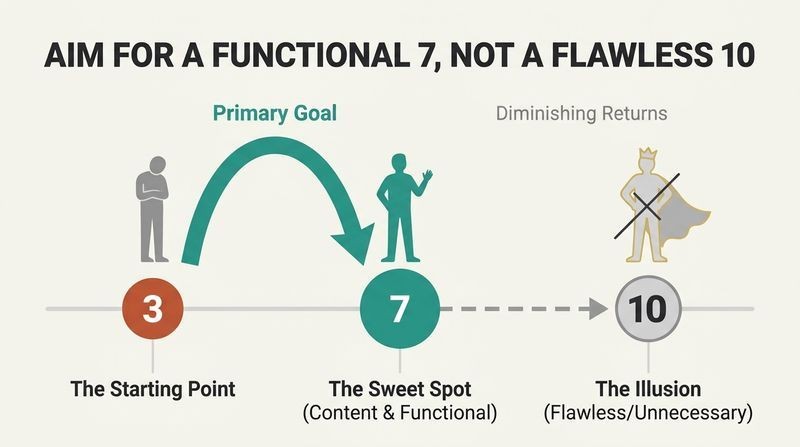
The book targets catching up, not superpowers. Chris MacLeod, who struggled socially in his youth, wrote the guide he wished he'd had. His explicit goal is moving you from an unhappy 3 to a content, functional 7 or higher, not teaching secret CEO handshake tricks. Charismatic people aren't wizards with hidden techniques; they simply execute the same fundamentals slightly better than average.
Social skills are skills, so they take time. Expect one to three years if you're behind across the board, because you've simply logged fewer social hours than your peers. Like learning guitar, the first month hurts and the six-month mark feels far easier. There's no confidence hack or magic formula; if shortcuts existed, they'd be common knowledge and this book wouldn't need to exist.
What's refreshing here is the deliberate deflation of expectations. Most social advice sells transformation; MacLeod sells competence. This aligns with deliberate-practice research from Anders Ericsson: expertise comes from accumulated, effortful reps, not epiphanies. The guitar analogy also maps onto the psychological concept of automaticity, where conscious effort gradually becomes unconscious fluency. One nuance worth adding: the 1-3 year estimate can itself discourage, and research on self-efficacy suggests early small wins matter more than accurate timelines for sustaining motivation. The honest framing is a feature, though, because false promises of instant change produce the very discouragement that makes people quit.
Fix the genuine problems, but refuse to sand off your personality
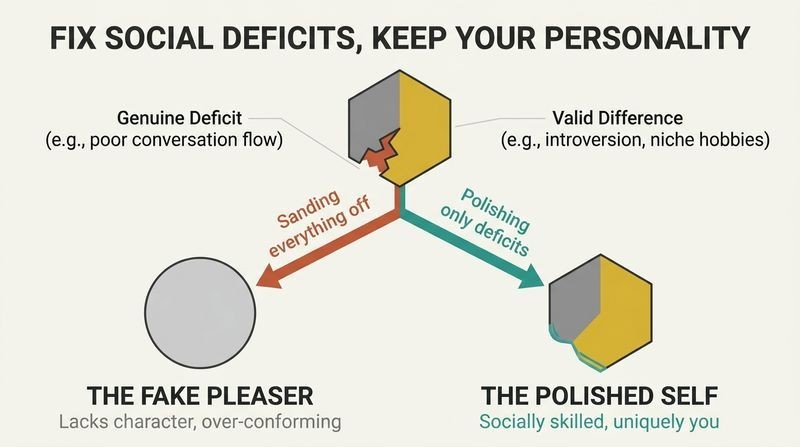
Separate real deficits from valid differences. MacLeod distinguishes clear-cut problems most people want gone (shyness, unpolished conversation, not knowing how to make friends) from acceptable variations that only cause trouble when others misjudge them. The latter include being introverted, needing few friends, preferring low-key hangouts, liking substance over chitchat, having quirky or non-mainstream hobbies, and getting drained by socializing.
You get to be your own judge. For each piece of advice, ask whether skipping it would leave you happier overall and whether you could live with the consequences. A blunt communicator might accept occasionally putting people off. Some men will never love sports but follow just enough scores to grease conversations, while others won't even do that and happily accept the minor cost. The aim is a more polished version of the same person, not a fake pleaser.
This is the book's ethical spine, and it separates it from manipulation-heavy persuasion literature. Susan Cain's work on introversion makes a parallel case: much social suffering comes from measuring quiet temperaments against an extroverted ideal rather than from actual deficits. The pragmatic middle path, complying selectively where the cost is low, resembles what psychologists call values-based action in Acceptance and Commitment Therapy. A subtle risk: the line between a fixable weakness and an authentic trait is genuinely blurry, and insecurity can disguise avoidance as identity (I'm just not a party person). MacLeod flags this honestly, urging self-honesty about whether a preference is chosen or defensive.
Stop waiting to feel calm; act while the nerves are still there
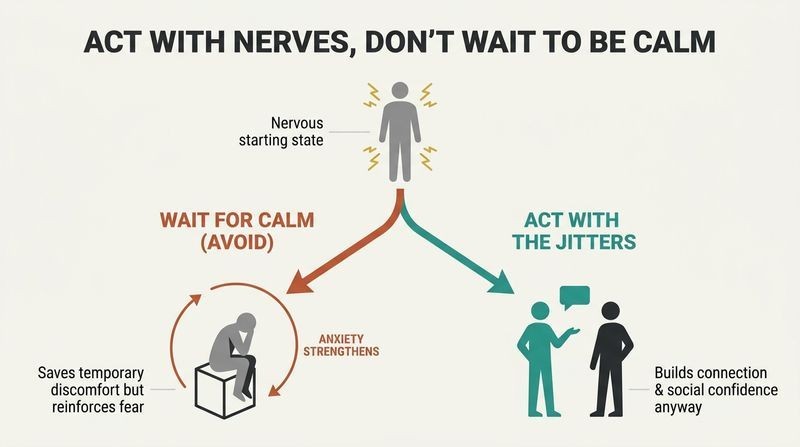
Two myths keep anxiety in power. The first is believing you must totally eradicate shyness before you can socialize; the second is believing any visible sign of discomfort will ruin an interaction. Both are false. Humans aren't wired for permanent self-assurance, so the target is being socially functional, meaning you can still meet your goals and enjoy yourself even while feeling jittery or self-doubting.
Avoidance is the real enemy. Each time you dodge a feared situation, the relief reinforces the belief that you escaped genuine danger, strengthening the anxiety. Watch for subtle avoidance disguised as reasonable excuses (Actually, I should study tonight) and safety behaviors like drinking to loosen up or sticking only to neutral topics. Two motivating mindsets help: gently thanking your anxiety for its concern but going anyway, or defiantly refusing to let it run your life.
This is textbook exposure logic, and it's the most evidence-backed idea in the book. Anxiety maintains itself through negative reinforcement: avoidance feels good, so it repeats. The insight that safety behaviors sabotage recovery is well established in clinical psychology, because they let the brain attribute survival to the crutch rather than to one's own capacity. The reframe from feeling confident to acting despite fear echoes the therapeutic principle that behavior change precedes emotional change, not the reverse. The added value of MacLeod's two mindsets is motivational packaging; the compassionate version tends to outlast the angry-defiant one, since self-criticism is itself an anxiety amplifier.
Interrogate the distorted thoughts secretly running your social life
Shyness runs on faulty thinking. MacLeod catalogs cognitive distortions applied to socializing: mind reading (she barely laughed, she must hate me), fortune-telling, all-or-nothing thinking, catastrophizing, and disqualifying the positive. Socially insecure people also have a lopsided attributional style, chalking up good conversations to luck or pity while blaming bad ones on their permanent flaws. Most people do the reverse, a slight self-serving bias that helps them function.
Replace them with balanced, not sunny, alternatives. The method: identify the thought, cross-examine it like a courtroom lawyer weighing real evidence, and swap it for something realistic. Against Everyone at this party will hate me, the fix isn't Everyone will love me but Some will like me, some won't, and the indifferent ones won't be cruel. A parallel tool is mindfulness: rather than debating an anxious thought, note it with detachment (like idly registering there's a hungry dragon nearby) and let it pass.
MacLeod is importing Cognitive Behavioral Therapy and Acceptance and Commitment Therapy into social skills, and doing it well. The attributional-style point is particularly sharp: research on depressive realism and self-serving bias suggests non-depressed people are mildly, usefully deluded in their own favor. The dragon exercise illustrates cognitive defusion, the ACT technique of loosening a thought's grip by observing it as mere mental noise. One helpful clarification for readers: CBT (dispute the thought) and mindfulness (don't engage it) can feel contradictory but are complementary tools for different situations. Debating works when a thought is genuinely distorted; defusion works when rumination itself, not the content, is the problem.
Beat big fears by climbing a ladder from mildly to very scary
Some beliefs only die from contradictory experience. Logic alone won't dislodge a fear that feels true, because the mind trusts lived evidence over reasoning. The fix is gradual exposure: build a hierarchy of your fear from least to most scary, then work up it, staying in each situation long enough to actually calm down. For party anxiety, that might run from nodding and smiling at people, to asking one quick question, to joining a friendly group, to approaching someone intimidating.
The rules make or break it. Start so easy it feels almost pointless. Only climb when a step becomes boring. Judge success by whether you faced the fear, not by the outcome. Eventually drop safety behaviors and go it sober. Partial progress counts (40 percent there, then 70, then 90). Zany stunts like deliberately getting rejected don't transfer well, because you know it's a lark and the real you isn't on the line.
This is graded exposure, the gold-standard treatment for phobias and social anxiety, translated for everyday use. The subtle point about outcome versus action is crucial and often botched by DIY practitioners who quit when a conversation flops, missing that the rep itself was the win. MacLeod's honesty about socializing being messier than fearing balconies is valuable: people aren't static stimuli, so clean hierarchies rarely survive contact with reality. His dismissal of rejection-therapy stunts challenges a popular pickup-artist trope, and he's right that novelty stunts fail the transfer test because they lack the ego stakes that make ordinary conversation frightening in the first place.
Real confidence is quiet self-acceptance, not a psyched-up high
Distinguish two flavors of confidence. Core self-esteem is your baseline sense of worth; situational confidence is how capable you feel in a specific setting. Genuine situational confidence is calm and earned through a track record (I've done this a hundred times, it usually works out). The psyched-up, chest-pounding version feels great but is fleeting and unreliable, and chasing it delays progress, because there's no way to summon it on command.
Build the foundation, then act. Healthy self-esteem feels like deep comfort with yourself, not cockiness. It grows from accepting you're a normal, imperfect human, questioning internalized cultural messages (you're worthless unless you have a huge friend group or a big salary), and living by self-affirming practices: standing up for yourself, showing your true self, doing meaningful work. Crucially, don't wait for rock-solid confidence before practicing; skills and confidence rise together, like building two towers where you can only add to one from atop the other.
The two-tower metaphor captures a truth that motivational culture ignores: confidence lags competence, it doesn't precede it. This directly contradicts the fake-it-till-you-make-it dogma, which MacLeod endorses only in small doses. His warning against chasing the psyched-up state connects to research on state versus trait: peak emotional arousal is inherently unstable, so building an identity around it guarantees inconsistency. The critique of contingent self-worth, basing esteem on salary or friend count, echoes Jennifer Crocker's research showing that externally contingent self-esteem is fragile and anxiety-producing. The strongest practical note is the last: waiting for confidence before acting is a trap, since action is the only reliable manufacturer of confidence.
Conversation is tennis: hand people something they can return
Give jumping-off points. When it's your turn to speak, don't send weak or unreturnable shots. Favor open-ended questions (what did you think of your major?) over closed ones answerable in a word. When making statements, load them with hooks: instead of my weekend was fun, mention what you actually did. If someone says they went jet skiing at a cottage, you can grab the weekend, the cottage, the jet skiing, or the first-time angle. Mix questions and statements, because pure questions feel like an interrogation and pure statements feel self-absorbed.
Clarify your goals and stop over-filtering. Broad goals guide you when you blank: learn about them, share about yourself, find common ground, seem friendly. Don't nix thoughts as too boring before they leave your mouth; saying something beats silence. Don't fear generic openers either, because friends happily discuss humdrum topics all the time.
The tennis metaphor is old but MacLeod operationalizes it usefully with jumping-off points, which reframes the vague complaint I never know what to say into a concrete search task: scan the last utterance for threads. This mirrors how improv comedy teaches yes-and, treating every offer as material. The advice to stop self-filtering targets a specific failure mode of anxious people: they generate plenty of candidate remarks but veto them all, mistaking a full mind for an empty one. The defense of small talk is quietly important, countering the intellectual's disdain for it; linguists note that phatic communication (talk that builds rapport rather than transfers information) is the necessary on-ramp to depth.
Deepen friendships by trading secrets in balanced escalating steps
Self-disclosure runs on reciprocity. Relationships deepen when people move from safe topics (job, hobbies) to somewhat personal ones (mild insecurities, quirks) to very personal ones (deep shames, heavy history), each side matching the other's level. If someone opens up and you don't reciprocate, the deepening stalls and they feel exposed. Emotions disclosed feel more intimate than facts: saying your parents' criticism made you feel worthless bonds more than noting your mom was strict.
Avoid both extremes. Oversharing too soon is a red flag that signals neediness and poor judgment, dumping emotional labor on someone who barely knows you. But being overly guarded backfires too: constant cageyness makes people imagine something worse than the truth, or assume you're not interested. The cure is reframing vulnerability, since revealing rough edges reads as endearingly human while seeming flawless reads as cold. Practice by disclosing to lower-stakes people first, then working up.
This is social penetration theory, developed by Altman and Taylor, rendered practical. The reciprocity norm is robust across cultures, and violating it in either direction stalls intimacy. MacLeod's emphasis on emotional over factual disclosure aligns with Arthur Aron's famous 36-questions study, which escalates precisely along the vulnerability gradient to manufacture closeness between strangers. Brene Brown's research on vulnerability supplies the reframe: hiding flaws to appear impressive is the very thing that prevents connection. The underrated insight here is symmetry, that guardedness is as damaging as oversharing. Anxious people fixate on the oversharing risk while committing the guardedness error, starving relationships of the mutual exposure that turns acquaintances into friends.
Empathy, listening, and body language quietly power every good chat
Three invisible skills do the heavy lifting. Empathy comes in two types: emotional (feeling what another feels) and cognitive (logically taking their perspective). Weak cognitive empathy causes gaffes like boring a friend with a topic they don't care about; weak emotional empathy causes flat responses to someone's bad news. Both improve with deliberate practice, like pausing during emotional movie scenes to feel what characters feel.
Listening and nonverbals seal it. Active listening means intent plus engaged body language plus responsive replies; the intent matters most, since people sense when you're faking. On nonverbal reading, no single cue is reliable, so read clusters: crossed arms plus turning away plus a sour face means something, but crossed arms alone may just be comfortable. The oft-cited 93-percent-nonverbal statistic is a myth, though the underlying point holds. Manage your own signals too: solid eye contact, an approachable resting face, and a voice that conveys conviction.
Bundling these three is smart because they're the substrate beneath conversational content. MacLeod's debunking of the 93 percent figure deserves applause; that number comes from Albert Mehrabian's narrow studies on communicating feelings and was wildly overgeneralized. His insistence on reading clusters, not isolated cues, guards against the pop-psychology trap of decoding a single crossed arm. The distinction between emotional and cognitive empathy matters clinically, since they're dissociable: some people feel deeply but misread perspectives, others read perspectives coldly without feeling. One caution he rightly flags for anxious readers: hypervigilant nonverbal reading feeds catastrophizing, so people prone to seeing rejection everywhere should read cues loosely and pursue their goals anyway.
Making friends is a repeatable four-step process, not dumb luck
The mechanics are learnable. MacLeod strips friendship down to a repeatable loop: find potential friends, make plans to hang out, gradually deepen the relationship, and repeat until your social life is full. Lonely people usually stumble on a specific step, not on being unlovable. Someone popular back home becomes lonely in a new city simply by going to work and then home, because they've stopped running the behaviors that produce friends.
Take relentless initiative and expect fuzziness. Assume you'll do all the work; don't wait to be invited, because people are harmlessly thoughtless and locked in their routines. Come with concrete plans (want to see a movie next week?) rather than vague ones, ask for contact info early, and try someone three or four times before giving up. Signals will be ambiguous (a slow reply, a busy weekend), so stay focused on your goals rather than reading disaster into every delay.
Reframing friendship as a process rather than chemistry is genuinely liberating, because it relocates loneliness from a character verdict to a fixable behavioral gap. This echoes sociologist Rebecca Adams's finding that adult friendship requires three ingredients: proximity, repeated unplanned interaction, and settings that encourage letting your guard down, which is exactly why post-college friendship gets harder. MacLeod's concrete-invitation rule has behavioral backing: specific proposals lower the cognitive cost of saying yes, whereas we should hang out sometime dies from ambiguity. The three-to-four-attempts heuristic is a useful antidote to the anxious tendency to quit after one unclear rejection, treating friendship as the numbers game it partly is.
Hold your ground with the broken-record technique when pressured
Assertiveness sits between passive and aggressive. It means protecting your own rights and needs directly while respecting the other person's, unlike aggression (trampling theirs) or passivity (abandoning yours). Chronic passivity erodes self-respect, invites mistreatment, and breeds passive-aggressive resentment. The everyday uses are mundane but vital: declining a drink, turning down an inconvenient favor, leaving a party early, or telling a friend their teasing stings.
Repetition beats argument. The broken-record technique means calmly repeating the same assertive line until the other person gives up, giving them nothing to argue against. Pressured to drink, you simply keep returning to No thanks, I'm not drinking more tonight through every guilt trip. A variant is agreeing without giving in (You're right, I am being boring, but I'm still not drinking). The beauty is you don't have to think on your feet under pressure; you just hold the line.
The broken-record method, drawn from Manuel Smith's assertiveness training, works because most social coercion relies on escalation and counter-argument; by refusing to supply new material, you deny the pressure any fuel. Its cognitive elegance is that it removes improvisation under stress, exactly when anxious people's on-the-spot thinking collapses. The passive-to-passive-aggressive pipeline MacLeod describes is well documented: unexpressed needs don't disappear, they leak sideways as sabotage or resentment. One nuance worth adding is cultural and relational calibration, since relentless repetition can read as cold in high-context cultures or close relationships where explaining and negotiating preserve the bond. The agree-but-don't-give-in variant is often the warmer, more sustainable move.
Drop the superiority; give so-called shallow people a real chance
Loneliness sours judgment. MacLeod cites the finding that lonely people tend to be more negative about others in general. Being chronically lonely makes people pessimistic and self-protective, so they reject others preemptively (this won't work out anyway). Some also nurse a sense of being deeper than the shallow masses who like sports, nightlife, and reality TV, which can curdle into ego-protecting false superiority that keeps them isolated.
Look past the surface. Many seemingly shallow people have hidden depth; their surface traits (a certain style, an accent, a bubbly manner, good social ease) are just easy to see while their substance is hidden. Meanwhile you have full access to your own rich inner dialogue, which inflates the contrast. The fix: actively seek people who genuinely share your wavelength (they exist), give others more of a chance, and soften your hostility toward activities like drinking or clubbing without having to participate. When lonely, prioritize getting any social life going over holding out for perfect matches.
This closing insight is unusually psychologically astute. John Cacioppo's research on loneliness established that it's self-reinforcing: it heightens vigilance for social threat and biases perception negatively, creating a feedback loop where the lonely person's guardedness produces the rejection they fear. MacLeod's point that we compare our rich interior to others' visible exterior is a version of the illusion of asymmetric insight, the well-documented tendency to believe we know others more deeply than they know us. The steelman of intellectual disdain is that genuine value mismatches exist; the challenge is that certainty about others' shallowness is usually a defensive projection, and the humbler, more curious stance is both truer and more socially effective.
Analysis
MacLeod's book is a comprehensive, unusually honest field manual for people who feel they missed the unwritten curriculum of socializing. Its structure is deliberate and cumulative: master the mind (shyness, anxiety, self-esteem), then the mechanics (conversation, listening, nonverbals), then the outcome (friendship). What distinguishes it from the crowded social-skills genre is its refusal to promise transformation. The stated target, moving from a miserable 3 to a serviceable 7, is almost radical in a market built on charisma fantasies.
The book's intellectual backbone is clinical psychology, quietly imported and translated. The anxiety chapters are essentially Cognitive Behavioral Therapy and exposure therapy for civilians; the mindfulness sections borrow from Acceptance and Commitment Therapy; the self-disclosure material recapitulates social penetration theory; the loneliness troubleshooting reflects Cacioppo-style research on how isolation distorts perception. MacLeod rarely name-drops the science, which keeps the prose accessible but occasionally undersells how well-evidenced his core moves are.
Its greatest strength is diagnostic granularity. Where most advice says be confident, MacLeod says confidence lags competence and hands you a ladder. Where others say just be yourself, he distinguishes fixable deficits from valid differences and lets the reader arbitrate. The recurring debunking of myths (the 93-percent-nonverbal figure, the eradicate-all-anxiety fantasy, the value of rejection stunts) shows a mind resistant to genre clichs.
The limitations are inherent to scope. At nearly 100,000 words the book is exhaustive to the point of overwhelming, and its list-heavy structure can read as a taxonomy rather than a narrative. Advice is necessarily general, and MacLeod repeatedly concedes this, pointing readers toward professionals or further reading. There's also a mild individualism assumption: the burden of change rests entirely on the reader, with little attention to structural loneliness, discrimination, or environments genuinely hostile to connection. Still, as a practical, psychologically grounded, non-manipulative resource, it earns its length. It treats social competence as a teachable craft and, crucially, as one compatible with remaining fully yourself.
Review Summary
The Social Skills Guidebook receives mixed reviews. Many find it helpful for those with severe social difficulties, offering practical advice on overcoming anxiety and improving conversations. However, some criticize it as too basic or common sense for average social skills. Readers appreciate its comprehensive approach and motivational aspects, but some find the writing dry or oversimplified. The book is praised for addressing mental barriers and providing strategies for forming friendships, though some suggest it could be more nuanced in its advice on appearance and social norms.
People Also Read








Glossary
Socially functional
Meeting social goals despite discomfortMacLeod's core target state: being able to start conversations, make friends, and enjoy yourself even while feeling shy, nervous, or self-doubting. It rejects the myth that you must first eliminate all anxiety, arguing that discomfort never fully disappears and that acting effectively despite it, rather than waiting to feel fearless, is the realistic and achievable goal.
Safety behaviors
Crutches that partly avoid fearSubtle tactics that shield you from the full force of a feared situation, such as drinking to loosen up at parties, sticking only to neutral topics, or carrying medication just in case. They feel helpful but sabotage recovery, because they let your brain credit the crutch rather than your own capacity for getting through the situation.
Jumping-off points
Conversational hooks others can grabThe details embedded in a statement that give a conversation partner multiple threads to respond to. Saying you went jet skiing at a cottage last weekend offers hooks about the weekend, the cottage, the jet skiing, and the first-time experience. Loading your statements with these hooks, rather than giving bare answers, keeps conversations flowing and shares the burden of continuing them.
Broken-record technique
Repeat your line until pressure stopsAn assertiveness tool for holding your ground under social pressure: calmly repeat the same firm statement over and over (No thanks, I'm not drinking more tonight) through every guilt trip or counter-argument. Because you supply no new material to argue against, the pressure loses fuel, and you avoid having to improvise clever responses while flustered.
Cognitive distortions
Irrational thoughts sustaining social fearSystematically misleading thought patterns that fuel shyness and anxiety, here applied to socializing. Examples include mind reading (assuming someone dislikes you without evidence), fortune-telling, all-or-nothing thinking, catastrophizing, and disqualifying the positive. The book's method is to identify each distortion, cross-examine it against real evidence, and replace it with a balanced (not blindly positive) alternative.
Attributional style
How you explain events to yourselfYour habitual way of interpreting outcomes. Socially insecure people credit good interactions to luck or the other person's pity while blaming bad ones on their own permanent flaws. Most people do the reverse, a mildly self-serving bias that supports functioning. Shifting toward giving yourself fair credit for successes is part of dismantling insecurity.
Approach-avoidance conflict
Wanting and fearing an action simultaneouslyThe mental tug-of-war that strikes when contemplating an optional but scary social move, like approaching a stranger. At a distance the desire to connect dominates; as you get closer, fear surges and often makes you bail at the last second. Understanding this pattern helps you push through the freeze point rather than mistaking it for genuine unwillingness.
FAQ
What's The Social Skills Guidebook about?
- Comprehensive Resource: The Social Skills Guidebook by Chris MacLeod is a detailed guide aimed at helping individuals manage shyness, improve conversations, and make friends while staying true to themselves.
- Practical Techniques: It offers actionable advice and techniques for navigating various social situations, from casual gatherings to structured environments like work or school.
- Building Confidence: The book emphasizes the importance of developing confidence and assertiveness in social interactions, allowing readers to engage more effectively with others.
Why should I read The Social Skills Guidebook?
- Overcome Social Anxiety: If you struggle with shyness or social anxiety, the book provides practical strategies to help you feel more comfortable in social settings.
- Improve Relationships: It offers insights into building and maintaining friendships, enhancing your overall quality of life and emotional well-being.
- Comprehensive Coverage: The guide covers a wide range of topics, including conversation skills, empathy, and nonverbal communication, making it a valuable resource for anyone looking to improve their social skills.
What are the key takeaways of The Social Skills Guidebook?
- Overcoming Anxiety: Social anxiety can be managed through understanding and practice, encouraging readers to face their fears gradually.
- Conversation Skills: Provides detailed guidance on initiating, maintaining, and ending conversations effectively, including tips for dealing with awkward silences.
- Building Friendships: Outlines a structured process for making friends, from identifying potential friends to deepening those relationships over time.
How does The Social Skills Guidebook define shyness and social anxiety?
- Shyness Defined: Shyness is feeling inhibited and uncomfortable in social situations due to worries about perception by others, ranging from mild to severe.
- Social Anxiety Explained: Characterized by intense nervousness in social situations, often with physical symptoms like sweating or trembling, leading to avoidance behaviors.
- Interconnected Issues: Shyness and social anxiety often overlap, leading to similar outcomes, such as avoidance of social interactions.
What are some effective strategies for managing social anxiety in The Social Skills Guidebook?
- Mindfulness Techniques: Use mindfulness to acknowledge and accept anxious thoughts without letting them control your actions, reducing anxiety intensity.
- Gradual Exposure: Face social fears gradually through a hierarchy of less intimidating to more challenging situations, allowing for desensitization over time.
- Coping Mechanisms: Employ strategies like deep breathing, progressive muscle relaxation, and positive self-talk to manage anxiety in the moment.
What specific methods does Chris MacLeod suggest for improving conversations?
- Active Listening: Fully engage with the speaker through body language and verbal affirmations, conveying that you value their input.
- Assertive Communication: Express needs and opinions respectfully while considering others' perspectives, enhancing mutual understanding.
- Empathy Development: Cultivate both emotional and cognitive empathy to connect with others and understand their feelings better.
How can I improve my conversation skills according to The Social Skills Guidebook?
- Ask Open-Ended Questions: Use open-ended questions to encourage deeper discussions and keep the conversation flowing, inviting others to share more.
- Practice Active Listening: Show genuine interest in what the other person is saying, enhancing interaction quality through nodding, eye contact, and appropriate responses.
- Share Personal Insights: Share your own experiences and opinions to create a balanced conversation, building rapport and making the interaction more engaging.
What techniques does The Social Skills Guidebook suggest for making friends?
- Identifying Potential Friends: Recognize individuals who may share your interests and values, making it easier to approach them for friendship.
- Making Plans: Take initiative to invite potential friends to hang out, helping to solidify the relationship.
- Deepening Connections: Once friendships are established, deepen those connections through shared experiences and open communication.
How does The Social Skills Guidebook address the importance of self-esteem in social interactions?
- Core Self-Esteem: Discusses the significance of having healthy self-esteem, allowing individuals to feel good about themselves and their social abilities.
- Situational Confidence: Emphasizes the need for situational confidence, feeling assured in specific social contexts, leading to more successful interactions.
- Positive Self-Image: Encourages practicing self-acceptance and challenging negative beliefs about oneself, enhancing overall self-esteem and social experiences.
What are some common conversation mistakes highlighted in The Social Skills Guidebook?
- Overthinking Responses: Worrying about what to say next can lead to awkward pauses; focus on the interaction rather than overanalyzing.
- Dominating the Conversation: Balance speaking and listening; dominating can alienate others. Be mindful of your contribution versus allowing others to share.
- Neglecting Nonverbal Cues: Failing to pay attention to body language and nonverbal signals can hinder communication. Be aware of both your own and others' nonverbal communication.
What are some tips for making friends in college from The Social Skills Guidebook?
- Utilize Orientation Events: Attend Orientation Week events to meet fellow students looking to make connections, helping to break the ice.
- Engage with Classmates: Initiate conversations with classmates and invite them to study sessions or coffee, building rapport in a shared academic environment.
- Join Clubs and Activities: Participate in clubs or extracurricular activities that align with your interests, providing a natural setting to meet like-minded individuals.
What are some key quotes from The Social Skills Guidebook and what do they mean?
- “You don’t need to completely change who you are to become more socially successful.”: Emphasizes that personal growth in social skills doesn’t require altering your core identity; it’s about enhancing existing traits.
- “Social skills are skills like any other.”: Highlights that social skills can be developed and improved over time with practice, just like any other skill set.
- “You’ll never banish all social discomfort from your life.”: Reminds that feeling nervous or shy is normal, and the goal is to manage these feelings rather than eliminate them entirely.
Download PDF
Download EPUB
.epub digital book format is ideal for reading ebooks on phones, tablets, and e-readers.








































