
Key Takeaways
1. The Jurassic Divide established a permanent North-South divide
The Jurassic Divide, which had defined pre-Roman and Roman Britannia, also shaped the English conquest.
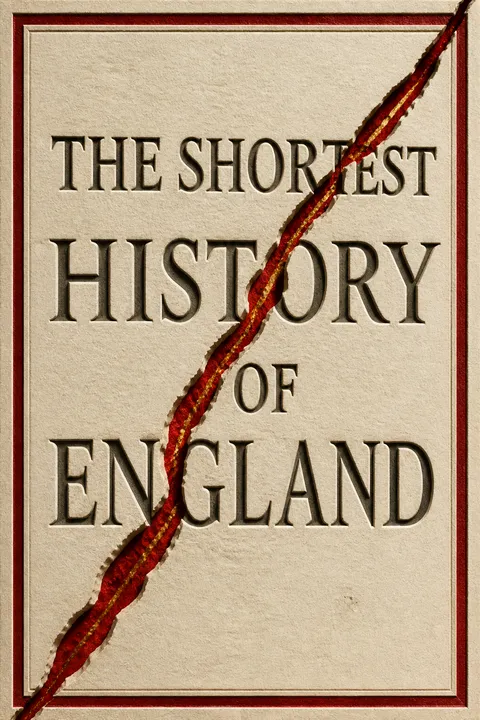
Geological destiny. The fundamental split in English history is rooted in the earth itself. The Jurassic Divide runs diagonally across the island, separating the fertile, younger soils of the Southeast from the rugged, older rocks of the North and West. This geological boundary historically dictated agricultural wealth, population density, and trade links with continental Europe.
Romanization and resistance. The Roman Empire successfully colonized and civilized only the lowland Southeast, leaving the North and West as heavily militarized frontier zones. This established a pattern of centralized, wealthy rule in the South facing constant resistance from the outer regions. Key historical developments include:
- The construction of Hadrian's Wall to keep out northern tribes.
- The concentration of Roman villas and civilian administration in the fertile plains.
- The establishment of military garrisons at York, Chester, and Caerleon to police the highlands.
Enduring cultural split. This ancient division persisted long after the Romans departed, shaping the Anglo-Saxon settlements and subsequent Viking invasions. The wealthier Southeast remained the political and economic powerhouse of the island, while the North and West retained a distinct, often rebellious identity.
2. The English language was forged through cultural replacement rather than assimilation
In England, and only in England, they entirely replaced the culture they found.
Founding cultural uniqueness. Unlike the Germanic tribes that invaded continental Europe and adopted the Latinate languages and Christian religion of the Roman Empire, the Anglo-Saxon settlers in Britain completely replaced the existing Romano-British culture. This total cultural wipeout is the defining characteristic of early English history. It explains why modern English contains virtually no traces of the native Celtic languages.
The maritime factor. The North Sea and the English Channel did not isolate Britain; instead, they made total conquest and colonization possible. Because the journey from Europe was relatively short, Germanic settlers could transport entire families, including women and children, to the fertile lands of the Southeast. This allowed them to maintain their pagan culture and language rather than intermarrying and assimilating with the local population.
A political choice. Over time, the surviving Romano-British population did not disappear but chose to adopt Englishness from the top down to survive. This linguistic and cultural shift was driven by political pragmatism rather than racial replacement. Key evidence of this transition includes:
- Genetic evidence showing that 60% to 90% of modern English DNA is Romano-British.
- The native elites adopting the Germanic tongue to maintain their social status.
- The laws of King Ine of Wessex protecting the "Welsh" but relegating them to second-class citizenship.
3. The Norman Conquest created a deep, bilingual class divide
A small armed group speaking a language incomprehensible to the majority of the population controlled virtually all the landed wealth.
Colonial elite rule. The Norman Conquest of 1066 was not a simple dynastic change but a brutal colonial occupation that systematically dispossessed the native English aristocracy. Within a generation, a tiny French-speaking military elite seized control of almost all the land and wealth in England. This established a profound social and linguistic chasm between the rulers and the ruled that persisted for centuries.
Linguistic class markers. For nearly three hundred years, French was the language of power, law, and polite society, while English was relegated to the illiterate peasantry. To climb the social ladder, ambitious native Englishmen had to abandon their mother tongue and adopt the language of their conquerors. This created a unique colonial dynamic:
- French was used by landlords, judges, and officers.
- English was spoken only by the "low men" and agricultural laborers.
- The legal system was conducted entirely in French, leaving the common people mute before the law.
Openness of the elite. To preserve their vast estates under strict rules of primogeniture, the Norman nobility occasionally allowed wealthy, collaborating English families to marry into their ranks. This created a relatively open elite that was defined by learnable culture and language rather than strict genealogy. However, it also left the ordinary English peasantry leaderless and culturally marginalized.
4. Magna Carta and Parliament were born as aristocratic shields against the Crown
Throughout the document it is implied that here is a law which is above the King and which even he must not break.
Aristocratic self-defense. The famous liberties of England, including Magna Carta and the rise of Parliament, did not originate from a popular desire for democracy. Instead, they were forged by a powerful, French-speaking baronial elite seeking to protect their own property and privileges from grasping, absolute monarchs. The Great Charter was a treaty between the king and his wealthiest subjects, written in Latin and translated into French.
The law above the king. The enduring legacy of Magna Carta is the revolutionary principle that even the sovereign is subject to the law of the land. This concept was repeatedly reinforced by a powerful alliance between the barons and a muscularly independent Church. Key constitutional milestones include:
- The requirement of a "general summons" of landowners to approve new taxes.
- The guarantee of trial by a jury of one's peers.
- The creation of a council of barons with the legal right to restrain the king.
The parliamentary compromise. To fund his expensive wars in Wales, Scotland, and France, Edward I was forced to negotiate with his subjects, leading to the Model Parliament of 1295. This institutionalized the sharing of power between the Crown and the wealthy landowners. However, because the king could not side with English-speaking peasants against his French-speaking nobility, the common people remained legally and economically subjugated.
5. The Reformation and enclosures birthed a centralized, Southern-focused elite
Enclosures made landowners richer, helped the better-off peasantry, and created the most destabilizing thing for any society: a class of poor folk with no hope of ever bettering themselves.
The great land grab. The Protestant Reformation under Henry VIII was less a spiritual awakening and more a massive, state-sponsored asset transfer. By dissolving the monasteries, the Crown seized a quarter of all the land in England and sold it off to a rising class of gentry and merchants. This created a wealthy, highly centralized Southern elite whose economic interests were permanently tied to the new Protestant state.
Destruction of the commons. Alongside the Reformation, the accelerating process of enclosure systematically stripped the English peasantry of their traditional rights to common land. Landlords consolidated open fields into private pastures for the lucrative wool trade, driving millions of subsistence farmers into poverty. This transformation had devastating social consequences:
- The loss of grazing rights for peasant livestock, which destroyed their economic safety net.
- The demolition of traditional villages and cottages to make way for sheep farming.
- The creation of a massive, landless class of rural poor forced to migrate to towns.
A nationalized church. The new Tudor state used the English Bible and state-sponsored theater to sell the Reformation to the literate yeomanry of the Southeast. By framing the break with Rome as a patriotic struggle against foreign oppression, the elite successfully co-opted the common people. However, this also deepened the divide with the conservative, Catholic North, which resisted the new order in the bloody Pilgrimage of Grace.
6. The English Civil War was a regional struggle for the soul of the nation
The North and West were regarded by parliamentarians as the “dark corners of the land.”
The regional divide. The English Civil War of the seventeenth century was not merely an ideological clash between King and Parliament, but a violent re-emergence of the ancient North-South divide. The Royalist cause drew its strength from the conservative, agricultural North, Wales, and Cornwall. Parliament, conversely, was backed by the wealthy, commercial Southeast, London, and the manufacturing towns.
Total war and radicalization. To defeat the King's regional alliance, Parliament was forced to mobilize the common people of the Southeast through the New Model Army. This highly disciplined, ideologically driven force was filled with radical Puritans who believed they were fighting to cast off the "Norman Yoke." The war quickly escalated into a total conflict that transformed the political landscape:
- The execution of Charles I, which shattered the divine right of kings.
- The military conquest and brutal pacification of Ireland and Scotland.
- The temporary abolition of the monarchy and the establishment of a military commonwealth.
The conservative reaction. The radicalism of the New Model Army and the oppressive rule of Cromwell's Major-Generals eventually terrified the wealthy elite. Following Cromwell's death, the gentry eagerly restored the monarchy under Charles II to re-establish traditional social order. However, the war permanently established the supremacy of Parliament over the Crown and solidified the political dominance of the Southeast.
7. The Industrial Revolution broke the Malthusian trap but deepened class divisions
With mighty fossil energy being extracted from beneath the fields, agriculture could still thrive on the surface.
Geological salvation. The Industrial Revolution was made possible by England's unique geological luck. The vast coal reserves located north of the Jurassic Divide allowed the country to break the Malthusian trap, which had historically limited economic growth by forcing land to be used for either food or fuel. By extracting fossil energy from beneath the earth, Britain could power its factories while still feeding its growing population.
The northern economic shift. This industrial explosion temporarily shifted the economic center of gravity away from the agricultural Southeast to the coalfields of the North and Midlands. Cities like Manchester, Birmingham, and Leeds grew at an unprecedented rate, creating a powerful new class of industrial magnates. This rapid urbanization transformed the daily lives of the working class:
- The transition from agricultural labor to grueling, clock-regulated factory shifts.
- The reliance on imported stimulants like tea, sugar, and tobacco to sustain long working hours.
- The physical deterioration of urban populations due to poor sanitation and overcrowding.
The global financial empire. Despite the industrial might of the North, the real financial power remained concentrated in the City of London. As the British Empire expanded, the Southern elite transformed themselves into "gentlemanly capitalists" who preferred global financial investment over domestic manufacturing. This decoupled the wealthy Southeast from the industrial North, setting the stage for future economic decline.
8. The public school system and Received Pronunciation unified the modern elite
The accent most usually heard in everyday speech in the families of Southern English persons whose menfolk have been educated at the great public boarding schools.
Co-opting the new rich. In the nineteenth century, the traditional landed aristocracy faced a powerful challenge from the newly wealthy industrial barons of the North. Rather than fighting them, the Southern elite successfully co-opted the sons of these industrialists through the reformed public school system. Schools like Eton, Harrow, and Rugby trained these boys to abandon their regional identities and adopt the manners of Southern gentlemen.
The linguistic filter. The defining badge of this unified imperial elite was Received Pronunciation (RP), a highly standardized, non-regional accent based on the speech of the Southeast. Anyone who wished to enter the professions, the civil service, or Parliament had to master this accent. This created a powerful cultural filter that effectively marginalized anyone who spoke with a regional dialect:
- The systematic eradication of regional accents in schools and universities.
- The use of RP by the BBC to project a standardized national voice.
- The division of the population into those who spoke "standard" English and those who did not.
The cult of the gentleman. This educational and linguistic unification created a highly cohesive ruling class that was uniquely equipped to run a global empire. However, it also reinforced the ancient class divide by making the language of power completely alien to the ordinary English working class. The "gentlemanly" ideal valued classical learning and sportsmanship over technical skill and industrial production, contributing to Britain's long-term economic decline.
9. Brexit emerged as a modern cultural class war rooted in ancient divisions
The UK, that construct founded in 1801 to control Ireland, and that should really have died in 1921 when most of Ireland tore itself away, is actually dead already.
The collapse of the union. The modern United Kingdom was constructed by a Southern-based elite to manage a global empire. With the loss of that empire and the devolution of power to Scotland, Wales, and Northern Ireland, the traditional British identity began to unravel. This left the Southern English majority politically frustrated and increasingly receptive to a new, exclusive English nationalism.
The convergence of discontent. The economic shock of the 2008 financial crisis, followed by years of government austerity and mass immigration from the EU, created a powerful wave of popular anger. This discontent united the economically marginalized working class of the North with the culturally conservative voters of the Southern periphery. The anti-EU movement successfully channeled this anger into a modern cultural class war:
- The framing of the EU as a foreign occupying power supported by a collaborating London elite.
- The rejection of "experts" and globalist institutions in favor of national sovereignty.
- The use of the Cross of St. George as a symbol of popular English resistance.
The final division. The Brexit vote of 2016 and the subsequent Tory victory of 2019 represented the triumph of this new English nationalism. However, by aligning the Conservative Party almost exclusively with English interests, it effectively shattered the political cohesion of the United Kingdom. England now faces the future as a deeply divided nation, still haunted by the ancient fault lines of its past.
Review Summary
People Also Read





Download PDF
Download EPUB
.epub digital book format is ideal for reading ebooks on phones, tablets, and e-readers.








































