


Key Takeaways
A skeptical poet channeled a discarnate personality who upended her worldview
An ordinary writer, an extraordinary claim. In 1963, Jane Roberts was a self-described rebel who had rejected the Catholic God of her childhood and believed consciousness ended at death. She and her artist husband Rob bought a Ouija board as research for an ESP book. The pointer began spelling messages, first from a bland personality, then from one who renamed himself Seth, calling himself an "energy personality essence no longer focused in physical reality."
Words before the board could spell them. Within weeks, Jane heard Seth's sentences in her head faster than the pointer moved, then began speaking them aloud in a deep, masculine voice unlike her own. Over five years she produced more than 5,000 typed pages while fighting her own disbelief every step of the way.
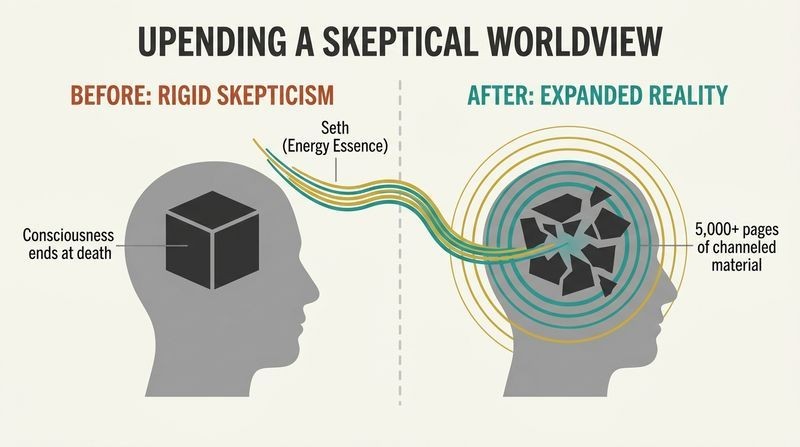
What's striking is the resistance at the center of the story. Great mediums, the introduction notes, share a paradoxical trait: susceptibility to trance combined with fierce self-criticism, like Eileen Garrett who devoted her life to investigating her own gift rather than worshipping it. This distrust is precisely what lends the account credibility as testimony. Modern psychology offers competing frames: dissociation, hypnagogic ideation, or what Ira Progoff called the "dynatype," a self-generated symbolic figure that balances the psyche. Whether Seth is spirit or subconscious dramatization, the phenomenon itself, sustained coherent authorship from an altered state, remains genuinely puzzling.
You build your reality from the inside out, like breathing
Matter is the shape of your beliefs. Seth's central claim is that we do not passively perceive an objective world; we actively construct it from inner thought and emotion, "as unselfconsciously as we breathe." Physical reality is plastic, moldable like clay, not concrete that traps us. Your body is the materialization of what you think you are. Your circumstances mirror your inner expectations.
The senses create, not just receive. In her first overwhelming experience, Jane scrawled a manuscript titled "The Physical Universe As Idea Construction," arguing that the eye projects images outward the way a projector throws film on a screen, rather than simply recording a pre-existing scene. If you dislike your world, Seth insists, examine your expectations, because you cooperated in forming even your childhood environment.
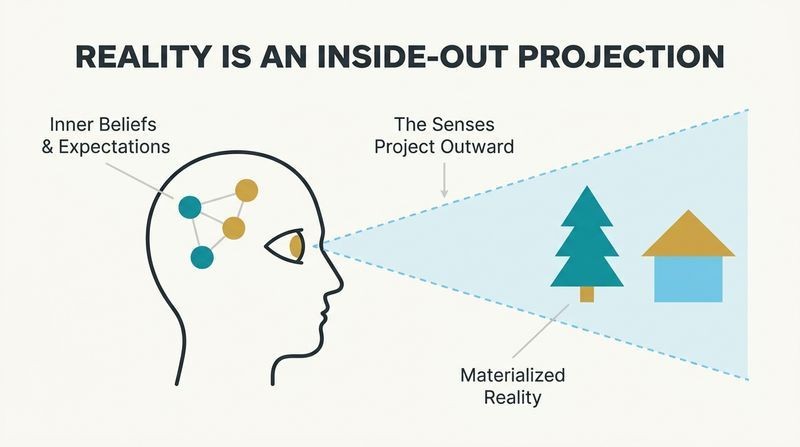
This is philosophical idealism dressed in mid-century American vernacular, echoing Kant's claim that the mind imposes structure on raw sense data, and Plato's forms preceding physical objects. The constructivist thread also anticipates cognitive science: perception is now understood as prediction, the brain generating a model and updating it against input, not a camera. Where Seth overreaches is the leap from "we co-construct experience" to "we literally create matter and events." That claim resists falsification and can curdle into victim-blaming, implying the sick or poor authored their suffering. The insight is powerful as psychology, riskier as physics.
You chose your parents, your challenges, and even your illnesses
Reincarnation as self-designed curriculum. Seth frames each life as a set of conditions selected beforehand to develop specific abilities. This reframes apparent injustice: the child born blind, the servicemen killed young, the crippling disease are not random cruelties or divine punishments but chosen challenges. Seth explicitly rejects the word "punishment" and replaces karma-as-retribution with karma-as-opportunity.
Illness serves the personality. In readings for grieving parents, Seth said a three-year-old who died of aplastic anemia had completed his reincarnations and returned only briefly to push his parents toward inner questioning. In another case, a woman's multiple sclerosis let her, as a former harsh caretaker, finally experience dependency from the inside. Illness, Seth argued, is often a purposeful communication, not an alien invader.
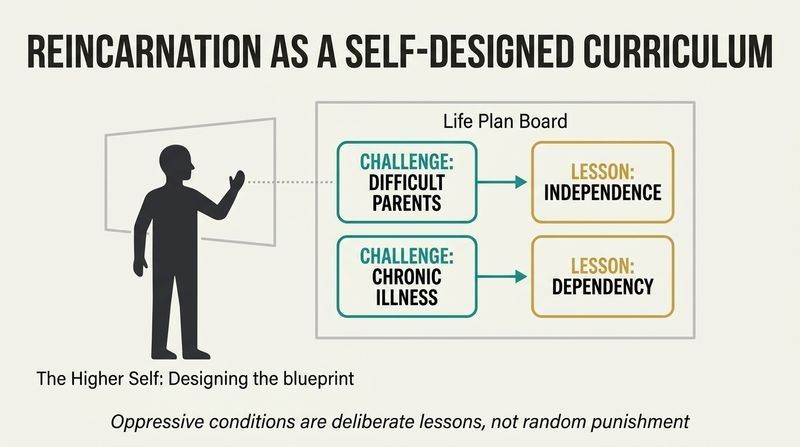
The therapeutic power here is real: reframing tragedy as meaningful can restore agency to the bereaved, echoing Viktor Frankl's logotherapy, where meaning-making buffers suffering. But the doctrine cuts both ways. Telling parents their child "chose" to die comforts some and horrifies others, and it edges toward the just-world fallacy that social psychologist Melvin Lerner documented, our tendency to assume victims deserve their fate. The claim is also conveniently unfalsifiable, since past lives "so long ago" cannot be checked. Notably, Seth's more recent reincarnational data occasionally aligned with verifiable biographical facts, which is where the account gets genuinely interesting rather than merely consoling.
Time is an illusion; all your lives happen at once
The Spacious Present. Seth's most radical departure from conventional reincarnation theory is that lives are not strung out sequentially. Past, present, and future exist simultaneously in what he calls the Spacious Present. We speak of "past lives" only because our physical senses can perceive reality just a sliver at a time, making one moment seem to vanish before the next arrives.
Cause and effect dissolves. Seth compares simultaneous selves to the multiple personalities in The Three Faces of Eve: all present at once, only one dominant at any moment. Because everything happens now, a past event does not cause a present one, and remarkably, present actions can alter the past. Memory itself, he says, is constantly rewritten as attitudes shift, an actual re-creation rather than a symbolic one.
The eternalist view of time, that past, present, and future are equally real, is not fringe; it follows from Einstein's block universe, where simultaneity is relative and the "now" has no privileged physical status. Seth's version pushes further, granting the perceiver power to edit the past, which resonates loosely with memory research: reconsolidation shows recall physically alters the memory trace each time it is accessed. The weak link is coherence. If cause and effect are illusions and all events coexist, the moral urgency Seth elsewhere demands, change yourself, refuse war, loses its footing. The framework strains against its own ethical exhortations.
Repressing anger poisons you; pluck it out and replace it
Negative thoughts materialize as illness. Seth taught that chronic fear, resentment, and self-loathing lower the body's defenses and eventually take physical form. His neighbor Joan, brilliantly witty but relentlessly cruel and convinced everyone disliked her, kept her nervous system in constant stress and died in her thirties after a parade of illnesses. What you see in others, Seth said, is the projection of what you think you are.
Recognition, not suppression. Crucially, Seth warned against burying negative feelings, which only redirects their energy inward as ulcers or worse. His technique: first consciously recognize the resentment, then imaginatively pluck it out by the roots and replace it with a constructive feeling. Erase "I have a headache" by turning attention to something pleasant rather than reinforcing the symptom.
The distinction between repression and conscious processing is psychologically sound and anticipates modern cognitive behavioral therapy, which trains patients to notice automatic negative thoughts and reframe them rather than stuff them down. The projection insight echoes Jung's shadow: what we condemn in others often mirrors disowned parts of ourselves. Where Seth overstates is the mind-over-matter causality of specific diseases; the mid-century "cancer personality" literature has largely failed replication, and attributing illness to attitude can heap guilt on the sick. Still, the core practice, name the emotion, then deliberately substitute a better one, maps neatly onto evidence-based affect regulation.
True discipline lives inside spontaneity, like seasons arriving on time
The flower that does not demand. When a rigid businessman student equated spontaneity with chaos, Seth offered a parable: imagine a flower dictating exactly when the sun must shine and which specific bees may visit. It would get nowhere. Yet the sun, bees, and seasons follow a magnificent order without any flower's commands. Spring never arrives in December.
Your body already knows. Seth argued that the nervous system regulates heartbeat, breathing, and healing spontaneously, and that this effortless inner intelligence is more disciplined than the controlling ego perched on top of it. Health is the body's natural state; we disrupt it by projecting false, fearful ideas onto it. Emotions, he said, flow through us like weather. We are not our emotions any more than we are the eggs we eat for breakfast.
The claim that spontaneity contains its own order rhymes with Taoist wu wei, effortless action aligned with natural flow, and with Mihaly Csikszentmihalyi's flow state, where peak performance feels unforced yet is highly structured. Biology supports the deeper point: autonomic and homeostatic systems manage staggering complexity without conscious oversight. The distancing move, you have emotions but are not them, prefigures the cognitive defusion of Acceptance and Commitment Therapy, which teaches patients to observe feelings as passing events. The tension worth flagging: total trust in spontaneity assumes a benign inner nature, an optimistic anthropology many traditions, from Freud to Hobbes, would contest.
Turn your flashlight of consciousness inward to reach your inner senses
The Inner Senses and Psychological Time. Seth catalogued inner methods of perception belonging to the self that operates independent of the body. The gateway skill is Psychological Time (Psy-Time): sit quietly, switch off the physical senses one by one as if turning dials, and focus on a dark inner screen until images, lights, or knowings appear. Practiced regularly, it expands normal awareness and can trigger out-of-body travel.
A different channel, not unconsciousness. Seth's analogy: consciousness is a flashlight habitually aimed down one path. Swing it elsewhere and that path goes dark momentarily, but new realities appear, and you can always swing it back. Setting the ego aside does not mean going blank; it means opening another door. The point is not party-trick telepathy but recognizing your identity as independent of physical matter.
Psy-Time is essentially a meditative induction, and the practice tracks decades of contemplative research: sustained inward attention reliably alters perception, reduces stress, and produces the hypnagogic imagery Seth describes. The flashlight metaphor is a clean model of attention as a spotlight, consistent with how cognitive science treats selective attention. Where claims exceed evidence is the leap from altered states to veridical out-of-body perception of distant locations. Jane's own tests were suggestive but conducted without controls. The durable value is experiential: whether or not one accepts "inner senses," deliberately redirecting attention inward demonstrably enriches self-knowledge and creative access.
Dreams are as real as waking life; use them as therapy
Rehearse solutions while you sleep. Seth held that dream reality is a genuine dimension, not mental static, and that we can consciously direct it. His practical prescription: before sleep, suggest to yourself that you will have a joyful dream that restores your vitality. Jane used this repeatedly to break depressive spells, waking refreshed whether or not she recalled the dream.
Work off aggression harmlessly. Seth proposed that thwarted impulses, if not expressed, can materialize as illness, and that dreams offer a safe arena to discharge them. But he set firm rules: never suggest dreaming of harming a specific person, because of telepathic effects and guilt. Aim the release at the intangible emotion itself. He half-joked about nations one day fighting wars in sleep rather than in waking life.
The idea that dreams process unresolved emotion has strong scientific backing. REM sleep appears to consolidate memory and defuse the emotional charge of experiences, what researcher Matthew Walker calls "overnight therapy." Pre-sleep suggestion also has an evidence base: dream incubation reliably increases the odds of dreaming about a target problem, and lucid dreaming, consciously directing the dream, is a documented, trainable skill now studied in labs. Seth's ethical caveat about not targeting real people in directed dreams is oddly thoughtful. The weakest claim is telepathic contamination between dreamers, which lacks support, but the core therapeutic practice is both safe and, increasingly, validated.
God is not a person but an ever-expanding creative energy gestalt
All That Is, born from agony. Seth replaces the father-God Jane rejected with "All That Is," a consciousness that creates by dreaming. In his origin myth, All That Is first existed in torment, holding infinite potential creations within itself but lacking the means to give them independent life. The dreamed individuals clamored to be real. To free them, All That Is had to release a portion of itself, an explosion of creativity that gave birth to actual, autonomous consciousness.
A God that changes. Unlike static theological concepts, this God grows through its creations and feels each falling sparrow because it is each sparrow. Seth also claimed the historical Christ was three separate men whose lives merged in memory, including John the Baptist, called forth by humanity from its own psychic reservoir in a time of need.
The creation-through-self-limitation motif has a deep pedigree: the Kabbalistic tzimtzum, where the infinite contracts to make room for a world, and process theology (Whitehead, Hartshorne), which similarly posits a God who evolves with creation rather than ruling it from outside. Framing divinity as immanent, closer than one's breath, aligns with panentheism. The three-Christs claim is Seth's most historically provocative and least verifiable, and it predictably diverges from every scholarly and doctrinal account. What gives the passage force is its psychological realism: creativity described as an agonized pressure seeking release will ring true to any artist, which is likely no accident given Jane's vocation.
There is never justification for violence, even in service of peace
Violence returns to its sender. After Martin Luther King Jr.'s assassination, and again when a student defended justified violence during protests, Seth interrupted with unusual sternness: those who commit violence for any reason are themselves changed, their purpose corrupted. When you curse another, the curse returns to you.
Change yourself, then the world. Seth's political ethic follows from his metaphysics: since we collectively dream reality into being, world conditions can only shift when individuals change en masse. His most concrete claim: when every young man refuses to go to war, war ends, though he conceded the difficulty of all nations refusing simultaneously. On King's death he added a jarring consolation, that murder is a crime we must confront precisely because we believe consciousness can be extinguished, though in his framework it cannot.
The absolutism here echoes Gandhian and Tolstoyan nonresistance, and the "refuse to fight" scenario recalls the classic pacifist hope famously voiced by Carl Sandburg, suppose they gave a war and nobody came. The claim that violence inevitably corrupts even righteous actors finds partial support in research on moral injury among combatants and on how perpetrating harm reshapes identity. The tension is acute, though: Seth simultaneously insists violence and death are ultimately illusory (consciousness survives) yet must be treated as real crimes. That move risks trivializing atrocity even as it condemns it, a philosophical knot the passage acknowledges more than it resolves.
You have probable selves living the choices you did not make
Every unchosen path is lived elsewhere. Seth taught that each decision spawns probable events, all of them real, experienced by portions of the self in other dimensions. Rob, an artist in this reality, supposedly has a probable self, Dr. Pietra, a physician who paints as a hobby, which explained Rob's uncanny ease with unfamiliar medical illustration. These probable selves are like distant cousins, further removed than reincarnational selves.
The whole self as multi-track recorder. Seth's analogy: imagine the entire self as a tape with numberless channels, each a separate self in a different dimension, none more valid than another. The "inner ego" is the stereo setting that can blend and perceive them all at once. When you face three options and pick one, the other two are genuinely experienced by other portions of you.
This is a striking anticipation of the many-worlds interpretation of quantum mechanics, formalized by Hugh Everett in 1957, in which every quantum measurement branches reality so all outcomes occur in parallel universes. Seth arrived at a psychologized version through trance in the 1960s. Modern fiction and physics alike have made "probable selves" mainstream intuition. The value for readers is less cosmological than emotional: framing unchosen paths as fully lived elsewhere can loosen the grip of regret and the tyranny of optimization. The obvious limit is testability, though the Rob-Pietra episode, which produced no verifiable contact, honestly reports its own failure rather than claiming success.
No perception is neutral; every message gets distorted passing through you
The medium is literally the message. Seth was refreshingly candid that his communications are never pure. Information must be squeezed through Jane's nervous system, vocabulary, and mood, and any perception physically alters the perceiver even as it is received. A medium in a depressed state will overstate pessimistic elements; a self-punishing person distorts data toward self-attack. This applies to ordinary sense perception too, not just trance.
A telegram, not a telephone. Seth compared himself to a pre-recorded educational broadcast: sometimes speaking live through Jane, sometimes a "playback" prepared while she slept, yet legitimate either way. He described a "psychological bridge" jointly built by communicator and medium. Roberts herself refused to simply declare Seth a spirit, calling him her channel to revelational knowledge, possibly a supraconscious extension of her own self.
This epistemic humility is what separates the Seth material from carnival spiritualism. Acknowledging that the instrument shapes the signal parallels a foundational principle of modern measurement, from quantum mechanics (observation disturbs the observed) to qualitative research (the researcher is part of the data). Roberts's refusal to resolve Seth's ontology, spirit, subconscious, or supraconscious, is intellectually mature; she holds the question open rather than selling certainty. The framing also inoculates the material against its own errors: any misfire can be attributed to distortion. That is philosophically honest and rhetorically convenient at once, a tension the reader should hold alongside the genuine sophistication of the admission.
Analysis
The Seth Material (1970) is a hybrid: part spiritual memoir, part channeled metaphysical treatise, part parapsychological case file. Its structure mirrors Jane Roberts's own arc, from Ouija-board skeptic to reluctant medium producing 5,000-plus pages through a personality called Seth. What makes it hard to summarize is its dual nature. The narrative is intimate and self-doubting, while the transmitted doctrine is sweeping and systematic, spanning reality-creation, reincarnation, simultaneous time, dreams, health, God, and probable universes. A faithful adaptation must preserve both the human story of resistance and the architecture of ideas.
The book's enduring influence is hard to overstate. Seth effectively seeded the "you create your own reality" doctrine that became the backbone of New Age thought and later mass-market phenomena like The Secret, though Roberts's version is more intellectually rigorous and less transactional than its descendants. Her material predates and parallels genuine developments in physics (Everett's many-worlds, Einstein's block universe) and psychology (constructivist perception, cognitive reframing, dream science), which is either evidence of intuition reaching real frontiers or evidence that a well-read mid-century mind synthesized the era's frontier concepts. Both readings are defensible, and the book's own epistemology, its insistence that all perception is distortion, cleverly accommodates either.
The central methodological virtue is Roberts's skepticism. Unlike credulous mediums, she stress-tested Seth: envelope experiments, out-of-body verifications, hostile psychologists, and a year of tedious tests for a demanding researcher who never reported results. She refused to call Seth a spirit and entertained that he was a supraconscious portion of herself. This refusal to close the question is the book's intellectual signature and its best defense against dismissal. The weaknesses are equally clear: unfalsifiable claims, the just-world implications of chosen suffering, and metaphysical contradictions between illusory death and moral urgency. Read as literal cosmology, it overreaches. Read as a phenomenology of consciousness and a toolkit for reframing fear, illness, and regret, it remains genuinely useful, which is likely why it still sells decades later.
Review Summary
People Also Read









FAQ
What is The Seth Material by Jane Roberts about?
- Channeled teachings from Seth: The book presents communications from an entity named Seth, channeled through Jane Roberts, exploring the nature of reality, consciousness, reincarnation, and the multidimensional self.
- Reality creation: Seth teaches that individuals create their own physical reality through thoughts, beliefs, and emotions, challenging the idea of being passive victims of circumstance.
- Multidimensional personality: The material introduces the concept that the self exists across multiple dimensions and probable realities, with all lives occurring simultaneously in a “Spacious Present.”
- Practical and spiritual insights: The book combines metaphysical concepts with practical advice for personal growth, psychic development, and understanding the deeper aspects of human existence.
Why should I read The Seth Material by Jane Roberts?
- Expands consciousness: The book offers a profound expansion of understanding about self and reality, encouraging readers to explore beyond physical limitations.
- Practical guidance: Seth provides concrete exercises and methods for developing psychic abilities, improving health, and enhancing creativity, making the material applicable to daily life.
- Philosophical and psychological depth: The teachings challenge conventional beliefs, offering compassionate psychological insights and original theories about identity and existence.
- Historical and cultural significance: The material bridges ancient spiritual traditions and modern parapsychology, enriching the reader’s perspective on human potential.
How did Jane Roberts receive the Seth Material and who is Seth?
- Mediumship through trance: Jane Roberts began channeling Seth in 1963 after a spontaneous psychic experience, entering trance states where Seth spoke through her.
- Distinct personality: Seth describes himself as an “energy essence personality,” independent from Jane, existing beyond physical form and communicating through a psychological bridge.
- Voice transformation: During sessions, Jane’s voice would change, becoming deeper and more masculine, signaling Seth’s presence and distinct identity.
- Scientific and personal testing: Jane and her husband Rob conducted experiments, including Ouija board sessions and clairvoyance tests, to validate the authenticity of Seth’s communications.
What are the key takeaways from The Seth Material by Jane Roberts?
- You create your reality: Seth’s core teaching is that thoughts, beliefs, and emotions shape physical reality, including health, relationships, and life circumstances.
- Multidimensional self: The self is not limited to one body or lifetime but exists across many dimensions and probable realities, all interconnected.
- Time is an illusion: Past, present, and future exist simultaneously; linear time is a construct of physical perception.
- Practical exercises: The book offers methods like Psychological Time and dream therapy to access inner senses and expand awareness.
What is the concept of “creating your own reality” in The Seth Material?
- Thoughts as creative energy: Seth teaches that every thought is energy that begins to manifest physically at the moment of its conception.
- Beliefs shape experience: Physical events and objects are direct reflections of inner beliefs and expectations, not fixed or imposed from outside.
- Continuous creation: Matter is constantly recreated by consciousness, and each person creates their own version of reality within their personal space continuum.
- Practical application: By changing beliefs and mental attitudes, individuals can transform their experiences and circumstances.
How does The Seth Material by Jane Roberts explain reincarnation and the multidimensional self?
- Simultaneous lives: All reincarnational selves exist at once in a timeless “Spacious Present,” rather than in a linear sequence.
- Roles and learning: Each entity experiences multiple roles (mother, father, child) across different lives to develop abilities and fulfill potential.
- Continuity of self: Deeper layers of the self retain knowledge and experiences from all lives, providing stability and cohesion.
- Purpose of reincarnation: Reincarnation is for learning, healing, and expanding consciousness, not punishment or escape.
What are “Inner Senses” in The Seth Material and how can they be developed?
- Definition: Inner Senses are non-physical methods of perception that allow awareness beyond the five physical senses, revealing multidimensional reality.
- Types of Inner Senses: Seth describes seven, including Inner Vibrational Touch (empathy), Psychological Time (awareness beyond time), and Conceptual Sense (experiencing ideas fully).
- Development exercises: Techniques like Psychological Time involve turning attention inward and “turning off” physical senses to activate inner perception.
- Benefits: Developing Inner Senses enhances intuition, telepathy, creativity, and self-understanding, integrating spiritual and material aspects of life.
How does The Seth Material by Jane Roberts address the nature of time and probable realities?
- Time as illusion: Seth teaches that past, present, and future exist simultaneously; divisions of time are artificial constructs based on neurological limitations.
- Probable realities: Reality consists of many probable events and selves existing in different dimensions, with the ego experiencing only one path.
- Consciousness beyond time: The inner self can perceive and influence events across time and dimensions, challenging deterministic models.
- Practical exercises: Psychological Time helps access awareness beyond linear time, expanding perception and creative potential.
What is the relationship between thoughts, emotions, and health in The Seth Material by Jane Roberts?
- Thoughts create health: Seth states that the inner psychological state is projected outward, manifesting as physical health or illness.
- Mental suggestions: Replacing negative thoughts with positive ones can aid healing and prevent reinforcing illness.
- Emotional flow: Emotions should be felt and released spontaneously; repression leads to negative energy and potential illness.
- Illness as communication: Physical symptoms are messages from the inner self, indicating mental or emotional issues that need attention.
What are “personality fragments” and how do they relate to the self in The Seth Material?
- Fragments as parts of the whole: Personality fragments are portions of the whole self or entity that can operate independently, sometimes without the main personality’s awareness.
- Projection and materialization: These fragments can be projected into other levels of existence or even materialize physically, explaining phenomena like apparitions or doubles.
- Role in psychic phenomena: Fragments carry latent abilities and information, contributing to experiences such as split personalities or psychic events.
- Integration and evolution: Human evolution involves integrating these fragments into clearer focus, expanding consciousness without strain.
How does The Seth Material by Jane Roberts describe the God concept and creation?
- God as psychic gestalt: Seth describes God as an “energy gestalt,” an ever-expanding psychic pyramid of consciousness, not a human-like individual.
- Creation from yearning: God (All That Is) created the universe out of a state of agonized yearning for expression, letting go of parts of itself to form individualized consciousness.
- No static God: God is constantly changing, enfolding and unfolding, seeking self-knowledge through creation and individual experience.
- Personal connection: Each consciousness contains a portion of All That Is, and prayer connects to this inner divine aspect.
What role do dreams play in The Seth Material by Jane Roberts and how can they be used for growth?
- Dreams as valid realities: Dreams are formed from psychic energy, existing in multiple dimensions and affecting waking life.
- Problem-solving: Dreams help the personality work through unresolved issues and express emotions not allowed in waking life.
- Shared and mass dreams: Dreams can be shared collectively, influencing social and historical realities through mass consciousness.
- Dream control techniques: Seth suggests exercises for directing dreams toward positive outcomes and healing, enhancing self-awareness and insight.
What practical advice does The Seth Material by Jane Roberts offer for developing psychic abilities and personal growth?
- Inner Senses development: Regular practice of exercises like Psychological Time and meditation expands awareness and psychic abilities.
- Mental attitude and health: Changing negative thoughts and emotions to positive ones improves health and vitality, preventing illness.
- Use of psychic energy: Seth emphasizes responsible use of psychic energy, balancing inner activity with social interaction.
- Training through practice: Consistent openness to experience, self-exploration, and application of Seth’s methods lead to personal transformation and growth.
About the Author
Other books by Jane Roberts

Download PDF
Download EPUB
.epub digital book format is ideal for reading ebooks on phones, tablets, and e-readers.








































