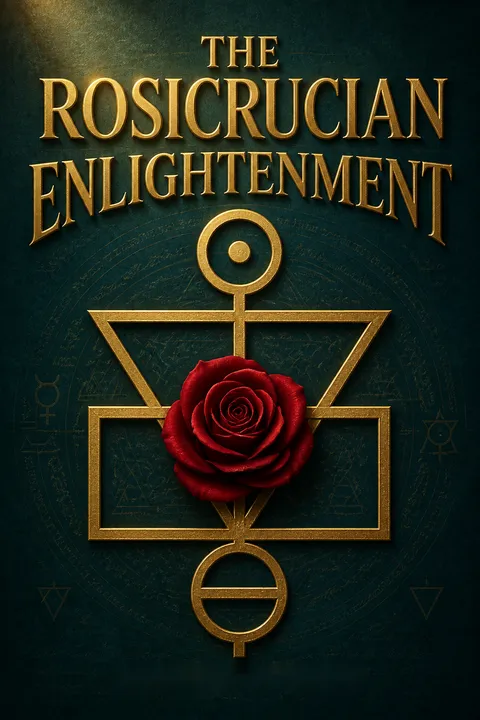

Key Takeaways
1. The Rosicrucian Manifestos: A Trumpet Call for Universal Enlightenment
God has revealed to us in these latter days a more perfect knowledge, both of his Son, Jesus Christ, and of Nature.
A new dawn. The early 17th century saw the emergence of the Rosicrucian manifestos—the Fama Fraternitatis (1614) and Confessio Fraternitatis (1615)—which proclaimed a coming "general reformation of the whole wide world." These documents, often described as a "trumpet call," announced a new era of spiritual and intellectual illumination, promising a deeper understanding of both divine truths and the secrets of nature. They invited learned individuals across Europe to join a benevolent, secret Fraternity dedicated to advancing knowledge and alleviating human suffering.
A blend of traditions. The manifestos presented a philosophy rooted in "Magia, Cabala, and Alchymia," advocating for a synthesis of ancient wisdom with new scientific inquiry. They criticized the rigid adherence to outdated authorities like Aristotle and Galen, urging a collaborative approach among "magicians, Cabalists, physicians, and philosophers" to unlock nature's secrets. This vision was not merely academic; it was deeply religious, aiming to restore humanity to a paradisal state of knowledge and harmony, believing that a "divine light" was breaking forth before a grand spiritual transformation.
Widespread excitement. The manifestos ignited an immense "furore" across Germany and beyond, sparking a torrent of pamphlets, appeals, and critiques. Many sought to join the mysterious "R.C. Brothers," drawn by promises of profound knowledge, healing, and a role in a universal reformation. This fervent response underscored a widespread yearning for change and a belief that a new age of discovery and spiritual renewal was at hand, even as the true nature and existence of the Fraternity remained shrouded in allegory and deliberate mystification.
2. Heidelberg: The Palatinate's Brief "Rosicrucian" Golden Age
Heidelberg castle was to become a centre whence strange and exciting influences were to emanate in the years following Elizabeth’s arrival there.
A strategic alliance. The marriage of Princess Elizabeth, daughter of James I, to Frederick V, Elector Palatine, in 1613, was celebrated as a grand diplomatic and religious event. This union positioned Heidelberg, the Palatinate capital, as a symbolic bastion of Protestantism and a potential leader against the rising Catholic Hapsburg power. The court at Heidelberg, infused with English Renaissance splendor, became a vibrant intellectual and artistic hub, attracting scholars, artists, and engineers who shared a vision of a reformed Europe.
Architectural marvels. Frederick invested heavily in transforming Heidelberg Castle and its gardens into a "Hermetic golden age," featuring mechanical statues, water-organs, and intricate geometrical designs by Salomon de Caus. These "magico-scientific marvels" reflected a blend of advanced technology and Renaissance occult philosophy, creating an atmosphere of wonder and intellectual curiosity. The castle, with its "Teutonic Nonesuch" aesthetic, symbolized a new cultural synthesis, a "marriage of the Thames and the Rhine," where English and German intellectual currents converged.
A beacon of hope. For many, Heidelberg represented a "citadel of advanced seventeenth-century culture" and a focal point for hopes of a new "enlightenment." The Palatinate's activism, guided by figures like Christian of Anhalt, aimed to challenge Hapsburg dominance and foster a more tolerant, reformed Europe. This environment provided fertile ground for the Rosicrucian ideals of universal reformation and scientific advancement, with the manifestos themselves appearing during this period of heightened expectation, implicitly linking their vision to Frederick's leadership.
3. John Dee: The Hidden Architect of Rosicrucian Philosophy
Dee as ‘Rosicrucian’ is thus a figure typical of the late Renaissance magus who combined ‘Magia, Cabala, and Alchymia’ to achieve a world-view in which advancing science was strangely mingled with angelology.
A profound legacy. The "more secret philosophy" behind the Rosicrucian manifestos was undeniably that of John Dee, the Elizabethan magus. His Monas Hieroglyphica (1564), a complex symbol integrating planetary, alchemical, and mathematical principles, served as a direct source for the Confessio and appeared prominently in Andreae's Chemical Wedding. Dee's vision encompassed a unified science that transcended earthly knowledge, seeking divine insight through number, magic, and angelic communication.
Bohemian connections. Dee's continental career, particularly his mission in Bohemia from 1583 to 1589, was crucial for transmitting these ideas. He cultivated a following in Rudolph II's Prague and at Trebona, influencing figures like Oswald Croll and, indirectly, Christian of Anhalt. This established a direct channel for Dee's unique blend of Hermeticism, Cabala, and alchemy to permeate the intellectual circles that would later foster the Rosicrucian movement in Germany.
A unifying framework. Dee's philosophy provided a comprehensive framework for the Rosicrucian call for a "general reformation." It offered a path to understanding the "Microcosmus" (man) in relation to the "Macrocosmus" (universe), promising not only scientific advancement but also spiritual illumination and a return to Adamic wisdom. This intellectual lineage, from Dee's Elizabethan England through his Bohemian sojourn to the German Rosicrucian manifestos, highlights his pivotal, though often unacknowledged, role in shaping this transformative intellectual current.
4. Alchemy's Spiritual and Scientific Renaissance
The true philosophers are far of another mind, esteeming little the making of gold, which is but a parergon; for besides that they have a thousand better things.
Beyond material gold. Rosicrucian alchemy, as expounded by figures like Robert Fludd and Michael Maier, transcended the mere pursuit of material gold. It was a profound spiritual and philosophical quest, viewing alchemical processes as allegories for inner transformation and the regeneration of the soul. The manifestos themselves emphasized that the "riches" offered by Father Rosencreutz were spiritual, leading to a vision of "Heavens open, and the angels of God ascending and descending."
Hermetic foundations. This spiritual alchemy was deeply rooted in the Hermetic tradition, revering Hermes Trismegistus and the Corpus Hermeticum. Fludd's monumental Utriusque Cosmi Historia systematically presented a macrocosm-microcosm philosophy, integrating Paracelsian alchemy with Cabala and Dee's mathematical insights. Maier, physician to Rudolph II, expressed similar ideas through intricate alchemical emblems, often with musical accompaniments, suggesting a sophisticated blend of art, science, and mysticism.
A new approach to nature. Rosicrucian alchemy fostered an experimental approach to nature, albeit one imbued with a magical worldview. It sought to decipher the "hieroglyphs" God had imprinted on the natural world, believing that understanding these divine "signatures" would lead to both scientific breakthroughs and spiritual enlightenment. This blend of empirical observation with mystical interpretation positioned alchemy as a vital, albeit controversial, precursor to modern chemistry and a key component of the broader Rosicrucian vision for advancing human knowledge.
5. The Bohemian Tragedy: A Crushing End to Rosicrucian Hopes
The R.C. movement collapsed when the Palatinate movement collapsed, when those inspiring vistas opened up behind the Elector Palatine and his brilliant alliances failed utterly with the flight of the King and Queen of Bohemia from Prague after the Battle of the White Mountain.
A fateful decision. Frederick V's acceptance of the Bohemian crown in 1619, against cautious advice, was a pivotal moment that ignited the Thirty Years' War. This "Bohemian adventure" was not merely a political gamble but a deeply religious act, driven by the belief that Frederick was destined to lead a universal reformation and break Hapsburg dominance. The enthusiasm surrounding his coronation in Prague, symbolized by prints depicting him as a divinely chosen king supported by the "Lions" of Protestant Europe, reflected the high hopes invested in his cause.
Betrayal and defeat. The anticipated support from James I, Frederick's father-in-law, proved to be a "chimera," as James pursued a policy of appeasement with the Hapsburgs. This lack of English backing, combined with the lukewarm support from other Protestant princes, led to Frederick's decisive defeat at the Battle of the White Mountain in November 1620. The "Winter King and Queen" fled Prague, losing both Bohemia and the Palatinate, marking a catastrophic end to their ambitious project.
Suppression and disillusionment. The collapse of the Frederickian movement brought an abrupt end to the Rosicrucian furore in Germany. The invading Hapsburg armies systematically suppressed all associated ideas, confiscating libraries, destroying cultural monuments, and launching propaganda campaigns that caricatured Frederick and linked his cause to dangerous "magic." This period of "unmitigated disaster" extinguished the immediate hopes of a "Rosicrucian Enlightenment," driving its proponents into exile or silence and leaving a legacy of profound disillusionment among those who had believed in its promise.
6. From Fictitious Brotherhoods to Real Christian Unions
The safest way will be . . . for you to embark upon your vessel which has the sign of Cancer for its distinctive mark, sail for Christianopolis yourself with favorable conditions, and there investigate everything very accurately in the fear of God.
Andreae's shift. Johann Valentin Andreae, the likely author of the Chemical Wedding and a key figure behind the Rosicrucian myth, grew increasingly alarmed by the "furore" and the misinterpretations surrounding the manifestos. By 1617, he began to disparage the R.C. Fraternity as a "ludibrium" or "play scene," not necessarily out of contempt for its ideals, but due to the "altercations" and "malicious conjectures" that had corrupted its original purpose. He sought to channel its aspirations into more tangible forms.
The Christianopolis vision. Andreae's Christianopolis (1619) presented a utopian city, a "real" model for a reformed society, blending intense piety with advanced scientific and technological pursuits. This city, with its mathematically ordered architecture, emphasis on education, and "service of angels," echoed the core ideals of the Rosicrucian manifestos but without the mystifying veil. It was a blueprint for a society where Christian charity and scientific inquiry worked hand-in-hand for human betterment.
Founding real societies. Andreae actively promoted the formation of "Christian Unions" or "Christian Societies," such as the "Societas Christiana," which aimed to embody the Rosicrucian ideals in a concrete, organized manner. These groups, though short-lived due to the war, focused on:
- Christian charity and brotherly love
- Intellectual and scientific activities for mankind's good
- Practical application of knowledge (e.g., technology, medicine)
- A non-sectarian approach to religious renewal
This transition from a "fictitious" brotherhood to "real" societies demonstrates Andreae's commitment to the underlying vision, even as he abandoned the problematic Rosicrucian label.
7. The Rosicrucian Scare: Magic, Witchcraft, and the Dawn of Mechanism
This great scare presupposes some knowledge of the Rosicrucian manifestos in its readers.
A Parisian panic. In 1623, Paris was gripped by a "hurricane" of rumor following the alleged appearance of placards announcing the presence of the "Brothers of the Rose Cross." These "Invisible Ones" were accused of diabolical pacts, devil-worship, and subversive activities, transforming the benevolent R.C. Brothers of the manifestos into figures of a terrifying witch-craze. This scare, fueled by Jesuit polemicists like François Garasse, reflected the intense fear of magic and heresy prevalent in Counter-Reformation Europe.
Targeting the "Invisible Ones." The accusations against the Rosicrucians drew directly from the manifestos, twisting their tenets into sinister implications:
- Their secrecy became diabolical concealment.
- Their rule of adopting local dress became a scheme for infiltration.
- Their pursuit of knowledge was reinterpreted as a lure to devil-worship.
- Their "invisibility" made them perfect targets for a witch-hunt, as they could not be found or proven innocent.
Mersenne's reaction. The Rosicrucian scare significantly influenced figures like Marin Mersenne, a friend of Descartes and a key figure in the rise of Cartesian mechanism. Mersenne, genuinely fearful of the perceived dangers of Renaissance magic, launched a massive intellectual assault on Hermeticism, Cabala, and figures like Robert Fludd, whom he considered a typical Rosicrucian. This reaction contributed to the broader shift from animistic Renaissance philosophies to a more mechanistic worldview, as scientists sought to distance themselves from any taint of "conjuring" or "evil magic."
8. Francis Bacon's New Atlantis: A Rosicrucian Utopia Reimagined
Though the name Rose Cross is nowhere mentioned by Bacon in the New Atlantis, it is abundantly clear that he knew the Rose Cross fiction and was adapting it to his own parable.
A parallel vision. Francis Bacon's unfinished utopian work, New Atlantis (published posthumously in 1627), presents a striking parallel to the Rosicrucian manifestos. It describes a hidden, scientifically advanced Christian society, Salomon's House, whose "priest-scientists" pursue knowledge for the benefit of mankind. This "fiction, parable, or ludibrium" clearly drew inspiration from the Rosicrucian myth, adapting its themes of a benevolent, invisible brotherhood dedicated to universal reformation.
Rosicrucian echoes. Several details in New Atlantis directly echo the Fama Fraternitatis:
- The scroll of instructions is sealed with "cherubin's wings, not spread, but hanging downwards, and by them a cross," reminiscent of the Fama's motto "Under the shadow of Jehova's wings."
- The inhabitants of New Atlantis heal the sick "gratis," a core rule of the R.C. Brothers.
- An official wears a "small red cross on the top" of his turban, a clear nod to the Rose Cross symbol.
- The "merchants of light" from Salomon's House travel invisibly, adopting local dress, mirroring the R.C. Brothers' rule of concealment.
Strategic adaptation. Bacon, while embracing the Rosicrucian ideal of advancing learning and restoring Adamic knowledge, carefully omitted explicit references to "magic" and "Cabala" that characterized the German movement. This strategic distancing was likely influenced by James I's deep-seated fear of magic and Bacon's desire to protect his scientific program from accusations of sorcery. New Atlantis thus represents a sanitized, more palatable version of the Rosicrucian vision, demonstrating how its core ideas could be re-packaged for a different cultural and political context.
9. Comenius and Pansophia: Carrying the Torch of Universal Wisdom
When all instances and rules have been collected, continues Comenius, we may hope that ‘an Art of Arts, a Science of Sciences, a Wisdom of Wisdom, a Light of Light’ shall at length be possessed.
A Bohemian heir. Johann Amos Comenius, a Bohemian Brother and a student at Heidelberg during Frederick V's early reign, was profoundly influenced by the Rosicrucian movement and Andreae's vision of Christian Unions. His early "pansophic" encyclopaedia, a "Theatre, or Amphitheatre, of all things in the world," reflected the macro-microcosmic philosophy central to Rosicrucian thought. Comenius witnessed firsthand the hopes and subsequent devastation of the Bohemian adventure, which deeply shaped his later work.
The Labyrinth of Disillusionment. In The Labyrinth of the World (1631), written in the aftermath of the Thirty Years' War, Comenius vividly described the Rosicrucian furore, acknowledging its initial promise but lamenting its ultimate failure and the ensuing "disappointment and disillusion." He recounted how the "trumpet sound" of the manifestos had raised hopes for a "new philosophy" and a "world reformation," only to see them dissolve into "fraud and deceit" and the "noise" of unfulfilled promises. This work captures the profound despair of an idealist witnessing the collapse of a grand vision.
Enduring ideals. Despite the tragedy, Comenius never abandoned the core ideals of universal reformation and the advancement of knowledge. His later work, particularly The Way of Light (1668), dedicated to the Royal Society, continued to advocate for a "Pansophia"—a universal wisdom that would integrate all knowledge for the betterment of mankind. He envisioned a "College, or a sacred society," dedicated to spreading light and learning, echoing the Rosicrucian and Baconian calls for collaborative scientific and spiritual progress, even as he warned against science detached from higher moral purpose.
10. The Invisible College's Legacy: Shaping the Royal Society
The best on’t is, that the cornerstones of the Invisible or (as they term themselves) the Philosophical College, do now and then honour me with their company . . .
Seeds of a new institution. The origins of the Royal Society, founded in 1660, can be traced back to informal meetings in London (1645) and Oxford (1648). Significantly, these early gatherings were influenced by figures like Theodore Haak, a Palatinate refugee, and John Wilkins, chaplain to the Elector Palatine's son. This "Palatinate colouring" suggests a direct lineage from the intellectual currents that had flourished in Heidelberg and were disrupted by the Thirty Years' War.
The "Invisible College." Robert Boyle's letters from 1646-1647 refer to a "new philosophical college" or "Invisible College," a term that directly echoes the Rosicrucian "ludibrium" of an unseen brotherhood. This suggests that the early proponents of experimental philosophy were aware of, and perhaps playfully adopted, the Rosicrucian concept of a hidden society dedicated to knowledge. The description of its members as "men of so capacious and searching spirits" and their "extensive charity" aligns with the philanthropic and intellectual ideals of the R.C. Brothers.
Cautious emergence. While the Royal Society ultimately adopted a more pragmatic, experimental, and less overtly mystical approach than its Rosicrucian predecessors, the influence is undeniable. Figures like John Wilkins, a key founder, openly cited the Fama in his Mathematicall Magick (1648), interpreting its marvels as scientifically produced. The Society's eventual emphasis on "Baconian experiment" and its deliberate avoidance of "dangerous topics" like explicit magic or utopian social reform can be seen as a strategic adaptation to the post-war climate, ensuring its survival by shedding the more controversial aspects of its intellectual heritage.
11. Esoteric Connections: Rosicrucianism and the Roots of Freemasonry
The original Free-Masons were a society that arose out of the Rosicrucian mania, certainly within the thirteen years from 1633 to 1646, and probably between 1633 and 1640.
A debated lineage. The relationship between Rosicrucianism and Freemasonry is a complex and often obscured historical question. While no direct, organized "Rosicrucian" secret society has been definitively proven, the Rosicrucian movement's emphasis on a benevolent, enlightened brotherhood, universal reformation, and esoteric knowledge undoubtedly influenced the broader landscape of secret societies. German researchers in the 18th century, like J.G. Buhle, even posited that Freemasonry itself originated from the "Rosicrucian mania."
Shared ideals and symbols. Both movements shared a common heritage in Renaissance esoteric traditions:
- Ancient Wisdom: Both traced their origins to ancient, often Egyptian or Hebraic, sources of wisdom, particularly geometry and the building of Solomon's Temple.
- Moral and Spiritual Development: Both emphasized ethical conduct, philanthropy, and a quest for deeper spiritual understanding.
- Symbolism: The "Great Architect of the Universe" in Freemasonry resonates with the Rosicrucian reverence for God's "wise architecture" in the cosmos.
Ashmole's pivotal role. Elias Ashmole, a founding member of the Royal Society, provides a crucial link. He was initiated into a Masonic lodge in 1646, one of the earliest documented instances of speculative masonry in England. Simultaneously, Ashmole meticulously copied the Rosicrucian manifestos and actively promoted English alchemy, explicitly linking it to Michael Maier's efforts within the German Rosicrucian movement. This suggests that for some, Rosicrucian ideals and Masonic affiliations were not mutually exclusive but rather complementary expressions of a shared esoteric worldview.
12. The Rosicrucian Enlightenment: A Lost Chapter in European Thought
The Rosicrucian Enlightenment included a vision of the necessity for a reform of society, particularly of education, for a third reformation of religion, embracing all sides of man’s activity—and saw this as a necessary accompaniment of the new science.
A unique intellectual style. The "Rosicrucian Enlightenment" represents a distinct, historically recognizable style of thinking that bridged the Renaissance and the Scientific Revolution. It was characterized by a fervent belief in a coming era of universal knowledge and spiritual illumination, rooted in a synthesis of Hermeticism, Cabala, and a reformed, spiritualized alchemy. This intellectual current, heavily influenced by John Dee, sought to understand the cosmos through mathematical harmony and angelic communication, aiming for a return to Adamic wisdom.
A confluence of influences. This movement was a complex tapestry woven from diverse European threads:
- English Renaissance: Dee's mathematical magic and Elizabethan chivalry.
- Bohemian Esotericism: Rudolph II's court, with its alchemists and Cabalists.
- German Mysticism: Figures like Andreae and Jacob Boehme, seeking spiritual renewal.
- Italian Liberalism: Anti-Hapsburg sentiments and calls for religious toleration from figures like Boccalini and Campanella.
A tragic interruption. The Rosicrucian Enlightenment, centered around the Palatinate and Frederick V's bid for Bohemia, was tragically cut short by the Thirty Years' War. This catastrophic failure led to the suppression of its overt manifestations, the discrediting of its name, and the scattering of its proponents. However, its ideals did not vanish but continued to flow as "subterranean forces," influencing later movements like the Christian Unions, the pansophic efforts of Comenius and Hartlib, and ultimately contributing to the intellectual foundations of the Royal Society and Freemasonry. This lost chapter reveals a period where scientific advancement was deeply intertwined with profound spiritual and social aspirations.
Review Summary
Reviews of The Rosicrucian Enlightenment are largely positive, averaging 4.22/5. Many praise Yates' scholarly yet accessible approach to a subject often mired in conspiracy thinking, commending her ability to contextualize the Rosicrucian manifestos within early 17th-century European politics, science, and occultism. Critics note the book's speculative conclusions, repetitive writing, and reliance on secondary sources. Readers appreciate its exploration of links between Renaissance Hermeticism and the Scientific Revolution, though some find the connections tenuous. Overall, it is considered an essential, fascinating starting point for studying Rosicrucianism.
People Also Read




Download PDF
Download EPUB
.epub digital book format is ideal for reading ebooks on phones, tablets, and e-readers.








































