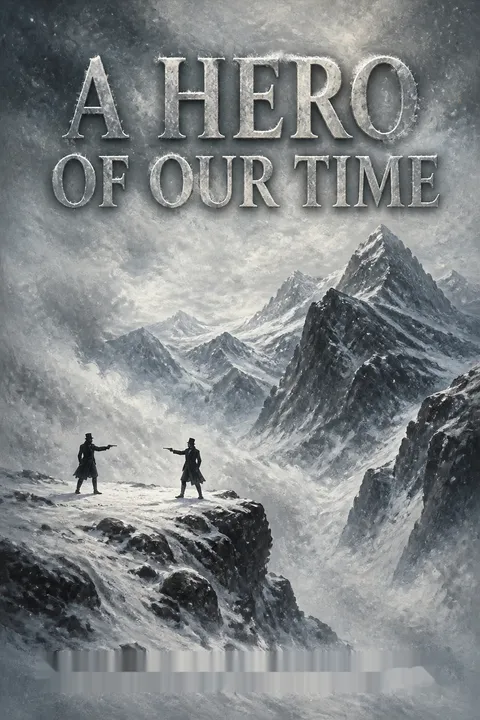

Plot Summary
Arrival in the Caucasus
A Russian officer, traveling through the wild, mountainous Caucasus, meets the seasoned and affable Maksim Maksimich. The two men, strangers at first, are united by the hardships and unpredictability of the region. Maksim Maksimich, a man shaped by years of service and exposure to the local cultures, becomes the storyteller, offering the traveler a glimpse into the lives and fates of those stationed at the empire's edge. The landscape is both beautiful and dangerous, setting the stage for tales of passion, violence, and existential searching. The journey is not just physical but psychological, as the characters are forced to confront the limits of their own understanding and the unpredictability of human nature.
The Storyteller's Bargain
Around a smoky fire, Maksim Maksimich begins to recount the story of Grigoriy Pechorin, a young officer whose arrival at the fort changed everything. Pechorin is enigmatic, charming, and restless—a man who seems to attract extraordinary events. Maksim Maksimich's narrative is colored by affection, confusion, and a touch of awe, as he describes Pechorin's odd habits, his unpredictable moods, and his ability to both delight and disturb those around him. The tale is not just about Pechorin, but about the storyteller's own longing for connection and meaning in a world that often seems indifferent to both.
Pechorin's Seduction of Bela
Pechorin, driven by a mix of boredom and desire, manipulates the local prince's son, Azamat, into trading his sister, Bela, for a coveted horse. The transaction is cold and calculated, revealing Pechorin's capacity for both charm and cruelty. Bela, a beautiful and spirited Circassian girl, is taken from her home and delivered into Pechorin's possession. At first, she resists, but Pechorin's persistence and gifts eventually wear down her defenses. The seduction is as much about power as it is about love, and the consequences of this act will ripple through the lives of everyone involved.
The Price of Obsession
As Bela becomes accustomed to her new life, Pechorin's interest in her begins to wane. The initial thrill of possession fades, replaced by a sense of emptiness and dissatisfaction. Bela, once vibrant, grows pale and withdrawn, her spirit broken by captivity and unrequited love. The arrival of Kazbich, a vengeful local who once loved Bela, brings the simmering tensions to a head. In a desperate act, Kazbich kidnaps and fatally wounds Bela, leaving Pechorin to confront the consequences of his actions. The tragedy exposes the destructive power of obsession and the futility of trying to possess another person.
Loss and Disillusionment
Bela's death leaves Pechorin hollow and adrift. Maksim Maksimich, who had grown fond of Bela, is devastated, while Pechorin's reaction is more complex—he is unable to grieve openly, his emotions dulled by years of disappointment and self-analysis. The episode marks a turning point for Pechorin, deepening his sense of alienation and reinforcing his belief in the futility of love and happiness. The world, once full of promise, now seems empty and indifferent, and Pechorin's restless search for meaning becomes more desperate.
Reunion and Estrangement
Years later, Maksim Maksimich and the narrator encounter Pechorin by chance at an inn. The reunion is awkward and bittersweet—Maksim Maksimich is eager to reconnect, but Pechorin is distant, preoccupied, and ultimately indifferent. The old bonds of friendship have dissolved, replaced by a sense of estrangement and disappointment. Pechorin's detachment is both a defense and a symptom of his deeper malaise. The episode underscores the theme of isolation and the difficulty of genuine human connection in a world governed by chance and self-interest.
The Enigmatic Hero Emerges
After Pechorin's death, his journal falls into the narrator's hands, offering a direct window into the hero's thoughts and motivations. The journal is a confession, a self-analysis, and a challenge to the reader. Pechorin emerges as a complex figure—intelligent, sensitive, and self-aware, yet also manipulative, cynical, and emotionally numb. He is both a product and a critic of his time, embodying the contradictions and anxieties of a generation caught between old certainties and new doubts. The journal structure allows for a fragmented, nonlinear exploration of character and fate.
Taman's Shadowy Intrigue
In the coastal town of Taman, Pechorin becomes entangled in a web of smuggling, deception, and ambiguous relationships. He encounters a blind boy, a mysterious girl, and a band of smugglers, all of whom seem to operate according to their own inscrutable logic. The episode is dreamlike and unsettling, blurring the boundaries between reality and illusion, innocence and guilt. Pechorin's attempts to assert control are frustrated, and he is left feeling both threatened and irrelevant. The adventure in Taman serves as a metaphor for the limits of knowledge and the dangers of meddling in other people's lives.
Princess Mary's Allure
At a fashionable spa, Pechorin becomes fascinated by Princess Mary, a young woman whose beauty and intelligence set her apart from the crowd. The pursuit is a game, a test of wills, and a means of alleviating boredom. Pechorin's rival, Grushnitski, is also in love with Mary, setting the stage for a contest marked by manipulation, jealousy, and wounded pride. Pechorin's interactions with Mary are marked by irony and ambiguity—he both desires and despises her, seeking to conquer her heart while remaining emotionally detached.
Rivalry and Manipulation
The competition for Mary's affection becomes increasingly ruthless, with Pechorin using his superior intelligence and psychological insight to outmaneuver Grushnitski at every turn. The rivalry is not just about love, but about power, self-worth, and the need to assert dominance in a world that offers few real challenges. Pechorin's actions are both cruel and calculated, exposing the emptiness of social conventions and the fragility of human vanity. The episode culminates in a series of humiliations and betrayals that leave all parties diminished.
Love, Jealousy, and Betrayal
Vera, a woman from Pechorin's past, reappears, reigniting old passions and resentments. Her presence complicates Pechorin's pursuit of Mary and forces him to confront the consequences of his emotional detachment. Vera's love is genuine but doomed, and Pechorin's inability to reciprocate fully leads to jealousy, misunderstanding, and heartbreak. The triangle of Pechorin, Mary, and Vera becomes a microcosm of the larger themes of the novel—desire, disillusionment, and the impossibility of lasting happiness.
The Fatal Duel
The rivalry between Pechorin and Grushnitski escalates to a duel, orchestrated by a circle of conspirators who hope to humiliate Pechorin. The duel is both a farce and a tragedy, exposing the emptiness of codes of honor and the dangers of pride. Pechorin, aware of the plot against him, turns the tables and kills Grushnitski, but the victory is hollow. The episode is a meditation on fate, free will, and the destructive power of ego. The duel marks the climax of Pechorin's journey, leaving him more isolated and disillusioned than ever.
Aftermath and Regret
In the wake of the duel, Pechorin is consumed by guilt, regret, and a sense of futility. His relationships with Vera and Mary are irreparably damaged, and he is forced to confront the emptiness at the heart of his existence. The world, once full of possibilities, now seems closed and indifferent. Pechorin's self-analysis becomes more acute, but also more despairing—he recognizes his own flaws but is powerless to change. The aftermath of the duel is a reckoning, both personal and philosophical.
The Question of Fate
In the story's final episode, Pechorin and his fellow officers debate the existence of fate and the limits of human agency. A series of chance events—a game of Russian roulette, a senseless murder—underscore the unpredictability of life and the fragility of human plans. Pechorin's own experiences have taught him to doubt both the power of reason and the comfort of superstition. The question of fate remains unresolved, but the search for meaning continues, even in the face of uncertainty and loss.
The End of Illusions
The novel ends with Pechorin's death, reported secondhand, and the narrator's reflections on the meaning of his life. Pechorin's story is both a cautionary tale and a mirror held up to a generation adrift between old values and new doubts. The hero of his time is not a model to be emulated, but a warning—a man whose intelligence and sensitivity are wasted in a world that offers no worthy outlet for his gifts. The end is not redemption, but resignation—a recognition that the search for meaning may be endless, and that the greatest tragedy is not failure, but the inability to care.
Analysis
A Hero of Our Time is a pioneering work of psychological realism and existential inquiry, offering a portrait of a generation caught between the collapse of old certainties and the absence of new ideals. Through the figure of Pechorin, Lermontov explores the dangers of intelligence without purpose, passion without commitment, and freedom without direction. The novel's fragmented structure, shifting perspectives, and ironic tone reflect the uncertainties of modern life, while its focus on self-analysis and inner conflict anticipates the concerns of later writers like Dostoevsky and Camus. At its core, the book is a meditation on the search for meaning in a world that often seems indifferent or hostile to human hopes. The lessons are both personal and universal: the pursuit of power, love, or adventure without self-knowledge leads only to emptiness and regret; the greatest challenge is not to conquer others, but to understand and accept oneself. In our own time, as in Lermontov's, the question remains: what does it mean to be a hero, and what kind of hero does our age demand?
Review Summary
A Hero of Our Time is a complex psychological novel exploring the character of Pechorin, a cynical and conflicted young officer. Readers praise Lermontov's vivid prose, insightful character study, and portrayal of 19th-century Russian society. The novel's structure, alternating perspectives, and exploration of themes like love, boredom, and fate are widely appreciated. Many find Pechorin's character both fascinating and repulsive, reflecting on human nature and societal disillusionment. The book is considered a masterpiece of Russian literature, bridging Romanticism and realism.
People Also Read
Characters
Grigoriy Pechorin
Pechorin is the central figure of the novel—a young officer whose intelligence, charm, and sensitivity are matched only by his cynicism, emotional detachment, and capacity for manipulation. He is a man out of step with his time, unable to find meaning or satisfaction in love, friendship, or duty. Pechorin's relationships are marked by a mixture of attraction and contempt, and his actions often lead to suffering for himself and others. He is both a victim and a perpetrator, a man who understands his own flaws but is powerless to change. Pechorin's psychological complexity makes him both fascinating and repellent—a hero for an age of disillusionment.
Maksim Maksimich
Maksim Maksimich serves as both a narrator and a foil to Pechorin. He is a career officer, practical and kind, whose straightforward values are challenged by the complexities of the world around him. Maksim Maksimich's affection for Pechorin is genuine, but ultimately unrequited, and his disappointment at their final meeting is one of the novel's most poignant moments. He represents the old order—loyal, dutiful, and emotionally open—but is ultimately left behind by the new generation's skepticism and self-absorption.
Bela
Bela is a beautiful Circassian girl whose abduction and seduction by Pechorin set the novel's central tragedy in motion. She is spirited and proud, but ultimately powerless in the face of Pechorin's manipulations. Bela's love for Pechorin is genuine, but it cannot survive the realities of captivity and emotional neglect. Her death is both a personal tragedy and a symbol of the destructive consequences of treating people as objects to be possessed.
Azamat
Azamat, the son of a local prince, is driven by his obsession with Kazbich's horse. His willingness to trade his sister for the animal reveals both his immaturity and the corrosive effects of envy and desire. Azamat is a pawn in Pechorin's schemes, and his actions set the stage for the novel's central tragedy.
Kazbich
Kazbich is a local horseman and bandit whose love for Bela and loss of his prized horse drive him to violence. He is both a villain and a victim, a man whose passions are as intense as Pechorin's but whose fate is shaped by forces beyond his control. Kazbich's actions are motivated by a sense of honor and revenge, but they ultimately lead to destruction and loss.
Princess Mary
Princess Mary is the object of Pechorin's and Grushnitski's affections. She is beautiful, cultured, and initially aloof, but her defenses are gradually worn down by Pechorin's attentions. Mary's journey from pride to vulnerability mirrors Pechorin's own emotional arc, and her eventual heartbreak is a testament to the dangers of love in a world governed by manipulation and self-interest.
Grushnitski
Grushnitski is Pechorin's chief rival for Mary's affection—a young officer whose romantic posturing masks deep insecurities and a need for validation. His rivalry with Pechorin escalates from petty jealousy to deadly enmity, culminating in the fatal duel. Grushnitski's fate is a cautionary tale about the dangers of pride, vanity, and the desire to be seen as a hero.
Vera
Vera is a woman from Pechorin's past whose love for him endures despite betrayal and disappointment. She is the only character who truly understands Pechorin, and her presence forces him to confront the emptiness of his own heart. Vera's love is both a source of comfort and a reminder of what Pechorin has lost through his inability to commit.
Werner
Werner is a doctor and Pechorin's confidant, a man whose skepticism and wit make him both a commentator on and participant in the novel's events. He serves as a sounding board for Pechorin's philosophical musings and provides a counterpoint to the more emotional characters. Werner's presence highlights the novel's themes of doubt, irony, and the search for meaning.
Vulich
Vulich is an officer whose belief in fate leads him to risk his life in a game of Russian roulette. His subsequent death at the hands of a drunken Cossack serves as a meditation on the unpredictability of life and the limits of human agency. Vulich's story is both a parable and a challenge to the novel's other characters, forcing them to confront their own beliefs about destiny and free will.
Plot Devices
Framed Narrative and Multiple Perspectives
The novel employs a complex narrative structure, with stories nested within stories and multiple narrators offering different perspectives on the same events. This technique creates a sense of ambiguity and distance, forcing the reader to question the reliability of each account. The gradual revelation of Pechorin's character—from the outside in, and finally through his own journal—mirrors the process of self-discovery and the difficulty of truly knowing another person. The structure also allows for a nonlinear exploration of time and memory, emphasizing the role of chance and coincidence in shaping human lives.
Eavesdropping and Coincidence
Eavesdropping, accidental meetings, and other forms of coincidence are central to the novel's plot. Characters frequently overhear conversations, stumble upon secrets, or find themselves in the right (or wrong) place at the right time. These devices underscore the unpredictability of life and the limits of human control, while also serving as metaphors for the ways in which people are shaped by forces beyond their understanding.
Psychological Realism and Self-Analysis
Pechorin's journal entries are marked by intense self-analysis and psychological realism. He is acutely aware of his own motives, desires, and flaws, and his willingness to expose his own contradictions is both disarming and unsettling. The novel's focus on inner life anticipates later developments in Russian literature and marks a shift from external action to internal conflict. Pechorin's self-awareness is both a strength and a weakness, enabling him to manipulate others but also trapping him in a cycle of doubt and dissatisfaction.
Irony and Parody of Romantic Conventions
The novel frequently parodies the conventions of Romantic literature—duels, passionate love, heroic exploits—by exposing their emptiness and absurdity. Pechorin is both a Byronic hero and a critique of that type, embodying the contradictions and failures of a generation that has lost faith in traditional values. The use of irony and self-mockery allows the novel to explore serious themes without descending into sentimentality or melodrama.
Fate and Free Will
The question of fate versus free will is a recurring theme, explored through both plot and dialogue. Characters debate the existence of destiny, the power of choice, and the meaning of chance events. The novel refuses to offer easy answers, instead presenting a world in which meaning is elusive and outcomes are often arbitrary. The tension between agency and inevitability is embodied in Pechorin's own actions, which are both deliberate and self-defeating.
FAQ
Synopsis & Basic Details
What is A Hero of Our Time about?
- A Byronic antihero's journey: A Hero of Our Time follows Grigoriy Pechorin, a young, intelligent, yet deeply cynical and restless Russian officer, through a series of adventures in the Caucasus mountains. The novel explores his psychological landscape as he manipulates, seduces, and ultimately alienates those around him, driven by an insatiable boredom and a profound sense of disillusionment.
- Framed Narrative and Multiple Perspectives: The story is presented through a unique, non-chronological framed narrative, beginning with an anonymous traveler's encounter with Maksim Maksimich, who recounts Pechorin's early exploits, and culminating in Pechorin's own journal entries. This structure gradually reveals the protagonist's complex inner world, offering multiple perspectives on his enigmatic character.
- Exploration of a "hero" for a generation: Lermontov's work is a critical portrait of the "vices of our generation," as stated in the author's introduction, depicting a man who embodies the spiritual malaise and moral ambiguity of 19th-century Russian society, particularly the educated elite. Pechorin's actions, though often destructive, are presented as a search for meaning in a world he finds inherently unsatisfying.
Why should I read A Hero of Our Time?
- Masterpiece of Psychological Realism and Self-Analysis: Readers should delve into A Hero of Our Time for its groundbreaking psychological realism, offering an unparalleled look into the mind of a complex antihero. Pechorin's relentless self-analysis and his candid confessions of his flaws and motivations provide a fascinating, if unsettling, portrait of human nature.
- Pioneering narrative structure: The novel's innovative use of a framed narrative and shifting perspectives (from the traveler, to Maksim Maksimich, to Pechorin himself) creates a multi-layered reading experience that challenges perceptions and deepens the mystery surrounding its protagonist. This structural complexity makes it a rewarding read for those interested in literary experimentation.
- Timeless exploration of existential themes: Lermontov's work grapples with universal questions of fate, free will, love, boredom, and the search for meaning, making it profoundly relevant even today. Pechorin's struggle against an indifferent world and his own inner demons resonates with contemporary anxieties about purpose and connection.
What is the background of A Hero of Our Time?
- Caucasus as a romantic and military frontier: The novel is set against the backdrop of the Caucasus, a region of stunning natural beauty and ongoing military conflict between the Russian Empire and local mountain tribes in the 1830s. This setting provides a dramatic stage for Pechorin's adventures, reflecting the wildness and unpredictability that both attracts and repels him.
- Author's personal experience and literary context: Mikhail Lermontov himself served in the Caucasus as punishment for a poem, and his own tragic death in a duel mirrors the fate of his protagonist. The novel draws heavily on the Byronic hero archetype, popular in European Romanticism, but subverts it through Pechorin's cynical self-awareness, offering a distinctly Russian critique of the type.
- Social commentary on 19th-century Russia: A Hero of Our Time serves as a sharp social commentary on the Russian gentry, particularly the "superfluous man" archetype—educated, privileged individuals who feel alienated and purposeless in a society that offers no meaningful outlet for their talents. The author's introduction explicitly states it's a "portrait composed of all the vices of our generation."
What are the most memorable quotes in A Hero of Our Time?
- "My soul has been impaired by the fashionable world, I have a restless fancy, an insatiable heart; whatever I get is not enough...": This quote from "Bela" (p. 49) encapsulates Pechorin's core psychological conflict and his profound ennui, revealing his self-awareness of his own destructive nature and the emptiness that drives his actions. It's central to understanding Pechorin's motivations and his inability to find lasting happiness.
- "Within me there are two persons: one of them lives in the full sense of the word, the other cogitates and judges him.": From "Princess Mary" (p. 165), this line offers a direct insight into Pechorin's fragmented psyche, highlighting his detached self-observation and the internal division that prevents him from fully experiencing life or genuine emotion. This duality is key to Pechorin's psychological analysis.
- "I love my enemies, although not in a Christian sense: they amuse me, they quicken my pulses.": Spoken in "Princess Mary" (p. 149), this quote reveals Pechorin's cynical and manipulative approach to human relationships, viewing conflict as a source of stimulation rather than a moral challenge. It underscores his thirst for power and control, a significant theme in A Hero of Our Time.
What writing style, narrative choices, and literary techniques does Mikhail Lermontov use?
- "Dry and drab" prose with emotional signals: As noted by Nabokov in the Translator's Foreword, Lermontov's prose is often "inelegant; it is dry and drab," yet he effectively conveys emotion through "code sentences" like "her lips grew pale," "he flushed," or "her hand trembled slightly" (p. 6). This starkness, combined with abrupt, violent gestures (e.g., striking the table with a fist, p. 6), creates a powerful, unadorned realism that contrasts with the romantic themes.
- Strategic use of "peg words" and repetition: Lermontov frequently employs a specific set of Russian "peg words" (e.g., zadúmat'sya - to become pensive, vdrug - suddenly) that, while seemingly commonplace, create a rhythmic and almost hypnotic effect through their repetition (p. 7). This stylistic choice, faithfully rendered by Nabokov, contributes to the novel's unique atmosphere and the sense of an underlying, almost fated, progression of events.
- Framed Narrative and Multiple Perspectives: The novel masterfully uses its framed narrative to introduce Pechorin gradually and from different viewpoints, often contradicting or recontextualizing earlier impressions. The narrator's initial idealization of Maksim Maksimich, and Maksim Maksimich's own biased account of Pechorin, serve as narrative misdirection, forcing the reader to actively interpret and question the "truth" of events, a core aspect of A Hero of Our Time analysis.
Hidden Details & Subtle Connections
What are some minor details that add significant meaning in A Hero of Our Time?
- The recurring "dull pallor" motif: Nabokov highlights the repeated description of "dull pallor" (p. 8) on characters' faces (the Taman girl, Mary, Pechorin, Grushnitski) as a code for inner agitation or suffering. This subtle detail links disparate characters through a shared experience of emotional turmoil, suggesting a pervasive undercurrent of anxiety and hidden struggle beneath their outward composure, a key element of A Hero of Our Time symbolism.
- The "springless carriage" vs. "traveling calash": The narrator's humble "small springless carriage" (p. 9) contrasts sharply with Pechorin's "marvelous carriage" and "empty traveling calash" (p. 54). This seemingly minor detail symbolizes the vast social and material gulf between the anonymous, practical narrator and the wealthy, detached Pechorin, highlighting the latter's privileged yet ultimately unfulfilling existence.
- Bela's grave and the "white acacia": The description of Bela's grave being surrounded by "bushes of white acacia and elder" (p. 52) is a poignant detail. As Nabokov notes, "white acacia" is the American Black locust, a non-native species. This subtle botanical detail could symbolize Bela's displacement and the foreignness of her fate, a Circassian girl buried in a Russian fort, reflecting the broader themes in A Hero of Our Time concerning cultural clash and tragic assimilation.
What are some subtle foreshadowing and callbacks in A Hero of Our Time?
- Lermontov's "Triple Dream" as a structural blueprint: Nabokov's foreword details Lermontov's prophetic poem, "The Triple Dream," which structurally mirrors the novel's nested narratives and non-chronological events (p. 3). This literary device subtly foreshadows the complex, layered revelation of Pechorin's character and fate, suggesting that his story, like the dream, is a predetermined, inescapable spiral.
- Pechorin's "death from a wicked wife" prophecy: Pechorin recounts an old woman's fortune-telling from his childhood, predicting "death from a wicked wife" (p. 139), which instilled in him an "insuperable aversion to marriage." This detail subtly foreshadows his destructive relationships and his ultimate, unconfirmed death, hinting at a fated end that he actively, yet perhaps unconsciously, brings about through his avoidance of commitment. This is a crucial aspect of Pechorin's motivations.
- The pistol misfire in "The Fatalist" echoing the duel: The dramatic scene where Vulich's pistol misfires before successfully shooting a cap (p. 187) serves as a powerful callback to the duel with Grushnitski, where Pechorin's pistol was intentionally loaded with a blank. This parallel underscores the novel's central debate on Fate and Free Will, suggesting that even seemingly random events or manipulations can align with a larger, predetermined destiny.
What are some unexpected character connections in A Hero of Our Time?
- Yanko and the blind lad mirroring Pechorin and Maksim Maksimich: Nabokov points out that the relationship between Yanko, the elusive smuggler, and the blind lad in "Taman" is a "pleasing echo of the scene between hero and hero-worshipper in 'Maksim Maksimich'" (p. 8). This subtle parallel connects the two pairs through a dynamic of dependence and unrequited loyalty, highlighting the universal patterns of human attachment and eventual abandonment that transcend social status or moral standing.
- Grushnitski as Pechorin's "grotesque shadow": As noted by Russian critics and Nabokov (p. 8), Grushnitski is not merely a rival but a "grotesque shadow of Pechorin." This connection reveals Grushnitski as a parodic, less refined version of the Byronic hero, embodying the superficial romanticism and vanity that Pechorin himself possesses but masks with greater cynicism and self-awareness. Their rivalry becomes a dark mirror, reflecting Pechorin's own destructive tendencies.
- Vera's husband as an unwitting accomplice: Vera's "little old gentleman" husband, Semyon Vasilievich G—v, is a distant relation of Princess Ligovskoy (p. 105) and becomes an unwitting tool in Pechorin's schemes. His naive trust and "enthusiasm" (p. 155) after the duel, believing Pechorin to be a "noble young man," ironically facilitate Pechorin's continued manipulation, showcasing the ease with which Pechorin exploits others' good intentions.
Who are the most significant supporting characters in A Hero of Our Time?
- Werner, the cynical intellectual mirror: Dr. Werner, Pechorin's confidant, is a "sceptic and a materialist" yet also a "poet in all his actions" (p. 95). He serves as Pechorin's intellectual equal and a cynical mirror, understanding Pechorin's complexities without judgment, but ultimately remaining detached. His presence highlights Pechorin's isolation, as even his closest intellectual companion cannot offer true connection, only shared observation of human folly.
- Vera, the enduring, self-sacrificing love: Vera is the only woman Pechorin admits he "could not bear to deceive" (p. 106), and the only one who truly understands his "petty weaknesses and wicked passions" (p. 130). Her unwavering, self-sacrificing love, despite his cruelty and emotional detachment, represents a profound, almost spiritual connection that Pechorin is incapable of fully reciprocating. Her character underscores the tragic limitations of Pechorin's heart.
- Maksim Maksimich, the embodiment of traditional values: The junior captain, Maksim Maksimich, is more than just a narrator; he represents the simple, loyal, and sentimental values of an older generation and the "Russian" character (p. 50). His deep affection for Pechorin and his profound disappointment at their final, cold reunion (p. 57) serve as a poignant critique of Pechorin's modern cynicism and emotional barrenness, highlighting the human cost of his detachment.
Psychological, Emotional, & Relational Analysis
What are some unspoken motivations of the characters in A Hero of Our Time?
- Pechorin's quest for control as a shield against emptiness: Pechorin's relentless pursuit of power and manipulation over others, as seen in his seduction of Bela and Mary, is an unspoken motivation to fill the "insatiable avidity" (p. 119) and "cold, helpless despair" (p. 118) within him. He seeks to "subjugate to my will all that surrounds me" (p. 119) not for genuine connection, but as a substitute for the "ardor of noble yearnings" he has lost, a core aspect of Pechorin's motivations.
- Princess Mary's desire for genuine depth: Mary's initial pride and disdain for superficial admirers, and her eventual vulnerability to Pechorin, reveal an unspoken motivation for a deeper, more authentic connection than her social circle offers. Her attraction to Pechorin's perceived "extraordinary person" (p. 130) stems from a longing to escape the "dull" (p. 135) and conventional, even if it leads to heartbreak.
- Vera's acceptance of suffering as a form of love: Vera's enduring love for Pechorin, despite his repeated betrayals and emotional distance, is driven by an unspoken motivation to find meaning in her own suffering. She confesses, "you gave me nothing but sufferings" (p. 104), yet she remains devoted, suggesting that for her, the intensity of their connection, even if painful, is preferable to emotional void, a complex aspect of Vera's character analysis.
What psychological complexities do the characters exhibit in A Hero of Our Time?
- Pechorin's fragmented self and detached self-analysis: Pechorin explicitly states, "Within me there are two persons: one of them lives in the full sense of the word, the other cogitates and judges him" (p. 165). This profound psychological complexity reveals a man who is both actor and observer of his own life, capable of merciless self-critique but unable to bridge the gap between his intellectual understanding and his emotional capacity, leading to his pervasive boredom and destructive behavior.
- Grushnitski's vanity as a tragic flaw: Grushnitski's entire persona is built on a fragile vanity, a desperate need to be seen as a "hero of a novel" (p. 86) and a "martyr" (p. 99). His psychological complexity lies in his inability to distinguish genuine emotion from theatrical posturing, making him easily manipulated by Pechorin and ultimately leading to his tragic downfall in the duel, a key element in Grushnitski's character analysis.
- Maksim Maksimich's naive emotional depth: Despite his "simple-hearted" (p. 8) nature, Maksim Maksimich exhibits a deep psychological complexity in his capacity for profound, unrequited affection and his inability to comprehend Pechorin's modern cynicism. His "hysterical behavior" (p. 8) at their reunion and his subsequent "resentment" (p. 58) reveal the pain of a loyal heart confronted with indifference, highlighting the clash between traditional values and modern alienation.
What are the major emotional turning points in A Hero of Our Time?
- Bela's death and Pechorin's feigned indifference: Bela's death is a major emotional turning point, particularly for Maksim Maksimich, who is "devastated" (Existing Summary). Pechorin, however, displays a chilling lack of outward grief, laughing and tracing in the sand (p. 52). This moment underscores his emotional barrenness and his inability to connect authentically, solidifying his self-perception as a "moral cripple" (p. 118) and deepening his sense of isolation.
- Maksim Maksimich's heartbreak at Pechorin's coldness: The reunion between Maksim Maksimich and Pechorin (p. 56) is a pivotal emotional turning point, especially for the older captain. Pechorin's "rather coolly" extended hand and his dismissive attitude shatter Maksim Maksimich's "fondest hopes and dreams" (p. 59), revealing the profound pain of unreciprocated friendship and the tragic consequences of Pechorin's emotional detachment.
- Pechorin's tears after losing Vera: After Vera's departure and his horse's death, Pechorin "fell on the wet grass and began crying like a child" (p. 175). This rare display of raw emotion is a significant turning point, revealing a crack in his cynical facade. It suggests that despite his claims of indifference, Vera's loss touches a deep, vulnerable part of his soul, hinting at the true cost of his self-imposed emotional isolation.
How do relationship dynamics evolve in A Hero of Our Time?
- **From
Download PDF
Download EPUB
.epub digital book format is ideal for reading ebooks on phones, tablets, and e-readers.








































