
Key Takeaways
1. Economic Growth Is Not Steady: The "Special Century" (1870-1970) Was Unique
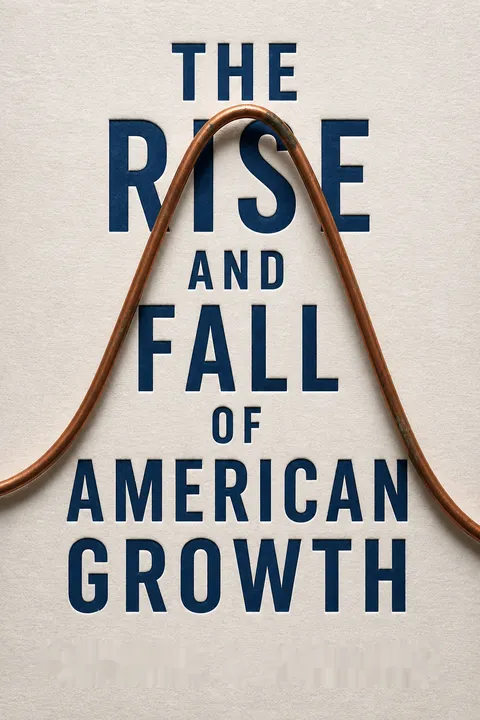
The economic revolution of 1870 to 1970 was unique in human history, unrepeatable because so many of its achievements could happen only once.
Uneven progress. Economic growth is not a continuous, steady process. For millennia, from the fall of the Roman Empire to the mid-18th century, there was virtually no economic growth. A slow transition occurred between 1770 and 1870, but the true "Age of Revolution" was the century following the American Civil War, from 1870 to 1970. This period saw an unprecedented acceleration in the U.S. standard of living.
Unrepeatable achievements. This "special century" was characterized by a unique clustering of "Great Inventions" that fundamentally transformed daily life. These were one-time changes that could not be replicated. For instance, the shift from candlelight to electric light, or from horse-drawn transport to motor vehicles, represented quantum leaps in human experience that, once achieved, left little room for further revolutionary improvement in that specific domain.
Post-1970 slowdown. The rapid growth of the special century gave way to a slower pace after 1970. This deceleration is evident in key economic metrics like total factor productivity (TFP), which grew at barely a third of its previous rate. This suggests that while innovation continued, its broad impact on the overall economy diminished compared to the transformative power of the earlier industrial revolutions.
2. The Second Industrial Revolution (IR #2) Transformed Every Aspect of Life
The century of revolution in the United States after the Civil War was economic, not political, freeing households from an unremitting daily grind of painful manual labor, household drudgery, darkness, isolation, and early death.
Broad impact. The Second Industrial Revolution (IR #2), driven by inventions from 1870 to 1900, profoundly reshaped nearly every facet of human existence. It liberated households from arduous daily tasks and dramatically improved living conditions. This era's innovations were pervasive, touching almost all aspects of life.
Key transformations:
- Housing: From dark, isolated homes to bright, networked dwellings with electricity, running water, indoor plumbing, and central heating.
- Transportation: The shift from horses to motor vehicles, and the rise of railroads and urban transit.
- Food & Clothing: Increased variety, improved safety, and a move from home production to market purchases.
- Health: Conquest of infant mortality and infectious diseases, significantly extending life expectancy.
- Work: Reduction in arduous labor, shorter workweeks, and a shift from dangerous manual jobs to safer, more comfortable occupations.
Fundamental change. These changes were not incremental but revolutionary, altering the very "meaning of community, of time and space, of present and future." The sheer breadth of these transformations across multiple dimensions of life makes IR #2 uniquely impactful in human history.
3. IR #2's Benefits Were Often Unmeasured by GDP
Real GDP does not value the reduction of infant mortality from 22 percent of new births in 1890 to about 1 percent in 1950.
Beyond market transactions. Traditional measures of economic growth, like real GDP per person, significantly underestimate the true improvement in the standard of living during IR #2. GDP primarily captures market-exchanged goods and services, often missing the immense "consumer surplus" generated by new inventions and quality-of-life enhancements.
Unaccounted welfare gains:
- Health: The dramatic increase in life expectancy, especially the conquest of infant mortality, provided immense value not reflected in market spending.
- Home life: The elimination of daily drudgery (e.g., hauling water, scrubbing laundry) due to networked homes and appliances freed up countless hours of labor.
- Safety & Environment: The removal of horse manure from city streets, safer workplaces, and cleaner air and water improved public health and living environments.
- Convenience: The ease of electric light, instant communication via telephone, and the vast selection offered by department stores and mail-order catalogs added immeasurable value.
Understated progress. These unmeasured benefits suggest that the actual growth rate of welfare in the first half of the 20th century was substantially higher than official GDP statistics indicate. The sheer magnitude and breadth of these non-market improvements highlight the profound, yet often invisible, impact of IR #2 on human well-being.
4. The "Great Leap Forward" (1920s-1950s) Was a Period of Unprecedented Productivity
The Great Leap Forward of the American level of labor productivity that occurred in the middle decades of the twentieth century is one of the greatest achievements in all of economic history.
Peak performance. The period between 1920 and 1970, particularly the decades from the 1920s to the 1950s, witnessed the fastest rate of productivity growth in American history. Labor productivity (output per hour) and total factor productivity (TFP) soared, far exceeding previous trends and subsequent rates. This surge fundamentally reshaped the U.S. economy and its productive capacity.
Disruption as catalyst. Paradoxically, the economic disruptions of the Great Depression and World War II played a crucial role in this "Great Leap." The Depression forced businesses to innovate and cut costs, leading to efficiency gains. World War II, with its immense production demands, spurred "learning by doing" and a massive expansion of government-financed, privately-operated capital, permanently enhancing the nation's productive capabilities.
Technological maturation. This era saw the full maturation and widespread implementation of IR #2 inventions. Electrification of factories, the widespread adoption of the assembly line, and the rapid increase in the power and efficiency of motor vehicles (cars, trucks, tractors) transformed manufacturing, transportation, and agriculture. Innovations in chemicals and plastics also contributed significantly, laying the groundwork for postwar prosperity.
5. The Third Industrial Revolution (IR #3) Had a Narrower Impact on Daily Life
This paradox is resolved when we recognize that advances since 1970 have tended to be channeled into a narrow sphere of human activity having to do with entertainment, communications, and the collection and processing of information.
Limited scope. In contrast to the pervasive transformations of IR #2, the Third Industrial Revolution (IR #3), centered on information and communication technology (ICT) since 1960, has had a more confined impact on daily life. While revolutionary within its domain, its effects did not extend across the full spectrum of human needs and wants.
Focused transformations:
- Entertainment: From broadcast TV to cable, satellite, high-definition, and streaming services, offering unprecedented choice and quality.
- Communication: Evolution from landlines to mobile phones, then smartphones, enabling instant, portable, and multimedia interactions.
- Information: Mainframe computers, personal computers, the Internet, web browsers, search engines, and e-commerce revolutionized access to information and commercial transactions.
Uneven progress. While ICT brought dazzling changes to how we entertain ourselves, communicate, and access information, progress in other fundamental areas slowed. Food, clothing, housing (beyond appliances), and surface transportation saw less dramatic, more evolutionary changes after 1970 compared to the earlier century. This narrower scope helps explain the overall deceleration of productivity growth.
6. IR #3's Productivity Boost Was Temporary and Has Slowed Significantly
For the decade 2005–2014, average trend productivity growth was just 1.30 percent and by the end of 2014 had reached only 0.6 percent per year.
Brief revival. The impact of IR #3 on economy-wide productivity growth was not continuous but episodic, primarily concentrated in the decade between 1994 and 2004. This period saw a temporary revival in total factor productivity (TFP) growth, largely driven by the widespread adoption of the Internet, web browsers, search engines, and e-commerce, which fundamentally reshaped business practices.
Post-2004 slowdown. Following this brief surge, TFP growth decelerated sharply after 2004, returning to rates even slower than those observed between 1970 and 1994. This suggests that the most impactful, one-time changes enabled by the digital revolution in areas like office automation, retail logistics, and financial processing were largely completed by the mid-2000s.
Diminishing returns. Objective measures confirm this slowdown:
- Manufacturing capacity growth turned negative.
- Net investment ratios declined significantly.
- The rate of improvement in computer performance (Moore's Law) slowed considerably after 2006.
- Business dynamism, measured by new firm entry, also declined.
This evidence indicates that the "dot-com era" was a unique, unrepeatable burst of productivity, and the economy has since settled into a slower, more evolutionary pace of technological impact.
7. Four "Headwinds" Are Stifling Future Growth and Increasing Inequality
Our chronicle of the rise in the American standard of living over the past 150 years rests heavily on the history of innovations, great and small alike. However, any consideration of U.S. economic progress in the future must look beyond innovation to contemplate the headwinds that are blowing like a gale to slow down the vessel of progress.
Beyond innovation. While innovation remains a crucial driver, its impact on the standard of living is increasingly challenged by powerful "headwinds." These systemic forces act as a drag on economic growth, particularly affecting the majority of Americans. Understanding these headwinds is essential for forecasting future prosperity.
Key headwinds:
- Inequality: A growing divergence in income and wealth, with disproportionate gains at the top.
- Education: Stagnation in educational attainment and declining quality of outcomes, especially for disadvantaged groups.
- Demography: Shifts in population age structure and labor force participation rates.
- Government Debt: The rising burden of public debt and the need for future fiscal adjustments.
Compounding challenges. These headwinds are not isolated but interact, exacerbating their collective impact. For instance, educational inequality contributes to income inequality, and an aging population strains public finances. Their combined force suggests a future where median real disposable income grows much slower than overall economic averages.
8. Rising Inequality Diverts Growth from the Majority
Chief among these headwinds is the rise of inequality that since 1970 has steadily directed an ever larger share of the fruits of the American growth machine to the top of the income distribution.
Uneven distribution. Since the early 1970s, the benefits of economic growth have been increasingly concentrated at the top of the income distribution, particularly among the wealthiest 1%. This "Great Divergence" contrasts sharply with the "Great Compression" of the mid-20th century, where incomes grew more equally across all segments of society.
Impact on the majority. For the bottom 90% of the income distribution, real pre-tax income has stagnated or even declined since 1972. Even after accounting for taxes and transfers, median household income growth has lagged significantly behind average income growth. This means that while the overall economic pie may grow, a shrinking slice reaches the typical American household.
Contributing factors:
- Decline of unions: Weakened bargaining power for many workers.
- Globalization: Increased competition from imports and offshoring of manufacturing jobs.
- Automation: Replacement of routine middle-skill jobs by machines.
- Erosion of minimum wage: Reduced purchasing power for low-wage workers.
- Superstar economics & executive compensation: Disproportionate gains for top earners and CEOs.
These forces collectively exert downward pressure on wages for the majority, while boosting incomes at the very top.
9. Educational Stagnation Undermines Future Productivity and Opportunity
If American high school students regularly rank poorly in international tests of reading, math, and science, then a sudden spike in scores to levels previously unseen may be considered improbable.
Faltering progress. The historic role of rising educational attainment as a key driver of productivity growth has diminished since 1970. High school graduation rates plateaued, and the U.S. has fallen behind other developed nations in college completion rates. This stagnation in human capital development acts as a significant drag on future economic potential.
Quality concerns. Beyond attainment rates, the quality of American education is a concern:
- U.S. 15-year-olds consistently rank in the bottom half of international PISA tests in reading, math, and science.
- A significant portion of high school graduates are not prepared for college-level work.
- Early childhood education disparities, with low-income children having significantly smaller vocabularies by kindergarten, create lasting disadvantages.
Affordability and debt. The soaring cost of higher education, which has outpaced inflation by threefold since 1972, has led to a national student debt burden exceeding $1.2 trillion. This debt, coupled with a growing number of college graduates unable to find jobs requiring their degrees, threatens to reverse the long-standing positive returns to higher education, particularly for students from less affluent backgrounds.
10. Demographic Shifts Reduce Per-Person Output and Create Fiscal Strain
The retirement of 77 million baby boomers into Social Security and Medicare is not theoretical projection. Demography is destiny.
Shrinking workforce. Demographic changes, particularly the retirement of the baby-boom generation (born 1946-1964), are causing a decline in hours worked per person in the population. This means that even if labor productivity continues to grow, output per person (the standard of living) will grow more slowly, as fewer people are working relative to the total population.
Declining participation. Beyond baby-boomer retirement, the labor force participation rate for prime-aged (25-54) men and women has also declined since 2000. This trend, partly linked to a lack of employment opportunities and "deaths of despair" among certain groups, further reduces the overall hours worked per person, exacerbating the demographic headwind.
Fiscal burden. An aging population, with a growing ratio of retirees to working taxpayers, places immense strain on public finances. Social Security and Medicare trust funds face projected insolvency within decades, necessitating future fiscal adjustments. These adjustments, likely involving higher taxes and/or reduced benefits, will further dampen the growth of disposable income for the working population.
11. The Future Pace of Innovation Will Likely Be Evolutionary, Not Revolutionary
We wanted flying cars, instead we got 140 characters.
Slower impact. Despite the rapid pace of innovation in digital technology, its impact on economy-wide productivity growth is expected to be evolutionary rather than revolutionary in the coming decades. The most transformative changes from the Third Industrial Revolution (IR #3), such as the widespread adoption of the internet, e-commerce, and office automation, largely occurred between 1994 and 2004.
Incremental gains. Future innovations, including advancements in robotics, artificial intelligence (AI), big data, and driverless vehicles, are likely to yield incremental improvements rather than the broad, foundational shifts seen in earlier industrial revolutions. While these technologies will continue to enhance specific tasks and create new niches, their overall macroeconomic impact on productivity growth is projected to be modest.
Challenges and limitations:
- Robots: Despite advancements, robots still struggle with complex dexterity and problem-solving in unstructured environments, limiting their widespread replacement of human labor outside of manufacturing.
- AI/Big Data: While powerful for marketing and analysis, AI's current applications often complement human work rather than fully replacing it, and its impact on aggregate productivity has not accelerated recently.
- Driverless vehicles: While promising for safety and convenience, the full societal integration of autonomous vehicles faces significant technical, legal, and logistical hurdles, and their productivity gains may be limited to specific sectors like long-haul trucking.
The future will bring continuous technological progress, but its broad economic effects are unlikely to match the transformative power of the "special century."
People Also Read










The Princeton Economic History of the Western World Series Series





Download PDF
Download EPUB
.epub digital book format is ideal for reading ebooks on phones, tablets, and e-readers.








































