
Key Takeaways
1. Mechanistic Ideology Fuels Totalitarianism
The Enlightenment tradition, the ideology of Reason, was a persistent attempt to squeeze life into logic and theories.
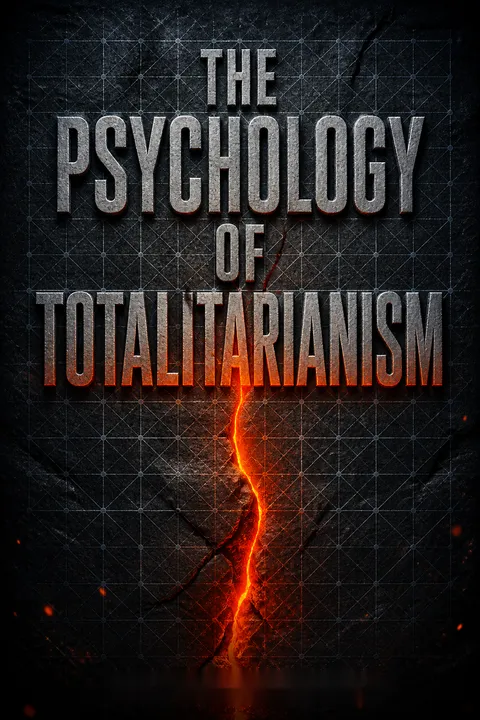
Totalitarianism's roots. The book argues that totalitarianism is not merely a political system but a profound psychological phenomenon, stemming directly from the mechanistic worldview that has dominated Western thought since the Enlightenment. This ideology, by reducing life to predictable, controllable mechanisms, inadvertently creates the conditions for mass formation and authoritarian rule. It promises liberation through reason but delivers a society ripe for control.
Erosion of humanity. This mechanistic lens, while fostering scientific and technological advancement, systematically ignores the psychological, symbolic, and ethical dimensions of human existence. It atomizes individuals, severing their connections to nature, community, and intrinsic meaning. This profound collective unease—manifesting as isolation, pessimism, and mental suffering—is the fertile ground upon which totalitarianism thrives.
A new form of control. Unlike classical dictatorships based on fear of brute force, modern totalitarianism, as envisioned by Hannah Arendt, is led by "dull bureaucrats and technocrats." It relies on an insidious psychological process of mass formation, where populations willingly sacrifice personal interests and critical thought for a perceived collective unity, often under the guise of scientific necessity.
2. Science Degenerates into Dogma and Unreliability
Science can, in essence, be defined as open-mindedness.
From truth to ideology. Originally, science embodied open-mindedness, questioning dogmas, and embracing uncertainty to discover truth. However, the mechanistic-materialistic branch of science, particularly the "hard sciences," became an ideology itself, transforming from a pursuit of knowledge into a system of belief and prejudice. This shift led to a "scientific fiction" that often disregarded facts.
Replication crisis. This ideological turn culminated in the 2005 "replication crisis," revealing widespread sloppiness, errors, biased conclusions, and even outright fraud in academic research. Up to 85% of studies in some fields, like biomedical research, yielded radically wrong conclusions, demonstrating a fundamental epistemological crisis. Researchers, often unconsciously, distorted results to fit preconceived notions.
Pseudo-objectivity. The problem is exacerbated in fields dealing with complex, dynamic phenomena like human psychology and medicine, where attempts to quantify the unmeasurable lead to "pseudo-objectivity." Numbers, graphs, and statistics, though appearing objective, are inherently relative and constructed from subjective assumptions. This creates an illusion of certainty that blinds people to the underlying biases and ideological frameworks.
3. Artificial Society Breeds Isolation and Meaninglessness
The mechanization of the world also had a direct effect at the level of meaning making.
Convenience at a cost. The practical applications of mechanistic science, from pendulum clocks to the internet, have undeniably made life more convenient. However, this convenience comes at a steep psychological price: a weakened connection to natural rhythms and social environments. Artificial light, mechanical time, and industrial labor progressively alienated humans from their innate contexts.
Erosion of social bonds. The rise of mass media and digitalization further transformed social connections, replacing direct human interactions with mediated ones. This "digitalization dehumanizes a conversation," leading to feelings of absence and exhaustion, and contributing to a "loneliness epidemic." The perceived safety of digital distance comes at the cost of genuine human connection and empathy.
Meaningless labor. Industrialization also stripped work of its inherent meaning. People now often produce for anonymous others, losing the direct satisfaction of seeing their labor's impact. This has led to a proliferation of "bullshit jobs," where a significant portion of the workforce finds their work meaningless, contributing to widespread burnout and existential unease.
4. The Illusion of Objective Numbers Distorts Reality
At first glance, the numbers seem only true to the facts, yet on closer inspection, it becomes clear that they slavishly serve every story.
Numbers are relative. The belief that numbers offer an objective basis for rational decisions is a dangerous illusion. Even seemingly simple measurements, like the length of a coastline, are relative and depend on subjective choices. More complex data, such as crime statistics, can be presented in different ways to support opposing conclusions, as illustrated by Simpson's paradox.
COVID-19 as a case study. The coronavirus crisis starkly exposed the relativity of medical measurements and statistics.
- PCR tests produced variable and often misleading "infection" counts.
- Hospitalization data were inflated by counting all positive patients as COVID-19 cases.
- Death counts were ambiguous, often including individuals with multiple comorbidities or those who died with the virus, not from it.
- Epidemiological models, like those from Imperial College, made wildly inaccurate predictions, yet policies remained unchanged.
Ideological confirmation. The crisis demonstrated how a society saturated with fear selects and interprets numbers to confirm its anxieties, reinforcing the dominant narrative. This "pseudo-objectivity" allows for the imposition of far-reaching measures and the suppression of dissent, blurring the line between scientific fact and ideological fiction.
5. Societal Anxiety Drives a Desire for Absolute Authority
The more we attempt to eliminate the fear and uncertainty through rationality and rules, the more we collide with failure.
Fear of suffering. The Enlightenment's promise to liberate humanity from fear and insecurity has paradoxically led to an intensification of these very feelings. Modern society exhibits an extreme intolerance for physical suffering and risk, leading to an "insurance mania" and frantic attempts to control every aspect of life, often with counterproductive results.
Narcissism and regulitis. This pervasive insecurity manifests in two key societal phenomena:
- Narcissism: An obsessive focus on external ideals and self-image, a fallacious attempt to overcome insecurity through superficial validation, leading to loneliness and inner emptiness.
- Regulitis: An enormous, ever-increasing proliferation of rules and regulations, both government-imposed and self-imposed (e.g., "woke" culture, climate movement). This hyper-strict morality, often more irrational than past religious dogmas, suffocates spontaneity and freedom.
Yearning for a master. The relentless pursuit of rational control and rules, however, inevitably fails because human language and life itself are inherently ambiguous. This failure, coupled with deep-seated anxiety, creates a psychological vacuum that society desperately seeks to fill with an absolute master—a totalitarian leader or technocratic system—who promises definitive answers and control.
6. Mass Formation: A Collective Hypnosis Against Uncertainty
Mass formation is, in essence, a kind of group hypnosis that destroys individuals’ ethical self-awareness and robs them of their ability to think critically.
Conditions for mass formation. Large-scale mass formation, the psychological bedrock of totalitarianism, arises when four conditions are met in a society:
- Generalized loneliness and social isolation.
- Lack of meaning in life.
- Widespread free-floating anxiety and psychological unease.
- Latent frustration and aggression seeking an outlet.
The hypnotic catalyst. When these conditions are present, a suggestive narrative, spread through mass media, identifies an object of anxiety (e.g., a virus, a scapegoat group) and offers a strategy to combat it. This narrative acts as a catalyst, allowing all free-floating anxiety to attach to the object, and uniting the atomized population in a common struggle.
Psychological gains and consequences. This process provides a temporary psychological "intoxication": anxiety becomes manageable, society regains a sense of coherence and meaning, and latent aggression is discharged onto "the enemy" (dissidents). This narrowing of attention leads to emotional insensitivity towards victims outside the narrative's focus and a willingness to accept self-destructive measures, often justified as "solidarity" or "civic responsibility."
7. Totalitarian Leaders are Blinded by Ideology, Not Just Malice
What characterizes the leaders of the masses is not greed or sadism, but their morbid ideological drive: Reality must and will be adjusted to the ideological fiction.
The banality of evil. Totalitarian leaders are not necessarily psychopathic or driven by personal gain; rather, they are often deeply hypnotized by the very ideology they seek to impose. Their "ice-cold reasoning" and "merciless dialectics" are rooted in a fanatical belief that their ideological fiction must become reality, justifying any means, including manipulation, deception, and atrocity.
Self-hypnosis and blindness. Leaders, like the masses, are caught in a circular causality of hypnosis. They are entranced by the effects they produce in the crowd and become mentally and emotionally blind to the suffering they inflict. This ideological blindness explains phenomena like Adolf Eichmann's pride in organizing the Holocaust, believing he was doing "the very best for everyone."
Anti-utilitarian destruction. Totalitarian systems are intrinsically anti-utilitarian and self-destructive. They prioritize ideological purity over practical outcomes, often destroying their own economies and populations in the process. The constant need to identify new "objects of anxiety" and implement new, often absurd, measures drives a vicious cycle of destruction, which only ends when the system devours itself.
8. Ideology, Not Conspiracy, is the Ultimate Master
If anything rules from the behind the scenes, it’s not so much secret societies, but ideologies.
The illusion of coordination. The coordinated behavior of masses and leaders often gives the impression of a grand, secret conspiracy. However, this coordination is primarily impersonal, driven by a dominant ideology—a shared way of thinking—rather than a clandestine group of individuals. Like the Sierpinski triangle, complex patterns emerge from individuals independently following the same simple rules dictated by the prevailing ideology.
The power of the zeitgeist. Institutions and individuals in positions of power are selected and shaped by the dominant ideology. They automatically follow its logic, succumbing to the same fallacies and behaviors without needing secret meetings. "Plans" like those from the Rockefeller or Gates Foundations are not so much secret conspiracies but open expressions of this ideology, reflecting and guiding societal trends towards a hyper-controlled technocracy.
The danger of both extremes. While genuine conspiracies exist (e.g., the meticulous planning of the Holocaust by a small group), reducing all societal dynamics to a single, malicious conspiracy is a psychological coping mechanism. It simplifies complexity, provides an enemy for anger, and absolves personal responsibility. This "conspiracy thinking" is as dangerous as mass formation itself, leading to dehumanization and hindering nuanced analysis.
9. The Universe is Living, Unpredictable, and Self-Organizing
Those studying chaotic dynamics discovered that the disorderly behavior of simple systems acted as a creative process.
Beyond mechanistic determinism. The mechanistic worldview, which sees the universe as a dead, predictable machine, is scientifically outdated. Quantum mechanics revealed that elementary particles are not solid, objective data but elusive, subjective phenomena influenced by consciousness. Chaos theory further demonstrates that even seemingly random natural phenomena exhibit self-organizing, unpredictable, yet strictly determined patterns.
Deterministic unpredictability. Phenomena like the "noise" on telephone lines or dripping water faucets, once dismissed as random, reveal complex, aesthetically sublime patterns (e.g., Cantor dust, Lorenz attractor). These systems possess "deterministic unpredictability": their future behavior cannot be precisely predicted, yet they are governed by timeless, underlying principles and forms, reminiscent of Plato's ideal world.
A vitalist worldview. Chaos theory suggests that matter is not merely passive but possesses inherent creativity and life. It points to the existence of formal and final causes, implying that "forms" or "ideas" coordinate material processes, rather than just efficient and material causes. This heralds an era where the universe is once again understood as pregnant with meaning, challenging the reductionist view.
10. Mind Over Matter: The Profound Power of the Psyche
The psychological realm is a primary dimension, which, under no circumstances, can be reduced to the physical, the chemical, or the biochemical domain.
Consciousness shapes reality. The mechanistic assumption that consciousness is merely a byproduct of brain biochemistry is refuted by science. Quantum mechanics shows that observation (a mental act) influences particle behavior, even retroactively. Furthermore, cases of individuals with minimal brain tissue functioning normally, and the phenomenon of neuroplasticity, demonstrate a circular causality between mind and brain.
Psychological causality. The psyche profoundly influences the physical body.
- Stress and immunity: Anxiety and stress significantly reduce physical resistance to viral infections, increasing mortality.
- Psychogenic death: In certain cultures, individuals can die from a shaman's curse, demonstrating the lethal power of belief and suggestion.
- Placebo/Nocebo effect: Placebos can induce astonishing physical effects, from opening coronary arteries to reactivating brain areas, while negative beliefs (nocebo) can cause illness or death. Hypnosis can even enable painless surgery.
The power of narrative. These effects are mediated by powerful mental images and symbolic narratives. Our bodies are "colonized" by the myths and stories we grow up with, influencing everything from basic reflexes to health outcomes. Medical practice, like shamanic rituals, operates within a symbolic framework that profoundly impacts its efficacy, often unconsciously.
11. Truth-Telling and Empathy as Antidotes to Totalitarianism
The awareness that no logic is absolute is the prerequisite for mental freedom.
Transcending false certainty. Totalitarianism, rooted in the illusion of absolute rational control, leads to the destruction of human creativity, individuality, and genuine social connection. To overcome this, society must defy its anxiety and embrace the inherent uncertainty of the human condition, recognizing it as a necessary space for creativity and authentic connection.
The art of truth-telling. The antidote lies in a return to sincere truth-telling, which Foucault defines in four forms:
- Prophecy: Sensing the underlying story gripping reality.
- Wisdom: Allowing others to hear their own words.
- Techné: Producing logically correct, factual discourse.
- Parrhesia: Courageously speaking out against fallacious societal narratives.
This involves moving beyond rhetoric to express subjective truth, fostering resonance and connection.
Cultivating empathy and individuality. This path requires cultivating empathy—the ability to resonate with others and the world—and embracing individuality. It means listening to one's body, understanding its language, and engaging in "full speech" to connect authentically. This approach allows for a different relationship with suffering and death, integrating them into a meaningful existence rather than fearing them.
Review Summary
Reviews of The Psychology of Totalitarianism are sharply divided. Supporters praise its accessible analysis of mass formation, its updating of Hannah Arendt's work, and its relevance to modern societal anxieties, particularly around COVID-19 responses. Critics, however, argue the book is pseudoscientific, relies on cherry-picked evidence, and presents a misleading strawman of science and the Enlightenment. Many negative reviewers object to comparisons between pandemic restrictions and historical totalitarianism, while others find the philosophical arguments vague, poorly evidenced, and ideologically motivated.
People Also Read








Download PDF
Download EPUB
.epub digital book format is ideal for reading ebooks on phones, tablets, and e-readers.








































