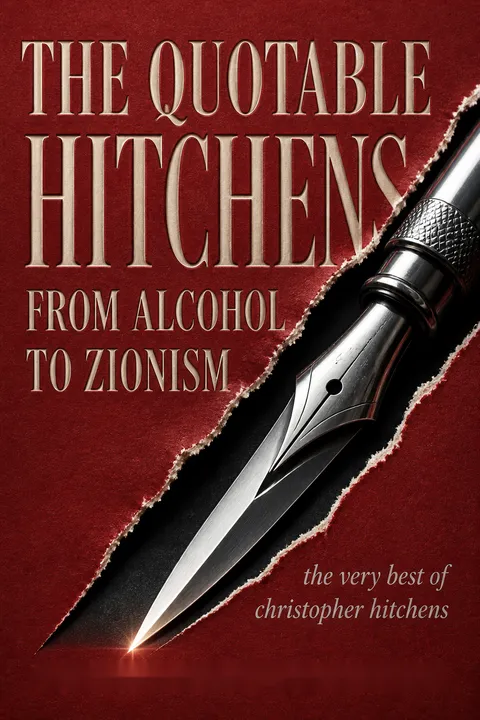

Summary Unavailable
This book is not suitable for a summary (it may be a textbook, workbook, cookbook, reference book, or collection). However, you can still explore the FAQs, about author, and other metadata below!
Key Takeaways
1. Unwavering Skepticism: Questioning All Authority
“The arrogance of power is boundless, but it mustn’t deprive us of that great consolation of the underdog—the presumption of guilt.”
Power's inherent corruption. Christopher Hitchens consistently argued that those in power are inherently suspect and capable of anything. He believed that a healthy democracy requires a "presumption of guilt" for rulers, rather than blind trust, to ensure accountability. This applied to all forms of authority, from political leaders to intelligence agencies.
Institutional distrust. His skepticism extended to institutions often seen as pillars of society. He viewed organizations like the CIA as prone to incompetence and criminality, suggesting that "it’s better to have no intelligence service at all than one that actively works against you." This critical stance was not born of cynicism but a deep-seated belief that power, unchecked, inevitably leads to abuse.
Examples of institutional critique:
- CIA: "The CIA got everything wrong before 9/11, and thereafter. It was conditioned by its own culture to see no evil."
- Catholic Church: "State or no state, the church is a highly disciplined multinational corporation that allows little or no autonomy to its branches and can no more be the judge in its own cause than British Petroleum."
- Monarchy: "The British monarchy inculcates unthinking credulity and servility. It forms a heavy layer on the general encrustation of our unreformed political institutions."
For Hitchens, true vigilance meant constantly challenging the narratives and actions of those who govern, recognizing that their self-interest often diverged from the public good.
2. The Poison of Religion: A Relentless Critique
“Religion is, precisely because we are still-evolving creatures, ineradicable. It will never die out, or at least not until we get over our fear of death, and of the dark, and of the unknown, and of each other.”
Religion's detrimental impact. Hitchens was a staunch "anti-theist," arguing that religion is not merely false but actively harmful. He saw it as a relic of humanity's "bawling and fearful infancy," providing answers before evidence and fostering a "slavish, credulous mentality." He believed that religion's claims to divine authority were the "worst excuse ever invented for the exertion of power by one primate over another."
Moral and intellectual failings. He contended that religion is "not just incongruent with morality but in essential ways incompatible with it." Instead of inspiring good, it often gives people "permission to behave in ways that would make a brothel-keeper or an ethnic cleanser raise an eyebrow." He highlighted the hypocrisy of religious figures and the way faith can lead to atrocities, from child abuse cover-ups to suicide-murder.
Key criticisms of religion:
- Misrepresents origins: "It wholly misrepresents the origins of man and the cosmos."
- Fosters servility and solipsism: "It manages to combine the maximum of servility with the maximum of solipsism."
- Sexual repression: "It is both the result and the cause of dangerous sexual repression."
- Wish-thinking: "It is ultimately grounded on wish-thinking."
- Censorship and intolerance: "All religions take care to silence or to execute those who question them."
For Hitchens, the rejection of man-made gods was a necessary, though not sufficient, condition for intellectual and moral emancipation, freeing humanity to address real-world problems.
3. Championing Free Inquiry and Expression
“Freedom of speech and expression did not fall from the sky. They had to be fought for and they have to be defended. This is payback time.”
The bedrock of liberty. Hitchens viewed free speech and inquiry as fundamental, hard-won rights that must be defended absolutely, even when the speech is offensive or unpopular. He saw censorship, whether political or "moral," as inherently absurd and totalitarian, designed to "mask distinctions" and prevent critical thought. The struggle for free intelligence, he asserted, is always a battle between the "ironic and the literal mind."
Against taboos and conformity. He was particularly critical of those who sought to limit expression based on "offended susceptibilities" or "sensitivity." He argued that "civil society means that free expression trumps the emotions of anyone to whom free expression might be inconvenient." This included defending controversial figures like Salman Rushdie, not out of agreement, but because "there is no other side to be on" when free expression is threatened.
Principles of free expression:
- No obligation to comment on truth/merit: "There is therefore no obligation, in defending or asserting the right to speak, to pass any comment on the truth or merit of what may be, or is being, said."
- Utilitarian case: "For your own sake, you need to know how other people think."
- Against taboos: "To legislate otherwise would be to instate a taboo, and that is exactly what the First Amendment exists to forestall."
- Truth through inquiry: "Truth is only to be sought by free inquiry and trial and error."
For Hitchens, the ability to speak and think freely was the ultimate defense against dogma, tyranny, and the "deadening of language."
4. The Perils of Credulity and Conformity
“Gullibility and credulity are considered undesirable qualities in every department of human life—except religion.”
The danger of uncritical acceptance. Hitchens frequently warned against the dangers of credulity, whether in religious belief, political propaganda, or popular opinion. He saw it as a "standing invitation for the wicked and the clever to exploit their brothers and sisters," leading to a "mindless and invertebrate" society. He believed that "people have a need for reassurance and belonging," which makes them susceptible to manipulation.
Critique of mass movements and polls. He was deeply suspicious of mass movements and the "tyranny of the opinion polls," which he saw as tools for "depoliticization" and the "mastery of populism by the elite." He argued that polls "undoubtedly help decide what people think, but their most important long-term influence may be on how people think," shaping rather than reflecting genuine public sentiment.
Manifestations of credulity/conformity:
- Religious belief: "The brilliant Schiller was wrong... It is actually by means of the gods that we make our stupidity and gullibility into something ineffable."
- Political correctness: "The beauty of consensus PC is that it makes differences on matters of principle almost unsayable."
- Populism: "Populism... exploits the very ‘people’ to whose grievances it claims to give vent."
- Media bias: "The overall bias of the American press is towards consensus."
Hitchens urged individuals to resist the urge to conform and to cultivate an independent mind, even if it meant being unpopular or accused of "elitism."
5. Embracing the Contrarian Spirit: A Duty to Dissent
“My own opinion is enough for me, and I claim the right to have it defended against any consensus, any majority, anywhere, any place, any time. And anyone who disagrees with this can pick a number, get in line, and kiss my ass.”
The value of independent thought. Hitchens famously embraced the label of "contrarian," not as a pose, but as a commitment to independent thought and a rejection of "party-mindedness." He believed that "the essence of the independent mind lies not in what it thinks, but in how it thinks," emphasizing critical self-reflection and a willingness to challenge even one's own core assumptions.
Dissent as a moral obligation. For Hitchens, dissent was not merely a right but a "civic duty," especially in times of war or when confronting injustice. He argued that "the noble title of ‘dissident’ must be earned rather than claimed; it connotes sacrifice and risk rather than mere disagreement." He was prepared to be "merciless to the prince, the president, and the pontiff," as well as to ordinary people, if their actions or beliefs warranted it.
Aspects of the contrarian spirit:
- Skepticism of allies: "The real test of a radical or a revolutionary is not the willingness to confront the orthodoxy and arrogance of the rulers but the readiness to contest illusions and falsehoods among close friends and allies."
- Resistance to consensus: "Right though I so very often am, it always makes me feel distinctly queasy to find myself in the majority."
- Courage to be unpopular: "For intellectuals, often the hardest thing is to be unpopular in their own circle."
- Self-criticism: "The high ambition... is that one should strive to combine the maximum of impatience with the maximum of skepticism, the maximum of hatred of injustice and irrationality with the maximum of ironic self-criticism."
His contrarianism was a deeply principled stance, driven by a desire for truth and a refusal to accept comforting lies, regardless of their source.
6. War and Intervention: A Moral Imperative, Not a Political Choice
“If you want to avoid a very big and very bad war later, be prepared to fight a small and principled war now.”
Intervention as a moral necessity. Hitchens's views on war, particularly his support for the Iraq War, were among his most controversial. He argued that intervention could be a moral imperative, especially when confronting "radical evil" like Saddam Hussein's regime. He believed that "nonintervention does not mean that nothing happens. It means that something else happens," often something worse.
Critique of pacifism and "anti-war" movements. He was scathing of what he saw as the "moral cowardice" of many "anti-war" movements, accusing them of "euphemizing dictators elsewhere" and failing to recognize fascism when it "is actually staring them in the face." He argued that such groups often prioritized their opposition to American power over the suffering of oppressed populations.
Key arguments for intervention:
- Lesser evil: "The best case for a regime change in Iraq is that it is the lesser evil: better on balance than the alternatives."
- Responsibility to act: "To the extent that the United States underwrote Saddam in the past, this redoubles our responsibility to cancel the moral debt by removing him."
- Protecting emergent democracies: "To help safeguard emergent systems of self-government who have the same deadly enemies as we do, and to whom, not quite incidentally, we gave our word."
- Confronting totalitarianism: "Coexistence with totalitarian, expansionist, one-man-state, one-god-state ideologies is impossible."
For Hitchens, the decision to intervene was a grave one, but sometimes a necessary one, driven by a "scrupulous" regard for human life and a commitment to fighting tyranny.
7. The Human Condition: Flawed, Ironic, and Worth Defending
“It could be that all existence is a pointless joke, but it is not in fact possible to live one’s everyday life as if this were so.”
Acknowledging human imperfection. Hitchens held a deeply realistic, often pessimistic, view of human nature, recognizing our inherent flaws, contradictions, and capacity for cruelty. He believed that "we are mammals and the prefrontal lobe... is too small while the adrenaline gland is too big," leading to unhappiness and disorder. Yet, he also saw an "unquenchable sense of dignity" and an "innate capacity to resist" injustice.
The role of irony and humor. He saw irony as a crucial tool for navigating this flawed existence, a "nuance that comes most effortlessly to the oppressed" and a "weapon of criticism and subversion." Humor, for him, was "part of the armor-plate with which to resist what is already farcical enough," often arising from the "ineluctable fact that we are all born into a losing struggle."
Reflections on life and death:
- Life as a wager: "All of life is a wager."
- Death as inevitable: "I’m not afraid of death myself, because I’m not going to know I’m dead. I’m awed a bit by the idea, but I’m perfectly reconciled to it."
- Growth of children: "Nothing reminds one of impending extinction more than the growth of one’s children, for whom room must be made."
- Despair preceding courage: "The moment of near despair is quite often the moment that precedes courage rather than resignation."
Despite the bleakness, Hitchens found meaning in human struggle, intellectual pursuit, and the defense of principles, believing that "human decency is not derived from religion. It precedes it."
8. Language as a Weapon: Precision Against Platitude
“I devoutly believe that words ought to be weapons. That is why I got into this business in the first place. I don’t seek the title of ‘inoffensive,’ which I think is one of the nastiest things that could be said about an individual writer.”
The power of precise language. Hitchens was a fierce advocate for clarity and precision in language, viewing it as essential for clear thought and effective communication. He despised "clogged language," "euphemisms," and "platitudes," which he saw as tools for obfuscation and the "cheapening of public opinion." For him, "words ought to be weapons" in the fight against falsehood and intellectual laziness.
Critique of journalistic and political cant. He was particularly critical of the "deadening of language" in journalism and politics, where "newspeak" and "slogans" replaced genuine thought. He argued that "an empty mind in the world of consensus journalism will not stay vacant for long but be swiftly filled up—with platitude." He believed that "the highest art in low politics is to be able to induce the masses to invest their own sense of dignity in yours."
Principles of good writing/speaking:
- Clarity and directness: "An honestly expressed prejudice, well-written and heedless of consequence, usually supplies the most memorable journalism."
- Against euphemism: "For the sake of argument, then, one must never let a euphemism or a false consolation pass uncontested."
- Truthful reporting: "If the press were as ill briefed as the readers it claims to instruct, it would be too dumb to bring out tomorrow’s edition."
- Conversation as foundation: "Good writing is in some degree dependent on good conversation."
Hitchens's own writing and speaking style exemplified his belief in the power of language: sharp, witty, uncompromising, and always aimed at provoking thought rather than offering easy comfort.
Last updated:
Report IssueReview Summary
The Quotable Hitchens receives mixed reviews (4.11/5). Fans praise Hitchens' wit, eloquence, and provocative insights across diverse topics, calling it an excellent bathroom book and reference collection. The introduction by Martin Amis earns particular acclaim. However, critics note significant flaws: quotes taken out of context make Hitchens sound cantankerous rather than intellectually nuanced, the book is overly long, and snippets don't capture his broader arguments. Several reviewers recommend reading his full essays and books instead for proper context and depth.
People Also Read



About the Author
Christopher Hitchens was a British-American author, journalist, and literary critic renowned for sharp wit and fearless commentary on religion, politics, and culture. A prolific essayist for The Atlantic, Vanity Fair, and Slate, he became a leading New Atheism figure with God Is Not Great (2007). Originally socialist-leaning, he controversially supported the Iraq War post-9/11. He criticized figures like Kissinger and the Clintons while championing Orwell and Jefferson. His formidable debating skills and polemical style made him influential yet divisive. Diagnosed with esophageal cancer in 2010, he wrote until his death in 2011.



Download PDF
Download EPUB
.epub digital book format is ideal for reading ebooks on phones, tablets, and e-readers.








































