

Key Takeaways
The opposite of Victim isn't winner, it's Creator
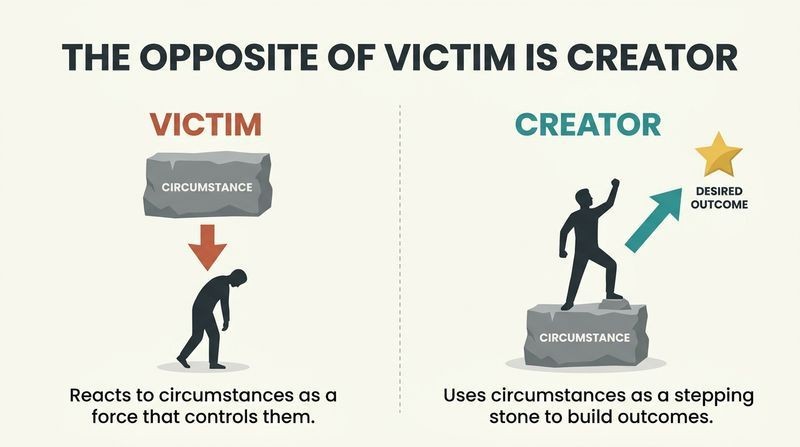
The book's central pivot. David Emerald frames the whole book as a fable answering one question he asked during personal crisis: what is the opposite of Victim? The intuitive answer is Persecutor or hero, but Emerald insists it is Creator. A Victim feels acted upon by people, conditions, and circumstances, powerless to change anything. A Creator claims the power to choose a response and to build toward a desired outcome.
The distinction matters because it reframes agency. Being victimized (a real event that happens to you) differs from Victimhood (a self-identity and a poor-me stance you carry). You cannot always control what happens, but you can always choose your orientation toward it. Emerald delivers this through a beachside conversation between David, a grieving divorced man, and a mysterious teacher named Ted.
What's striking is how this reframe sidesteps the toxic positivity trap. Emerald never denies that abuse, loss, and injustice are real. He separates the event from the identity, echoing Viktor Frankl's insight from the concentration camps that the last human freedom is choosing one's attitude. Cognitive behavioral therapy rests on the same hinge: events plus interpretation produce emotion, not events alone. The risk worth flagging is that oversimplified versions of this idea can slide into victim-blaming. Emerald guards against it by naming the difference between lowercase victimization and capital-V Victimhood, a nuance many motivational books skip entirely.
Every drama needs three players: Victim, Persecutor, Rescuer
The Dreaded Drama Triangle (DDT). Building on psychotherapist Stephen Karpman's 1968 model, Emerald describes three interlocking roles. The Victim feels powerless and mistreated. The Persecutor is the perceived cause of the woes, and crucially need not be a person: it can be a disease, a hurricane, or a job. The Rescuer swoops in to help, which secretly reinforces the Victim's helplessness by silently broadcasting poor you.
When David trips on a sandy path, Ted uses it as a live demonstration: David is Victim, the loose sand is Persecutor, and Ted offering a hand is Rescuer. The trio is unstable. People switch roles constantly. A Rescuer whose advice gets ignored suddenly feels like a martyred Victim. Everyone stays defensive, exhausted, and alert for the next threat. Emerald nicknames it DDT after the banned toxic pesticide.
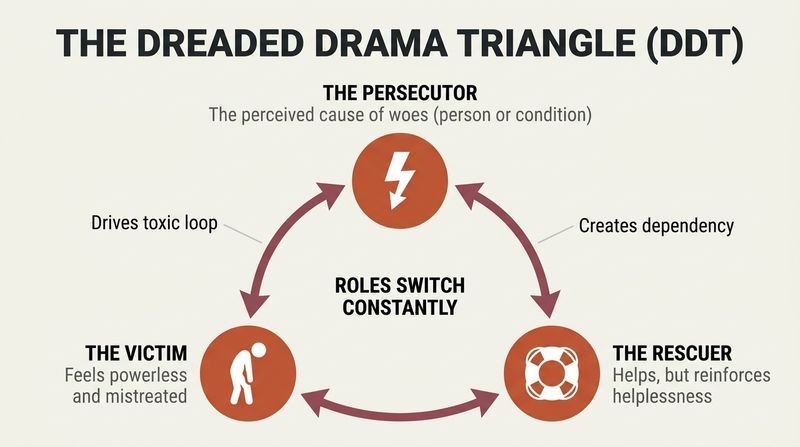
The genius of Karpman's triangle, which Emerald popularizes, is showing that the three roles are a closed system, not fixed identities. Family systems therapy documents the same rotation: the enabling spouse of an addict oscillates between rescuing, persecuting, and self-pitying. What Emerald adds is the insistence that Persecutors are almost always former Victims, mobilized by the vow never to be small again. That maps onto trauma research on the cycle of abuse. One caution: labeling helpers as Rescuers can be weaponized to dismiss genuine care. Emerald's point is subtler, that help which fosters dependency differs from help that builds capacity.
You react to your own anxiety, not the problem
The delusion at Victimhood's core. Emerald introduces the FISBE, an acronym for Focus, Inner State, Behavior. Whatever you Focus on triggers an emotional Inner State, which drives your Behavior. In the Victim Orientation the sequence runs: Focus on a problem, feel anxiety, react by fighting, fleeing, or freezing.
Here is the trap Ted exposes. You believe you are reacting to the problem, but you are actually reacting to your anxiety. So when a reaction lowers the anxiety, your motivation to act evaporates, even though the root problem survives. The problem goes dormant, then flares up again. David recognizes his own weight roller coaster: the scale alarms him, he diets, he feels good, he relaxes, the pounds return. The same loop governs addiction relapse and abusive relationships where apology cycles reset the drama.
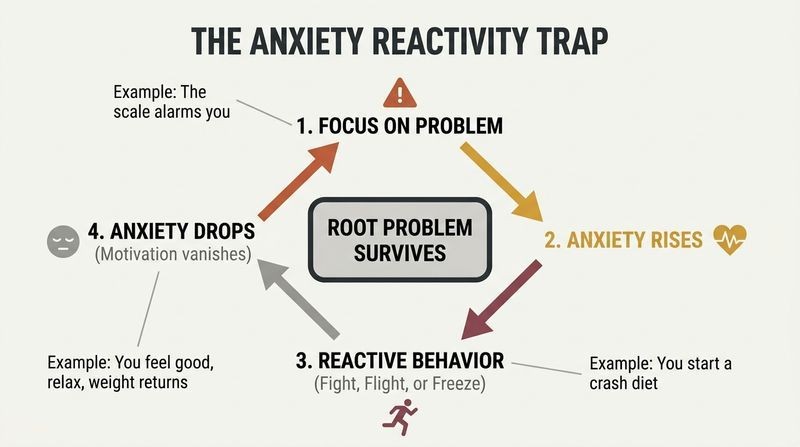
This is the sharpest analytical moment in the book, and it aligns with clinical models of anxiety maintenance. Avoidance provides immediate relief, which negatively reinforces the avoidance, which prevents genuine resolution, exactly the mechanism behind why exposure therapy works and reassurance-seeking fails. Emerald's insight that you need a problem to feel motivated in Victim mode explains chronic crisis-creators and drama addicts. Behavioral economists would call this hyperbolic discounting: the anxiety-relief reward is immediate, the real fix is distant. The practical upshot is diagnostic. When a problem keeps returning, suspect that your fix targeted the feeling, not the cause.
Aim your attention at outcomes you want, not problems you dread
The Creator Orientation's FISBE. Flip the three circles. A Creator Focuses on a vision or outcome, taps an Inner State of passion, and takes Baby Steps toward it. Baby Steps are the next small doable actions: a phone call, a conversation, gathering information. Each one either advances the vision or clarifies its final form, and Emerald insists there is no such thing as a wasted step.
He distills the contrast into another acronym, AIR:
1. Attention: on what you want, not what you fear
2. Intention: to manifest outcomes, not merely escape problems
3. Results: satisfying and sustainable, not temporary and reactive
Crucially, Creators still face problems. They just choose which problems serve the vision and solve only those, rather than being yanked around by whatever crisis shouts loudest.
The prescription echoes Robert Fritz, whom Emerald credits, and prefigures modern approaches like Acceptance and Commitment Therapy, which orients behavior toward values rather than symptom relief. There is solid psychology here: approach goals (moving toward something desired) predict higher wellbeing than avoidance goals (moving away from something feared), a finding replicated across motivation research. One honest limitation is that vision-focus assumes a baseline of safety and resources. Someone in acute survival mode may genuinely need to solve immediate threats first. Emerald would likely agree, since he never claims problems vanish, only that a Creator chooses which ones deserve energy.
Hold your dream and your reality at once to generate creative tension
Dynamic Tension, the engine of creating. Emerald has David loop a stretchy exercise band around the fingers of both hands. The right hand is your vision, the left is your current reality. Stretched between them, the band strains to resolve. That strain is Dynamic Tension, and Emerald calls it a creative force as reliable as gravity.
You can resolve the tension two ways. Snap back by abandoning the vision (the easy, common failure), or step forward by taking Baby Steps toward it. Two seductive escape hatches sabotage people. First, compromising the vision, telling yourself the dream is unrealistic. Second, lying about current reality, painting it rosier or gloomier than it is. Sophia's example: she took a mediocre training job, told herself she could build coaching into it, and settled far short of what she wanted.
Fritz's structural tension model, which Emerald adapts, is quietly profound because it treats motivation as a byproduct of a well-constructed gap rather than a resource to be summoned through willpower. This resembles the psychological principle behind goal-gradient effects and the Zeigarnik effect, where unresolved gaps stay mentally active. The dual failure modes map neatly onto two documented biases: motivated reasoning inflates our reality assessments, and self-handicapping shrinks our goals to protect our egos. Emerald's demand to see reality without labeling it good or bad is essentially the discipline of the stoic dichotomy of control plus the scientist's commitment to accurate data before action.
Anxiety and creative tension feel similar but are not the same
Have your anxiety, don't let it have you. Emerald warns that the fear which surfaces when you stretch toward a big vision can be mistaken for the tension itself, tricking you into collapsing your dream to feel calmer. Sophia's skydiving-instructor friend offers the clarifying analogy: the exhilaration of jumping is not the same as the gravity pulling him down. Gravity contributes to the thrill, but they are distinct forces.
Likewise, Dynamic Tension is the structural pull toward your vision, while anxiety is an emotional passenger along for the ride. Anxiety has an upside (excitement, energy) and a downside (it can shove you back into reactive Victim mode). The skill is noticing the anxiety, naming it, and continuing to act with courage rather than reacting to discharge the discomfort.
This distinction between a structural force and an emotional state is philosophically clean and practically useful. It parallels the emotion-regulation research on cognitive reappraisal, where relabeling arousal as excitement rather than anxiety measurably improves performance, a finding from Alison Wood Brooks at Harvard. The phrase have your anxiety, don't let it have you compresses the entire premise of mindfulness-based therapies: observe the feeling without fusing with it. Where Emerald could go deeper is acknowledging that clinical anxiety sometimes requires more than reframing. For everyday creative fear, though, his separation of the felt sensation from the underlying motivational pull is a genuinely liberating tool.
Trade the three toxic roles for three empowering antidotes
TED, The Empowerment Dynamic. This is the book's title concept and the antidote to the DDT. Each drama role has an empowered counterpart:
1. Victim becomes Creator, who chooses responses and builds toward outcomes
2. Persecutor becomes Challenger, who provokes growth rather than fear
3. Rescuer becomes Coach, who asks questions rather than fixing people
A Challenger can be constructive (a mentor who pushes you) or deconstructive (a harsh boss or a painful loss that forces learning). Either way, a Creator reframes the challenge as a call to grow. A Coach, unlike a Rescuer, treats others as whole, resourceful, and capable, leaving power with them. Ted himself is named after The Empowerment Dynamic. Sophia's difficult manager, once a Persecutor, became the Challenger who clarified the work she truly wanted.
The parallel structure is elegant pedagogy: three villains, three heroes, one-to-one swaps that are easy to remember and apply. The Coach-versus-Rescuer distinction anticipates the entire coaching profession's ethos and echoes self-determination theory, which shows autonomy-supportive help boosts motivation while controlling help erodes it. The Challenger concept resonates with post-traumatic growth research, where adversity, when reframed, produces measurable development. A fair critique is that reframing every Persecutor as a Challenger risks spiritual bypassing, prematurely finding the gift in genuine harm. Emerald partially guards this by requiring real forgiveness work rather than instant gratitude, but the line between growth-framing and denial deserves vigilance.
Your persecutors are teachers hiding as tormentors
Reframing through the Challenger exercise. Emerald offers a concrete practice: list every person, condition, or circumstance you have cast as a Persecutor, then write at least seven ways each one has been a gift or teacher. Keep asking what the lesson is and what the hidden gift might be, then journal deeper.
David applies it to his own wreckage. His father's death challenged him to grow into adulthood. His infertility, a deconstructive Challenger, forced him to reconsider how he contributes to the world, opening him to stepparenting, mentoring, and his work. His ex-wife's withdrawal made him examine what he actually wants in a relationship. Emerald pairs this with a definition of forgiveness borrowed from Henri Nouwen's idea that forgiveness changes how we remember, converting a curse into a blessing. It also means giving up hope for a better past.
The seven-gifts exercise is a structured version of benefit-finding, a coping strategy correlated with better health outcomes in studies of cancer patients and the bereaved. Forcing a minimum count is clever, because the first two reframes come easily while the later ones demand real cognitive work that rewires the narrative. James Pennebaker's expository writing research shows that translating trauma into coherent narrative improves immune function and reduces rumination. The Nouwen framing that forgiveness means abandoning hope for a better past is nearly identical to radical acceptance in dialectical behavior therapy. The caveat remains: this works best after safety is established, not as a bypass around justified anger.
You can only change yourself, never make the shift for others
The interpersonal limit. Emerald distinguishes the intrapersonal shift (how you meet your own experience) from the interpersonal shift (how you interact with others). The hard rule is that you can only change yourself. As you grow skilled at being Creator, Challenger, and Coach, others may choose to change, but you cannot make it your goal to change them.
Sophia learned this the hard way and offers the sharpest line: the fastest way to become someone's Persecutor is to tell them they are being a Victim. Even the labels of this framework become weapons when imposed. If someone gets defensive around you, that is your clue you are showing up as a Persecutor. The remedy is to check your intention, apologize if you were trying to look right or instill fear, and offer a take-it-or-leave-it invitation instead.
This is the humility clause that keeps the framework from becoming a superiority complex, and it is the piece most self-help systems omit. There is deep wisdom in noticing that diagnosing others with your model is itself a Persecutor move. Motivational interviewing research confirms it: direct confrontation increases resistance, while eliciting a person's own reasons for change increases it. The defensiveness-as-feedback heuristic is practical emotional intelligence. Marriage researcher John Gottman found that criticism and contempt predict divorce precisely because they cast a partner as defective. Emerald's prescription, to check intention and offer rather than impose, is a concrete de-escalation protocol that any relationship could use.
Every moment is a Choice Point between reacting and creating
Making shift happen daily. Emerald frames life as a series of Choice Points, moments where you consciously pick which orientation to inhabit. The pivot question is simple: what do I really want here? Asking it instantly redirects focus from problem to outcome. He adds a moral guardrail: what you want should serve the highest good and harm no one, otherwise the ego-driven pursuit slides you into Persecutor.
Sophia describes a twenty-minute morning ritual: gratitude, an invitation for guidance, an affirmation to live as a Creator, a review of yesterday's choices, and three Baby Steps for the day. Her two criteria for a valid Baby Step: it must be doable, and it must be 100 percent yours to do, which forces you to own your responsibility rather than wait on someone else.
The Choice Point concept operationalizes agency into a repeatable micro-decision, which is how durable behavior change actually happens, one moment at a time rather than one grand resolution. The 100-percent-yours criterion is quietly brilliant because it filters out the disguised Victim move of setting goals that depend on other people's cooperation. This resembles the Stoic dichotomy of control and the Serenity Prayer's logic. Implementation-intention research by Peter Gollwitzer shows that specifying concrete next actions dramatically raises follow-through versus vague intentions. The morning ritual functions as a keystone habit. The main risk is ritual becoming performance, going through motions without the underlying shift in attention it is meant to trigger.
Analysis
The Power of TED succeeds as a rare hybrid: a therapeutic framework smuggled inside a beachside parable. David Emerald takes Stephen Karpman's clinical Drama Triangle, a tool used by transactional analysts since 1968, and does two transformative things. First, he expands Persecutor beyond people to include conditions and circumstances, which universalizes the model from interpersonal conflict to the whole human relationship with adversity. Second, and more originally, he builds a positive mirror image, arguing that psychology has been generous in diagnosing dysfunction but stingy in mapping its antidote. TED (Creator, Challenger, Coach) fills that gap. The intellectual lineage is transparent and honestly credited: Robert Fritz supplies Dynamic Tension and the creative-orientation logic, Viktor Frankl supplies the freedom to choose one's response, and Karpman supplies the triangle. Emerald's contribution is synthesis and accessibility. The FISBE model (Focus, Inner State, Behavior) is a genuinely useful compression of cognitive-behavioral theory into three memorable circles. The book's deepest insight, that in Victim mode we react to our own anxiety rather than the problem, and therefore lose motivation the moment we feel better while the problem survives, is a sophisticated account of why people cycle through the same crises for decades. That single mechanism explains dieting relapse, addiction, and abusive relationship loops with equal force. The parable format is a double-edged choice. It makes abstract concepts sticky and emotionally resonant, but the dialogue occasionally strains under exposition, and the mystical framing (synchronicity, an inner voice announcing Creator, the sand-dollar amulet) will alienate empirically minded readers. The framework's genuine limitation is scope: it assumes a threshold of safety and agency that trauma survivors and people in genuine crisis may not possess. Emerald partly guards this with the victimization-versus-Victimhood distinction, but the line between empowering reframe and victim-blaming stays thin. Applied with the humility Emerald prescribes, especially the rule that you can only change yourself, TED is a durable tool for self-leadership and relationship repair.
Review Summary
The Power of TED* receives mixed reviews, with an average rating of 4.07 out of 5. Many readers find the book's concepts transformative, praising its approach to shifting from victim mentality to empowerment. The Empowerment Dynamic (TED) model is seen as a valuable tool for personal growth. However, some criticize the book's writing style as cheesy or condescending, and others find the concepts oversimplified. The narrative format receives mixed reactions, with some enjoying the storytelling approach while others prefer a more straightforward presentation of ideas.
People Also Read






Glossary
Dreaded Drama Triangle (DDT)
Three toxic interlocking rolesEmerald's expansion of Karpman's Drama Triangle, naming three fear-based roles people rotate through: Victim (feels powerless), Persecutor (the blamed cause, which can be a person, condition, or circumstance), and Rescuer (helps in ways that reinforce the Victim's helplessness). The roles are unstable and interchangeable, keeping everyone defensive and exhausted. Nicknamed after the banned pesticide DDT to signal its toxicity.
The Empowerment Dynamic (TED)
Three empowering role antidotesThe antidote framework to the DDT, consisting of three roles: Creator (chooses responses and builds toward a vision), Challenger (provokes growth and learning rather than fear), and Coach (supports others by asking questions rather than fixing them). Each role directly counteracts a DDT counterpart. The character Ted is named after this dynamic.
FISBE
Focus, Inner State, BehaviorA mental model describing how orientation works: what you Focus on triggers an emotional Inner State, which drives your Behavior. In the Victim Orientation, focus on a problem produces anxiety, which produces fight, flight, or freeze reactions. In the Creator Orientation, focus on a vision produces passion, which produces Baby Steps.
Victim Orientation vs Creator Orientation
Two default life stancesTwo contrasting mental standpoints. The Victim Orientation focuses on problems to escape, driven by anxiety, producing reactive temporary results, and breeds the DDT. The Creator Orientation focuses on desired outcomes, driven by passion, producing sustainable results through conscious choice, and cultivates TED. Emerald calls them orientations because what you orient toward shapes what manifests.
Dynamic Tension
Creative pull toward visionAdapted from Robert Fritz, the structural tension created by simultaneously holding a clear vision and an honest assessment of current reality. Like a stretched rubber band, this tension seeks resolution. Creators resolve it by taking Baby Steps toward the vision, rather than by abandoning the vision or distorting reality. Emerald likens it to gravity, a reliable creative force.
Baby Steps
Small actions toward visionThe everyday incremental actions a Creator takes toward a desired outcome, such as a phone call or conversation. Each step either advances the vision or clarifies its final form, so none is wasted. Emerald's two criteria: a valid Baby Step must be doable and 100 percent yours to do, requiring no one else's action.
AIR
Attention, Intention, ResultsAn acronym for three differences between Victim and Creator Orientations: Attention (on what you want versus what you fear), Intention (to manifest outcomes versus to escape problems), and Results (sustainable and satisfying versus temporary and reactive). AIR also evokes the different atmosphere each orientation generates.
Challenger
Growth-provoking antidote to PersecutorThe TED role replacing Persecutor. A Challenger provokes learning and growth rather than fear. Constructive Challengers consciously push a Creator to develop; deconstructive Challengers are unwelcome people, conditions, or events that force learning through difficulty. A Creator reframes challenges as calls to grow rather than threats to react against.
Coach
Question-asking antidote to RescuerThe TED role replacing Rescuer. Unlike a Rescuer, who fixes people and fosters dependency, a Coach treats others as whole, resourceful, and creative, leaving power with them. A Coach asks clarifying questions about vision, current reality, and possible Baby Steps rather than dispensing advice or solutions.
Choice Point
Moment to shift orientationThe moment in any experience where you can consciously choose which orientation and role to inhabit. Asking what do I really want here shifts focus from problem to outcome. Emerald adds a moral guardrail: the chosen outcome should serve the highest good and harm no one, or the pursuit risks sliding into the Persecutor role.
FAQ
What's "The Power of TED" by David Emerald about?
- Overview: "The Power of TED" is a self-help book that introduces readers to The Empowerment Dynamic (TED), a framework designed to help individuals shift from a victim mindset to a creator mindset.
- Core Concept: The book contrasts the Dreaded Drama Triangle (DDT), which involves roles of Victim, Persecutor, and Rescuer, with TED, which involves roles of Creator, Challenger, and Coach.
- Narrative Style: It is written as a parable, following the protagonist David as he learns to transform his life by adopting the TED framework.
- Purpose: The book aims to empower readers to take control of their lives by focusing on desired outcomes rather than problems.
Why should I read "The Power of TED"?
- Personal Growth: The book provides practical tools for personal development, helping readers to overcome feelings of powerlessness and victimhood.
- Empowerment: It offers a new perspective on how to approach life's challenges, encouraging a proactive and creative mindset.
- Relatable Story: Through its parable format, the book presents complex psychological concepts in an accessible and engaging way.
- Universal Application: The principles of TED can be applied to various aspects of life, including relationships, work, and personal goals.
What are the key takeaways of "The Power of TED"?
- Shift in Mindset: The book emphasizes the importance of shifting from a Victim Orientation to a Creator Orientation.
- Role Transformation: It introduces the roles of Creator, Challenger, and Coach as alternatives to the Victim, Persecutor, and Rescuer roles.
- Dynamic Tension: The concept of Dynamic Tension is crucial for creating desired outcomes by balancing vision and current reality.
- Empowerment Dynamic: TED provides a framework for building empowering relationships and fostering personal growth.
What is the Dreaded Drama Triangle (DDT) in "The Power of TED"?
- Victim Role: The central role in the DDT, where individuals feel powerless and focus on problems.
- Persecutor Role: The perceived cause of the Victim's woes, which can be a person, condition, or circumstance.
- Rescuer Role: Someone or something that attempts to alleviate the Victim's distress, often reinforcing their powerlessness.
- Cycle of Reactivity: The DDT perpetuates a cycle of fear, blame, and dependency, hindering personal growth.
How does The Empowerment Dynamic (TED) differ from the DDT?
- Creator Role: Focuses on desired outcomes and personal power, contrasting with the Victim's focus on problems.
- Challenger Role: Encourages growth and learning, unlike the Persecutor, which provokes fear and defensiveness.
- Coach Role: Supports and facilitates a Creator's journey, as opposed to the Rescuer, which fosters dependency.
- Empowerment vs. Reactivity: TED fosters proactive and empowering relationships, while the DDT is rooted in reactivity and victimhood.
What is the Creator Orientation in "The Power of TED"?
- Vision Focus: Creators focus on what they want to achieve, rather than on problems.
- Passion-Driven: The Creator Orientation is fueled by passion and desire, motivating individuals to take action.
- Baby Steps: Creators take small, manageable steps toward their goals, learning and adjusting along the way.
- Empowerment: This orientation empowers individuals to take control of their lives and create meaningful outcomes.
What is Dynamic Tension in "The Power of TED"?
- Concept: Dynamic Tension is the creative force between a vision and current reality, driving the process of manifestation.
- Resolution of Tension: Creators resolve this tension by taking Baby Steps toward their vision, rather than compromising or denying reality.
- Role of Anxiety: Anxiety is a natural part of the process, but it should not be confused with the tension itself.
- Creative Principle: Dynamic Tension is a fundamental principle that can be harnessed to achieve desired outcomes.
How can I shift from a Victim to a Creator mindset according to "The Power of TED"?
- Focus on Outcomes: Shift your focus from problems to what you want to create in your life.
- Embrace Passion: Connect with your passions and desires to fuel your actions.
- Take Baby Steps: Break down your goals into small, achievable steps and take action.
- Choose Empowerment: Consciously choose to respond to life's challenges as a Creator, rather than reacting as a Victim.
What are the roles of Challenger and Coach in "The Power of TED"?
- Challenger Role: Encourages growth and learning by presenting opportunities for development and change.
- Constructive vs. Deconstructive: Challengers can be constructive, supporting positive change, or deconstructive, prompting reflection and learning.
- Coach Role: Supports Creators by asking questions, facilitating clarity, and encouraging self-discovery.
- Empowerment Focus: Both roles aim to empower individuals to take control of their lives and achieve their goals.
What are some practical applications of "The Power of TED"?
- Personal Relationships: Use TED principles to improve communication and understanding in personal relationships.
- Workplace Dynamics: Apply the Creator Orientation to foster collaboration and innovation at work.
- Self-Leadership: Develop self-awareness and personal responsibility by adopting the Creator mindset.
- Community Engagement: Use TED to build empowering and supportive communities focused on shared goals.
What are the best quotes from "The Power of TED" and what do they mean?
- "The opposite of Victim is Creator." This quote encapsulates the book's central message of shifting from a mindset of powerlessness to one of empowerment.
- "You cannot not create!" Emphasizes the inherent creative potential within everyone, urging readers to harness it consciously.
- "Forgiveness changes the way we remember." Highlights the transformative power of forgiveness in shifting from a Persecutor to a Challenger mindset.
- "Be patient toward all that is unsolved in your heart." Encourages embracing uncertainty and living into the answers over time.
How can "The Power of TED" impact my life?
- Empowerment: The book provides tools and frameworks to empower you to take control of your life and create desired outcomes.
- Improved Relationships: By adopting TED roles, you can foster healthier and more supportive relationships.
- Personal Growth: The principles of TED encourage continuous learning and self-improvement.
- Broader Perspective: The book offers a new way of viewing challenges and opportunities, leading to a more fulfilling and purposeful life.
Download PDF
Download EPUB
.epub digital book format is ideal for reading ebooks on phones, tablets, and e-readers.








































