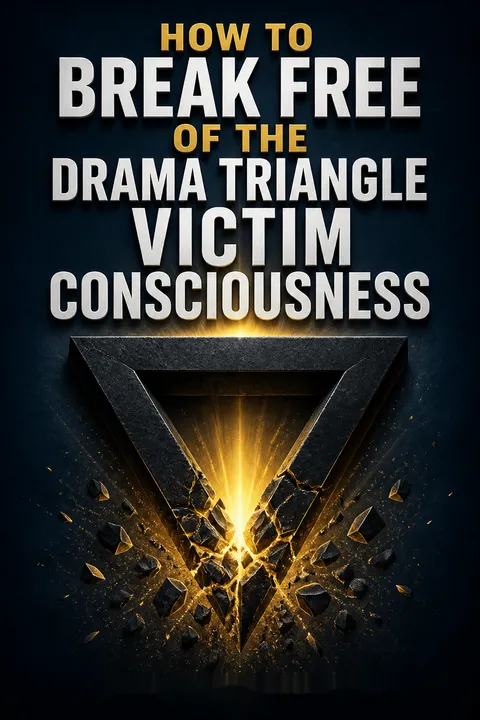

Key Takeaways
1. The Drama Triangle: A Pervasive Game of Dysfunction
The Drama Triangle is an interpersonal communication dynamic so embedded in human consciousness and social interactions that we call it the only game in town.
A universal script. The Drama Triangle, identified by psychiatrist Stephen Karpman, is a dysfunctional social game played out in countless interactions, from personal relationships to global politics. It involves three interchangeable roles: the Persecutor, the Rescuer, and the Victim, each with specific behaviors and hidden payoffs. This dynamic is so common it forms the underlying plot of most television dramas, movies, and even historical conflicts like the Cold War.
The roles defined. The Persecutor is the "bad guy," blaming and criticizing others to feel justified in expressing anger and maintaining control. The Rescuer is the "good guy," doing things for others unasked, often to feel superior or to satisfy their own unmet need to be rescued. The Victim is the central role, feeling helpless and oppressed, seeking a Rescuer, and avoiding responsibility by blaming others.
The game's allure. Players unconsciously rotate through these roles, creating chaos and confusion. The ultimate prize is the Victim role, as it allows one to get needs met indirectly and avoid accountability. This constant role-switching, driven by underlying beliefs of scarcity and a desire for indirect gratification, perpetuates the drama and prevents authentic connection.
2. Victim Consciousness: When Life Happens To You
What is Victim Consciousness? Here’s the short ‘n sweet definition: it’s when life happens to you rather than you being an active participant in making it happen.
A state of helplessness. Victim Consciousness is more than an attitude; it's a way of living characterized by beliefs of helplessness, powerlessness, and hopelessness. Individuals in this state believe good things are due to luck and bad things are someone else's fault, thus avoiding personal accountability or self-reflection. This mindset is often "wired into us" from early childhood experiences.
Black-and-white thinking. People trapped in Victim Consciousness typically engage in either/or thinking, seeing only two choices for every problem. This "splitting" prevents them from generating creative solutions or understanding complex situations. Robert Kegan's research on adult consciousness stages found that over 70% of adults operate at a level where they feel like a victim or actively try to victimize others.
Beliefs that bind. A core set of beliefs underpins Victim Consciousness, such as:
- "It is my fault when people get angry with me."
- "Other people’s feelings/needs are more important than mine."
- "I need to rely on others to make important decisions for me."
- "If people knew who I really am, they would reject me."
These beliefs reinforce dependency and prevent individuals from claiming their personal power.
3. Unresolved Trauma Fuels the Drama Triangle's Cycle
If the developmental tasks of bonding and separation were not completed on schedule (as they rarely are) this requires that they be completed as an adult in your relationships.
Early developmental wounds. Relational or developmental trauma experienced during the first three years of life, particularly during the separation stage (birth-36 months), has a profound, lifelong impact. This early trauma often leads to "splitting," where individuals perceive the world and people as either entirely good or entirely bad, hindering their ability to develop nuanced "both/and" thinking.
The genesis of games. When children don't receive appropriate support to integrate good and bad qualities in their caregivers, they compensate by playing social games like the Drama Triangle. This prevents the development of a strong sense of Self, leading to passive, other-directed behaviors that prime them for Victim, Rescuer, or Persecutor roles. They learn that manipulation is the only way to get needs met.
Trauma's lasting imprint. Repeated victimization or witnessing it in childhood creates traumatic memory modules—images, sounds, feelings—stored in the emotional brain. These memories, when triggered by present-time events, can cause flashbacks, catapulting individuals back into past trauma. This explains why reactions often seem disproportionate to current situations, indicating unhealed post-traumatic stress.
4. Societal Systems Perpetuate Victimhood and Control
Christian churches promise believers salvation and redemption from their original sin if they are willing to follow religious doctrine, contribute money to the church, and expect the church to rescue them from their sinful ways.
Religious manipulation. The concept of Original Sin, largely popularized by Augustine of Hippo, serves as a powerful tool for controlling Christian masses. By defining humanity as inherently sinful and dependent on the church for salvation, it traps believers in Victim Consciousness. This creates a "Savior Complex," where individuals strive for an unattainable perfection, giving church leaders immense power and control over their lives.
The twisted Golden Rule. Even seemingly benign principles can be distorted. The Christian Golden Rule, "Do unto others as you would have them do unto you," differs from Rabbi Hillel's "Do not do unto others that which is hateful unto thee." The Christian version, as interpreted, fosters an expectation of return, encouraging manipulation and codependent behaviors by focusing on what one wants from others rather than one's own internal integrity.
The Need/Obligate System. This system, a core aspect of codependency and a variation of the Drama Triangle, operates on unspoken agreements: "I did this for you, now you are obligated to return the favor." It's prevalent in organizations and politics, exemplified by lobbyists' donations creating obligations for politicians. This indirect manipulation and control mechanism keeps people trapped in a cycle of unspoken expectations and resentment.
5. Breaking Free Demands Directness and Self-Responsibility
Commit to getting your needs met by asking directly for what you want and need. This means giving up your victim behaviors and leaving victim consciousness.
The path to freedom. Breaking free from the Drama Triangle and Victim Consciousness requires a conscious commitment to five key steps. The first and most crucial is to take charge of meeting your own needs by asking directly for what you want 100% of the time. This fosters emotional and psychological separation from others, allowing you to trust your inner guidance rather than seeking external validation.
Refuse to rescue. The second step is to stop rescuing others. This means not doing anything for anyone unless they explicitly ask for it or you have their permission. This prevents enabling and ensures that others take responsibility for their own needs, breaking the codependent cycle inherent in the Rescuer role.
Unearthing past wounds. A powerful exercise, "The Two Lists," helps identify developmental traumas:
- What I wanted & didn't get: Reveals bonding traumas, unmet needs, and a tendency to manipulate.
- What I got & didn't want: Highlights counter-dependent traumas, hurtful experiences, and defensive behaviors.
These lists serve as a "healing list," guiding you to identify current relationships where these needs can be met directly and to release old resentments through practices like "forgiveness" (giving back what isn't yours) and the empty chair technique.
6. Reclaim Your Projections to See Yourself and Others Clearly
Don't Take Anything Personally. Nothing others do is because of you. What others say and do is a projection of their own reality, their own dream.
The mirror of projection. Projections are the most common way people avoid confronting disliked or unaccepted parts of themselves. Instead, they see these unwanted qualities in others, often accompanied by "pointy finger" accusations and blaming comments. A key sign of projection is an overreaction ("fifty-cent reaction to a ten-cent issue") or blaming others for your feelings ("You make me feel angry!").
Integrating the Shadow. Poet Robert Bly describes a five-stage process for reclaiming projections, culminating in integrating one's "Shadow"—all the parts of yourself you've pushed away or onto others. This involves facing and accepting these aspects, leading to deeper feelings, increased passion, spontaneity, and wisdom. Until projections are reclaimed, difficult people will continue to appear in your life, serving as mirrors.
A path to authenticity. Reclaiming projections is essential for developing an authentic Self. It means taking responsibility for your emotional reactions and understanding that others' actions are often about their own internal struggles, not personal attacks. This process allows you to move beyond judgment and into a more grounded, self-aware state, reducing your vulnerability to the Drama Triangle.
7. Heal Developmental Trauma to Escape the Drama
The results of any traumatic experience, such as abuse, can only be resolved by experiencing, articulating and judging every facet of the original experience within a process of careful therapeutic disclosure.
Trauma's grip. Your participation in Drama Triangle dynamics is a clear indicator of unhealed developmental traumas. These traumas, often from early childhood, are stored in your nervous system and brain, influencing your behavioral responses. Healing them is crucial for breaking free from Victim Consciousness and reclaiming your personal power.
The Trauma Elimination Technique (TET). This self-healing tool, synthesizing elements of TAT, EMDR, and TFT, empowers individuals to clear trauma without needing a therapist. The process involves:
- Holding a specific acupressure pose.
- Focusing on a specific traumatic memory (picture, thoughts, belief, feelings).
- Maintaining the pose until an internal shift is felt.
- Scanning the body for tension and repeating the pose.
- Zooming in on "hot spots" within the memory until they no longer trigger a reaction.
A multi-layered healing. TET can address present-life, past-life, and parallel-life traumas, depending on your intention. It's common for clearing one layer of trauma to reveal another underneath, requiring continued application of the technique. This systematic approach helps release stored emotional energy, allowing for genuine healing and a reduction in reactivity to triggers.
8. Exiting the Triangle Means Embracing the "Bad Guy" Role
Karpman says that the exit point in the Drama Triangle is through the Persecutor role. Once you decide to get off the triangle, you will be perceived as the Bad Guy.
The "Coke Machine Syndrome." When you decide to exit the Drama Triangle, other players will inevitably try to pull you back in by "pushing your buttons." They will blame, accuse, and try to make you feel guilty, much like someone repeatedly pushing buttons on a broken vending machine. Your commitment to non-reactivity is key; simply stating, "Thank you, I am aware of that," or "Thank you, I wasn't aware of that," can disarm their attempts.
Stopping the blame game. A powerful tool to halt triangulation and blame is to ask directly, "Is there something that you want from me?" This shifts the focus from accusation to accountability, forcing the other person to articulate their needs. This direct approach leaves no room for manipulation or game-playing, allowing for straightforward transactions.
Authentic emotional expression. To stay off the triangle, you must learn to acknowledge and express your emotions honestly and effectively, preventing others from using them to control you. Understanding that anger signals an unmet need, sadness a loss, and fear a lack of safety allows for clear communication. By asking directly for what you need when these emotions arise, you maintain your personal power and avoid being drawn back into the drama.
9. Build a Functional Family Triangle for Healthy Relationships
When both parents decide to break free of the Drama Triangle by applying the five-step process we share here, it is possible to create a healthy family structure in which everyone communicates directly in order to get their needs met.
An alternative model. The Functional Family Triangle offers a healthy alternative to the dysfunctional Drama Triangle. In this structure, all members, especially children, learn to communicate directly to get their needs met, fostering an "I'm okay, you're okay" mindset. This environment supports children in completing their psychological birth and developing a strong, self-directed sense of Self.
Guidelines for functional communication. Key principles for healthy family interactions include:
- Support feelings: Acknowledge emotions without judgment ("I can see you are upset").
- Refuse triangulation: Do not take sides or agree with judgments about another caregiver's "badness."
- Reassure and inform: Ensure children know their needs will be met and caregivers will return.
- Encourage directness: Support children in speaking directly to the person they have a conflict with.
- No secrets: Avoid creating family secrets or enabling indirect communication.
Empowering children. By consistently applying these guidelines, parents model authentic communication and emotional regulation. This helps children develop internal power, regulate their emotions, and move into independent development. While initially awkward, this direct and empathetic approach is highly effective in creating a safe, supportive, and drama-free family environment.
People Also Read









Download PDF
Download EPUB
.epub digital book format is ideal for reading ebooks on phones, tablets, and e-readers.








































