

Key Takeaways
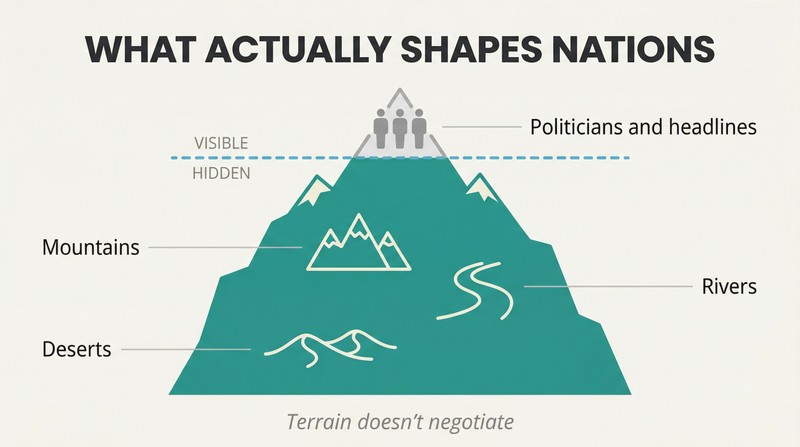
Politicians make headlines, but mountains make history
Marshall's central thesis is blunt. Across ten regions — from Iran's unconquerable mountain fortress to Australia's uninhabitable Outback to Spain's identity-fracturing highlands — he shows that physical terrain constrains what nations and leaders can actually do. Egypt depends on Ethiopia for water. Greece's mountains created independent city-states. Saudi Arabia's lack of a single river shapes its entire future.
The "flat world" is fantasy. The idea that digital communications have made landscape meaningless applies only to a tiny fraction of globe-trotting elites, not the other 8 billion people. Every country's story begins with its location relative to neighbors, sea routes, and natural resources. Terrain doesn't negotiate.
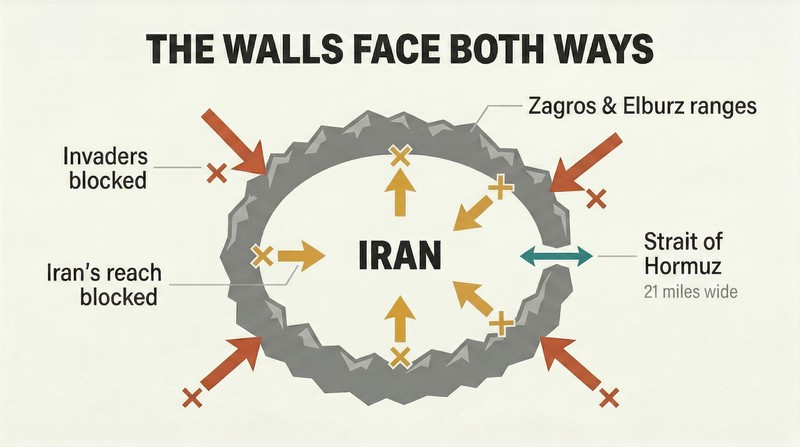
Iran's mountain ring keeps invaders out — and Iran trapped inside
Iran is a natural fortress. The Zagros Mountains run along the west, the Elburz along the north, and smaller ranges complete the circuit. Alexander the Great took Persia but couldn't hold it. The Mongols wrecked the place and left. When Bush-era hawks pushed for invasion, wiser heads noted ground forces would face marshland, mountains, and deserts.
But the fortress imprisons Iran too. The Strait of Hormuz — just 21 miles wide — is Iran's sole ocean access. Tehran can threaten to close it (one-fifth of global oil passes through), but closure hurts Iran equally. Only half the country's roads are paved. Population centers are scattered across mountains, making unity expensive and central control difficult. The walls face both ways.
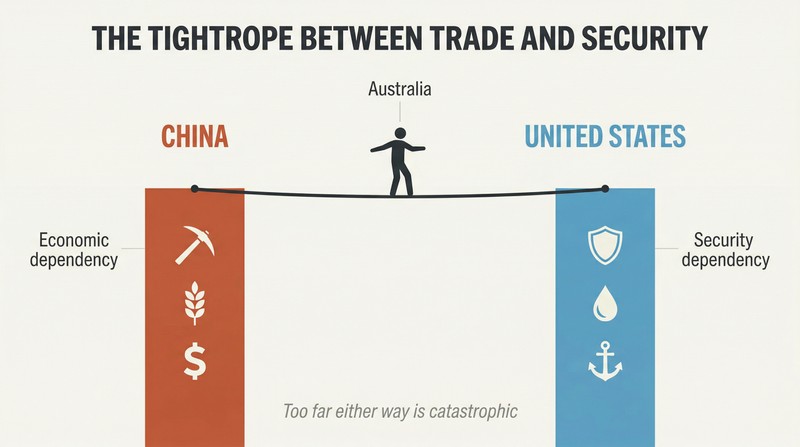
Australia's biggest trading partner is also its biggest threat
Australia sits in an impossible squeeze. China buys almost a third of Australia's farm exports, half its barley, and is a massive market for iron ore and gas. When Australia called for a Covid-19 origins investigation, Chinese copper imports dropped from 100,000 metric tons to zero within a year. Economic dependency is deep.
Defense dependency runs the other direction. Australia holds only about two months' oil in reserves. If northern straits like Malacca were blocked, the country would grind to a halt within weeks. The US guarantees security, but China is expected to exceed America's GDP by midcentury. Australia must walk a tightrope — too close to Washington risks an Indo-Pacific cold war; too weak risks a Chinese military base in its backyard.
Saudi Arabia must replace oil before oil replaces Saudi Arabia
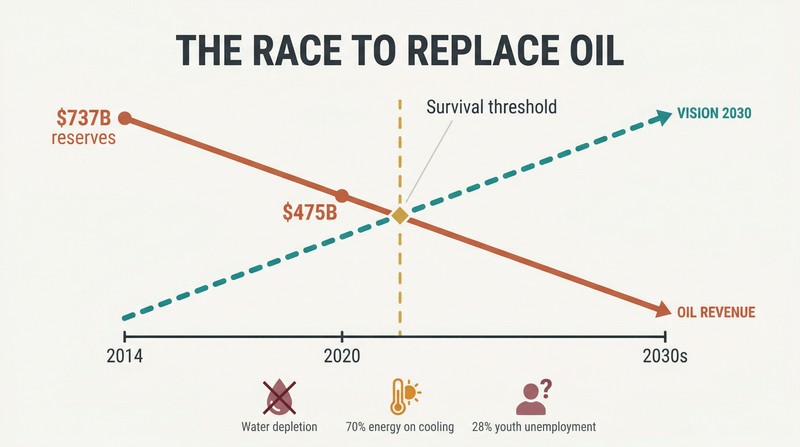
Oil funded legitimacy; its decline threatens survival. Between 2014 and 2020, Saudi foreign reserves fell from $737 billion to $475 billion. Crown Prince MBS's Vision 2030 aims to diversify into technology and tourism, but mega-projects like the $500-billion city of Neom are already behind schedule.
The structural challenges are brutal. Saudi Arabia is the world's largest country without a river. Underground freshwater may run out in the 2030s. Air conditioning consumes 70% of the nation's electricity. Youth unemployment sits at 28%. MBS is breaking the 280-year-old Saud-Wahhab alliance — trading religious conservatism for modernization — but without oil-funded welfare, unrest is nearly certain.
Ethiopia's dam turns the Nile into a geopolitical weapon
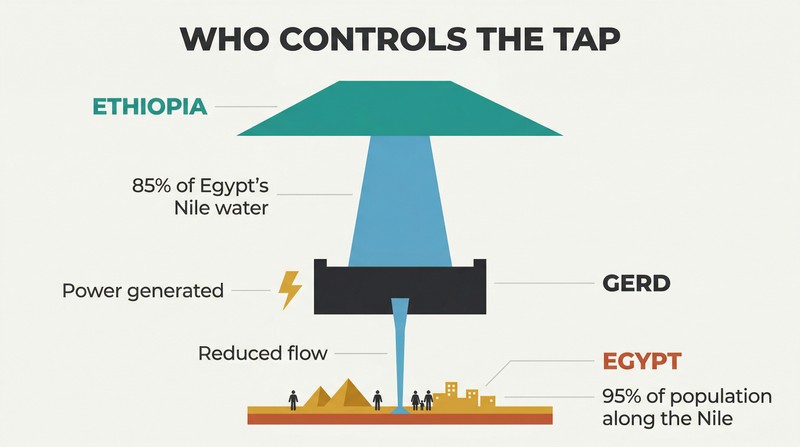
The GERD is Africa's biggest dam. Eighty-five percent of the Nile's flow into Egypt comes from the Blue Nile, and Ethiopia now controls the tap. Egypt is mostly desert; 95% of its 104 million people live along the river. Cairo fears that reducing flow by even 10% could put 5 million farmers out of work within years.
Geography heavily favors Ethiopia. Any Egyptian military assault would need to cross Sudan or take a Red Sea route through Eritrea — logistically nightmarish. Egypt's F-16s likely can't refuel for a round trip. Ethiopia has Israeli-supplied missile defenses around the dam. For centuries, Ethiopia's rivers plunged too violently for commerce; now technology converts that waterpower into electricity and geopolitical leverage.
Turkey is dismantling its Western identity to rebuild an Ottoman one
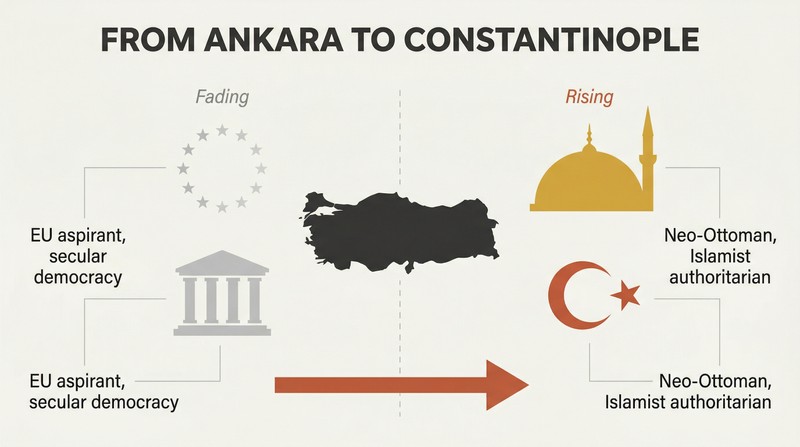
Neo-Ottomanism drives the shift. Under Erdoğan, Turkey has gone from aspiring EU member to semidetached NATO ally buying Russian S-400 missiles. The belief: Turkey's destiny is to reemerge as a global power as the West declines. Military interventions in Syria, Libya, and Iraq, plus aggressive maritime claims in the Aegean, follow this logic.
The Hagia Sophia conversion was symbolic. In 2020, Erdoğan turned the museum back into a mosque. His English messaging emphasized inclusivity; his Arabic version called it a step toward "liberating" Al Aqsa Mosque in Jerusalem. Turkey controls 90% of the Euphrates headwaters and the flow of migrants into Europe — giving it leverage over both Arab neighbors and the EU. The Blue Homeland doctrine envisions Turkish dominance over three surrounding seas.
The Sahel's collapse would send millions toward Europe
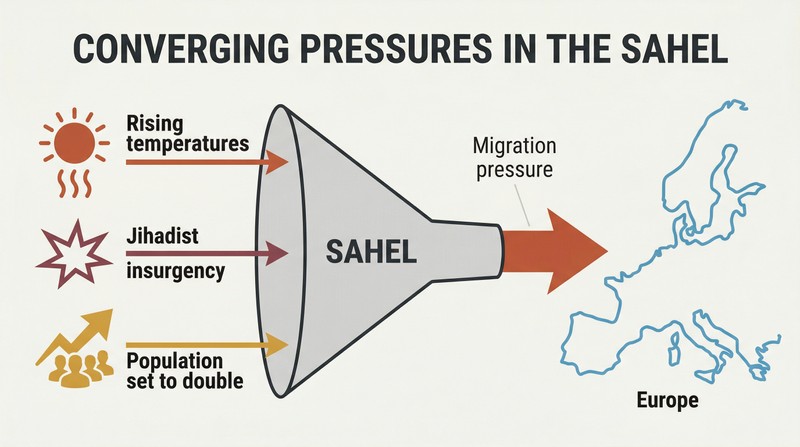
Climate change and jihadism collide. The Sahel stretches 2,200 miles across Africa between the Sahara and the rain forests. Average temperatures have risen 50% more than the global average. Lake Chad shrank 90% in the twentieth century's last four decades. Thirty million people face food insecurity.
Insurgency fills the vacuum. France has 5,100 troops in what risks becoming a "forever war." Al-Qaeda and ISIS affiliates exploit ethnic tensions among groups like the Fulani, a 23-million-strong nation without a state. Gold mines are "taxed" by jihadists; uranium fuels French nuclear power. Africa's population is expected to double to 2.4 billion by 2050. Niger alone may nearly triple from 23 million to 65 million. If Sahel states collapse, migration pressure on Europe would dwarf the 2015 crisis.
Scottish independence would shatter Britain's nuclear deterrent
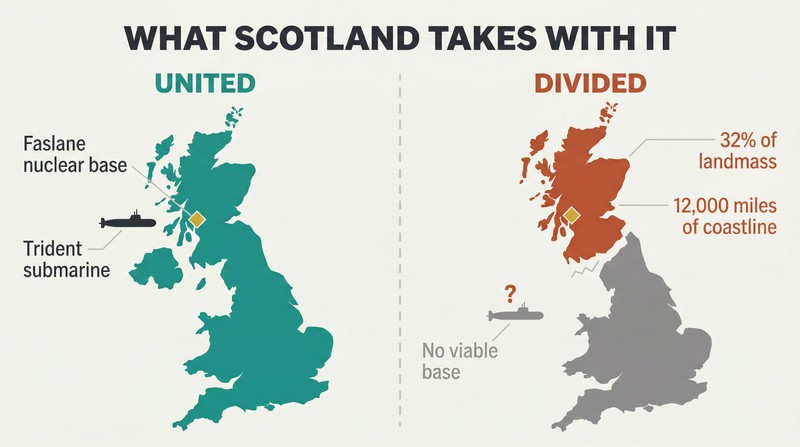
The 1707 union unlocked empire. When Scotland and England merged, one authority controlled the whole island — ending the French back-door threat and freeing resources for global expansion. Now Brexit has endangered that union. Scotland voted more strongly for the EU, and independence support has grown since 2016.
Defense implications are devastating. Britain's nuclear submarines operate from Faslane, Scotland, with deep water and quick Atlantic access. A senior naval officer called replicating those facilities elsewhere "almost inconceivable." Scotland would also take key air bases that intercept Russian aircraft, leaving shorter early-warning windows. Northern Ireland might follow, further fragmenting the island that geography made powerful only when it was whole.
Geography keeps Spain's regions more loyal to themselves than Madrid
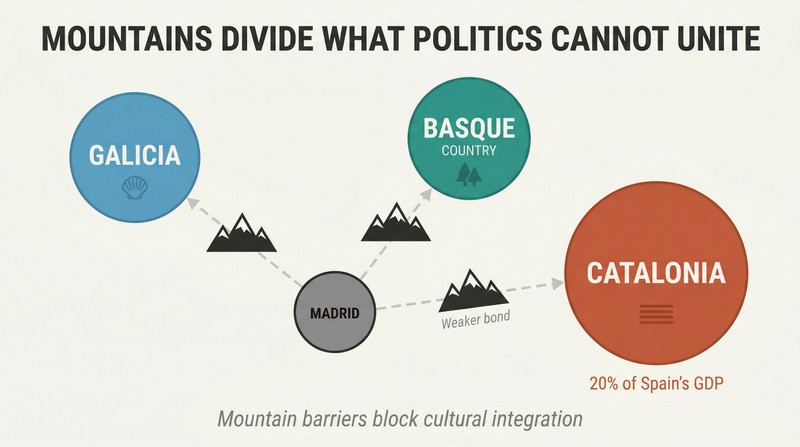
Mountains preserved distinct identities. Spain has been a state since the 1500s, yet Catalonia, the Basque Country, and Galicia have never fully assimilated. Franco's 36-year dictatorship banned Catalan and Basque languages in public, but they survived in homes and football stadiums. Barcelona FC fans sang in Catalan as an act of defiance.
Catalonia's push tests all of Europe. Catalonia produces 20% of Spain's GDP and a quarter of its exports. A 2017 independence referendum — declared illegal — drew riot police. The EU backed Madrid because successful secession could embolden separatists from Corsica to Flanders to Scotland. If frozen out of the EU, an independent Catalonia could become a gateway for Chinese or Russian influence in the western Mediterranean.
Whoever dominates low Earth orbit dominates the planet below
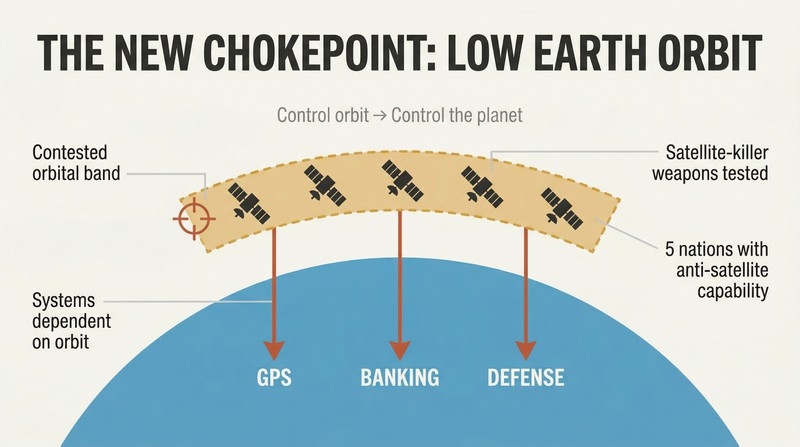
Space has chokepoints too. Gravitational corridors, refueling zones, and satellite belts make low Earth orbit the strategic equivalent of the Strait of Malacca. The 2020 Artemis Accords govern Moon exploration for eight nations, but Russia and China are excluded and plan their own lunar bases.
The arms race is already underway. Russia, China, the US, India, and Israel have satellite-killer systems. In 2020, a Russian satellite fired a projectile in what the US and UK called a weapons test in orbit. NATO extended its mutual defense clause to cover space attacks. Destroying satellites would cripple GPS, banking, and nuclear early-warning systems. An asteroid called 3554 Amun holds metals worth roughly $20 trillion — enough to share, if nations can agree on who mines them.
Analysis
Tim Marshall's sequel to Prisoners of Geography extends his thesis — that physical terrain constrains state behavior more than ideology or leadership — to ten regions poised to shape the coming decades. The analytical method is Braudelian in spirit, echoing Fernand Braudel's longue durée framework where deep structures of geography and climate outlast the surface politics of any era. Marshall demonstrates this through accumulation: by the time you've seen mountains define Iran's boundaries, rivers dictate Ethiopia's leverage, and straits determine Australia's vulnerability, geographic determinism becomes difficult to dismiss.
Where Marshall is most original is in his treatment of middle powers — countries like Turkey, Saudi Arabia, and Australia that are neither superpowers nor minor players but whose choices will determine which great-power bloc prevails. These are nations constrained by topography in ways their leaders can barely influence. MBS cannot will water into the Saudi desert. Erdoğan cannot wish away the Bosporus bottleneck. Abiy Ahmed cannot un-landlocked Ethiopia.
The anthology structure — ten standalone regional essays plus a space chapter — is both the book's strength and limitation. Each chapter works independently, but the format prevents Marshall from building the kind of cumulative theoretical argument that might push his thesis into truly new territory. The space chapter necessarily abandons geographic determinism, since orbital terrain is being defined rather than inherited, though applying chokepoint logic to orbital mechanics is a provocative exercise.
The book's most important implicit warning concerns the growing mismatch between Westphalian borders — lines drawn by politicians on maps — and the physical geography beneath them. From Catalonia to the Sahel to Kurdistan, the fractures are geological as much as political. Colonial-era boundaries in Africa, arbitrarily imposed at the 1884 Berlin Conference, cut across trading routes, ethnic identities, and ecological zones. The resulting states are held together more by international convention than internal logic — a brittleness that jihadists, climate change, and great-power competition are now systematically exploiting.
Review Summary
The Power of Geography explores geopolitics through historical and geographical analysis of ten regions. Readers appreciate Marshall's accessible writing and insightful perspectives, though some find it less focused on geography than expected. The book offers valuable context for understanding global affairs, but opinions vary on its depth and relevance. Some reviewers found certain chapters more engaging than others, with mixed views on the balance between historical background and future predictions. Overall, it's considered informative but may not meet all readers' expectations set by Marshall's previous work.
People Also Read




Glossary
Multipolar world
Multiple powers competing simultaneouslyMarshall's term for the current geopolitical era where no single power dominates global affairs, unlike the bipolar Cold War (US vs. USSR) or the 'unipolar' 1990s of unchallenged American power. Marshall argues we are returning to the historical norm of multiple-power rivalries, with the US, China, Russia, the EU, India, Turkey, and others all jostling for influence.
Area-denial capability
Blocking enemy access to territoryMilitary concept meaning the ability to prevent enemy forces from entering, staying in, or crossing a defined geographical area. Marshall applies it to China's strategy of pushing US and allied forces out of the South and East China Seas past the first island chain stretching from Japan to the Philippines, with concerns this zone could expand southward toward Australia.
Blue Homeland (Mavi Vatan)
Turkey's maritime dominance doctrineTurkish maritime doctrine popularized by former rear admiral Cem Gürdeniz, envisioning Turkish dominance over the Black Sea, Aegean, and eastern Mediterranean. The concept seeks to overturn the Treaty of Lausanne (1923) boundaries and has been adopted as the name of the Turkish Naval War College's journal and a major 2019 military exercise. It underpins Turkey's aggressive maritime claims against Greece and Cyprus.
The Quad
US-Japan-India-Australia security dialogueThe Quadrilateral Security Dialogue: a strategic framework linking the US, Japan, India, and Australia for naval cooperation in the Indo-Pacific. Not a formal alliance but a mechanism to ensure sea lanes remain open and curb Chinese influence. Given a boost during the 2020 Covid-19 crisis when concerns about Chinese belligerence grew. Talk of a 'Quad Plus' includes New Zealand, South Korea, and Vietnam.
Five Eyes
Five-nation intelligence-sharing allianceIntelligence-sharing alliance among the US, UK, Canada, Australia, and New Zealand. Marshall calls it 'probably the world's most efficient intelligence-gathering network.' Membership gives each country unparalleled access to signals intelligence and surveillance data. Australia's Pine Gap base near Alice Springs is among its most important facilities, supporting CIA satellite operations and missile defense systems.
Vision 2030
Saudi economic diversification planCrown Prince Mohammed bin Salman's plan to transform Saudi Arabia's economy beyond oil dependency. Key elements include selling approximately 5% of Saudi Aramco, developing technology and tourism sectors, building the futuristic $500-billion city of Neom by the Red Sea, and increasing renewable energy to at least 7% of electricity by 2030. Several projects are behind schedule.
GERD
Africa's largest hydroelectric damThe Grand Ethiopian Renaissance Dam, built on the Blue Nile near the Sudanese border. Africa's largest hydroelectric power plant, expected to supply most of Ethiopia's energy needs with surplus for export. Egypt considers it existential because 85% of the Nile's flow into Egypt originates from the Blue Nile. Ethiopia argues it is not bound by colonial-era water agreements it never signed.
Astropolitik
Realpolitik applied to spaceA geopolitical theory for space developed by Everett Dolman of the US Air Force's Air Command and Staff College. It assumes great powers will seek to dominate space for commercial and military advantage, building on the terrestrial theories of Halford Mackinder and Alfred Mahan. Dolman's key maxim: 'Who controls low Earth orbit controls near-Earth space. Who controls near-Earth space dominates Terra.'
Neo-Ottomanism
Turkey reclaiming Ottoman-era influenceTurkey's strategic orientation under Erdoğan toward reclaiming influence in territories formerly controlled by the Ottoman Empire. Rooted in Ahmet Davutoğlu's 2001 book Strategic Depth, which argued Turkey should 'end the status quo and get on the front foot.' It envisions Turkey as a standalone global power projecting force across the Balkans, Middle East, Central Asia, and Mediterranean simultaneously.
Velayat-e faqih
Guardianship of the religious juristThe foundational governing concept of Iran's Islamic Republic, embedded in the constitution by Ayatollah Khomeini after the 1979 revolution. It holds that the most learned religious authority should have supreme political and religious control, making the Supreme Leader commander in chief with power to declare war. Marshall compares the selection process to papal election, except the Supreme Leader also controls armed forces and state policy.
FAQ
What's The Power of Geography about?
- Geopolitical Analysis Focus: The Power of Geography by Tim Marshall examines how geography influences global politics and international relations. It highlights ten key regions and their geographical features.
- Historical Context: The book provides historical examples, from the Cold War to contemporary issues, to show geography's role in shaping conflicts and alliances.
- Multipolar World Dynamics: Marshall argues that the world is moving towards a multipolar system, with multiple nations, including smaller states, playing significant roles.
Why should I read The Power of Geography?
- Understanding Current Events: The book enhances understanding of geopolitical tensions and conflicts, connecting historical events to present-day issues.
- Insightful Perspectives: It offers unique insights into how geographical factors influence political decisions, encouraging critical thinking about international relations.
- Accessible Writing Style: Tim Marshall's engaging style makes complex concepts accessible to a broad audience, from students to casual readers.
What are the key takeaways of The Power of Geography?
- Geography Shapes Politics: Geography is a fundamental factor in shaping political decisions and international relations, influencing trade routes and military strategies.
- Emerging Powers: The rise of emerging powers like India and Brazil is highlighted, emphasizing the shift towards a multipolar world.
- Environmental Challenges: Climate change and resource scarcity, particularly water, are becoming critical geopolitical issues.
What are the best quotes from The Power of Geography and what do they mean?
- "Empires rise, and they fall.": This quote reflects the cyclical nature of power in international relations, suggesting that shifts in power dynamics are inevitable.
- "Geography is not fate—humans get a vote in what happens—but it matters.": It emphasizes the balance between geographical determinism and human agency in shaping history.
- "The falcon cannot hear the falconer.": This symbolizes the breakdown of communication and order, reflecting contemporary geopolitical chaos.
How does Tim Marshall use maps in The Power of Geography?
- Illustrative Tool: Maps are used to explain complex geopolitical concepts, serving as visual representations of the themes discussed.
- Geographical Context: They provide context to historical and contemporary events, helping readers visualize relationships between nations.
- Focus on Specific Regions: Each chapter uses maps to highlight key geographical factors influencing political dynamics in specific regions.
How does geography influence the Middle East's political landscape in The Power of Geography?
- Iran's Strategic Position: Iran's geographical features create a natural fortress, influencing its military strategies and regional power projection.
- Water Scarcity Issues: Water resources play a critical role in Middle Eastern geopolitics, with tensions over the Nile River exemplifying potential conflicts.
- Saudi Arabia's Oil Dependency: The country's geography leads to a reliance on oil exports, shaping its foreign policy and international relationships.
What role does Australia play in the Indo-Pacific region according to The Power of Geography?
- Geographical Significance: Positioned between the US and China, Australia is a key player in the Indo-Pacific geopolitical landscape.
- Defense Strategy: Australia's defense posture focuses on strong alliances, particularly with the US, to counterbalance China's influence.
- Resource Management: Abundant natural resources are vital for Australia's economy and international relations, influencing its future role in global politics.
How does The Power of Geography address the concept of a multipolar world?
- Shift from Unipolarity: The world is transitioning from a US-dominated unipolar system to a multipolar one with multiple influential nations.
- Emergence of New Powers: Countries like India and Brazil are rising as significant players, challenging traditional power structures.
- Impact of Smaller Nations: Smaller nations can play crucial roles in shaping global politics through strategic alliances and resource management.
How does The Power of Geography explain the relationship between geography and climate change?
- Geopolitical Implications: Climate change is reshaping geopolitical landscapes, particularly in regions vulnerable to environmental changes.
- Resource Scarcity: Water scarcity, exacerbated by climate change, is becoming a critical geopolitical issue, leading to potential conflicts.
- Adaptation Strategies: Countries must develop sustainable practices and policies to mitigate climate change impacts, including investing in renewable energy.
How does The Power of Geography address the concept of nationalism?
- Geographical Identity: Geography contributes to national identity, influencing how people view themselves and their nation.
- Regional Autonomy: Geographical features can lead to calls for regional autonomy, as seen in places like Catalonia and the Basque Country.
- Historical Context: Past grievances related to geography continue to fuel contemporary nationalist movements, highlighting the importance of historical understanding.
What examples does Tim Marshall provide to illustrate the impact of geography on global politics?
- The Sahel Region: The Sahel faces challenges due to climate change, resource scarcity, and political instability, influenced by its geographical features.
- Turkey and its Neighbors: Turkey's position as a bridge between Europe and Asia affects its foreign policy and regional power dynamics.
- The Arctic: The Arctic is a new frontier for geopolitical competition, driven by melting ice and access to resources.
What is the significance of the title The Power of Geography?
- Influence of Geography: The title emphasizes geography's profound influence on global politics and human behavior.
- Geopolitical Power: It highlights how geographical features can confer power to nations, shaping their capabilities and strategies.
- Call to Awareness: The title invites readers to explore the connections between geography, history, and contemporary issues, fostering a deeper understanding of global dynamics.
Politics of Place Series
About the Author
Other books by Tim Marshall

Download PDF
Download EPUB
.epub digital book format is ideal for reading ebooks on phones, tablets, and e-readers.








































