

Key Takeaways
Geography imprisons world leaders more than ideology ever could
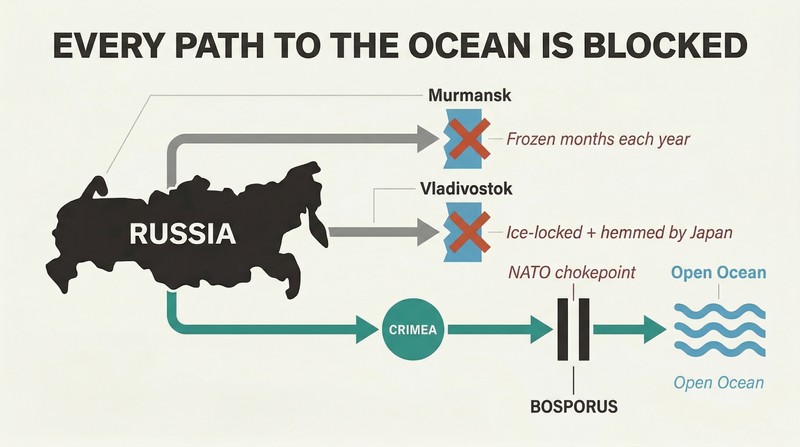
Mountains, rivers, and deserts decide. Tim Marshall's central argument is that physical geography — not personalities, not ideologies — is the most underestimated force in global politics. Putin must control Ukraine's flatlands because there's no mountain range to shield Moscow. China must hold Tibet because its rivers start there. America became a superpower in part because it sits between two oceans with no serious threats on either border.
The rules haven't changed. The same constraints that dictated strategy for Hannibal and Alexander the Great still dictate it today. Technology bends the rules — aircraft carriers, drones, and satellites help — but a sandstorm in Afghanistan can still ground the world's most advanced military for thirty-six hours, as Marshall witnessed firsthand in 2001.
Russia pushes west because a flat plain offers no place to hide
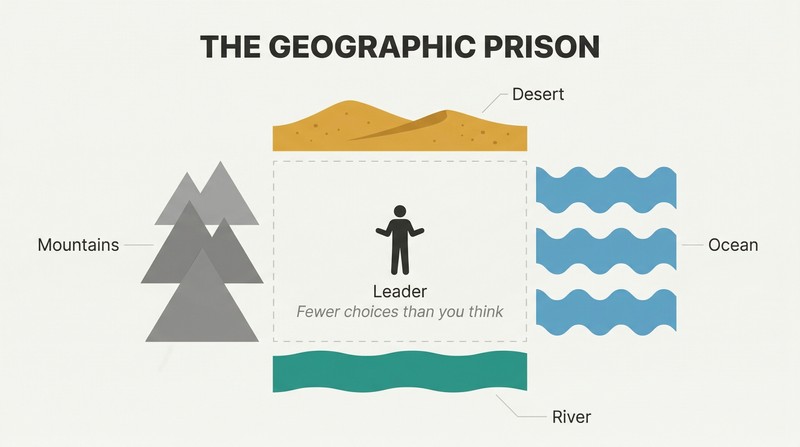
The North European Plain is Russia's nightmare. This vast corridor of flatland stretches from France to the Urals. At Poland, it narrows to just 300 miles wide — a bottleneck Russia could theoretically defend. But by the time it reaches Russia's borders, it fans out to over 2,000 miles, offering no natural barriers to stop an invading army.
Russia has been invaded from the west repeatedly: Poles in 1605, Swedes in 1708, Napoleon in 1812, Germans in 1914 and 1941. From Napoleon onward, Russia was fighting in or around this plain roughly once every thirty-three years. This history explains why Moscow panics when NATO expands eastward. By 2004, every former Warsaw Pact state except Russia had joined NATO or the EU.
Russia's 500-year quest for a warm-water port explains Crimea
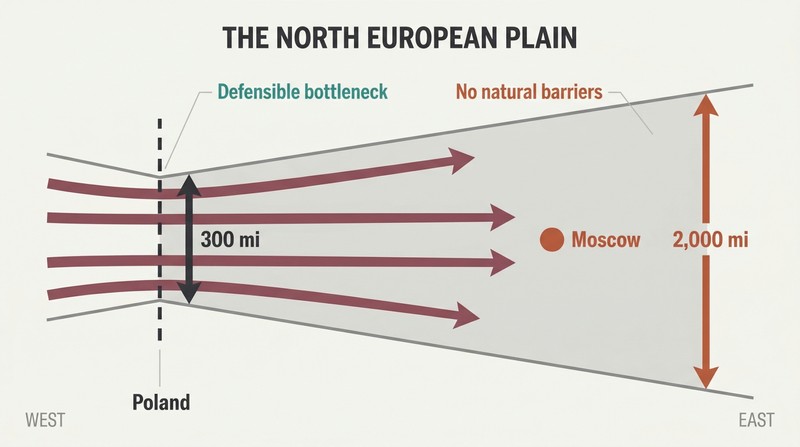
Frozen harbors cripple a superpower. Murmansk freezes for months. Vladivostok is ice-locked four months a year and hemmed in by Japan. Russia's only real warm-water naval base is at Sevastopol in Crimea. When Ukraine's 2014 revolution threatened to pull the country toward NATO — potentially evicting Russia from Sevastopol — Putin annexed the peninsula within weeks.
Even Sevastopol has limits. Ships leaving the Black Sea must pass through Turkey's Bosporus Strait, controlled by a NATO member. Even then, they must navigate the Aegean before reaching the Mediterranean. In wartime, Russia's navy would be bottled up. This is why Moscow maintains a small naval presence in Syria and is building new capacity at Novorossiysk — hedging against being trapped behind geography.
The Mississippi basin gave America an unbeatable trading advantage
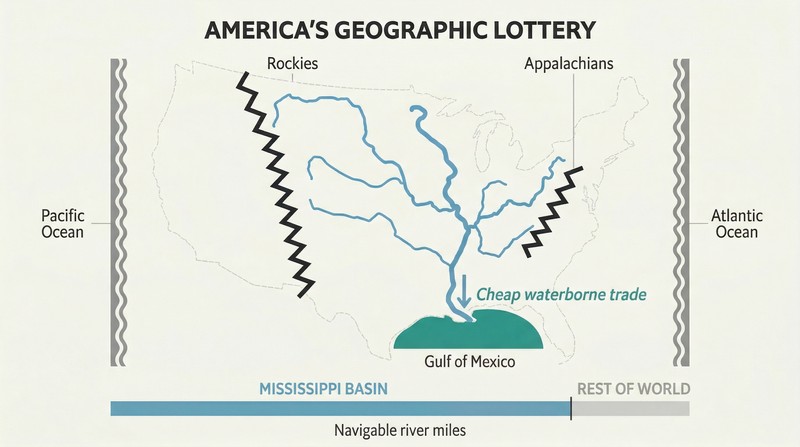
America won the geographic lottery. The 1803 Louisiana Purchase — $15 million for territory the size of Spain, Italy, France, the UK, and Germany combined — gave the young republic the Mississippi basin and its unparalleled river network. These rivers flow gently from low highlands to the Gulf of Mexico, enabling cheap waterborne trade across a massive fertile interior.
Geography made unification inevitable. The rivers connected settlers north to south, the Appalachians were crossable, and the Rockies were far enough away that by the time Americans reached them, they had the numbers and technology to push through. Add two protective oceans, weak neighbors to the north and south, and hundreds of millions of privately owned guns, and you have a nation that is essentially uninvadable.
China occupies Tibet for water and military high ground, not ideology
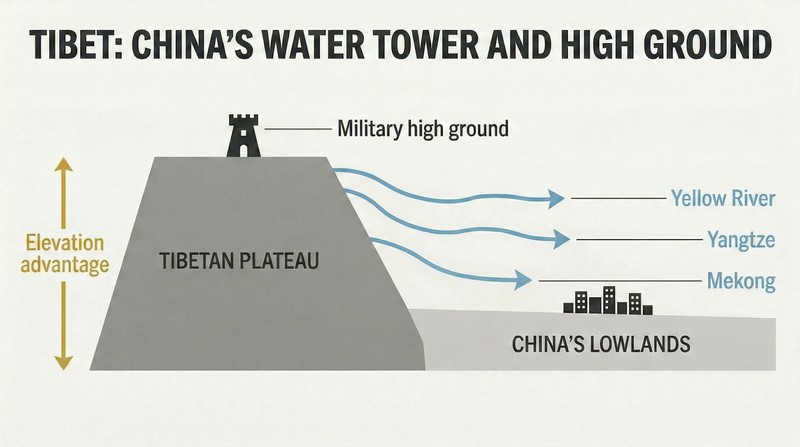
Tibet is China's water tower. Three of China's greatest rivers — the Yellow, Yangtze, and Mekong — originate on the Tibetan Plateau. China, with roughly the same water usage as the USA but five times the population, cannot allow any other power to control those headwaters. If India ever held Tibet, it would have both the commanding military heights and the ability to cut China's water supply.
Demographics are finishing what the army started. China built a railway to Lhasa that experts said was impossible. Four trains arrive daily from Shanghai and Beijing, carrying consumer goods, tourists — and Han Chinese settlers. Manchuria, Inner Mongolia, and Xinjiang were all once majority non-Han. All three are now majority Han. Tibet is following the same trajectory.
A flat border between France and Germany caused centuries of war
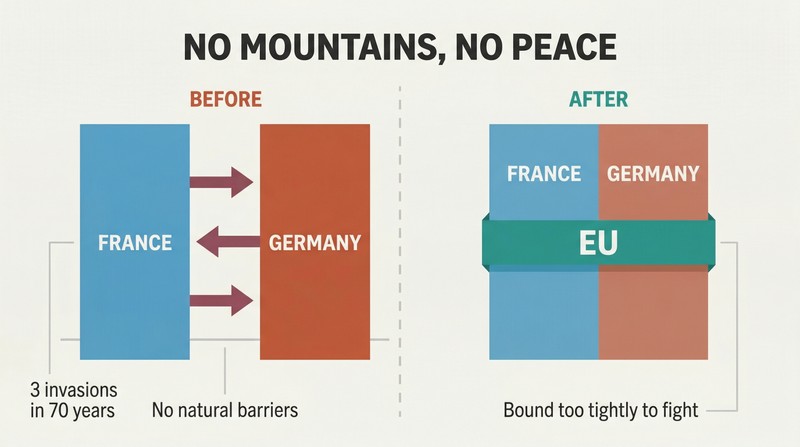
Europe's geography made it both rich and volatile. Long, navigable rivers enabled trade and the birth of industrialized nation states. But those same rivers rarely connect, acting as boundaries rather than highways — which partly explains why a space smaller than the USA contains over two dozen countries. France and Germany share the most dangerous stretch: the unprotected North European Plain, which Germany breached three times in seventy years.
The EU was geography's diplomatic fix. After centuries of warfare, exhausted Europeans accepted American military protection and agreed to trust each other. The euro crisis, however, exposed ancient fault lines: the richer northern nations and the poorer south. Germany rescued Greece but resentment surged on both sides, reviving stereotypes of profligate southerners and domineering northerners.
Drawing borders on other people's maps guarantees generational violence
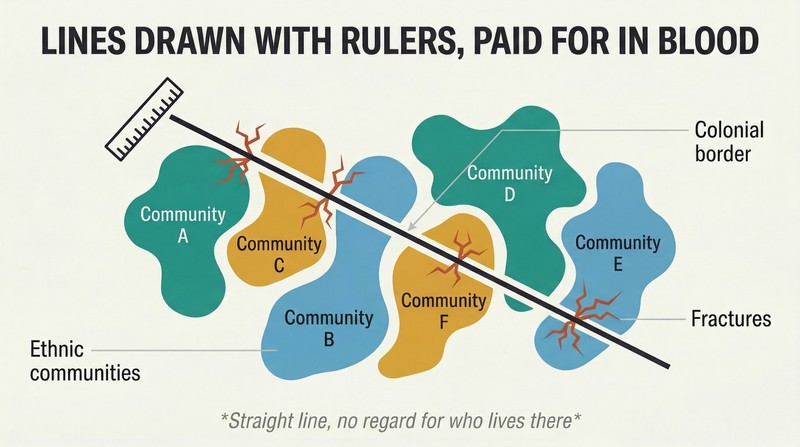
Sykes-Picot drew the Middle East's wounds. In 1916 a British diplomat drew a line from Haifa to Kirkuk with a chinagraph pencil, carving the Ottoman Empire into French and British zones. There had been no Syria, Lebanon, Jordan, or Iraq before. These artificial states threw together Sunni, Shia, Kurdish, and Christian communities with no shared national identity, overseen by strongmen who kept the peace through fear, not consent.
Africa suffered the same fate. Colonialists drew borders that ignored over 200 ethnic groups in the Congo alone. The DRC, bigger than Germany, France, and Spain combined, has seen six million war deaths since the 1990s. Nigeria's oil-rich south and impoverished Muslim north were welded together by the British in 1898 — fueling the conditions that produced Boko Haram.
Unnavigable rivers and smooth coastlines kept Africa centuries behind
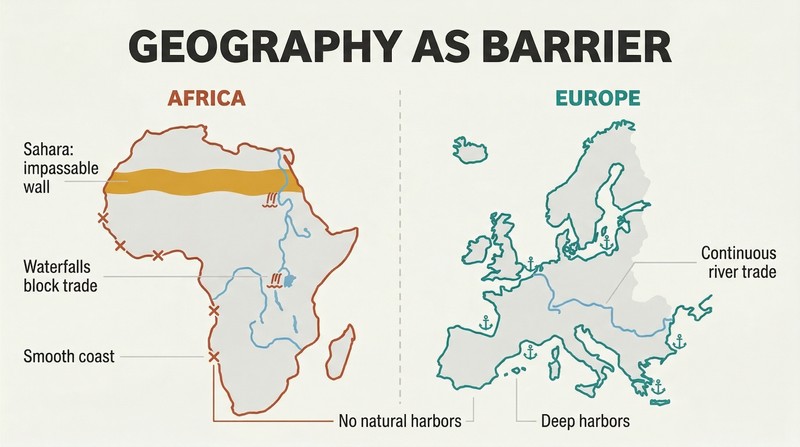
Africa's geography worked against it at every turn. Its rivers look mighty on maps but drop over waterfalls every few miles, blocking the kind of continuous trade routes that built European wealth. Unlike Europe's jagged coastline with its deep natural harbors, much of Africa's coast is smooth — preventing early sailors from penetrating more than 100 miles inland. The Sahara Desert cut sub-Saharan Africa off from Eurasian idea exchange for millennia.
Even animals refused to cooperate. Africa had few domesticable plants or animals. Rhinos and giraffes would not become beasts of burden. Diseases like malaria thrived in the heat. The result: by the time Europeans arrived with guns and ships, most of sub-Saharan Africa had yet to develop writing, paper, gunpowder, or the wheel.
Gas pipelines are Russia's most powerful non-nuclear weapon
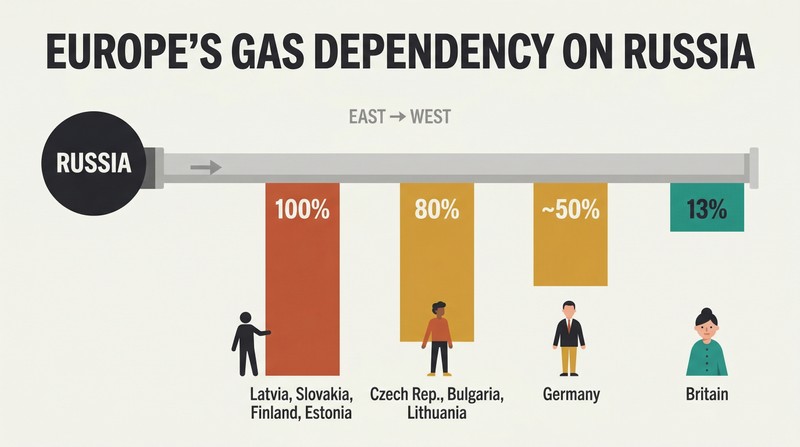
Energy dependency muzzles foreign policy. Over 25 percent of Europe's gas comes from Russia, and the closer a country sits to Moscow, the deeper the dependency. Latvia, Slovakia, Finland, and Estonia are 100 percent reliant on Russian gas. The Czech Republic, Bulgaria, and Lithuania are 80 percent dependent. Germany imports about half its gas from Russia — which partly explains why Berlin criticizes the Kremlin more softly than Britain, which sits at just 13 percent dependency.
The pipelines flow east to west, and the Kremlin can turn the taps on and off. Price disputes with Ukraine in 2005 – 10 cut gas to eighteen countries. The US counter-strategy: export liquefied natural gas to Europe, which requires building LNG terminals along European coastlines — an expensive but strategically critical investment.
The Arctic race has started, and Russia is laps ahead
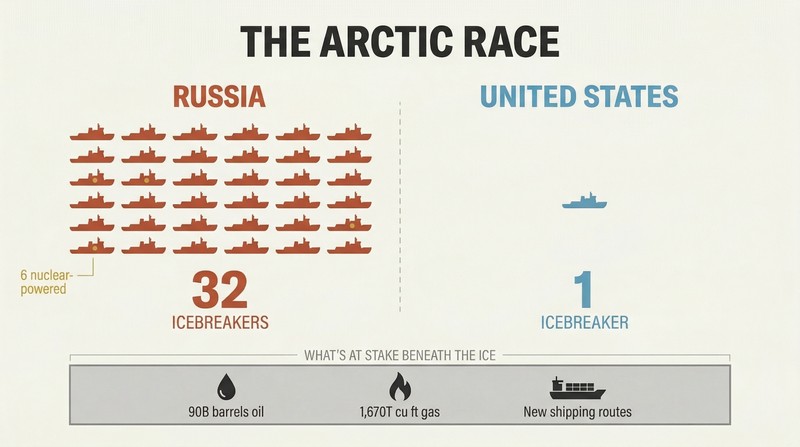
Russia has 32 icebreakers, six of them nuclear-powered. The United States has one functioning heavy icebreaker. Russia is building six new Arctic military bases, reopening Cold War installations, and readying a force of at least 6,000 combat soldiers for the Murmansk region. In 2007, Russian submersibles planted a titanium flag on the seabed of the North Pole.
The stakes are enormous. The US Geological Survey estimates 90 billion barrels of oil and 1,670 trillion cubic feet of natural gas lie beneath the Arctic. The melting ice is opening shipping routes — the Northwest Passage already saved a cargo ship 40 percent of its transit distance in 2014. Russia, Canada, Norway, Denmark, and the US all have competing sovereignty claims, and unlike the nineteenth-century Scramble for Africa, this race at least has rules — the UN Convention on the Law of the Sea — though whether those rules hold remains to be seen.
Analysis
Marshall's Prisoners of Geography represents a deliberate revival of classical geopolitical thinking in the tradition of Halford Mackinder and Nicholas Spykman, repackaged for a post-Cold War audience that had convinced itself geography no longer mattered. The book's intellectual contribution is not its originality — geographic determinism has been debated since Herodotus — but its accessibility and timeliness, arriving just as Russia's annexation of Crimea shattered the post-1991 consensus that great-power territorial competition was obsolete.
The book's greatest strength is its explanatory parsimony. By reducing the complexity of each region to a few geographic variables — flatlands, rivers, ports, mountain ranges — Marshall offers readers a durable mental model that actually predicts behavior. Why does Russia always expand westward? Why can't China and India fight a major war? Why has Africa lagged despite a 200,000-year head start? Each answer follows the same geographic logic, making the framework both memorable and transferable.
However, this parsimony is also its weakness. Marshall occasionally slides from 'geography constrains' to 'geography determines,' underplaying the role of institutions, culture, and contingency. South Korea and North Korea share identical geography yet produced radically different societies. Singapore, a city-state with zero natural resources, became wealthier than most of Europe. The book would benefit from more explicit engagement with these counter-cases.
The work also carries an implicit realist foreign policy perspective — that humanitarian interventions which ignore geographic constraints are doomed, that nation-building requires understanding terrain before ideology — which proved prescient regarding Afghanistan's collapse in 2021. Marshall's framework serves not as a complete theory of international relations but as an essential first filter: before asking what leaders want, ask what geography will let them do.
Review Summary
Prisoners of Geography receives mostly positive reviews for providing an accessible introduction to geopolitics through the lens of geography. Readers appreciate Marshall's clear writing style and insightful analysis of how physical features shape nations' policies. Some criticize the book's Western-centric perspective and oversimplification of complex issues. Many find it thought-provoking and relevant to current events, though a few note it's already somewhat outdated. Overall, reviewers recommend it as an engaging primer on how geography influences global politics, with maps that complement the text.
People Also Read




Glossary
North European Plain
Flat corridor from France to RussiaA vast stretch of flatland running from France through Belgium, the Netherlands, northern Germany, and Poland to the Ural Mountains in Russia. At its narrowest point (Poland) it is only 300 miles wide, widening to over 2,000 miles at Russia's borders. This corridor has been the primary invasion route into Russia for centuries and is central to Russian strategic anxiety.
Strategic depth
Space to retreat during invasionThe geographic distance and terrain a defending nation can fall back through when under attack, allowing it to absorb an invasion while stretching the attacker's supply lines. Russia's vast interior provides enormous strategic depth, as Napoleon and Hitler discovered. Pakistan notably lacks it—Islamabad sits less than 250 miles from the Indian border across flat ground.
Blue Water navy
Navy capable of global operationsA naval force able to operate across deep oceans far from its home ports, as opposed to a 'Green Water navy' that only patrols its own maritime borders. The US Navy is the world's preeminent Blue Water force. China is building one but is estimated to be decades away from matching American capability, making it reliant on securing regional sea lanes in the meantime.
First Island Chain
Archipelago blocking China's Pacific accessThe string of islands running from Japan through the Ryukyu Islands, Taiwan, the Philippines, and down to Indonesia that sits between mainland China and the open Pacific Ocean. Beijing views this chain as a geographic prison that could be used to blockade Chinese trade in wartime. Breaking through or controlling passages in this chain is a primary objective of China's naval expansion.
Sykes-Picot
Colonial carving of the Middle EastShorthand for the 1916 secret agreement between British diplomat Sir Mark Sykes and French counterpart François Georges-Picot to divide the Ottoman Empire's Middle Eastern territories into spheres of influence. The line Sykes drew from Haifa to Kirkuk became the basis for borders that created Iraq, Syria, Lebanon, Jordan, and other states with little regard for ethnic, religious, or tribal realities on the ground.
GIUK gap
North Atlantic naval choke pointThe Greenland-Iceland-United Kingdom gap, a strategic passage in the North Atlantic that any Russian naval vessel must traverse when moving from Arctic waters to the Atlantic Ocean. During the Cold War, NATO designated this corridor the 'Kill Zone' where it planned to intercept the Soviet fleet. It remains strategically important for controlling North Atlantic sea lanes.
Near abroad
Russia's term for former Soviet statesA Russian foreign policy concept referring to the fourteen countries that were formerly part of the Soviet Union. Moscow regards these nations—including Ukraine, Georgia, the Baltic States, and the Central Asian republics—as falling within its natural sphere of influence and has demonstrated willingness to use military force, energy leverage, and ethnic Russian populations to maintain control there.
Albedo effect
Dark surfaces absorb more heatIn the Arctic context, the phenomenon whereby melting ice exposes darker land and open water, which absorb more solar heat than reflective white ice and snow. This creates a feedback loop: as ice melts, newly exposed surfaces accelerate further warming and melting. Marshall notes this effect will be intensified by industrial residue from resource extraction settling on remaining ice.
FAQ
What's Prisoners of Geography about?
- Geopolitical Influence: Prisoners of Geography by Tim Marshall explores how geographical features like mountains, rivers, and plains shape the political landscape and decisions of nations.
- Ten Key Regions: The book is divided into ten chapters, each focusing on a specific region such as Russia, China, the USA, and the Middle East, with maps illustrating geographical factors.
- Historical Context: It provides historical examples to show how geography has influenced leaders' actions and nations' fates, emphasizing its importance in understanding current international relations.
Why should I read Prisoners of Geography?
- Insightful Analysis: The book offers sharp insights into the interplay between geography and global politics, making complex topics accessible and understandable.
- Concise Primer: It serves as a concise introduction to geopolitics, especially for those unfamiliar with the subject, with engaging anecdotes and straightforward writing.
- Relevance to Current Events: Given ongoing geopolitical tensions, the book is timely and helps readers contextualize current events within a geographical framework.
What are the key takeaways of Prisoners of Geography?
- Geography Shapes Destiny: Geography is a fundamental factor in shaping a nation's destiny, constraining leaders' choices and influencing strategies.
- Historical Patterns: Historical patterns often repeat due to geographical constraints, such as the North European Plain's role in invasions affecting Russia's strategies.
- Geopolitical Implications: Understanding geographical factors provides insights into contemporary conflicts, like those in Ukraine and the South China Sea.
What are the best quotes from Prisoners of Geography and what do they mean?
- "Geography is the most overlooked factor in international relations.": This quote highlights the book's thesis that geographical features significantly influence political decisions and historical outcomes.
- "The landscape imprisons their leaders.": It emphasizes how geographical constraints limit political leaders' options, forcing them to navigate within their country's geography.
- "If God had built mountains in Ukraine...": This illustrates how the absence of natural barriers in Ukraine has made it vulnerable to invasions, showing geography's role in national security.
How does Tim Marshall define geopolitics in Prisoners of Geography?
- Geopolitics Explained: Marshall defines geopolitics as the study of how geographical factors influence international relations and political power.
- Interconnected Factors: It involves a complex interplay of geography, history, and human behavior, essential for analyzing global events and conflicts.
- Historical Context: The book provides historical examples to show geography's influence on political decisions over time, helping readers appreciate its long-standing impact.
What regions does Prisoners of Geography focus on?
- Ten Key Regions: The book covers Russia, China, the USA, Western Europe, Africa, the Middle East, India and Pakistan, Korea and Japan, Latin America, and the Arctic.
- Geographical Features: Each chapter delves into the geographical features and political dynamics of these areas, like Russia's vastness and China's naval ambitions.
- Global Implications: The geographical characteristics of these regions have global implications, affecting international relations and conflicts.
How does geography influence Russia's political strategies in Prisoners of Geography?
- Strategic Depth: Russia's vast size and geographical features provide strategic depth, influencing its military strategies and defensive posture.
- Historical Invasions: Past invasions, like those by Napoleon and Hitler, highlight geography's role in their failures, with the North European Plain being significant.
- Current Tensions: Russia's geographical concerns relate to contemporary issues like Crimea's annexation and NATO tensions, driven by border security desires.
What role does geography play in China's rise as a global power according to Prisoners of Geography?
- Land Power to Naval Power: Historically a land power, China is developing a blue-water navy to secure maritime interests due to geographical necessities.
- Geographical Barriers: Barriers like the Himalayas have limited military engagements with India, shaping China's foreign policy and strategies.
- Trade Routes: Securing trade routes is crucial for China's growth, with the South China Sea being a critical area for trade and energy supplies.
How does Prisoners of Geography address the Middle East's geopolitical challenges?
- Artificial Borders: European powers drew arbitrary borders, leading to conflicts by ignoring ethnic and religious complexities, causing instability.
- Resource Conflicts: Oil and gas shape geopolitical dynamics, with control over these resources leading to conflicts and power struggles.
- Historical Context: Historical agreements like Sykes-Picot are crucial for understanding current tensions and the region's geopolitical complexities.
What are the implications of geography for Africa's development as discussed in Prisoners of Geography?
- Geographical Challenges: Africa's vast deserts and poor navigable rivers hinder economic development, limiting trade and regional connectivity.
- Colonial Legacy: Colonialism's impact on borders and political structures contributes to ethnic conflicts and instability in African nations.
- Resource Wealth: Africa's natural resources can attract exploitation and conflict, posing challenges to equitable development.
How does Prisoners of Geography explain the significance of the Arctic?
- Emerging Opportunities: Climate change opens new shipping routes and resource access, increasing interest from Arctic nations and global powers.
- Geopolitical Tensions: Competing territorial claims among nations like Russia, Canada, and the USA heighten potential conflicts due to strategic importance.
- Environmental Concerns: Increased Arctic activity raises ecological impact concerns, emphasizing the need for sustainable resource management.
How does Prisoners of Geography relate to current global issues?
- Relevance to Modern Conflicts: The book connects historical geographical influences to contemporary conflicts, essential for understanding current events.
- Impact of Climate Change: Climate change reshapes geopolitical considerations, particularly in the Arctic, raising environmental and territorial disputes.
- Global Power Shifts: The rise of new powers like China affects traditional dynamics, with geography playing a key role in trade routes and resource access.
Politics of Place Series
About the Author
Other books by Tim Marshall


Download PDF
Download EPUB
.epub digital book format is ideal for reading ebooks on phones, tablets, and e-readers.








































