
Key Takeaways
1. Rural Consciousness: A Core Identity of Injustice
Rural consciousness signals an identification with rural people and rural places and denotes a multifaceted resentment against cities.
A unique perspective. Many rural residents interpret politics through a lens the author calls "rural consciousness." This isn't just an attachment to place; it's a profound identity that shapes how they view power, resources, and respect. It encompasses a deep-seated belief that their communities are systematically overlooked and undervalued by urban decision-makers.
Three core elements. Rural consciousness is characterized by:
- A belief that rural areas are ignored by policy makers.
- A perception that rural areas do not receive their fair share of resources.
- A sense that rural folks have distinct values and lifestyles, often misunderstood and disrespected by city dwellers.
This perspective transforms political disagreements into something far more fundamental, rooted in who they are and where they belong.
Beyond mere correlation. While a correlation between rural areas and conservative voting patterns has long been observed, rural consciousness explains how this connection is forged. It's not simply about voting habits; it's about a complex, layered understanding of the world where resentment towards cities and their perceived inhabitants becomes a central organizing principle for political thought.
2. The Politics of Resentment: Blaming Fellow Citizens
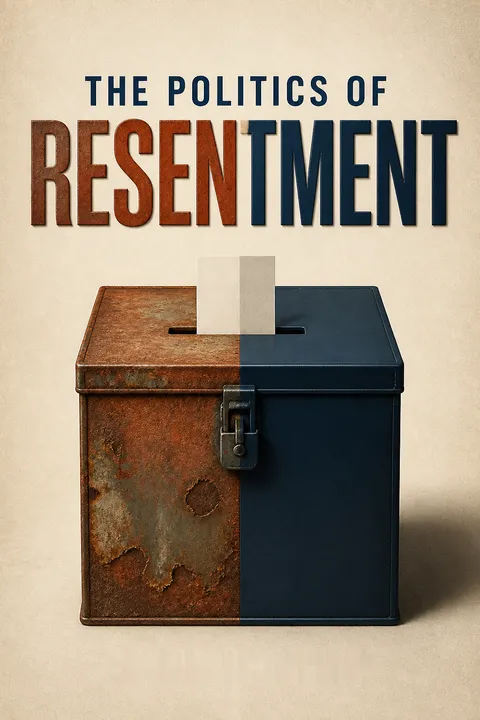
I call this book The Politics of Resentment because there are other ways to make sense of politics than by relying primarily on ideas about which of one’s fellow citizens are getting more than their fair share and who among them is undeserving.
A different blame game. In a politics of resentment, people often attribute their struggles not to broad systemic forces or distant elites, but to specific groups of fellow citizens. This shifts the focus from structural issues to interpersonal grievances, making "us vs. them" dynamics central to political discourse. The author observed this vividly in Wisconsin, where rural residents frequently blamed urbanites and public employees for their economic woes.
Identity over ideology. This form of politics suggests that issues might be secondary to identities. When people vote, their primary calculation might not be about policy alignment, but rather, "Is this person like me? Do they understand people like me?" This identity-driven approach intertwines economic considerations with social and cultural perceptions, creating a powerful narrative of deservingness and blame.
Exploiting divisions. Political leaders often capitalize on these pre-existing resentments, activating them for electoral gain. By framing issues in terms of who is getting an unfair share or who is "undeserving," politicians can mobilize support, even if the policies ultimately benefit a different segment of society. This dynamic makes resentment a potent, and often destructive, tool in contemporary democracy.
3. Urban-Rural Divide: A Deeply Personal Rift
This is a little shocking. Unfortunately, it is not unusual in Wisconsin anymore. It has gotten downright nasty around here. People, in casual conversation, are treating each other as enemies.
Beyond red and blue. The author's fieldwork revealed that beneath the partisan "red versus blue" maps lies a profound urban-versus-rural divide, particularly stark in Wisconsin. This isn't just about differing voting patterns; it's a deeply personal rift where people from different geographic areas perceive each other as fundamentally different, even as enemies. This animosity extends to everyday interactions, transforming casual conversations into contentious exchanges.
Madison vs. "Outstate". In Wisconsin, this divide often manifests as "Madison and Milwaukee versus the rest of the state." Rural residents frequently expressed feeling ignored and disrespected by these urban centers, which they saw as monopolizing resources and political power. This perception of geographic marginalization fuels a sense of injustice that permeates their political views.
Values and lifestyles. The divide is also rooted in perceived differences in values and lifestyles. Rural residents often pride themselves on hard work, self-reliance, and a slower pace of life, contrasting this with what they see as the fast-paced, bureaucratic, and sometimes "lazy" urban existence. This cultural clash reinforces the "us vs. them" mentality, making it difficult to find common ground on policy issues.
4. Economic Hardship Fuels Place-Based Resentment
The big thing that affects the rural areas in the last fifteen years is the change in the agriculture where you don’t have the mom-and-pop farms anymore.
Perpetual struggle. For many rural Wisconsinites, economic hardship is not a temporary recession but a permanent state of affairs. They describe their communities as "dying," with dwindling local businesses, rising costs (like gas for long commutes), and a "brain drain" of young people seeking opportunities elsewhere. This long-term struggle makes them particularly sensitive to perceived economic injustices.
"Sucked in" by cities. Rural residents often believe their tax dollars are "sucked in" by Madison and Milwaukee, never to return to their struggling towns. They perceive that urban areas receive disproportionate funding for schools, infrastructure, and services, while their own communities are left to decay. This belief persists despite mixed empirical evidence on per capita spending, highlighting the power of perception over raw data.
Tourism's double edge. While tourism provides some economic relief, it also exacerbates resentment. Rural residents feel that urban tourists drive up property values and taxes, making it harder for locals to afford homes, while often failing to understand the year-round economic precarity of tourist-dependent jobs. They resent the perception that they lead leisurely lives, when in reality, they often work multiple jobs during peak seasons just to survive.
5. Public Employees as the "Haves": A Target of Rural Resentment
You know, who’re all those people protesting during the week? I mean, all the big crowds showed up on the weekends and who’re the people that are protesting during the week? Well the people showing up on the weekends were people in the private sector. The people during the week were the people calling in sick, public employees and you know, why were the private-sector people showing up only on the weekend? That’s because if they’d called in sick to their employer they would have been fired.
The "undeserving" public sector. A central component of rural resentment is directed at public employees, who are often perceived as "haves" enjoying extravagant salaries, benefits, and pensions at the expense of hard-working taxpayers. This perception is particularly acute in lower-income rural areas where public sector wages can indeed be higher than private sector wages, making public jobs seem like a privileged class.
Lazy bureaucrats. Rural residents frequently characterize public employees as inefficient, out-of-touch bureaucrats who "don't work very hard" or "don't know how to work with their hands." This contrasts sharply with their own self-perception as tough, diligent laborers. The author, a university employee, even felt "sheepish" about her job when confronted with these narratives of manual labor.
Madison's symbolic role. Institutions like the University of Wisconsin-Madison and the Department of Natural Resources (DNR) become symbolic targets. University professors are seen as aloof, overpaid, and having "the summer off," while DNR employees are viewed as imposing ridiculous regulations without understanding rural life. These perceptions reinforce the idea that public institutions are controlled by urban, liberal elites who disregard local knowledge and values.
6. Small Government Support: Rooted in Identity, Not Just Principle
I suggest that whom people support in the election booth has to do with something rather different than issue voting—namely, identity.
Beyond libertarianism. Support for small government among rural residents is often less about abstract libertarian principles and more about a visceral resentment rooted in identity. When people say "the less government, the better," it's frequently a shorthand for "less government that benefits 'them' (urbanites, public employees) at 'our' (rural taxpayers') expense." This makes their stance on government deeply personal and emotionally charged.
"Can't afford it." Many rural residents express a desire for government services, like better schools or infrastructure, but simultaneously resist higher taxes. Their reasoning is often: "We can hardly make ends meet as it is, and our taxes keep going up, but the money never comes back to our dying communities. Why would we want more government if it's just going to waste our hard-earned dollars on undeserving others?"
Regulation as disrespect. Government regulations, particularly from agencies like the DNR, are often seen as impositions from out-of-touch urban decision-makers who don't understand rural life. This fuels a desire for less regulation, not necessarily out of a belief in free-market efficiency, but out of a feeling of being disrespected and controlled by distant, ignorant authorities. This intertwining of economic, cultural, and power dynamics makes small government a logical choice for those with a strong rural consciousness.
7. Politicians Exploit Rural Consciousness for Electoral Gain
Scott Walker not only made the most of the Great Recession—he also tapped into rural consciousness.
Riding the wave. Politicians like Scott Walker effectively capitalize on existing rural consciousness and resentment. Walker's campaign rhetoric, particularly his opposition to the high-speed rail project between Madison and Milwaukee, framed it as an urban "boondoggle" that would drain resources from "real" Wisconsinites in rural areas. He positioned himself as an outsider fighting against the "political machine" in the cities.
"Brown-bag common sense." Walker deliberately cultivated an image of identifying with small-town values, claiming to have "a little bit of that brown-bag common sense" from his rural upbringing. This resonated with rural voters who felt ignored and disrespected by urban elites. His attacks on public employee benefits, often equating them with "places like Madison," further solidified his image as someone fighting for the "have-nots" against the "haves."
A mandate for small government? When politicians win elections by tapping into these resentments, they often claim a mandate for their small-government policies. However, the author's research suggests that this support is not necessarily a principled endorsement of limited government, but rather a vote against perceived "undeserving" groups. This misinterpretation of voter sentiment can lead to policies that don't truly address the underlying concerns of the electorate.
8. Race's Complex Role in Shaping Resentment
It is very possible that the lack of references to urban racial minorities in the conversations I observed is a manifestation of the threat hypothesis, or the idea that racial prejudice is heightened when people of different racial backgrounds are in proximity to one another.
Implicit, not always explicit. While overt racism was rare in the author's rural observations, race plays a complex and often implicit role in rural consciousness and resentment. In a racially segregated state like Wisconsin, "urban" can become a racialized shorthand, even when not explicitly stated. Historically, arguments against government redistribution have often been intertwined with racial animosity, equating deservingness with whiteness.
Blaming "others." When rural residents complained about "lazy welfare recipients" or "people sucking tax dollars away," they were often referring to white neighbors or government employees, not necessarily urban racial minorities. However, the broader political culture allows for racial resentment to be activated by such arguments, even if the immediate target is not a person of color. This makes it difficult to disentangle race from other forms of resentment.
Obama's "otherness." Barack Obama's race made him an "other" figure, and while some rural residents initially expressed a cautious openness to him, his perceived urban, liberal identity, combined with his race, ultimately led many to view him as just another politician out of touch with rural concerns. This highlights how racial identity, even when not the sole factor, can amplify existing resentments and shape political perceptions.
9. Listening Reveals the Nuances of Political Understanding
My goal is to better understand how people think about politics. Some public opinion scholars have argued that opinions about redistribution are not just a function of economic considerations but are, instead, the products of people embedded in particular social locations and social environments.
Beyond polls. The author's ethnographic approach, involving repeated visits to informal groups in diverse communities, offers a unique window into how people construct their political understandings. Unlike traditional surveys that measure what people think, this method reveals the complex, intertwined reasons behind their opinions, showing that political beliefs are deeply rooted in personal identities, values, and perceptions of their social world.
The value of context. By immersing herself in these communities, the author learned that political opinions are not formed in a vacuum but are shaped by local contexts, daily interactions, and shared narratives. For instance, the pervasive belief that rural areas are ignored by the media, despite the author's content analysis showing otherwise, suggests that these perceptions are cultivated through interpersonal communication rather than mass media.
Challenging assumptions. This "bottom-up" listening challenges the simplistic notion that voters are "ignorant" or "duped" when they vote against their perceived economic interests. Instead, it reveals that their choices are often logical within their own complex worldview, which integrates economic realities with deeply held social and cultural identities and resentments. Understanding these nuanced perspectives is crucial for comprehending contemporary political behavior.
10. The Peril of Resentment for Democracy
My fear is that democracy will always tend toward a politics of resentment, in which savvy politicians figure out ways to amass coalitions by tapping into our deepest and most salient social divides: race, class, culture, place.
Democracy's inherent tension. While democracy thrives on debate and contention, a "politics of resentment" transforms these disagreements into intensely personal battles. When political differences become fundamental clashes of identity, values, and deservingness, the ability for citizens to engage in constructive public discourse diminishes, leading to incivility and a breakdown of social cohesion.
Misrepresenting voter interests. In a politics of resentment, politicians can claim a mandate for policies (e.g., small government) by tapping into anger against specific social groups, rather than addressing the complex, underlying concerns of the electorate. This can lead to policies that disproportionately benefit the affluent, while the broader public remains focused on blaming fellow citizens, diverting attention from systemic inequalities.
A call for redirection. The author argues that the energy currently directed towards criticizing fellow citizens should be redirected towards improving the policy process to be more responsive to everyone's needs. This requires political leaders who bridge divides rather than foment them, fostering a public life where respect and understanding, rather than resentment, drive democratic engagement. The future of democracy depends on finding ways to prevent resentment from dominating political understanding.
People Also Read




Download PDF
Download EPUB
.epub digital book format is ideal for reading ebooks on phones, tablets, and e-readers.








































