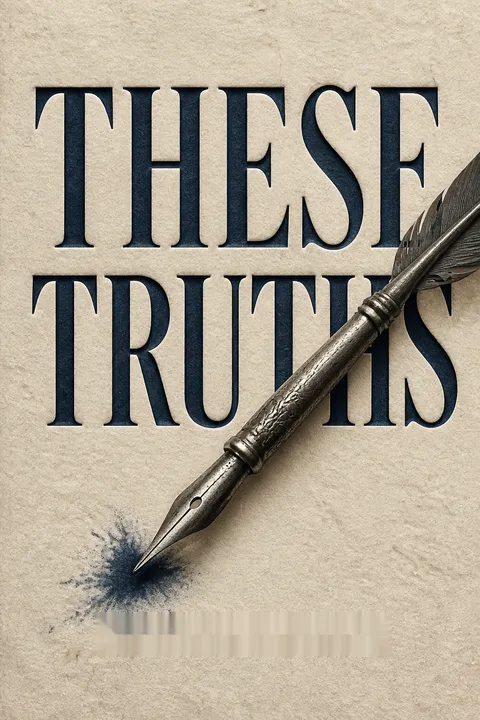

Key Takeaways
1. Truths Forged in Contradiction: The American Paradox
The history of the United States can be said to begin in 1492 because the idea of equality came out of a resolute rejection of the idea of inequality; a dedication to liberty emerged out of bitter protest against slavery; and the right to self-government was fought for, by sword and, still more fiercely, by pen.
Foundational ideals. America's core principles of liberty, equality, and self-government were not pristine but were forged in a crucible of violence and contradiction from its very inception. European colonizers, like Columbus, justified conquest by denying the humanity and sovereignty of native peoples, claiming their lands through written declarations. This "literall advantage" allowed them to impose their "truths" on those they encountered.
Contested rights. The English, arriving later, championed "English liberties" for their colonists, including the rule of law and representative government, yet simultaneously codified brutal racial slavery. Debates over natural rights, as seen in figures like Antonio de Montesinos asking "Are they not men?", highlighted the hypocrisy of a society built on both freedom and forced labor. This inherent tension between proclaimed ideals and lived realities became a defining feature of the American experiment.
Revolutionary spirit. The American Revolution itself, while fighting for independence from British tyranny, was deeply intertwined with the struggle against slavery and native resistance. The Declaration of Independence, proclaiming "all men are created equal," was a powerful statement of universal rights, yet its framers made compromises that perpetuated slavery, leaving a profound moral and political debt for future generations to address.
2. Whose History, Whose Truth? The Power of the Record
History is the study of what remains, what’s left behind, which can be almost anything, so long as it survives the ravages of time and war.
Incomplete narratives. History is inherently incomplete and biased, shaped by what survives and who records it. Columbus's lost diary, Ramón Pané's vanished account of the Taíno, and the burning of Aztec libraries illustrate how much of the past is irrevocably lost or filtered through dominant perspectives. The "literall advantage" of writing allowed Europeans to impose their narratives, often erasing indigenous voices and experiences.
Shaping national identity. Early American historians, like George Bancroft, consciously constructed a national narrative by beginning with Columbus, aiming to make the nation's founding seem inevitable and God-ordained. This selective storytelling served political purposes, such as justifying westward expansion and creating a shared, albeit often mythical, ancestry for a diverse populace. The historical record, therefore, is not merely a collection of facts but a tool for shaping collective memory and national identity.
Contesting narratives. Marginalized groups consistently challenged these dominant narratives, asserting their own histories and truths. From the Taíno songs foretelling their demise to David Walker's "Appeal" claiming the Declaration for black Americans, and later, Ida B. Wells exposing lynching, these counter-narratives forced a reckoning with the nation's contradictions. The struggle over whose history is told, and how, remains central to understanding America's ongoing debates about its past and future.
3. The Unending Dance of Liberty and Bondage
The American political tradition was forged by philosophers and by statesmen, by printers and by writers, and it was forged, too, by slaves.
Intertwined destinies. From the earliest colonial days, the ideals of liberty and the realities of slavery were inextricably linked in America. The English colonists, while demanding their "English liberties" from the Crown, simultaneously codified racial slavery, creating a system where the freedom of some was built upon the absolute subjugation of others. This paradox was foundational, shaping laws, economy, and social structure.
Resistance as a catalyst. Slave rebellions and native resistance, from the Stono Rebellion to King Philip's War, profoundly influenced colonial politics, hardening racial lines and fueling fears of insurrection. These acts of defiance, though often brutally suppressed, forced colonists to articulate and defend their own claims to freedom, inadvertently sharpening the arguments for universal liberty that would later be used against them.
Constitutional compromise. The U.S. Constitution, a document born of revolutionary ideals, enshrined this paradox through compromises like the Three-Fifths Clause, which granted slave states disproportionate political power. This "rotten part of the Constitution," as some called it, ensured that the nation's political arithmetic was skewed by slavery, leading to decades of sectional conflict and ultimately, civil war, demonstrating that the struggle for liberty was never solely a white man's fight.
4. From Republic to Democracy: The Rise of "The People"
The people, Milton insisted, are not “slow and dull, but of a quick, ingenious and piercing spirit, acute to invent, subtle and sinewy to discourse, not beneath the reach of any point the highest that human capacity can soar to.”
Expanding suffrage. The transition from a limited republic to a mass democracy was marked by a gradual but significant expansion of suffrage, particularly for white men. Early state constitutions, influenced by figures like John Adams, initially restricted voting rights, but by the Jacksonian era, property qualifications were largely abolished, leading to a dramatic increase in voter participation and the rise of "King Numbers."
Party politics and popular will. The emergence of a stable two-party system, beginning with the Federalists and Republicans, channeled political dissent and ensured peaceful transfers of power. Figures like Thomas Paine, with his "plain truth" in Common Sense, and later Andrew Jackson, championed the idea that "the majority is to govern," transforming elections into popular mandates and making direct appeals to "the people" a central feature of American politics.
Challenges to popular rule. This embrace of popular sovereignty was not without its critics, who feared the "turbulence and follies of democracy." Concerns about the "tyranny of the majority" and the potential for an uneducated populace to make poor decisions led to ongoing debates about the balance between popular will and constitutional checks, a tension that would continue to define American governance.
5. Machines of Progress, Engines of Division
Next to the influence of Christianity on our moral nature, technology “has had a leading sway in promoting the progress and happiness of our race.”
Technological utopianism. From the printing press to the telegraph, radio, and early computers, new technologies were consistently hailed as instruments of progress, promising to unite the nation, spread knowledge, and even usher in an era of peace and equality. Samuel Morse believed the telegraph would "bind man to his fellow-man in such bonds of amity as to put an end to war," while early photography was seen as democratizing art and revealing universal humanity.
Unintended consequences. Despite utopian promises, these innovations often exacerbated existing inequalities and created new forms of social and political division.
- Printing press: Accelerated the spread of ideas but also partisan propaganda.
- Cotton gin: Made American slavery more profitable, deepening the sectional divide.
- Factories: Created immense wealth but also "mechanical slaves" and alienated wage laborers, leading to stark economic inequality.
- Railroads/Telegraph: Physically connected the continent but also fueled land speculation and corporate monopolies, leading to populist revolts.
The "Gospel of Machinery." The unquestioning faith in technological progress, dubbed the "gospel of machinery," often overshadowed critical examination of its social impact. While some, like Thoreau, questioned whether "improved means" led to "an unimproved end," the relentless march of invention continued, shaping the economy, social relations, and the very nature of political communication, often with unforeseen and disruptive effects.
6. The State's Expanding Reach: Welfare, Warfare, and Control
The federal government, especially the administration of Ulysses S. Grant, became notorious for corruption and bribery.
Crisis-driven expansion. The federal government's power expanded dramatically in response to national crises, particularly wars and economic depressions.
- Civil War: Led to unprecedented federal authority, including conscription, federal currency, and income taxes.
- Progressive Era: Saw the creation of numerous federal agencies (e.g., Forest Service, Bureau of Efficiency) to regulate big business and conserve resources.
- New Deal: Established a broad welfare state with programs like Social Security, public works, and agricultural assistance, fundamentally altering the government's role in the economy and individual lives.
The national security state. The Cold War further transformed the state, shifting focus from social welfare to national security. Unprecedented military spending, the creation of new intelligence agencies (CIA, NSA), and a permanent military-industrial complex became central features of American governance. This expansion, while aimed at containing communism abroad, also led to increased surveillance and restrictions on civil liberties at home.
Contested authority. This growth of state power was constantly contested. Populists railed against government complicity with capitalists, conservatives fought against "big government" and "socialism," and civil liberties advocates warned against executive overreach. The debates over federal intervention, taxation, and regulation became enduring battlegrounds in American politics, shaping the ideological divides between parties.
7. Defining Citizenship: A Century-Long Battle for Rights
All persons born or naturalized in the United States, and subject to the jurisdiction thereof, are citizens of the United States and of the State wherein they reside.
An elusive definition. For much of American history, the definition of "citizen" remained maddeningly vague, leading to ongoing struggles over who belonged to the political community and what rights they possessed. The Constitution itself offered little clarity, and early laws often restricted citizenship based on race, such as the "free white person" clause for naturalization.
Post-Civil War redefinition. The Civil War and Reconstruction forced a fundamental redefinition of citizenship. The 14th Amendment, a "signal constitutional achievement," established birthright citizenship and guaranteed equal protection and due process to all "persons." However, its promise was immediately undermined by the insertion of "male" into its second section, denying women suffrage, and by the rise of Jim Crow laws that systematically disenfranchised black men.
Ongoing struggles. The fight to realize the full promise of citizenship continued through the 20th century. Women fought for suffrage (19th Amendment), and civil rights activists battled Jim Crow (Brown v. Board, Civil Rights Act, Voting Rights Act). Immigrants, particularly from Asia and Mexico, faced exclusion and discrimination, highlighting the persistent tension between America's ideals of universal rights and its often-racist and nativist practices.
8. The Disrupted Republic: When Truth Became a Weapon
The effort to state an absolute fact is simply an attempt to achieve what is humanly impossible; all I can do is to give you my interpretation of the facts.
Erosion of objectivity. The late 19th and 20th centuries saw a profound shift in the understanding of truth, moving from a belief in objective facts to a more subjective, interpretive view. This was fueled by the rise of social sciences, which challenged traditional ways of knowing, and by the emergence of public relations, which explicitly aimed to "propagate ideas" and manipulate public opinion.
Partisan media and political consultants. The decline of traditional, broadly objective journalism, coupled with the rise of partisan media (talk radio, cable news) and sophisticated political consulting firms, transformed political discourse. These new actors prioritized emotional appeals, simplified messages, and targeted messaging over nuanced debate, often deliberately creating "fake news" and exploiting divisions for electoral gain.
Digital age fragmentation. The Internet and social media accelerated this fragmentation of truth, allowing individuals to inhabit "their own realities." Algorithms fed users only information confirming their existing views, leading to extreme polarization, distrust in institutions, and the proliferation of conspiracy theories. This "epistemological abyss" made reasoned debate increasingly difficult, turning political differences into existential battles where "truth" became a weapon rather than a shared foundation.
Review Summary
People Also Read
Download PDF
Download EPUB
.epub digital book format is ideal for reading ebooks on phones, tablets, and e-readers.








































