


Key Takeaways
Build a PlayBook of setups that fit you, not copied gurus
The core thesis is personalization. A PlayBook is a personal archive of the trading setups that make the most sense to you, built by documenting your best trade after every session in a fixed template. Bellafiore, cofounder of the New York prop firm SMB Capital, argues most underperforming traders lack a methodology to build from their strengths. They flit from strategy to strategy, or blindly copy a star trader.
A pizzeria analogy captures it. If you open a pizza shop and a customer asks for a taco, you refuse, because you make pizza. Traders lose money making tacos. Legends like Jim Rogers and David Einhorn refuse to give hot tips because a tip is useless unless you know how to trade it. You must make every setup your own.
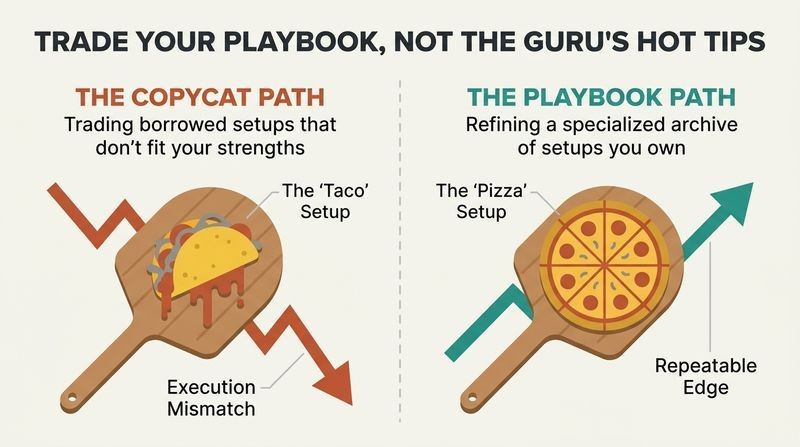
What's compelling is the reframing of trading as a craft of self-knowledge rather than market prediction. This echoes deliberate-practice research from Anders Ericsson and the deliberate-practice literature Bellafiore leans on (Coyle, Colvin): expertise comes from encoding domain-specific patterns, not raw talent. The PlayBook functions like a chess master's memorized board positions. One tension worth noting: excessive personalization risks confirmation bias, where a trader keeps only setups that flatter existing habits. The discipline of archiving losers too, which the book urges elsewhere, is what keeps the PlayBook honest rather than a highlight reel.
Weigh every trade through five lenses before risking a dollar
Each decision is a circle you color in. Bellafiore filters trades through five checks: the Big Picture (overall market strength and what catalyst is moving it), Intraday Fundamentals (fresh news in the stock), Technical Analysis (key long- and short-term levels), Reading the Tape (bids, offers, and prints on Level II), and Intuition (the inner voice built only through screen time).
No single check dominates. A supermodel uptrend chart can collapse if Speaker Boehner announces fiscal-cliff talks stalled, because 80 percent of stocks follow the market. New traders overvalue technicals and ignore the story. The point is learning how to think through a trade, not memorizing a mechanical system. There is no red-light-sell, green-light-buy formula that lasts forever; markets change and even automated strategies need constant reconfiguring.
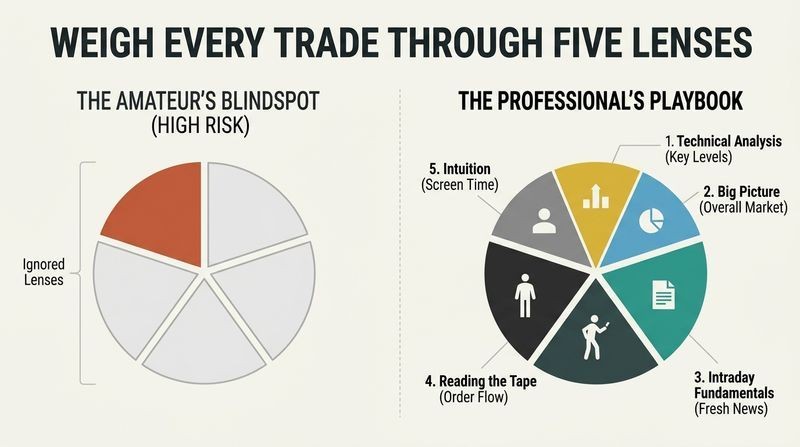
The five-check framework resembles a weighted-evidence model, closer to Bayesian updating than to rule-following. That is its strength and its danger. Discretionary weighting lets a skilled trader adapt when regimes shift, but it resists falsification, making it hard for novices to know if they are improving or fooling themselves. Behavioral finance would flag that intuition, the fifth check, is where overconfidence hides; Kahneman showed intuition is trustworthy only in high-validity, high-feedback environments. Bellafiore implicitly agrees, insisting intuition is a money-maker for veterans but a trap for newbies who mistake noise for a sixth sense.
Only trade stocks with fresh news driving real order flow
Fresh news creates clean trends. Bellafiore calls a stock with a catalyst a Stock In Play, and only these deserve your capital because real order flow makes trends run with fewer shakeouts. His summer interns compiled a cheat sheet of Super Stocks In Play catalysts:
1. Improved margins
2. Government investigation (sell first, ask later)
3. Raised guidance going forward
4. Revenue far above consensus
5. A stock gapping plus or minus 3 percent on heavy premarket volume
A vanilla setup is not enough. A bullish flag pattern on a random stock wins far less often than the same flag on a stock In Play. The built-in catalyst raises the odds that other players keep buying, which is what makes the pattern pay.
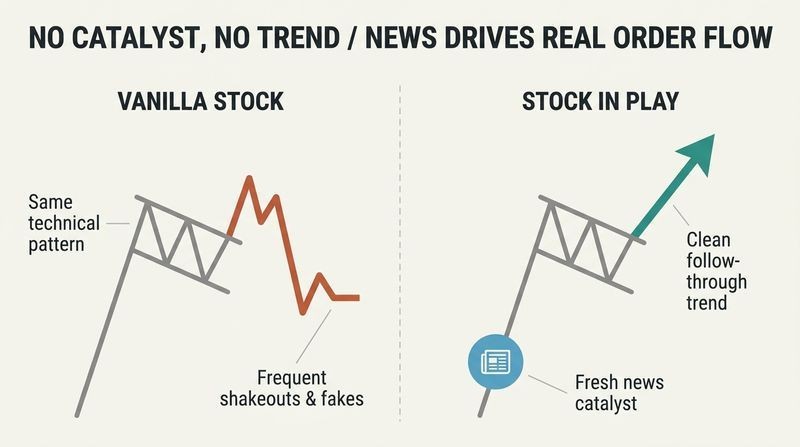
This is essentially an edge-selection filter: concentrate attention where information asymmetry and forced flows are largest. Academic microstructure research supports the intuition, since earnings surprises and post-earnings-announcement drift are among the most durable documented anomalies. The catalyst does double duty, both signaling direction and guaranteeing the liquidity a short-term trader needs to enter and exit. A caveat: catalysts are widely watched, so any retail edge lives in execution and tape-reading speed, not in the news itself. Bellafiore concedes as much when he admits high-frequency algorithms front-run the obvious moves, pushing his traders toward holding for larger swings instead.
Sell only when you spot a reason, never to soothe anxiety
Separate the two trade types first. A Move2Move trade is a quick scalp for the next tick; a Trade2Hold (or intraday swing) aims to capture the real multi-point move. Traders torture themselves about selling too early when they actually made a proper scalp. The fix is deciding the trade type before entry.
For holds, define your Reasons2Sell. Bellafiore lists concrete exits: the stock hits your target, the intraday uptrend breaks, breaking news hits, the market reaches major resistance, an unusual seller appears on the tape, the buying pattern dies, or the move gets too steep. You do not sell until one appears, even if the position gives back open profit. Your job is to trade the setup well, not to squeeze every penny.
The deeper insight is psychological outsourcing: predefined exit rules protect traders from disposition effect, the well-documented tendency (Shefrin and Statman) to sell winners too soon and ride losers too long. By naming a finite checklist of Reasons2Sell, Bellafiore converts a moment of emotional temptation into a mechanical yes-or-no query. It mirrors implementation-intention research by Peter Gollwitzer, where if-then plans dramatically raise follow-through versus vague intentions. The subtle move is redefining success as process fidelity (did I follow my plan?) rather than P&L, which paradoxically improves P&L by removing the panic that causes premature exits.
If you're not big in your best setups, you're risking too much
Trader Wuss Syndrome is the silent killer. Bellafiore's counterintuitive claim, voiced by his trader Iceman, is that failing to size up in your highest-probability setups is itself excessive risk, because you accept the same downside on mediocre trades while starving your best ones. Trading is math: your A+ setups combine the best win rate and expected reward.
Make sizing a rule, then grow it. His prescription: risk 30 percent of your intraday stop-loss on every A+ trade (or 2 to 5 percent of account for swing traders), and hold for the real move. To grow bigger, do not just add shares; increase your capital and keep thinking in percentages, not dollars, so you stay scalable. A rip should breed disappointment, not trauma; trauma means shrink back.
The framing inverts a novice's mental model, where being cautious feels safe. Kelly criterion logic backs Bellafiore: under-betting a genuine edge sacrifices compound growth almost as surely as over-betting courts ruin. The genius is behavioral rather than mathematical: by thinking in percentage-of-account terms and raising capital rather than share count, traders sidestep the loss-aversion spike that a raw dollar figure triggers. The trauma-versus-disappointment distinction is astute and maps onto stress research, where manageable arousal enhances performance while overwhelming stress degrades it. The unstated risk is that this advice, decoupled from rigorous edge verification, could rationalize reckless sizing for traders who only think they have an A+ setup.
Grind a detailed trade review every single day, energy or not
Shark built skill through relentless output. Shark, an unremarkable applicant from an upstate town with no Ivy pedigree or perfect SAT, became SMB's best trainee purely by submitting more PlayBook trades than everyone on the desk combined. His edge was doing a stock-by-stock review after every close, no matter how tired or how badly the day went, because the work compounds daily.
Every rep counts, even imagined ones. Bellafiore cites research that the brain makes little distinction between live trading and thinking through a trade. So a live trade is one rep, archiving it is another, reviewing it another, and discussing it with a peer another. Miss a day and you squander a session of maximum improvement. His mantra: build from strengths, improve every day.
This is deliberate practice applied to markets, and the neuroscience Bellafiore invokes (mental rehearsal activating similar circuitry to physical action) is supported by motor-imagery studies in sports and rehabilitation. The Shark story doubles as a myth-busting counterweight to the finance industry's obsession with pedigree, echoing Carol Dweck's growth mindset, which Bellafiore explicitly credits. What elevates the lesson beyond hustle-culture cliche is the specificity: not just working hard, but converting each trade into multiple encoding events through archiving, review, and peer discussion. The honest tension is survivorship, since for every Shark, unnamed others reviewed diligently and still washed out. Review is necessary, not sufficient.
True competitiveness is silent daily work, not talk or ego
TO redefined what competing means. TO, a former teenage online-poker winner, embodied competitiveness not through trash talk but through obsessive preparation: staying until 7 p.m., rewatching his own trades on screen-capture software ten times, writing academic-grade reviews. Bellafiore distinguishes this from ego, mocking the idea that wanting to win at ping-pong or vacation golf proves you are competitive. If you are not spending 30 hours a week improving your craft, wanting to win is just ego.
Be one step ahead and build intuition. TO created a social-media watch list months before the Facebook IPO, letting him correctly call the short opportunity when others chased longs. Intuition, Bellafiore stresses, is not innate; TO's foresight came from prior weeks of screen time and study. Do the work and the feel follows.
The talk-versus-work distinction resonates with research on grit (Angela Duckworth) and with the coaching philosophy of figures like Coach K, whom Bellafiore cites via the mantra Next Play. What is intellectually sharp here is decoupling competitiveness from its usual macho signaling and relocating it in unglamorous preparation, a move that reframes an emotional trait as a behavioral discipline anyone can adopt. The Facebook watch-list example is a clean illustration of how expert intuition is compiled pattern recognition, not magic. A fair challenge: TO also burned hot with self-criticism and near-burnout, hinting that this intensity carries a psychological tax the book treats as manageable but which derails many.
Stop losing before dreaming of big wins; profitability is a ladder
Follow the Path of Pippen. Pippen, a polite Southern California trader, was negative his first two months, lost less by month three, turned slightly positive by month four, and compounded from there. Bellafiore maps a fixed sequence: lose money, lose less, break even, small monthly profit, consistent profit, then expand the PlayBook and size up. Skipping rungs is delusional.
The deadliest myth is widening your stop. Unprofitable traders say if they just gave trades more room they would win. The only result is bigger losses. Bellafiore recounts a trader convinced he was one rule away from a huge week; in reality he had five problems to fix just to reach flat. Winning trades usually work fast. Master one setup profitably before adding the next.
The staged-progression model is essentially a competency ladder, and it counters the lottery-ticket psychology that draws people to trading in the first place. It aligns with skill-acquisition frameworks (Dreyfus model) where novices must consolidate fundamentals before improvising. The widen-your-stop delusion is a vivid case of what psychologists call escalation of commitment, throwing more resources at a failing position to avoid admitting error. Bellafiore's insistence on reaching flat before chasing gains reframes breakeven as an achievement, not a disappointment, which is emotionally counterintuitive but statistically sound. The ladder also implicitly manages the money clock: many traders fail not from inability but from running out of runway before the skill compounds.
Even elite traders need coaches and must reinvent constantly
Trading is never mastered. GMan, ranked a top-two trader under 30, twice tried to quit and, despite his recognition, worked weekly with a paid trading coach to keep improving. Bellafiore compares him to Phil Mickelson, who employs a putting coach, short-game coach, swing coach, caddie, trainer, and mental coach despite earning tens of millions. If the world's best golfer needs a team, so does a trader.
Adapt or die. GMan mined two years of data to build his Pullback Trade, which enters only when momentum returns in the trend's direction, often after taking a small loss on the first attempt. He shifted his most stressful trades into options and different time frames. Setups that printed money in 2007 got gamed out by algorithms, forcing reinvention.
The claim that mastery is a moving target fits the reflexivity thesis of George Soros: markets change partly because participants learn, so any durable edge decays. This is why Bellafiore's traders migrate from momentum scalping toward multi-day holds and options as high-frequency algorithms colonize the fast game. The coaching argument leans on solution-focused therapy, which unlike problem-focused approaches amplifies what already works rather than excavating pathology, an evidence-based clinical method. GMan's Pullback Trade insight, deliberately taking the first loss to enter the higher-probability second attempt, is a sophisticated acceptance that being wrong once is the price of a better setup, inverting the amateur's need to be right on the first try.
Match your trading style to your actual personality
Iceman trades high-beta chaos because it fits him. A fearless former fraternity member, Iceman excels at Opening Drive Plays in volatile, expensive names like LinkedIn and Apple, precisely the trades most traders fear. Bellafiore, citing Jack Schwager's Market Wizards and coach Van Tharp, argues the best traders find a strategy matching their temperament rather than forcing themselves into someone else's system.
Fun and fit precede performance. SMB built a Rotation Program so traders could discover their best product and time frame. TO gravitates to contrarian Fade Trades; Pippen to momentum; GMan shifted stressful setups elsewhere. Iceman's fearlessness makes him take controlled risk others cannot stomach. The lesson, drawn from positive-psychology research that happiness precedes success, is that a strategy at war with your nature will short-circuit no matter how sound it looks on paper.
Personality-strategy fit is underappreciated in trading pedagogy, which tends to sell one-size systems. The claim finds support in research on person-environment fit and in the observation that adherence, not theoretical optimality, drives real-world results, much as the best diet is the one you will actually follow. Iceman's comfort with high-beta volatility likely reflects individual differences in risk tolerance and stress reactivity, traits with documented heritable and neurochemical components. The positive-psychology framing (happiness precedes success, per Shawn Achor and Barbara Fredrickson's broaden-and-build theory) is legitimate but oversimplified here; enjoyment aids performance, yet plenty of miserable traders profit. Fit reduces friction; it does not guarantee edge.
Trade tilt, FOMO, and giveback with hard rules, not willpower
Name the demons, then build guardrails. Prep, a polished prep-school athlete, made nearly every psychological mistake: blaming the market, overtrading, negative self-talk, and ignoring his giveback rule. Bellafiore attacks each with structure rather than willpower.
1. FOMO (fear of missing out): rate each trade's fear-driven motive; above 50 percent, skip it.
2. Tilt (aggressive emotional betting, a poker term): when you cannot take four calm breaths, walk away.
3. Giveback rule: if you surrender 30 percent of a profitable day's gains, stop trading.
Gratitude counters impatience. Coach Menaker links impulsive trading to low life satisfaction and prescribes cultivating gratitude to slow the craving for immediate reward. The market reveals your character; trading does not build patience, it exposes whether you have it.
The move from willpower to rules reflects a mature understanding that self-control is a depletable, unreliable resource, so environmental and procedural constraints outperform grit under stress. The giveback rule is a circuit breaker borrowed from institutional risk management, and the FOMO scale is a crude but usable metacognitive check. Menaker's gratitude prescription connects to neuroscience of reward and delay discounting: people with richer sources of contentment discount future rewards less steeply, reducing impulsivity. This is genuinely cross-disciplinary and ahead of its 2013 publication. The sharpest line, that trading reveals character rather than building it, aligns with the view that markets are mirrors, amplifying whatever anxieties, egos, or impatience a person already carries.
Analysis
The Playbook is a business-and-craft book disguised as an anthology of character studies, and its structure is its argument: by profiling traders (Shark's work ethic, TO's competitiveness, Pippen's patience, Iceman's boldness, Prep's flaws, Rudy's failure, GMan's reinvention), Bellafiore insists that trading success is idiosyncratic and cannot be transmitted as a universal system. This is both refreshing and evasive. Refreshing because it demolishes the finance-industry fantasy of pedigree and prediction; evasive because the central deliverable, a PlayBook of personally chosen setups, resists the falsifiability that would let a reader know whether their edge is real or imagined. The book is strongest as applied behavioral finance. Long before it was fashionable, it operationalizes loss aversion (the disposition effect via Reasons2Sell), escalation of commitment (the widen-your-stop delusion), implementation intentions (giveback and FOMO rules), and deliberate practice (daily review, mental rehearsal). Its weakest claims are its most confident ones: that anyone with passion and work can compete, and that intelligence and pedigree barely matter. Survivorship bias saturates the narrative, since we meet the traders who stayed at a firm whose economics depend on churning through recruits. The book is candid about this in flashes (the trader graveyard, the 5 percent success figure it cites), but the emotional pull of the winners crowds out the base rate. Read in 2013's shadow of high-frequency trading, its most durable insight is adaptive humility: edges decay, algorithms colonize the fast game, and even seven-figure traders wake up unable to make a dime, so reinvention and coaching are permanent obligations, not remedial ones. The deepest takeaway is almost philosophical: trading is a mirror that exposes character under financial pressure. Discipline, patience, and ego management are not trading skills layered on top of a person; they are the person, revealed.
Review Summary
The Playbook receives mostly positive reviews, with readers praising its insights into professional trading and practical advice for developing a personalized trading strategy. Many appreciate the real-world examples and psychological aspects covered. Some criticize it for being too anecdotal or reading like an advertisement for SMB Capital. Overall, readers find it valuable for both novice and experienced traders, highlighting its focus on building a trading playbook, journaling trades, and developing the right mindset for success in the markets.
People Also Read



FAQ
What's The Playbook about?
- Trading Improvement Focus: The Playbook by Mike Bellafiore is aimed at helping traders enhance their skills and profitability by developing a personal trading methodology.
- Building a PlayBook: It introduces the concept of a "PlayBook," a collection of archived trades that align with a trader's style, aiding in internalizing successful setups.
- Real-Life Examples: The book shares stories from SMB Capital, illustrating trading principles through the experiences of various traders.
Why should I read The Playbook?
- Practical Guidance: Offers actionable insights and strategies that can be applied immediately to improve trading performance.
- Inspiration from Real Traders: Learn from successful traders like Shark and TO, who exemplify hard work and continuous improvement.
- Focus on Mindset: Emphasizes the psychological aspects of trading, teaching readers how to manage emotions and maintain a competitive mindset.
What are the key takeaways of The Playbook?
- Daily Improvement: Stresses the importance of striving to become a better trader every day, with a proactive approach to challenges.
- Developing a Personal PlayBook: Encourages traders to document their best setups and strategies, aiding in recognizing patterns and making informed decisions.
- Understanding Market Dynamics: Teaches traders to analyze the Big Picture, Intraday Fundamentals, Technical Analysis, Reading the Tape, and Intuition.
What is the PlayBook and how does it work?
- Collection of Trades: A structured archive of trades that resonate with a trader's style, helping internalize successful setups.
- Daily Trade Review: Encourages documenting best trades daily, reflecting on successes and failures to recognize patterns.
- Framework for Improvement: Provides a comprehensive framework for adapting to market conditions and refining strategies.
How does The Playbook address trading psychology?
- Psychological Challenges: Discusses common challenges like fear and greed, emphasizing the need for self-awareness and emotional regulation.
- Mindset Rewiring: Traders must rewire their minds to handle market emotions, practicing self-awareness and emotional regulation.
- Journaling for Growth: Keeping a trading journal helps track emotions and reflect on decisions, aiding in disciplined trading.
What are the best quotes from The Playbook and what do they mean?
- “Trading is not rocket science.”: Emphasizes that trading is a skill that can be learned and mastered with practice.
- “You must have guts to be your best trader.”: Highlights the importance of taking calculated risks in trading.
- “If you are not taking enough risk with your trading, you are taking on too much risk.”: Underscores the balance between risk and reward.
How can I eliminate trades that are not worth my capital according to The Playbook?
- Review Past Trades: Regularly analyze trading history to identify loss patterns and improve performance.
- Set Criteria for Trades: Develop specific criteria for worthwhile trades, focusing on historically positive setups.
- Stick to Your PlayBook: Use the PlayBook to guide decisions, ensuring alignment with successful strategies.
What is a Reason2Sell and how do I use it in trading?
- Exit Strategy: A predetermined condition prompting a trader to exit a winning position, such as hitting a price target.
- Develop Your List: Create a personal list of Reasons2Sell based on trading style and experiences.
- Avoid Emotional Decisions: Clear exit rules help avoid emotional turmoil and lead to disciplined trading.
What is the "giveback rule" mentioned in The Playbook?
- Definition of Giveback Rule: A personal guideline dictating how much profit a trader is willing to give back before stopping for the day.
- Purpose of the Rule: Helps avoid giving back too much of the gains, encouraging discipline and self-control.
- Implementation: Traders should establish and adhere to their own giveback rule based on style and risk tolerance.
How does the mindset of a trader affect performance according to The Playbook?
- Focus on Process Over P&L: Successful traders prioritize the trading process over profits or losses, allowing rational decisions.
- Emotional Management: Managing emotions is crucial; maintaining composure during losses and avoiding overconfidence during wins improves performance.
- Continuous Learning: A growth mindset encourages viewing challenges as opportunities for improvement, fostering resilience.
What are some common mistakes traders make according to The Playbook?
- Cutting Winners Too Early: Many traders sell winning positions too soon out of fear, which can be mitigated with a solid exit strategy.
- Overtrading: Entering too many positions without sufficient analysis leads to poor performance; focus on quality over quantity.
- Ignoring the Big Picture: Failing to consider overall market conditions can lead to misguided trades; understanding the broader context is crucial.
How can I develop my intuition as a trader according to The Playbook?
- Gain Screen Time: Intuition develops through experience and exposure to various market conditions.
- Reflect on Trades: Reviewing trades helps understand what worked and what didn’t, honing intuitive skills.
- Stay Open to Learning: Engage with other traders, seek feedback, and continuously educate yourself about market dynamics.
About the Author
Other books by Mike Bellafiore

Download PDF
Download EPUB
.epub digital book format is ideal for reading ebooks on phones, tablets, and e-readers.








































