

Key Takeaways
Winning an argument costs you the only prize that matters
Fisher's core thesis is contrarian for a trial lawyer. In a deposition, a physically intimidating witness named Bobby LaPray slammed the table and called Fisher's questions stupid. Every instinct screamed to fire back. Instead, Fisher asked, "What's been your biggest struggle this year?" LaPray broke down — he'd just placed his mother in assisted living and was drowning in legal paperwork he couldn't understand. Fisher connected him with an elder law attorney on the spot. The deposition finished smoothly.
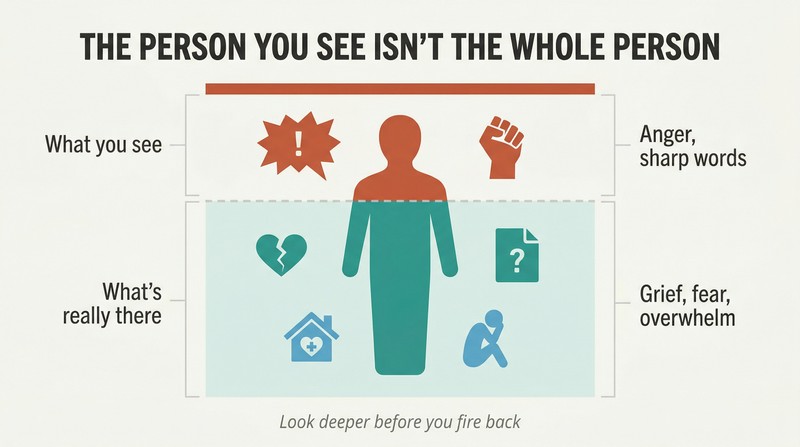
Behind every harsh word is a hidden struggle. The agitated coworker may be worried about a sibling in rehab. The short-fused spouse just got a devastating work email. Fisher's foundational principle: "The person you see isn't the person you're talking to." Treat every argument as a window into someone's unseen world, not a battle to dominate.
Don't fix this conversation — fix the next one
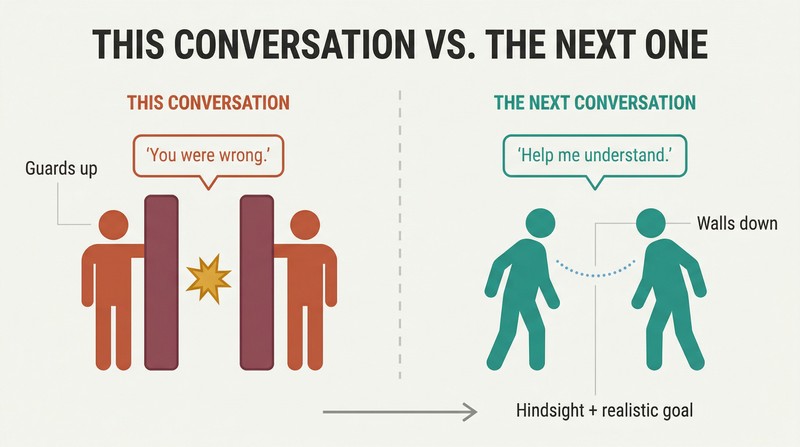
Fisher's title concept reframes failure as setup. Initial conversations are performances — guards up, best behavior on. Follow-up conversations are where truth and healing happen, because both sides arrive with hindsight and lower defenses. When two friends meet for lunch after a fight, the first attempt crashes because both expect the other to grovel. The redo works because one friend arrives with a realistic goal: "Help me understand what I missed."
Set goals you can actually reach. Expecting "You were right, I was wrong" gets you nowhere. Instead, aim for understanding, mutual acknowledgment, or simply feeling heard. Fisher recommends asking yourself before any hard talk: "What's the one thing I need them to understand?" and "Is there a part of this I'm trying to win?" Your personal values — honesty, kindness, gratitude — become the compass that guides you when emotions try to steer.
Make your breath the first word of every sentence
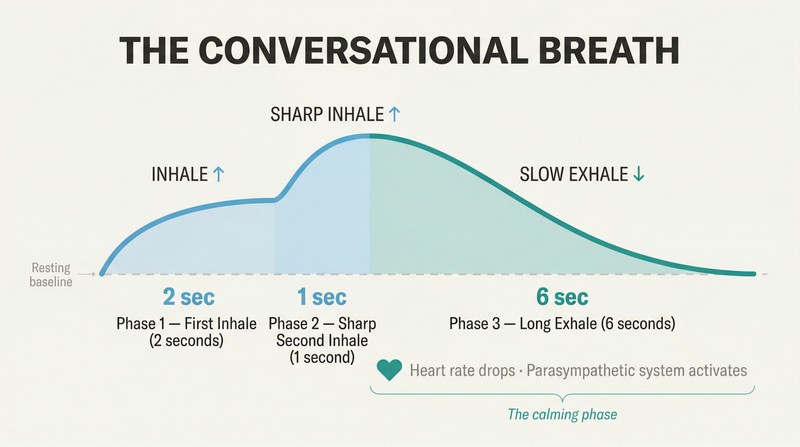
Fisher developed the conversational breath after watching his legal client Elizabeth nearly crack under an aggressive deposition. The technique, rooted in Stanford's 2023 physiological sigh research:
1. Inhale through your nose for 2 seconds
2. Take a sharp second inhale for 1 second
3. Exhale through your nose for 6 seconds — twice the inhale length
4. Repeat at least twice or as needed
The science is direct. Nasal breathing slows respiration; double inhalation fully inflates the lungs; a long exhale activates your parasympathetic nervous system, lowering heart rate and clearing mental fog. Elizabeth used this mid-deposition — one controlled breath between the opposing attorney's question and her answer — and regained total composure. The technique is invisible to others; it looks like normal breathing.
A ten-second pause extracts more truth than a sharp retort
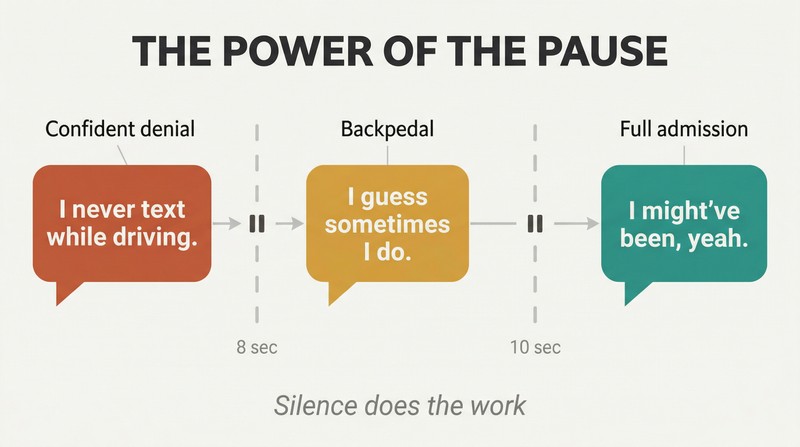
Fisher considers silence the most underused communication tool. Short pauses (1 – 4 seconds) act like reading glasses — they sharpen whatever follows with emphasis and weight. Long pauses (5 – 10 seconds) act like mirrors — they force the other person's words to echo back to them, often prompting self-correction or apology before you say a word.
A lying truck driver proved it. During a deposition, a driver swore he never texted while driving. Fisher paused for eight seconds. The driver backpedaled: "I mean, I say never. I guess sometimes I do." Another ten-second pause. "I might've been, yeah." Full reversal — no shouting, no evidence presented yet. Honest people sit comfortably in silence; dishonest people unravel trying to fill it. In any argument, the person who speaks last typically loses, because the only way to top a hurtful comment is to cut deeper.
Confidence isn't summoned — it's built through assertive action
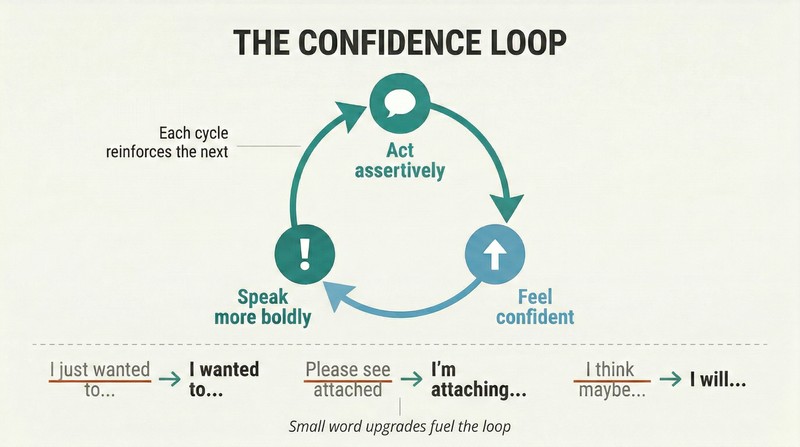
Fisher redefines confidence as a feeling you generate, not a trait you're born with. Asking "How do I feel confident?" is like asking "How do I feel angry?" — feelings come from experiences, not willpower. The only path is through assertive behavior, which creates a positive feedback loop: speaking assertively produces the feeling of confidence, which emboldens you to speak more assertively.
Start with word choice. Remove "just" from emails ("I wanted to touch base" not "I just wanted to touch base"). Replace "Please see the attached" with "I'm attaching the contract." Say what you're going to do, then do it — Fisher calls it calling your shot. In one example, a person threatens to leave an argument but stays; their credibility evaporates instantly. Assertiveness means following through, proving to yourself that your words carry weight.
Replace every needless 'sorry' with a 'thank you'
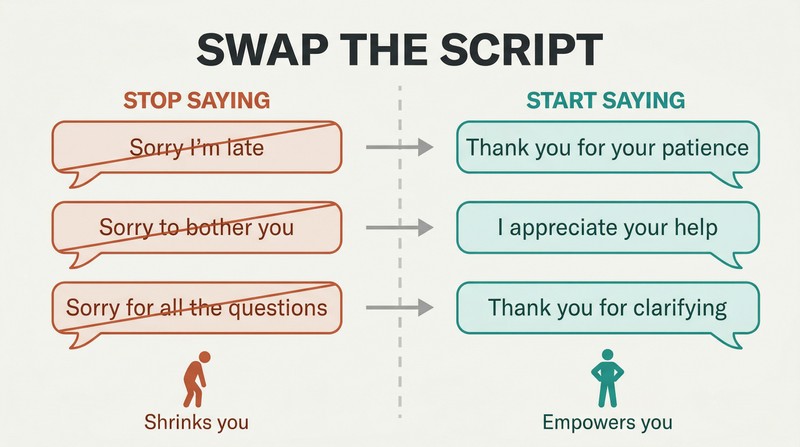
Over-apologizing is a silent confidence killer. Phrases like "Sorry to bother you," "Sorry, can you repeat that?" and "So sorry for all the questions" frame your existence as an inconvenience. Fisher argues you should save real apologies for real wrongs — asking forgiveness, owning mistakes, or expressing sympathy.
Swap the script with gratitude. Instead of "Sorry I'm late," say "Thank you for your patience." Instead of "Sorry to bother you," say "I appreciate your help." Instead of "Sorry for the questions," say "Thank you for clarifying that." Similarly, stop underselling with phrases like "This is probably a dumb question" or "Does that make sense?" — they force the other person into a mini-reassurance conversation about your insecurity before you even reach your point.
Force rude people to repeat themselves — it kills the dopamine
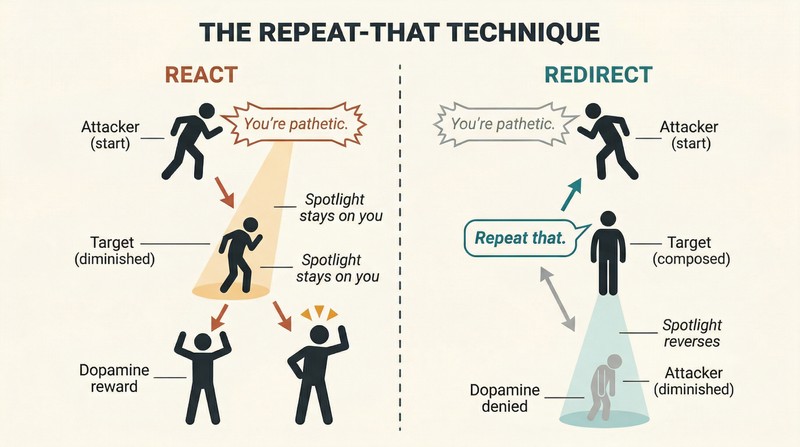
Insults and belittling seek one thing: dopamine from your reaction. The neurochemical reward the other person gets from your visible distress makes the powerless feel powerful and the insecure feel in control. Fisher's counter-strategy denies them that hit entirely. For insults: give a long pause, then slowly repeat their words back. For patronizing remarks: ask them to say it again — "I need you to repeat that." The spotlight jerks from you back to them.
Then ask a question of outcome. "Did you want that to hurt?" or "Was that supposed to make me feel small?" Follow with silence. In one of Fisher's cases, two feuding sisters met for negotiation. When one said "You're dead to me," the other replied, "I need you to repeat that." The sister couldn't. The case settled minutes later.
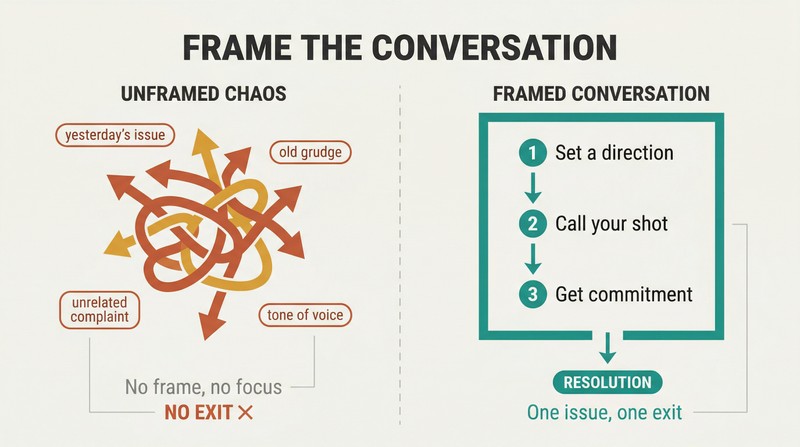
Frame every hard talk: one issue, one direction, one exit
Fisher compares frameless conversations to a kid overwhelmed in a shoe store — infinite choices, no decision. A conversational frame limits what's discussed and where it should end. Three steps:
1. Set a direction: "I want to talk about what you said at yesterday's meeting"
2. Call your shot: "I want to walk away with a stronger working relationship"
3. Get their commitment: "Sound good to you?"
One frame, one issue keeps focus. Without a frame, past grievances resurface and both people leave feeling nothing was accomplished. If someone drags in unrelated complaints, acknowledge first, then redirect: "I hear your point. Let me finish what we started, and we can come back to that." Never dismiss with "That's beside the point!" — it only creates a second argument on top of the first.
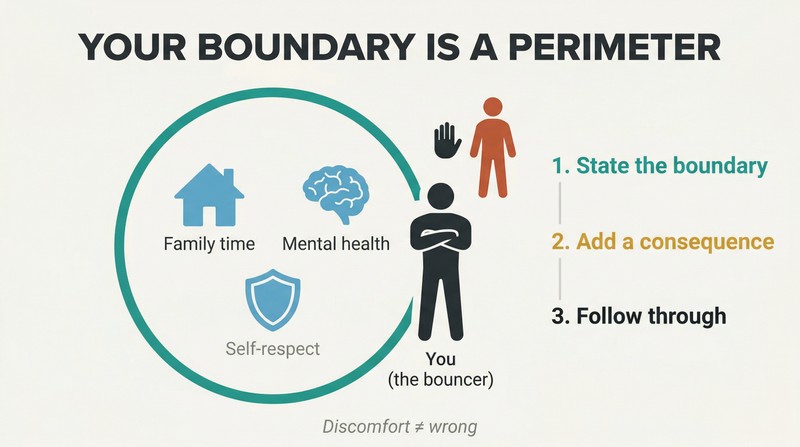
Build boundaries like a perimeter, then be the bouncer
A boundary isn't a line — it's a perimeter enclosing what you value most: family time, mental health, self-respect. Fisher's three-step enforcement:
1. State the boundary: "I don't accept how you're treating me"
2. Add a consequence: "If you continue, I'm going to end this conversation"
3. Follow through — no exceptions
Give people an operator's manual, not a remote control. Instead of reacting ("Stop yelling at me!"), instruct ("I don't respond to that volume"). Write down your own manual — a numbered list of what you will and won't accept. Saying no follows a similar formula: lead with the decline, layer with gratitude, finish with kindness. "I can't. Thank you for the invite. Hope it's a great time!" No justification needed. People who criticize your boundaries are simply reacting to a loss of privilege.
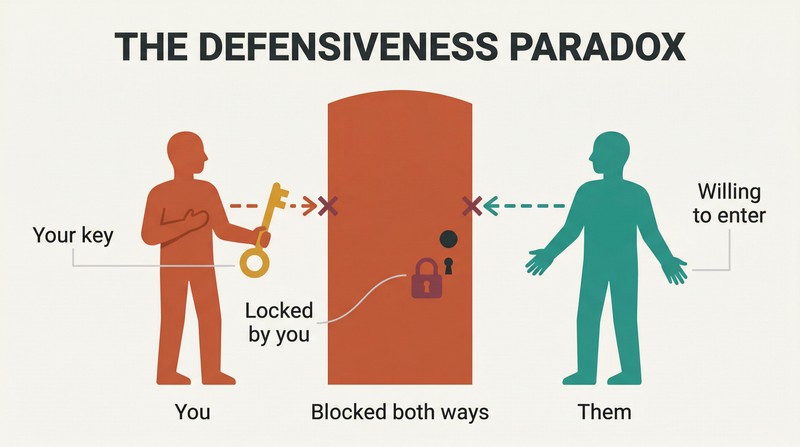
Defensiveness locks your door, then blames them for not entering
Defensiveness is the fastest connection-killer because it builds walls in both directions — it stops others from understanding you while closing you off from understanding them. Fisher traces it to cognitive dissonance: your beliefs are rarely just yours. They're your grandmother's, your best friend's, your childhood memories. Attacking a belief means attacking all of that, which is why more logic only hardens resistance.
Three moves disarm your own defensiveness. Catch yourself with a conversational breath, imagine their words falling to the ground before reaching you, then get curious about the source. To prevent it in others: start sentences with "I" instead of "You" ("I felt unappreciated" not "You don't appreciate me"), replace "Why did you...?" with "What made you...?", and acknowledge their point before presenting your own.
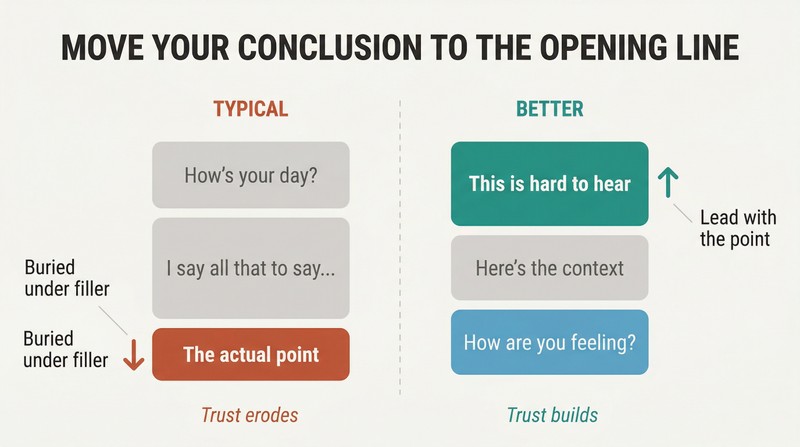
In tough talks, drop pleasantries and lead with the punchline
Fisher learned this after barging into a senior partner's office and getting shouted out. Schedule tough talks for a specific window ("Do you have bandwidth Thursday night?"), giving both sides time to prepare. When the conversation starts, skip "How's your day?" warmups — people sense when pleasantries mask bad news, and the pretense destroys trust. Say "This is going to be hard to hear" upfront instead.
Move your conclusion to the opening line. Instead of a ten-minute buildup ending with "I say all that to say...," lead with the takeaway. "We should create a more welcoming lobby environment" beats two minutes of throat-clearing. Fisher also advises creating safe space when someone brings hard news to you: "I'm glad you came to me with this" keeps the door open. Ask one question before sharing your own perspective — "How are you feeling about that?" — and the other person stays connected.
Analysis
Fisher's book occupies a distinctive position in the communication self-help canon. While Carnegie's 1936 classic taught influence through agreeableness and Voss's 2016 'Never Split the Difference' taught negotiation through tactical empathy, Fisher explicitly rejects the winning frame — a genuinely contrarian stance for a practicing trial attorney whose livelihood depends on prevailing in court. His central insight is that competition is a context-specific tool, not a default setting for human interaction.
The book's real innovation is packaging clinical techniques for real-time deployment during verbal conflict. The conversational breath is a simplified physiological sigh from Stanford's 2023 research; the quick scan is micro-mindfulness compressed to two seconds; the small talk is implementation intention research dressed in cowboy boots. None of these are novel in clinical psychology, but their compression into usable mid-argument windows is genuinely practical — and the courtroom stories that anchor each technique create far more credibility than laboratory citations would.
Fisher's treatment of defensiveness represents the book's intellectual peak. His insight that beliefs are identity infrastructure — that challenging someone's political opinion functionally attacks their grandmother who held it — explains why logic fails in arguments more elegantly than most academic treatments of cognitive dissonance. The 'operator's manual versus remote control' metaphor for boundaries similarly succeeds because it reframes self-perception from victim to architect.
The book's limitations are predictable for its scope. Fisher addresses symmetrical conflicts between peers, partners, and siblings well, but underweights power asymmetries — using a 'question of outcome' with an abusive boss carries risks the text doesn't explore. His boundary formula assumes eventual rational response, which fails with genuine personality disorders, hence the hidden bonus chapter on narcissists. And the claim that these are purely experiential lessons understates how much the breathing techniques, trigger taxonomy, and frame-setting overlap with established CBT and motivational interviewing frameworks. Still, Fisher's audience isn't therapists — it's people who've never heard of the parasympathetic nervous system but desperately need its help at their next Thanksgiving dinner.
Review Summary
The Next Conversation receives overwhelmingly positive reviews, with readers praising Jefferson Fisher's practical, accessible advice on effective communication. Many appreciate his emphasis on empathy, assertiveness, and conflict resolution. The book is lauded for its relatable examples, actionable strategies, and focus on improving both personal and professional relationships. Readers find Fisher's approach refreshing and impactful, with many reporting immediate improvements in their communication skills. Some criticism notes a perceived masculine bias, but overall, the book is highly recommended for anyone seeking to enhance their conversational abilities.
Glossary
Conversational breath
Controlled breathing before respondingFisher's breathing technique for use during conversation. Inhale through the nose for 2 seconds, take a sharp second inhale for 1 second, then exhale through the nose for 6 seconds (twice the inhale length). Designed to be invisible to others during dialogue. Incorporates the physiological sigh from Stanford's 2023 research to activate the parasympathetic nervous system, lowering heart rate and restoring clear thinking.
Quick scan
Rapid body-and-emotion self-checkFisher's four-step self-assessment technique usable in real time during conversation. Steps: (1) take a conversational breath, (2) close eyes briefly like a long blink, (3) scan the body for hidden tension and release it on the exhale, (4) label the dominant emotion in one word. With practice, compresses to about two seconds. Extended by verbalizing findings using 'I can tell' phrases, such as 'I can tell I'm getting frustrated.'
Small talk
Short self-empowering personal phraseFisher redefines 'small talk' not as casual chitchat but as a brief, verb-led phrase used as a personal anchor before or during difficult conversations. Unlike abstract affirmations ('I am enough'), small talks are concrete and context-specific. Guidelines: tie it to your conversational goal, start with a verb, and make it personally meaningful. Examples include 'Find the struggle,' 'Stand firm,' and one client's phrase, 'Tell 'em, Doris,' drawn from a memory of her assertive grandmother.
Ignition phase
Fight-or-flight stage of argumentsFisher's term for the heating stage of any argument when the sympathetic nervous system activates fight-or-flight. Characterized by elevated heart rate, shallow or rapid breathing, suppressed prefrontal cortex function, and emotion-driven rather than logic-driven behavior. Marked by three escalation levels: lighting a match (feeling threatened), blowing a fuse (getting defensive), and going nuclear (resorting to personal attacks). Opposite of the cooling phase.
Cooling phase
Recovery stage after conflict peaksFisher's term for the recovery stage of an argument when the parasympathetic nervous system re-engages. Voices lower, words become more selective, reflection replaces reaction. Occurs when someone walks away, mutual understanding is reached, or there is nothing left to burn. The prefrontal cortex re-engages for rational thought, often accompanied by regret over things said during the ignition phase.
Conversational frame
Defined scope around a discussionFisher's technique for placing boundaries around a conversation to limit scope and amplify focus. Three-step setup: (1) set a direction by stating what you want to discuss, (2) call your shot by describing how you want to feel afterward, (3) get their commitment to proceed together. Prevents off-topic tangents, reduces misinterpretation, and ensures both parties know the conversation's destination before it begins.
Question of outcome
Asks about their intended effectFisher's response technique for belittling or patronizing comments. Instead of retaliating, ask the speaker about the effect they were trying to achieve. Examples: 'Did you want that to hurt?' 'Was that supposed to make me feel small?' 'Did that feel good to say out loud?' Forces the speaker to confront the impact of their words and strips the dopamine reward from the exchange.
Question of intent
Probes the speaker's purposeFisher's response technique for rude or dismissive comments. Probes the speaker's purpose rather than their impact. Examples: 'Did you mean for that to sound rude?' 'What did you intend with that statement?' 'Was that meant to be helpful, or hurtful?' Often prompts clarification or apology. Effective in both verbal and written communication—a quick text asking 'Did you mean for that to sound short?' can resolve most poorly worded messages.
One frame, one issue
Single-topic discussion ruleFisher's principle that each conversation should address only one topic or problem at a time. When a conversation covers too many issues, focus is diluted, discussion stays shallow, and participants leave feeling nothing was accomplished. Applying this rule forces speakers to eliminate fluff, creates deeper space for nuance, and respects everyone's time and cognitive resources. In practice, may mean breaking broad meetings into focused micro-sessions.
Is it worth it? filter
Two-question disagreement defuserFisher's technique for evaluating whether a disagreement merits continued energy. Two sequential questions: (1) 'Is this something we have to agree on?' which forces evaluation of the argument's priority, and (2) if yes, 'Is this something we have to agree on right now?' which introduces postponement until more information is available. Particularly effective for the 99 percent of arguments Fisher says are about nothing.
FAQ
What's "The Next Conversation: Argue Less, Talk More" about?
- Focus on Communication: The book by Jefferson Fisher is about improving interpersonal communication, particularly in difficult conversations and arguments.
- Practical Advice: It offers practical strategies to argue less and talk more effectively, aiming to foster better understanding and connection.
- Personal and Professional Growth: The book is designed to help readers enhance their communication skills in both personal and professional settings.
Why should I read "The Next Conversation: Argue Less, Talk More"?
- Improve Relationships: It provides tools to improve relationships by reducing conflict and enhancing understanding.
- Practical Techniques: The book offers actionable techniques that can be applied immediately in everyday conversations.
- Build Confidence: It helps build confidence in communication, making it easier to express needs and boundaries.
What are the key takeaways of "The Next Conversation: Argue Less, Talk More"?
- Never Win an Argument: Winning an argument often leads to losing more valuable things like trust and respect.
- Confidence Through Assertiveness: Confidence is built through assertive communication, which involves expressing needs clearly and respectfully.
- Connection Over Transmission: True connection involves understanding and acknowledgment, not just the transmission of information.
How does Jefferson Fisher suggest handling difficult conversations?
- Set Aside Time: Ensure conversations happen at a time when both parties are undistracted and ready to engage.
- Be Direct: Avoid pleasantries and get straight to the point to maintain honesty and clarity.
- Lead with the Conclusion: Start with the main takeaway to avoid confusion and ensure the conversation stays on track.
What is the "conversational breath" technique in "The Next Conversation"?
- Breath as a Word: Treat your breath as the first word in a conversation to maintain control and calmness.
- Controlled Breathing: Inhale through the nose, take a second sharp inhale, and exhale longer to regulate emotions.
- Maintain Focus: This technique helps keep your mind clear and focused during heated discussions.
How does "The Next Conversation" address defensiveness in communication?
- Recognize Triggers: Understand what triggers defensiveness and work to manage these responses.
- Pause and Reflect: Use pauses to prevent knee-jerk defensive reactions and to consider the other person's perspective.
- Acknowledge First: Start responses with acknowledgment to prevent the other person from becoming defensive.
What are the benefits of setting boundaries according to "The Next Conversation"?
- Protects Well-being: Boundaries help protect emotional and mental well-being by defining what is acceptable.
- Clarifies Values: They communicate what you value and what you will not tolerate.
- Improves Relationships: Clear boundaries can improve relationships by ensuring mutual respect and understanding.
How does Jefferson Fisher suggest using pauses in conversations?
- Control the Pace: Pauses help control the pace of the conversation, allowing for reflection and thoughtful responses.
- Short vs. Long Pauses: Short pauses emphasize points, while long pauses allow for reflection and can defuse tension.
- Enhance Communication: Pauses can enhance communication by giving weight to words and preventing misunderstandings.
What role does assertiveness play in "The Next Conversation"?
- Express Needs Clearly: Assertiveness involves expressing needs and opinions clearly and respectfully.
- Builds Confidence: Practicing assertiveness helps build confidence in communication.
- Avoids Aggression: It balances respect for oneself and others, avoiding aggressive or passive communication styles.
How does "The Next Conversation" suggest dealing with difficult people?
- Deflect Insults: Use pauses and questions to deflect insults and prevent giving the other person a reaction.
- Stand Your Ground: Use assertive language to stand your ground without escalating the conflict.
- Avoid Bad Apologies: Recognize and address insincere apologies to maintain integrity in communication.
What are some of the best quotes from "The Next Conversation" and what do they mean?
- "Never win an argument." This emphasizes that winning an argument can lead to losing more important things like trust and respect.
- "Confidence is found in the doing." This highlights that confidence is built through action, particularly through assertive communication.
- "Connection is both positive and negative." This means that true connection involves understanding and acknowledgment, even in difficult conversations.
How does "The Next Conversation" define connection in communication?
- Understanding and Acknowledgment: Connection involves both understanding the other person and acknowledging their perspective.
- Beyond Transmission: It goes beyond just transmitting information to truly engaging with the other person.
- Facilitates Growth: Connection is essential for personal and professional growth, fostering deeper relationships.
Download PDF
Download EPUB
.epub digital book format is ideal for reading ebooks on phones, tablets, and e-readers.








































