


Key Takeaways
Self-sabotage isn't self-hatred — it's self-protection gone wrong
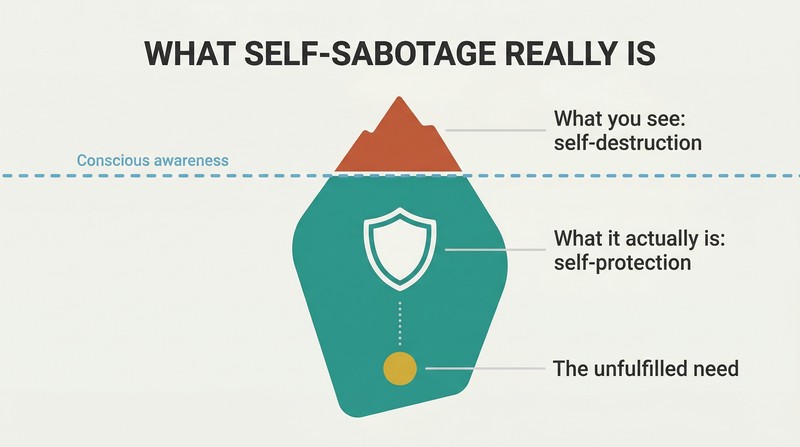
Wiest's central thesis reframes self-sabotage from character flaw to signal system. The behaviors keeping you stuck aren't random — they're intelligently designed by your subconscious to meet an unfulfilled need. Carl Jung demonstrated this as a child: after hitting his head at school, he developed fainting spells his unconscious mind used to escape a place where he was miserable. He later called all such patterns "substitutes for legitimate suffering."
The same logic applies everywhere. You sabotage finances because you associate wealth with being corrupt. You sabotage relationships because love feels unsafe. You overeat because food soothes an emotional hunger you haven't named. The "mountain" in the book's title isn't external hardship — it's this internal conflict between what you consciously want and what your unconscious mind is protecting you from.
Your tolerance for happiness has a ceiling — raise it gradually
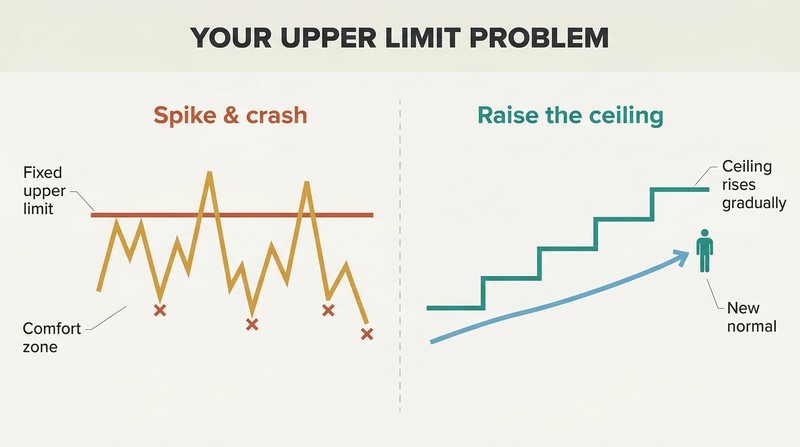
Gay Hendricks coined the term "upper limit" — your internal thermostat for how much goodness you'll tolerate before unconsciously pulling yourself back down. When life exceeds your familiar comfort level, you sabotage: picking fights after a great date, spending recklessly after a raise, getting mysteriously ill before a milestone.
Adjustment shock makes this worse. Positive life events — weddings, new jobs, financial gains — can actually trigger depressive episodes because any change, even wonderful change, disrupts your comfort zone. The fix isn't dramatic overhaul. Slowly acclimate to your new normal. Instead of shocking yourself into big upgrades, make incremental shifts that gradually reset your baseline. Over time, your thermostat recalibrates, and what once felt dangerously good becomes your new familiar.
Find the unconscious commitment driving your stuck patterns
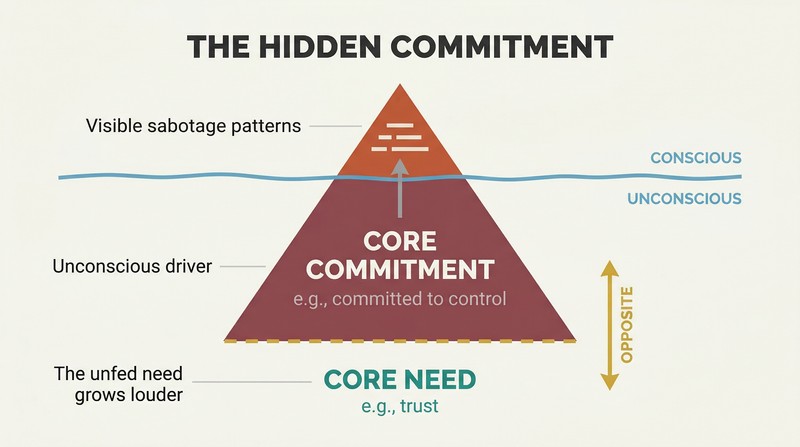
Your core commitment is your deepest unconscious priority — the thing you pursue even when it undermines your stated goals. Someone committed to freedom sabotages career opportunities. Someone committed to being wanted stays in intense but uncommitted relationships. Someone committed to control develops anxiety about anything unpredictable.
The diagnostic is simple: examine your most persistent struggles and trace them to a common root. The transformative twist is that your core need is always the opposite of your core commitment. Committed to control? You need trust. Committed to being needed? You need to feel wanted. Committed to being loved by others? You need self-love. The less you feed your core need directly, the louder and more destructive the sabotaging symptoms become.
Anxiety means you stopped thinking too soon — finish the thought
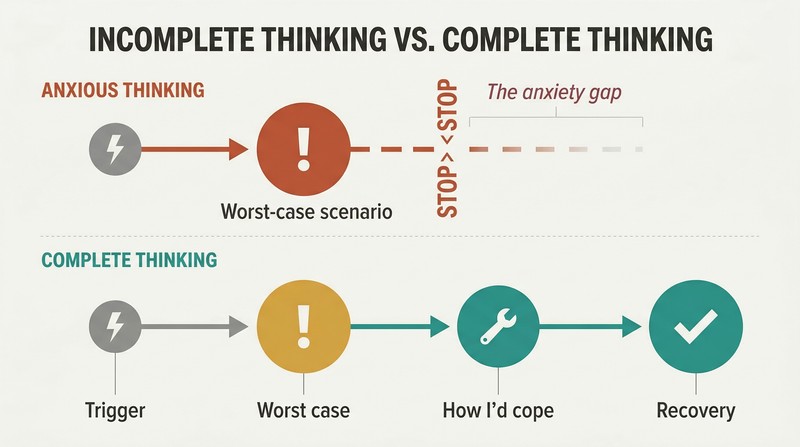
Wiest argues chronic anxiety isn't overthinking — it's under-thinking. When you're anxious, you leap to the worst-case scenario and stop there. This is a "logical lapse ": the crisis becomes the conclusion. You imagine you'd panic, and because you're scared, you never think through how you'd actually respond, cope, or recover.
Consider something you're not afraid of. Why doesn't it scare you? Because you can mentally walk the entire scenario from problem to resolution — you have a plan. Anxiety thrives in that gap between imagining the catastrophe and imagining the recovery. Exposure therapy works for exactly this reason: it closes the loop by proving you can survive the feared situation. The solution isn't positive thinking; it's complete thinking.
Treat each trigger as a dispatch from your buried needs
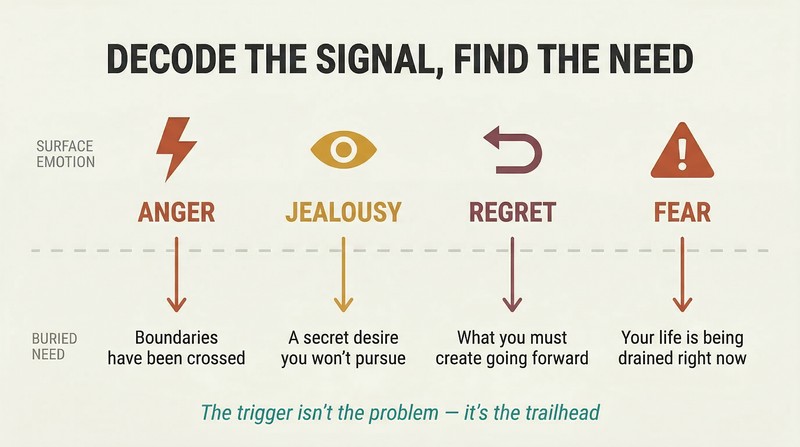
Wiest maps specific emotions to specific messages:
1. Anger reveals where your boundaries have been crossed
2. Jealousy exposes what you secretly want but won't pursue
3. Regret shows what you must create going forward
4. Chronic fear projects what's already happening — your life is being drained now
Decode, don't eliminate. If you fear being a passenger in a car, the real issue might be loss of control in your life. If you keep checking an ex's social media, the relationship wounded you more deeply than you admitted. The trigger isn't the problem — it's the trailhead to the actual problem. Trace the surface emotion to its root, and you discover both the wound and the path forward.
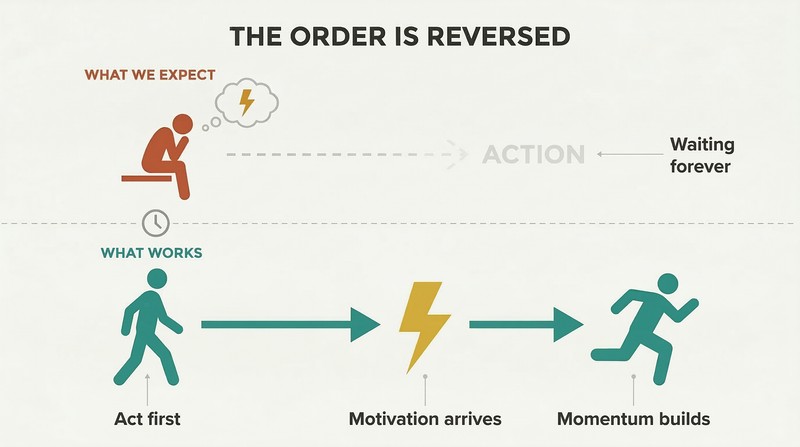
Act before you feel like it — motivation follows movement
Your feelings operate as a comfort system — they signal "good" when you do what's familiar, not what's beneficial. This means waiting to feel motivated guarantees you'll never start. The order is reversed from what we expect: action produces motivation, not the other way around.
Your brain can be retrained to prefer healthier behaviors, but the first few repetitions will feel wrong. This is the same process by which someone becomes a regular exerciser — they pushed through initial discomfort until the new behavior became their familiar default. You can feel resistance and act anyway. The trick is disconnecting what you do from what you feel, using logic and vision as your guides instead of emotion.
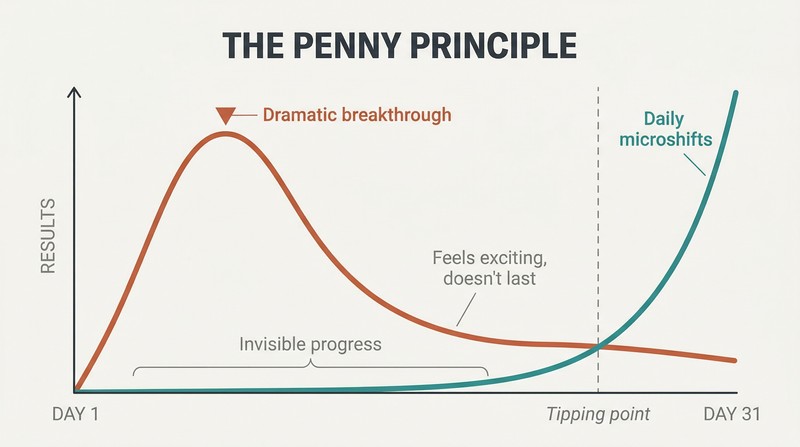
Change through daily microshifts, not dramatic breakthroughs
A microshift is a nearly invisible change in daily behavior that compounds over time. Want to spend less time on your phone? Skip checking it once today. Want to eat better? Drink one extra glass of water. Want to exercise? Do just 10 minutes. Then repeat tomorrow.
The penny analogy crystallizes this. Would you take $1 million today or a penny that doubles daily for 31 days? The penny yields over $10 million. Our brains can't intuit compound returns from tiny habits, so we chase dramatic transformations that shock our comfort zones and never stick. Breakthroughs aren't lightning strikes — they're tipping points after months of invisible shifts. Thomas Kuhn called this a "paradigm shift": assumptions unravel gradually, not all at once.
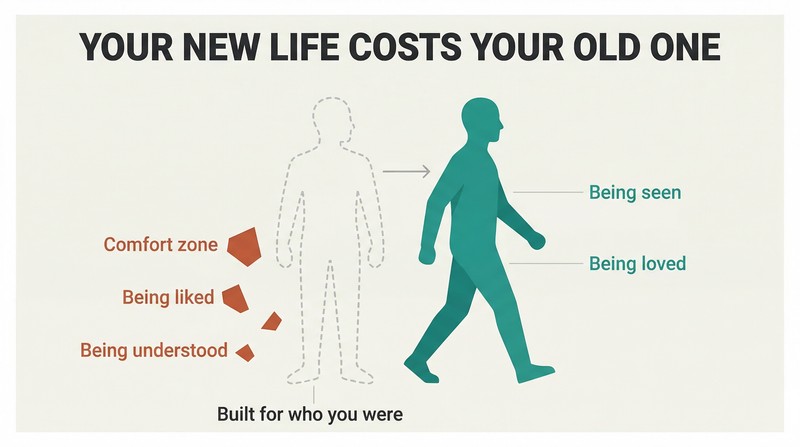
Your new life will cost your old one — let it
Wiest is blunt about transformation's price tag. Your new life will cost you your comfort zone, certain relationships, being liked, and being understood. Some people won't follow you into the next chapter.
This is liberating, not devastating. The people meant for you will meet you on the other side. Instead of being liked, you'll be loved. Instead of being understood, you'll be seen. The real danger isn't losing what you have — it's clinging to a life designed for someone you've already outgrown. Remaining attached to your old life is itself the final act of self-sabotage. Every moment spent maintaining an outdated identity is a moment stolen from the person you're becoming.
Don't force letting go — build something new instead
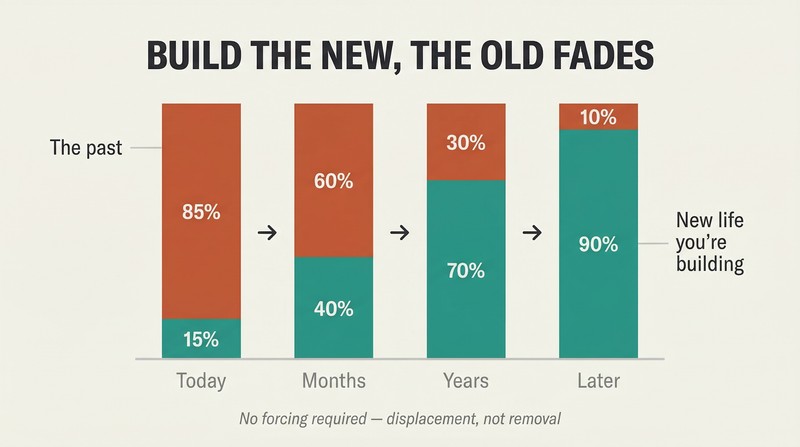
Telling yourself to "let go" tightens the grip — like being told not to think of a white elephant. Wiest's counterintuitive prescription: don't fight the past. Pour energy into building something so compelling that the old life fades on its own.
The process is gradual. Take one step toward a new life today, then grieve as long as you need. One day you'll go an hour without thinking about the loss. Then a day. Then years drift by and what you feared would destroy you becomes a distant memory. Wiest also teaches a visualization technique: reenter a painful memory and imagine your current, wiser self sitting beside your younger self, offering the specific reassurance and guidance they needed at the time.
Heal trauma by restoring safety exactly where it was broken
Trauma physically restructures your brain. After traumatic events, the hippocampus shrinks, the amygdala goes into overdrive, and the prefrontal cortex — responsible for planning and growth — dials down. Your body hardens to protect you, the same way fascia tightens around a broken bone.
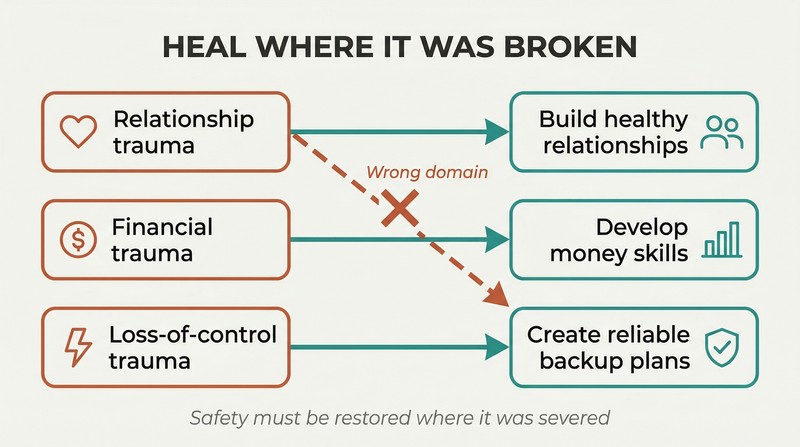
The critical mistake is overcompensating in the wrong domain. Traumatized by relationships? Many people hoard money to feel "safe." But financial security can't heal relational wounds. Wiest's prescription is domain-specific:
1. Relationship trauma → build healthy relationships
2. Financial trauma → develop money management skills
3. Loss-of-control trauma → create reliable backup plans
Safety must be restored precisely where it was severed. Anything else is a more elaborate form of avoidance.
Swap inspiration for principles — boring daily laws beat big dreams
More money doesn't solve money problems. A new partner doesn't fix relationship patterns. Without principles — cause-and-effect rules governing daily behavior — your problems simply scale as your life grows. Someone earning $500K can be as deeply in debt as someone earning $50K, and frequently is.
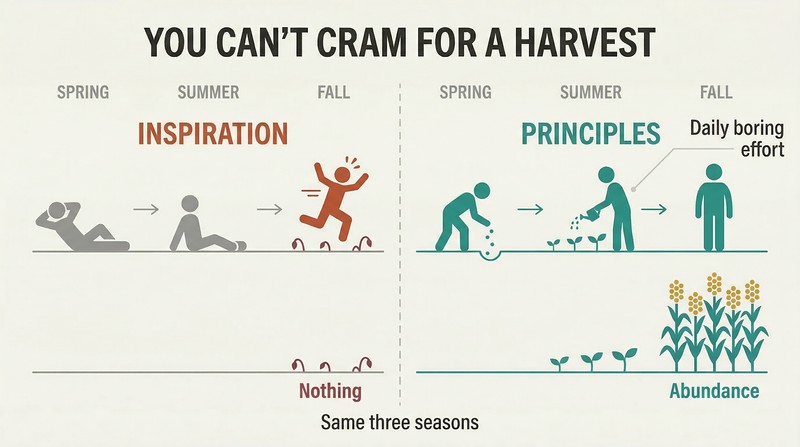
Hardy's farming analogy makes this vivid. You can't cram for a harvest. Forget to plant in spring, slack off all summer, and no amount of fall hustle saves you. The same applies to finances, health, and relationships. One day of compound interest is invisible; 20 years transforms everything. Start by identifying what you value — relationships, financial freedom, creative work — then build daily non-negotiable behaviors around those values. Principles are boring. That's exactly why they work.
Analysis
Wiest's The Mountain Is You arrived in 2020 at the intersection of therapy-speak culture and pandemic-era introspection, quickly becoming a social media phenomenon — particularly on platforms where her audience already sensed that external fixes weren't solving internal patterns. Her central reframe — self-sabotage as protection rather than punishment — echoes Internal Family Systems therapy's premise that every psychological 'part' serves a protective function, but she packages it with uncommon accessibility for a lay audience.
The book's strongest contribution is its taxonomy of sabotaging patterns. Where most self-help shouts 'just do the hard thing,' Wiest asks 'why aren't you?' — and the diagnostic tools she provides (core commitments, upper limits, logical lapses) give readers vocabulary for dynamics that previously felt nameless. The core commitments framework, in which your deepest need is always the inverse of your most persistent sabotaging behavior, is genuinely elegant and resonant with clinical principles.
Her weakest moments come when she conflates normal adaptive discomfort with clinical pathology. The framework works brilliantly for someone stuck in a career they've outgrown; it's less adequate for someone with complex PTSD requiring professional treatment. The somatic awareness material borrows heavily from Bessel van der Kolk's body-based trauma work without the clinical rigor or caveats.
Methodologically, Wiest synthesizes rather than originates — Hendricks, Kuhn, Taleb, Buddhist non-attachment, behavioral activation research — but the synthesis itself is the product. The microshifts concept, grounded in habit-formation science, may be the most practically valuable idea: it directly counters the all-or-nothing thinking that keeps people perpetually 'planning to change.' Combined with the core commitments framework, readers receive both diagnosis and prescription.
The book's enduring appeal lies in its refusal to let readers off the hook. Wiest doesn't comfort you with affirmations; she confronts you with the possibility that your coping mechanisms are more comfortable than your dreams — and that the only mountain you have to climb is the one you built yourself.
Review Summary
The Mountain is You received mixed reviews. Many readers found it insightful and life-changing, praising its accessible language and relatable content on self-sabotage and personal growth. However, some critics felt it lacked depth, originality, and scientific backing, comparing it to Instagram quotes. Positive reviewers appreciated the book's therapeutic quality and practical advice, while critics found it repetitive and oversimplified. The book's impact seems to vary based on readers' prior exposure to self-help literature and their current stage in personal development.



Glossary
Upper limit
Your tolerance ceiling for happinessA concept from Gay Hendricks describing the maximum amount of positive feeling or experience a person will unconsciously allow themselves before sabotaging to return to a familiar comfort level. When surpassed, manifests as physical symptoms (aches, tension, illness) or emotional reactions (sudden conflict, guilt, resistance). Raised gradually through slow acclimation to new levels of success or happiness.
Core commitments
Your deepest unconscious prioritiesYour primary unconscious objective that drives behavior, often without your awareness. Identified by examining persistent life struggles and strongest drives, then tracing them to a common root cause. Examples include commitment to freedom (sabotages career), commitment to being wanted (chases intensity over stability), or commitment to control (develops anxiety about the unpredictable). Always paired with a corresponding core need.
Core needs
The inverse of core commitmentsWhat you actually require to feel fulfilled, which is always the opposite of your core commitment. If your commitment is control, your need is trust. If your commitment is being needed, your need is to feel wanted. If your commitment is being loved by others, your need is self-love. Directly feeding core needs quiets the self-sabotaging symptoms driven by core commitments.
Microshifts
Tiny daily behavioral changes that compoundNearly invisible changes in daily behavior—drinking one glass of water, exercising for 10 minutes, skipping one phone check—that compound over time to produce lasting transformation. Contrasted with dramatic breakthroughs, which rarely stick because they shock the comfort zone. Based on the principle that the brain adapts to whatever is repeated, gradually restructuring the comfort zone around healthier defaults.
Psychic thinking
Treating feelings as future predictionsA cognitive distortion in which a person assumes they can know what others think, predict future outcomes based on current emotions, or that the intensity of a feeling indicates its truth. Includes believing the least likely outcome is most viable because it triggers the strongest reaction. Fueled by confirmation bias, extrapolation, and the spotlight effect. Not related to actual psychic claims—it's a pattern of mistaking emotional noise for prophetic signal.
Positive disintegration
Breakdown that enables psychological renewalA psychological process in which a person's existing self-concept breaks down under pressure, creating conditions for growth and the emergence of a more capable, authentic identity. Wiest compares it to forest fires that open seeds requiring heat to sprout. The discomfort of the breakdown is not pathology but a natural stage of reinvention—the tipping point that precedes a breakthrough.
Adjustment shock
Stress triggered by positive changeThe counterintuitive anxiety, hypervigilance, or resistance that follows beneficial life changes such as new relationships, financial gains, or career advances. Occurs because any change—even objectively good—disrupts the comfort zone and can surface unconscious beliefs. Can manifest as paranoia about losing what was gained, or resistance to the new identity required by the achievement.
Logical lapse
Reasoning gap that fuels anxietyA break in the thinking process where a person imagines a worst-case scenario but stops before reasoning through the response, recovery, or resolution. The crisis becomes the conclusion. The person never mentally simulates how they would cope, leaving the threat feeling permanent and undefeatable. Explains why people fear some things but not others—they lack a logical lapse in areas where they can envision the full scenario from problem to resolution.
FAQ
What's "The Mountain Is You" about?
- Self-Sabotage to Self-Mastery: The book focuses on transforming self-sabotaging behaviors into self-mastery by understanding and overcoming internal conflicts.
- Metaphor of the Mountain: It uses the metaphor of a mountain to represent personal challenges and growth, emphasizing that the real mountain to conquer is oneself.
- Emotional Intelligence: The book delves into emotional intelligence, helping readers identify and process their emotions to facilitate personal growth.
- Practical Guidance: It offers practical tools and insights for readers to recognize and change patterns that hold them back from achieving their potential.
Why should I read "The Mountain Is You"?
- Personal Growth: The book provides a roadmap for personal growth by addressing self-sabotage and offering strategies for self-improvement.
- Emotional Awareness: It enhances emotional awareness, helping readers understand their feelings and use them as guides for transformation.
- Actionable Advice: The book is filled with actionable advice and exercises that encourage readers to take steps toward self-mastery.
- Inspiration and Motivation: It serves as a source of inspiration and motivation for those seeking to overcome personal challenges and live a more fulfilling life.
What are the key takeaways of "The Mountain Is You"?
- Self-Sabotage as a Coping Mechanism: Self-sabotage is often a way to cope with unmet needs or unresolved emotions, and recognizing this is the first step to change.
- Emotional Processing: Developing emotional intelligence is crucial for understanding and managing emotions, which can lead to personal growth.
- Microshifts Lead to Change: Lasting change occurs through small, consistent actions rather than sudden breakthroughs.
- Inner Peace and Purpose: Finding inner peace and aligning with one's true purpose are essential for overcoming self-sabotage and achieving self-mastery.
How does Brianna Wiest define self-sabotage in "The Mountain Is You"?
- Conflicting Desires: Self-sabotage is described as having two conflicting desires—one conscious and one unconscious—that prevent progress.
- Unmet Needs: It often fulfills an unconscious need, such as avoiding vulnerability or maintaining control, which must be addressed to overcome it.
- Coping Mechanism: Self-sabotage acts as a maladaptive coping mechanism, providing temporary relief without solving the underlying problem.
- Awareness and Change: Recognizing self-sabotage is the first step, followed by understanding its root causes and making conscious changes.
What practical advice does "The Mountain Is You" offer for overcoming self-sabotage?
- Identify Triggers: Recognize what triggers self-sabotaging behaviors and use them as guides to understand deeper issues.
- Emotional Intelligence: Develop emotional intelligence to process and respond to emotions in a healthy way.
- Microshifts: Focus on making small, consistent changes that gradually lead to significant transformation.
- Align with Purpose: Connect with your highest potential future self and align daily actions with your true purpose.
What is the significance of the mountain metaphor in "The Mountain Is You"?
- Personal Challenges: The mountain represents personal challenges and the journey of self-discovery and growth.
- Inner Conflict: It symbolizes the internal conflict between conscious desires and unconscious fears that must be reconciled.
- Path to Mastery: Climbing the mountain is a metaphor for the path to self-mastery, requiring resilience and self-understanding.
- Transformation: The process of overcoming the mountain leads to personal transformation and the realization of one's potential.
How does Brianna Wiest suggest we handle negative emotions in "The Mountain Is You"?
- Interpretation of Emotions: Negative emotions are seen as messages that need to be interpreted to understand underlying needs or issues.
- Anger as Motivation: Anger can be a transformative emotion that mobilizes change when directed inward for self-improvement.
- Sadness and Grief: Allowing oneself to experience sadness and grief is essential for processing loss and moving forward.
- Validation and Release: Validating emotions and allowing them to be felt fully can lead to their release and personal growth.
What role does emotional intelligence play in "The Mountain Is You"?
- Understanding Emotions: Emotional intelligence involves understanding and interpreting emotions to respond to them effectively.
- Self-Awareness: It enhances self-awareness, helping individuals recognize patterns and triggers of self-sabotage.
- Healthy Processing: Emotional intelligence enables healthy processing of emotions, reducing the likelihood of self-sabotaging behaviors.
- Foundation for Growth: It serves as a foundation for personal growth and transformation by fostering resilience and adaptability.
What are some of the best quotes from "The Mountain Is You" and what do they mean?
- "The mountain that stands in front of you is the calling of your life, your purpose for being here, and your path finally made clear." This quote emphasizes that personal challenges are integral to discovering one's purpose and path in life.
- "In the end, it is not the mountain that you must master, but yourself." It highlights the idea that true mastery comes from overcoming internal obstacles rather than external ones.
- "Your new life is going to cost you your old one." This quote suggests that transformation requires letting go of old habits and identities to embrace new possibilities.
- "The greatest act of self-love is to no longer accept a life you are unhappy with." It underscores the importance of taking responsibility for one's happiness and making necessary changes.
How does "The Mountain Is You" address the concept of inner peace?
- Beyond Happiness: Inner peace is presented as a more stable and enduring goal than fleeting happiness.
- Present Moment: It involves being present and accepting life as it is, rather than constantly seeking external validation or change.
- Emotional Regulation: Achieving inner peace requires emotional regulation and the ability to process complex emotions.
- Alignment with Self: Inner peace is found through aligning with one's true self and purpose, leading to a more fulfilling life.
What exercises or practices does "The Mountain Is You" recommend for personal growth?
- Visualization Techniques: The book suggests visualizing your highest potential future self to guide daily actions and decisions.
- Journaling: Writing exercises help identify and process emotions, uncover unconscious patterns, and set intentions for change.
- Mindfulness and Meditation: These practices are recommended for developing emotional intelligence and finding inner peace.
- Goal Setting: Setting aligned goals and making microshifts toward them are emphasized as key strategies for personal growth.
How does "The Mountain Is You" suggest we find our true purpose?
- Intersection of Skills and Interests: Purpose is found at the intersection of one's skills, interests, and the needs of the world.
- Self-Discovery: It involves a process of self-discovery, understanding one's inherent desires, and aligning actions with them.
- Beyond Career: Purpose is not limited to a career or role but encompasses the impact one has on the world and personal growth.
- Responding to Adversity: Purpose often emerges through overcoming adversity and using challenges as catalysts for transformation.
About the Author




Download PDF
Download EPUB
.epub digital book format is ideal for reading ebooks on phones, tablets, and e-readers.








































