


Plot Summary
Prologue
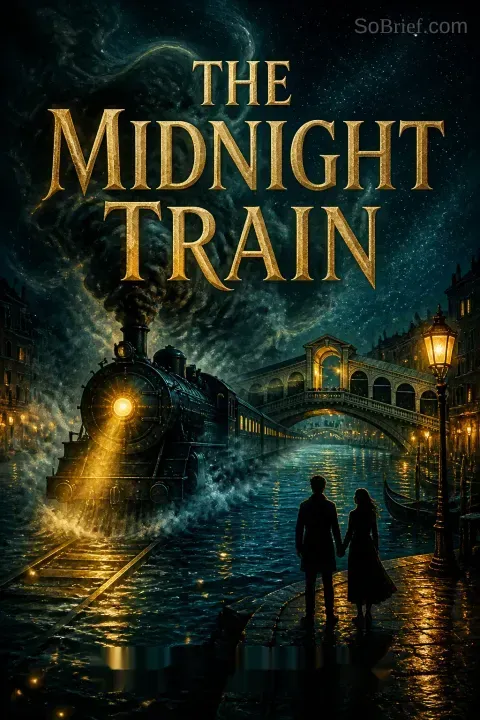
Wilbur1 and Maggie Budd,2 newly married, arrive by water taxi in Venice in August 1974. They are radiant, holding hands, joking about the strangeness of being called Mr and Mrs Budd. Maggie2 photographs the Doge's Palace with a Pentax camera, a wedding gift from her father.
They drink wine by the Grand Canal and fantasize about moving there, about Wilbur1 selling his Sheffield bookshop and Maggie2 becoming an artist. It is the happiest Wilbur1 has ever felt. On the Rialto Bridge, Maggie2 discusses the painter Titian and the concept of chiaroscuro, the interplay of light and dark.
Suddenly Wilbur1 sees him: a man in identical sandals, flared jeans, and green shirt, with the same tousled hair and sideburns. His exact double,1 standing beneath a portico, waving. Wilbur1 raises his hand uncertainly, then dismisses it as heat and wine. As they walk on, he hears a faint whistle, a rhythmic chugging, like a train leaving a station.
The honeymoon functions as both summit and seed: Wilbur has everything his childhood lacked (love, security, purpose), yet his joke about selling the shop reveals ambition already competing with contentment. The doppelganger introduces the book's central conceit: Wilbur's older self is watching, trying to intervene across time. Venice, an unchanging city of labyrinths, becomes the metaphor for what Wilbur will fail to preserve: the timeless quality of being truly present with someone he loves. Maggie's chiaroscuro lesson, how Renaissance painters used darkness to make light more radiant, is the book's thesis statement. The train whistle closing the chapter is the first thread connecting life to death, honeymoon to heartbreak, presence to absence.
The Midnight Station
In 2026, Wilbur Budd1 dies of a heart attack on his Bedfordshire lawn, still clutching the last page of a letter Maggie2 wrote him decades ago. He wakes on a desolate train platform, young again, wearing the same flared jeans and green shirt from his 1974 honeymoon.
A sign reads Wilbur instead of a city name. A ticket flutters into his hand: single journey, the Midnight Train. A steam engine arrives, identical to the Duke of Gloucester toy his brother once gave him, but emblazoned THE MIDNIGHT TRAIN. A prim woman in 1920s dress steps off.
It is Agnes Bagdale,5 the original owner of the Sheffield bookshop where he worked. She is his ghost guide, tasked with showing him his life so he can understand it before entering eternity. She explains he now appears at the age he came closest to his true self.
Death as a train station externalizes an internal truth: we are all waiting to process our lives. Wilbur's return to his 29-year-old body, not his childhood or old-age self, suggests his honeymoon represented peak authenticity, before ambition calcified him into someone unrecognizable. Agnes as guide, rather than an angel or deity, grounds the afterlife in the earthly: a bookseller who knew him. Her mix of strictness and warmth mirrors the book's central tension between accepting one's life and wanting desperately to revise it.
The Duke of Gloucester
The train stops on Glossop Road in Sheffield. Wilbur's1 ghost walks through Blitz rubble and finds his seven-year-old brother Dougie3 playing football, thin and fierce, one shoe sole flapping open. Their mother Edith4 drags Dougie3 home by his ear.
Inside number 77, the ghost1 watches Dougie3 present baby Wilbur1 with a toy train, the Duke of Gloucester, stolen from Redgates toy shop. He confesses to the infant that stealing is wrong, but a baby deserves a toy, especially one whose father was shot from the sky by Hitler.
Baby Wilbur's1 eyes track the ghost,1 seeing him clearly. The moment shatters with a knock: Mr Parkin,11 the landlord, demanding overdue rent with biblical self-righteousness. Edith4 returns from her pub shift to count farthings on the kitchen table, resentful of another mouth to feed.
Dougie's theft reveals how poverty forces love through transgression. The toy train becomes the book's central symbol: childhood wonder, brotherly devotion, and the mechanical forward momentum that will define Wilbur's life. Baby Wilbur seeing the ghost establishes that the boundary between living and dead is permeable at life's edges. Edith's coin-counting and Parkin's threats plant the scarcity mindset that will drive Wilbur's later empire-building: his terror of holes in his shoes becomes a terror of ever being enough.
Glossop Road Introduction
At thirteen, Wilbur1 sits on his doorstep reading The Old Man and the Sea. Two girls in grammar school uniforms pass: red-haired Doreen9 mocks him, but Maggie Shaw2 asks about his book and mentions she's reading How Green Was My Valley. She says characters are like people but better because you don't have to talk to them.
Wilbur1 stands taller, claims he wants to be a writer. Doreen9 jokes that writers are lettuces, boring wet things. Maggie2 counters that Marilyn Monroe married one. The moment collapses when a police car arrives carrying Dougie,3 arrested for carrying a flick-knife.
Wilbur1 burns with shame, denies knowing his brother. Maggie's2 face shows understanding, not judgment. She introduces herself and walks away, but looks back and smiles. The ghost1 watches, knowing this is the thread that will stitch his entire life together.
This scene captures class anxiety in microcosm: Wilbur's self-education through library books, his Oxford dreams, his shame about his criminal brother. Maggie's response to Dougie reveals her core gift: she reads people like Wilbur reads books, seeing the whole from a single page. The lettuce joke masks the real tension: working-class kids reaching above their station. The ghost's presence adds the ache of hindsight: every moment of this meeting is freighted with what he now knows will follow.
The Sycamore Tree
July 27, 1964. Wilbur1 convinces Dougie3 to attend a Rolling Stones concert, hoping to soften the blow of his Oxford news. At the pub beforehand, Dougie3 reacts with silence and heavy drinking. Inside City Hall, Wilbur1 spots Maggie.2 A man named Tommy harasses her; Wilbur1 pulls him off.
Dougie3 swings at Tommy and pulls a knife. The brothers flee, jump in Dougie's3 Vauxhall Cresta. Police chase them through Sheffield. Dougie3 drives drunk and frantic, talking about their dead father, how Wilbur1 always had things fall his way. A rabbit hops across the road from Endcliffe Park.
Dougie,3 the tough kid who would never hurt an animal, swerves violently. The car hits a sycamore tree. Dougie3 is thrown through the windshield, his body a crumpled shape at the tree's base. Wilbur1 survives, twisted low in his seat, then falls unconscious.
Dougie's death is the novel's emotional core: a tragedy born of love (swerving for the rabbit) and systemic failures (undiagnosed trauma, poverty, no mental health support). Wilbur's survival guilt becomes the engine of his ambition and the barrier to his intimacy. The sycamore tree, a natural object turned lethal, becomes a landmark Wilbur cannot face for decades, rerouting his drives through the city to avoid it. Dougie's final words about things falling Wilbur's way become a curse: Wilbur's success will always feel unearned.
Rock Bottom in Sheffield
After Dougie's3 death, Wilbur1 abandons Oxford to stay with his deteriorating mother. Edith4 self-admits to Middlewood psychiatric hospital and receives electroconvulsive therapy that leaves her vacant. Wilbur,1 now twenty-one, drinks heavily. At the bookshop, Mr Bagdale7 almost fires him for lateness.
Only an elderly customer's praise saves him. Wilbur1 begs for full-time work, promising to revive the shop with children's sections and comfortable chairs. Later, drunk on stout and whisky, he stands on the roof of Park Hill flats contemplating the drop. He does not jump.
Instead, he returns home and begins reading The Grapes of Wrath, a novel about resilience and poverty and community. Something in Steinbeck's depiction of people enduring the unendurable begins to pull him back. He commits himself to the bookshop, deciding that if he cannot escape Sheffield, he will build something within it.
This is the false-bottom moment where Wilbur chooses life but misidentifies the instrument. The bookshop becomes his raft, but he mistakes it for a ladder. His near-suicide and rescue-by-literature shows how stories can be survival equipment, but also how easily purpose can harden into escape. The Grapes of Wrath offers absolution Wilbur cannot yet accept: he will spend decades running from this rooftop before understanding he never had to run at all.
Chiaroscuro at the Grave
In 1969, Wilbur1 sits at Dougie's3 grave reading French philosophy. Maggie2 appears, visiting her own mother's grave nearby. She is now an art student with short hair and striking eyeliner. They sit on the bench and talk about her mother, about quitting teaching to pursue art, about Wilbur1 managing the bookshop.
She admits she broke up with her boyfriend Edward. Wilbur,1 prompted by his ghost's1 unheard shouting, tells her he feels free when he is with her. She leans in and kisses him.
But she is still technically with Edward, and soon after accepts a design job in London. The date Wilbur1 had planned never happens. The ghost1 feels the train shudder: even this small interference nearly derailed the timeline. The kiss remains, a seed planted years earlier than it grew in the original life.
Chiaroscuro, the Renaissance technique of contrasting light and dark, becomes the metaphor for their relationship: Wilbur's darkness needs Maggie's light to be visible. The ghost's intervention shows the book's central tension: the desperate wish to speed love up, to skip the years of missed chances. Yet the train's shudder warns that even small changes risk unraveling everything. The cemetery setting insists that love and death are not opposites but companions: only in acknowledging mortality can we fully choose connection.
The Loan and London
After marrying in August 1974, Wilbur1 and Maggie2 honeymoon in Venice. On a narrow street, Wilbur1 announces he is accepting a bank loan to expand the bookshop. Maggie2 hesitates, remembering his earlier fantasy of moving to Venice, of art tours and a quiet bookstall. He dismisses those as jokes. The loan funds more shops, then a move to London, then dozens of Budd Books across Britain.
Maggie2 leaves her beloved Crucible Theatre job. At a Sunday roast in 1976, Wilbur1 tells his mother Edith4 they are moving south. She responds by announcing her engagement to Cecil Parkin,11 the old landlord Wilbur1 has hated since childhood. Wilbur1 rages, storms out. The ghost1 notes that he never spoke to his mother properly again.
The expansion is presented not as greed but as emotional avoidance dressed as provision. Wilbur's childhood terror of scarcity, symbolized by Parkin, makes enough impossible to recognize. His fury at his mother's engagement reveals how much he has invested in old resentments as armor. Maggie's hesitation, asking whether the loan will take them away from each other, is the question he cannot answer without confronting his grief. The train accelerates: the faster he moves, the less he feels.
New York, Alone
December 1980. Thirty-five-year-old Wilbur1 sits in the Waldorf Astoria preparing a keynote for American publishers. Walter Cronkite announces John Lennon's murder on the television. The phone rings. Maggie,2 four thousand miles away in London, is sobbing and bleeding.
She has miscarried their baby, alone in their bathroom, cleaning blood off new tiles. Wilbur1 tells her he cannot fly back until Thursday, the speech is tomorrow, he is committed. He pours whisky and watches The Price Is Right, trying not to feel.
Years later, he fires Charlie Applewood6 over pizza at the Italian Stallion, handing the accounts to an American finance professional. Charlie6 reminds him he moved his whole life for Wilbur.1 Wilbur1 calls it business, not personal. Charlie6 replies that this is his whole problem.
The miscarriage and the firing are structurally identical: Wilbur choosing abstraction over particular human beings in crisis. His emotional paralysis in that Manhattan hotel room, channel-surfing while his wife grieves, is the logical endpoint of using ambition as anesthetic. Charlie's rejoinder diagnoses Wilbur's central sickness: he has turned every relationship into a transaction. That he cannot see this is the tragedy; that we watch him do it is the indictment.
The Letter on the Tiles
In 1995, Maggie2 confronts Wilbur1 in their South Kensington living room. She has just learned a breast lump is benign, but the scare clarified everything. She tells him the Palace Cinema, where she once worked, is being demolished for a shopping center that will include a Budd Books.
She tells him her father has Parkinson's and she is moving back to Sheffield. Wilbur1 protests: the IPO, the stock market flotation, he cannot leave now. She reminds him he promised to quit at fifty. She asks when he will stop acting like he still has holes in his shoes.
Days later, she leaves a letter and returns north. The letter says she still loves the man she married, but that man is gone, lost somewhere inside the businessman he became. Wilbur1 drinks scotch, shows up drunk at Charlie's6 door at midnight, but cannot bring himself to apologize.
Maggie's letter articulates what Wilbur cannot: that love persists even when presence does not, and that leaving someone may be the only way to stay faithful to the person they once were. Her observation that the world grows old around art but the art stays fresh applies equally to memory: their marriage exists in amber even as its living version crumbles. Wilbur's doorstep visit to Charlie is the most pathetic moment in his arc: he knows what he needs to do but has lost the vocabulary for friendship.
The Ghost's Rebellion
The Midnight Train arrives at Venice on August 9, 1974. The ghost1 watches his younger self and Maggie2 wander through the city, blissfully in love. On the Rialto Bridge, he whispers in his own ear: you need to keep hold of this. Young Wilbur1 sees him, waves uncertainly.
Agnes5 urges the ghost1 back; the train is waiting. But the ghost1 refuses. He remembers his old teacher Miss Graham12 telling him that sometimes you must break the rules to truly live. He follows Wilbur1 and Maggie2 back to Hotel Proserpina, where his younger self, exhausted from wine and travel, falls asleep on the bed still in his clothes.
Agnes5 warns that if the ghost1 is present when his living self sleeps, the Dreamer1 will be pulled onto the train for a journey through his own future. The ghost1 decides this is exactly what he wants.
The ghost's rebellion transforms the novel from passive reflection to active intervention. His refusal to board is the first truly free choice he has made since dying, perhaps since living. Miss Graham's advice, ignore what is expected of you, becomes the counterweight to Agnes's rules. The ghost is gambling his eternity on the possibility that his younger self can learn what he could not: that knowing the cost of a mistake before making it is the only true second chance.
A Future on Fast-Forward
The Dreamer1 wakes on the ghost's1 train, wearing identical clothes. Agnes,5 furious but resigned, explains the rules are broken. The train shows him everything: the loan accepted, the London move, Edith4 crying at her kitchen table, the miscarriage phone call from the Waldorf, Charlie's6 firing at the pizzeria, Maggie's2 face hardening across decades of neglected anniversaries, himself at fifty still promising to quit, at sixty still alone.
The Dreamer1 is horrified, then defensive, then finally silent. The ghost1 explains: he mistook velocity for purpose, used work to outrun grief, built an empire because he could not build a home.
They watch the old Wilbur1 get piano lessons from a woman named Nora Seed,13 who tells him the only way to learn is to live. Then they watch him die on his lawn, clutching Maggie's letter.
This section is the novel's moral reckoning compressed into montage. The Dreamer's reactions (denial, defensiveness, silence) mirror the stages of any genuine self-confrontation. Nora Seed's cameo reinforces the multiverse logic: other lives exist, other choices are possible. By showing the Dreamer not just the events but their emotional cost (the loneliness, the avoidance, the atrophy of love), the ghost provides something rare: regret as a gift rather than a wound.
Into the Void
The train reaches the end of the line. Two doors wait at the front carriage. Agnes5 explains the ghost1 must step into the void first, sacrificing his eternity, so the Dreamer1 can return to his body. It may not even work. The ghost1 thanks Agnes,5 who hugs him with uncharacteristic warmth.
He tells the Dreamer1 to make Maggie2 happy, to be nostalgic about the present, to live how the dead would if only they had the chance. Then he opens the door onto absolute nothing and steps through with something close to a smile. The train immediately begins to break apart.
Agnes5 falls toward the open door. The Dreamer1 catches her forearm. She tells him to let go, that she will be fine, that he must live. He releases her hand. The train shudders violently, then light floods everything. He feels himself lying on something soft.
The ghost's sacrifice reverses the novel's central wound: instead of Dougie dying so Wilbur can survive, the older Wilbur unmakes himself so the younger can truly live. Agnes's fall and reassurance shows that even those who enforce rules understand when they must be broken. The void is not described as terrifying but as nothingness: the absence of self the ghost has already been practicing through decades of avoidance. His smile suggests that finally having a purpose, saving himself, is worth more than eternity without meaning.
Waking in Venice
Wilbur1 wakes on the hotel bed in Venice. Only five minutes have passed. His mind feels rinsed clean. Maggie2 emerges from the bathroom in a blue dress he recognizes from the train window. At dinner in La Zucca, he identifies the bald man at the next table, the bigoli in salsa Maggie2 orders, the precise decor.
After the meal, he tells Maggie2 he is turning down the bank loan. He wants to keep Bagdale's name, run one good bookshop, have a life with her. He tells her he misses Dougie,3 says it aloud without flinching.
They wander the labyrinthine streets, find themselves in Piazza San Marco at midnight. A busker plays Verdi on a violin. Wilbur1 tosses a coin into the case. When Maggie2 asks what they should do tomorrow, he says they should make it up as they go along. They hold hands and walk back toward the hotel.
The ending trusts the reader to understand that Wilbur has not escaped pain, only the specific pain of his own avoidance. His refusal of the loan is not a rejection of ambition but of ambition as anesthetic. Saying Dougie's name aloud shows he is finally letting grief be present rather than suppressed. Making it up as we go along is the antithesis of the projections and quarterly targets that ruled his other life: it is an embrace of improvisation, vulnerability, and the terrifying freedom of not knowing what comes next.
Analysis
The Midnight Train is a novel about the velocity of avoidance. Wilbur Budd1 is not a villain; he is a man who, after his brother's3 traumatic death, discovers that work can function as a painkiller. The tragedy is not that he becomes ambitious but that ambition becomes his only vocabulary for love: providing financially replaces being present emotionally. He buys Maggie2 a grand house but cannot sit on a bench with her. He employs Charlie6 but cannot stay friends with him. The novel's supernatural frame, the train journey through memory, externalizes what every regretful person does internally: replay the past, searching for the moment things went wrong, hoping somehow that seeing it clearly might change it. What distinguishes Wilbur's1 story is that the ghost1 refuses to be merely an observer. By sacrificing his eternity to show his younger self the consequences of his choices, he enacts the novel's deepest argument: that understanding your life is not the same as accepting it. Some lives deserve a second draft. The book also insists on the inseparability of love and grief. Wilbur's1 inability to mourn Dougie3 becomes his inability to stay present with Maggie.2 He fears losing her as he lost his brother, so he preemptively abandons her through work. The novel's title refers not just to the spectral train but to the midnight of the soul: the darkest hour where we must decide whether to keep running or finally stand still and feel what we have been fleeing. Matt Haig leaves the ending open: Wilbur1 wakes with a second chance, but the novel never pretends this guarantees happiness. What it guarantees is presence. The final image, Wilbur1 and Maggie2 walking through moonlit Venice deciding to make it up as they go along, is the antithesis of the five-year plans and quarterly projections that hollowed out his other life. The miracle is not that he is saved from suffering but that he is saved from numbness.
Review Summary
Most readers deeply enjoyed The Midnight Train, praising its tender emotional depth, relatable themes of regret, second chances, and the beauty of life's quiet moments. Many compared it favorably to The Midnight Library and A Christmas Carol, appreciating the nostalgic train metaphor and Wilbur Budd's flawed yet touching journey. Critics noted occasional flat characterization and predictability, with some feeling disconnected from Wilbur and Maggie. Overall, the book resonated strongly for its life-affirming message and Haig's signature warm, accessible prose.
People Also Read





Characters
Wilbur Budd
Bookseller turned reluctant tycoonBorn in 1945 Sheffield to a war widow, Wilbur grows up poor, bookish, and haunted by the father he never knew. His older brother Dougie's3 violent death in a car crash when Wilbur is nineteen shatters his Oxford dreams and seeds a lifelong guilt. He throws himself into the family bookshop, transforming it into Budd Books, a chain of over two hundred stores. His ambition is fueled not by greed but by terror of the poverty and powerlessness of his childhood. This drive costs him his marriage to Maggie2, his friendship with Charlie6, and eventually himself. He dies at eighty-one, wealthy and alone, only to be given a chance, through supernatural intervention, to show his younger self the cost of his choices.
Maggie Shaw
Artist, wife, and lost compassMaggie meets Wilbur1 at thirteen on a Sheffield street. She is warm, perceptive, and artistically gifted, seeing the world with a painter's eye for light and shadow. After her mother's death, she raises herself largely, training as a teacher before switching to art college. She marries Wilbur1 in 1974, hoping for a life of shared adventure and mutual support. Instead, she watches him retreat into work, sacrificing connection for expansion. After a miscarriage she endures alone and decades of emotional neglect, she writes him a devastating letter and returns to Sheffield. She never stops loving the man she married, but cannot find him inside the businessman he became.
Dougie Budd
Wilbur's troubled older brotherSix years older than Wilbur1, Dougie is shaped by their father's wartime death and their mother's4 emotional absence. He becomes a petty criminal, a brawler, but also a fiercely protective brother who steals a toy train for baby Wilbur1. When Wilbur1 gets into Oxford, Dougie feels abandoned. Hours after a Rolling Stones concert, fleeing police after a knife fight, Dougie swerves to avoid a rabbit and dies crashing into a sycamore tree. His death becomes the wound Wilbur1 organizes his entire life around avoiding.
Edith Budd
War widow and struggling motherEdith loses her husband George in the RAF during World War II, leaving her to raise two boys alone on a barmaid's wages and a war widow's pension. She resents baby Wilbur1 as another burden, drinks cheap sherry, and eventually suffers a mental breakdown after Dougie's3 death, requiring electroconvulsive therapy. Late in life, she finds companionship with Cecil Parkin11, the old landlord Wilbur1 despises. Wilbur's1 fury at this relationship causes a permanent rift; he never speaks to her again before her death.
Agnes Bagdale
Afterlife guide and original booksellerThe founder of Bagdale's Bookshop in Sheffield, Agnes ran it for decades with warmth, a fox terrier named Clementine, and an uncanny gift for matching readers with the perfect book. She dies before the main action but appears as a ghost guide on the Midnight Train, dressed in 1920s fashion. She is strict, rule-bound, and committed to helping Wilbur1 understand his life so he can enter eternity peacefully. Beneath her prim exterior is deep compassion and her own unspoken regrets. She chose to be Wilbur's1 guide because she remembered the boy who was too proud to accept a free book.
Charlie Applewood
Loyal best friend and physicistWilbur's1 best friend since adolescence, Charlie grows from a bullied, stuttering boy into a brilliant physicist and accountant. He works for Wilbur1 at Budd Books for over a decade, managing the finances while listening to David Bowie in his office. Charlie moves his whole life to London for Wilbur1. When Wilbur1 fires him without warning, replacing him with an American finance professional, Charlie is devastated but never stops caring about his old friend. His theories about quantum physics and the nature of time provide the metaphysical underpinning for Wilbur's1 journey.
Arthur Bagdale
Agnes's disappointing sonAgnes's5 son, who takes over the bookshop but lacks her passion for books and readers. He is grouchy, drinks from a hip flask, and almost fires Wilbur1 several times. Eventually he hands Wilbur1 the keys.
Alice Dobson
Wilbur's first girlfriendA slightly older, posher Sheffield girl who dates Wilbur1 before Oxford. She is unsettled by his ambition to leave and his criminal brother Dougie3. Their relationship ends when Dougie3 is arrested for stealing from her father's carpet factory.
Doreen Taylor
Maggie's sharp-tongued friendMaggie's2 red-haired best friend from school, nicknamed Reenie. She is funny and blunt, calling Wilbur's1 Hemingway book dull as owt. Later in life, she leaves her husband and finds love with a woman named Rosie.
Claudette Campbell
Charlie's wife, Maggie's friendA warm, stylish woman from St Vincent who becomes Maggie's2 close friend and marries Charlie6. She works at the Sheffield Crucible Theatre. After Wilbur1 fires Charlie6, she stops speaking to Maggie2 out of loyalty to her husband.
Cecil Parkin
The despised landlordThe landlord who owned the Budds' house and many others on Glossop Road. Wilbur1 and Dougie3 hate him for raising rents on war widows. Decades later, Edith4 marries him, and he quietly pays for Dougie's3 funeral and donates to hospitals. Wilbur1 never forgives him.
Miss Graham
Radical English teacherWilbur's1 Marxist English teacher who fosters his love of books and encourages him to apply to Oxford. She smokes in class, quotes Macbeth, and volunteered as a nurse in the Spanish Civil War. Her ghost briefly appears on the train to advise Wilbur1 to break the rules.
Nora Seed
Piano teacher with her own storyWilbur's1 piano teacher in his eighties, a kind woman in her forties who once attempted suicide but had a transformative experience between life and death. She tells Wilbur1 the only way to learn is to live, a revelation that echoes through his journey.
Plot Devices
The Midnight Train
Death transport through memoryA supernatural steam engine, modeled on Wilbur's1 childhood toy the Duke of Gloucester, that carries the dead through their own lives. It stops at significant moments, allowing the ghost to disembark and witness scenes from the past as an invisible observer. The train is guided by Agnes5 and is bound by strict rules: the ghost1 must re-board when the whistle blows, must never meddle, and must never be present when his living self falls asleep. The train's journey is meant to help the dead understand their lives before entering eternity. When the ghost1 breaks the rules, the train becomes unstable, juddering and threatening to derail entirely.
The Duke of Gloucester Toy
Symbol of brotherly love and childhoodA miniature three-cylinder express passenger engine that Dougie3 steals from a toy shop to give to baby Wilbur1. It represents the pure, protective love Dougie3 felt for his brother despite his rough exterior. The full-size Midnight Train appearing in this same form connects Wilbur's1 death to his earliest memory of being loved, suggesting that the afterlife is shaped by our deepest attachments rather than religious doctrine.
Maggie's Letter
Emotional truth Wilbur could not faceWritten when Maggie2 leaves Wilbur1 in the 1990s, this letter explains with devastating clarity why she must go: she still loves the man she married, but that man is gone. She describes Wilbur1 as forever somewhere else, even when right next to her. The letter ends with the line, I don't know where the past hides, but I will meet you there. Wilbur1 keeps it for decades and is holding its last page when he dies of a heart attack. The letter functions as the book's thesis statement about love, presence, and the cost of emotional avoidance.
The Aging Portrait
Visual tracker of Wilbur's life stageAn oil painting of Wilbur1 that hangs inside the Midnight Train carriage. As the train travels through his life, the portrait ages in real time: his hair grows and shortens, his face broadens and hardens, frown lines deepen, his eyes dim. Agnes5 describes it as a kind of satellite navigation through time, more beautiful than any twenty-first-century GPS. When the ghost1 sacrifices himself, the portrait becomes a blank square.
Hotel Proserpina
Threshold between life and deathThe terracotta-fronted Venetian hotel where Wilbur1 and Maggie2 stay on their honeymoon. Its name references Proserpina (Persephone), the Roman goddess who spent half the year in the underworld and half on earth. The hotel is where Wilbur1 falls asleep, allowing his ghost to pull the Dreamer1 onto the Midnight Train. It is also where he wakes after the journey, crossing back from death's knowledge to life's second chance.
About the Author
Other books by Matt Haig






Download PDF
Download EPUB
.epub digital book format is ideal for reading ebooks on phones, tablets, and e-readers.








































